
the Creative Commons Attribution 4.0 License.
the Creative Commons Attribution 4.0 License.
 | 11 Jun 2026
Straw and biochar co-application: A strategy to reduce Cd–Zn bioavailability, alleviate microbial nutrient limitations and enhance soil C stability
Abstract. Biochar is widely used to remediate heavy metal-contaminated soils; however, it can increase C limitation in soil microorganisms, potentially compromising soil ecological sustainability. Effective strategies are, therefore, needed to reduce heavy metal bioavailability while maintaining microbial activity and soil fertility. To this end, we aimed to evaluate the effects of different straw–biochar ratios on heavy metal availability, microbial nutrient limitation, C cycling and soil fertility and to identify an optimal remediation strategy for Cd- and Zn-contaminated soil. Cd- and Zn-contaminated soils were amended with varying straw–biochar ratios (S4C0, S3C1, S2C2, S1C3, S0C4 and control) and incubated for 90 days. Soil heavy metal bioavailability, microbial nutrient limitation, CO2 emissions, enzyme activities and organic C stability were analysed. Compared with the control, the straw–biochar treatment at a 1:3 ratio (S1C3) reduced diethylenetriaminepentaacetic acid–extractable Cd and Zn by 30.22–32.81% and 21.31–23.06%, respectively. S1C3 significantly improved soil organic C content and stability, enhanced available nutrients (N, P and K), increased microbial biomass and elevated enzyme activities related to C, N and P acquisition and alleviated microbial C limitation. The optimized straw–biochar ratio (1:3) provides a novel integrated approach for remediating heavy metal-contaminated agricultural soils while simultaneously enhancing soil C stability, nutrient availability and microbial activity. This strategy offers a practical foundation for sustainable farmland management.
-
Notice on discussion status
The requested preprint has a corresponding peer-reviewed final revised paper. You are encouraged to refer to the final revised version.
-
Preprint
(2254 KB)
-
The requested preprint has a corresponding peer-reviewed final revised paper. You are encouraged to refer to the final revised version.
- Preprint
(2254 KB) - Metadata XML
- BibTeX
- EndNote
- Final revised paper


Journal article(s) based on this preprint
Interactive discussion
Status: closed
-
RC1: 'Comment on egusphere-2026-2586', Anonymous Referee #1, 03 Jul 2026
-
CC1: 'Reply on RC1', Xirui Kang, 21 Jul 2026
Thank you for your valuable comment. Your suggestion is constructive on the improvement of this manuscript. We have made revisions to the manuscript according to your suggestion. Please see attached our reply letter for the point-by-point responses to every comment.
-
AC1: 'Reply on RC1', Yanhong Lou, 25 Jul 2026
Thank you for your valuable comment. Your suggestion is constructive on the improvement of this manuscript. We have made revisions to the manuscript according to your suggestion. Please see attached our reply letter for the point-by-point responses to every comment.
-
CC1: 'Reply on RC1', Xirui Kang, 21 Jul 2026
-
RC2: 'Comment on egusphere-2026-2586', Abel Veloso, 15 Jul 2026
This paper is well written and deals with a subject that is both scientifically relevant and within the journal’s scope. The authors evaluated an extensive list of variables, allowing for a comprehensive treatment of the subject. However, there are some points that, in my opinion, should be improved. The discussion could be strengthened by further comparing the results obtained by the authors with those of other studies. Additionally, some of the conclusions drawn by the authors should be more firmly supported by the results and, in particular, by the statistical analysis. My detailed comments are provided in the attached file.
-
CC2: 'Reply on RC2', Xirui Kang, 22 Jul 2026
We sincerely appreciate your valuable time and constructive comments, which effectively improve the integrity and rigor of our manuscript. We have carefully revised the whole manuscript based on all your suggestions. Please see attached our reply letter for the point-by-point responses to every comment.
-
AC2: 'Reply on RC2', Yanhong Lou, 25 Jul 2026
We sincerely appreciate your valuable time and constructive comments, which effectively improve the integrity and rigor of our manuscript. We have carefully revised the whole manuscript based on all your suggestions. Please see attached our reply letter for the point-by-point responses to every comment.
-
CC2: 'Reply on RC2', Xirui Kang, 22 Jul 2026
Peer review completion


Interactive discussion
Status: closed
-
RC1: 'Comment on egusphere-2026-2586', Anonymous Referee #1, 03 Jul 2026
Review
Title : Straw and biochar co-application: A strategy to reduce Cd–Zn bioavailability, alleviate microbial nutrient limitations and enhance soil C stability
The manuscript idea is wonderful and interesting, as the study aims to evaluate the effect of different ratios of straw to biochar (incubation experiment for 90 day) to provide an optimal strategy for treating soil contaminated with cadmium and zinc, and to study their ability to treat soil contaminated with these heavy metals, and also to study the availability of microbial nutrients, the carbon cycle, and the elements available in the soil (soil fertility). The topic is important, and manuscript fits with the scope of the journal. The manuscript is very well written, the effort is very evident, and the way the results are presented is excellent. But it has some weaknesses associated with the presented data and discussion have shortcomings as discussed below. Therefore, the current version of the manuscript needs major revision to be published in (egusphere). There are several issues must be addressed.
Major comments
- Line 64: What is the texture of the soil used in the study?
- Line 96: please add the reference of microbial biomass estimation.
- Line 110: in statical analysis, the experiment was CRD or WHAT….?
- Line 119: It says the results were on days 30, 60, and 90... Please clarify this in the materials section.
- In Results and discussion section…. Please write the value of heavy metals concentration not the reduction rate only to clarify the result more.
- Line 145: please add reference.
- Figure 2: illustrate CO2 flux and (b) accumulation of different treatments in different time.... please clarify it in material section.
- In general, please specify the days on which the measurements were taken in more detail in material section.
- Please provide a more detailed and clearer explanation of why these transactions were the best or worst in value. What is the underlying reason for this?
- Figure 3: please write down the day the measurement was taken.
- The title of Figure 4 needs further clarification and detail, with the full name written next to the abbreviations.
- Line 193: what do you mean by “cultivation progressed”?
- Figure 5: please write down the day the measurement was taken for further clarification.
- Line 208: Soil microbial biomass. Please write the discussion in a more detailed manner and cite scientific references in this section.
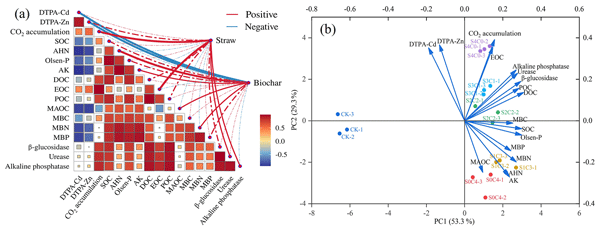
- Line 265: Correlation and principal component analysis. Please write the discussion in more detail and cite scientific references in this section.
- References are generally very good, but they need to be expanded and cite recent research related to the research topic.
Overall, the research is very good and the idea is excellent, but please cite more references in the discussion as there are sections without definitive references. Also, please include the original measured value compared to the control or initial value, and not just the percentage increase or decrease. The number itself indicates the actual concentration.
-
CC1: 'Reply on RC1', Xirui Kang, 21 Jul 2026
Thank you for your valuable comment. Your suggestion is constructive on the improvement of this manuscript. We have made revisions to the manuscript according to your suggestion. Please see attached our reply letter for the point-by-point responses to every comment.
-
AC1: 'Reply on RC1', Yanhong Lou, 25 Jul 2026
Thank you for your valuable comment. Your suggestion is constructive on the improvement of this manuscript. We have made revisions to the manuscript according to your suggestion. Please see attached our reply letter for the point-by-point responses to every comment.
-
RC2: 'Comment on egusphere-2026-2586', Abel Veloso, 15 Jul 2026
This paper is well written and deals with a subject that is both scientifically relevant and within the journal’s scope. The authors evaluated an extensive list of variables, allowing for a comprehensive treatment of the subject. However, there are some points that, in my opinion, should be improved. The discussion could be strengthened by further comparing the results obtained by the authors with those of other studies. Additionally, some of the conclusions drawn by the authors should be more firmly supported by the results and, in particular, by the statistical analysis. My detailed comments are provided in the attached file.
-
CC2: 'Reply on RC2', Xirui Kang, 22 Jul 2026
We sincerely appreciate your valuable time and constructive comments, which effectively improve the integrity and rigor of our manuscript. We have carefully revised the whole manuscript based on all your suggestions. Please see attached our reply letter for the point-by-point responses to every comment.
-
AC2: 'Reply on RC2', Yanhong Lou, 25 Jul 2026
We sincerely appreciate your valuable time and constructive comments, which effectively improve the integrity and rigor of our manuscript. We have carefully revised the whole manuscript based on all your suggestions. Please see attached our reply letter for the point-by-point responses to every comment.
-
CC2: 'Reply on RC2', Xirui Kang, 22 Jul 2026
Peer review completion
Journal article(s) based on this preprint
Viewed
| HTML | XML | Total | BibTeX | EndNote | |
|---|---|---|---|---|---|
| 294 | 77 | 38 | 409 | 30 | 27 |
- HTML: 294
- PDF: 77
- XML: 38
- Total: 409
- BibTeX: 30
- EndNote: 27
Viewed (geographical distribution)
| Country | # | Views | % |
|---|
| Total: | 0 |
| HTML: | 0 |
| PDF: | 0 |
| XML: | 0 |
- 1
Xirui Kang
Na Geng
Yaping Li
Hui Wang
Hong Pan
Quangang Yang
Zhongchen Yang
Yanhong Lou

Yuping Zhuge
The requested preprint has a corresponding peer-reviewed final revised paper. You are encouraged to refer to the final revised version.
- Preprint
(2254 KB) - Metadata XML
Review
Title : Straw and biochar co-application: A strategy to reduce Cd–Zn bioavailability, alleviate microbial nutrient limitations and enhance soil C stability
The manuscript idea is wonderful and interesting, as the study aims to evaluate the effect of different ratios of straw to biochar (incubation experiment for 90 day) to provide an optimal strategy for treating soil contaminated with cadmium and zinc, and to study their ability to treat soil contaminated with these heavy metals, and also to study the availability of microbial nutrients, the carbon cycle, and the elements available in the soil (soil fertility). The topic is important, and manuscript fits with the scope of the journal. The manuscript is very well written, the effort is very evident, and the way the results are presented is excellent. But it has some weaknesses associated with the presented data and discussion have shortcomings as discussed below. Therefore, the current version of the manuscript needs major revision to be published in (egusphere). There are several issues must be addressed.
Major comments
Overall, the research is very good and the idea is excellent, but please cite more references in the discussion as there are sections without definitive references. Also, please include the original measured value compared to the control or initial value, and not just the percentage increase or decrease. The number itself indicates the actual concentration.