
the Creative Commons Attribution 4.0 License.
the Creative Commons Attribution 4.0 License.
 | 13 May 2026
Temperature-dependent multiphase chemical kinetics can explain uniform atmospheric nanoparticle growth rates
Abstract. Aerosols have a profound influence on climate and human health, but new particle formation in the atmosphere has remained a scientific conundrum. In particular, the growth rates of atmospheric nanoparticles are often smaller and less dependent on condensable vapor concentration than expected. Here, we take a new integrative approach to analyze observational data from field measurements and chamber experiments, which were previously unexplained and appeared inconsistent with theory and model predictions. We show that the observed growth rates can be predicted when the temperature dependence and multiphase kinetics of gas-particle partitioning are resolved. Slow surface-to-bulk transport limits the rates of vapor uptake by semi-solid particles with low diffusivity, whereas shifts in the volatility distribution following the Clausius-Clapeyron equation enhance growth rates at low temperature and concentration levels. These antagonistic effects lead to an effective buffering of the organic vapor concentration dependence of nanoparticle growth in secondary organic aerosols. Our study reveals how counteracting temperature dependencies of organic vapor oxidation, volatility and multiphase kinetics lead to a convergence of growth rates around a few nanometers per hour under widely differing atmospheric conditions.
Competing interests: At least one of the (co-)authors is a member of the editorial board of Atmospheric Chemistry and Physics.
Publisher's note: Copernicus Publications remains neutral with regard to jurisdictional claims made in the text, published maps, institutional affiliations, or any other geographical representation in this paper. While Copernicus Publications makes every effort to include appropriate place names, the final responsibility lies with the authors. Views expressed in the text are those of the authors and do not necessarily reflect the views of the publisher.-
Notice on discussion status
The requested preprint has a corresponding peer-reviewed final revised paper. You are encouraged to refer to the final revised version.
-
Preprint
(1111 KB)
-
Supplement
(710 KB)
-
The requested preprint has a corresponding peer-reviewed final revised paper. You are encouraged to refer to the final revised version.
- Preprint
(1111 KB) - Metadata XML
-
Supplement
(710 KB) - BibTeX
- EndNote
- Final revised paper


Journal article(s) based on this preprint
Interactive discussion
Status: closed
-
RC1: 'Comment on egusphere-2026-2564', Anonymous Referee #1, 05 Jun 2026
This study by Zhang et al. addresses the problem of relatively uniform (1-10 nm h-1) nanoparticle growth rate observations across different environments and conditions, which was recently formulated and investigated by Stolzenburg and co-workers (Stolzenburg et al., 2023, 2025). Zhang et al. uses a multi-layer model of multiphase chemistry (KM3C) to investigate if temperature-dependent diffusion limitations and volatility-shifts of the condensable vapors can explain as to why nanoparticle grow at comparable speeds at cold and warm temperatures. While the application of a better multiphase chemistry model to this puzzle is of great value and the authors seem to find a better agreement of their model with the slow growth observations at high temperatures, the manuscript, in its current form clearly overstates the achievement of this work. In fact, the references to previous studies are not put into the correct context, and therefore the manuscript cannot be published without major revisions clarifying what are the novel aspects in this work and how exactly the application of the KM3C model changes our previous understanding of the process.
Major comments:
- It is important to acknowledge in the text that there is a fundamental difference between a purely kinetic approach and the volatility-basis-set (VBS) based growth modeling (Stolzenburg et al., 2022), with the latter being able to capture most observations under the condition that the full volatility distribution is known (through e.g., combination of different mass spectrometers). The problem statement of Stolzenburg et al. (2025) is rather, as to why at high temperatures (summer-time) in ambient data, the VBS-based approach predicts higher growth rates than measured. The high VBS distribution is a result of higher organic emissions and enhanced autoxidation, with the latter already demonstrated by Stolzenburg et al. (2018) and Praske et al. (2018). The manuscript currently reads (I am convinced that this wasn’t the intention of the authors), such as the full experimental coverage of the OOM distribution and the shift in volatility at low temperatures, which promotes the condensation of moderately oxygenated organics, is the result of the KM3C model. However, this puzzle has been already solved and there are several passages in the manuscript which do not convey this information or point towards the real problem addressed here, that is the slower than expected growth at high temperatures.
- 21-23: The growth rates in Stolzenburg et al. (2018) were perfectly described by their model, which considered the volatility shifts at different temperatures (see Fig. 2 E,F and Fig. 3 in their work). Moreover, Mohr et al. (2019), Qiao et al. (2022) and more recently Cai et al. (2026) (all for ambient data) and Dada et al. (2023) (for more complex organic mixtures in a chamber experiment) provided closure between nanoparticle growth rates and modeled condensational growth using a volatility-basis-set (without diffusion limitations) for most conditions.
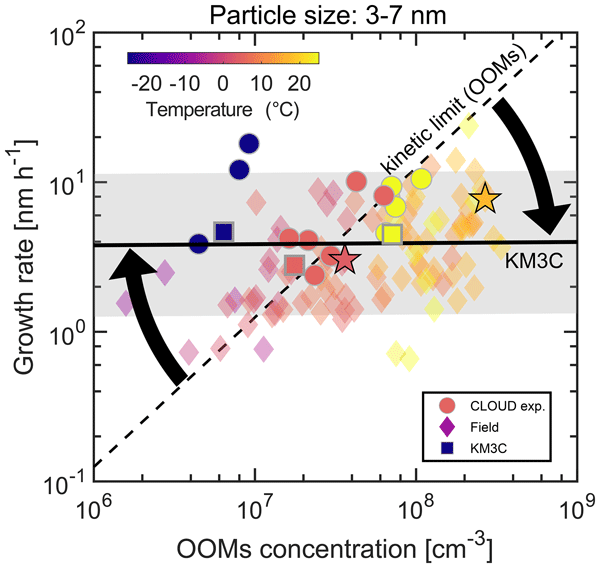
- 81-87: The main challenge in this puzzle is not explaining the CLOUD data, as Stolzenburg et al. (2018) were able to do this. The main challenge is why a diffusion limitation is needed for ambient data and not for CLOUD data to achieve closure, as the Stolzenburg (2018) data at high temperatures can be perfectly explained from VBS-based condensation with no diffusion-limitations. In that sense, the main value of Fig.2 are the shaded areas which show the differences between a diffusion-limited case and a non-diffusion-limited case. And here we exactly see the difference between CLOUD and ambient data: For 3-7 nm (the most robust region in terms of GR determination), the experimental results at warm temperatures are all at the upper end of the yellow band (so imply a diffusivity of only 10-15 cm2 s-1) and therefore - in line with Stolzenburg (2018) - there seems to be no need to imply diffusivity constraints for warm temperatures (in contrast to the ambient data). The authors need to address this ambiguity in a revised version of the manuscript.
- 89-91: Related to the above: “Thus, we included organic vapors measured by proton-transfer reaction time-of-flight mass spectrometry (PTR3) and integrated the Clausius-Clapeyron equation in KM3C to describe the temperature-dependent volatility distribution of organic vapors”. This was exactly done by Stolzenburg et al. (2018) (see Fig. 1 of their work) and they achieved closure with this approach across all temperatures and without any diffusion-limitations. It is not the novelty of this work, which is noted in the SI but never in the main text.
- 93-95: The requirement for a full coverage of the volatility distribution and therefore the measurement of moderately oxygenated organics at lower temperatures have been previously stated by other work: Mohr et al. (2019) used iodide CIMS, which covers the moderately oxygenated organics well (Riva et al., 2019), Stolzenburg et al. (2018, 2025) and Dada et al. (2023) used a combination of different ionization schemes to obtain that coverage. These studies (and the once mentioned above) should be referenced and the statement put this manuscript better into perspective.
- 114-118: Again here: The purely kinetic approach (condensing all measured OOMs kinetically) did not provide any insights into this behavior, the full VBS approach however could already explain most of these observations, except for the points at high temperature (high OOM) well below the kinetic line.
- 3: While I agree with the conceptual statement of Fig. 3, the solid black lines as a fit to three CLOUD experiments at different temperatures would already have been possible for Stolzenburg et al. (2025). The real difference is – as outline above extensively – not the CLOUD data but the ambient data and therefore I do not see the benefit of a line obtained from the data where diffusion limitation was not needed to be included. I would keep the Figure as a conceptual picture and add it to Fig. 4 with the two think black errors being label “volatility shift” and “diffusion limitations” or something along those lines.
- It is not clear currently if the K3MC model outperforms the two-film model with respect to the growth rate prediction at warmer temperatures. In fact, the manuscript currently shows not the correct comparison. In a revised version the authors need to address the following points:
- 1 shows the VBS-based modeling result from Stolzenburg et al. (2025) with the ±1 bin uncertainty on the VBS distribution and not the results from the model including the diffusion-limitations within the two-film model (yellow shaded area in Stolzenburg et al., 2025). This should be included as well. The relevant data can be found in the data repository published together with Stolzenburg et al. (2025).
- In addition, the diffusion coefficient assumed here for summer-time is 10-20 cm2 s-1, while Stolzenburg et al. (2025) used only 10-18 cm2 s-1 (I needed to look into the published code for producing their respective figure, as it is, indeed, not mentioned in the text). It is therefore not clear if the agreement is due to the even lower assumed diffusivity or due to the model choice.
- One major determinant to decide if the model simulates the behavior during growth is the agreement of the size-dependency of the modeled versus measured growth rates. Here, it seems that the KM3C approach is stronger, as diffusion limitations do not only appear at larger sizes. This is a strong point of the manuscript and therefore I would love if the authors can elaborate on the difference of this prediction in more detail (one possibility I could think of is showing Fig. 1 c-d type plots for different sizes).
References:
Cai, R., Li, X., Li, Y., Blichner, S., Stolzenburg, D., Zha, Q., Cai, J., Nie, W., Yan, C., Huang, D.D., Wang, Z., Wu, J., Yin, R., Sarnela, N., Huang, W., Tuovinen, S., Holm, S., Ahonen, L., Yao, L., Ding, A., Bianchi, F., Liu, Y., Winkler, P.M., Petäjä, T., Chen, J., Kerminen, V.-M., Wang, L., Worsnop, D., Jiang, J., Kulmala, M., Kangasluoma, J. (2026). The key role of nanoparticle concentration gradient in aerosol initial growth. Nat. Commun., 17, 3338. https://doi.org/10.1038/s41467-026-70082-2
Dada, L., Stolzenburg, D., Simon, M., Fischer, L., Heinritzi, M., Wang, M., Xiao, M., Vogel, A. L., Ahonen, L., Amorim, A., Baalbaki, R., Baccarini, A., Baltensperger, U., Bianchi, F., Daellenbach, K. R., DeVivo, J., Dias, A., Dommen, J., Duplissy, J., … Kulmala, M. (2023). Role of sesquiterpenes in biogenic new particle formation. Sci. Adv., 9(36), eadi5297. https://doi.org/10.1126/sciadv.adi5297
Mohr, C., Thornton, J. A., Heitto, A., Lopez-Hilfiker, F. D., Lutz, A., Riipinen, I., Hong, J., Donahue, N. M., Hallquist, M., Petäjä, T., Kulmala, M., & Yli-Juuti, T. (2019). Molecular identification of organic vapors driving atmospheric nanoparticle growth. Nat. Commun., 10(1), 4442. https://doi.org/10.1038/s41467-019-12473-2
Praske, E., Otkjær, R. V, Crounse, J. D., Hethcox, J. C., Stoltz, B. M., Kjaergaard, H. G., & Wennberg, P. O. (2018). Atmospheric autoxidation is increasingly important in urban and suburban North America. P. Nat. Acad. Sci. USA, 115(1), 64–69. https://doi.org/10.1073/pnas.1715540115
Qiao, X., Yan, C., Li, X., Guo, Y., Yin, R., Deng, C., Li, C., Nie, W., Wang, M., Cai, R., Huang, D., Wang, Z., Yao, L., Worsnop, D. R., Bianchi, F., Liu, Y., Donahue, N. M., Kulmala, M., & Jiang, J. (2021). Contribution of Atmospheric Oxygenated Organic Compounds to Particle Growth in an Urban Environment. Environ. Sci. Technol., 55(20), 13646–13656. https://doi.org/10.1021/acs.est.1c02095
Riva, M., Rantala, P., Krechmer, J. E., Peräkylä, O., Zhang, Y., Heikkinen, L., Garmash, O., Yan, C., Kulmala, M., Worsnop, D., & Ehn, M. (2019). Evaluating the performance of five different chemical ionization techniques for detecting gaseous oxygenated organic species. Atmos. Meas. Tech., 12(4), 2403–2421. https://doi.org/10.5194/amt-12-2403-2019
Stolzenburg, D., Cai, R., Blichner, S. M., Kontkanen, J., Zhou, P., Makkonen, R., Kerminen, V.-M., Kulmala, M., & Kangasluoma, J. (2023). Atmospheric nanoparticle growth. Rev. Mod. Phys., 95(4), 045002. https://doi.org/10.1103/RevModPhys.95.045002
Stolzenburg, D., Fischer, L., Vogel, A. L., Heinritzi, M., Schervish, M., Simon, M., Wagner, A. C., Dada, L., Ahonen, L. R., Amorim, A., Baccarini, A., Bauer, P. S., Baumgartner, B., Bergen, A., Bianchi, F., Breitenlechner, M., Brilke, S., Buenrostro Mazon, S., Chen, D., … Winkler, P. M. (2018). Rapid growth of organic aerosol nanoparticles over a wide tropospheric temperature range. P. Nat. Acad. Sci. USA, 115(37), 9122–9127. https://doi.org/10.1073/pnas.1807604115
Stolzenburg, D., Sarnela, N., Bianchi, F., Cai, J., Cai, R., Cheng, Y., Dada, L., Donahue, N. M., Grothe, H., Holm, S., Kerminen, V.-M., Lehtipalo, K., Petäjä, T., Sulo, J., Winkler, P. M., Yan, C., Kangasluoma, J., & Kulmala, M. (2025). Incomplete mass closure in atmospheric nanoparticle growth. Npj Climate and Atmospheric Science, 8(1), 75. https://doi.org/10.1038/s41612-025-00893-5
Stolzenburg, D., Wang, M., Schervish, M., & Donahue, N. M. (2022). Tutorial: Dynamic organic growth modeling with a volatility basis set. J. Aerosol Sci., 166, 106063. https://doi.org/https://doi.org/10.1016/j.jaerosci.2022.106063
Citation: https://doi.org/10.5194/egusphere-2026-2564-RC1 -
AC1: 'Reply on RC1', Thomas Berkemeier, 07 Jul 2026
The comment was uploaded in the form of a supplement: https://egusphere.copernicus.org/preprints/2026/egusphere-2026-2564/egusphere-2026-2564-AC1-supplement.pdf
- It is important to acknowledge in the text that there is a fundamental difference between a purely kinetic approach and the volatility-basis-set (VBS) based growth modeling (Stolzenburg et al., 2022), with the latter being able to capture most observations under the condition that the full volatility distribution is known (through e.g., combination of different mass spectrometers). The problem statement of Stolzenburg et al. (2025) is rather, as to why at high temperatures (summer-time) in ambient data, the VBS-based approach predicts higher growth rates than measured. The high VBS distribution is a result of higher organic emissions and enhanced autoxidation, with the latter already demonstrated by Stolzenburg et al. (2018) and Praske et al. (2018). The manuscript currently reads (I am convinced that this wasn’t the intention of the authors), such as the full experimental coverage of the OOM distribution and the shift in volatility at low temperatures, which promotes the condensation of moderately oxygenated organics, is the result of the KM3C model. However, this puzzle has been already solved and there are several passages in the manuscript which do not convey this information or point towards the real problem addressed here, that is the slower than expected growth at high temperatures.
-
RC2: 'Comment on egusphere-2026-2564', Anonymous Referee #2, 10 Jun 2026
Zhang et al. analyze data from field measurements and chamber studies to investigate why atmospheric particle growth rates are often lower than those predicted by traditional kinetic models. They propose that nanoparticles may exist in a highly viscous phase state, resulting in limited surface-to-bulk transport and consequently reduced particle growth rates. Under this assumption, the model can successfully reproduce observations from previous field campaigns and chamber experiments. The manuscript is written very clearly and the presentation quality is outstanding. However, I have several major concerns regarding this work as detailed below. First, several previous studies have suggested that nanoparticles are likely to be liquid-like rather than highly viscous, which appears inconsistent with the central assumption of the manuscript. Only with indication from the modeling without experimental/observational evidence, it is hard to believe that particles would adopt a lower viscous phase state under low T. The authors do not account for coagulation nor particle wall loss, despite their potential influence on particle growth rates. These issues need to be addressed.
- The authors estimate extremely low diffusion coefficients (~ 10-15 – 10-20 cm2 s-1; please show/list bulk diffusivity at different T for ambient and chamber conditions) and suggest that this is due to nanoparticles being highly viscous and nearly glassy. This is contradicting to previous work by several groups that indicate that nanoparticles should be liquid-like. a-pinene SOA formed in CLOUD was found to be viscous semisolid under low temperature (Jarvinen et al., ACP, 16, 4423–4438, 2016); this study showed that particle viscosity is lower at lower T, which is consistent with numerous other literatures showing that particles would be more viscous under low temperature. In general, particles at room temperature are expected to be liquid for diameters below ~20 nm (Cheng et al. Nat. Commun., 6, 5923, 2015). Similarly, another study has demonstrated that as SOA diameters decrease below 100 nm their glass transition temperatures decrease significantly leading to lower viscosities (Petters & Kasparoglu, Sci. Rep., 10:15170, 2020). Even if the bulk is glassy, it may have a highly mobile surface layer which is a few nanometers thick (Tian et al. Appl. Phys. Rev. 9, 011316, 2022). The fractional Stokes-Einstein relation implies that 10-20 cm2 s-1 is unlikely at higher temperature. For ambient PM in Hyytiala, bounce measurements have also indicated that small nanoparticles are less likely to bounce compared to larger particles indicating that nanoparticles are more liquid-like (Virtanen et al. Atmos. Chem. Phys., 11, 8759–8766, 2011). I understand the authors argument that more SVOC would be condensed at lower T, but it is hard to believe this effect would overwhelm temperature effect on phase state. The authors could calculate Tg based on volatility distributions presented in Fig. S3 using Tg parameterizations (even then, Tg might be suppressed for small particles).
Given these studies, it is questionable that the bulk diffusivity is 10-20 cm2 s-1 at higher T while Db is higher at 10-15 cm2 s-1 at lower T; Db would be lower for summer compared to spring even though temperature difference is 13 degree C (it would be helpful to compare Tg in both seasons if they could provide estimates; otherwise are there any measurements indicating difference in bounce behavior, chemical composition, or volatility distributions?). Without any additional experimental measurements or constraints, they may rather indicate that the model might be missing some critical processes (coagulation, wall loss, etc.) that might lead to this conclusion. Overall, I feel that experimental measurements of phase state/viscosity/bulk diffusivity would be necessary to solidify their results, given that the conclusion appears to be inconsistent with previous studies in many regards.
- I understand that ksb parameter is critical; could other unresolved miscroscopic surface processes or thermodynamics (activity coefficient or solubility?) play a role that is not treated for this parameter?
- The authors only treat condensation of SVOCs and do not consider coagulation and the impact that this may have on growth rates. Coagulation is an essential process in nanoparticle growth (Vehkamäki & Riipinen, Chem. Soc. Rev., 41, 5160-5173, 2012.) which may increase growth rates of nanoparticles significantly which might also depend on particle phase state (Nguyen et al. Environ. Sci.: Atmos., 2026, 6, 152). If the model does not treat coagulation, can you at least estimate (quantitatively if possible) or discuss the impact of coagulation on the results?
- Coagulation could also lead to an apparent decrease in growth rates if nanoparticles are being scavenged by larger background particles. For chamber experiments there may also be losses of nanoparticles to chamber walls. Have the authors considered these mechanisms to explain the apparent low growth rates and could the omission of these mechanisms from their model be the reason for the apparent low diffusion coefficients that they estimate in their work?
- It is unclear how the growth rates are calculated in both the experimental measurements and in the model. Could this be clarified? Do the growth rates change over time?
- How did you consider particle and vapor wall loss in modeling CLOUD chamber studies? These processes might be temperature dependent (or not?). Do wall loss impact modeled or measured growth rates?
- What is surface coverage during the simulation? Given very long desorption lifetime shown in Fig. S6, the coverage seems to be close to 1 (correct?). In this case, would you need to consider multilayer adsorption?
Citation: https://doi.org/10.5194/egusphere-2026-2564-RC2 -
AC2: 'Reply on RC2', Thomas Berkemeier, 07 Jul 2026
The comment was uploaded in the form of a supplement: https://egusphere.copernicus.org/preprints/2026/egusphere-2026-2564/egusphere-2026-2564-AC2-supplement.pdf
-
AC2: 'Reply on RC2', Thomas Berkemeier, 07 Jul 2026
Peer review completion


Interactive discussion
Status: closed
-
RC1: 'Comment on egusphere-2026-2564', Anonymous Referee #1, 05 Jun 2026
This study by Zhang et al. addresses the problem of relatively uniform (1-10 nm h-1) nanoparticle growth rate observations across different environments and conditions, which was recently formulated and investigated by Stolzenburg and co-workers (Stolzenburg et al., 2023, 2025). Zhang et al. uses a multi-layer model of multiphase chemistry (KM3C) to investigate if temperature-dependent diffusion limitations and volatility-shifts of the condensable vapors can explain as to why nanoparticle grow at comparable speeds at cold and warm temperatures. While the application of a better multiphase chemistry model to this puzzle is of great value and the authors seem to find a better agreement of their model with the slow growth observations at high temperatures, the manuscript, in its current form clearly overstates the achievement of this work. In fact, the references to previous studies are not put into the correct context, and therefore the manuscript cannot be published without major revisions clarifying what are the novel aspects in this work and how exactly the application of the KM3C model changes our previous understanding of the process.
Major comments:
- It is important to acknowledge in the text that there is a fundamental difference between a purely kinetic approach and the volatility-basis-set (VBS) based growth modeling (Stolzenburg et al., 2022), with the latter being able to capture most observations under the condition that the full volatility distribution is known (through e.g., combination of different mass spectrometers). The problem statement of Stolzenburg et al. (2025) is rather, as to why at high temperatures (summer-time) in ambient data, the VBS-based approach predicts higher growth rates than measured. The high VBS distribution is a result of higher organic emissions and enhanced autoxidation, with the latter already demonstrated by Stolzenburg et al. (2018) and Praske et al. (2018). The manuscript currently reads (I am convinced that this wasn’t the intention of the authors), such as the full experimental coverage of the OOM distribution and the shift in volatility at low temperatures, which promotes the condensation of moderately oxygenated organics, is the result of the KM3C model. However, this puzzle has been already solved and there are several passages in the manuscript which do not convey this information or point towards the real problem addressed here, that is the slower than expected growth at high temperatures.
- 21-23: The growth rates in Stolzenburg et al. (2018) were perfectly described by their model, which considered the volatility shifts at different temperatures (see Fig. 2 E,F and Fig. 3 in their work). Moreover, Mohr et al. (2019), Qiao et al. (2022) and more recently Cai et al. (2026) (all for ambient data) and Dada et al. (2023) (for more complex organic mixtures in a chamber experiment) provided closure between nanoparticle growth rates and modeled condensational growth using a volatility-basis-set (without diffusion limitations) for most conditions.
- 81-87: The main challenge in this puzzle is not explaining the CLOUD data, as Stolzenburg et al. (2018) were able to do this. The main challenge is why a diffusion limitation is needed for ambient data and not for CLOUD data to achieve closure, as the Stolzenburg (2018) data at high temperatures can be perfectly explained from VBS-based condensation with no diffusion-limitations. In that sense, the main value of Fig.2 are the shaded areas which show the differences between a diffusion-limited case and a non-diffusion-limited case. And here we exactly see the difference between CLOUD and ambient data: For 3-7 nm (the most robust region in terms of GR determination), the experimental results at warm temperatures are all at the upper end of the yellow band (so imply a diffusivity of only 10-15 cm2 s-1) and therefore - in line with Stolzenburg (2018) - there seems to be no need to imply diffusivity constraints for warm temperatures (in contrast to the ambient data). The authors need to address this ambiguity in a revised version of the manuscript.
- 89-91: Related to the above: “Thus, we included organic vapors measured by proton-transfer reaction time-of-flight mass spectrometry (PTR3) and integrated the Clausius-Clapeyron equation in KM3C to describe the temperature-dependent volatility distribution of organic vapors”. This was exactly done by Stolzenburg et al. (2018) (see Fig. 1 of their work) and they achieved closure with this approach across all temperatures and without any diffusion-limitations. It is not the novelty of this work, which is noted in the SI but never in the main text.
- 93-95: The requirement for a full coverage of the volatility distribution and therefore the measurement of moderately oxygenated organics at lower temperatures have been previously stated by other work: Mohr et al. (2019) used iodide CIMS, which covers the moderately oxygenated organics well (Riva et al., 2019), Stolzenburg et al. (2018, 2025) and Dada et al. (2023) used a combination of different ionization schemes to obtain that coverage. These studies (and the once mentioned above) should be referenced and the statement put this manuscript better into perspective.
- 114-118: Again here: The purely kinetic approach (condensing all measured OOMs kinetically) did not provide any insights into this behavior, the full VBS approach however could already explain most of these observations, except for the points at high temperature (high OOM) well below the kinetic line.
- 3: While I agree with the conceptual statement of Fig. 3, the solid black lines as a fit to three CLOUD experiments at different temperatures would already have been possible for Stolzenburg et al. (2025). The real difference is – as outline above extensively – not the CLOUD data but the ambient data and therefore I do not see the benefit of a line obtained from the data where diffusion limitation was not needed to be included. I would keep the Figure as a conceptual picture and add it to Fig. 4 with the two think black errors being label “volatility shift” and “diffusion limitations” or something along those lines.
- It is not clear currently if the K3MC model outperforms the two-film model with respect to the growth rate prediction at warmer temperatures. In fact, the manuscript currently shows not the correct comparison. In a revised version the authors need to address the following points:
- 1 shows the VBS-based modeling result from Stolzenburg et al. (2025) with the ±1 bin uncertainty on the VBS distribution and not the results from the model including the diffusion-limitations within the two-film model (yellow shaded area in Stolzenburg et al., 2025). This should be included as well. The relevant data can be found in the data repository published together with Stolzenburg et al. (2025).
- In addition, the diffusion coefficient assumed here for summer-time is 10-20 cm2 s-1, while Stolzenburg et al. (2025) used only 10-18 cm2 s-1 (I needed to look into the published code for producing their respective figure, as it is, indeed, not mentioned in the text). It is therefore not clear if the agreement is due to the even lower assumed diffusivity or due to the model choice.
- One major determinant to decide if the model simulates the behavior during growth is the agreement of the size-dependency of the modeled versus measured growth rates. Here, it seems that the KM3C approach is stronger, as diffusion limitations do not only appear at larger sizes. This is a strong point of the manuscript and therefore I would love if the authors can elaborate on the difference of this prediction in more detail (one possibility I could think of is showing Fig. 1 c-d type plots for different sizes).
References:
Cai, R., Li, X., Li, Y., Blichner, S., Stolzenburg, D., Zha, Q., Cai, J., Nie, W., Yan, C., Huang, D.D., Wang, Z., Wu, J., Yin, R., Sarnela, N., Huang, W., Tuovinen, S., Holm, S., Ahonen, L., Yao, L., Ding, A., Bianchi, F., Liu, Y., Winkler, P.M., Petäjä, T., Chen, J., Kerminen, V.-M., Wang, L., Worsnop, D., Jiang, J., Kulmala, M., Kangasluoma, J. (2026). The key role of nanoparticle concentration gradient in aerosol initial growth. Nat. Commun., 17, 3338. https://doi.org/10.1038/s41467-026-70082-2
Dada, L., Stolzenburg, D., Simon, M., Fischer, L., Heinritzi, M., Wang, M., Xiao, M., Vogel, A. L., Ahonen, L., Amorim, A., Baalbaki, R., Baccarini, A., Baltensperger, U., Bianchi, F., Daellenbach, K. R., DeVivo, J., Dias, A., Dommen, J., Duplissy, J., … Kulmala, M. (2023). Role of sesquiterpenes in biogenic new particle formation. Sci. Adv., 9(36), eadi5297. https://doi.org/10.1126/sciadv.adi5297
Mohr, C., Thornton, J. A., Heitto, A., Lopez-Hilfiker, F. D., Lutz, A., Riipinen, I., Hong, J., Donahue, N. M., Hallquist, M., Petäjä, T., Kulmala, M., & Yli-Juuti, T. (2019). Molecular identification of organic vapors driving atmospheric nanoparticle growth. Nat. Commun., 10(1), 4442. https://doi.org/10.1038/s41467-019-12473-2
Praske, E., Otkjær, R. V, Crounse, J. D., Hethcox, J. C., Stoltz, B. M., Kjaergaard, H. G., & Wennberg, P. O. (2018). Atmospheric autoxidation is increasingly important in urban and suburban North America. P. Nat. Acad. Sci. USA, 115(1), 64–69. https://doi.org/10.1073/pnas.1715540115
Qiao, X., Yan, C., Li, X., Guo, Y., Yin, R., Deng, C., Li, C., Nie, W., Wang, M., Cai, R., Huang, D., Wang, Z., Yao, L., Worsnop, D. R., Bianchi, F., Liu, Y., Donahue, N. M., Kulmala, M., & Jiang, J. (2021). Contribution of Atmospheric Oxygenated Organic Compounds to Particle Growth in an Urban Environment. Environ. Sci. Technol., 55(20), 13646–13656. https://doi.org/10.1021/acs.est.1c02095
Riva, M., Rantala, P., Krechmer, J. E., Peräkylä, O., Zhang, Y., Heikkinen, L., Garmash, O., Yan, C., Kulmala, M., Worsnop, D., & Ehn, M. (2019). Evaluating the performance of five different chemical ionization techniques for detecting gaseous oxygenated organic species. Atmos. Meas. Tech., 12(4), 2403–2421. https://doi.org/10.5194/amt-12-2403-2019
Stolzenburg, D., Cai, R., Blichner, S. M., Kontkanen, J., Zhou, P., Makkonen, R., Kerminen, V.-M., Kulmala, M., & Kangasluoma, J. (2023). Atmospheric nanoparticle growth. Rev. Mod. Phys., 95(4), 045002. https://doi.org/10.1103/RevModPhys.95.045002
Stolzenburg, D., Fischer, L., Vogel, A. L., Heinritzi, M., Schervish, M., Simon, M., Wagner, A. C., Dada, L., Ahonen, L. R., Amorim, A., Baccarini, A., Bauer, P. S., Baumgartner, B., Bergen, A., Bianchi, F., Breitenlechner, M., Brilke, S., Buenrostro Mazon, S., Chen, D., … Winkler, P. M. (2018). Rapid growth of organic aerosol nanoparticles over a wide tropospheric temperature range. P. Nat. Acad. Sci. USA, 115(37), 9122–9127. https://doi.org/10.1073/pnas.1807604115
Stolzenburg, D., Sarnela, N., Bianchi, F., Cai, J., Cai, R., Cheng, Y., Dada, L., Donahue, N. M., Grothe, H., Holm, S., Kerminen, V.-M., Lehtipalo, K., Petäjä, T., Sulo, J., Winkler, P. M., Yan, C., Kangasluoma, J., & Kulmala, M. (2025). Incomplete mass closure in atmospheric nanoparticle growth. Npj Climate and Atmospheric Science, 8(1), 75. https://doi.org/10.1038/s41612-025-00893-5
Stolzenburg, D., Wang, M., Schervish, M., & Donahue, N. M. (2022). Tutorial: Dynamic organic growth modeling with a volatility basis set. J. Aerosol Sci., 166, 106063. https://doi.org/https://doi.org/10.1016/j.jaerosci.2022.106063
Citation: https://doi.org/10.5194/egusphere-2026-2564-RC1 -
AC1: 'Reply on RC1', Thomas Berkemeier, 07 Jul 2026
The comment was uploaded in the form of a supplement: https://egusphere.copernicus.org/preprints/2026/egusphere-2026-2564/egusphere-2026-2564-AC1-supplement.pdf
- It is important to acknowledge in the text that there is a fundamental difference between a purely kinetic approach and the volatility-basis-set (VBS) based growth modeling (Stolzenburg et al., 2022), with the latter being able to capture most observations under the condition that the full volatility distribution is known (through e.g., combination of different mass spectrometers). The problem statement of Stolzenburg et al. (2025) is rather, as to why at high temperatures (summer-time) in ambient data, the VBS-based approach predicts higher growth rates than measured. The high VBS distribution is a result of higher organic emissions and enhanced autoxidation, with the latter already demonstrated by Stolzenburg et al. (2018) and Praske et al. (2018). The manuscript currently reads (I am convinced that this wasn’t the intention of the authors), such as the full experimental coverage of the OOM distribution and the shift in volatility at low temperatures, which promotes the condensation of moderately oxygenated organics, is the result of the KM3C model. However, this puzzle has been already solved and there are several passages in the manuscript which do not convey this information or point towards the real problem addressed here, that is the slower than expected growth at high temperatures.
-
RC2: 'Comment on egusphere-2026-2564', Anonymous Referee #2, 10 Jun 2026
Zhang et al. analyze data from field measurements and chamber studies to investigate why atmospheric particle growth rates are often lower than those predicted by traditional kinetic models. They propose that nanoparticles may exist in a highly viscous phase state, resulting in limited surface-to-bulk transport and consequently reduced particle growth rates. Under this assumption, the model can successfully reproduce observations from previous field campaigns and chamber experiments. The manuscript is written very clearly and the presentation quality is outstanding. However, I have several major concerns regarding this work as detailed below. First, several previous studies have suggested that nanoparticles are likely to be liquid-like rather than highly viscous, which appears inconsistent with the central assumption of the manuscript. Only with indication from the modeling without experimental/observational evidence, it is hard to believe that particles would adopt a lower viscous phase state under low T. The authors do not account for coagulation nor particle wall loss, despite their potential influence on particle growth rates. These issues need to be addressed.
- The authors estimate extremely low diffusion coefficients (~ 10-15 – 10-20 cm2 s-1; please show/list bulk diffusivity at different T for ambient and chamber conditions) and suggest that this is due to nanoparticles being highly viscous and nearly glassy. This is contradicting to previous work by several groups that indicate that nanoparticles should be liquid-like. a-pinene SOA formed in CLOUD was found to be viscous semisolid under low temperature (Jarvinen et al., ACP, 16, 4423–4438, 2016); this study showed that particle viscosity is lower at lower T, which is consistent with numerous other literatures showing that particles would be more viscous under low temperature. In general, particles at room temperature are expected to be liquid for diameters below ~20 nm (Cheng et al. Nat. Commun., 6, 5923, 2015). Similarly, another study has demonstrated that as SOA diameters decrease below 100 nm their glass transition temperatures decrease significantly leading to lower viscosities (Petters & Kasparoglu, Sci. Rep., 10:15170, 2020). Even if the bulk is glassy, it may have a highly mobile surface layer which is a few nanometers thick (Tian et al. Appl. Phys. Rev. 9, 011316, 2022). The fractional Stokes-Einstein relation implies that 10-20 cm2 s-1 is unlikely at higher temperature. For ambient PM in Hyytiala, bounce measurements have also indicated that small nanoparticles are less likely to bounce compared to larger particles indicating that nanoparticles are more liquid-like (Virtanen et al. Atmos. Chem. Phys., 11, 8759–8766, 2011). I understand the authors argument that more SVOC would be condensed at lower T, but it is hard to believe this effect would overwhelm temperature effect on phase state. The authors could calculate Tg based on volatility distributions presented in Fig. S3 using Tg parameterizations (even then, Tg might be suppressed for small particles).
Given these studies, it is questionable that the bulk diffusivity is 10-20 cm2 s-1 at higher T while Db is higher at 10-15 cm2 s-1 at lower T; Db would be lower for summer compared to spring even though temperature difference is 13 degree C (it would be helpful to compare Tg in both seasons if they could provide estimates; otherwise are there any measurements indicating difference in bounce behavior, chemical composition, or volatility distributions?). Without any additional experimental measurements or constraints, they may rather indicate that the model might be missing some critical processes (coagulation, wall loss, etc.) that might lead to this conclusion. Overall, I feel that experimental measurements of phase state/viscosity/bulk diffusivity would be necessary to solidify their results, given that the conclusion appears to be inconsistent with previous studies in many regards.
- I understand that ksb parameter is critical; could other unresolved miscroscopic surface processes or thermodynamics (activity coefficient or solubility?) play a role that is not treated for this parameter?
- The authors only treat condensation of SVOCs and do not consider coagulation and the impact that this may have on growth rates. Coagulation is an essential process in nanoparticle growth (Vehkamäki & Riipinen, Chem. Soc. Rev., 41, 5160-5173, 2012.) which may increase growth rates of nanoparticles significantly which might also depend on particle phase state (Nguyen et al. Environ. Sci.: Atmos., 2026, 6, 152). If the model does not treat coagulation, can you at least estimate (quantitatively if possible) or discuss the impact of coagulation on the results?
- Coagulation could also lead to an apparent decrease in growth rates if nanoparticles are being scavenged by larger background particles. For chamber experiments there may also be losses of nanoparticles to chamber walls. Have the authors considered these mechanisms to explain the apparent low growth rates and could the omission of these mechanisms from their model be the reason for the apparent low diffusion coefficients that they estimate in their work?
- It is unclear how the growth rates are calculated in both the experimental measurements and in the model. Could this be clarified? Do the growth rates change over time?
- How did you consider particle and vapor wall loss in modeling CLOUD chamber studies? These processes might be temperature dependent (or not?). Do wall loss impact modeled or measured growth rates?
- What is surface coverage during the simulation? Given very long desorption lifetime shown in Fig. S6, the coverage seems to be close to 1 (correct?). In this case, would you need to consider multilayer adsorption?
Citation: https://doi.org/10.5194/egusphere-2026-2564-RC2 -
AC2: 'Reply on RC2', Thomas Berkemeier, 07 Jul 2026
The comment was uploaded in the form of a supplement: https://egusphere.copernicus.org/preprints/2026/egusphere-2026-2564/egusphere-2026-2564-AC2-supplement.pdf
-
AC2: 'Reply on RC2', Thomas Berkemeier, 07 Jul 2026
Peer review completion
Journal article(s) based on this preprint
Viewed
| HTML | XML | Total | Supplement | BibTeX | EndNote | |
|---|---|---|---|---|---|---|
| 615 | 138 | 51 | 804 | 97 | 43 | 37 |
- HTML: 615
- PDF: 138
- XML: 51
- Total: 804
- Supplement: 97
- BibTeX: 43
- EndNote: 37
Viewed (geographical distribution)
| Country | # | Views | % |
|---|
| Total: | 0 |
| HTML: | 0 |
| PDF: | 0 |
| XML: | 0 |
- 1
Zhiqiang Zhang
Hyun Gu Kang
Ulrich Pöschl

The requested preprint has a corresponding peer-reviewed final revised paper. You are encouraged to refer to the final revised version.
- Preprint
(1111 KB) - Metadata XML
-
Supplement
(710 KB) - BibTeX
- EndNote
- Final revised paper