
the Creative Commons Attribution 4.0 License.
the Creative Commons Attribution 4.0 License.
 | 13 May 2026
Dynamic CO2 evasion and colloidal control of trace metals in the Lower Lena River
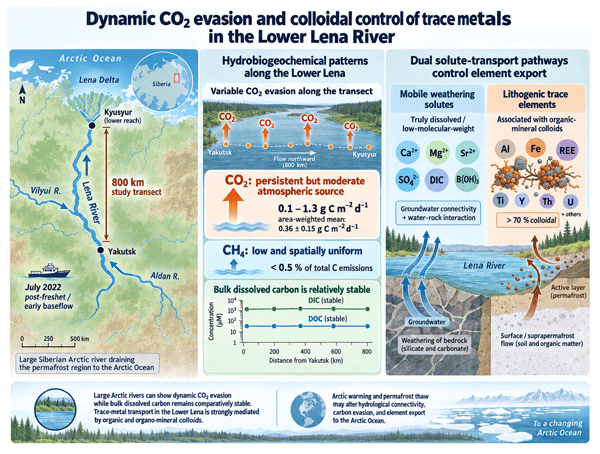
Abstract. Large Arctic rivers integrate carbon and element fluxes across vast permafrost-dominated landscapes, yet the lower reaches of these systems remain poorly constrained in terms of greenhouse gas (GHG) emissions and solute organization. We investigated the Low Lena River over ~800 km during the beginning of summer baseflow, combining continuous in situ pCO2 measurements, floating chamber flux determinations, and analyses of major and trace elements including colloidal size fractionation. CO2 concentrations exhibited pronounced short-distance variability and weak northward decrease along the main stem. Diffusive CO2 fluxes (0.1–1.3 g C m−2 d−1) were comparable to values reported for other large Siberian rivers, confirming the Lena as a persistent but moderate atmospheric CO₂ source during the open-water season. In contrast, CH4 concentrations were low and spatially uniform, contributing <0.5 % to total carbon emissions. Notably, bulk DOC and DIC concentrations remained remarkably stable along the transect and were consistent with long-term monitoring records and previous expeditions, indicating strong buffering of dissolved carbon pools despite dynamic CO2 evasion.
Major and trace elements segregated into two geochemical groups. Highly mobile major ions, Si, and selected oxyanion-forming trace elements were predominantly present in truly dissolved form (0–20 % colloidal fraction) and reflected groundwater connectivity and water–rock interaction. In contrast, lithogenic low-solubility elements – including trivalent and tetravalent hydrolysates – were strongly associated with Fe–Al–organic colloids (>70 %), indicating surface and suprapermafrost mobilization pathways. Multivariate statistics confirmed this dual organization of solute transport. These findings reveal a functional decoupling between structurally buffered dissolved carbon pools and dynamically regulated CO2 exchange, a pattern likely characteristic of large Arctic rivers. Under ongoing warming, shifts in hydrological connectivity, discharge regime, and permafrost thaw may alter this balance, with implications for pan-Arctic carbon and element export to the Arctic Ocean.
-
Notice on discussion status
The requested preprint has a corresponding peer-reviewed final revised paper. You are encouraged to refer to the final revised version.
-
Preprint
(2329 KB)
-
Supplement
(898 KB)
-
The requested preprint has a corresponding peer-reviewed final revised paper. You are encouraged to refer to the final revised version.
- Preprint
(2329 KB) - Metadata XML
-
Supplement
(898 KB) - BibTeX
- EndNote
- Final revised paper


Journal article(s) based on this preprint
Interactive discussion
Status: closed
-
RC1: 'Comment on egusphere-2026-2540', Anonymous Referee #1, 14 Jun 2026
-
AC1: 'Reply on RC1', O.S. Pokrovsky, 23 Jun 2026
Response to Anonymous Referee #1
We thank the reviewer for the positive assessment of the dataset, the spatial coverage, and the integration of greenhouse-gas, hydrochemical, and colloidal measurements. We agree that the manuscript will benefit from a clearer treatment of colloidal dissolved organic carbon, more cautious interpretation of concentration stability, explicit limitations of dialysis-based fractionation, moderated novelty claims, and a more restrained use of PCA.
Comment 1 - Colloidal DOC dynamics
The manuscript discusses colloidal transport extensively, especially in Sections 3.6 and 4.2.2, yet the review of colloidal DOC dynamics is insufficient. The authors mainly cite studies related to Fe/Al colloids and trace metals. The discussion would benefit from engagement with broader colloid and DOM literature from Arctic and boreal systems, and from treating DOC colloids both operationally and mechanistically.
Response: We agree. The original text focused too strongly on metal-bearing Fe-Al colloids and did not sufficiently explain what the measured colloidal DOC fraction represents. We will explicitly define colloidal DOC as an operational 1 kDa-0.45 um fraction and discuss it mechanistically as a mixture of humic supramolecular assemblies, high-molecular-weight organic macromolecules, microbial/plant-derived polymers, and organic coatings or complexes on mineral surfaces. We will also add broader Arctic and boreal DOM references, including Amon et al. (2012), Mann et al. (2012), Guéguen et al. (2006), Fellman et al. (2010), and Novak et al. (2022), in addition to the existing colloid/trace-metal references.
Comment 2 - Concentration stability versus compositional and process stability
The manuscript’s central conceptual conclusion is that DOC/DIC pools are buffered whereas pCO2 remains dynamically regulated. This is interesting. On the other hand, stable DOC concentration does not necessarily imply buffered carbon cycling because DOC composition may vary substantially, DOC lability may shift, and residence time effects are unknown. Concentration stability, compositional stability, and process stability need to be distinguished.
Response: We fully agree. Our conclusion should be limited to concentration-level patterns of bulk DOC and DIC, not to stability of DOC composition, lability, residence time, or overall carbon cycling. We will replace several uses of “buffered dissolved carbon pools” by “stable bulk DOC and DIC concentrations” or “concentration-level buffering”. We will add an explicit caveat stating that our dataset does not resolve DOC molecular composition, biodegradability, photoreactivity, or water residence-time effects.
Comment 3 - Novelty and framing as an integration advance
While the combined dataset is valuable, several components have already been investigated individually in the Lena system. The actual novelty lies more in integrating GHG measurements with colloidal geochemistry, obtaining high-resolution longitudinal observations during post-freshet recession, and linking CO2 evasion with trace-element partitioning. The manuscript would be stronger if the authors framed the work as a synthesis/integration advance rather than a fundamentally new conceptual discovery. In addition, the related claims (e.g., first assessment, first evaluation, first colloidal transport, etc.) should be moderated.
Response: We agree. We will moderate claims of “first” assessments and reframe the manuscript as an integrated longitudinal study that combines high-resolution greenhouse-gas observations, solute chemistry, and operational colloidal partitioning under the same post-freshet hydrological conditions. This framing better reflects the actual advance and acknowledges previous Lena River work on individual components.
Comment 4 - Operational limitations of dialysis-based colloid separation
The manuscript heavily emphasizes colloidal controls on trace elements and DOC. However, the colloidal dataset is somewhat limited, relying on one operational cutoff. Are there changes in microbial activity, colloidal aggregation, and metal adsorption/desorption during dialysis over 3-5 days? Although the authors state concentrations changed <10%, this does not guarantee preservation of original colloidal structure. The operational limitations of dialysis-based colloid separation should be discussed a bit.
Response: We agree. The dialysis data provide robust operational partitioning between <1 kDa and 1 kDa-0.45 um fractions, but they do not preserve or identify the exact in situ colloidal structure. We will explicitly state that dialysis can potentially influence aggregation, adsorption/desorption, and microbial processing during the 3-5 day equilibration. The <10% change in <0.45 um concentrations indicates bulk chemical stability during dialysis, but not necessarily full preservation of the original size distribution or colloid morphology. Note that ideally, dialysis bags should be deployed directly in situ within river or lake waters (e.g., Vasyukova et al., 2010; Pokrovsky et al., 2012; Mikhaleiko et al., 2026a), as this minimizes potential alterations of colloidal structure during sample handling and incubation. However, such deployment was not compatible with the logistics of a continuous ship-based survey covering 1500 km of the Lena River, where prolonged equilibration times (3–5 days) at individual locations were not possible.
Comment 5 - Direct colloidal characterization and future work
Is there any colloidal characterization in the present study or planned research to better strengthen conclusions regarding Fe-Al-organic colloids? For example, particle size distribution, zeta potential, Fe speciation, organic ligand composition, and DOM molecular composition.
Response: In the present study, direct characterization of colloid size distributions, surface charge, Fe speciation, organic ligand composition, or DOM molecular composition was not performed. The inference of Fe-Al-organic colloidal carriers is based on operational dialysis, strong co-variation of trace elements with Al, Fe, and DOC, and previous Lena River studies that directly characterized Fe-bearing particles and colloids. We will make this limitation explicit and propose specific future measurements.
We agree that a multidisciplinary characterization of colloidal material, including in situ spectroscopic techniques, would greatly improve understanding of the structure of organic matter–trace metal complexes and the composition of organic ligands. Examples of such approaches have been provided in previous studies by our group, including nuclear magnetic resonance characterization of Al–DOM associations in Central Siberian rivers (Pourpoint et al., 2017) and Fourier-transform ion cyclotron resonance mass spectrometry analysis of DOM molecular composition in western Siberian rivers (Kurek et al., 2025). However, applying these approaches to Lena River colloids was beyond the scope and budget of the present study, although such analyses are clearly desirable for future work.
A major technical limitation is the need to concentrate large volumes of river water to obtain sufficient colloidal material for resolving molecular and structural organization, because most microscopic and spectroscopic methods have relatively low sensitivity at natural riverine concentrations. Such pre-concentration can itself introduce artefacts, including aggregation, restructuring, coagulation, and conformational changes of organic–mineral colloids. Consequently, although advanced structural analyses would be highly valuable, the resulting material may not fully preserve the original colloidal state present under natural river conditions.
Kurek, M.R., Pokrovsky, O.S., Krickov, I.V., Lim, A.G., Korets, M.A., McKenna, A.M., Spencer, R.G.M.: Assessing the molecular-level controls of dissolved organic matter cycling in Western Siberia Lowland rivers, J. Geophys. Res.: Biogeosciences, 30(4), Art No e2024JG008537, DOI:10.1029/2024JG008537, 2025.
Pourpoint F., Templier J., Anquetil C., et al. : Probing the aluminum complexation by Siberian riverine organic matter using solid-state DNP-NMR, Chemical Geology, 452, 1-8, 2017.
Comment 6 - PCA variance explained and moderation of dominant controls
In the PCA interpretation, the first two components explain only 23% and 13% of variance. As such, >60% of variability remains unexplained. Statements regarding dominant controls should be moderated.
Response: We agree. The current wording is too strong, especially where PCA is said to “confirm” or identify “dominant controls”. The first two components explain 36% of the total variance and should be interpreted as the most interpretable axes of covariation, not as an exhaustive description of the dataset. We will revise the Methods, Results, Discussion, and Conclusions accordingly and present PCA as exploratory and complementary to pairwise correlations, longitudinal trends, and dialysis results.
Comment 7 - Interpretation of low methane concentrations
The low CH4 values are interesting. Are they related to floodplain connectivity, oxidation, or sediment processes?
Response: We agree that the low and spatially uniform CH4 signal deserves more interpretation. We will add a short discussion emphasizing that the post-freshet recession period likely reduced connectivity with anoxic floodplain habitats relative to peak flood, while high oxygen concentrations and turbulent main-channel transport likely favored methane oxidation and atmospheric loss. Limited exchange with anoxic sediments in the deep, fast-flowing main stem may also contribute. The floodplain lake sample with elevated pCO2 and CH4 supports this interpretation, because hydrologically disconnected or weakly connected floodplain waters can retain stronger methanogenic signatures.
Comment 8 - Terminology: “Low Lena” versus “Lower Lena”
Low Lena may read Lower Lena or use consistently?
Response: We agree. We will use “Lower Lena River” consistently when referring to the studied river sector and “lower Lena reaches” only in descriptive lower-case usage. This also aligns with the manuscript title.
Citation: https://doi.org/10.5194/egusphere-2026-2540-AC1
-
AC1: 'Reply on RC1', O.S. Pokrovsky, 23 Jun 2026
-
RC2: 'Comment on egusphere-2026-2540', Anonymous Referee #2, 23 Jun 2026
General comments:
This manuscript reflects a thorough and integrative study of hydro-chemical parameters of an emblematic Arctic river at a seldom sampled period. The strengths of the paper lie in the use of longitudinal data over an impressive transect, and integration of greenhouse gas measurements and major/trace element analyses with colloidal fractionation analyses. The paper also confirms gas exchange velocities used in other studies while updating estimated carbon budgets of the system, making an important contribution to the study of major Arctic river carbon cycling. Comparisons of the current study with other long-term datasets are valuable and the discussion contextualizes both regional and climate-related drivers of spatial and seasonal variability. The paper is well written and clear and suitable for publication.
Specific comments:
- More detail is needed about the methods for the control measurements for pCO2 in figure 3A. And a brief discussion why at some places the control measurements are very different than shipboard measurements for pCO2 methods?
- You mention regional differences in several parameters, for example high Mn in Undyulyung River, or CO2 from certain tributaries. Can you add details about potential drivers of this variability or anomalies?
- PCA figure and analysis: Can you add color, grouping, or annotations to this figure that increases interpretability? Also, the cumulative amount of variance explained is relatively low, can you amend statements about the confidence of these findings to reflect this?
- Discussion of drivers of seasonal differences CO2 on lines 561-566 could use some citations.
- While absolute DOC/DIC concentrations appear to be stable the study doesn’t present specific evidence that there are no changes to lability, source, or composition of DOC over the river transect. A short discussion of this is warranted, especially when linking DOC to pCO2 I also think a short discussion of any previously observed DIC speciation data could strengthen the DIC buffering statements (~line 605).
Technical corrections:
There are a few occasions of CO2 in the text and in figure 2 that should be pCO2.
Figure 1A it is hard to see the hydrological station locations on the map.
Line 121 and 125: These seem to be contradictory statements. Can you clarify if they apply to different basins?
Line 257: Is kkk a typo?
Line 457: Typo, remove “the”
Citation: https://doi.org/10.5194/egusphere-2026-2540-RC2 -
AC2: 'Reply on RC2', O.S. Pokrovsky, 24 Jun 2026
We thank the reviewer for the positive and constructive assessment of the manuscript. We have revised the Methods, Results, Discussion, and figures to clarify the independent pCO₂ control measurements, provide cautious explanations for tributary-scale anomalies, improve the PCA presentation and moderated its interpretation, add references supporting the proposed seasonal mechanisms, and distinguish stability of bulk DOC/DIC concentrations from possible changes in organic carbon composition, lability, and inorganic carbon carbonate speciation. We also corrected the terminology and technical issues identified by the reviewer.
1. Independent pCO₂ control measurements and their discrepancies
More detail is needed about the methods for the control measurements for pCO₂ in Figure 3A. And a brief discussion why at some places the control measurements are very different than shipboard measurements for pCO₂ methods?
Response:
We thank the reviewer for identifying this omission. We will expand Sect. 2.4 to describe the second, independently calibrated pCO₂ system and clarify that the red symbols in Fig. 3A are stationary field-validation measurements rather than exact analytical replicates of the moving shipboard record. We will also add a short explanation in Sect. 3.2 and revised the figure caption. The underway system integrates water delivered through the Kingston intake over moving ~1.25-km segments, whereas each control measurement is a local snapshot obtained at a different time and potentially a slightly different depth. The largest discrepancies occur where pCO₂ changes rapidly, particularly near tributary mixing zones, and can therefore reflect real spatial/temporal heterogeneity, incomplete mixing, and different membrane response times rather than a systematic analytical bias. No consistent positive or negative offset was evident.
2. Potential causes of tributary-scale anomalies
You mention regional differences in several parameters, for example high Mn in Undyulyung River, or CO₂ from certain tributaries. Can you add details about potential drivers of this variability or anomalies?
Response:
We agree and will add a concise, explicitly hypothesis-based interpretation of the tributary anomalies. We now relate the Fe-Mn enrichments to local reducing end-member waters and the contrasting pCO₂ signals to differences in floodplain/wetland connectivity, residence time, biological processing, and prior degassing. In particular, Mn exhibits distinct role as a tracer of active-layer hydrological connectivity (Ji et al., 2021), which can explain its local enrichment in some peatland-affected headwaters of the continuous permafrost zone (Krickov et al., 2025). We have to state, however, that the available dataset does not allow definitive source attribution.
Ji, X., Abakumov, E., Polyakov, V., Xie, X., 2021. Mobilization of geochemical elements to surface water in the active layer of permafrost in the Russian Arctic. Water Resources Research 57, e2020WR028269. https://doi.org/10.1029/2020WR028269.
3. PCA presentation and confidence of interpretation
PCA figure and analysis: Can you add color, grouping, or annotations to this figure that increases interpretability? Also, the cumulative amount of variance explained is relatively low, can you amend statements about the confidence of these findings to reflect this?
Response:
We have redesigned Fig. 7 using colored interpretive envelopes and explicit variance percentages on the axes (see attachment). We will also revise the Methods, Results, caption, and Discussion to state that the first two rotated components explain only 36% of total variance and that the PCA is an exploratory ordination rather than a definitive classification or causal test. In the revised version, The PCA interpretation will be retained only where it agrees with pairwise correlations and independent dialysis results.
4. Citations for the proposed seasonal CO₂ mechanisms
Discussion of drivers of seasonal differences CO₂ on lines 561–566 could use some citations.
Response:
We agree. In the revised section 4.1, we will add references supporting snowmelt flushing, seasonal changes in lateral inputs, in-stream production, and degassing. We will also clarify that this is a mechanistic interpretation rather than a direct within-year comparison, because the spring and post-freshet estimates derive from different campaigns and river sectors.
5. DOC/DIC concentration versus composition, lability, and speciation
While absolute DOC/DIC concentrations appear to be stable the study doesn’t present specific evidence that there are no changes to lability, source, or composition of DOC over the river transect. A short discussion of this is warranted, especially when linking DOC to pCO₂. I also think a short discussion of any previously observed DIC speciation data could strengthen the DIC buffering statements.
Response:
We agree and will revise the text to make clear that “stability” refers only to the limited longitudinal variability of bulk (< 0.45 µm) DOC and DIC concentrations during the sampled period. We will explicitly state that no molecular, optical, isotopic, or incubation data were obtained to assess DOC source, composition, or lability. Concerning the Lena carbonate-system context, the bicarbonate ions dominate total DIC under open-water, near-neutral conditions, whereas the dissolved CO₂ fraction and pCO₂ can vary rapidly. We also strongly agree that the DOC-FCO₂ correlation indicates covariance and does not establish direct mineralization of DOC as the CO₂ source.
-
RC3: 'Comment on egusphere-2026-2540', Anonymous Referee #3, 29 Jun 2026
Reviewer report for: Dynamic CO2 evasion and colloidal control of trace metals in the Lower Lena River by Kolesnichenko et al.
Overview and general comments: This study provides an extensive and high-resolution snapshot of carbon fluxes during summer baseflow conditions in the Lower Lena River basin, and connects them to underlying processes through association with the composition and behaviour of solutes, colloids and trace elements. It is an important contribution to our understanding of the probable impacts of climate-associated changes on, and feedbacks from, Arctic river systems and proximate zones of permafrost thaw.
The other two Reviewers have noted the larger-scale questions and concerns associated with the work, which have been addressed by the Authors. The following line-specific comments are thus restricted to more minor, primarily editorial suggestions.
Line-specific comments:
Lines 105–106: …spatial patterns of hydrological control…?
Lines 141–150, Figure 1: Should this be Yakutsk to Kyusyur, to correspond to the locations identified on Figure 1? Yakutsk is also not labelled on the map, nor is Samoilov Island. It is recommended to make the map location labels consistent with the locations named in the text.
Line 151: This sentence seems to suggest that there were sampling points along the Aldan, Vilyui and smaller tributaries, but these locations are not identified on the map. Please ensure that the description in the text is consistent with the labelling of sampling points on the map.
Line 155: “carbon speciation”… Speciation probably is not the correct term unless the composition and structure of all carbon-containing compounds were identified.
Lines 256–263: Should kkk be kCH4 or kCO2?
Line 283: Please indicate the supplier for SLRS-6, and it’s nature/composition/matrix as a CRM.
Figure 1B: Please identify which data the blue and red lines correspond to.
Figures 2A–F: There appear to be one or more potential outliers in each panel. Were these values associated with a single sample, or something anomalous for several samples? If not, is it worth testing them as outliers and removing them if they are?
Results: Much of the material presented in this section seems like it would be better placed in the Discussion section, especially comparisons with other findings. Maybe this could be the title of the first subsection of the Discussion, where all of the results are compared together? There is also a fair bit of interpretation of the results in this section, which might be better moved to the Discussion (e.g. Lines 467–475, 503–509).
Line 376: Should use the longer “en dash” to separate numerical ranges, rather than the shorter hyphen (e.g. – vs -).
Lines 379–382 and Figure 3: Please add all tributaries listed here onto the general area map (Fig. 1) so that readers can identify their locations and visualize the discontinuities in the longitudinal pattern that are discussed.
Lines 397, 402, 426 and elsewhere: Should be “Lower Lena”? Or “lower Lena”, as on line 432?
Lines 417, 419, 436 and elsewhere: Should be mainstem instead of main-stem and main stem?
Line 478 and Figure 6: Line 478 states that this analysis was restricted to the mainstem of the Lena R., but the caption of Figure 6 states “Lena River and its tributaries”.
Figure 8: The y-axis scale has cut off the top ends of some of the error bars.
Lines 513–515: Better/clearer to write “dissolved (<0.45 µm) colloids with sizes >1 kDa”, instead of “colloidal (1 kDa–0.45 μm) fractions within the dissolved pool (<0.45 μm)”? It may also be better to represent the next sentence as a ratio formula, instead of describing it with words? The term “total dissolved concentration” is strange given that dissolved is a subset of total.
Lines 521, 525: Suggest changing “are” and “is” to “were” and “was” for consistent tense.
Line 529: Should Al-rich (organo)mineral particles be mentioned here if Al was in the mixed colloidal group (~ 50%).
Discussion: Much of this section is presented in the present tense, but is best written in the past tense since it is based on measured variables that are likely to change under different freshet conditions, and generally over time with climate change.
Line 596: Although it is implied by “increased channel width” with all else being equal, is decreasing depth also worth mentioning?
Lines 613–617: Is it worth also considering the impact of any observed decreases in temperature from south to north on the rate of in-stream carbon processing by microorganisms and associated abiotic reactions that may produce CO2?
Lines 652–654: Better to say “…dissolved (<0.45 μm) low-solubility trivalent and…”, since the particulate fraction (>0.45 μm) was not accounted for?
Line 661: Negative correlation vs negative relationships?
Line 665: Humic acids typically form more stable complexes with divalent cations like Cu, compared to fulvic acids. They are also known to stabilize Fe and Al (oxyhydr)oxides.
Line 681: Better to say colloidal versus truly dissolved, and/or include the size ranges?
Line 701: Better to say relatively inert instead of rather inert? Certainly colloid-stabilized DOC is inert relative to more labile forms, but it is also more reactive than other forms of carbon-mineral associations (e.g. allophane).
Line 728: Better to say that continuous permafrost did not alter transport architecture, and specifically for the studied and reported rivers/area (rather than does not in the general sense for all Arctic and boreal rivers), since that may change with time and may be different in other river systems?
Citation: https://doi.org/10.5194/egusphere-2026-2540-RC3 -
AC3: 'Reply on RC3', O.S. Pokrovsky, 04 Jul 2026
We sincerely thank Reviewer 3 for the positive evaluation of our manuscript and for the careful line-by-line reading. We are pleased that the reviewer recognizes the value of the dataset and its contribution to understanding carbon emissions, colloidal transport, and trace-element mobility in a large Arctic river system during the post-freshet period. We also appreciate that the comments are primarily editorial and aimed at improving clarity, consistency, and precision.
In the revised manuscript, we will carefully address all line-specific suggestions. In particular, we will standardize geographical terminology and spelling throughout the paper, using Lower Lena consistently where appropriate, and we will harmonize terms such as mainstem/main stem, numerical en dashes, and tense usage in the Discussion. We will also correct ambiguous or inappropriate wording, including replacing “carbon speciation” with a more accurate term such as “carbon forms” or “carbon pools,” and we will correct typographical errors such as “kkk” in the gas-transfer section. We will also provide the supplier and matrix description for the SLRS-6 certified reference material.
We agree that the figures require several clarifications. Figure 1 will be revised to label Yakutsk, Kyusyur, Samoilov Island, and the sampled tributaries consistently with the text, so that the spatial discontinuities discussed later can be more easily interpreted. The blue and red lines in Fig. 1B will be clearly identified, the Fig. 6 caption will be corrected to match the dataset actually used in the analysis, and the y-axis range in Fig. 8 will be adjusted so that all error bars are fully visible. We will also inspect the apparent outliers in Fig. 2. If they correspond to valid samples, they will be retained and briefly explained; if any reflect analytical or transcription errors, they will be corrected or removed.
We also agree that some material currently placed in the Results section is interpretative or comparative and would be better located in the Discussion. During revision, we will move or shorten such passages, particularly where broader comparisons or mechanistic interpretations are presented. Finally, we will refine the colloid-related wording by clearly defining the operational fraction as dissolved material <0.45 µm with colloids >1 kDa, avoiding ambiguous expressions such as “total dissolved concentration,” and moderating statements about colloidal stabilization, Al-rich particles, fulvic/humic ligands, and permafrost effects. The revised text will be more cautious, emphasizing that our conclusions apply to the studied Lower Lena reach and sampled hydrological period rather than to all Arctic rivers universally.
Citation: https://doi.org/10.5194/egusphere-2026-2540-AC3
-
AC3: 'Reply on RC3', O.S. Pokrovsky, 04 Jul 2026
Peer review completion


Interactive discussion
Status: closed
-
RC1: 'Comment on egusphere-2026-2540', Anonymous Referee #1, 14 Jun 2026
This manuscript presents an extensive hydrobiogeochemical investigation of the lower Lena River during the post-freshet period, integrating measurements of pCO₂, CH₄, dissolved organic and inorganic carbon pools, major and trace elements, and colloidal fractionation. The dataset is spatially impressive and addresses an important topic concerning Arctic river carbon cycling and trace metal transport under permafrost thaw.
The manuscript is generally well written, data-rich, and suitable for publication in EGU Sphere. The study has several important strengths, including valuable Arctic river dataset, strong spatial coverage, integration of carbon and trace-metal dynamics with colloidal partitioning data, relevance to permafrost-climate feedbacks, important observations on tributary-driven heterogeneity, and useful hydrochemical comparison with long-term datasets.
Overall, minor revisions are needed to address issues related to conceptual, methodological, and interpretative strengths and to improve the manuscript’s impact and robustness.
Below are comments for consideration:
- The manuscript discusses colloidal transport extensively, especially in Sections 3.6 and 4.2.2, yet the review of colloidal DOC dynamics is insufficient. The authors mainly cite studies related to Fe/Al colloids and trace metals. The discussion would benefit from engagement with broader colloid and DOM literature from Arctic and boreal systems, and from treating DOC colloids both operationally and mechanistically.
- The manuscript’s central conceptual conclusion is that DOC/DIC pools are buffered whereas pCO₂ remains dynamically regulated. This is interesting. On the other hand, stable DOC concentration does not necessarily imply buffered carbon cycling because DOC composition may vary substantially, DOC lability may shift, and residence time effects are unknown. Concentration stability, compositional stability, and process stability need to be distinguished.
- While the combined dataset is valuable, several components have already been investigated individually in the Lena system. The actual novelty lies more in integrating GHG measurements with colloidal geochemistry, obtaining high-resolution longitudinal observations during post-freshet recession, and linking CO₂ evasion with trace-element partitioning. The manuscript would be stronger if the authors framed the work as a synthesis/integration advance rather than a fundamentally new conceptual discovery. In addition, the related claims (e.g., first assessment, first evaluation, first colloidal transport, etc) should be moderated.
- The manuscript heavily emphasizes colloidal controls on trace elements and DOC. However, the colloidal dataset is somewhat limited, relying on one operational cutoff. Are there changes in microbial activity, colloidal aggregation, and metal adsorption/desorption during dialysis over 3–5 days? Although the authors state concentrations changed <10%, this does not guarantee preservation of original colloidal structure. The operational limitations of dialysis-based colloid separation should be discussed a bit.
- Is there any colloidal characterization in the present study or planed research to better strengthen conclusions regarding Fe–Al–organic colloids? For example, particle size distribution, zeta potential, Fe speciation, organic ligand composition, and DOM molecular composition.
- In the PCA interpretation, the first two components explain only 23% and 13% of variance. As such, >60% of variability remains unexplained. Statements regarding dominant controls should be moderated.
- The low CH₄ values are interesting. Are they related to floodplain connectivity, oxidation, or sediment processes?
- Low Lena may read Lower Lena or use consistently?
Citation: https://doi.org/10.5194/egusphere-2026-2540-RC1 -
AC1: 'Reply on RC1', O.S. Pokrovsky, 23 Jun 2026
Response to Anonymous Referee #1
We thank the reviewer for the positive assessment of the dataset, the spatial coverage, and the integration of greenhouse-gas, hydrochemical, and colloidal measurements. We agree that the manuscript will benefit from a clearer treatment of colloidal dissolved organic carbon, more cautious interpretation of concentration stability, explicit limitations of dialysis-based fractionation, moderated novelty claims, and a more restrained use of PCA.
Comment 1 - Colloidal DOC dynamics
The manuscript discusses colloidal transport extensively, especially in Sections 3.6 and 4.2.2, yet the review of colloidal DOC dynamics is insufficient. The authors mainly cite studies related to Fe/Al colloids and trace metals. The discussion would benefit from engagement with broader colloid and DOM literature from Arctic and boreal systems, and from treating DOC colloids both operationally and mechanistically.
Response: We agree. The original text focused too strongly on metal-bearing Fe-Al colloids and did not sufficiently explain what the measured colloidal DOC fraction represents. We will explicitly define colloidal DOC as an operational 1 kDa-0.45 um fraction and discuss it mechanistically as a mixture of humic supramolecular assemblies, high-molecular-weight organic macromolecules, microbial/plant-derived polymers, and organic coatings or complexes on mineral surfaces. We will also add broader Arctic and boreal DOM references, including Amon et al. (2012), Mann et al. (2012), Guéguen et al. (2006), Fellman et al. (2010), and Novak et al. (2022), in addition to the existing colloid/trace-metal references.
Comment 2 - Concentration stability versus compositional and process stability
The manuscript’s central conceptual conclusion is that DOC/DIC pools are buffered whereas pCO2 remains dynamically regulated. This is interesting. On the other hand, stable DOC concentration does not necessarily imply buffered carbon cycling because DOC composition may vary substantially, DOC lability may shift, and residence time effects are unknown. Concentration stability, compositional stability, and process stability need to be distinguished.
Response: We fully agree. Our conclusion should be limited to concentration-level patterns of bulk DOC and DIC, not to stability of DOC composition, lability, residence time, or overall carbon cycling. We will replace several uses of “buffered dissolved carbon pools” by “stable bulk DOC and DIC concentrations” or “concentration-level buffering”. We will add an explicit caveat stating that our dataset does not resolve DOC molecular composition, biodegradability, photoreactivity, or water residence-time effects.
Comment 3 - Novelty and framing as an integration advance
While the combined dataset is valuable, several components have already been investigated individually in the Lena system. The actual novelty lies more in integrating GHG measurements with colloidal geochemistry, obtaining high-resolution longitudinal observations during post-freshet recession, and linking CO2 evasion with trace-element partitioning. The manuscript would be stronger if the authors framed the work as a synthesis/integration advance rather than a fundamentally new conceptual discovery. In addition, the related claims (e.g., first assessment, first evaluation, first colloidal transport, etc.) should be moderated.
Response: We agree. We will moderate claims of “first” assessments and reframe the manuscript as an integrated longitudinal study that combines high-resolution greenhouse-gas observations, solute chemistry, and operational colloidal partitioning under the same post-freshet hydrological conditions. This framing better reflects the actual advance and acknowledges previous Lena River work on individual components.
Comment 4 - Operational limitations of dialysis-based colloid separation
The manuscript heavily emphasizes colloidal controls on trace elements and DOC. However, the colloidal dataset is somewhat limited, relying on one operational cutoff. Are there changes in microbial activity, colloidal aggregation, and metal adsorption/desorption during dialysis over 3-5 days? Although the authors state concentrations changed <10%, this does not guarantee preservation of original colloidal structure. The operational limitations of dialysis-based colloid separation should be discussed a bit.
Response: We agree. The dialysis data provide robust operational partitioning between <1 kDa and 1 kDa-0.45 um fractions, but they do not preserve or identify the exact in situ colloidal structure. We will explicitly state that dialysis can potentially influence aggregation, adsorption/desorption, and microbial processing during the 3-5 day equilibration. The <10% change in <0.45 um concentrations indicates bulk chemical stability during dialysis, but not necessarily full preservation of the original size distribution or colloid morphology. Note that ideally, dialysis bags should be deployed directly in situ within river or lake waters (e.g., Vasyukova et al., 2010; Pokrovsky et al., 2012; Mikhaleiko et al., 2026a), as this minimizes potential alterations of colloidal structure during sample handling and incubation. However, such deployment was not compatible with the logistics of a continuous ship-based survey covering 1500 km of the Lena River, where prolonged equilibration times (3–5 days) at individual locations were not possible.
Comment 5 - Direct colloidal characterization and future work
Is there any colloidal characterization in the present study or planned research to better strengthen conclusions regarding Fe-Al-organic colloids? For example, particle size distribution, zeta potential, Fe speciation, organic ligand composition, and DOM molecular composition.
Response: In the present study, direct characterization of colloid size distributions, surface charge, Fe speciation, organic ligand composition, or DOM molecular composition was not performed. The inference of Fe-Al-organic colloidal carriers is based on operational dialysis, strong co-variation of trace elements with Al, Fe, and DOC, and previous Lena River studies that directly characterized Fe-bearing particles and colloids. We will make this limitation explicit and propose specific future measurements.
We agree that a multidisciplinary characterization of colloidal material, including in situ spectroscopic techniques, would greatly improve understanding of the structure of organic matter–trace metal complexes and the composition of organic ligands. Examples of such approaches have been provided in previous studies by our group, including nuclear magnetic resonance characterization of Al–DOM associations in Central Siberian rivers (Pourpoint et al., 2017) and Fourier-transform ion cyclotron resonance mass spectrometry analysis of DOM molecular composition in western Siberian rivers (Kurek et al., 2025). However, applying these approaches to Lena River colloids was beyond the scope and budget of the present study, although such analyses are clearly desirable for future work.
A major technical limitation is the need to concentrate large volumes of river water to obtain sufficient colloidal material for resolving molecular and structural organization, because most microscopic and spectroscopic methods have relatively low sensitivity at natural riverine concentrations. Such pre-concentration can itself introduce artefacts, including aggregation, restructuring, coagulation, and conformational changes of organic–mineral colloids. Consequently, although advanced structural analyses would be highly valuable, the resulting material may not fully preserve the original colloidal state present under natural river conditions.
Kurek, M.R., Pokrovsky, O.S., Krickov, I.V., Lim, A.G., Korets, M.A., McKenna, A.M., Spencer, R.G.M.: Assessing the molecular-level controls of dissolved organic matter cycling in Western Siberia Lowland rivers, J. Geophys. Res.: Biogeosciences, 30(4), Art No e2024JG008537, DOI:10.1029/2024JG008537, 2025.
Pourpoint F., Templier J., Anquetil C., et al. : Probing the aluminum complexation by Siberian riverine organic matter using solid-state DNP-NMR, Chemical Geology, 452, 1-8, 2017.
Comment 6 - PCA variance explained and moderation of dominant controls
In the PCA interpretation, the first two components explain only 23% and 13% of variance. As such, >60% of variability remains unexplained. Statements regarding dominant controls should be moderated.
Response: We agree. The current wording is too strong, especially where PCA is said to “confirm” or identify “dominant controls”. The first two components explain 36% of the total variance and should be interpreted as the most interpretable axes of covariation, not as an exhaustive description of the dataset. We will revise the Methods, Results, Discussion, and Conclusions accordingly and present PCA as exploratory and complementary to pairwise correlations, longitudinal trends, and dialysis results.
Comment 7 - Interpretation of low methane concentrations
The low CH4 values are interesting. Are they related to floodplain connectivity, oxidation, or sediment processes?
Response: We agree that the low and spatially uniform CH4 signal deserves more interpretation. We will add a short discussion emphasizing that the post-freshet recession period likely reduced connectivity with anoxic floodplain habitats relative to peak flood, while high oxygen concentrations and turbulent main-channel transport likely favored methane oxidation and atmospheric loss. Limited exchange with anoxic sediments in the deep, fast-flowing main stem may also contribute. The floodplain lake sample with elevated pCO2 and CH4 supports this interpretation, because hydrologically disconnected or weakly connected floodplain waters can retain stronger methanogenic signatures.
Comment 8 - Terminology: “Low Lena” versus “Lower Lena”
Low Lena may read Lower Lena or use consistently?
Response: We agree. We will use “Lower Lena River” consistently when referring to the studied river sector and “lower Lena reaches” only in descriptive lower-case usage. This also aligns with the manuscript title.
Citation: https://doi.org/10.5194/egusphere-2026-2540-AC1
-
RC2: 'Comment on egusphere-2026-2540', Anonymous Referee #2, 23 Jun 2026
General comments:
This manuscript reflects a thorough and integrative study of hydro-chemical parameters of an emblematic Arctic river at a seldom sampled period. The strengths of the paper lie in the use of longitudinal data over an impressive transect, and integration of greenhouse gas measurements and major/trace element analyses with colloidal fractionation analyses. The paper also confirms gas exchange velocities used in other studies while updating estimated carbon budgets of the system, making an important contribution to the study of major Arctic river carbon cycling. Comparisons of the current study with other long-term datasets are valuable and the discussion contextualizes both regional and climate-related drivers of spatial and seasonal variability. The paper is well written and clear and suitable for publication.
Specific comments:
- More detail is needed about the methods for the control measurements for pCO2 in figure 3A. And a brief discussion why at some places the control measurements are very different than shipboard measurements for pCO2 methods?
- You mention regional differences in several parameters, for example high Mn in Undyulyung River, or CO2 from certain tributaries. Can you add details about potential drivers of this variability or anomalies?
- PCA figure and analysis: Can you add color, grouping, or annotations to this figure that increases interpretability? Also, the cumulative amount of variance explained is relatively low, can you amend statements about the confidence of these findings to reflect this?
- Discussion of drivers of seasonal differences CO2 on lines 561-566 could use some citations.
- While absolute DOC/DIC concentrations appear to be stable the study doesn’t present specific evidence that there are no changes to lability, source, or composition of DOC over the river transect. A short discussion of this is warranted, especially when linking DOC to pCO2 I also think a short discussion of any previously observed DIC speciation data could strengthen the DIC buffering statements (~line 605).
Technical corrections:
There are a few occasions of CO2 in the text and in figure 2 that should be pCO2.
Figure 1A it is hard to see the hydrological station locations on the map.
Line 121 and 125: These seem to be contradictory statements. Can you clarify if they apply to different basins?
Line 257: Is kkk a typo?
Line 457: Typo, remove “the”
Citation: https://doi.org/10.5194/egusphere-2026-2540-RC2 -
AC2: 'Reply on RC2', O.S. Pokrovsky, 24 Jun 2026
We thank the reviewer for the positive and constructive assessment of the manuscript. We have revised the Methods, Results, Discussion, and figures to clarify the independent pCO₂ control measurements, provide cautious explanations for tributary-scale anomalies, improve the PCA presentation and moderated its interpretation, add references supporting the proposed seasonal mechanisms, and distinguish stability of bulk DOC/DIC concentrations from possible changes in organic carbon composition, lability, and inorganic carbon carbonate speciation. We also corrected the terminology and technical issues identified by the reviewer.
1. Independent pCO₂ control measurements and their discrepancies
More detail is needed about the methods for the control measurements for pCO₂ in Figure 3A. And a brief discussion why at some places the control measurements are very different than shipboard measurements for pCO₂ methods?
Response:
We thank the reviewer for identifying this omission. We will expand Sect. 2.4 to describe the second, independently calibrated pCO₂ system and clarify that the red symbols in Fig. 3A are stationary field-validation measurements rather than exact analytical replicates of the moving shipboard record. We will also add a short explanation in Sect. 3.2 and revised the figure caption. The underway system integrates water delivered through the Kingston intake over moving ~1.25-km segments, whereas each control measurement is a local snapshot obtained at a different time and potentially a slightly different depth. The largest discrepancies occur where pCO₂ changes rapidly, particularly near tributary mixing zones, and can therefore reflect real spatial/temporal heterogeneity, incomplete mixing, and different membrane response times rather than a systematic analytical bias. No consistent positive or negative offset was evident.
2. Potential causes of tributary-scale anomalies
You mention regional differences in several parameters, for example high Mn in Undyulyung River, or CO₂ from certain tributaries. Can you add details about potential drivers of this variability or anomalies?
Response:
We agree and will add a concise, explicitly hypothesis-based interpretation of the tributary anomalies. We now relate the Fe-Mn enrichments to local reducing end-member waters and the contrasting pCO₂ signals to differences in floodplain/wetland connectivity, residence time, biological processing, and prior degassing. In particular, Mn exhibits distinct role as a tracer of active-layer hydrological connectivity (Ji et al., 2021), which can explain its local enrichment in some peatland-affected headwaters of the continuous permafrost zone (Krickov et al., 2025). We have to state, however, that the available dataset does not allow definitive source attribution.
Ji, X., Abakumov, E., Polyakov, V., Xie, X., 2021. Mobilization of geochemical elements to surface water in the active layer of permafrost in the Russian Arctic. Water Resources Research 57, e2020WR028269. https://doi.org/10.1029/2020WR028269.
3. PCA presentation and confidence of interpretation
PCA figure and analysis: Can you add color, grouping, or annotations to this figure that increases interpretability? Also, the cumulative amount of variance explained is relatively low, can you amend statements about the confidence of these findings to reflect this?
Response:
We have redesigned Fig. 7 using colored interpretive envelopes and explicit variance percentages on the axes (see attachment). We will also revise the Methods, Results, caption, and Discussion to state that the first two rotated components explain only 36% of total variance and that the PCA is an exploratory ordination rather than a definitive classification or causal test. In the revised version, The PCA interpretation will be retained only where it agrees with pairwise correlations and independent dialysis results.
4. Citations for the proposed seasonal CO₂ mechanisms
Discussion of drivers of seasonal differences CO₂ on lines 561–566 could use some citations.
Response:
We agree. In the revised section 4.1, we will add references supporting snowmelt flushing, seasonal changes in lateral inputs, in-stream production, and degassing. We will also clarify that this is a mechanistic interpretation rather than a direct within-year comparison, because the spring and post-freshet estimates derive from different campaigns and river sectors.
5. DOC/DIC concentration versus composition, lability, and speciation
While absolute DOC/DIC concentrations appear to be stable the study doesn’t present specific evidence that there are no changes to lability, source, or composition of DOC over the river transect. A short discussion of this is warranted, especially when linking DOC to pCO₂. I also think a short discussion of any previously observed DIC speciation data could strengthen the DIC buffering statements.
Response:
We agree and will revise the text to make clear that “stability” refers only to the limited longitudinal variability of bulk (< 0.45 µm) DOC and DIC concentrations during the sampled period. We will explicitly state that no molecular, optical, isotopic, or incubation data were obtained to assess DOC source, composition, or lability. Concerning the Lena carbonate-system context, the bicarbonate ions dominate total DIC under open-water, near-neutral conditions, whereas the dissolved CO₂ fraction and pCO₂ can vary rapidly. We also strongly agree that the DOC-FCO₂ correlation indicates covariance and does not establish direct mineralization of DOC as the CO₂ source.
-
RC3: 'Comment on egusphere-2026-2540', Anonymous Referee #3, 29 Jun 2026
Reviewer report for: Dynamic CO2 evasion and colloidal control of trace metals in the Lower Lena River by Kolesnichenko et al.
Overview and general comments: This study provides an extensive and high-resolution snapshot of carbon fluxes during summer baseflow conditions in the Lower Lena River basin, and connects them to underlying processes through association with the composition and behaviour of solutes, colloids and trace elements. It is an important contribution to our understanding of the probable impacts of climate-associated changes on, and feedbacks from, Arctic river systems and proximate zones of permafrost thaw.
The other two Reviewers have noted the larger-scale questions and concerns associated with the work, which have been addressed by the Authors. The following line-specific comments are thus restricted to more minor, primarily editorial suggestions.
Line-specific comments:
Lines 105–106: …spatial patterns of hydrological control…?
Lines 141–150, Figure 1: Should this be Yakutsk to Kyusyur, to correspond to the locations identified on Figure 1? Yakutsk is also not labelled on the map, nor is Samoilov Island. It is recommended to make the map location labels consistent with the locations named in the text.
Line 151: This sentence seems to suggest that there were sampling points along the Aldan, Vilyui and smaller tributaries, but these locations are not identified on the map. Please ensure that the description in the text is consistent with the labelling of sampling points on the map.
Line 155: “carbon speciation”… Speciation probably is not the correct term unless the composition and structure of all carbon-containing compounds were identified.
Lines 256–263: Should kkk be kCH4 or kCO2?
Line 283: Please indicate the supplier for SLRS-6, and it’s nature/composition/matrix as a CRM.
Figure 1B: Please identify which data the blue and red lines correspond to.
Figures 2A–F: There appear to be one or more potential outliers in each panel. Were these values associated with a single sample, or something anomalous for several samples? If not, is it worth testing them as outliers and removing them if they are?
Results: Much of the material presented in this section seems like it would be better placed in the Discussion section, especially comparisons with other findings. Maybe this could be the title of the first subsection of the Discussion, where all of the results are compared together? There is also a fair bit of interpretation of the results in this section, which might be better moved to the Discussion (e.g. Lines 467–475, 503–509).
Line 376: Should use the longer “en dash” to separate numerical ranges, rather than the shorter hyphen (e.g. – vs -).
Lines 379–382 and Figure 3: Please add all tributaries listed here onto the general area map (Fig. 1) so that readers can identify their locations and visualize the discontinuities in the longitudinal pattern that are discussed.
Lines 397, 402, 426 and elsewhere: Should be “Lower Lena”? Or “lower Lena”, as on line 432?
Lines 417, 419, 436 and elsewhere: Should be mainstem instead of main-stem and main stem?
Line 478 and Figure 6: Line 478 states that this analysis was restricted to the mainstem of the Lena R., but the caption of Figure 6 states “Lena River and its tributaries”.
Figure 8: The y-axis scale has cut off the top ends of some of the error bars.
Lines 513–515: Better/clearer to write “dissolved (<0.45 µm) colloids with sizes >1 kDa”, instead of “colloidal (1 kDa–0.45 μm) fractions within the dissolved pool (<0.45 μm)”? It may also be better to represent the next sentence as a ratio formula, instead of describing it with words? The term “total dissolved concentration” is strange given that dissolved is a subset of total.
Lines 521, 525: Suggest changing “are” and “is” to “were” and “was” for consistent tense.
Line 529: Should Al-rich (organo)mineral particles be mentioned here if Al was in the mixed colloidal group (~ 50%).
Discussion: Much of this section is presented in the present tense, but is best written in the past tense since it is based on measured variables that are likely to change under different freshet conditions, and generally over time with climate change.
Line 596: Although it is implied by “increased channel width” with all else being equal, is decreasing depth also worth mentioning?
Lines 613–617: Is it worth also considering the impact of any observed decreases in temperature from south to north on the rate of in-stream carbon processing by microorganisms and associated abiotic reactions that may produce CO2?
Lines 652–654: Better to say “…dissolved (<0.45 μm) low-solubility trivalent and…”, since the particulate fraction (>0.45 μm) was not accounted for?
Line 661: Negative correlation vs negative relationships?
Line 665: Humic acids typically form more stable complexes with divalent cations like Cu, compared to fulvic acids. They are also known to stabilize Fe and Al (oxyhydr)oxides.
Line 681: Better to say colloidal versus truly dissolved, and/or include the size ranges?
Line 701: Better to say relatively inert instead of rather inert? Certainly colloid-stabilized DOC is inert relative to more labile forms, but it is also more reactive than other forms of carbon-mineral associations (e.g. allophane).
Line 728: Better to say that continuous permafrost did not alter transport architecture, and specifically for the studied and reported rivers/area (rather than does not in the general sense for all Arctic and boreal rivers), since that may change with time and may be different in other river systems?
Citation: https://doi.org/10.5194/egusphere-2026-2540-RC3 -
AC3: 'Reply on RC3', O.S. Pokrovsky, 04 Jul 2026
We sincerely thank Reviewer 3 for the positive evaluation of our manuscript and for the careful line-by-line reading. We are pleased that the reviewer recognizes the value of the dataset and its contribution to understanding carbon emissions, colloidal transport, and trace-element mobility in a large Arctic river system during the post-freshet period. We also appreciate that the comments are primarily editorial and aimed at improving clarity, consistency, and precision.
In the revised manuscript, we will carefully address all line-specific suggestions. In particular, we will standardize geographical terminology and spelling throughout the paper, using Lower Lena consistently where appropriate, and we will harmonize terms such as mainstem/main stem, numerical en dashes, and tense usage in the Discussion. We will also correct ambiguous or inappropriate wording, including replacing “carbon speciation” with a more accurate term such as “carbon forms” or “carbon pools,” and we will correct typographical errors such as “kkk” in the gas-transfer section. We will also provide the supplier and matrix description for the SLRS-6 certified reference material.
We agree that the figures require several clarifications. Figure 1 will be revised to label Yakutsk, Kyusyur, Samoilov Island, and the sampled tributaries consistently with the text, so that the spatial discontinuities discussed later can be more easily interpreted. The blue and red lines in Fig. 1B will be clearly identified, the Fig. 6 caption will be corrected to match the dataset actually used in the analysis, and the y-axis range in Fig. 8 will be adjusted so that all error bars are fully visible. We will also inspect the apparent outliers in Fig. 2. If they correspond to valid samples, they will be retained and briefly explained; if any reflect analytical or transcription errors, they will be corrected or removed.
We also agree that some material currently placed in the Results section is interpretative or comparative and would be better located in the Discussion. During revision, we will move or shorten such passages, particularly where broader comparisons or mechanistic interpretations are presented. Finally, we will refine the colloid-related wording by clearly defining the operational fraction as dissolved material <0.45 µm with colloids >1 kDa, avoiding ambiguous expressions such as “total dissolved concentration,” and moderating statements about colloidal stabilization, Al-rich particles, fulvic/humic ligands, and permafrost effects. The revised text will be more cautious, emphasizing that our conclusions apply to the studied Lower Lena reach and sampled hydrological period rather than to all Arctic rivers universally.
Citation: https://doi.org/10.5194/egusphere-2026-2540-AC3
-
AC3: 'Reply on RC3', O.S. Pokrovsky, 04 Jul 2026
Peer review completion
Journal article(s) based on this preprint
Viewed
| HTML | XML | Total | Supplement | BibTeX | EndNote | |
|---|---|---|---|---|---|---|
| 429 | 109 | 43 | 581 | 59 | 33 | 32 |
- HTML: 429
- PDF: 109
- XML: 43
- Total: 581
- Supplement: 59
- BibTeX: 33
- EndNote: 32
Viewed (geographical distribution)
| Country | # | Views | % |
|---|
| Total: | 0 |
| HTML: | 0 |
| PDF: | 0 |
| XML: | 0 |
- 1
Yuri Ya. Kolesnichenko
Sergey N. Vorobyev
Viktor A. Nikitkin
Oleg V. Dudarev
Denis V. Chernykh
Eduard A. Spivak
Arkadiy V. Kurilenko
Vladimir A. Kholodov
Igor P. Semiletov

The requested preprint has a corresponding peer-reviewed final revised paper. You are encouraged to refer to the final revised version.
- Preprint
(2329 KB) - Metadata XML
-
Supplement
(898 KB) - BibTeX
- EndNote
- Final revised paper
This manuscript presents an extensive hydrobiogeochemical investigation of the lower Lena River during the post-freshet period, integrating measurements of pCO₂, CH₄, dissolved organic and inorganic carbon pools, major and trace elements, and colloidal fractionation. The dataset is spatially impressive and addresses an important topic concerning Arctic river carbon cycling and trace metal transport under permafrost thaw.
The manuscript is generally well written, data-rich, and suitable for publication in EGU Sphere. The study has several important strengths, including valuable Arctic river dataset, strong spatial coverage, integration of carbon and trace-metal dynamics with colloidal partitioning data, relevance to permafrost-climate feedbacks, important observations on tributary-driven heterogeneity, and useful hydrochemical comparison with long-term datasets.
Overall, minor revisions are needed to address issues related to conceptual, methodological, and interpretative strengths and to improve the manuscript’s impact and robustness.
Below are comments for consideration: