
the Creative Commons Attribution 4.0 License.
the Creative Commons Attribution 4.0 License.
 | 03 Jul 2026
Influence of irradiance and mixing layer height on the vertical trace matter distribution in the lower planetary boundary layer – drone-based investigation
Abstract. Drone-based atmospheric measurements allow time-resolved investigation of stratification in the lower atmosphere of many atmospherically relevant variables. Measuring a variety of variables can be used, e.g., for mixing layer (height, MLH) identification and examination of the representativity of ground-based measurements in the lowermost boundary layer. We present drone-based vertical profiling during two 2.5‑week summer field campaigns in rural Germany to investigate the vertical distribution of trace matter and meteorological variables in the lowermost troposphere.
Night-time vertical profiling of temperature, humidity, wind speed, and trace substances (CO2, O3, particle mass and number concentrations) in the lowest 120 m revealed a multiple-layer fine-scale stratification. Trace substances surpassed several traditional meteorological variables in sensitivity for MLH detection. Among all variables, O3 and potential temperature were the most reliable MLH markers, highlighting combining trace matter and meteorological measurements to understand stratification processes.
Using a gradient-based approach for diurnal vertical profiles up to 500 m above ground, we evaluate under which conditions and to which degree ground-based measurements, used world-wide in networks or during individual field campaigns, can be taken as representative for the lowermost mixing layer, and how strong radiative-driven mixing reduces vertical gradients. Location-specific sources and sinks affect the trace matter distribution in the ML much stronger than irradiance. However, homogeneity of aerosol particle concentrations was strongly promoted under high-radiative conditions, even at low MLHs. This suggests distinguishing between high- and low-irradiation conditions in the planetary boundary layer could improve parameterization for vertical mixing and should be considered when evaluating ground-based data.
-
Notice on discussion status
The requested preprint has a corresponding peer-reviewed final revised paper. You are encouraged to refer to the final revised version.
-
Preprint
(1328 KB)
-
Supplement
(1533 KB)
-
The requested preprint has a corresponding peer-reviewed final revised paper. You are encouraged to refer to the final revised version.
- Preprint
(1328 KB) - Metadata XML
-
Supplement
(1533 KB) - BibTeX
- EndNote
- Final revised paper


Journal article(s) based on this preprint
Interactive discussion
Status: closed
-
RC1: 'Comment on egusphere-2026-2494', Anonymous Referee #1, 27 Jul 2026
- AC2: 'Reply on RC1', Lasse Moormann, 25 Sep 2026
-
RC2: 'Comment on egusphere-2026-2494', Anonymous Referee #2, 19 Aug 2026
The authors presented a very interesting vertical profiling study of meteorological parameters and air pollutants in Germany using an uncrewed aerial system (UAS). Detailed analysis on mixing layer and boundary layer heights were performed using various criteria, and justification given. It also provided interpretations on how the dynamics of planetary boundary layer (PBL) affects vertical distributions of air pollutants, as well as how representative ground-based measurements are to cover the lower part of the PBL. Recommendations are given for accurate identification of the mixing layer and boundary layer heights in both nighttime and daytime scenarios, as well as to reconcile the ground-based and vertical measurements to better represent the relationships between emission and PBL dynamics that shape air pollutant distributions. The study can be published after some minor revisions, and my comments are given as below.
- Although the authors justified that an extensive comparison is out of the scope of the current study (P13/L357), brief mentioning on recent studies of vertical profiling using UAS in some proper locations in Introduction and Discussion sections might help readers to appreciate the uniqueness of the current study.
- There are a few places that measured data can be provided or referred to, so as to make the points more clearly. 1) P6/L185: I thought latent heat flux was measured in the ground-based MoLa (P4/L103). Please show data to support the statement here in P6/L185. 2) P9/L280: please show or refer to the data of correlation between PBLH and irradiance.
- There are a few places that the authors used O3 titration by NO to interpret steep slopes of O3 profiles in early morning and/or foggy conditions. This chemistry is for sure real and may be responsible. But can the author provide a brief comparison of time scales of passive diffusion, active convection, and O3 + NO reaction to further support that it is the case?
- For PNC, the authors assumed that they are mainly from direct anthropogenic emission and disperse by convection. Was there any new particle formation (NPF) and growth events captured in the campaigns (say in more sophisticated size distribution measurements in MoLa) that might affect this assumption?
- P10/L312: I thought the FLab measurements were up to 500 m only. Where did the data at 1300 m come from? Remote sensing from MoLa? Please clarify.
- P16/L411: it is not clear whether the 0-25 m results were from ground-based measurement only, or the average of the bins below 25 m from the UAS measurements. Please specify.
- P20/L509: the underestimation of O3 is much larger than 5% shown in Figure 6, and the statement here is inconsistent with the statement in P23/L613. Am I missing anything?
- Section 4.4: the first point of the recommendation is about estimation of PBLH, which makes this section not just about the representativity of ground-based measurements. Better to merge it into Section 5.
- Figure 2: should the schematic sketch of dPNC/dz vs. ln(z) (panel a) have a positive slope as what is shown in cloudy days (blue) data points in panel c?
- Figures 4 and 5: the legend labeling is a bit misleading. Should it be (closed blue circle): “cloudy” days for 0 – 500 m, (open blue circle): “cloudy” days for 0 m to PBLH, (closed red circle): “clear-sky” days for 0 – 500 m, and (open red circle): “clear-sky” days for 0 m to PBLH?
- Figure 6: better to rearrange parameters in the x axis according to the discussion, i.e., air pollutants first, and then meteorological parameters, as two clearly separated categories.
- P8/L242: a typo for PBLH.
- P13/L352: “permanent” to “static”?
- P14/L384: “stronger” to “more strongly”.
Citation: https://doi.org/10.5194/egusphere-2026-2494-RC2 - AC1: 'Reply on RC2', Lasse Moormann, 25 Sep 2026
Peer review completion


Interactive discussion
Status: closed
-
RC1: 'Comment on egusphere-2026-2494', Anonymous Referee #1, 27 Jul 2026
This study (egusphere-2026-2494) investigates how irradiance and mixing layer height (MLH) affect the vertical distribution of trace substances in rural areas of Germany, using data from two summer drone measurement campaigns conducted up to 500 m above ground, along with data from ground-based stations. The findings suggest that irradiance is the primary factor influencing diurnal mixing mechanisms. Furthermore, the research highlights that ground-based measurements do not always accurately represent the conditions throughout the entire mixed layer. However, several concerns need to be addressed.
- In this study, the sample size for nighttime analysis is quite small, relying on data from only one night (June 20–21, 2024). Although the data is of high resolution, its statistical representativeness is limited, so caution should be taken when drawing conclusions. It is advisable to include additional nighttime profiles or to clearly define the study as a case study.
- In section 3, the authors conduct a multi-variable analysis of MLH using various meteorological variables, including potential temperature, temperature, humidity, wind speed, and the bulk Richardson number, as well as profiles of trace substances such as O₃, CO₂, and particle number and mass concentrations. While this comparative approach offers potential value, the manuscript currently treats the resulting height estimates primarily as alternative indicators of a single “MLH.” Conceptually, boundary-layer height can be classified into three distinct physical categories (e.g., Tan et al. (2025)):
Thermal PBL height defined by static stability, e.g., potential-temperature or virtual-potential-temperature gradients/parcel method.
Dynamic PBL height defined by dynamic stability, e.g., bulk Richardson number or wind-shear criteria
Material PBL height, defined by the vertical distribution of atmospheric constituents, e.g., aerosol or trace gas gradients.
The three heights mentioned are not interchangeable; they correspond to distinct physical processes and often differ, particularly when there is weak dynamical forcing or when residual-layer chemistry and surface sources or sinks are present. The current manuscript fails to adequately recognize or discuss this important distinction. The authors should explicitly define and consistently distinguish thermal, dynamic, and material boundary-layer heights throughout the text, figures, and captions. The authors should also clarify why differences among the three methods are inevitable, focusing on the physical mechanisms involved instead of suggesting that one of the measured MLH values is a more accurate or comprehensive representation of MLH.
- The core logic in section 3 is flawed. The author tries to pinpoint a so-called "ground truth" that would perfectly represent the average state of the mixing layer. However, as previously mentioned, the three types of PBLH have different implications. The thermal, dynamic, and material boundary layer heights each reflect distinct physical properties, and the differences among them highlight the complexity of atmospheric processes rather than being attributed to measurement errors.
- In section 4, the discussion focuses on the representativeness of near-surface measurements for column-averaged concentrations of CO₂, O₃, and particle number density within the lowest 500 m. This topic is closely related to the material boundary layer, particularly concerning the actual vertical distribution and mixing of atmospheric constituents. However, the entire analysis framework in Section 4 relies exclusively on planetary boundary layer heights derived from the ICON-D2 model, which is defined only by thermal PBL height. Consequently, the manuscript equates the thermal mixed-layer height with the height that governs the vertical distribution of the very tracers being assessed for representativeness. This substitution lacks justification. The authors' own nocturnal results in Section 3 have already demonstrated that thermal and material layer heights often differ. This discrepancy also applies to the daytime conditions discussed in Section 4. Relying solely on thermal PBL height as a reference for a material boundary layer issue introduces a conceptual inconsistency. Such flawed reasoning undermines the physical interpretation of the reported gradients and the R metric. The authors should either (i) derive and use material layer heights based on their own in-situ tracer profiles for the daytime analysis, or (ii) provide a rigorous justification, supported by direct comparisons, for why the ICON-D2 thermal PBL height can be deemed a reliable proxy for the material mixed layer in this context.
References
Tan, Y., Xin, J., Qin, X., Ma, Y., Xu, J., Du, Y., Shang, C., Zhao, L., Tian, Y., Fan, Q., Zhou, X., Ren, Y., Wang, P., Hao, F., Yin, N., Ren, X., Peng, K., Jia, D., Pan, X., Li, J., Wang, Z., and Butt, A. Q.: Differences Among Thermal, Dynamic, and Material Boundary Layers Over Complex Terrain, J. Geophys. Res., 130, e2024JD043043, doi: https://doi.org/10.1029/2024JD043043, 2025.
Citation: https://doi.org/10.5194/egusphere-2026-2494-RC1 - AC2: 'Reply on RC1', Lasse Moormann, 25 Sep 2026
-
RC2: 'Comment on egusphere-2026-2494', Anonymous Referee #2, 19 Aug 2026
The authors presented a very interesting vertical profiling study of meteorological parameters and air pollutants in Germany using an uncrewed aerial system (UAS). Detailed analysis on mixing layer and boundary layer heights were performed using various criteria, and justification given. It also provided interpretations on how the dynamics of planetary boundary layer (PBL) affects vertical distributions of air pollutants, as well as how representative ground-based measurements are to cover the lower part of the PBL. Recommendations are given for accurate identification of the mixing layer and boundary layer heights in both nighttime and daytime scenarios, as well as to reconcile the ground-based and vertical measurements to better represent the relationships between emission and PBL dynamics that shape air pollutant distributions. The study can be published after some minor revisions, and my comments are given as below.
- Although the authors justified that an extensive comparison is out of the scope of the current study (P13/L357), brief mentioning on recent studies of vertical profiling using UAS in some proper locations in Introduction and Discussion sections might help readers to appreciate the uniqueness of the current study.
- There are a few places that measured data can be provided or referred to, so as to make the points more clearly. 1) P6/L185: I thought latent heat flux was measured in the ground-based MoLa (P4/L103). Please show data to support the statement here in P6/L185. 2) P9/L280: please show or refer to the data of correlation between PBLH and irradiance.
- There are a few places that the authors used O3 titration by NO to interpret steep slopes of O3 profiles in early morning and/or foggy conditions. This chemistry is for sure real and may be responsible. But can the author provide a brief comparison of time scales of passive diffusion, active convection, and O3 + NO reaction to further support that it is the case?
- For PNC, the authors assumed that they are mainly from direct anthropogenic emission and disperse by convection. Was there any new particle formation (NPF) and growth events captured in the campaigns (say in more sophisticated size distribution measurements in MoLa) that might affect this assumption?
- P10/L312: I thought the FLab measurements were up to 500 m only. Where did the data at 1300 m come from? Remote sensing from MoLa? Please clarify.
- P16/L411: it is not clear whether the 0-25 m results were from ground-based measurement only, or the average of the bins below 25 m from the UAS measurements. Please specify.
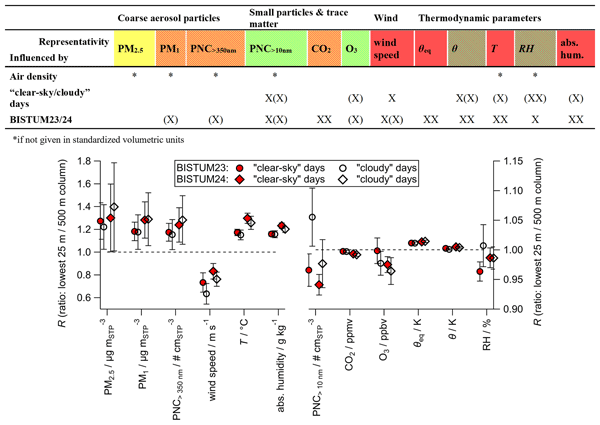
- P20/L509: the underestimation of O3 is much larger than 5% shown in Figure 6, and the statement here is inconsistent with the statement in P23/L613. Am I missing anything?
- Section 4.4: the first point of the recommendation is about estimation of PBLH, which makes this section not just about the representativity of ground-based measurements. Better to merge it into Section 5.
- Figure 2: should the schematic sketch of dPNC/dz vs. ln(z) (panel a) have a positive slope as what is shown in cloudy days (blue) data points in panel c?
- Figures 4 and 5: the legend labeling is a bit misleading. Should it be (closed blue circle): “cloudy” days for 0 – 500 m, (open blue circle): “cloudy” days for 0 m to PBLH, (closed red circle): “clear-sky” days for 0 – 500 m, and (open red circle): “clear-sky” days for 0 m to PBLH?
- Figure 6: better to rearrange parameters in the x axis according to the discussion, i.e., air pollutants first, and then meteorological parameters, as two clearly separated categories.
- P8/L242: a typo for PBLH.
- P13/L352: “permanent” to “static”?
- P14/L384: “stronger” to “more strongly”.
Citation: https://doi.org/10.5194/egusphere-2026-2494-RC2 - AC1: 'Reply on RC2', Lasse Moormann, 25 Sep 2026
Peer review completion
Journal article(s) based on this preprint
Viewed
| HTML | XML | Total | Supplement | BibTeX | EndNote | |
|---|---|---|---|---|---|---|
| 149 | 114 | 57 | 320 | 57 | 55 | 43 |
- HTML: 149
- PDF: 114
- XML: 57
- Total: 320
- Supplement: 57
- BibTeX: 55
- EndNote: 43
Viewed (geographical distribution)
| Country | # | Views | % |
|---|
| Total: | 0 |
| HTML: | 0 |
| PDF: | 0 |
| XML: | 0 |
- 1
Lasse Moormann
Friederike Fachinger
Holger Tost
Frank Drewnick

The requested preprint has a corresponding peer-reviewed final revised paper. You are encouraged to refer to the final revised version.
- Preprint
(1328 KB) - Metadata XML
-
Supplement
(1533 KB) - BibTeX
- EndNote
- Final revised paper
This study (egusphere-2026-2494) investigates how irradiance and mixing layer height (MLH) affect the vertical distribution of trace substances in rural areas of Germany, using data from two summer drone measurement campaigns conducted up to 500 m above ground, along with data from ground-based stations. The findings suggest that irradiance is the primary factor influencing diurnal mixing mechanisms. Furthermore, the research highlights that ground-based measurements do not always accurately represent the conditions throughout the entire mixed layer. However, several concerns need to be addressed.
Thermal PBL height defined by static stability, e.g., potential-temperature or virtual-potential-temperature gradients/parcel method.
Dynamic PBL height defined by dynamic stability, e.g., bulk Richardson number or wind-shear criteria
Material PBL height, defined by the vertical distribution of atmospheric constituents, e.g., aerosol or trace gas gradients.
The three heights mentioned are not interchangeable; they correspond to distinct physical processes and often differ, particularly when there is weak dynamical forcing or when residual-layer chemistry and surface sources or sinks are present. The current manuscript fails to adequately recognize or discuss this important distinction. The authors should explicitly define and consistently distinguish thermal, dynamic, and material boundary-layer heights throughout the text, figures, and captions. The authors should also clarify why differences among the three methods are inevitable, focusing on the physical mechanisms involved instead of suggesting that one of the measured MLH values is a more accurate or comprehensive representation of MLH.
References
Tan, Y., Xin, J., Qin, X., Ma, Y., Xu, J., Du, Y., Shang, C., Zhao, L., Tian, Y., Fan, Q., Zhou, X., Ren, Y., Wang, P., Hao, F., Yin, N., Ren, X., Peng, K., Jia, D., Pan, X., Li, J., Wang, Z., and Butt, A. Q.: Differences Among Thermal, Dynamic, and Material Boundary Layers Over Complex Terrain, J. Geophys. Res., 130, e2024JD043043, doi: https://doi.org/10.1029/2024JD043043, 2025.