
the Creative Commons Attribution 4.0 License.
the Creative Commons Attribution 4.0 License.
 | 08 May 2026
Long-Term Open-Path Dual-Comb Spectroscopy for Urban CO2 Monitoring
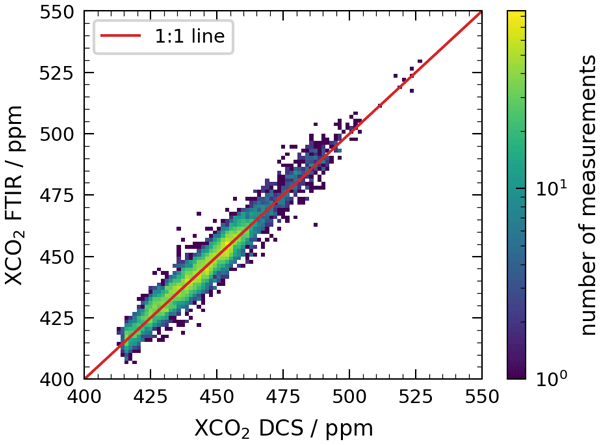
Abstract. Accurate quantification of urban greenhouse gas (GHG) emissions can benefit from path-averaged, high-precision, high-temporal-resolution measurements that complement point sensors and passive remote sensing. Among open-path techniques, dual-comb spectroscopy (DCS) stands out as a particularly capable candidate, offering simultaneous broadband coverage, an absolute SI-traceable frequency axis, and sufficient spectral radiance for multi-kilometer paths. Here we present an open-path dual-comb spectrometer using two commercial, self-referenced, turn-key frequency combs operated continuously in Heidelberg, Germany, over an urban landscape. The instrument allows to infer column-averaged dry-air mole fractions of CO2 along a 3.1 km absorption path. During routine observations within the evaluation period from September 2025 to February 2026 the system achieved a data coverage of 85 %, with losses primarily attributable to visibility-limiting weather conditions such as fog and heavy rain. The instrument precision, characterized by the overlapping Allan deviation under stable atmospheric conditions, reaches 4.79 ppm √s for CO2, equivalent to 0.28 ppm at five minutes averaging time. These values are on par with or better than previous open-path DCS experiments and represent roughly one order of magnitude improvement over a co-deployed open-path Fourier transform spectrometer operating on the same path. The two instruments differ by a small bias of 0.16 ppm for CO2. The results demonstrate that high-quality, long-term open-path DCS operation is achievable with readily available hardware, making the technique accessible to the broader atmospheric science community for applications ranging from urban-flux monitoring and network-scale observations to the validation of spectroscopic databases.
Competing interests: At least one of the (co-)authors is a member of the editorial board of Atmospheric Measurement Techniques.
Publisher's note: Copernicus Publications remains neutral with regard to jurisdictional claims made in the text, published maps, institutional affiliations, or any other geographical representation in this paper. While Copernicus Publications makes every effort to include appropriate place names, the final responsibility lies with the authors. Views expressed in the text are those of the authors and do not necessarily reflect the views of the publisher.-
Notice on discussion status
The requested preprint has a corresponding peer-reviewed final revised paper. You are encouraged to refer to the final revised version.
-
Preprint
(1182 KB)
-
The requested preprint has a corresponding peer-reviewed final revised paper. You are encouraged to refer to the final revised version.
- Preprint
(1182 KB) - Metadata XML
- BibTeX
- EndNote
- Final revised paper


Journal article(s) based on this preprint
Interactive discussion
Status: closed
-
RC1: 'Comment on egusphere-2026-2428', Anonymous Referee #1, 02 Jun 2026
- AC1: 'Reply on RC1', Tobias D. Schmitt, 24 Aug 2026
-
RC2: 'Comment on egusphere-2026-2428', Anonymous Referee #2, 09 Jun 2026
This paper presents an open-path dual-comb spectroscopy system based on commercial frequency combs. The system was deployed to measure CO2 (and CH4) across a 3.1 km round trip path in Heidelberg. The system was operated for 6 months with high uptime. The sensitivity of the system is comparable to or better than previous demonstrations. A particularly interesting/novel aspect of the study is the direct comparison to a co-located open-path FTS running over the same path. The paper shows a remarkably good agreement between between the DCS and the FTS, with the DCS providing an order of maginitude better sensitivity. Overall, the paper is well written and suitable for publication in AMT. I do have some minor comments/corrections:
- The Mead et al ref used mid-infrared DCS and detected ethane and propane as well as methane. As such, the citation location is not completely appropriate. It would be better to either cite after Giorgetta 2021 (line 59) or at the end of the oil and gas section as an extension to the mid-infrared.
- What dfr was used? Are the combs locked to have an integer number of points per interferogram?
- What is the transmitted beam diameter? Is it a collimated beam? I could not tell from Fig 2.
- Did you use any active transceiver alignment feedback? Is the transceiver located outside or in a building?
- Did you try a single retroreflector instead of an array? If so, how different was the return power? Do you see any issues in the interferogram or measured spectrum due to the multiple reflectors?
- What are the integrated phase noise numbers on the comb locks?
- When co-adding the interferograms, do you do a phase correction between interferograms? If so, could you provide more information about how this is done? Is it a single phase per interferogram, or a phase and timing correction (e.g., phase and spectral phase slope)? Related to question 2, are the interferograms resampled, or are there already an integer number of points per interferogram?
- For the spectral retrievals, was the FTS data fit with the same spectral parameters?
- I was a bit confused about the uptime numbers. The abstract lists an 85% uptime; however, later a number of 76% is also given. What is the difference between these two numbers?
Citation: https://doi.org/10.5194/egusphere-2026-2428-RC2 - AC2: 'Reply on RC2', Tobias D. Schmitt, 24 Aug 2026
-
RC3: 'Comment on egusphere-2026-2428', Anonymous Referee #3, 17 Jun 2026
General Comments:
The authors report details of a measurement with a DCS system used for sensing greenhouse gases in an urban area. They show that DCS can achieve an order of magnitude better precision for CO2 path-averaged concentration than open-path FTIR at the same location. The application of a turnkey DCS system for precise atmospheric measurements of urban greenhouse gases will be of interest to the EGU community. The article is well-organized, concise, and easy to follow. I recommend the article for publication with only a few minor revisions.
Specific Comments:
- Line 69: The authors cite Eber et al. 2024 as performing “open-path DCS sensing in the ultra-violet”. However, Eber et al. report a DCS measurement from 514 nm to 520 nm, which is in the visible region of the electromagnetic spectrum. This should be corrected.
- Line 135: It would be helpful if the authors would give an example from the literature of real-time averaging at the hardware level.
- Line 211: The authors note that their system achieves CO2 precision better than all compared studies other than Waxman et al. (2019). However, from figure 8, the actual allan deviation appears to be worse than Malarich et al. (2025) at 1-hour averaging time. As the authors mention, drift in atmospheric composition drives larger allan deviations beyond 400s, which is why they extrapolate a fit for the first seven points. Since Malarich et al. (2025) was performed at Mauna Loa Observatory, far from sources and sinks, whereas this work was performed in an urban environment, it is reasonable to expect Malarich et al. (2025) to show lower allan deviations at longer averaging times, even if the systems perform similarly. This different measurement context should be made explicit for the reader who may not be familiar with the work of Malarich et al. (2025).
- I would like to know whether there is potential for gains in precision with the FTIR system by improving the duty cycle, as is possible with the DCS. Additionally, from looking at figure 5, I am curious about the extent of temporal coverage with the FTIR system and how this compares to the DCS system. Please report the duty cycle of the co-located FTIR instrument and the fractional coverage of 5-minute bins by FTIR.
Citation: https://doi.org/10.5194/egusphere-2026-2428-RC3 - AC3: 'Reply on RC3', Tobias D. Schmitt, 24 Aug 2026
Peer review completion
Post-review adjustments


Interactive discussion
Status: closed
-
RC1: 'Comment on egusphere-2026-2428', Anonymous Referee #1, 02 Jun 2026
- AC1: 'Reply on RC1', Tobias D. Schmitt, 24 Aug 2026
-
RC2: 'Comment on egusphere-2026-2428', Anonymous Referee #2, 09 Jun 2026
This paper presents an open-path dual-comb spectroscopy system based on commercial frequency combs. The system was deployed to measure CO2 (and CH4) across a 3.1 km round trip path in Heidelberg. The system was operated for 6 months with high uptime. The sensitivity of the system is comparable to or better than previous demonstrations. A particularly interesting/novel aspect of the study is the direct comparison to a co-located open-path FTS running over the same path. The paper shows a remarkably good agreement between between the DCS and the FTS, with the DCS providing an order of maginitude better sensitivity. Overall, the paper is well written and suitable for publication in AMT. I do have some minor comments/corrections:
- The Mead et al ref used mid-infrared DCS and detected ethane and propane as well as methane. As such, the citation location is not completely appropriate. It would be better to either cite after Giorgetta 2021 (line 59) or at the end of the oil and gas section as an extension to the mid-infrared.
- What dfr was used? Are the combs locked to have an integer number of points per interferogram?
- What is the transmitted beam diameter? Is it a collimated beam? I could not tell from Fig 2.
- Did you use any active transceiver alignment feedback? Is the transceiver located outside or in a building?
- Did you try a single retroreflector instead of an array? If so, how different was the return power? Do you see any issues in the interferogram or measured spectrum due to the multiple reflectors?
- What are the integrated phase noise numbers on the comb locks?
- When co-adding the interferograms, do you do a phase correction between interferograms? If so, could you provide more information about how this is done? Is it a single phase per interferogram, or a phase and timing correction (e.g., phase and spectral phase slope)? Related to question 2, are the interferograms resampled, or are there already an integer number of points per interferogram?
- For the spectral retrievals, was the FTS data fit with the same spectral parameters?
- I was a bit confused about the uptime numbers. The abstract lists an 85% uptime; however, later a number of 76% is also given. What is the difference between these two numbers?
Citation: https://doi.org/10.5194/egusphere-2026-2428-RC2 - AC2: 'Reply on RC2', Tobias D. Schmitt, 24 Aug 2026
-
RC3: 'Comment on egusphere-2026-2428', Anonymous Referee #3, 17 Jun 2026
General Comments:
The authors report details of a measurement with a DCS system used for sensing greenhouse gases in an urban area. They show that DCS can achieve an order of magnitude better precision for CO2 path-averaged concentration than open-path FTIR at the same location. The application of a turnkey DCS system for precise atmospheric measurements of urban greenhouse gases will be of interest to the EGU community. The article is well-organized, concise, and easy to follow. I recommend the article for publication with only a few minor revisions.
Specific Comments:
- Line 69: The authors cite Eber et al. 2024 as performing “open-path DCS sensing in the ultra-violet”. However, Eber et al. report a DCS measurement from 514 nm to 520 nm, which is in the visible region of the electromagnetic spectrum. This should be corrected.
- Line 135: It would be helpful if the authors would give an example from the literature of real-time averaging at the hardware level.
- Line 211: The authors note that their system achieves CO2 precision better than all compared studies other than Waxman et al. (2019). However, from figure 8, the actual allan deviation appears to be worse than Malarich et al. (2025) at 1-hour averaging time. As the authors mention, drift in atmospheric composition drives larger allan deviations beyond 400s, which is why they extrapolate a fit for the first seven points. Since Malarich et al. (2025) was performed at Mauna Loa Observatory, far from sources and sinks, whereas this work was performed in an urban environment, it is reasonable to expect Malarich et al. (2025) to show lower allan deviations at longer averaging times, even if the systems perform similarly. This different measurement context should be made explicit for the reader who may not be familiar with the work of Malarich et al. (2025).
- I would like to know whether there is potential for gains in precision with the FTIR system by improving the duty cycle, as is possible with the DCS. Additionally, from looking at figure 5, I am curious about the extent of temporal coverage with the FTIR system and how this compares to the DCS system. Please report the duty cycle of the co-located FTIR instrument and the fractional coverage of 5-minute bins by FTIR.
Citation: https://doi.org/10.5194/egusphere-2026-2428-RC3 - AC3: 'Reply on RC3', Tobias D. Schmitt, 24 Aug 2026
Peer review completion
Post-review adjustments
Journal article(s) based on this preprint
Viewed
| HTML | XML | Total | BibTeX | EndNote | |
|---|---|---|---|---|---|
| 394 | 135 | 42 | 571 | 37 | 42 |
- HTML: 394
- PDF: 135
- XML: 42
- Total: 571
- BibTeX: 37
- EndNote: 42
Viewed (geographical distribution)
| Country | # | Views | % |
|---|
| Total: | 0 |
| HTML: | 0 |
| PDF: | 0 |
| XML: | 0 |
- 1
Tobias D. Schmitt

Romain Dubroeucq
Moritz Sindram
André Butz
Thomas Pfeifer
Markus K. Oberthaler
The requested preprint has a corresponding peer-reviewed final revised paper. You are encouraged to refer to the final revised version.
- Preprint
(1182 KB) - Metadata XML
Please find my comments attached.