
the Creative Commons Attribution 4.0 License.
the Creative Commons Attribution 4.0 License.
 | 30 Apr 2026
Depolarization ratio of smoke and volcanic ash aerosol particles at 1565 nm using a HALO Doppler lidar
Abstract. Particle linear depolarization ratio is a widely used parameter in lidar research to distinguish different aerosol types and the thermodynamic phase of water. It is most frequently measured at ultraviolet and visible wavelengths (355 and 532 nm), yet multi-wavelength observations suggest that this parameter can vary substantially with wavelength. In this work, we assessed particle linear depolarization ratios at 1565 nm using Halo Photonics StreamLine Doppler lidars. We examined the depolarization ratio through three case studies featuring extremely fresh and aged smoke, and volcanic ash aerosol particles in the troposphere. Both fresh and aged smoke aerosol particles induced low values. Specifically, aerosol layers dominated by extremely fresh smoke showed a depolarization ratio of 0.017 ± 0.004, whereas aged long-range transported smoke par ticles exhibited marginally higher values. Volcanic aerosol layers induced high depolarization ratios with layer mean values of 0.45 ± 0.01. For the extremely fresh smoke case, we further estimated the smoke mass concentration using the lidar observations at 1565 nm and found good agreement with the in situ observations. These results demonstrate that Halo Doppler lidars operating at 1565 nm wavelength are capable of distinguishing several key aerosol types and can therefore assist in the characterization of atmospheric aerosols.
Competing interests: At least one of the (co-)authors is a member of the editorial board of Atmospheric Chemistry and Physics. The peer-review process was guided by an independent editor, and the authors also have no other competing interests to declare.
Publisher's note: Copernicus Publications remains neutral with regard to jurisdictional claims made in the text, published maps, institutional affiliations, or any other geographical representation in this paper. While Copernicus Publications makes every effort to include appropriate place names, the final responsibility lies with the authors. Views expressed in the text are those of the authors and do not necessarily reflect the views of the publisher.-
Notice on discussion status
The requested preprint has a corresponding peer-reviewed final revised paper. You are encouraged to refer to the final revised version.
-
Preprint
(21795 KB)
-
The requested preprint has a corresponding peer-reviewed final revised paper. You are encouraged to refer to the final revised version.
- Preprint
(21795 KB) - Metadata XML
- BibTeX
- EndNote
- Final revised paper


Journal article(s) based on this preprint
Interactive discussion
Status: closed
-
RC1: 'Comment on egusphere-2026-2421', Anonymous Referee #1, 26 May 2026
- AC1: 'Reply on RC1', Maria Filioglou, 29 Jul 2026
-
RC2: 'Comment on egusphere-2026-2421', Anonymous Referee #2, 23 Jun 2026
The manuscript by Filioglou and co-authors reports depolarization ratios at 1565 nm for very fresh and long-range transported smoke plumes. Additionally, they report observations from a southern hemispheric volcanic ash plume. Previously, such values were reported at 355 and 532 nm and rarely at 1064 nm. Therefore, the measurements at 1565 nm add novel information. Ideally, this information would have been accompanied with simultaneous observations at shorter wavelengths to derive the spectral behavior for the same event. However, it is understandable that in such close proximity to the active fires not every lidar can be operated. Also in South Africa, it is not easy to operate a standard polarization lidar. The manuscript is clearly written and could be published after addressing minor revisions.
Minor Comments
- L43-47: The statements about the spectral depolarization ratio are not correct. Looking at Freudenthaler et al., 2009, lower values at 1064 nm were reported compared to the values at 532 nm. Also, Haarig et al., 2022, reported lower values at 1064 nm compared to 532 nm. And Vakkari et al., 2021, reported for one case study higher values at 1565 nm (Saharan dust) and for another (dust from Egypt) lower values at the longer wavelength.
- L110-112: New conversion factors were reported recently in Ansmann et al., AMT 2026, now also at 355, 910 and 1064 nm, but not at 1565 nm. Nevertheless, the value at 532 nm remained unchanged to the one used here.
- About the fresh smoke plume, might saturation or overlap effects affect the results?
- L266-268: Please repeat the literature values for fresh smoke here, so that the reader has not search in the indicated papers (De Rosa et al., 2025).
- L306-308: The weighted average is a good way to cope the noisier signals at lower backscatter coefficients. Please provide a little more detail on how you did the weighted mean of the depolarization ratio.
- L360: I would not use the term near-spherical, because it is used to describe highly depolarizing particles with close to spherical shape as discussed in Bi et al., Optics Express, 2018. Better use “almost spherical” or something similar.
- Sect 3.4: I see that the depolarization ratio at 1565 nm is a good indicator for large non-spherical particles. Besides the non-sphericity, I would emphasize the size effect, because at longer wavelengths the sensitivity to the larger particles is stronger. All particles with an enhanced depolarization ratio at 1565 nm listed in Tab. 1 are usually large particles (dust, pollen, volcanic ash). It has been shown for stratospheric smoke particles, that the size matters and that a small particle even if it is non-spherical in shape might show a low depolarization ratio at longer wavelengths.
- L385-386: In general, the measurement of the depolarization ratio improves the aerosol classification. It is not so specific for your new observations. However, I would see the benefit of the HALO depolarization ratio, if it is deployed additionally to a classical single or dual wavelength polarization lidar. Together with my previous comment, it might provide important size information, e.g., for pollen or smoke particles.
- Appendix: To my opinion, the appendix is not necessary. The 1-hour resolution plots do not add significant new information to the already shown 15-min resolution plots. Furthermore, Fig. 10 might be more focused on the plume without the so long observations before and after. I leave the decision to the authors.
Technical Corrections
- Please keep a unique date format, e.g., 6 June 2024, also in the figures (e.g., Fig. 2, 5, 6 …).
- Fig 5: The symbol for the SMPS-OPC measurements is missing in the legend, where just the black line is provided.
Citation: https://doi.org/10.5194/egusphere-2026-2421-RC2 - AC2: 'Reply on RC2', Maria Filioglou, 29 Jul 2026
-
RC3: 'Comment on egusphere-2026-2421', Anonymous Referee #3, 15 Jul 2026
The paper by Filioglou presents studies of the depolarization ratio of smoke (fresh and long-range transported) and volcanic ash at 1565 nm. Adding measurements of the depolarization ratio at a longer wavelength is in general of high interest and importance. The paper is well written and has a clear structure. This is way I recommend publication after addressing this general comment:
Giving the significance depolarization measurements at a longer wavelength can have, the authors should add some more details on the system specification and the data processing should be given. The authors refer to former publications on that, but a minimum of information should at least been given here. Furthermore, it would be good to get at least a rugh error estimation.Citation: https://doi.org/10.5194/egusphere-2026-2421-RC3 - AC3: 'Reply on RC3', Maria Filioglou, 29 Jul 2026
Peer review completion


Interactive discussion
Status: closed
-
RC1: 'Comment on egusphere-2026-2421', Anonymous Referee #1, 26 May 2026
Review for manuscript “Depolarization ratio of smoke and volcanic ash aerosol particles at 1565 nm using a HALO Doppler lidar” by M. Filioglou et al.
The manuscript presents an investigation into the particle linear depolarization ratio at 1565 nm for key aerosol types, namely extremely fresh smoke, aged smoke, and volcanic ash using Halo Doppler lidars. Three distinct case studies were conducted in Finland and South Africa, making possible to understand of how these particles behave at longer infrared wavelengths, where systematic observations have historically been scarce. Additionally, by using a combination of ancillary in situ instrumentation and modeling tools (including ground- and drone-based sensors, Mie scattering calculations, and air mass trajectory simulations) the authors provide a validation of their findings.
Providing new observational values at 1565 nm is a significant contribution to the field, especially given that depolarization research has traditionally focused on UV and visible spectra. The application of a consistent methodology across diverse environments and aerosol types provides a robust framework for investigating spectral dependence. Furthermore, the inclusion of a detailed review of existing linear particle depolarization values at this specific wavelength serves as a very useful reference for the community.
Given the scientific level of the work and its clear relevance to atmospheric aerosol characterization, I recommend the paper be accepted for publication after addressing some minor revisions to improve the work clarity:
-Line 21: “the ratio of cross- to co-polarized signal” is a poor definition of particle linear depolarization ratio, referred to the backscattered radiation. Please be more precise.
-The sentence in lines 48-50 (“They also found that …”) may seem confusing, suggesting that δ increases with the total aerosol concentration. Do you actually mean that δ depends on the large-particle concentration and its relative contribution to the aerosol mixture? If so, please clarify.
-Lines 55-64: this paragraph could be better structured (e.g. last sentence justifying one advantage of using 1565 nm), could you try to re-organize the main ideas?
-Lines 90-94: although the technical papers containing the main details of the methodology for calibrating and obtaining depolarization from Halo Doppler lidars are conveniently cited in the paper, some general ideas should also be included in the present manuscript for a better understanding. For example, a general definition of the bleed-through parameter and obtained values.
-Lines 100-101: “Similar assumption…” should be re-written to clarify the idea. What do you mean with “which represents the particle backscatter coefficient”? Is it equivalent? Proportional? Under which conditions?
-Line 141: what do you mean with “default” mass absorption cross-section? Please clarify and include a reference from where the value has been taken.
-Line 145: are there any references for the mentioned software tools?
-Line 147: when authors write “all in situ aerosol observations”, they mean the previous optical properties described, but in the next paragraph pollen concentration (which are also a type of in situ aerosol observations) is described. Please specify if you refer only to the previously mentioned ones.
-Line 150: what is the time resolution for pollen concentration measurements?
-Line 183: it would be helpful to briefly define the “potential emission sensitivity” and their units [s^-1 according to Figures 8 and 11, even if you cited the original paper describing this model.
-Authors refer to Vakkari et al. (2021) as the methodology used for deriving particle backscatter coefficient and linear depolarization ratio from Doppler lidar measurements. In that paper, there is also a description of the uncertainty estimation for the depolarization ratio. In the current manuscript, that uncertainty is used e.g. in Figures 9 and 12 as color scale, so you should mention about its calculation in the methodology section. Additionally, there seems to be a filter applied in Figures 2, 6 and 10 to discard noisy values (appearing as white pixels in the plot), is this filter related with the depolarization uncertainty, with the SNR level or something else? Please include it explicitly.
-How do you define the boundaries of the layer of interest in each case? This should be explained in the methodology section.
-Lines 221-232: The idea of this paragraph is more or less understandable, but I think it should be re-written for better structure and clarity. For example, lines 221-222 seems unconnected with the rest, and the rest of the sentences seem connected to the idea that the higher values of linear particle depolarization ration are due to mixing with pollen, but the main ideas should be clearly stated and then explained with the mentioned observations.
-Lines 252-265: here it is also a trend for a bit unstructured writing, so I also propose to re-write so that the main idea is highlighted and then the explanation is elaborated with the values, uncertainties and literature mentioned.
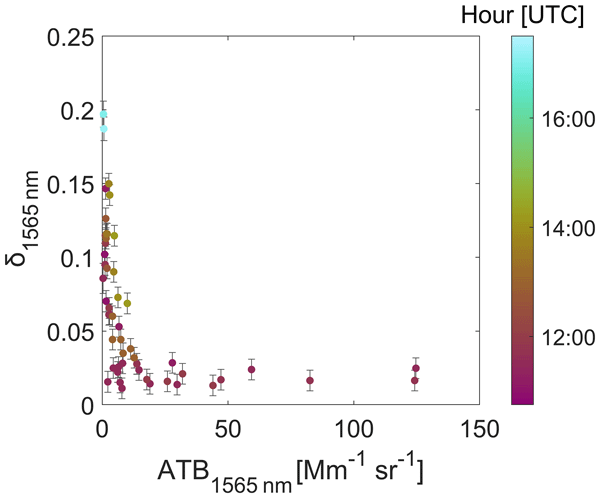
-Section 3.2: In the previous case, the explanation of higher beta related to lower depolarization was that higher fresh smoke concentration was present in the boundary layer mix, making the total depolarization ratio lower. How do you explain that relationship in this second, free-tropospheric case? In any case, I don't think there is a clear trend like this in Figure 9, but probably the higher the uncertainty, the more scattered are the values, but the general trend is a constant depolarization with respect to beta.
-Line 307: it would be appropriate to explicitly indicate how were backscatter coefficient and depolarization ratio uncertainties accounted in the weighted average.
-Line 321: “The feature between 2.5 and 3.5 km” should be more concrete, e.g., “the increase of backscatter coefficient in a particular region…” or something similar. The same when you describe the observation of the layers in the previous cases.
-Section 3.3: the attribution of the detected layer as ash originating from the Copahue Volcano is reasonably justified with the calculated air trajectories and the already studied information about emission and propagation of the ashes by Paez et al. (2021). However, in light of the trajectories in Figure 11, would it be possible the presence of other highly depolarizing aerosol type?
-Table 1: due to the useful intention of including this table as a review of different observations of linear particle depolarization ratio at 1565 nm, you could also include the pollen values in Vakkari et al. (2021) or other types in Le et al., (2024).
Other corrections or typos:
-Line 49: “depended” should be “dependent”
-Line 105: the first “alpha” should also have the lambda dependence indicated in brackets.
-Lines 111, 243, 248: please check notation for the cv numeric value (it should be 10^-12 and not e^-12)
-Line 208: “realized” should be “was carried out” or “was conducted” (or similar), and maybe the word “events” could be better replaced with “stages” or “phases”.
-Figures (2, 6, 10, A1, A2) including backscatter coefficient present logarithmic color scale, if I am not wrong. Please indicate it if it is like that.
-Line 214 and others: “seen by the lidar” may seem a bit colloquial for this context, please consider using more technical or accurate verbs as “recorded”, “measured” or “detected”.
-Line 217: “black filled” should be “red filled”
Citation: https://doi.org/10.5194/egusphere-2026-2421-RC1 - AC1: 'Reply on RC1', Maria Filioglou, 29 Jul 2026
-
RC2: 'Comment on egusphere-2026-2421', Anonymous Referee #2, 23 Jun 2026
The manuscript by Filioglou and co-authors reports depolarization ratios at 1565 nm for very fresh and long-range transported smoke plumes. Additionally, they report observations from a southern hemispheric volcanic ash plume. Previously, such values were reported at 355 and 532 nm and rarely at 1064 nm. Therefore, the measurements at 1565 nm add novel information. Ideally, this information would have been accompanied with simultaneous observations at shorter wavelengths to derive the spectral behavior for the same event. However, it is understandable that in such close proximity to the active fires not every lidar can be operated. Also in South Africa, it is not easy to operate a standard polarization lidar. The manuscript is clearly written and could be published after addressing minor revisions.
Minor Comments
- L43-47: The statements about the spectral depolarization ratio are not correct. Looking at Freudenthaler et al., 2009, lower values at 1064 nm were reported compared to the values at 532 nm. Also, Haarig et al., 2022, reported lower values at 1064 nm compared to 532 nm. And Vakkari et al., 2021, reported for one case study higher values at 1565 nm (Saharan dust) and for another (dust from Egypt) lower values at the longer wavelength.
- L110-112: New conversion factors were reported recently in Ansmann et al., AMT 2026, now also at 355, 910 and 1064 nm, but not at 1565 nm. Nevertheless, the value at 532 nm remained unchanged to the one used here.
- About the fresh smoke plume, might saturation or overlap effects affect the results?
- L266-268: Please repeat the literature values for fresh smoke here, so that the reader has not search in the indicated papers (De Rosa et al., 2025).
- L306-308: The weighted average is a good way to cope the noisier signals at lower backscatter coefficients. Please provide a little more detail on how you did the weighted mean of the depolarization ratio.
- L360: I would not use the term near-spherical, because it is used to describe highly depolarizing particles with close to spherical shape as discussed in Bi et al., Optics Express, 2018. Better use “almost spherical” or something similar.
- Sect 3.4: I see that the depolarization ratio at 1565 nm is a good indicator for large non-spherical particles. Besides the non-sphericity, I would emphasize the size effect, because at longer wavelengths the sensitivity to the larger particles is stronger. All particles with an enhanced depolarization ratio at 1565 nm listed in Tab. 1 are usually large particles (dust, pollen, volcanic ash). It has been shown for stratospheric smoke particles, that the size matters and that a small particle even if it is non-spherical in shape might show a low depolarization ratio at longer wavelengths.
- L385-386: In general, the measurement of the depolarization ratio improves the aerosol classification. It is not so specific for your new observations. However, I would see the benefit of the HALO depolarization ratio, if it is deployed additionally to a classical single or dual wavelength polarization lidar. Together with my previous comment, it might provide important size information, e.g., for pollen or smoke particles.
- Appendix: To my opinion, the appendix is not necessary. The 1-hour resolution plots do not add significant new information to the already shown 15-min resolution plots. Furthermore, Fig. 10 might be more focused on the plume without the so long observations before and after. I leave the decision to the authors.
Technical Corrections
- Please keep a unique date format, e.g., 6 June 2024, also in the figures (e.g., Fig. 2, 5, 6 …).
- Fig 5: The symbol for the SMPS-OPC measurements is missing in the legend, where just the black line is provided.
Citation: https://doi.org/10.5194/egusphere-2026-2421-RC2 - AC2: 'Reply on RC2', Maria Filioglou, 29 Jul 2026
-
RC3: 'Comment on egusphere-2026-2421', Anonymous Referee #3, 15 Jul 2026
The paper by Filioglou presents studies of the depolarization ratio of smoke (fresh and long-range transported) and volcanic ash at 1565 nm. Adding measurements of the depolarization ratio at a longer wavelength is in general of high interest and importance. The paper is well written and has a clear structure. This is way I recommend publication after addressing this general comment:
Giving the significance depolarization measurements at a longer wavelength can have, the authors should add some more details on the system specification and the data processing should be given. The authors refer to former publications on that, but a minimum of information should at least been given here. Furthermore, it would be good to get at least a rugh error estimation.Citation: https://doi.org/10.5194/egusphere-2026-2421-RC3 - AC3: 'Reply on RC3', Maria Filioglou, 29 Jul 2026
Peer review completion
Journal article(s) based on this preprint
Viewed
| HTML | XML | Total | BibTeX | EndNote | |
|---|---|---|---|---|---|
| 479 | 170 | 54 | 703 | 56 | 59 |
- HTML: 479
- PDF: 170
- XML: 54
- Total: 703
- BibTeX: 56
- EndNote: 59
Viewed (geographical distribution)
| Country | # | Views | % |
|---|
| Total: | 0 |
| HTML: | 0 |
| PDF: | 0 |
| XML: | 0 |
- 1

Krista Luoma
Eija Asmi
Klaus Haikarainen
David Brus
Tero Mielonen
Mika Komppula
Annele Virtanen
Olli Sippula
Iida Pullinen
Angela Buchholz
Pasi Miettinen
Snehitha Kommula
Saara Peltokorpi
Liqing Hao
Kajar Köster
Annika Saarto
Sanna Pätsi
Pieter G. van Zyl
Liezl Bredenkamp
Ville Vakkari
The requested preprint has a corresponding peer-reviewed final revised paper. You are encouraged to refer to the final revised version.
- Preprint
(21795 KB) - Metadata XML
Review for manuscript “Depolarization ratio of smoke and volcanic ash aerosol particles at 1565 nm using a HALO Doppler lidar” by M. Filioglou et al.
The manuscript presents an investigation into the particle linear depolarization ratio at 1565 nm for key aerosol types, namely extremely fresh smoke, aged smoke, and volcanic ash using Halo Doppler lidars. Three distinct case studies were conducted in Finland and South Africa, making possible to understand of how these particles behave at longer infrared wavelengths, where systematic observations have historically been scarce. Additionally, by using a combination of ancillary in situ instrumentation and modeling tools (including ground- and drone-based sensors, Mie scattering calculations, and air mass trajectory simulations) the authors provide a validation of their findings.
Providing new observational values at 1565 nm is a significant contribution to the field, especially given that depolarization research has traditionally focused on UV and visible spectra. The application of a consistent methodology across diverse environments and aerosol types provides a robust framework for investigating spectral dependence. Furthermore, the inclusion of a detailed review of existing linear particle depolarization values at this specific wavelength serves as a very useful reference for the community.
Given the scientific level of the work and its clear relevance to atmospheric aerosol characterization, I recommend the paper be accepted for publication after addressing some minor revisions to improve the work clarity:
-Line 21: “the ratio of cross- to co-polarized signal” is a poor definition of particle linear depolarization ratio, referred to the backscattered radiation. Please be more precise.
-The sentence in lines 48-50 (“They also found that …”) may seem confusing, suggesting that δ increases with the total aerosol concentration. Do you actually mean that δ depends on the large-particle concentration and its relative contribution to the aerosol mixture? If so, please clarify.
-Lines 55-64: this paragraph could be better structured (e.g. last sentence justifying one advantage of using 1565 nm), could you try to re-organize the main ideas?
-Lines 90-94: although the technical papers containing the main details of the methodology for calibrating and obtaining depolarization from Halo Doppler lidars are conveniently cited in the paper, some general ideas should also be included in the present manuscript for a better understanding. For example, a general definition of the bleed-through parameter and obtained values.
-Lines 100-101: “Similar assumption…” should be re-written to clarify the idea. What do you mean with “which represents the particle backscatter coefficient”? Is it equivalent? Proportional? Under which conditions?
-Line 141: what do you mean with “default” mass absorption cross-section? Please clarify and include a reference from where the value has been taken.
-Line 145: are there any references for the mentioned software tools?
-Line 147: when authors write “all in situ aerosol observations”, they mean the previous optical properties described, but in the next paragraph pollen concentration (which are also a type of in situ aerosol observations) is described. Please specify if you refer only to the previously mentioned ones.
-Line 150: what is the time resolution for pollen concentration measurements?
-Line 183: it would be helpful to briefly define the “potential emission sensitivity” and their units [s^-1 according to Figures 8 and 11, even if you cited the original paper describing this model.
-Authors refer to Vakkari et al. (2021) as the methodology used for deriving particle backscatter coefficient and linear depolarization ratio from Doppler lidar measurements. In that paper, there is also a description of the uncertainty estimation for the depolarization ratio. In the current manuscript, that uncertainty is used e.g. in Figures 9 and 12 as color scale, so you should mention about its calculation in the methodology section. Additionally, there seems to be a filter applied in Figures 2, 6 and 10 to discard noisy values (appearing as white pixels in the plot), is this filter related with the depolarization uncertainty, with the SNR level or something else? Please include it explicitly.
-How do you define the boundaries of the layer of interest in each case? This should be explained in the methodology section.
-Lines 221-232: The idea of this paragraph is more or less understandable, but I think it should be re-written for better structure and clarity. For example, lines 221-222 seems unconnected with the rest, and the rest of the sentences seem connected to the idea that the higher values of linear particle depolarization ration are due to mixing with pollen, but the main ideas should be clearly stated and then explained with the mentioned observations.
-Lines 252-265: here it is also a trend for a bit unstructured writing, so I also propose to re-write so that the main idea is highlighted and then the explanation is elaborated with the values, uncertainties and literature mentioned.
-Section 3.2: In the previous case, the explanation of higher beta related to lower depolarization was that higher fresh smoke concentration was present in the boundary layer mix, making the total depolarization ratio lower. How do you explain that relationship in this second, free-tropospheric case? In any case, I don't think there is a clear trend like this in Figure 9, but probably the higher the uncertainty, the more scattered are the values, but the general trend is a constant depolarization with respect to beta.
-Line 307: it would be appropriate to explicitly indicate how were backscatter coefficient and depolarization ratio uncertainties accounted in the weighted average.
-Line 321: “The feature between 2.5 and 3.5 km” should be more concrete, e.g., “the increase of backscatter coefficient in a particular region…” or something similar. The same when you describe the observation of the layers in the previous cases.
-Section 3.3: the attribution of the detected layer as ash originating from the Copahue Volcano is reasonably justified with the calculated air trajectories and the already studied information about emission and propagation of the ashes by Paez et al. (2021). However, in light of the trajectories in Figure 11, would it be possible the presence of other highly depolarizing aerosol type?
-Table 1: due to the useful intention of including this table as a review of different observations of linear particle depolarization ratio at 1565 nm, you could also include the pollen values in Vakkari et al. (2021) or other types in Le et al., (2024).
Other corrections or typos:
-Line 49: “depended” should be “dependent”
-Line 105: the first “alpha” should also have the lambda dependence indicated in brackets.
-Lines 111, 243, 248: please check notation for the cv numeric value (it should be 10^-12 and not e^-12)
-Line 208: “realized” should be “was carried out” or “was conducted” (or similar), and maybe the word “events” could be better replaced with “stages” or “phases”.
-Figures (2, 6, 10, A1, A2) including backscatter coefficient present logarithmic color scale, if I am not wrong. Please indicate it if it is like that.
-Line 214 and others: “seen by the lidar” may seem a bit colloquial for this context, please consider using more technical or accurate verbs as “recorded”, “measured” or “detected”.
-Line 217: “black filled” should be “red filled”