
the Creative Commons Attribution 4.0 License.
the Creative Commons Attribution 4.0 License.
 | 22 May 2026
Sodium Lidar observed multiple sodium layer structures and their dynamical coupling mechanism
Abstract. On the night of 13 June 2013, the University of Science and Technology of China (USTC) sodium lidar observed multiple sporadic sodium layers (SSLs) and enhanced sodium patterns (ESPs) over Hefei, China (31.8°N, 117.3°E). These structures appeared at different times, collectively spanning nearly the entire night, and exhibited distinct vertical motions and horizontal propagation behaviors. Their propagation was closely linked to the background horizontal wind, indicating the role of horizontal transport. Combined observations from the nearby meteor radar and ionosonde in Wuhan (~200 miles west of Hefei) revealed that SSLs occurring before 19:30 UT are closely associated with the sporadic E (Es) layer. The evolution of the Es layer shows an overall downward propagation consistent with tidal wind variations, suggesting that tidal waves modulate ion distribution and associated sodium production. Notably, two ESP events exhibit quasi-periodic structures with periods of ~50–60 minutes, accompanied by similar oscillations in the Es layer and associated ion convergence regions. This behavior indicates that the atmospheric gravity waves may also modulate the horizontal wind, thereby influencing ion convergence, the Es layer, and sodium density. These observations provide new insights into the roles of wave-modulated horizontal winds in driving sodium-layer variability and underscore the importance of coupled neutral–ion processes in the MLT region.
-
Notice on discussion status
The requested preprint has a corresponding peer-reviewed final revised paper. You are encouraged to refer to the final revised version.
-
Preprint
(1677 KB)
-
The requested preprint has a corresponding peer-reviewed final revised paper. You are encouraged to refer to the final revised version.
- Preprint
(1677 KB) - Metadata XML
- BibTeX
- EndNote
- Final revised paper


Journal article(s) based on this preprint
Interactive discussion
Status: closed
- RC1: 'Comment on egusphere-2026-2411', Anonymous Referee #1, 01 Jun 2026
-
RC2: 'Comment on egusphere-2026-2411', Anonymous Referee #2, 30 Jun 2026
1. The authors introduce the term "enhanced sodium patterns (ESPs)" but do not provide a clear, objective criterion to distinguish ESPs from SSLs. Please provide a quantitative operational definition for ESPs
2. The propagation delays for ESPs are estimated by visually aligning phase lines, no uncertainty estimates are provided. Please provide a more objective cross-correlation analysis between the east and west beam time series, with uncertainty quantification. This is essential for the horizontal transport discussion.
3. In Section 5.2, the tidal reconstruction is useful for illustrating tidal control, but the ion convergence calculation (Figure 10) already uses lidar zonal wind. The connection between the two approaches is not clearly explained. Please clarify the added value of the tidal reconstruction and why the lidar wind is not used for the zero-wind comparison in Figure 9.
4. In discussion, the statement that GWs may induce a downward vertical phase shift of the Es layer over Hefei (Page 15) is speculative. Please provide a physical or modeling basis for this, or rephrase as a hypothesis.
Citation: https://doi.org/10.5194/egusphere-2026-2411-RC2 - AC1: 'Final author response to Referee #1 and Referee #2', Yuxia Jia, 21 Jul 2026
Peer review completion


Interactive discussion
Status: closed
-
RC1: 'Comment on egusphere-2026-2411', Anonymous Referee #1, 01 Jun 2026
This paper describes some dramatic variations of the mesospheric Na layer during a night, captured by a Na lidar. To understand the underlying mechanism, simultaneous observations from a nearby meteor wind radar and ionosonde are introduced. The results are consistent with those reported by the previous studies, and the paper is mostly clean and easy to follow. This important work demonstrates the complexity of the dynamics in the mesosphere and lower thermosphere, which is reflected by the mesospheric Na variations. While the description of the event is straight forward, some of the critical terminologies need more rigorous definition and clarification. For example, the definition of SSL is quite vague and there is no definition of ESP at all in the paper. I would like to see some rigorous quantitative definitions for these two features that discussed intensively in the paper. This will clarify the ambiguity on why the event between ~18:30 and 19:30 is not qualified as SSL but, instead, an ESP? Both have the similar thickness, except the peak Na number density of ESP is less than that of SSL. It appears the categorization is related to the comparison between the instantaneous Na profile and the background Na. However, the calculation process of this background Na profile is not described. The altitude of Es (what is h’Es?) is also not defined. The arguments on the Es being the primary source of SSL1 and SSL2, along with the role of horizontal wind, are also not convincing. The author reaches this conclusion based on “The close spatiotemporal correspondence between SSL and Es”. However, the two events are ~ 10 km apart in altitude, meaning the electron number density near the SSL could be very low, depending on the thickness of Es. There is no horizontal wind data in the Es altitudes. Thus, the zero-wind line argument is just a pure hypothesis. One potential argument regarding these two issues could be the different tracers of ionosonde and the lidar. The ionosonde measures echoes from electrons, not the Na+, which could converge at lower altitude (Kopp, 1997). None the less, I would tune down these two statements throughout the paper.
Minor technical issues:
Line 61, please define ESP
Line 75, regarding the uncertainties, are these values including both statistical and systematic uncertainties?
Line 95, “upward propagation” and the “downward propagation” used later in line 115 are referring to the feature of the atmospheric waves. The SSLs are not waves feature and, thus, these terminologies do not fit the description here. Same for the ESP description in line 139, using “downward phase propagation”.
Line 150-155, the determination of the black dashed lines in Figure 5 seem somewhat arbitrary. Please provide clarification on how they are decided or calculated.
Line 165, I am not sure including the two digits behind the decimal point, like “2.67”, is necessary. I suggest the author to ignore them, because the uncertainty is large. In addition, please use the same unit, either km/hr or m/s, to be consistent throughout the paper.
Line 170, the statement “… suggests that the Es layer served as the primary source of SSL1” seems to be too strong (see my comment above). There have been no direct evidence to support this statement.
Line 201, suggesting to replace “are less reliable” with “have large uncertainty”
Line 202-203, are these wind values at the centroid/peak altitude of SSL/ESP? Please clarify.
Line 235-237, see my comment above about the altitude difference and zero-wind line. This statement is questionable. If the Es altitude has to be down shifted by 10 km, the zero-wind line cannot occur within the Es. There could be another zero-wind line above, where the radar cannot reach. Therefore, the contribution from radar is very limited in this investigation.
Line 250-255, I understand the calculation of the overall uncertainty of the vertical ion drift based on EQ 1 can be a challenging task. However, I would appreciate the author can provide some estimation of the uncertainty of Wiz, because it is important for related discussion followed. If possible, the uncertainty can be added in Figure 9 and 10.
Line 321, suggest to replace “coupled” with “likely”
Line 328, suggest to replace “indicate” with “suggest”
Figure captions:
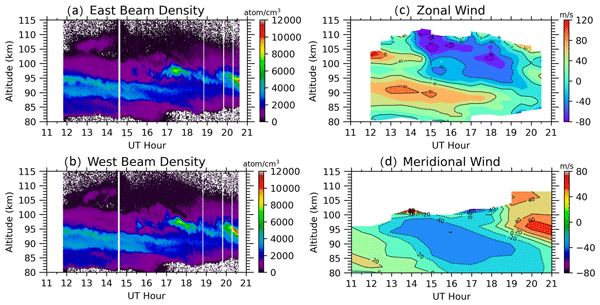
Figure 1. I think the white vertical lines are data gaps. If so, please include the related statement in the caption.
Figure 4. I think “over 95-100 km height” is referring the altitude range. Please modify.
Citation: https://doi.org/10.5194/egusphere-2026-2411-RC1 -
RC2: 'Comment on egusphere-2026-2411', Anonymous Referee #2, 30 Jun 2026
1. The authors introduce the term "enhanced sodium patterns (ESPs)" but do not provide a clear, objective criterion to distinguish ESPs from SSLs. Please provide a quantitative operational definition for ESPs
2. The propagation delays for ESPs are estimated by visually aligning phase lines, no uncertainty estimates are provided. Please provide a more objective cross-correlation analysis between the east and west beam time series, with uncertainty quantification. This is essential for the horizontal transport discussion.
3. In Section 5.2, the tidal reconstruction is useful for illustrating tidal control, but the ion convergence calculation (Figure 10) already uses lidar zonal wind. The connection between the two approaches is not clearly explained. Please clarify the added value of the tidal reconstruction and why the lidar wind is not used for the zero-wind comparison in Figure 9.
4. In discussion, the statement that GWs may induce a downward vertical phase shift of the Es layer over Hefei (Page 15) is speculative. Please provide a physical or modeling basis for this, or rephrase as a hypothesis.
Citation: https://doi.org/10.5194/egusphere-2026-2411-RC2 - AC1: 'Final author response to Referee #1 and Referee #2', Yuxia Jia, 21 Jul 2026
Peer review completion
Journal article(s) based on this preprint
Data sets
Data of "Sodium Lidar observed multiple sodium layer structures and their dynamical coupling mechanism" Jia Yuxia et al. https://doi.org/10.57760/sciencedb.34682
Viewed
| HTML | XML | Total | BibTeX | EndNote | |
|---|---|---|---|---|---|
| 267 | 106 | 48 | 421 | 38 | 33 |
- HTML: 267
- PDF: 106
- XML: 48
- Total: 421
- BibTeX: 38
- EndNote: 33
Viewed (geographical distribution)
| Country | # | Views | % |
|---|
| Total: | 0 |
| HTML: | 0 |
| PDF: | 0 |
| XML: | 0 |
- 1
Yuxia Jia
Chao Ban

Xin Fang
Zhaopeng Wu
Jianfei Wu
Weilin Pan
Chengyun Yang
The requested preprint has a corresponding peer-reviewed final revised paper. You are encouraged to refer to the final revised version.
- Preprint
(1677 KB) - Metadata XML
This paper describes some dramatic variations of the mesospheric Na layer during a night, captured by a Na lidar. To understand the underlying mechanism, simultaneous observations from a nearby meteor wind radar and ionosonde are introduced. The results are consistent with those reported by the previous studies, and the paper is mostly clean and easy to follow. This important work demonstrates the complexity of the dynamics in the mesosphere and lower thermosphere, which is reflected by the mesospheric Na variations. While the description of the event is straight forward, some of the critical terminologies need more rigorous definition and clarification. For example, the definition of SSL is quite vague and there is no definition of ESP at all in the paper. I would like to see some rigorous quantitative definitions for these two features that discussed intensively in the paper. This will clarify the ambiguity on why the event between ~18:30 and 19:30 is not qualified as SSL but, instead, an ESP? Both have the similar thickness, except the peak Na number density of ESP is less than that of SSL. It appears the categorization is related to the comparison between the instantaneous Na profile and the background Na. However, the calculation process of this background Na profile is not described. The altitude of Es (what is h’Es?) is also not defined. The arguments on the Es being the primary source of SSL1 and SSL2, along with the role of horizontal wind, are also not convincing. The author reaches this conclusion based on “The close spatiotemporal correspondence between SSL and Es”. However, the two events are ~ 10 km apart in altitude, meaning the electron number density near the SSL could be very low, depending on the thickness of Es. There is no horizontal wind data in the Es altitudes. Thus, the zero-wind line argument is just a pure hypothesis. One potential argument regarding these two issues could be the different tracers of ionosonde and the lidar. The ionosonde measures echoes from electrons, not the Na+, which could converge at lower altitude (Kopp, 1997). None the less, I would tune down these two statements throughout the paper.
Minor technical issues:
Line 61, please define ESP
Line 75, regarding the uncertainties, are these values including both statistical and systematic uncertainties?
Line 95, “upward propagation” and the “downward propagation” used later in line 115 are referring to the feature of the atmospheric waves. The SSLs are not waves feature and, thus, these terminologies do not fit the description here. Same for the ESP description in line 139, using “downward phase propagation”.
Line 150-155, the determination of the black dashed lines in Figure 5 seem somewhat arbitrary. Please provide clarification on how they are decided or calculated.
Line 165, I am not sure including the two digits behind the decimal point, like “2.67”, is necessary. I suggest the author to ignore them, because the uncertainty is large. In addition, please use the same unit, either km/hr or m/s, to be consistent throughout the paper.
Line 170, the statement “… suggests that the Es layer served as the primary source of SSL1” seems to be too strong (see my comment above). There have been no direct evidence to support this statement.
Line 201, suggesting to replace “are less reliable” with “have large uncertainty”
Line 202-203, are these wind values at the centroid/peak altitude of SSL/ESP? Please clarify.
Line 235-237, see my comment above about the altitude difference and zero-wind line. This statement is questionable. If the Es altitude has to be down shifted by 10 km, the zero-wind line cannot occur within the Es. There could be another zero-wind line above, where the radar cannot reach. Therefore, the contribution from radar is very limited in this investigation.
Line 250-255, I understand the calculation of the overall uncertainty of the vertical ion drift based on EQ 1 can be a challenging task. However, I would appreciate the author can provide some estimation of the uncertainty of Wiz, because it is important for related discussion followed. If possible, the uncertainty can be added in Figure 9 and 10.
Line 321, suggest to replace “coupled” with “likely”
Line 328, suggest to replace “indicate” with “suggest”
Figure captions:
Figure 1. I think the white vertical lines are data gaps. If so, please include the related statement in the caption.
Figure 4. I think “over 95-100 km height” is referring the altitude range. Please modify.