
the Creative Commons Attribution 4.0 License.
the Creative Commons Attribution 4.0 License.
 | 27 May 2026
Heterogeneous Nitrosation Reactions of Amines Driven by Dinitrogen Tetroxide: A Missing Source of Particulate Nitrosamines
Abstract. Nitrosamines are highly carcinogenic and reactive nitrogen-containing pollutants that are widely detected in atmospheric particulate matter; however, their formation mechanisms remain poorly understood. Herein, we elucidate previously unrecognized yet kinetically viable heterogeneous mechanisms for nitrosamine formation via amine-mediated reactions with dinitrogen tetroxide (N2O4) at the air–water interface, using Born–Oppenheimer molecular dynamics simulations. The reactions proceed via two distinct pathways: (i) barrierless N-nitrosation of methylamine (MA) or dimethylamine (DMA) by N2O4, directly yielding nitrosamine cations and nitrate ions (NO3−); and (ii) MA/DMA-mediated hydrolysis of N2O4 produces interfacial HONO rapidly within ~2–16 ps, which can further react with amines to form nitrosamines, albeit with a relatively high reaction barrier of 7.65 kcal mol−1. Overall, the amine-mediated interfacial N-nitrosation reactions proceed rapidly and may represent an important source of particulate nitrosamines. Meanwhile, amine-mediated interfacial hydrolysis of N2O4 is a potential source of HONO, proceeding through the combined effects of interfacial water bridging and strong basicity of amines. Our findings reveal a previously overlooked role of heterogeneous interfacial chemistry in elevated particulate nitrosamine formation and coupled HONO production, with important implications for urban reactive nitrogen cycling and its representation in chemical transport models.
-
Notice on discussion status
The requested preprint has a corresponding peer-reviewed final revised paper. You are encouraged to refer to the final revised version.
-
Preprint
(18995 KB)
-
Supplement
(27206 KB)
-
The requested preprint has a corresponding peer-reviewed final revised paper. You are encouraged to refer to the final revised version.
- Preprint
(18995 KB) - Metadata XML
-
Supplement
(27206 KB) - BibTeX
- EndNote
- Final revised paper


Journal article(s) based on this preprint
Interactive discussion
Status: closed
-
RC1: 'Comment on egusphere-2026-2401', Anonymous Referee #1, 10 Jun 2026
-
AC1: 'Reply on RC1', Xiuhui Zhang, 02 Aug 2026
Dear Editor,
Thank you very much for your time and effort in handling our manuscript (MS No.: EGUSPHERE-2026-2401) entitled “Heterogeneous Nitrosation Reactions of Amines Driven by Dinitrogen Tetroxide: A Missing Source of Particulate Nitrosamines”. We are also grateful to the reviewers for the thoughtful, constructive, and insightful comments, which have greatly helped us improve the quality and clarity of the manuscript.
In response to the reviewers’ comments and suggestions, we have carefully revised the manuscript and addressed each point in detail. All changes made in the revised manuscript are highlighted in blue for ease of reference. A detailed, point-by-point response is provided below.
Reviewer(s)’ Comments to Author:
Response to Referee #1
Referee’s general assessment:
Chi et al. present a well-designed theoretical study on the heterogeneous formation mechanisms of carcinogenic nitrosamines at the air–water interface. Using ab initio molecular dynamics simulations, the authors demonstrate that amines (MA/DMA) can rapidly react with dinitrogen tetroxide (N2O4) at aqueous aerosol surfaces, resulting in the direct formation of particulate nitrosamines and nitrate. This study provides in-depth mechanistic insights into the particulate nitrosamine production in urban atmospheres. Additionally, combination of BOMD and metadynamics simulations enables a precise monitoring of these ultrafast interfacial processes, and the accompanying wave function analyses enhance mechanistic interpretation. Overall, this manuscript is well-designed and contains substantial theoretical results. The obtained theoretical results are of significant importance to atmospheric multiphase chemistry and aerosol interfacial processes. The reviewer recommends publication of this manuscript in Atmos. Chem. Phys. after the following minor concerns are addressed:
Author response: We sincerely thank the referee for the positive evaluation of our manuscript and for the constructive comments and valuable suggestions. We have carefully revised the manuscript accordingly, with all changes highlighted in blue. Our detailed responses to each comment are provided below.
Scientific issues:
Comment S1. Schemes 1 and 2 are very informative and greatly aid the understanding of the proposed reaction mechanisms. However, Scheme 2 (iii) should be explicitly referenced and discussed in Section 3.2 to better direct the readers to the mechanistic pathways presented. In addition, the authors should further clarify why the reaction pathway shown in Scheme 2 (iii) is not feasible. Notably, the preformed complex involved in Scheme 2 (iii) appears to be the same as that shown in Scheme 1 (ii). In Scheme 1 (ii), collision of this complex with the air–water interface directly leads to nitrosation at the interface. However, this does not adequately explain why hydrolysis cannot occur when the same complex interacts with the air–water interface. A more detailed mechanistic explanation distinguishing the feasibility of nitrosation versus hydrolysis pathways would strengthen the interpretation of the interfacial reaction mechanisms.
Author response: We sincerely thank the referee for this insightful and constructive comment. We agree that a more explicit discussion of Scheme 2 (iii) and its relationship to Scheme 1 (ii) improves the clarity of the competing interfacial reaction pathways. Accordingly, Scheme 2 (iii) has now been explicitly referenced and discussed in Section 3.2. In addition, we have expanded the mechanistic discussion to clarify why the pathway shown in Scheme 2 (iii) is kinetically unfavorable. The corresponding text has been added to Lines 207–218 of the revised manuscript, as follows:
“It is worth noting that the gas-phase pre-reactive complex t-ONONO2–MA/DMA shown in Scheme 2 (iii) is structurally identical to that presented in Scheme 1 (ii). However, when this complex collides with the air–water interface, it preferentially undergoes N-nitrosation rather than hydrolysis. This difference can be understood from the distinct elementary steps involved in the two pathways. In the N-nitrosation pathway (Scheme 1 (ii)), the preformed t-ONONO2–MA/DMA complex already possesses an N···N interaction between the amine and the NO moiety of t-ONONO2. Upon adsorption at the air–water interface, the interfacial environment facilitates the transfer of the NO group to the amine, leading to the formation of the nitrosamine cation. In contrast, the hydrolysis pathway requires nucleophilic attack by interfacial water molecules on the t-ONONO2 moiety, accompanied by concerted solvent-assisted proton transfer. The BOMD trajectories suggest that the pre-existing N···N interaction between the amine and the NO moiety may reduce the accessibility of interfacial water molecules to the reactive site and hinder their adoption of a favorable orientation for nucleophilic attack. Consequently, the preformed gas-phase complex preferentially undergoes N-nitrosation upon collision with the air–water interface, whereas the competing hydrolysis pathway is kinetically disfavored.”
Comment S2. It is recommended to cite recent key studies in the “introduction” to offer a clear picture regarding the “reaction-accelerating effect of the air–water interface”.
Author response: We sincerely thank the referee for this helpful suggestion. We agree that citing recent key studies on the air–water interface induced reaction acceleration provides important context for the present work. Accordingly, we have incorporated the references into the Introduction. The corresponding revisions have been made in Lines 58–62 of the revised manuscript:
“This possibility is motivated not only by the inability of existing gas- and aqueous-phase pathways to explain the observed particulate nitrosamine levels, but also by accumulating evidence that MA and DMA exhibit strong interfacial propensity (Deng et al., 2026; Ning et al., 2023, 2024) and that the air–water interface can substantially accelerate a wide range of atmospheric reactions (Chen et al., 2025; Fang et al., 2025; Song et al., 2024; Xie et al., 2024; Zhang et al., 2026).”
Newly added references:
Chen, X., Wan, Z., Bai, Q., Zhu, C., and Francisco, J. S.: HOCl/ClONO2 Catalytic Cycle: Promotion of the Reactive Uptake of N2O5 at the Air–Water Interface, J. Am. Chem. Soc., 147, 29215–29222, https://doi.org/10.1021/jacs.5c08347, 2025.
Xie, R., Guo, K., Li, Y., Zhang, Y., Zhong, H., Leung, D. Y. C., and Huang, H.: Harnessing air–water interface to generate interfacial ROS for ultrafast environmental remediation, Nat. Commun., 15, 8860, https://doi.org/10.1038/s41467-024-53289-z, 2024.
Zhang, Y., Yang, X., Gu, J., Liu, Y., Wang, Z., Liu, B., Li, H., and Zhang, X.: H2O2-Driven Sulfate Formation at Air–Water Interfaces: Stepwise Mechanism and Accelerated Kinetics, Environ. Sci. Technol., acs.est.5c17902, https://doi.org/10.1021/acs.est.5c17902, 2026.
Comment S3. The conclusion effectively summarizes the key findings. Please explicitly reiterate the “missing source” aspect in the final paragraph to tie it back to the Abstract and resonate with the readers.
Author response: We sincerely thank the referee for this valuable suggestion. We agree that the “missing source” aspect should be explicitly reiterated in the concluding paragraph to better connect the Conclusion with the Abstract. Accordingly, we have revised the final paragraph to emphasize that the heterogeneous interfacial N-nitrosation mechanism identified in this study represents a previously overlooked source of particulate nitrosamines and may help explain the missing nitrosamine sources reported in atmospheric observations. This revision further reinforces the broader atmospheric significance of our findings. The corresponding changes have been made in Lines 329–333 of the revised manuscript:
“Furthermore, the identified heterogeneous interfacial N-nitrosation pathway represents a previously overlooked source of particulate nitrosamines and may account for the missing sources inferred from atmospheric observations. By incorporating the revealed interfacial N-nitrosation pathway into the established scheme of gas- and aqueous-phase nitrogen chemistry, this study advances and broadens our current understanding of multiphase reactive nitrogen cycling (Fig. 5).”
Comment S4. The environmental implications of simultaneous HONO and nitrate formation deserve further emphasis. The manuscript primarily focuses on nitrosamine production, while the concurrent formation of HONO and nitrate is not strictly discussed. From an atmospheric chemistry perspective, this coupled production pathway could be highly important because it simultaneously influences oxidation capacity, aerosol nitrate burden, and reactive nitrogen cycling. The authors may consider expanding this discussion in the Conclusion section to better highlight the broader implications of the revealed chemistry beyond nitrosamine formation alone.
Author response: We sincerely thank the referee for this valuable suggestion. We agree that the simultaneous formation of HONO and nitrate, together with nitrosamines, represents an important atmospheric implication of the revealed interfacial chemistry. Following the referee’s suggestion, we have expanded the Conclusion to explicitly emphasize that the identified heterogeneous pathway simultaneously produces nitrosamines, HONO, and nitrate, thereby coupling particulate toxicity with atmospheric oxidation capacity, aerosol nitrate formation, and reactive nitrogen cycling. The corresponding changes have been incorporated in Lines 325–328 of the revised manuscript:
“Importantly, the coupled formation of nitrosamines, HONO, and nitrate simultaneously influences particulate toxicity, atmospheric oxidation capacity, aerosol nitrate burden, and reactive nitrogen cycling, thereby extending the atmospheric significance of the identified interfacial chemistry beyond nitrosamine formation alone.”
Comment S5. The discussion of HONO-mediated nitrosation could be strengthened to better contextualize its atmospheric significance. Although the HONO + DMA pathway is identified as secondary due to its higher free-energy barrier, the calculated interfacial rate constant is still reported to be 7-8 orders of magnitude faster than the corresponding aqueous-phase value. This represents a remarkably strong interfacial enhancement. The authors may therefore consider discussing under what atmospheric conditions this secondary pathway could nevertheless become important, such as in aged aerosols or HONO-rich nighttime environments.
Author response: We sincerely thank the referee for this insightful comment. We agree that the atmospheric significance of the HONO-mediated nitrosation pathway deserves further discussion. Following the referee’s suggestion, we have expanded the discussion in Section 3.3 to clarify that the HONO-mediated pathway may become atmospherically relevant under specific environmental conditions. The corresponding discussion has been added to Lines 256–264 of the revised manuscript.
“Although the HONO-mediated nitrosation pathway is kinetically less favorable than the direct N-nitrosation by N2O4 under the investigated conditions, this pathway may become environmentally relevant under specific atmospheric scenarios. In particular, aged aerosols with prolonged atmospheric residence times and nighttime HONO-rich environments may provide favorable conditions for this secondary pathway, because heterogeneous HONO production and accumulation can increase the availability of HONO at aqueous aerosol surfaces, whereas the concentration of highly reactive N2O4 may decrease during aerosol evolution. Under such conditions, interfacial HONO may serve as an important reactive nitrogen reservoir, linking inorganic nitrogen species with particulate organic nitrogen formation through subsequent reactions with amines. Therefore, the HONO-mediated pathway should not be considered merely as a kinetically minor reaction, but rather as a potentially important complementary pathway that contributes to particulate nitrosamine formation under specific atmospheric conditions.”
Technical corrections:
- Typos and non-scientific corrections:
a). Line 73: Add the missing article “the” before “plane-wave basis set”: “...while that for the plane-wave basis set was set to 280 Ry.”
Author response: Thanks. The revised sentence appears in Lines 84–85 of the revised manuscript:
“The cutoff energy for the Gaussian basis set was set to 40 Ry, while that for the plane-wave basis set was 280 Ry.”
b). Section 3.3: In the sentence “Although the calculated energy barrier... is 7.65 kcal mol−1... which is significantly lower...”, the relative clause is awkward. Please split this into two sentences or rephrase to “Although the calculated energy barrier is 7.65 kcal mol−1—a value significantly lower than...”
Author response: We sincerely thank the referee for this helpful suggestion. Following this comment, we reassessed the HONO–DMA reaction in the gas and aqueous phases, removed the corresponding barrier calculations, and revised the discussion. The revised sentence appears in Lines 239–241 of the revised manuscript:
“The calculated energy barrier for this process is 7.65 kcal mol−1 (Fig. 4c), corresponding to an interfacial rate constant of 1.67 × 10⁷ M−1 s−1 at 300 K based on transition state theory (TST).”
c). Table S1: Please specify “Vibrational frequencies” in the header instead of “Calculated frequencies”.
Author response: Accordingly, we have revised the header of Table S1 from “Calculated frequencies” to “Vibrational frequencies” in the revised Supporting Information.
-
AC1: 'Reply on RC1', Xiuhui Zhang, 02 Aug 2026
-
RC2: 'Comment on egusphere-2026-2401', Anonymous Referee #2, 16 Jul 2026
General comments
The current study presents an interesting and potentially important contribution to the understanding of heterogeneous nitrosamine formation mediated by N2O4 at the air–water interface, that addresses a significant knowledge gap concerning observed concentrations of particulate nitrosamines. The Born–Oppenheimer molecular dynamics and metadynamics simulations are carefully designed and performed, demonstrating the mechanistic feasibility of spontaneous N2O4-mediated nitrosation. Nevertheless, the work establishes mechanistic plausibility more convincingly than quantitative kinetic significance, and several important issues require clarification before the atmospheric implications can be fully substantiated. For these reasons, I support publication after major revision, provided that the following points are satisfactorily addressed.Specific comments
The abstract should be written in a clearer way, with a more distinct presentation of the key findings. For example, a general overview of the competing reactions under different environments (as illustrated in Figure 5) could make the abstract more appealing and concise.
The introduction should be significantly improved, since key related preceding studies are missing. The “Theoretical Investigation of Nitration and Nitrosation of Dimethylamine by N2O4” (J. Phys. Chem. A 2008, 112, 7098–7105) as well as some of the references included in that study, should be presented and later compared/commented in the “Discussions” part. Also, a more in-depth search in the literature on experiments revolving around N-nitration of amines in the particle phase (e.g. Chemosphere 293 (2022) 133639) could help substantially in the discussion of the theoretical results.
The discussion would benefit from a more critical comparison with previous atmospheric kinetic models, particularly the SINTEF aqueous-phase chemistry mechanism (Karl et al., 2012) and the work of Choi et al. (2021, 2025a). Those studies employ effective rate coefficients for the reactions of DMA with HONO, N2O3, and N2O4 that are largely derived, estimated, or calibrated rather than directly measured or obtained from first-principles kinetics. The authors should therefore discuss how the proposed N2O4-mediated mechanism modifies or replaces these existing parameterizations and whether its inclusion would quantitatively alter current atmospheric models.
Furthermore, the conclusion that direct N2O4-mediated nitrosation represents the dominant heterogeneous pathway is based primarily on comparison with the HONO-mediated route, whereas another well-established atmospheric nitrosating agent, N2O3, is not considered. Since previous atmospheric models consistently identify both N2O4 and N2O4 as relevant nitrosating species, omission of the N2O3 pathway makes it difficult to assess whether the proposed mechanism is genuinely dominant or simply one of several competing routes. The authors are, therefore, encouraged to at least discuss the potential role of N2O3 and justify its exclusion from the present work.
While Interfacial N-nitrosation reactions and Interfacial Hydrolysis of t-ONONO2 were studied for both MA and DMA, interfacial reaction with HONO was studied only for DMA. Please provide justification for this selection.
Moreover, the TST-derived interfacial rate constant should be compared to the gas- and aqueous-phase rate constants derived directly from the authors' own calculated potential energy surfaces, rather than with values reported in technical reports (e.g., Karl et al., 2012).
In this context, the potential energy surface presented in Figure S12 raises several concerns. The pre-reactive complex (ER1) appears to adopt substantially different geometries in the gas and aqueous phases while exhibiting essentially identical relative energies, which deserves further explanation. In addition, the large change in the imaginary frequency of TS1 between the gas and aqueous phases, together with the presence of several low-frequency modes in the pre- and post-reactive complexes, raises concerns regarding the reliability of the B3LYP-D3/6-311++G(3df,2p) level of theory for describing such weakly bound systems.
Overall, I recommend either (i) re-evaluating this reaction using a higher-level electronic structure method (with a more robust characterization of the stationary points and TST analysis), or (ii) removing the quantitative kinetic discussion of the HONO pathway altogether.
Technical corrections
IARC Monographs on the Evaluation of Carcinogenic Risks to Humans. World Health Organization (WHO), 1978. The latest updated monograph should be cited.Citations missing from the Computational Methods section, e.g. Grimme’s D3 dispersion correction, CCSD(T) ab-initio method, should be added.
What do the yellow arrows of Scheme 1 represent?
In Section S4 of the Supporting Information, the degeneracy σ should be explicitly given, along with a reference for TST theory.
In Figure S4, does the green line actually represent the distance N1-N2 that is gradually increasing after 10 ps? Also, N1-O2 remains fixed at 2.0 Å? Please control.
Line 19: produce should be producing
Line 59: Add…mechanism can explain
Line 71: Delete “And” in the sentence “And the DZVP-MOLOPT-SR-GTH…”
Line 44: “Since HONO is also a key nitrosamine precursor, this pathway is explored in detail in a following section.
Line 240: ConclusionsCitation: https://doi.org/10.5194/egusphere-2026-2401-RC2 -
AC2: 'Reply on RC2', Xiuhui Zhang, 02 Aug 2026
Dear Editor,
Thank you very much for your time and effort in handling our manuscript (MS No.: EGUSPHERE-2026-2401) entitled “Heterogeneous Nitrosation Reactions of Amines Driven by Dinitrogen Tetroxide: A Missing Source of Particulate Nitrosamines”. We are also grateful to the reviewers for the thoughtful, constructive, and insightful comments, which have greatly helped us improve the quality and clarity of the manuscript.
In response to the reviewers’ comments and suggestions, we have carefully revised the manuscript and addressed each point in detail. All changes made in the revised manuscript are highlighted in blue for ease of reference. A detailed, point-by-point response is provided below.
Reviewer(s)’ Comments to Author:
Response to Referee #2
Referee’s general assessment:
The current study presents an interesting and potentially important contribution to the understanding of heterogeneous nitrosamine formation mediated by N2O4 at the air–water interface, that addresses a significant knowledge gap concerning observed concentrations of particulate nitrosamines. The Born–Oppenheimer molecular dynamics and metadynamics simulations are carefully designed and performed, demonstrating the mechanistic feasibility of spontaneous N2O4-mediated nitrosation. Nevertheless, the work establishes mechanistic plausibility more convincingly than quantitative kinetic significance, and several important issues require clarification before the atmospheric implications can be fully substantiated. For these reasons, I support publication after major revision, provided that the following points are satisfactorily addressed.
Author response: We sincerely thank the referee for the positive evaluation of our manuscript and for the constructive comments and valuable suggestions. We have carefully revised the manuscript accordingly, with all changes highlighted in blue. Our detailed responses to each comment are provided below.
Specific comments
Comment S1. The abstract should be written in a clearer way, with a more distinct presentation of the key findings. For example, a general overview of the competing reactions under different environments (as illustrated in Figure 5) could make the abstract more appealing and concise.
Author response: We sincerely thank the reviewer for this valuable suggestion. We agree that the original Abstract did not sufficiently emphasize the relative importance of the competing reaction pathways under different environments. Following the reviewer’s recommendation, we have substantially revised the Abstract to improve its clarity and logical flow. These revisions make the key findings more accessible while providing readers with a clearer summary of the environmental implications of the proposed mechanisms. The corresponding revisions have been made in Lines 13–24 of the revised manuscript:
“Nitrosamines are carcinogenic nitrogen-containing atmospheric pollutants that are widely detected in particulate matter. However, their formation mechanisms remain poorly understood. While gas-phase and bulk aqueous pathways have been extensively investigated, the role of heterogeneous interfacial chemistry remains largely unexplored. Herein, we elucidate the molecular mechanisms underlying heterogeneous nitrosamine formation via amine-mediated reactions with dinitrogen tetroxide (N2O4) at the air–water interface using Born–Oppenheimer molecular dynamics and metadynamics simulations. These reactions proceed through two distinct and competing pathways: (i) a kinetically favored, barrierless N-nitrosation pathway in which N2O4 directly reacts with methylamine (MA) or dimethylamine (DMA), yielding nitrosamine cations and nitrate ions (NO3−); and (ii) a MA/DMA-mediated hydrolysis pathway of N2O4 that rapidly generates interfacial HONO (~2–16 ps), providing a potential secondary source of nitrosamines via subsequent HONO-mediated nitrosation with a free-energy barrier of 7.65 kcal mol−1 at 300 K. These findings reveal amine-mediated interfacial chemistry as an important heterogeneous pathway distinct from bulk processes, providing molecular insights into urban reactive nitrogen cycling and improving atmospheric chemical transport models.”
Comment S2. The introduction should be significantly improved, since key related preceding studies are missing. The “Theoretical Investigation of Nitration and Nitrosation of Dimethylamine by N2O4” (J. Phys. Chem. A 2008, 112, 7098–7105) as well as some of the references included in that study, should be presented and later compared/commented in the “Discussions” part. Also, a more in-depth search in the literature on experiments revolving around N-nitration of amines in the particle phase (e.g. Chemosphere 293 (2022) 133639) could help substantially in the discussion of the theoretical results.
Author response: We sincerely thank the reviewer for this insightful and valuable suggestion. We agree that the Introduction should provide a more comprehensive overview of previous studies related to amine nitrosation chemistry. Accordingly, we have revised the Introduction by incorporating the recommended theoretical study published in J. Phys. Chem. A (2008, 112, 7098–7105), together with additional relevant references cited therein, to better summarize the current understanding of N2O4-mediated nitrosation chemistry. The corresponding text has been added to Lines 46–56 of the revised manuscript, as follows:
“Although amines can undergo aqueous N-nitrosation with N2O3, N2O4, and HONO (Challis and Kyrtopoulos, 1979; Choi et al., 2021, 2025a; Hutchings et al., 2010; Karl et al., 2012b), these aqueous-phase pathways have been predicted to be kinetically insufficient to explain the high particulate nitrosamine concentrations observed in the atmosphere (Choi et al., 2021; Karl et al., 2012b), suggesting the existence of an important yet unrecognized formation pathway. For N2O4-mediated nitrosation in particular, early mechanistic studies proposed that the asymmetric ON–ONO2 isomer, rather than the symmetric ON–ONO2 dimer, serves as the active nitrosating species (Challis et al., 1982; White and Feldman, 1957). This view was further corroborated by the theoretical calculations of Lv et al. (2008), who explicitly identified the asymmetric ON–ONO2 isomer as the key intermediate responsible for NDMA formation. However, these prior theoretical investigations were all performed on isolated gas-phase molecules or using implicit-solvent models, which cannot reproduce the dynamic solvent environment and reaction kinetics of heterogeneous processes at atmospheric air–water interfaces.”
Furthermore, we have expanded the Discussion section by comparing the previously reported gas-phase and implicit-solvent reaction mechanisms with the heterogeneous interfacial mechanism revealed in the present work, highlighting their mechanistic similarities as well as the unique role of the aqueous interface in regulating the reaction pathway. In addition, following the reviewer’s recommendation, we have incorporated recent experimental studies on the nitration and nitrosation of amines in the particle phase, including the suggested article (Chemosphere 293 (2022) 133639), to better establish the connection between our theoretical findings and available atmospheric observations. The corresponding text has been added to Lines 265–288 of the revised manuscript, as follows:
“Considering that both the HONO- and N2O4-mediated pathways originate from reactive nitrogen species in the atmosphere, their relative importance should be evaluated within the broader context of previous molecular studies, particle-phase observations, and atmospheric kinetic models. Previous theoretical studies have provided important insights into the intrinsic reactivity of DMA toward N2O4. Lv et al. (2008) systematically investigated the nitration and nitrosation pathways of DMA with N2O4 and identified asymmetric ON–ONO2 as the key reactive isomer responsible for N-nitrosation. Their calculations demonstrated that ON–ONO2 can undergo a nearly barrierless concerted reaction with DMA in both the gas phase and an implicit aqueous environment, establishing the molecular feasibility of N2O4-mediated nitrosamine formation. These findings provided a mechanistic basis for understanding the role of N2O4 as an effective nitrosating agent in aqueous environments.
Beyond these theoretical investigations, recent experimental studies have demonstrated that amines in the particulate phase can undergo heterogeneous reactions with reactive nitrogen species under atmospheric conditions. Chen et al. (2022) investigated the transformation of particulate DMA under NOx exposure and reported the formation of both nitramine and nitrosamine products through experimental measurements and theoretical analysis. They further suggested that reactive nitrogen oxide species, including N2O4 and N2O3, may contribute to DMA transformation through interactions with the nitrogen center of the amine. However, the specific reactive intermediates and molecular pathways controlling N2O4-driven nitrosation at the air–water interface of aqueous aerosols remain poorly constrained.
Building upon these theoretical insights and atmospheric observations, the present study reveals how the air–water interface regulates N2O4-mediated nitrosation under realistic heterogeneous conditions. Consistent with the findings of Lv et al. (2008), our BOMD simulations identify t-ONONO2 as the active nitrosating species. However, unlike what is captured in previous gas-phase and continuum-solvent models, the explicit aqueous interface introduces dynamic solvent organization, interfacial hydrogen-bond networks, and adsorption-dependent collision configurations that regulate the reaction pathway. Therefore, this work extends previous descriptions of N2O4-mediated nitrosation from intrinsic molecular reactivity to heterogeneous atmospheric chemistry by demonstrating that aqueous aerosol interfaces can facilitate nitrosamine formation through interface-mediated reaction dynamics.”
References:
Challis, B. C., Shuker, D. E., Fine, D. H., Goff, E. U., and Hoffman, G. A.: Amine nitration and nitrosation by gaseous nitrogen dioxide, IARC Scientific Publication, 41, 11–20, 1982.
Chen, T., Ge, Y., Liu, Y., and He, H.: N-nitration of secondary aliphatic amines in the particle phase, Chemosphere, 293, 133639, https://doi.org/10.1016/j.chemosphere.2022.133639, 2022.
Lv, C. L., Liu, Y. D., and Zhong, R.: Theoretical Investigation of Nitration and Nitrosation of Dimethylamine by N2O4, J. Phys. Chem. A, 112, 7098–7105, https://doi.org/10.1021/jp8029924, 2008.
White, E. H. and Feldman, W. R.: THE NITROSATION AND NITRATION OF AMINES AND ALCOHOLS WITH NITROGEN TETROXIDE, J. Am. Chem. Soc., 79, 5832–5833, https://doi.org/10.1021/ja01578a074, 1957.
Comment S3. The discussion would benefit from a more critical comparison with previous atmospheric kinetic models, particularly the SINTEF aqueous-phase chemistry mechanism (Karl et al., 2012b) and the work of Choi et al. (2021, 2025a). Those studies employ effective rate coefficients for the reactions of DMA with HONO, N2O3, and N2O4 that are largely derived, estimated, or calibrated rather than directly measured or obtained from first-principles kinetics. The authors should therefore discuss how the proposed N2O4-mediated mechanism modifies or replaces these existing parameterizations and whether its inclusion would quantitatively alter current atmospheric models.
Author response: We thank the reviewer for this valuable suggestion. We have expanded the Discussion section (Section 3.3) to compare our proposed interfacial mechanism with the N2O4-mediated nitrosation mechanisms considered in the atmospheric models of Karl et al. (2012b) and Choi et al. (2021, 2025a). Specifically, we clarify that the N2O4-mediated nitrosation pathways in these models rely on parameterized or indirectly estimated rate coefficients, whereas our study provides an explicit molecular-level heterogeneous mechanism for N2O4-mediated nitrosation at the air–water interface. We also emphasize that the box models developed by Choi et al. did not include heterogeneous reactions owing to the limited kinetic data available at the time, leaving aerosol interfacial chemistry unrepresented. Finally, we discuss that although the quantitative impact of the interfacial pathway on atmospheric nitrosamine budgets requires future model implementation, our results demonstrate that aerosol interfacial chemistry should be incorporated into future parameterizations of heterogeneous nitrosamine formation. The corresponding text has been added to Lines 289–304 of the revised manuscript, as follows:
“The atmospheric implications of the proposed mechanism can be further considered in the context of existing kinetic models. Previous atmospheric chemistry models, including the SINTEF mechanism developed by Karl et al. (2012b) and the box-model study of Choi et al. (2021, 2025a), represented DMA nitrosation by HONO, N2O3, and N2O4 using parameterized reaction pathways and effective rate coefficients. Although these mechanisms provide an important framework for evaluating secondary nitrosamine formation, the associated kinetic parameters remain subject to uncertainty. Importantly, the box models developed by Choi et al. (2021, 2025a) did not incorporate heterogeneous reactions, primarily due to the limited kinetic data available at the time. Consequently, aerosol interfacial nitrosation pathways remain absent from current atmospheric kinetic models, despite their potential atmospheric relevance. Furthermore, the molecular mechanisms underlying N2O4-mediated nitrosation, particularly at the air–water interface of aqueous aerosols, remain poorly understood. As a result, many of the kinetic parameters adopted in current atmospheric models are based on indirect estimates, analogous systems, or empirical parameterizations rather than explicit molecular-level reaction mechanisms.
Moreover, the interfacial pathway identified in this study exhibits rapid kinetics, with the N2O4-mediated reaction producing nitrosamine cations within picoseconds, while the HONO-mediated interfacial pathway also proceeds efficiently. Although the quantitative influence of this interfacial pathway on atmospheric nitrosamine budgets requires future model implementation, our findings highlight the need to incorporate aerosol interfacial chemistry into future parameterizations of heterogeneous nitrosamine formation.”
Comment S4. Furthermore, the conclusion that direct N2O4-mediated nitrosation represents the dominant heterogeneous pathway is based primarily on comparison with the HONO-mediated route, whereas another well-established atmospheric nitrosating agent, N2O3, is not considered. Since previous atmospheric models consistently identify both N2O4 and N2O3 as relevant nitrosating species, omission of the N2O3 pathway makes it difficult to assess whether the proposed mechanism is genuinely dominant or simply one of several competing routes. The authors are, therefore, encouraged to at least discuss the potential role of N2O3 and justify its exclusion from the present work.
Author response: We thank the reviewer for this helpful suggestion and agree that the potential role of N2O3 should be discussed. Accordingly, we have added a discussion in the revised manuscript noting that, although previous atmospheric kinetic models have identified both N2O4 and N2O3 as potential nitrosating agents, N2O4 is generally expected to be substantially more abundant than N2O3 under typical nighttime atmospheric conditions because NO is rapidly consumed by ozone, whereas NO2 readily dimerizes to form N2O4 (Brown and Stutz, 2012; Roscoe and Hind, 1993). In addition, we would like to clarify that the primary objective of this study was to elucidate the heterogeneous interfacial reaction mechanism initiated by N2O4, motivated by previous experimental and theoretical studies demonstrating its interfacial stability and persistent adsorption at the air–water interface. Therefore, the mechanistic investigation was intentionally focused on N2O4-mediated heterogeneous chemistry. The corresponding text has been added to Lines 243–250 of the revised manuscript, as follows:
“However, previous atmospheric kinetic models have also identified N2O3 as a potentially important nitrosating agent, in addition to HONO and N2O4. The N2O3-mediated pathway was not considered in the present study because, under typical nighttime atmospheric conditions, N2O4 is generally expected to be substantially more abundant than N2O3. This difference is attributed to the rapid consumption of NO by ozone, which suppresses N2O3 formation, whereas NO2 readily undergoes dimerization to form N2O4 (Brown and Stutz, 2012; Roscoe and Hind, 1993). Nevertheless, N2O3-mediated interfacial nitrosation may also contribute under conditions where sufficient N2O3 is available. Further studies on N2O3-mediated interfacial reactions are therefore needed to evaluate their potential role in atmospheric nitrosamine formation.”
In addition, we have modified our previous statement that N2O4-mediated direct nitrosation dominates heterogeneous nitrosamine formation. The corresponding text has been added to Lines 316–318 of the revised manuscript, as follows:
“The results demonstrate that spontaneous direct nitrosation of MA/DMA with N2O4 at the air–water interface provides a kinetically favorable pathway for particulate-phase nitrosamine formation.”
Reference:
Brown, S. S. and Stutz, J.: Nighttime radical observations and chemistry, Chem. Soc. Rev., 41, 6405–6447, https://doi.org/10.1039/c2cs35181a, 2012.
Roscoe, H. K., Hind, A. K: The equilibrium constant of NO2 with N2O4 and the temperature dependence of the visible spectrum of NO2: A critical review and the implications for measurements of NO2 in the polar stratosphere, J. Atmos. Chem. 16, 257–276. https://doi.org/10.1007/BF00696899, 1993.
Comment S5. While Interfacial N-nitrosation reactions and Interfacial Hydrolysis of t-ONONO2 were studied for both MA and DMA, interfacial reaction with HONO was studied only for DMA. Please provide justification for this selection.
Author response: We thank the reviewer for this valuable suggestion. The primary objective of investigating the HONO-mediated pathway was to assess whether HONO generated from the newly identified interfacial hydrolysis of N2O4 could further facilitate particulate-phase nitrosamine formation under atmospheric conditions. Among nitrosamines, NDMA has received particular attention because field observations have reported substantially higher atmospheric abundances of NDMA compared with NMA, highlighting the greater atmospheric relevance of its formation pathways. Accordingly, we selected DMA as the representative amine system, as DMA is one of the most extensively studied atmospheric amines, and its reaction with HONO leading to NDMA formation has been widely investigated in both laboratory experiments and atmospheric kinetic models (e.g., Karl et al., 2012b; Choi et al., 2021, 2025a). This selection also enables a direct comparison between the newly proposed N2O4-mediated mechanism and existing HONO-based parameterizations. Therefore, our HONO-mediated mechanistic investigation was focused on the DMA system. The corresponding text has been added to Lines 232–237 of the revised manuscript, as follows:
“To evaluate the contribution of interfacially generated HONO to particulate-phase nitrosamine formation, we investigated the reaction of DMA with HONO at the air–water interface using BOMD and MetaD simulations. DMA was selected as the representative amine due to the substantially higher atmospheric abundance of NDMA compared to NMA in field observations, as well as the extensive data available for DMA-driven nitrosamine formation in kinetic models (Karl et al., 2012b; Choi et al., 2021, 2025a). Consequently, while MA is also a relevant precursor, the current study focuses specifically on the DMA system to align with these dominant atmospheric observations.”
Comment S6. Moreover, the TST-derived interfacial rate constant should be compared to the gas- and aqueous-phase rate constants derived directly from the authors’ own calculated potential energy surfaces, rather than with values reported in technical reports (e.g., Karl et al., 2012b). In this context, the potential energy surface presented in Figure S12 raises several concerns. The pre-reactive complex (ER1) appears to adopt substantially different geometries in the gas and aqueous phases while exhibiting essentially identical relative energies, which deserves further explanation. In addition, the large change in the imaginary frequency of TS1 between the gas and aqueous phases, together with the presence of several low-frequency modes in the pre- and post-reactive complexes, raises concerns regarding the reliability of the B3LYP-D3/6-311++G(3df,2p) level of theory for describing such weakly bound systems. Overall, I recommend either (i) re-evaluating this reaction using a higher-level electronic structure method (with a more robust characterization of the stationary points and TST analysis), or (ii) removing the quantitative kinetic discussion of the HONO pathway altogether.
Author response: We thank the reviewer for this careful assessment and agree that our current calculations do not provide a sufficiently robust basis for quantitatively comparing the rate constants of the interfacial, gas-phase, and aqueous-phase reactions. Following the reviewer’s recommendation, we have removed the quantitative kinetic discussion of the HONO-mediated pathway, including the comparison of interfacial and bulk-phase rate constants, as well as Fig. S12 and the associated discussion from the Supporting Information. The revised manuscript therefore focuses on the qualitative mechanistic insights provided by the interfacial reaction pathway, rather than on quantitative kinetic comparisons. We agree that a more rigorous quantitative treatment would require higher-level electronic structure calculations together with a more comprehensive characterization of the stationary points and kinetic analysis, and we will pursue this direction in future work.
Technical corrections
- IARC Monographs on the Evaluation of Carcinogenic Risks to Humans. World Health Organization (WHO), 1978. The latest updated monograph should be cited.
Author response: We thank the reviewer for this suggestion. We agree that the original citation (IARC, 1978) is outdated. We have replaced it with the updated IARC Monograph on “Smokeless Tobacco and Some Tobacco-specific N-Nitrosamines” (IARC Monographs, Volume 89, 2007), which provides a more recent evaluation of the carcinogenicity of N-nitrosamines, including NDMA. The corresponding citation has been revised in the manuscript.
Reference:
IARC: Smokeless Tobacco and Some Tobacco-specific N-Nitrosamines, IARC Monographs on the Evaluation of Carcinogenic Risks to Humans, Vol. 89, International Agency for Research on Cancer, Lyon, France, 2007.
- Citations missing from the Computational Methods section, e.g. Grimme’s D3 dispersion correction, CCSD(T) ab-initio method, should be added.
Author response: We appreciate the reviewer’s helpful suggestion. The citation for Grimme’s D3 dispersion correction has been added to the revised Computational Methods section. We agree with the reviewer that the current calculations do not provide a sufficiently robust basis for a quantitative comparison of the rate constants among the interfacial, gas-phase, and aqueous-phase systems. Therefore, the CCSD(T) calculations previously performed for the HONO-mediated DMA nitrosation pathway under gas-phase and aqueous-phase conditions have been removed during revision, together with the corresponding methodological description. Accordingly, no CCSD(T) citation is required in the revised manuscript.
Reference:
Grimme, S., Antony, J., Ehrlich, S., and Krieg, H.: A consistent and accurate ab initio parametrization of density functional dispersion correction (DFT-D) for the 94 elements H-Pu, J. Chem. Phys., 132, 154104, https://doi.org/10.1063/1.3382344, 2010.
- What do the yellow arrows of Scheme 1 represent?
Author response: We appreciate the reviewer’s helpful suggestion. The yellow arrows in Scheme 1 indicate the different products that are obtained after the completion of the reactions. To improve the clarity and readability of the figure, we have added the sentence “The yellow arrows point to the corresponding interfacial products formed in each reaction pathway” to the figure caption in the revised manuscript. The revised figure and its caption are shown below:
Scheme 1. Illustration of the interfacial N-nitrosation mechanism of MA/DMA initiated by t-ONONO2 (MA/DMA + t-ONONO2 → CH3NH2NO+/(CH3)2NH+NO + NO3−. The dashed lines denote ionic bonds (blue), whereas the red arrows indicate the formation of CH3NH2NO+/(CH3)2NH+NO. The yellow arrows point to the corresponding interfacial products formed in each reaction pathway. Patterns (i)–(iii) illustrate different collision scenarios, with black arrows showing the directions of collision. The blue, red, white, and ochre spheres represent the N, O, H, and C atoms, respectively. The symbols “√” and “×” denote whether the reaction can or cannot occur, respectively.
- In Section S4 of the Supporting Information, the degeneracy σshould be explicitly given, along with a reference for TST theory.
Author response: We sincerely thank the reviewer for this valuable suggestion. In the revised Supporting Information, the reaction path degeneracy (σ) in the TST equation has been explicitly given as σ = 1 for the DMA–HONO interfacial reaction. Furthermore, the corresponding reference for transition state theory has been added in Section S4:
“In this study, the rate constant k was calculated using transition state theory (TST) (Truhlar et al., 1996), as given by the following expression:
where σ is the reaction path degeneracy, which was set to 1 in the present calculation”
Reference:
Truhlar, D. G.; Garrett, B. C.; Klippenstein, S. J.: Current Status of Transition-State Theory, J. Phys. Chem., 100, 12771–12800, https://doi.org/10.1021/j100238a003, 1996.
- In Figure S4, does the green line actually represent the distance N1-N2 that is gradually increasing after 10 ps? Also, N1–O2 remains fixed at 2.0 Å? Please control.
Author response: We thank the reviewer for carefully checking Figure S4 and for pointing out this labeling error. We apologize for the mistake in the original figure. The bond assignments have been carefully re-examined and corrected in the revised Figure S4. Specifically, the green line now represents the N1–O1 bond distance, the purple line represents the N1–O2 bond distance, and the yellow line represents the N1–N2 bond distance. The previous assignment of the N1–O2 bond was incorrect and has been corrected accordingly.
In the corrected Figure S4, the N1–N2 bond is observed to form at 1.29 ps and remains stable at around 2.0 Å during the subsequent simulation, indicating the formation of a stable nitrosamine product. Meanwhile, the N1–O1 and N1–O2 bond distances gradually increase during the reaction process. At 18 ps, both bond distances reach approximately 6 Å, demonstrating the complete rupture of the two N–O bonds and the full separation of the resulting nitrosaminium species and nitrate ions. The updated Figure S4 is shown below.
Figure S4. (a) Snapshot structures from the BOMD simulations, illustrating the stepwise mechanism of the MA-mediated N-nitrosation reaction of t-ONONO2. (b) Time evolution of key bond distances mediated by MA. The black arrows indicate the directions of collision, while the dashed lines represent ionic bonds. The blue, red, white, and ochre spheres represent the N, O, H, and C atoms, respectively. The green arrows denote atom transfer directions
- Line 19: produce should be producing
Author response: We thank the reviewer for identifying this grammatical error. The suggested correction has been adopted in the revised manuscript.
- Line 59: Add…mechanism can explain
Author response: We appreciate the reviewer’s careful reading. Following the reviewer’s comment on the Introduction, we have revised the final paragraph accordingly by removing the previous inappropriate statement. The revised paragraph can be found in Lines 68–74 of the revised manuscript.
“In this work, we employ Born–Oppenheimer molecular dynamics (BOMD) simulations together with well-tempered metadynamics (MetaD) calculations to investigate the heterogeneous reactions of MA and DMA with N2O4 at the air–water interface. Building upon previous theoretical mechanistic studies, our aim is to determine whether heterogeneous interfacial chemistry provides a kinetically viable pathway for particulate nitrosamine formation under atmospheric conditions. The simulations characterize the associated free-energy landscapes and elucidate the molecular mechanisms of heterogeneous N-nitrosation, providing molecular-level insights into the roles of amine basicity, interfacial hydrogen-bond networks, proton transfer, and steric effects in governing nitrosamine formation at atmospheric aerosol surfaces.”
- Line 71: Delete “And” in the sentence “And the DZVP-MOLOPT-SR-GTH…”
Author response: We appreciate the reviewer for pointing out this language issue. The word “And” at the beginning of the sentence has been removed in the revised manuscript.
- Line 144: “Since HONO is also a key nitrosamine precursor, this pathway is explored in detail in a following section.”
Author response: We thank the reviewer for the helpful suggestion. The original sentence has been revised as suggested in Line 142 of the revised manuscript:
“Since HONO is also a key nitrosamine precursor, this pathway is explored in detail in a following section.”
- Line 240: Conclusions
Author response: We thank the reviewer for the helpful suggestion. The section title has been changed from “Conclusion” to “Conclusions” in the revised manuscript (Line 309).
-
AC2: 'Reply on RC2', Xiuhui Zhang, 02 Aug 2026
Peer review completion


Interactive discussion
Status: closed
-
RC1: 'Comment on egusphere-2026-2401', Anonymous Referee #1, 10 Jun 2026
Chi et al. present a well-designed theoretical study on the heterogeneous formation mechanisms of carcinogenic nitrosamines at the air–water interface. Using ab initio molecular dynamics simulations, the authors demonstrate that amines (MA/DMA) can rapidly react with dinitrogen tetroxide (N2O4) at aqueous aerosol surfaces, resulting in the direct formation of particulate nitrosamines and nitrate. This study provides in-depth mechanistic insights into the particulate nitrosamine production in urban atmospheres. Additionally, combination of BOMD and metadynamics simulations enables a precise monitoring of these ultrafast interfacial processes, and the accompanying wave function analyses enhance mechanistic interpretation. Overall, this manuscript is well-designed and contains substantial theoretical results. The obtained theoretical results are of significant importance to atmospheric multiphase chemistry and aerosol interfacial processes. The reviewer recommends publication of this manuscript in Atmos. Chem. Phys. after the following minor concerns are addressed:
1. Schemes 1 and 2 are very informative and greatly aid the understanding of the proposed reaction mechanisms. However, Scheme 2 (iii) should be explicitly referenced and discussed in Section 3.2 to better direct the readers to the mechanistic pathways presented. In addition, the authors should further clarify why the reaction pathway shown in Scheme 2 (iii) is not feasible. Notably, the preformed complex involved in Scheme 2 (iii) appears to be the same as that shown in Scheme 1 (ii). In Scheme 1 (ii), collision of this complex with the air–water interface directly leads to nitrosation at the interface. However, this does not adequately explain why hydrolysis cannot occur when the same complex interacts with the air–water interface. A more detailed mechanistic explanation distinguishing the feasibility of nitrosation versus hydrolysis pathways would strengthen the interpretation of the interfacial reaction mechanisms.
2. It is recommended to cite recent key studies in the “introduction” to offer a clear picture regarding the “reaction-accelerating effect of the air-water interface”.
3. The conclusion effectively summarizes the key findings. Please explicitly reiterate the “missing source” aspect in the final paragraph to tie it back to the Abstract and resonate with the readers.
4. The environmental implications of simultaneous HONO and nitrate formation deserve further emphasis. The manuscript primarily focuses on nitrosamine production, while the concurrent formation of HONO and nitrate is not strictly discussed. From an atmospheric chemistry perspective, this coupled production pathway could be highly important because it simultaneously influences oxidation capacity, aerosol nitrate burden, and reactive nitrogen cycling. The authors may consider expanding this discussion in the Conclusion section to better highlight the broader implications of the revealed chemistry beyond nitrosamine formation alone.
5. The discussion of HONO-mediated nitrosation could be strengthened to better contextualize its atmospheric significance. Although the HONO + DMA pathway is identified as secondary due to its higher free-energy barrier, the calculated interfacial rate constant is still reported to be 7-8 orders of magnitude faster than the corresponding aqueous-phase value. This represents a remarkably strong interfacial enhancement. The authors may therefore consider discussing under what atmospheric conditions this secondary pathway could nevertheless become important, such as in aged aerosols or HONO-rich nighttime environments.
6. Typos and non-scientific corrections:
a). Line 73: Add the missing article “the” before “plane-wave basis set”: “...while that for the plane-wave basis set was set to 280 Ry.”
b). Section 3.3: In the sentence “Although the calculated energy barrier... is 7.65 kcal mol−1... which is significantly lower...”, the relative clause is awkward. Please split this into two sentences or rephrase to “Although the calculated energy barrier is 7.65 kcal mol−1—a value significantly lower than...”
c). Table S1: Please specify “Vibrational frequencies” in the header instead of “Calculated frequencies”.
Citation: https://doi.org/10.5194/egusphere-2026-2401-RC1 -
AC1: 'Reply on RC1', Xiuhui Zhang, 02 Aug 2026
Dear Editor,
Thank you very much for your time and effort in handling our manuscript (MS No.: EGUSPHERE-2026-2401) entitled “Heterogeneous Nitrosation Reactions of Amines Driven by Dinitrogen Tetroxide: A Missing Source of Particulate Nitrosamines”. We are also grateful to the reviewers for the thoughtful, constructive, and insightful comments, which have greatly helped us improve the quality and clarity of the manuscript.
In response to the reviewers’ comments and suggestions, we have carefully revised the manuscript and addressed each point in detail. All changes made in the revised manuscript are highlighted in blue for ease of reference. A detailed, point-by-point response is provided below.
Reviewer(s)’ Comments to Author:
Response to Referee #1
Referee’s general assessment:
Chi et al. present a well-designed theoretical study on the heterogeneous formation mechanisms of carcinogenic nitrosamines at the air–water interface. Using ab initio molecular dynamics simulations, the authors demonstrate that amines (MA/DMA) can rapidly react with dinitrogen tetroxide (N2O4) at aqueous aerosol surfaces, resulting in the direct formation of particulate nitrosamines and nitrate. This study provides in-depth mechanistic insights into the particulate nitrosamine production in urban atmospheres. Additionally, combination of BOMD and metadynamics simulations enables a precise monitoring of these ultrafast interfacial processes, and the accompanying wave function analyses enhance mechanistic interpretation. Overall, this manuscript is well-designed and contains substantial theoretical results. The obtained theoretical results are of significant importance to atmospheric multiphase chemistry and aerosol interfacial processes. The reviewer recommends publication of this manuscript in Atmos. Chem. Phys. after the following minor concerns are addressed:
Author response: We sincerely thank the referee for the positive evaluation of our manuscript and for the constructive comments and valuable suggestions. We have carefully revised the manuscript accordingly, with all changes highlighted in blue. Our detailed responses to each comment are provided below.
Scientific issues:
Comment S1. Schemes 1 and 2 are very informative and greatly aid the understanding of the proposed reaction mechanisms. However, Scheme 2 (iii) should be explicitly referenced and discussed in Section 3.2 to better direct the readers to the mechanistic pathways presented. In addition, the authors should further clarify why the reaction pathway shown in Scheme 2 (iii) is not feasible. Notably, the preformed complex involved in Scheme 2 (iii) appears to be the same as that shown in Scheme 1 (ii). In Scheme 1 (ii), collision of this complex with the air–water interface directly leads to nitrosation at the interface. However, this does not adequately explain why hydrolysis cannot occur when the same complex interacts with the air–water interface. A more detailed mechanistic explanation distinguishing the feasibility of nitrosation versus hydrolysis pathways would strengthen the interpretation of the interfacial reaction mechanisms.
Author response: We sincerely thank the referee for this insightful and constructive comment. We agree that a more explicit discussion of Scheme 2 (iii) and its relationship to Scheme 1 (ii) improves the clarity of the competing interfacial reaction pathways. Accordingly, Scheme 2 (iii) has now been explicitly referenced and discussed in Section 3.2. In addition, we have expanded the mechanistic discussion to clarify why the pathway shown in Scheme 2 (iii) is kinetically unfavorable. The corresponding text has been added to Lines 207–218 of the revised manuscript, as follows:
“It is worth noting that the gas-phase pre-reactive complex t-ONONO2–MA/DMA shown in Scheme 2 (iii) is structurally identical to that presented in Scheme 1 (ii). However, when this complex collides with the air–water interface, it preferentially undergoes N-nitrosation rather than hydrolysis. This difference can be understood from the distinct elementary steps involved in the two pathways. In the N-nitrosation pathway (Scheme 1 (ii)), the preformed t-ONONO2–MA/DMA complex already possesses an N···N interaction between the amine and the NO moiety of t-ONONO2. Upon adsorption at the air–water interface, the interfacial environment facilitates the transfer of the NO group to the amine, leading to the formation of the nitrosamine cation. In contrast, the hydrolysis pathway requires nucleophilic attack by interfacial water molecules on the t-ONONO2 moiety, accompanied by concerted solvent-assisted proton transfer. The BOMD trajectories suggest that the pre-existing N···N interaction between the amine and the NO moiety may reduce the accessibility of interfacial water molecules to the reactive site and hinder their adoption of a favorable orientation for nucleophilic attack. Consequently, the preformed gas-phase complex preferentially undergoes N-nitrosation upon collision with the air–water interface, whereas the competing hydrolysis pathway is kinetically disfavored.”
Comment S2. It is recommended to cite recent key studies in the “introduction” to offer a clear picture regarding the “reaction-accelerating effect of the air–water interface”.
Author response: We sincerely thank the referee for this helpful suggestion. We agree that citing recent key studies on the air–water interface induced reaction acceleration provides important context for the present work. Accordingly, we have incorporated the references into the Introduction. The corresponding revisions have been made in Lines 58–62 of the revised manuscript:
“This possibility is motivated not only by the inability of existing gas- and aqueous-phase pathways to explain the observed particulate nitrosamine levels, but also by accumulating evidence that MA and DMA exhibit strong interfacial propensity (Deng et al., 2026; Ning et al., 2023, 2024) and that the air–water interface can substantially accelerate a wide range of atmospheric reactions (Chen et al., 2025; Fang et al., 2025; Song et al., 2024; Xie et al., 2024; Zhang et al., 2026).”
Newly added references:
Chen, X., Wan, Z., Bai, Q., Zhu, C., and Francisco, J. S.: HOCl/ClONO2 Catalytic Cycle: Promotion of the Reactive Uptake of N2O5 at the Air–Water Interface, J. Am. Chem. Soc., 147, 29215–29222, https://doi.org/10.1021/jacs.5c08347, 2025.
Xie, R., Guo, K., Li, Y., Zhang, Y., Zhong, H., Leung, D. Y. C., and Huang, H.: Harnessing air–water interface to generate interfacial ROS for ultrafast environmental remediation, Nat. Commun., 15, 8860, https://doi.org/10.1038/s41467-024-53289-z, 2024.
Zhang, Y., Yang, X., Gu, J., Liu, Y., Wang, Z., Liu, B., Li, H., and Zhang, X.: H2O2-Driven Sulfate Formation at Air–Water Interfaces: Stepwise Mechanism and Accelerated Kinetics, Environ. Sci. Technol., acs.est.5c17902, https://doi.org/10.1021/acs.est.5c17902, 2026.
Comment S3. The conclusion effectively summarizes the key findings. Please explicitly reiterate the “missing source” aspect in the final paragraph to tie it back to the Abstract and resonate with the readers.
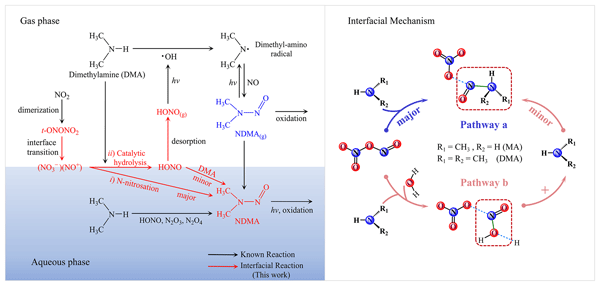
Author response: We sincerely thank the referee for this valuable suggestion. We agree that the “missing source” aspect should be explicitly reiterated in the concluding paragraph to better connect the Conclusion with the Abstract. Accordingly, we have revised the final paragraph to emphasize that the heterogeneous interfacial N-nitrosation mechanism identified in this study represents a previously overlooked source of particulate nitrosamines and may help explain the missing nitrosamine sources reported in atmospheric observations. This revision further reinforces the broader atmospheric significance of our findings. The corresponding changes have been made in Lines 329–333 of the revised manuscript:
“Furthermore, the identified heterogeneous interfacial N-nitrosation pathway represents a previously overlooked source of particulate nitrosamines and may account for the missing sources inferred from atmospheric observations. By incorporating the revealed interfacial N-nitrosation pathway into the established scheme of gas- and aqueous-phase nitrogen chemistry, this study advances and broadens our current understanding of multiphase reactive nitrogen cycling (Fig. 5).”
Comment S4. The environmental implications of simultaneous HONO and nitrate formation deserve further emphasis. The manuscript primarily focuses on nitrosamine production, while the concurrent formation of HONO and nitrate is not strictly discussed. From an atmospheric chemistry perspective, this coupled production pathway could be highly important because it simultaneously influences oxidation capacity, aerosol nitrate burden, and reactive nitrogen cycling. The authors may consider expanding this discussion in the Conclusion section to better highlight the broader implications of the revealed chemistry beyond nitrosamine formation alone.
Author response: We sincerely thank the referee for this valuable suggestion. We agree that the simultaneous formation of HONO and nitrate, together with nitrosamines, represents an important atmospheric implication of the revealed interfacial chemistry. Following the referee’s suggestion, we have expanded the Conclusion to explicitly emphasize that the identified heterogeneous pathway simultaneously produces nitrosamines, HONO, and nitrate, thereby coupling particulate toxicity with atmospheric oxidation capacity, aerosol nitrate formation, and reactive nitrogen cycling. The corresponding changes have been incorporated in Lines 325–328 of the revised manuscript:
“Importantly, the coupled formation of nitrosamines, HONO, and nitrate simultaneously influences particulate toxicity, atmospheric oxidation capacity, aerosol nitrate burden, and reactive nitrogen cycling, thereby extending the atmospheric significance of the identified interfacial chemistry beyond nitrosamine formation alone.”
Comment S5. The discussion of HONO-mediated nitrosation could be strengthened to better contextualize its atmospheric significance. Although the HONO + DMA pathway is identified as secondary due to its higher free-energy barrier, the calculated interfacial rate constant is still reported to be 7-8 orders of magnitude faster than the corresponding aqueous-phase value. This represents a remarkably strong interfacial enhancement. The authors may therefore consider discussing under what atmospheric conditions this secondary pathway could nevertheless become important, such as in aged aerosols or HONO-rich nighttime environments.
Author response: We sincerely thank the referee for this insightful comment. We agree that the atmospheric significance of the HONO-mediated nitrosation pathway deserves further discussion. Following the referee’s suggestion, we have expanded the discussion in Section 3.3 to clarify that the HONO-mediated pathway may become atmospherically relevant under specific environmental conditions. The corresponding discussion has been added to Lines 256–264 of the revised manuscript.
“Although the HONO-mediated nitrosation pathway is kinetically less favorable than the direct N-nitrosation by N2O4 under the investigated conditions, this pathway may become environmentally relevant under specific atmospheric scenarios. In particular, aged aerosols with prolonged atmospheric residence times and nighttime HONO-rich environments may provide favorable conditions for this secondary pathway, because heterogeneous HONO production and accumulation can increase the availability of HONO at aqueous aerosol surfaces, whereas the concentration of highly reactive N2O4 may decrease during aerosol evolution. Under such conditions, interfacial HONO may serve as an important reactive nitrogen reservoir, linking inorganic nitrogen species with particulate organic nitrogen formation through subsequent reactions with amines. Therefore, the HONO-mediated pathway should not be considered merely as a kinetically minor reaction, but rather as a potentially important complementary pathway that contributes to particulate nitrosamine formation under specific atmospheric conditions.”
Technical corrections:
- Typos and non-scientific corrections:
a). Line 73: Add the missing article “the” before “plane-wave basis set”: “...while that for the plane-wave basis set was set to 280 Ry.”
Author response: Thanks. The revised sentence appears in Lines 84–85 of the revised manuscript:
“The cutoff energy for the Gaussian basis set was set to 40 Ry, while that for the plane-wave basis set was 280 Ry.”
b). Section 3.3: In the sentence “Although the calculated energy barrier... is 7.65 kcal mol−1... which is significantly lower...”, the relative clause is awkward. Please split this into two sentences or rephrase to “Although the calculated energy barrier is 7.65 kcal mol−1—a value significantly lower than...”
Author response: We sincerely thank the referee for this helpful suggestion. Following this comment, we reassessed the HONO–DMA reaction in the gas and aqueous phases, removed the corresponding barrier calculations, and revised the discussion. The revised sentence appears in Lines 239–241 of the revised manuscript:
“The calculated energy barrier for this process is 7.65 kcal mol−1 (Fig. 4c), corresponding to an interfacial rate constant of 1.67 × 10⁷ M−1 s−1 at 300 K based on transition state theory (TST).”
c). Table S1: Please specify “Vibrational frequencies” in the header instead of “Calculated frequencies”.
Author response: Accordingly, we have revised the header of Table S1 from “Calculated frequencies” to “Vibrational frequencies” in the revised Supporting Information.
-
AC1: 'Reply on RC1', Xiuhui Zhang, 02 Aug 2026
-
RC2: 'Comment on egusphere-2026-2401', Anonymous Referee #2, 16 Jul 2026
General comments
The current study presents an interesting and potentially important contribution to the understanding of heterogeneous nitrosamine formation mediated by N2O4 at the air–water interface, that addresses a significant knowledge gap concerning observed concentrations of particulate nitrosamines. The Born–Oppenheimer molecular dynamics and metadynamics simulations are carefully designed and performed, demonstrating the mechanistic feasibility of spontaneous N2O4-mediated nitrosation. Nevertheless, the work establishes mechanistic plausibility more convincingly than quantitative kinetic significance, and several important issues require clarification before the atmospheric implications can be fully substantiated. For these reasons, I support publication after major revision, provided that the following points are satisfactorily addressed.Specific comments
The abstract should be written in a clearer way, with a more distinct presentation of the key findings. For example, a general overview of the competing reactions under different environments (as illustrated in Figure 5) could make the abstract more appealing and concise.
The introduction should be significantly improved, since key related preceding studies are missing. The “Theoretical Investigation of Nitration and Nitrosation of Dimethylamine by N2O4” (J. Phys. Chem. A 2008, 112, 7098–7105) as well as some of the references included in that study, should be presented and later compared/commented in the “Discussions” part. Also, a more in-depth search in the literature on experiments revolving around N-nitration of amines in the particle phase (e.g. Chemosphere 293 (2022) 133639) could help substantially in the discussion of the theoretical results.
The discussion would benefit from a more critical comparison with previous atmospheric kinetic models, particularly the SINTEF aqueous-phase chemistry mechanism (Karl et al., 2012) and the work of Choi et al. (2021, 2025a). Those studies employ effective rate coefficients for the reactions of DMA with HONO, N2O3, and N2O4 that are largely derived, estimated, or calibrated rather than directly measured or obtained from first-principles kinetics. The authors should therefore discuss how the proposed N2O4-mediated mechanism modifies or replaces these existing parameterizations and whether its inclusion would quantitatively alter current atmospheric models.
Furthermore, the conclusion that direct N2O4-mediated nitrosation represents the dominant heterogeneous pathway is based primarily on comparison with the HONO-mediated route, whereas another well-established atmospheric nitrosating agent, N2O3, is not considered. Since previous atmospheric models consistently identify both N2O4 and N2O4 as relevant nitrosating species, omission of the N2O3 pathway makes it difficult to assess whether the proposed mechanism is genuinely dominant or simply one of several competing routes. The authors are, therefore, encouraged to at least discuss the potential role of N2O3 and justify its exclusion from the present work.
While Interfacial N-nitrosation reactions and Interfacial Hydrolysis of t-ONONO2 were studied for both MA and DMA, interfacial reaction with HONO was studied only for DMA. Please provide justification for this selection.
Moreover, the TST-derived interfacial rate constant should be compared to the gas- and aqueous-phase rate constants derived directly from the authors' own calculated potential energy surfaces, rather than with values reported in technical reports (e.g., Karl et al., 2012).
In this context, the potential energy surface presented in Figure S12 raises several concerns. The pre-reactive complex (ER1) appears to adopt substantially different geometries in the gas and aqueous phases while exhibiting essentially identical relative energies, which deserves further explanation. In addition, the large change in the imaginary frequency of TS1 between the gas and aqueous phases, together with the presence of several low-frequency modes in the pre- and post-reactive complexes, raises concerns regarding the reliability of the B3LYP-D3/6-311++G(3df,2p) level of theory for describing such weakly bound systems.
Overall, I recommend either (i) re-evaluating this reaction using a higher-level electronic structure method (with a more robust characterization of the stationary points and TST analysis), or (ii) removing the quantitative kinetic discussion of the HONO pathway altogether.
Technical corrections
IARC Monographs on the Evaluation of Carcinogenic Risks to Humans. World Health Organization (WHO), 1978. The latest updated monograph should be cited.Citations missing from the Computational Methods section, e.g. Grimme’s D3 dispersion correction, CCSD(T) ab-initio method, should be added.
What do the yellow arrows of Scheme 1 represent?
In Section S4 of the Supporting Information, the degeneracy σ should be explicitly given, along with a reference for TST theory.
In Figure S4, does the green line actually represent the distance N1-N2 that is gradually increasing after 10 ps? Also, N1-O2 remains fixed at 2.0 Å? Please control.
Line 19: produce should be producing
Line 59: Add…mechanism can explain
Line 71: Delete “And” in the sentence “And the DZVP-MOLOPT-SR-GTH…”
Line 44: “Since HONO is also a key nitrosamine precursor, this pathway is explored in detail in a following section.
Line 240: ConclusionsCitation: https://doi.org/10.5194/egusphere-2026-2401-RC2 -
AC2: 'Reply on RC2', Xiuhui Zhang, 02 Aug 2026
Dear Editor,
Thank you very much for your time and effort in handling our manuscript (MS No.: EGUSPHERE-2026-2401) entitled “Heterogeneous Nitrosation Reactions of Amines Driven by Dinitrogen Tetroxide: A Missing Source of Particulate Nitrosamines”. We are also grateful to the reviewers for the thoughtful, constructive, and insightful comments, which have greatly helped us improve the quality and clarity of the manuscript.
In response to the reviewers’ comments and suggestions, we have carefully revised the manuscript and addressed each point in detail. All changes made in the revised manuscript are highlighted in blue for ease of reference. A detailed, point-by-point response is provided below.
Reviewer(s)’ Comments to Author:
Response to Referee #2
Referee’s general assessment:
The current study presents an interesting and potentially important contribution to the understanding of heterogeneous nitrosamine formation mediated by N2O4 at the air–water interface, that addresses a significant knowledge gap concerning observed concentrations of particulate nitrosamines. The Born–Oppenheimer molecular dynamics and metadynamics simulations are carefully designed and performed, demonstrating the mechanistic feasibility of spontaneous N2O4-mediated nitrosation. Nevertheless, the work establishes mechanistic plausibility more convincingly than quantitative kinetic significance, and several important issues require clarification before the atmospheric implications can be fully substantiated. For these reasons, I support publication after major revision, provided that the following points are satisfactorily addressed.
Author response: We sincerely thank the referee for the positive evaluation of our manuscript and for the constructive comments and valuable suggestions. We have carefully revised the manuscript accordingly, with all changes highlighted in blue. Our detailed responses to each comment are provided below.
Specific comments
Comment S1. The abstract should be written in a clearer way, with a more distinct presentation of the key findings. For example, a general overview of the competing reactions under different environments (as illustrated in Figure 5) could make the abstract more appealing and concise.
Author response: We sincerely thank the reviewer for this valuable suggestion. We agree that the original Abstract did not sufficiently emphasize the relative importance of the competing reaction pathways under different environments. Following the reviewer’s recommendation, we have substantially revised the Abstract to improve its clarity and logical flow. These revisions make the key findings more accessible while providing readers with a clearer summary of the environmental implications of the proposed mechanisms. The corresponding revisions have been made in Lines 13–24 of the revised manuscript:
“Nitrosamines are carcinogenic nitrogen-containing atmospheric pollutants that are widely detected in particulate matter. However, their formation mechanisms remain poorly understood. While gas-phase and bulk aqueous pathways have been extensively investigated, the role of heterogeneous interfacial chemistry remains largely unexplored. Herein, we elucidate the molecular mechanisms underlying heterogeneous nitrosamine formation via amine-mediated reactions with dinitrogen tetroxide (N2O4) at the air–water interface using Born–Oppenheimer molecular dynamics and metadynamics simulations. These reactions proceed through two distinct and competing pathways: (i) a kinetically favored, barrierless N-nitrosation pathway in which N2O4 directly reacts with methylamine (MA) or dimethylamine (DMA), yielding nitrosamine cations and nitrate ions (NO3−); and (ii) a MA/DMA-mediated hydrolysis pathway of N2O4 that rapidly generates interfacial HONO (~2–16 ps), providing a potential secondary source of nitrosamines via subsequent HONO-mediated nitrosation with a free-energy barrier of 7.65 kcal mol−1 at 300 K. These findings reveal amine-mediated interfacial chemistry as an important heterogeneous pathway distinct from bulk processes, providing molecular insights into urban reactive nitrogen cycling and improving atmospheric chemical transport models.”
Comment S2. The introduction should be significantly improved, since key related preceding studies are missing. The “Theoretical Investigation of Nitration and Nitrosation of Dimethylamine by N2O4” (J. Phys. Chem. A 2008, 112, 7098–7105) as well as some of the references included in that study, should be presented and later compared/commented in the “Discussions” part. Also, a more in-depth search in the literature on experiments revolving around N-nitration of amines in the particle phase (e.g. Chemosphere 293 (2022) 133639) could help substantially in the discussion of the theoretical results.
Author response: We sincerely thank the reviewer for this insightful and valuable suggestion. We agree that the Introduction should provide a more comprehensive overview of previous studies related to amine nitrosation chemistry. Accordingly, we have revised the Introduction by incorporating the recommended theoretical study published in J. Phys. Chem. A (2008, 112, 7098–7105), together with additional relevant references cited therein, to better summarize the current understanding of N2O4-mediated nitrosation chemistry. The corresponding text has been added to Lines 46–56 of the revised manuscript, as follows:
“Although amines can undergo aqueous N-nitrosation with N2O3, N2O4, and HONO (Challis and Kyrtopoulos, 1979; Choi et al., 2021, 2025a; Hutchings et al., 2010; Karl et al., 2012b), these aqueous-phase pathways have been predicted to be kinetically insufficient to explain the high particulate nitrosamine concentrations observed in the atmosphere (Choi et al., 2021; Karl et al., 2012b), suggesting the existence of an important yet unrecognized formation pathway. For N2O4-mediated nitrosation in particular, early mechanistic studies proposed that the asymmetric ON–ONO2 isomer, rather than the symmetric ON–ONO2 dimer, serves as the active nitrosating species (Challis et al., 1982; White and Feldman, 1957). This view was further corroborated by the theoretical calculations of Lv et al. (2008), who explicitly identified the asymmetric ON–ONO2 isomer as the key intermediate responsible for NDMA formation. However, these prior theoretical investigations were all performed on isolated gas-phase molecules or using implicit-solvent models, which cannot reproduce the dynamic solvent environment and reaction kinetics of heterogeneous processes at atmospheric air–water interfaces.”
Furthermore, we have expanded the Discussion section by comparing the previously reported gas-phase and implicit-solvent reaction mechanisms with the heterogeneous interfacial mechanism revealed in the present work, highlighting their mechanistic similarities as well as the unique role of the aqueous interface in regulating the reaction pathway. In addition, following the reviewer’s recommendation, we have incorporated recent experimental studies on the nitration and nitrosation of amines in the particle phase, including the suggested article (Chemosphere 293 (2022) 133639), to better establish the connection between our theoretical findings and available atmospheric observations. The corresponding text has been added to Lines 265–288 of the revised manuscript, as follows:
“Considering that both the HONO- and N2O4-mediated pathways originate from reactive nitrogen species in the atmosphere, their relative importance should be evaluated within the broader context of previous molecular studies, particle-phase observations, and atmospheric kinetic models. Previous theoretical studies have provided important insights into the intrinsic reactivity of DMA toward N2O4. Lv et al. (2008) systematically investigated the nitration and nitrosation pathways of DMA with N2O4 and identified asymmetric ON–ONO2 as the key reactive isomer responsible for N-nitrosation. Their calculations demonstrated that ON–ONO2 can undergo a nearly barrierless concerted reaction with DMA in both the gas phase and an implicit aqueous environment, establishing the molecular feasibility of N2O4-mediated nitrosamine formation. These findings provided a mechanistic basis for understanding the role of N2O4 as an effective nitrosating agent in aqueous environments.
Beyond these theoretical investigations, recent experimental studies have demonstrated that amines in the particulate phase can undergo heterogeneous reactions with reactive nitrogen species under atmospheric conditions. Chen et al. (2022) investigated the transformation of particulate DMA under NOx exposure and reported the formation of both nitramine and nitrosamine products through experimental measurements and theoretical analysis. They further suggested that reactive nitrogen oxide species, including N2O4 and N2O3, may contribute to DMA transformation through interactions with the nitrogen center of the amine. However, the specific reactive intermediates and molecular pathways controlling N2O4-driven nitrosation at the air–water interface of aqueous aerosols remain poorly constrained.
Building upon these theoretical insights and atmospheric observations, the present study reveals how the air–water interface regulates N2O4-mediated nitrosation under realistic heterogeneous conditions. Consistent with the findings of Lv et al. (2008), our BOMD simulations identify t-ONONO2 as the active nitrosating species. However, unlike what is captured in previous gas-phase and continuum-solvent models, the explicit aqueous interface introduces dynamic solvent organization, interfacial hydrogen-bond networks, and adsorption-dependent collision configurations that regulate the reaction pathway. Therefore, this work extends previous descriptions of N2O4-mediated nitrosation from intrinsic molecular reactivity to heterogeneous atmospheric chemistry by demonstrating that aqueous aerosol interfaces can facilitate nitrosamine formation through interface-mediated reaction dynamics.”
References:
Challis, B. C., Shuker, D. E., Fine, D. H., Goff, E. U., and Hoffman, G. A.: Amine nitration and nitrosation by gaseous nitrogen dioxide, IARC Scientific Publication, 41, 11–20, 1982.
Chen, T., Ge, Y., Liu, Y., and He, H.: N-nitration of secondary aliphatic amines in the particle phase, Chemosphere, 293, 133639, https://doi.org/10.1016/j.chemosphere.2022.133639, 2022.
Lv, C. L., Liu, Y. D., and Zhong, R.: Theoretical Investigation of Nitration and Nitrosation of Dimethylamine by N2O4, J. Phys. Chem. A, 112, 7098–7105, https://doi.org/10.1021/jp8029924, 2008.
White, E. H. and Feldman, W. R.: THE NITROSATION AND NITRATION OF AMINES AND ALCOHOLS WITH NITROGEN TETROXIDE, J. Am. Chem. Soc., 79, 5832–5833, https://doi.org/10.1021/ja01578a074, 1957.
Comment S3. The discussion would benefit from a more critical comparison with previous atmospheric kinetic models, particularly the SINTEF aqueous-phase chemistry mechanism (Karl et al., 2012b) and the work of Choi et al. (2021, 2025a). Those studies employ effective rate coefficients for the reactions of DMA with HONO, N2O3, and N2O4 that are largely derived, estimated, or calibrated rather than directly measured or obtained from first-principles kinetics. The authors should therefore discuss how the proposed N2O4-mediated mechanism modifies or replaces these existing parameterizations and whether its inclusion would quantitatively alter current atmospheric models.
Author response: We thank the reviewer for this valuable suggestion. We have expanded the Discussion section (Section 3.3) to compare our proposed interfacial mechanism with the N2O4-mediated nitrosation mechanisms considered in the atmospheric models of Karl et al. (2012b) and Choi et al. (2021, 2025a). Specifically, we clarify that the N2O4-mediated nitrosation pathways in these models rely on parameterized or indirectly estimated rate coefficients, whereas our study provides an explicit molecular-level heterogeneous mechanism for N2O4-mediated nitrosation at the air–water interface. We also emphasize that the box models developed by Choi et al. did not include heterogeneous reactions owing to the limited kinetic data available at the time, leaving aerosol interfacial chemistry unrepresented. Finally, we discuss that although the quantitative impact of the interfacial pathway on atmospheric nitrosamine budgets requires future model implementation, our results demonstrate that aerosol interfacial chemistry should be incorporated into future parameterizations of heterogeneous nitrosamine formation. The corresponding text has been added to Lines 289–304 of the revised manuscript, as follows:
“The atmospheric implications of the proposed mechanism can be further considered in the context of existing kinetic models. Previous atmospheric chemistry models, including the SINTEF mechanism developed by Karl et al. (2012b) and the box-model study of Choi et al. (2021, 2025a), represented DMA nitrosation by HONO, N2O3, and N2O4 using parameterized reaction pathways and effective rate coefficients. Although these mechanisms provide an important framework for evaluating secondary nitrosamine formation, the associated kinetic parameters remain subject to uncertainty. Importantly, the box models developed by Choi et al. (2021, 2025a) did not incorporate heterogeneous reactions, primarily due to the limited kinetic data available at the time. Consequently, aerosol interfacial nitrosation pathways remain absent from current atmospheric kinetic models, despite their potential atmospheric relevance. Furthermore, the molecular mechanisms underlying N2O4-mediated nitrosation, particularly at the air–water interface of aqueous aerosols, remain poorly understood. As a result, many of the kinetic parameters adopted in current atmospheric models are based on indirect estimates, analogous systems, or empirical parameterizations rather than explicit molecular-level reaction mechanisms.
Moreover, the interfacial pathway identified in this study exhibits rapid kinetics, with the N2O4-mediated reaction producing nitrosamine cations within picoseconds, while the HONO-mediated interfacial pathway also proceeds efficiently. Although the quantitative influence of this interfacial pathway on atmospheric nitrosamine budgets requires future model implementation, our findings highlight the need to incorporate aerosol interfacial chemistry into future parameterizations of heterogeneous nitrosamine formation.”
Comment S4. Furthermore, the conclusion that direct N2O4-mediated nitrosation represents the dominant heterogeneous pathway is based primarily on comparison with the HONO-mediated route, whereas another well-established atmospheric nitrosating agent, N2O3, is not considered. Since previous atmospheric models consistently identify both N2O4 and N2O3 as relevant nitrosating species, omission of the N2O3 pathway makes it difficult to assess whether the proposed mechanism is genuinely dominant or simply one of several competing routes. The authors are, therefore, encouraged to at least discuss the potential role of N2O3 and justify its exclusion from the present work.
Author response: We thank the reviewer for this helpful suggestion and agree that the potential role of N2O3 should be discussed. Accordingly, we have added a discussion in the revised manuscript noting that, although previous atmospheric kinetic models have identified both N2O4 and N2O3 as potential nitrosating agents, N2O4 is generally expected to be substantially more abundant than N2O3 under typical nighttime atmospheric conditions because NO is rapidly consumed by ozone, whereas NO2 readily dimerizes to form N2O4 (Brown and Stutz, 2012; Roscoe and Hind, 1993). In addition, we would like to clarify that the primary objective of this study was to elucidate the heterogeneous interfacial reaction mechanism initiated by N2O4, motivated by previous experimental and theoretical studies demonstrating its interfacial stability and persistent adsorption at the air–water interface. Therefore, the mechanistic investigation was intentionally focused on N2O4-mediated heterogeneous chemistry. The corresponding text has been added to Lines 243–250 of the revised manuscript, as follows:
“However, previous atmospheric kinetic models have also identified N2O3 as a potentially important nitrosating agent, in addition to HONO and N2O4. The N2O3-mediated pathway was not considered in the present study because, under typical nighttime atmospheric conditions, N2O4 is generally expected to be substantially more abundant than N2O3. This difference is attributed to the rapid consumption of NO by ozone, which suppresses N2O3 formation, whereas NO2 readily undergoes dimerization to form N2O4 (Brown and Stutz, 2012; Roscoe and Hind, 1993). Nevertheless, N2O3-mediated interfacial nitrosation may also contribute under conditions where sufficient N2O3 is available. Further studies on N2O3-mediated interfacial reactions are therefore needed to evaluate their potential role in atmospheric nitrosamine formation.”
In addition, we have modified our previous statement that N2O4-mediated direct nitrosation dominates heterogeneous nitrosamine formation. The corresponding text has been added to Lines 316–318 of the revised manuscript, as follows:
“The results demonstrate that spontaneous direct nitrosation of MA/DMA with N2O4 at the air–water interface provides a kinetically favorable pathway for particulate-phase nitrosamine formation.”
Reference:
Brown, S. S. and Stutz, J.: Nighttime radical observations and chemistry, Chem. Soc. Rev., 41, 6405–6447, https://doi.org/10.1039/c2cs35181a, 2012.
Roscoe, H. K., Hind, A. K: The equilibrium constant of NO2 with N2O4 and the temperature dependence of the visible spectrum of NO2: A critical review and the implications for measurements of NO2 in the polar stratosphere, J. Atmos. Chem. 16, 257–276. https://doi.org/10.1007/BF00696899, 1993.
Comment S5. While Interfacial N-nitrosation reactions and Interfacial Hydrolysis of t-ONONO2 were studied for both MA and DMA, interfacial reaction with HONO was studied only for DMA. Please provide justification for this selection.
Author response: We thank the reviewer for this valuable suggestion. The primary objective of investigating the HONO-mediated pathway was to assess whether HONO generated from the newly identified interfacial hydrolysis of N2O4 could further facilitate particulate-phase nitrosamine formation under atmospheric conditions. Among nitrosamines, NDMA has received particular attention because field observations have reported substantially higher atmospheric abundances of NDMA compared with NMA, highlighting the greater atmospheric relevance of its formation pathways. Accordingly, we selected DMA as the representative amine system, as DMA is one of the most extensively studied atmospheric amines, and its reaction with HONO leading to NDMA formation has been widely investigated in both laboratory experiments and atmospheric kinetic models (e.g., Karl et al., 2012b; Choi et al., 2021, 2025a). This selection also enables a direct comparison between the newly proposed N2O4-mediated mechanism and existing HONO-based parameterizations. Therefore, our HONO-mediated mechanistic investigation was focused on the DMA system. The corresponding text has been added to Lines 232–237 of the revised manuscript, as follows:
“To evaluate the contribution of interfacially generated HONO to particulate-phase nitrosamine formation, we investigated the reaction of DMA with HONO at the air–water interface using BOMD and MetaD simulations. DMA was selected as the representative amine due to the substantially higher atmospheric abundance of NDMA compared to NMA in field observations, as well as the extensive data available for DMA-driven nitrosamine formation in kinetic models (Karl et al., 2012b; Choi et al., 2021, 2025a). Consequently, while MA is also a relevant precursor, the current study focuses specifically on the DMA system to align with these dominant atmospheric observations.”
Comment S6. Moreover, the TST-derived interfacial rate constant should be compared to the gas- and aqueous-phase rate constants derived directly from the authors’ own calculated potential energy surfaces, rather than with values reported in technical reports (e.g., Karl et al., 2012b). In this context, the potential energy surface presented in Figure S12 raises several concerns. The pre-reactive complex (ER1) appears to adopt substantially different geometries in the gas and aqueous phases while exhibiting essentially identical relative energies, which deserves further explanation. In addition, the large change in the imaginary frequency of TS1 between the gas and aqueous phases, together with the presence of several low-frequency modes in the pre- and post-reactive complexes, raises concerns regarding the reliability of the B3LYP-D3/6-311++G(3df,2p) level of theory for describing such weakly bound systems. Overall, I recommend either (i) re-evaluating this reaction using a higher-level electronic structure method (with a more robust characterization of the stationary points and TST analysis), or (ii) removing the quantitative kinetic discussion of the HONO pathway altogether.
Author response: We thank the reviewer for this careful assessment and agree that our current calculations do not provide a sufficiently robust basis for quantitatively comparing the rate constants of the interfacial, gas-phase, and aqueous-phase reactions. Following the reviewer’s recommendation, we have removed the quantitative kinetic discussion of the HONO-mediated pathway, including the comparison of interfacial and bulk-phase rate constants, as well as Fig. S12 and the associated discussion from the Supporting Information. The revised manuscript therefore focuses on the qualitative mechanistic insights provided by the interfacial reaction pathway, rather than on quantitative kinetic comparisons. We agree that a more rigorous quantitative treatment would require higher-level electronic structure calculations together with a more comprehensive characterization of the stationary points and kinetic analysis, and we will pursue this direction in future work.
Technical corrections
- IARC Monographs on the Evaluation of Carcinogenic Risks to Humans. World Health Organization (WHO), 1978. The latest updated monograph should be cited.
Author response: We thank the reviewer for this suggestion. We agree that the original citation (IARC, 1978) is outdated. We have replaced it with the updated IARC Monograph on “Smokeless Tobacco and Some Tobacco-specific N-Nitrosamines” (IARC Monographs, Volume 89, 2007), which provides a more recent evaluation of the carcinogenicity of N-nitrosamines, including NDMA. The corresponding citation has been revised in the manuscript.
Reference:
IARC: Smokeless Tobacco and Some Tobacco-specific N-Nitrosamines, IARC Monographs on the Evaluation of Carcinogenic Risks to Humans, Vol. 89, International Agency for Research on Cancer, Lyon, France, 2007.
- Citations missing from the Computational Methods section, e.g. Grimme’s D3 dispersion correction, CCSD(T) ab-initio method, should be added.
Author response: We appreciate the reviewer’s helpful suggestion. The citation for Grimme’s D3 dispersion correction has been added to the revised Computational Methods section. We agree with the reviewer that the current calculations do not provide a sufficiently robust basis for a quantitative comparison of the rate constants among the interfacial, gas-phase, and aqueous-phase systems. Therefore, the CCSD(T) calculations previously performed for the HONO-mediated DMA nitrosation pathway under gas-phase and aqueous-phase conditions have been removed during revision, together with the corresponding methodological description. Accordingly, no CCSD(T) citation is required in the revised manuscript.
Reference:
Grimme, S., Antony, J., Ehrlich, S., and Krieg, H.: A consistent and accurate ab initio parametrization of density functional dispersion correction (DFT-D) for the 94 elements H-Pu, J. Chem. Phys., 132, 154104, https://doi.org/10.1063/1.3382344, 2010.
- What do the yellow arrows of Scheme 1 represent?
Author response: We appreciate the reviewer’s helpful suggestion. The yellow arrows in Scheme 1 indicate the different products that are obtained after the completion of the reactions. To improve the clarity and readability of the figure, we have added the sentence “The yellow arrows point to the corresponding interfacial products formed in each reaction pathway” to the figure caption in the revised manuscript. The revised figure and its caption are shown below:
Scheme 1. Illustration of the interfacial N-nitrosation mechanism of MA/DMA initiated by t-ONONO2 (MA/DMA + t-ONONO2 → CH3NH2NO+/(CH3)2NH+NO + NO3−. The dashed lines denote ionic bonds (blue), whereas the red arrows indicate the formation of CH3NH2NO+/(CH3)2NH+NO. The yellow arrows point to the corresponding interfacial products formed in each reaction pathway. Patterns (i)–(iii) illustrate different collision scenarios, with black arrows showing the directions of collision. The blue, red, white, and ochre spheres represent the N, O, H, and C atoms, respectively. The symbols “√” and “×” denote whether the reaction can or cannot occur, respectively.
- In Section S4 of the Supporting Information, the degeneracy σshould be explicitly given, along with a reference for TST theory.
Author response: We sincerely thank the reviewer for this valuable suggestion. In the revised Supporting Information, the reaction path degeneracy (σ) in the TST equation has been explicitly given as σ = 1 for the DMA–HONO interfacial reaction. Furthermore, the corresponding reference for transition state theory has been added in Section S4:
“In this study, the rate constant k was calculated using transition state theory (TST) (Truhlar et al., 1996), as given by the following expression:
where σ is the reaction path degeneracy, which was set to 1 in the present calculation”
Reference:
Truhlar, D. G.; Garrett, B. C.; Klippenstein, S. J.: Current Status of Transition-State Theory, J. Phys. Chem., 100, 12771–12800, https://doi.org/10.1021/j100238a003, 1996.
- In Figure S4, does the green line actually represent the distance N1-N2 that is gradually increasing after 10 ps? Also, N1–O2 remains fixed at 2.0 Å? Please control.
Author response: We thank the reviewer for carefully checking Figure S4 and for pointing out this labeling error. We apologize for the mistake in the original figure. The bond assignments have been carefully re-examined and corrected in the revised Figure S4. Specifically, the green line now represents the N1–O1 bond distance, the purple line represents the N1–O2 bond distance, and the yellow line represents the N1–N2 bond distance. The previous assignment of the N1–O2 bond was incorrect and has been corrected accordingly.
In the corrected Figure S4, the N1–N2 bond is observed to form at 1.29 ps and remains stable at around 2.0 Å during the subsequent simulation, indicating the formation of a stable nitrosamine product. Meanwhile, the N1–O1 and N1–O2 bond distances gradually increase during the reaction process. At 18 ps, both bond distances reach approximately 6 Å, demonstrating the complete rupture of the two N–O bonds and the full separation of the resulting nitrosaminium species and nitrate ions. The updated Figure S4 is shown below.
Figure S4. (a) Snapshot structures from the BOMD simulations, illustrating the stepwise mechanism of the MA-mediated N-nitrosation reaction of t-ONONO2. (b) Time evolution of key bond distances mediated by MA. The black arrows indicate the directions of collision, while the dashed lines represent ionic bonds. The blue, red, white, and ochre spheres represent the N, O, H, and C atoms, respectively. The green arrows denote atom transfer directions
- Line 19: produce should be producing
Author response: We thank the reviewer for identifying this grammatical error. The suggested correction has been adopted in the revised manuscript.
- Line 59: Add…mechanism can explain
Author response: We appreciate the reviewer’s careful reading. Following the reviewer’s comment on the Introduction, we have revised the final paragraph accordingly by removing the previous inappropriate statement. The revised paragraph can be found in Lines 68–74 of the revised manuscript.
“In this work, we employ Born–Oppenheimer molecular dynamics (BOMD) simulations together with well-tempered metadynamics (MetaD) calculations to investigate the heterogeneous reactions of MA and DMA with N2O4 at the air–water interface. Building upon previous theoretical mechanistic studies, our aim is to determine whether heterogeneous interfacial chemistry provides a kinetically viable pathway for particulate nitrosamine formation under atmospheric conditions. The simulations characterize the associated free-energy landscapes and elucidate the molecular mechanisms of heterogeneous N-nitrosation, providing molecular-level insights into the roles of amine basicity, interfacial hydrogen-bond networks, proton transfer, and steric effects in governing nitrosamine formation at atmospheric aerosol surfaces.”
- Line 71: Delete “And” in the sentence “And the DZVP-MOLOPT-SR-GTH…”
Author response: We appreciate the reviewer for pointing out this language issue. The word “And” at the beginning of the sentence has been removed in the revised manuscript.
- Line 144: “Since HONO is also a key nitrosamine precursor, this pathway is explored in detail in a following section.”
Author response: We thank the reviewer for the helpful suggestion. The original sentence has been revised as suggested in Line 142 of the revised manuscript:
“Since HONO is also a key nitrosamine precursor, this pathway is explored in detail in a following section.”
- Line 240: Conclusions
Author response: We thank the reviewer for the helpful suggestion. The section title has been changed from “Conclusion” to “Conclusions” in the revised manuscript (Line 309).
-
AC2: 'Reply on RC2', Xiuhui Zhang, 02 Aug 2026
Peer review completion
Journal article(s) based on this preprint
Viewed
| HTML | XML | Total | Supplement | BibTeX | EndNote | |
|---|---|---|---|---|---|---|
| 260 | 128 | 44 | 432 | 105 | 21 | 27 |
- HTML: 260
- PDF: 128
- XML: 44
- Total: 432
- Supplement: 105
- BibTeX: 21
- EndNote: 27
Viewed (geographical distribution)
| Country | # | Views | % |
|---|
| Total: | 0 |
| HTML: | 0 |
| PDF: | 0 |
| XML: | 0 |
- 1
Tai-Xing Chi
Shuang Ni
Wei-Kang Xiao
Yang Liu
Xiu-Cong Deng

Zhen Zhao
The requested preprint has a corresponding peer-reviewed final revised paper. You are encouraged to refer to the final revised version.
- Preprint
(18995 KB) - Metadata XML
-
Supplement
(27206 KB) - BibTeX
- EndNote
- Final revised paper
Chi et al. present a well-designed theoretical study on the heterogeneous formation mechanisms of carcinogenic nitrosamines at the air–water interface. Using ab initio molecular dynamics simulations, the authors demonstrate that amines (MA/DMA) can rapidly react with dinitrogen tetroxide (N2O4) at aqueous aerosol surfaces, resulting in the direct formation of particulate nitrosamines and nitrate. This study provides in-depth mechanistic insights into the particulate nitrosamine production in urban atmospheres. Additionally, combination of BOMD and metadynamics simulations enables a precise monitoring of these ultrafast interfacial processes, and the accompanying wave function analyses enhance mechanistic interpretation. Overall, this manuscript is well-designed and contains substantial theoretical results. The obtained theoretical results are of significant importance to atmospheric multiphase chemistry and aerosol interfacial processes. The reviewer recommends publication of this manuscript in Atmos. Chem. Phys. after the following minor concerns are addressed:
1. Schemes 1 and 2 are very informative and greatly aid the understanding of the proposed reaction mechanisms. However, Scheme 2 (iii) should be explicitly referenced and discussed in Section 3.2 to better direct the readers to the mechanistic pathways presented. In addition, the authors should further clarify why the reaction pathway shown in Scheme 2 (iii) is not feasible. Notably, the preformed complex involved in Scheme 2 (iii) appears to be the same as that shown in Scheme 1 (ii). In Scheme 1 (ii), collision of this complex with the air–water interface directly leads to nitrosation at the interface. However, this does not adequately explain why hydrolysis cannot occur when the same complex interacts with the air–water interface. A more detailed mechanistic explanation distinguishing the feasibility of nitrosation versus hydrolysis pathways would strengthen the interpretation of the interfacial reaction mechanisms.
2. It is recommended to cite recent key studies in the “introduction” to offer a clear picture regarding the “reaction-accelerating effect of the air-water interface”.
3. The conclusion effectively summarizes the key findings. Please explicitly reiterate the “missing source” aspect in the final paragraph to tie it back to the Abstract and resonate with the readers.
4. The environmental implications of simultaneous HONO and nitrate formation deserve further emphasis. The manuscript primarily focuses on nitrosamine production, while the concurrent formation of HONO and nitrate is not strictly discussed. From an atmospheric chemistry perspective, this coupled production pathway could be highly important because it simultaneously influences oxidation capacity, aerosol nitrate burden, and reactive nitrogen cycling. The authors may consider expanding this discussion in the Conclusion section to better highlight the broader implications of the revealed chemistry beyond nitrosamine formation alone.
5. The discussion of HONO-mediated nitrosation could be strengthened to better contextualize its atmospheric significance. Although the HONO + DMA pathway is identified as secondary due to its higher free-energy barrier, the calculated interfacial rate constant is still reported to be 7-8 orders of magnitude faster than the corresponding aqueous-phase value. This represents a remarkably strong interfacial enhancement. The authors may therefore consider discussing under what atmospheric conditions this secondary pathway could nevertheless become important, such as in aged aerosols or HONO-rich nighttime environments.
6. Typos and non-scientific corrections:
a). Line 73: Add the missing article “the” before “plane-wave basis set”: “...while that for the plane-wave basis set was set to 280 Ry.”
b). Section 3.3: In the sentence “Although the calculated energy barrier... is 7.65 kcal mol−1... which is significantly lower...”, the relative clause is awkward. Please split this into two sentences or rephrase to “Although the calculated energy barrier is 7.65 kcal mol−1—a value significantly lower than...”
c). Table S1: Please specify “Vibrational frequencies” in the header instead of “Calculated frequencies”.