
the Creative Commons Attribution 4.0 License.
the Creative Commons Attribution 4.0 License.
 | 05 May 2026
Characteristics of Extreme Snowfall–Wind-Gust Events in Finland (1960–2024): Frequency, Duration, and Intensity
Abstract. Compound weather events involving both strong wind gusts and intense snowfall can have significant impacts on critical infrastructure and public safety. This study analyses the frequency, duration, and intensity of such events in Finland using ERA5 reanalysis data for 1960–2024. Extreme wind gust and snowfall conditions were identified using spatially varying 95th and 98th percentile thresholds. Events with both snowfall and wind gust exceeding these thresholds simultaneously were classified as compound events (SWG). SWGs were most frequent along Finland’s south facing coastal regions and eastern Finland. Increasing the threshold from 95th to 98th reduced the number of SWGs but emphasized the dominance of coastal areas and highlighted more severe cases. Approximately half of the events were short-lived (20 m s˗1, hourly snowfall rates >2.5 mm h˗1, and total snowfall >20 mm. Although rare, these high-impact SWGs can create substantial operational challenges for energy production and other critical infrastructures. The results underscore the importance of incorporating compound-event analysis into hazard assessments and preparedness strategies for regions exposed to severe winter weather.
-
Notice on discussion status
The requested preprint has a corresponding peer-reviewed final revised paper. You are encouraged to refer to the final revised version.
-
Preprint
(3426 KB)
-
The requested preprint has a corresponding peer-reviewed final revised paper. You are encouraged to refer to the final revised version.
- Preprint
(3426 KB) - Metadata XML
- BibTeX
- EndNote
- Final revised paper


Journal article(s) based on this preprint
Interactive discussion
Status: closed
-
RC1: 'Comment on egusphere-2026-2363', Anonymous Referee #1, 07 Jun 2026
-
AC1: 'Reply on RC1', Taru Olsson, 17 Aug 2026
We sincerely thank the reviewer for the encouraging and thoughtful evaluation of our manuscript. We are pleased that the reviewer found the study clear, interesting, and suitable for
publication, and that the analyses addressing potential limitations and methodological choices were considered valuable. We also appreciate the specific suggestions for improving the clarity of the text. All comments have been carefully addressed (supplement pdf), and the manuscript has been revised accordingly
-
AC1: 'Reply on RC1', Taru Olsson, 17 Aug 2026
-
RC2: 'Comment on egusphere-2026-2363', Anonymous Referee #2, 06 Jul 2026
This paper presents an assessment of compound wind–snow extremes, defined as hourly occurrences during which both wind speed and snowfall exceed specified thresholds (the 95th and 98th percentiles). Consecutive hourly occurrence are then used to define events from which they can extract characteristics such as duration. The authors examine these events across Finland, characterising their spatial variability and historical occurrence. The topic is both scientifically relevant and societally important, particularly given the potential impacts associated with concurrent weather hazards.
While the study has merit, I believe several aspects require refinement before the manuscript can be recommended for publication. In particular, the motivation for certain methodological choices could be explained more clearly, and the interpretation of some results would benefit from greater precision. I also think that a small number of additional analyses and refinements to the metrics used would strengthen the paper and provide a more complete characterisation of wind–snow compound events.
Overall, the manuscript is generally well written and presents a valuable contribution to the literature. With some revisions to improve the motivation, interpretation, and presentation of the results, I believe it would be suitable for publication. I have outlined a number of suggestions below that I hope the authors will find constructive and helpful.
Specific Comments:
1. Definition of Extremes and comparison of SWG95 to SWG98
The definition of an "extreme" is inevitably somewhat subjective, but I am not convinced that the 95th percentile of hourly values is sufficiently rare to constitute an extreme event. For example, if 95th percentile exceedances were uniformly distributed in time, one would expect around 216 exceedance hours per winter season (24 hours × 180 days × 0.05), which suggests that such conditions occur relatively frequently. This is not to imply that these exceedances are unimportant from an impact perspective; however, I think the authors could provide a stronger justification for adopting a threshold that is exceeded so often.
I also think the rationale for using both the 95th and 98th percentile thresholds could be explained more clearly. From my reading, the comparison does not appear to yield any substantive scientific conclusions beyond the expected differences in event frequency and duration that arise from using a more stringent threshold. If this is the case, I would suggest focusing on a single threshold, which would considerably simplify the presentation and improve readability. At present, the frequent switching between SWG95 and SWG98 events makes parts of the manuscript difficult to follow.
If there are scientific reasons for analysing both thresholds, beyond simply demonstrating sensitivity to threshold choice, I encourage the authors to state these motivations explicitly and to more clearly articulate the specific insights that emerge from the comparison. This would help the reader understand the value of maintaining both event definitions throughout the paper.
2. Interpretation of SWG95 and SWG98 comparison
The comparison between the SWG95 and SWG98 events would benefit from a more careful interpretation. Throughout the manuscript, these are often presented as two distinct sets of events, whereas the SWG98 events are simply a subset of the SWG95 events. As a result, some of the conclusions are misleading. For example, on P23, L400, the authors state that “events detected with the higher threshold (e.g. 98th percentile) are typically more intense but shorter in duration and may result in total accumulation”. While the higher threshold does isolate the most intense portions of the events and therefore reduces their duration, it does not fundamentally identify different events or imply different total accumulations. Rather, the SWG98 definition focuses on the most extreme segments of the same underlying events captured by the SWG95 threshold.
Similar interpretations appear elsewhere in the manuscript and should be revised to more clearly distinguish between differences arising from the threshold definition and differences in the underlying event characteristics. Doing so would make the results and their interpretation more precise and avoid implying that the two thresholds identify independent event populations.
3. Compound nature of wind-snow events
I believe the paper would benefit from additional analyses and metrics that explicitly quantify the dependence between wind and snow extremes. Figure 3 presents the proportion of winter hours characterised by concurrent wind-snow extremes, which is useful for assessing spatial variability; however, it provides limited insight into the strength of the relationship between the two hazard types. For example, an analysis of extremal dependence using conditional probabilities would provide a more direct assessment of their co-occurrence behaviour. Owen et al. (2021), particularly Figure 2, offers a useful example of this approach.
I also feel that the definition of compound events adopted in this study is somewhat narrow. The authors define compound events only as hours during which both wind and snow exceed their respective thresholds simultaneously. However, these extremes are often embedded within larger-scale weather systems (e.g. cyclones or frontal systems), in which wind and snow extremes may occur at different times while still being associated with the same event. Similarly, the extremes may occur in different locations but arise from the same underlying system, as illustrated by the Storm Lyly case study in Figure 8. This distinction is important because impacts can compound and accumulate over both time and space, potentially leading to greater overall consequences than those associated with a single extreme. Such compounding does not necessarily require the hazards to be perfectly co-located in time or space. The current definition is entirely valid for the purposes of this study, but it would be helpful for the authors to acknowledge the broader range of compound event definitions and clarify that their analysis focuses on one specific definition of compound risk.
Overall, I think the authors and the paper’s discussion would benefit more broadly from engaging with the wider literature around compound events, particularly studies of wind and rainfall extremes, which may be directly relevant for this study.
Technical Correction
P3 L64-65: I think it would be helpful if you could mention the dataset that the wind speeds are measured from. Absolute values can mean different things depending on if the wind exceeds 17ms-1 according to ERA5 or according to in-situ station observations.
P8 L174: Correct EAR5 to ERA5.
P8 182-186: If observations only include snowfall amounts above 0.01, then should you not remove such measurements from ERA5 also? Please outline why this is justified.
P8 L187-190: I think it would be beneficial to additionally discuss the differences between in-situ observations and a grid-based product such as ERA5. This will automatically introduce differences between the datasets and so a one-to-one comparison is unlikely to yield exact like for like comparison. Additionally, I’m surprised to see higher wind speeds in ERA5 compared to the in-situ wind speeds given that ERA5 provides a grid cell average. I wonder if this arises due to the location along the coast. For instance, does the nearest grid cell overlap land and sea? And if so, which roughness coefficient does ERA5 use at this grid cell? If its using a roughness coefficient from the sea, then this could explain why the wind speeds are higher. If that’s the case, it might useful to have an additional comparison with a grid cell that is entirely over land.
P15 L270-271: The result does not indicate anything about impacts. It shows that the hazards are more likely, but without knowledge of exposure or vulnerability, we have no indication if impacts are greater here.
P17 Table: Please reduce the text in the first column to give only the conditions. Text such as ‘Number of SWG event with…’ is redundant and makes it quite difficult to read the table. I would also suggest using a figure instead of a table to show these results. In that way, you could also assess frequencies across a range of thresholds. Furthermore, an additional improvement would be the replace frequency metrics with return periods which is easier to interpret. Otherwise, one has to continuously refer to the total number of years assessed when trying to see how often these events are likely to occur.
P19 Figure 7: It is not clear why Figure 7 is used, nor why events with durations longer than 12 hours are highlighted in red. The authors mention Figure 7 on P18 L328-334 but we are not given any insight as why we need to look at this figure. Please discuss this more and highlight exactly what you are concluding from Figure 7. There is likely a lot more information in this Figure than the Authors discuss including information on the dependence of snowfall and wind gust during events.
P20 Section 3.5: What is the motivation for these case studies. It is not clear what they are adding to the paper and how they relate to previous results. I believe would be useful to expand this section, in particular to link it in with previous results as well as highlight why it is necessary.
P24 L427: The distinction demonstrates different types of compound events but I do not agree that it demonstrates an additional value. However, please further explain this value if there is another reason beyond identifying different types of events.
P24 L436-437: In what sense does the percentile based approach make the analysis in ERA5 more robust?
Citation: https://doi.org/10.5194/egusphere-2026-2363-RC2 - AC2: 'Reply on RC2', Taru Olsson, 17 Aug 2026
Peer review completion


Interactive discussion
Status: closed
-
RC1: 'Comment on egusphere-2026-2363', Anonymous Referee #1, 07 Jun 2026
This paper was very well written and provides a clear and interesting assessment. I found as I read the manuscript that potential issues or shortcomings I had were eventually answered (i.e., comparison of the ERA5 variables to stations - which I am glad to see was done, and the comparison of wind/snow only events to SWGs, which was an interesting comparison I was going to suggest anyway). The authors acknowledge the shortcomings of ERA5 while showing why such a product is necessary for this type of assessment. I have made a few comments on some unclear sentences in the text which I suggest rewording for clarity, but otherwise I find this ready for publication. I have indicated I would be willing to review this paper, but I don't feel I will need to given the minor revisions I have suggested.
Comments:- Line 166-167: where the text says “Only those time steps are included in the comparison when snowfall is recorded on observation station” – I am not sure what this means. Is it that only concurrent hours between ERA5 and the station are included? Suggest a re-word here.
- Line 196: where the text says “…the number of compound events varies largely spatially.”, it may be clearer to say something like “the number of compound events exhibits coherent spatial patterns.”
- Line 327: where the text says “For short duration but extreme compound events were used the following fixed thresholds…” – I am unclear as to what this is meant to mean.
Citation: https://doi.org/10.5194/egusphere-2026-2363-RC1 -
AC1: 'Reply on RC1', Taru Olsson, 17 Aug 2026
We sincerely thank the reviewer for the encouraging and thoughtful evaluation of our manuscript. We are pleased that the reviewer found the study clear, interesting, and suitable for
publication, and that the analyses addressing potential limitations and methodological choices were considered valuable. We also appreciate the specific suggestions for improving the clarity of the text. All comments have been carefully addressed (supplement pdf), and the manuscript has been revised accordingly
-
RC2: 'Comment on egusphere-2026-2363', Anonymous Referee #2, 06 Jul 2026
This paper presents an assessment of compound wind–snow extremes, defined as hourly occurrences during which both wind speed and snowfall exceed specified thresholds (the 95th and 98th percentiles). Consecutive hourly occurrence are then used to define events from which they can extract characteristics such as duration. The authors examine these events across Finland, characterising their spatial variability and historical occurrence. The topic is both scientifically relevant and societally important, particularly given the potential impacts associated with concurrent weather hazards.
While the study has merit, I believe several aspects require refinement before the manuscript can be recommended for publication. In particular, the motivation for certain methodological choices could be explained more clearly, and the interpretation of some results would benefit from greater precision. I also think that a small number of additional analyses and refinements to the metrics used would strengthen the paper and provide a more complete characterisation of wind–snow compound events.
Overall, the manuscript is generally well written and presents a valuable contribution to the literature. With some revisions to improve the motivation, interpretation, and presentation of the results, I believe it would be suitable for publication. I have outlined a number of suggestions below that I hope the authors will find constructive and helpful.
Specific Comments:
1. Definition of Extremes and comparison of SWG95 to SWG98
The definition of an "extreme" is inevitably somewhat subjective, but I am not convinced that the 95th percentile of hourly values is sufficiently rare to constitute an extreme event. For example, if 95th percentile exceedances were uniformly distributed in time, one would expect around 216 exceedance hours per winter season (24 hours × 180 days × 0.05), which suggests that such conditions occur relatively frequently. This is not to imply that these exceedances are unimportant from an impact perspective; however, I think the authors could provide a stronger justification for adopting a threshold that is exceeded so often.
I also think the rationale for using both the 95th and 98th percentile thresholds could be explained more clearly. From my reading, the comparison does not appear to yield any substantive scientific conclusions beyond the expected differences in event frequency and duration that arise from using a more stringent threshold. If this is the case, I would suggest focusing on a single threshold, which would considerably simplify the presentation and improve readability. At present, the frequent switching between SWG95 and SWG98 events makes parts of the manuscript difficult to follow.
If there are scientific reasons for analysing both thresholds, beyond simply demonstrating sensitivity to threshold choice, I encourage the authors to state these motivations explicitly and to more clearly articulate the specific insights that emerge from the comparison. This would help the reader understand the value of maintaining both event definitions throughout the paper.
2. Interpretation of SWG95 and SWG98 comparison
The comparison between the SWG95 and SWG98 events would benefit from a more careful interpretation. Throughout the manuscript, these are often presented as two distinct sets of events, whereas the SWG98 events are simply a subset of the SWG95 events. As a result, some of the conclusions are misleading. For example, on P23, L400, the authors state that “events detected with the higher threshold (e.g. 98th percentile) are typically more intense but shorter in duration and may result in total accumulation”. While the higher threshold does isolate the most intense portions of the events and therefore reduces their duration, it does not fundamentally identify different events or imply different total accumulations. Rather, the SWG98 definition focuses on the most extreme segments of the same underlying events captured by the SWG95 threshold.
Similar interpretations appear elsewhere in the manuscript and should be revised to more clearly distinguish between differences arising from the threshold definition and differences in the underlying event characteristics. Doing so would make the results and their interpretation more precise and avoid implying that the two thresholds identify independent event populations.
3. Compound nature of wind-snow events
I believe the paper would benefit from additional analyses and metrics that explicitly quantify the dependence between wind and snow extremes. Figure 3 presents the proportion of winter hours characterised by concurrent wind-snow extremes, which is useful for assessing spatial variability; however, it provides limited insight into the strength of the relationship between the two hazard types. For example, an analysis of extremal dependence using conditional probabilities would provide a more direct assessment of their co-occurrence behaviour. Owen et al. (2021), particularly Figure 2, offers a useful example of this approach.
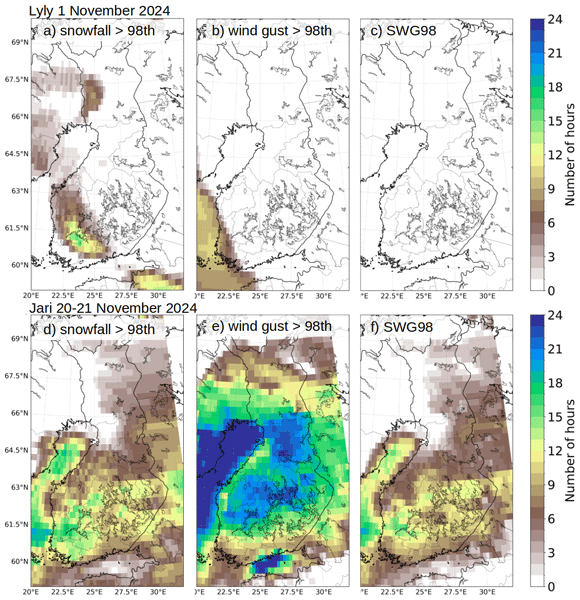
I also feel that the definition of compound events adopted in this study is somewhat narrow. The authors define compound events only as hours during which both wind and snow exceed their respective thresholds simultaneously. However, these extremes are often embedded within larger-scale weather systems (e.g. cyclones or frontal systems), in which wind and snow extremes may occur at different times while still being associated with the same event. Similarly, the extremes may occur in different locations but arise from the same underlying system, as illustrated by the Storm Lyly case study in Figure 8. This distinction is important because impacts can compound and accumulate over both time and space, potentially leading to greater overall consequences than those associated with a single extreme. Such compounding does not necessarily require the hazards to be perfectly co-located in time or space. The current definition is entirely valid for the purposes of this study, but it would be helpful for the authors to acknowledge the broader range of compound event definitions and clarify that their analysis focuses on one specific definition of compound risk.
Overall, I think the authors and the paper’s discussion would benefit more broadly from engaging with the wider literature around compound events, particularly studies of wind and rainfall extremes, which may be directly relevant for this study.
Technical Correction
P3 L64-65: I think it would be helpful if you could mention the dataset that the wind speeds are measured from. Absolute values can mean different things depending on if the wind exceeds 17ms-1 according to ERA5 or according to in-situ station observations.
P8 L174: Correct EAR5 to ERA5.
P8 182-186: If observations only include snowfall amounts above 0.01, then should you not remove such measurements from ERA5 also? Please outline why this is justified.
P8 L187-190: I think it would be beneficial to additionally discuss the differences between in-situ observations and a grid-based product such as ERA5. This will automatically introduce differences between the datasets and so a one-to-one comparison is unlikely to yield exact like for like comparison. Additionally, I’m surprised to see higher wind speeds in ERA5 compared to the in-situ wind speeds given that ERA5 provides a grid cell average. I wonder if this arises due to the location along the coast. For instance, does the nearest grid cell overlap land and sea? And if so, which roughness coefficient does ERA5 use at this grid cell? If its using a roughness coefficient from the sea, then this could explain why the wind speeds are higher. If that’s the case, it might useful to have an additional comparison with a grid cell that is entirely over land.
P15 L270-271: The result does not indicate anything about impacts. It shows that the hazards are more likely, but without knowledge of exposure or vulnerability, we have no indication if impacts are greater here.
P17 Table: Please reduce the text in the first column to give only the conditions. Text such as ‘Number of SWG event with…’ is redundant and makes it quite difficult to read the table. I would also suggest using a figure instead of a table to show these results. In that way, you could also assess frequencies across a range of thresholds. Furthermore, an additional improvement would be the replace frequency metrics with return periods which is easier to interpret. Otherwise, one has to continuously refer to the total number of years assessed when trying to see how often these events are likely to occur.
P19 Figure 7: It is not clear why Figure 7 is used, nor why events with durations longer than 12 hours are highlighted in red. The authors mention Figure 7 on P18 L328-334 but we are not given any insight as why we need to look at this figure. Please discuss this more and highlight exactly what you are concluding from Figure 7. There is likely a lot more information in this Figure than the Authors discuss including information on the dependence of snowfall and wind gust during events.
P20 Section 3.5: What is the motivation for these case studies. It is not clear what they are adding to the paper and how they relate to previous results. I believe would be useful to expand this section, in particular to link it in with previous results as well as highlight why it is necessary.
P24 L427: The distinction demonstrates different types of compound events but I do not agree that it demonstrates an additional value. However, please further explain this value if there is another reason beyond identifying different types of events.
P24 L436-437: In what sense does the percentile based approach make the analysis in ERA5 more robust?
Citation: https://doi.org/10.5194/egusphere-2026-2363-RC2 - AC2: 'Reply on RC2', Taru Olsson, 17 Aug 2026
Peer review completion
Journal article(s) based on this preprint
Viewed
| HTML | XML | Total | BibTeX | EndNote | |
|---|---|---|---|---|---|
| 292 | 104 | 39 | 435 | 32 | 38 |
- HTML: 292
- PDF: 104
- XML: 39
- Total: 435
- BibTeX: 32
- EndNote: 38
Viewed (geographical distribution)
| Country | # | Views | % |
|---|
| Total: | 0 |
| HTML: | 0 |
| PDF: | 0 |
| XML: | 0 |
- 1

Terhi Laurila
Ari Aaltonen
Kirsti Jylhä
The requested preprint has a corresponding peer-reviewed final revised paper. You are encouraged to refer to the final revised version.
- Preprint
(3426 KB) - Metadata XML
This paper was very well written and provides a clear and interesting assessment. I found as I read the manuscript that potential issues or shortcomings I had were eventually answered (i.e., comparison of the ERA5 variables to stations - which I am glad to see was done, and the comparison of wind/snow only events to SWGs, which was an interesting comparison I was going to suggest anyway). The authors acknowledge the shortcomings of ERA5 while showing why such a product is necessary for this type of assessment. I have made a few comments on some unclear sentences in the text which I suggest rewording for clarity, but otherwise I find this ready for publication. I have indicated I would be willing to review this paper, but I don't feel I will need to given the minor revisions I have suggested.
Comments: