
the Creative Commons Attribution 4.0 License.
the Creative Commons Attribution 4.0 License.
 | 30 Apr 2026
A simplified isoprene oxidation mechanism for fast global chemistry transport modeling and emission inversion
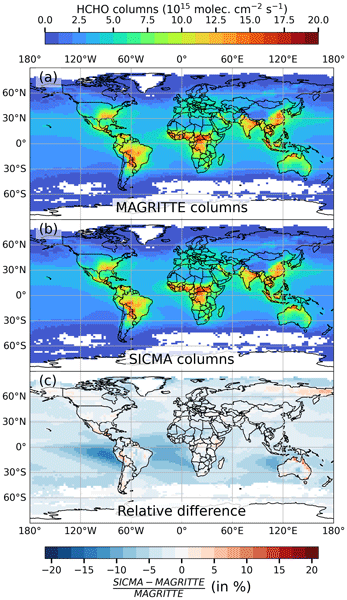
Abstract. We introduce the Simplified Isoprene Chemistry for MAGRITTE (SICMA), a compact chemical mechanism designed for computationally efficient global chemistry transport modeling and adjoint-based emission inversions. The scheme reduces the isoprene oxidation network of the MAGRITTEv1.2 model from 93 organic species and 243 reactions to four organic species and five lumped reactions. The SICMA parameters (rate coefficients and product yields) are optimized using box-model simulations across multiple NOx regimes to reproduce cumulative formaldehyde (HCHO) production and HOx concentrations from the full mechanism. The simplified scheme successfully captures the NOx-dependent branching of isoprene oxidation and reproduces HCHO production and oxidant recycling with high fidelity. Implemented in the global MAGRITTE model, SICMA reproduces the monthly HCHO vertical columns from the full chemistry run within 10 % over most continental regions. Larger discrepancies occur over boreal forests and remote oceans, mainly due to the simplified treatment of monoterpene oxidation and organic nitrate chemistry. Despite these simplifications, the seasonal cycle and spatial distribution of HCHO columns remain in close agreement with both the full chemistry simulation and TROPOMI observations. Inversions of isoprene emissions constrained by TROPOMI HCHO columns yield nearly identical global totals when using SICMA or the full chemistry (568.0 and 568.4 Tg yr-1, respectively). SICMA therefore provides a robust and computationally efficient alternative to detailed isoprene mechanisms for large-scale modeling and emission inversion applications.
-
Notice on discussion status
The requested preprint has a corresponding peer-reviewed final revised paper. You are encouraged to refer to the final revised version.
-
Preprint
(12529 KB)
-
Supplement
(2953 KB)
-
The requested preprint has a corresponding peer-reviewed final revised paper. You are encouraged to refer to the final revised version.
- Preprint
(12529 KB) - Metadata XML
-
Supplement
(2953 KB) - BibTeX
- EndNote
- Final revised paper


Journal article(s) based on this preprint
Interactive discussion
Status: closed
-
RC1: 'Comment on egusphere-2026-2362', Anonymous Referee #1, 30 May 2026
- AC1: 'Reply on RC1', Glenn-Michael Oomen, 24 Aug 2026
-
RC2: 'Comment on egusphere-2026-2362', Anonymous Referee #2, 08 Jun 2026
The comment was uploaded in the form of a supplement: https://egusphere.copernicus.org/preprints/2026/egusphere-2026-2362/egusphere-2026-2362-RC2-supplement.pdf
- AC2: 'Reply on RC2', Glenn-Michael Oomen, 24 Aug 2026
-
RC3: 'Referee comment on egusphere-2026-2362', Anonymous Referee #3, 16 Jun 2026
This manuscript introduces a drastically reduced isoprene oxidation mechanism "SICMA" for use in chemical transport modeling to minimize the computational cost of chemistry steps within the model. The authors specify a five-reaction, three-isoprene-related-species format for a reaction network meant to mimic the effect of isoprene photooxidation on formaldehyde, OH, and HO2. They then optimize tunable parameters within this framework (including some reaction rates and product yields) to minimize differences between SICMA and a detailed mechanism of concentrations of HCHO, OH, and HO2 using a simple box model setup. Next, they incorporate SICMA into the global MAGRITTE model and show that the reduced mechanism adequately represents outcomes of interest over major isoprene-emitting regions. Finally, they use SICMA to perform a model inversion, deriving isoprene emissions from measured TROPOMI satellite HCHO columns, and find minimal overall differences from an equivalent inversion with complex chemistry.Overall, the manuscript is very well-written, and the utility of SICMA is made fairly obvious for this specific application of deriving biogenic VOC emissions from formaldehyde columns -- a process that requires substantial computational capacity and for which SICMA is specifically optimized. I recommend the manuscript be published in GMD following minor revisions to address the points raised below. I'd also like to note that my area of expertise does not include the emission inversion process, so hopefully another reviewer is better able to assess those sections.
First, I believe that the title and abstract moderately over-sell the utility of SICMA; it's very specifically designed to optimize formaldehyde, and does an excellent job as demonstrated here for inversions from formaldehyde observations, but specifically does not optimize NOx or ozone or allow for any isoprene (or monoterpene) derived SOA formation, which severely limits its utility for many other applications in global chemistry transport modeling. I'd recommend specifically referencing formaldehyde, or perhaps formaldehyde and HOx together, in the title to clarify.
Second and perhaps most importantly, I find the choice of combining isoprene with monoterpenes in a 10:1 ratio for the mechanism simplification and subsequent inversion very strange and highly limiting. if i'm understanding it right, you've optimized not an isoprene mechanism, but a fixed, specific isoprene + monoterpene combination that therefore doesn't really let you back out isoprene emissions precisely, and doesn't allow for flexibility in the spatial and temporal distribution of the isoprene-to-monoterpene ratio. Would it have been severely limiting to optimize a separate monoterpene + OH --> x*HCHO reaction (or a few reactions to get the NOx dependence right), or to consider the monoterpene-derived formaldehyde fixed and only optimize the mechanism and perform an inversion for isoprene?
I hesitate to suggest that the authors reformulate their mechanism or rerun any simulations, but at least acknowledging this detail of the mechanism in the abstract and discussing the implications for inversions and for forward modeling in the conclusions (beyond the cursory acknowledgment of the "crude" accounting on L 326) seems necessary to again avoid overselling the utility of this mechanism. The prospects for improving monoterpene representation in future versions of SICMA should also be discussed.
Further more minor concerns and comments are provided (mostly with line numbers refering to the original manuscript preprint) below:
• Can you provide quantitative evidence of the reduction in computational cost with the SICMA mechanism relative to MAGRITTE for forward and inverse global modeling runs?
• L 139-140: if both HO2 and isomerization contribute in the same environments, why is it necessary to separate them out into two reactions? Are their contributions spatially and temporally heterogeneous enough for this to matter?
• L 146-147 & 155-156: Isomerization being applied to all RO2, instead of just the fraction of RO2 radicals able to undergo 1,6 H-shifts, seems like it should introduce a lot of potential for deviation from the main mechanism. Is this satisfactorily ameliorated by fitting the other parameters? Why not scale the isomerization rate to the fractional abundance of the isomers that are able to undergo the 1,6 H shift? And similarly, why not optimize the yields of OH and HO2 in these reactions? Are they really so well-constrained with actual experimental evidence that they merit this fixed treatment?
• L 163: This fixed value for O3 seems relatively low, as though it might underestimate the contribution of ozonolysis in many actual ambient conditions, and the fixed value for water vapor seem would also impose a limitation on the actual variability of formaldehyde yields from that ozonolysis. Can you estimate how much potential error this introduces to the mechanism by excluding an ozonolysis reaction, and how big a deal it would be if your simulations designed for mechanism optimization has higher ozone concentrations?
• L 167: Imposing a peak of 1 ppb of isoprene and continuous emissions means that your mechanism is optimized for early-generation, short-term formaldehyde production; could this be why you have lower formaldehyde columns over the ocean in comparison to MAGRITTE (fig 4)? Could this be fixed by optimizing against a time series that allows for longer durations, and either (a) adding a third generation, or (b) allowing the IOX + OH reaction to produce a small amount of IOX, or of another formaldehyde precursor already contained in the mechanism?
• L 197-202: Can you comment / speculate on what causes these differences, and potentially how to fix them in future SICMA versions? It seems in particular that a midday difference would be problematic for comparison with a midday satellite...
• Fig 3: Why does Figure 3 show the best HCHO agreement midday if that's when Figure 2 showed the worst agreement?
• L 220-221: Is it important to also evaluate regions beyond the emission hotspots? Genuine question -- maybe if you're just trying to optimize total gross emissions, the answer's no, but it also seems like the potential for the reduced mechanism to deviate from the main one would increase in places either downwind from emissions, where the temporal evolution of the oxidation chain matters, or where you have a mixture of different emission sources
Citation: https://doi.org/10.5194/egusphere-2026-2362-RC3 - AC3: 'Reply on RC3', Glenn-Michael Oomen, 24 Aug 2026
Peer review completion


Interactive discussion
Status: closed
-
RC1: 'Comment on egusphere-2026-2362', Anonymous Referee #1, 30 May 2026
Review of Oomen et al. 2026
This is an interesting and well written evaluation paper of the SIMCA reduced chemical complexity mechanism for the degradation of isoprene. Oomen et al. first detail the development of the reduced chemical mechanism from the MAGRITTE v1.2 mechanism including the box model experiments used to derive the key parameters. They then compare the performance of the SIMCA mechanism in a full CTM simulation to that of a corresponding simulation using the MAGRITTE v1.2 mechanism. Finally, they use inversion techniques and TROPOMI observations of formaldehyde columns to derive new spatial estimates for isoprene emissions.
Overall, this is a good study but before it is considered for publication several key areas need to be addressed and I detail these below.
Please note that as emission inversions are not my area of expertise, I have not evaluated the inversion setup (Section 3.3) in detail.
Major Comments
Parameter optimisation – a fixed temperature of 298 K is used in all box model simulations. While this is a sensible daily mean value for the tropics, the 1,6-H shift of the isoprene is highly temperature dependent (as you capture with your large exponent for R4). How did you derive this temperature dependence if you weren’t changing the temperature in the box model?
Please explain how you forced the concentration of isoprene to follow a diurnal profile in the box modelling. Does this run this risk that, as there is a fixed source of isoprene, that any feedbacks between oxidants and isoprene, which could be different between the mechanisms, are suppressed?
The role of monoterpene chemistry is an important feature of the SIMCA chemistry and needs greater explanation. As I interpret it, while the SIMCA mechanism has no explicit monoterpene chemistry, it implicitly includes a 10:1 ratio of isoprene to monoterpene emissions and this is captured in the fitted parameters. Therefore, its parameters (Table 3) are not describing an isoprene-only situation, but an isoprene + monoterpene situation where the monoterpene concentration is ~10% of the isoprene concentration. If this is correct, this needs to be made much clearer in the abstract and throughout the main text.
Further on this topic, in the CTM evaluation in Section 5 the MAGRITTE v1.2 simulation uses 439 Tg yr-1 of isoprene emissions and the 108 Tg yr-1 of monoterpene emissions. However, SIMCA has no monoterpene chemistry so only uses the 439 Tg yr-1 of isoprene emissions with remaining 108 Tg yr-1 “accounted for” by SIMCA’s chemistry. Is that correct? If so, this needs to be made clear.
When looking at the boreal OH high bias in SIMCA (relative to MAGRITTE), would it be better correct to saying that SIMCA is effectively underestimating monoterpenes in this region (since, as you say, monoterpene/isoprene emissions >> 0.1 here)? I am surprised that the higher local NOx, due to lack of isoprene and monoterpene nitrate formation in SIMCA, doesn’t lead to higher O3 in the region since there should be plentiful isoprene. Could you explain this?
While I broadly agree with the framework for parameter optimisation, the one major omission is the lack of an isoprene nitrate or PAN-type species to act as a surrogate for NOx-reservoir species. To their credit, the authors highlight in several places the problems this omission causes. I will not ask the authors to redo the optimisation, but it is imperative that they mention in their concluding statements that a high priority for further SIMCA development is the inclusion of a nitrate term.
The choice to optimise for HCHO production makes sense given that one of the aims of the SIMCA mechanisms is to be used to generate new isoprene emission estimates. However, there are other important species whose performance needs to be evaluated in more detail if the second aim of the SIMCA mechanism, that of being a feasible alternative mechanism to MAGRITTE v1.2 for chemical transport modelling, is to be met. Specifically, the following evaluation should be done as a minimum and included in the revised manuscript’s main text.
- Monthly mean tropospheric ozone burden for SIMCA and MAGRITTE v1.2 as a timeseries
- Zonal mean ozone differences (for the whole troposphere) between SIMCA and MAGRITTE v1.2
- Tropospheric ozone column differences between SIMCA and MAGRITTE v1.2 using a latitude-time Hovmoller setup to reveal seasonality
- Methane lifetime in SIMCA and MAGRITTE v1.2
In addition, most researchers would expect the production of ozone or ozone burden to the most useful constraint metric, not formaldehyde production. I am not saying your choice is wrong but please explain in more detail the decision not to use ozone burden/production as a target.
While you note that the inversion-derived emissions are very similar using the SIMCA and MAGRITTE v1.2 scheme and that they are 30% higher than the MEGAN emissions, there is no further analysis on the reason for this difference. Given that it is very large, I would like to see some explanation for why both mechanisms need a lot more isoprene to optimise HCHO column performance. Could it potentially be a bias in the NOx emissions being used?
I also think more explanation should be given to the spatial differences in the estimated emissions using the SIMCA and MAGRITTE mechanisms. While the global totals are very similar, the spatial differences are substantial in fractional, and in some places like the Congo or western Amazonia, in absolute terms.
Minor Comments
Line 21 - please make it clear to what “its” corresponds. I suspect it is isoprene but the preceding sentence references biogenic VOCs.
Figure 6 - I think there is a standard from term (e.g. x 1015) missing on the y axis.
Please add the equivalent of Figure 7 for the SIMCA inversion, i.e. specifically 7(b) and 7(c) so that a side by side comparison can be made. Also make clear the bwr colourbar has a logarithmic scale and consider if you can “zoom” in (i.e. I don’t think it is necessary to go from 0.1 to 10) so that the magnitude of changes are easier to identify.
Please give an indication of the decreases to model runtime and compute on switching from MAGRITTE v1.2 to SIMCA.
On line 228 you reference Fig 2c for OH but OH is Fig 2d. I note also that Fig 2d, as it is right now doesn’t present evidence for lower nighttime OH as all OH lines are ~ zero. You will need a log plot to make this argument.
Citation: https://doi.org/10.5194/egusphere-2026-2362-RC1 - AC1: 'Reply on RC1', Glenn-Michael Oomen, 24 Aug 2026
-
RC2: 'Comment on egusphere-2026-2362', Anonymous Referee #2, 08 Jun 2026
The comment was uploaded in the form of a supplement: https://egusphere.copernicus.org/preprints/2026/egusphere-2026-2362/egusphere-2026-2362-RC2-supplement.pdf
- AC2: 'Reply on RC2', Glenn-Michael Oomen, 24 Aug 2026
-
RC3: 'Referee comment on egusphere-2026-2362', Anonymous Referee #3, 16 Jun 2026
This manuscript introduces a drastically reduced isoprene oxidation mechanism "SICMA" for use in chemical transport modeling to minimize the computational cost of chemistry steps within the model. The authors specify a five-reaction, three-isoprene-related-species format for a reaction network meant to mimic the effect of isoprene photooxidation on formaldehyde, OH, and HO2. They then optimize tunable parameters within this framework (including some reaction rates and product yields) to minimize differences between SICMA and a detailed mechanism of concentrations of HCHO, OH, and HO2 using a simple box model setup. Next, they incorporate SICMA into the global MAGRITTE model and show that the reduced mechanism adequately represents outcomes of interest over major isoprene-emitting regions. Finally, they use SICMA to perform a model inversion, deriving isoprene emissions from measured TROPOMI satellite HCHO columns, and find minimal overall differences from an equivalent inversion with complex chemistry.Overall, the manuscript is very well-written, and the utility of SICMA is made fairly obvious for this specific application of deriving biogenic VOC emissions from formaldehyde columns -- a process that requires substantial computational capacity and for which SICMA is specifically optimized. I recommend the manuscript be published in GMD following minor revisions to address the points raised below. I'd also like to note that my area of expertise does not include the emission inversion process, so hopefully another reviewer is better able to assess those sections.
First, I believe that the title and abstract moderately over-sell the utility of SICMA; it's very specifically designed to optimize formaldehyde, and does an excellent job as demonstrated here for inversions from formaldehyde observations, but specifically does not optimize NOx or ozone or allow for any isoprene (or monoterpene) derived SOA formation, which severely limits its utility for many other applications in global chemistry transport modeling. I'd recommend specifically referencing formaldehyde, or perhaps formaldehyde and HOx together, in the title to clarify.
Second and perhaps most importantly, I find the choice of combining isoprene with monoterpenes in a 10:1 ratio for the mechanism simplification and subsequent inversion very strange and highly limiting. if i'm understanding it right, you've optimized not an isoprene mechanism, but a fixed, specific isoprene + monoterpene combination that therefore doesn't really let you back out isoprene emissions precisely, and doesn't allow for flexibility in the spatial and temporal distribution of the isoprene-to-monoterpene ratio. Would it have been severely limiting to optimize a separate monoterpene + OH --> x*HCHO reaction (or a few reactions to get the NOx dependence right), or to consider the monoterpene-derived formaldehyde fixed and only optimize the mechanism and perform an inversion for isoprene?
I hesitate to suggest that the authors reformulate their mechanism or rerun any simulations, but at least acknowledging this detail of the mechanism in the abstract and discussing the implications for inversions and for forward modeling in the conclusions (beyond the cursory acknowledgment of the "crude" accounting on L 326) seems necessary to again avoid overselling the utility of this mechanism. The prospects for improving monoterpene representation in future versions of SICMA should also be discussed.
Further more minor concerns and comments are provided (mostly with line numbers refering to the original manuscript preprint) below:
• Can you provide quantitative evidence of the reduction in computational cost with the SICMA mechanism relative to MAGRITTE for forward and inverse global modeling runs?
• L 139-140: if both HO2 and isomerization contribute in the same environments, why is it necessary to separate them out into two reactions? Are their contributions spatially and temporally heterogeneous enough for this to matter?
• L 146-147 & 155-156: Isomerization being applied to all RO2, instead of just the fraction of RO2 radicals able to undergo 1,6 H-shifts, seems like it should introduce a lot of potential for deviation from the main mechanism. Is this satisfactorily ameliorated by fitting the other parameters? Why not scale the isomerization rate to the fractional abundance of the isomers that are able to undergo the 1,6 H shift? And similarly, why not optimize the yields of OH and HO2 in these reactions? Are they really so well-constrained with actual experimental evidence that they merit this fixed treatment?
• L 163: This fixed value for O3 seems relatively low, as though it might underestimate the contribution of ozonolysis in many actual ambient conditions, and the fixed value for water vapor seem would also impose a limitation on the actual variability of formaldehyde yields from that ozonolysis. Can you estimate how much potential error this introduces to the mechanism by excluding an ozonolysis reaction, and how big a deal it would be if your simulations designed for mechanism optimization has higher ozone concentrations?
• L 167: Imposing a peak of 1 ppb of isoprene and continuous emissions means that your mechanism is optimized for early-generation, short-term formaldehyde production; could this be why you have lower formaldehyde columns over the ocean in comparison to MAGRITTE (fig 4)? Could this be fixed by optimizing against a time series that allows for longer durations, and either (a) adding a third generation, or (b) allowing the IOX + OH reaction to produce a small amount of IOX, or of another formaldehyde precursor already contained in the mechanism?
• L 197-202: Can you comment / speculate on what causes these differences, and potentially how to fix them in future SICMA versions? It seems in particular that a midday difference would be problematic for comparison with a midday satellite...
• Fig 3: Why does Figure 3 show the best HCHO agreement midday if that's when Figure 2 showed the worst agreement?
• L 220-221: Is it important to also evaluate regions beyond the emission hotspots? Genuine question -- maybe if you're just trying to optimize total gross emissions, the answer's no, but it also seems like the potential for the reduced mechanism to deviate from the main one would increase in places either downwind from emissions, where the temporal evolution of the oxidation chain matters, or where you have a mixture of different emission sources
Citation: https://doi.org/10.5194/egusphere-2026-2362-RC3 - AC3: 'Reply on RC3', Glenn-Michael Oomen, 24 Aug 2026
Peer review completion
Journal article(s) based on this preprint
Data sets
TROPOMI HCHO columns from ESA CCI (L3) I. De Smedt et al. https://doi.org/10.18758/y591kda5
Model code and software
KPP-Based Optimization of Simplified Chemistry Models G.-M. Oomen https://doi.org/10.5281/zenodo.19886691
Viewed
| HTML | XML | Total | Supplement | BibTeX | EndNote | |
|---|---|---|---|---|---|---|
| 405 | 185 | 56 | 646 | 58 | 57 | 65 |
- HTML: 405
- PDF: 185
- XML: 56
- Total: 646
- Supplement: 58
- BibTeX: 57
- EndNote: 65
Viewed (geographical distribution)
| Country | # | Views | % |
|---|
| Total: | 0 |
| HTML: | 0 |
| PDF: | 0 |
| XML: | 0 |
- 1
Glenn-Michael Oomen

Jean-François Müller
Trissevgeni Stavrakou
Isabelle De Smedt
Vincent Huijnen
Flora Kluge
Antje Inness
Johannes Flemming
The requested preprint has a corresponding peer-reviewed final revised paper. You are encouraged to refer to the final revised version.
- Preprint
(12529 KB) - Metadata XML
-
Supplement
(2953 KB) - BibTeX
- EndNote
- Final revised paper
Review of Oomen et al. 2026
This is an interesting and well written evaluation paper of the SIMCA reduced chemical complexity mechanism for the degradation of isoprene. Oomen et al. first detail the development of the reduced chemical mechanism from the MAGRITTE v1.2 mechanism including the box model experiments used to derive the key parameters. They then compare the performance of the SIMCA mechanism in a full CTM simulation to that of a corresponding simulation using the MAGRITTE v1.2 mechanism. Finally, they use inversion techniques and TROPOMI observations of formaldehyde columns to derive new spatial estimates for isoprene emissions.
Overall, this is a good study but before it is considered for publication several key areas need to be addressed and I detail these below.
Please note that as emission inversions are not my area of expertise, I have not evaluated the inversion setup (Section 3.3) in detail.
Major Comments
Parameter optimisation – a fixed temperature of 298 K is used in all box model simulations. While this is a sensible daily mean value for the tropics, the 1,6-H shift of the isoprene is highly temperature dependent (as you capture with your large exponent for R4). How did you derive this temperature dependence if you weren’t changing the temperature in the box model?
Please explain how you forced the concentration of isoprene to follow a diurnal profile in the box modelling. Does this run this risk that, as there is a fixed source of isoprene, that any feedbacks between oxidants and isoprene, which could be different between the mechanisms, are suppressed?
The role of monoterpene chemistry is an important feature of the SIMCA chemistry and needs greater explanation. As I interpret it, while the SIMCA mechanism has no explicit monoterpene chemistry, it implicitly includes a 10:1 ratio of isoprene to monoterpene emissions and this is captured in the fitted parameters. Therefore, its parameters (Table 3) are not describing an isoprene-only situation, but an isoprene + monoterpene situation where the monoterpene concentration is ~10% of the isoprene concentration. If this is correct, this needs to be made much clearer in the abstract and throughout the main text.
Further on this topic, in the CTM evaluation in Section 5 the MAGRITTE v1.2 simulation uses 439 Tg yr-1 of isoprene emissions and the 108 Tg yr-1 of monoterpene emissions. However, SIMCA has no monoterpene chemistry so only uses the 439 Tg yr-1 of isoprene emissions with remaining 108 Tg yr-1 “accounted for” by SIMCA’s chemistry. Is that correct? If so, this needs to be made clear.
When looking at the boreal OH high bias in SIMCA (relative to MAGRITTE), would it be better correct to saying that SIMCA is effectively underestimating monoterpenes in this region (since, as you say, monoterpene/isoprene emissions >> 0.1 here)? I am surprised that the higher local NOx, due to lack of isoprene and monoterpene nitrate formation in SIMCA, doesn’t lead to higher O3 in the region since there should be plentiful isoprene. Could you explain this?
While I broadly agree with the framework for parameter optimisation, the one major omission is the lack of an isoprene nitrate or PAN-type species to act as a surrogate for NOx-reservoir species. To their credit, the authors highlight in several places the problems this omission causes. I will not ask the authors to redo the optimisation, but it is imperative that they mention in their concluding statements that a high priority for further SIMCA development is the inclusion of a nitrate term.
The choice to optimise for HCHO production makes sense given that one of the aims of the SIMCA mechanisms is to be used to generate new isoprene emission estimates. However, there are other important species whose performance needs to be evaluated in more detail if the second aim of the SIMCA mechanism, that of being a feasible alternative mechanism to MAGRITTE v1.2 for chemical transport modelling, is to be met. Specifically, the following evaluation should be done as a minimum and included in the revised manuscript’s main text.
In addition, most researchers would expect the production of ozone or ozone burden to the most useful constraint metric, not formaldehyde production. I am not saying your choice is wrong but please explain in more detail the decision not to use ozone burden/production as a target.
While you note that the inversion-derived emissions are very similar using the SIMCA and MAGRITTE v1.2 scheme and that they are 30% higher than the MEGAN emissions, there is no further analysis on the reason for this difference. Given that it is very large, I would like to see some explanation for why both mechanisms need a lot more isoprene to optimise HCHO column performance. Could it potentially be a bias in the NOx emissions being used?
I also think more explanation should be given to the spatial differences in the estimated emissions using the SIMCA and MAGRITTE mechanisms. While the global totals are very similar, the spatial differences are substantial in fractional, and in some places like the Congo or western Amazonia, in absolute terms.
Minor Comments
Line 21 - please make it clear to what “its” corresponds. I suspect it is isoprene but the preceding sentence references biogenic VOCs.
Figure 6 - I think there is a standard from term (e.g. x 1015) missing on the y axis.
Please add the equivalent of Figure 7 for the SIMCA inversion, i.e. specifically 7(b) and 7(c) so that a side by side comparison can be made. Also make clear the bwr colourbar has a logarithmic scale and consider if you can “zoom” in (i.e. I don’t think it is necessary to go from 0.1 to 10) so that the magnitude of changes are easier to identify.
Please give an indication of the decreases to model runtime and compute on switching from MAGRITTE v1.2 to SIMCA.
On line 228 you reference Fig 2c for OH but OH is Fig 2d. I note also that Fig 2d, as it is right now doesn’t present evidence for lower nighttime OH as all OH lines are ~ zero. You will need a log plot to make this argument.