
the Creative Commons Attribution 4.0 License.
the Creative Commons Attribution 4.0 License.
 | 11 May 2026
A workflow for the identification of earthquake sources from macroseismic data
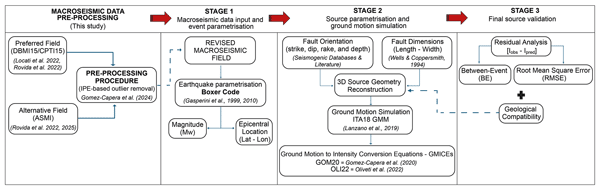
Abstract. Macroseismic intensity data are a fundamental source of information for characterising historical earthquakes. This study presents a methodology to constrain the sources of large earthquake through the analysis and modelling of macroseismic intensity data. The proposed workflow consists of three main stages: (1) the identification and removal of outlier intensity data points; (2) the revision of macroseismic earthquake parameters (epicentral location and magnitude); and (3) the construction of three-dimensional (3D) seismogenic sources, simulation of ground shaking including site effects, and a subsequent residual analysis. The application of this workflow to a set of case studies from the parametric catalogue of Italian earthquakes demonstrates that the implemented approach allows the identification of seismogenic sources for large to moderate magnitude events, which are consistent with macroseismic data, geological structures and ground motion data, when available. The results of this study can have direct implications for seismic hazard assessment and shaking scenario modelling. The proposed workflow can be systematically applied to reconstruct the seismogenic sources of the strongest Italian historical earthquakes (Mw ≥ 5.5).
-
Notice on discussion status
The requested preprint has a corresponding peer-reviewed final revised paper. You are encouraged to refer to the final revised version.
-
Preprint
(2407 KB)
-
Supplement
(1213 KB)
-
The requested preprint has a corresponding peer-reviewed final revised paper. You are encouraged to refer to the final revised version.
- Preprint
(2407 KB) - Metadata XML
-
Supplement
(1213 KB) - BibTeX
- EndNote
- Final revised paper


Journal article(s) based on this preprint
Interactive discussion
Status: closed
-
RC1: 'Comment on egusphere-2026-2323', Anonymous Referee #1, 24 May 2026
-
AC1: 'Reply on RC1', Veronica Gironelli, 21 Jun 2026
The comment was uploaded in the form of a supplement: https://egusphere.copernicus.org/preprints/2026/egusphere-2026-2323/egusphere-2026-2323-AC1-supplement.pdf
-
AC1: 'Reply on RC1', Veronica Gironelli, 21 Jun 2026
-
RC2: 'Comment on egusphere-2026-2323', Josep Batlló, 15 Jun 2026
Review of “A workflow for the identification of earthquake sources from macroseismic data”
The paper “A workflow for the identification of earthquake sources from macroseismic data” submitted for publication in NHESS by Gironelli, Luzi, Antonucci and Rovida, introduces a methodology to elucidate among different earthquake sources as origin of a given event using macroseismic data.
I think this is a good contribution, showing new ways to investigate among competing earthquakes sources using macroseismic data and contributing, at the very end, to a better assessment of regional seismic hazard.
The paper is using data and methodologies already available. The key point is how to use them for the proposed objectives. The methodology is a quantitative and repeatable one, based in a workflow using available tools, easy to implement, in wise manner.
The process (workflow in the authors terminology) starts with a selection of available macroseismic fields for a given earthquake, elimination of IDP outliers (because they are not properly assigned or due to factors as local amplification, accumulation of damage, etc.) and epicentral parameter recalculation using Boxer algorithm. Then, the reviewed epicentral parameters and the characteristics of the possible seismic sources for the event (obtained from DISS) are used to calculate synthetic macroseismic fields with two different GMICE commonly used in Italy. Finally, fitting of the synthetic macroseismic fields with the real one, based on statistical parameters gives the best fitting seismic source for the investigated event. Certainly, this methodology is not going to solve/clarify all cases; but it may be useful in many of them.
Databases, models and examples used in this paper apply to Italy; but the methodology is applicable elsewhere if similar information (IDPs, GMICEs, earthquake sources/active faults) is available.
About the article itself, as it has been submitted for publication, in an overview, and to my understanding, it is properly written. It is quite long. As four cases are analyzed in a very similar way, it may look repetitive, but I do not see another way to show them properly (they may be presented as supplementary material; but the authors try to show different cases -data quality, fault type, etc.- and it is good to show all of them at the same level). Presentation and discussion of the different topics covered are well organized. The examples have been properly selected and are presented with enough detail level. Figures are appropriate and clear. Finally, the bibliography covers well the topics/issues presented and is quite comprehensive.
The presented results are relevant for the improvement of local/regional identification of true earthquake sources when different candidates are available. Also, even not said explicitly, the methodology may be useful to assess more confident epicentral parameters when available macroseismic data show inconsistencies. Moreover, the presented methodologies can be used in many other places worldwide and the submitted paper can be used as guide for similar studies elsewhere. Thus, I think the submitted paper fits properly on the scope of NHESS.
I’ll not go into many specific details on the submitted written text. It is good for me. But I’ll point some questions and a few items I think may be improved and/or clarified.
-----------------
Title: I’m in doubt… Maybe the title should be “A methodology for…”. Then, in the article body, on presenting the methodology, there is a workflow to be followed. Maybe the editor has a better view about what to use.
Lines 38/39.- Citations (Gasperini and Ferrari, 1995, 2000) are not in the reference list.
Lines 75 and 86.- At line 75 you mention the IPE of Sibol (1987). It is used in Boxer. In line 86 you are referring the IPE of Gomez-Caper at al. (2024). I assume you are using the last one to generate the synthetic IDP; but not in Boxer. Am I right?? Using one IPE for earthquake parameters and another for synthetics does not look very nice (or coherent). I agree it is the easiest way. Other way, you should recompile Boxer.
Line 137.- Citation (Tinti et al, 2016) is not in the reference list.
Line 174.- I think citation (Pondrelli, 2002) is wrong.
Line 176.- Maybe on citing Rossi et al, (2019) it should be indicated these data will be called ROSAL019 here. Otherwise, ROSAL019 is found for the first time in figure 3 caption.
Lines 221/223.- It will be good to give a reference for the problem of saturation exhibited by OLI22.
Lines 230/231.- Are you fixing thresholds for BE and RMSE arbitrarily or have you some previous experience on this topic.
Line 281.- Citation (Westaway et al, 1989) is not found in the reference list.
Lines 310/314.- Thus, your choice is META_04 because META_007 does not feet properly with the geological setting, isn’t it??
Lines 328 and 344.- See note about Pondrelli in the reference list.
Lines 683/685.- For coherence with the body text (line 327), this reference should start as OGS-RSFVG, Istituto…
Line 688.- Again, for coherence with the body text (line 140), this reference should start as ISC, International…
Lines 745/749.- It should be clarified which article is “Pondrelli et al, 2006a and 2006b”. Check also in the body text.
Lines 798/802.- Please, check alphabetical order.
Citation: https://doi.org/10.5194/egusphere-2026-2323-RC2 -
AC2: 'Reply on RC2', Veronica Gironelli, 21 Jun 2026
The comment was uploaded in the form of a supplement: https://egusphere.copernicus.org/preprints/2026/egusphere-2026-2323/egusphere-2026-2323-AC2-supplement.pdf
-
AC2: 'Reply on RC2', Veronica Gironelli, 21 Jun 2026
Peer review completion


Interactive discussion
Status: closed
-
RC1: 'Comment on egusphere-2026-2323', Anonymous Referee #1, 24 May 2026
Title: A workflow for the identification of earthquake sources from macroseismic data by Gironelli et al.
The manuscript presents a well-structured and scientifically valuable workflow for reconstructing seismogenic sources using macroseismic intensity data. The integration of pre-processing, source reconstruction, ground-motion simulation, and residual analysis is comprehensive and methodologically sound. The topic is highly relevant for historical seismology and seismic hazard assessment, especially in regions with limited instrumental data but abundant macroseismic observations. The workflow is clearly explained and supported by suitable case studies, including both instrumental and historical earthquakes, thereby strengthening the applicability of the proposed methodology. The manuscript demonstrates a strong use of Italian seismic databases, such as DBMI15, CPTI15, DISS, and ITACA, and effectively integrates multidisciplinary datasets.
- in abstract change “This study presents a methodology to constrain the sources of large earthquakes...”
Additionally, please mention the novelty of integrating residual analysis with outlier detection in the abstract.
- The literature review is extensive; however, it may benefit from a short paragraph emphasizing the limitations of existing approaches and how the proposed workflow addresses them.
-Some long sentences could be simplified for better readability, particularly lines 50–65.
- The explanation of the pre-processing stage and outlier removal using the Gomez-Capera et al. (2024) IPE is scientifically sound.
- The authors may consider discussing the sensitivity of the results to the selected 3σ threshold for outlier identification.
- The methodology would benefit from a small flowchart legend explaining abbreviations such as BE, RMSE, GOM20, and OLI22 for readers unfamiliar with the terminology.
- The choice of Wells and Coppersmith (1994) scaling relations is appropriate, but the limitations of applying these empirical relations to historical earthquakes could be briefly discussed.
- The discussion of the 1990 Potenza earthquake clearly illustrates how outliers can bias epicentral estimation.
- In Tables 3 and 5, it may help readers if the best-performing source configurations are highlighted using bold formatting in addition to the asterisk.
- Some figure captions are very long and may be shortened for improved readability.
- Increase font size in several figures (especially residual maps and legends), as some labels are difficult to read.
- Table formatting could be improved slightly for better alignment of columns and readability.
Corrections
“large earthquake” → “large earthquakes”
“best fits the data is identified” → “best-fitting fault is identified”
“ground shaking including the site effects” → “ground shaking including site effects”
Citation: https://doi.org/10.5194/egusphere-2026-2323-RC1 -
AC1: 'Reply on RC1', Veronica Gironelli, 21 Jun 2026
The comment was uploaded in the form of a supplement: https://egusphere.copernicus.org/preprints/2026/egusphere-2026-2323/egusphere-2026-2323-AC1-supplement.pdf
-
AC1: 'Reply on RC1', Veronica Gironelli, 21 Jun 2026
-
RC2: 'Comment on egusphere-2026-2323', Josep Batlló, 15 Jun 2026
Review of “A workflow for the identification of earthquake sources from macroseismic data”
The paper “A workflow for the identification of earthquake sources from macroseismic data” submitted for publication in NHESS by Gironelli, Luzi, Antonucci and Rovida, introduces a methodology to elucidate among different earthquake sources as origin of a given event using macroseismic data.
I think this is a good contribution, showing new ways to investigate among competing earthquakes sources using macroseismic data and contributing, at the very end, to a better assessment of regional seismic hazard.
The paper is using data and methodologies already available. The key point is how to use them for the proposed objectives. The methodology is a quantitative and repeatable one, based in a workflow using available tools, easy to implement, in wise manner.
The process (workflow in the authors terminology) starts with a selection of available macroseismic fields for a given earthquake, elimination of IDP outliers (because they are not properly assigned or due to factors as local amplification, accumulation of damage, etc.) and epicentral parameter recalculation using Boxer algorithm. Then, the reviewed epicentral parameters and the characteristics of the possible seismic sources for the event (obtained from DISS) are used to calculate synthetic macroseismic fields with two different GMICE commonly used in Italy. Finally, fitting of the synthetic macroseismic fields with the real one, based on statistical parameters gives the best fitting seismic source for the investigated event. Certainly, this methodology is not going to solve/clarify all cases; but it may be useful in many of them.
Databases, models and examples used in this paper apply to Italy; but the methodology is applicable elsewhere if similar information (IDPs, GMICEs, earthquake sources/active faults) is available.
About the article itself, as it has been submitted for publication, in an overview, and to my understanding, it is properly written. It is quite long. As four cases are analyzed in a very similar way, it may look repetitive, but I do not see another way to show them properly (they may be presented as supplementary material; but the authors try to show different cases -data quality, fault type, etc.- and it is good to show all of them at the same level). Presentation and discussion of the different topics covered are well organized. The examples have been properly selected and are presented with enough detail level. Figures are appropriate and clear. Finally, the bibliography covers well the topics/issues presented and is quite comprehensive.
The presented results are relevant for the improvement of local/regional identification of true earthquake sources when different candidates are available. Also, even not said explicitly, the methodology may be useful to assess more confident epicentral parameters when available macroseismic data show inconsistencies. Moreover, the presented methodologies can be used in many other places worldwide and the submitted paper can be used as guide for similar studies elsewhere. Thus, I think the submitted paper fits properly on the scope of NHESS.
I’ll not go into many specific details on the submitted written text. It is good for me. But I’ll point some questions and a few items I think may be improved and/or clarified.
-----------------
Title: I’m in doubt… Maybe the title should be “A methodology for…”. Then, in the article body, on presenting the methodology, there is a workflow to be followed. Maybe the editor has a better view about what to use.
Lines 38/39.- Citations (Gasperini and Ferrari, 1995, 2000) are not in the reference list.
Lines 75 and 86.- At line 75 you mention the IPE of Sibol (1987). It is used in Boxer. In line 86 you are referring the IPE of Gomez-Caper at al. (2024). I assume you are using the last one to generate the synthetic IDP; but not in Boxer. Am I right?? Using one IPE for earthquake parameters and another for synthetics does not look very nice (or coherent). I agree it is the easiest way. Other way, you should recompile Boxer.
Line 137.- Citation (Tinti et al, 2016) is not in the reference list.
Line 174.- I think citation (Pondrelli, 2002) is wrong.
Line 176.- Maybe on citing Rossi et al, (2019) it should be indicated these data will be called ROSAL019 here. Otherwise, ROSAL019 is found for the first time in figure 3 caption.
Lines 221/223.- It will be good to give a reference for the problem of saturation exhibited by OLI22.
Lines 230/231.- Are you fixing thresholds for BE and RMSE arbitrarily or have you some previous experience on this topic.
Line 281.- Citation (Westaway et al, 1989) is not found in the reference list.
Lines 310/314.- Thus, your choice is META_04 because META_007 does not feet properly with the geological setting, isn’t it??
Lines 328 and 344.- See note about Pondrelli in the reference list.
Lines 683/685.- For coherence with the body text (line 327), this reference should start as OGS-RSFVG, Istituto…
Line 688.- Again, for coherence with the body text (line 140), this reference should start as ISC, International…
Lines 745/749.- It should be clarified which article is “Pondrelli et al, 2006a and 2006b”. Check also in the body text.
Lines 798/802.- Please, check alphabetical order.
Citation: https://doi.org/10.5194/egusphere-2026-2323-RC2 -
AC2: 'Reply on RC2', Veronica Gironelli, 21 Jun 2026
The comment was uploaded in the form of a supplement: https://egusphere.copernicus.org/preprints/2026/egusphere-2026-2323/egusphere-2026-2323-AC2-supplement.pdf
-
AC2: 'Reply on RC2', Veronica Gironelli, 21 Jun 2026
Peer review completion
Journal article(s) based on this preprint
Viewed
| HTML | XML | Total | Supplement | BibTeX | EndNote | |
|---|---|---|---|---|---|---|
| 320 | 142 | 37 | 499 | 57 | 33 | 32 |
- HTML: 320
- PDF: 142
- XML: 37
- Total: 499
- Supplement: 57
- BibTeX: 33
- EndNote: 32
Viewed (geographical distribution)
| Country | # | Views | % |
|---|
| Total: | 0 |
| HTML: | 0 |
| PDF: | 0 |
| XML: | 0 |
- 1
Veronica Gironelli

Lucia Luzi
Andrea Antonucci
Andrea Rovida
The requested preprint has a corresponding peer-reviewed final revised paper. You are encouraged to refer to the final revised version.
- Preprint
(2407 KB) - Metadata XML
-
Supplement
(1213 KB) - BibTeX
- EndNote
- Final revised paper
Title: A workflow for the identification of earthquake sources from macroseismic data by Gironelli et al.
The manuscript presents a well-structured and scientifically valuable workflow for reconstructing seismogenic sources using macroseismic intensity data. The integration of pre-processing, source reconstruction, ground-motion simulation, and residual analysis is comprehensive and methodologically sound. The topic is highly relevant for historical seismology and seismic hazard assessment, especially in regions with limited instrumental data but abundant macroseismic observations. The workflow is clearly explained and supported by suitable case studies, including both instrumental and historical earthquakes, thereby strengthening the applicability of the proposed methodology. The manuscript demonstrates a strong use of Italian seismic databases, such as DBMI15, CPTI15, DISS, and ITACA, and effectively integrates multidisciplinary datasets.
- in abstract change “This study presents a methodology to constrain the sources of large earthquakes...”
Additionally, please mention the novelty of integrating residual analysis with outlier detection in the abstract.
- The literature review is extensive; however, it may benefit from a short paragraph emphasizing the limitations of existing approaches and how the proposed workflow addresses them.
-Some long sentences could be simplified for better readability, particularly lines 50–65.
- The explanation of the pre-processing stage and outlier removal using the Gomez-Capera et al. (2024) IPE is scientifically sound.
- The authors may consider discussing the sensitivity of the results to the selected 3σ threshold for outlier identification.
- The methodology would benefit from a small flowchart legend explaining abbreviations such as BE, RMSE, GOM20, and OLI22 for readers unfamiliar with the terminology.
- The choice of Wells and Coppersmith (1994) scaling relations is appropriate, but the limitations of applying these empirical relations to historical earthquakes could be briefly discussed.
- The discussion of the 1990 Potenza earthquake clearly illustrates how outliers can bias epicentral estimation.
- In Tables 3 and 5, it may help readers if the best-performing source configurations are highlighted using bold formatting in addition to the asterisk.
- Some figure captions are very long and may be shortened for improved readability.
- Increase font size in several figures (especially residual maps and legends), as some labels are difficult to read.
- Table formatting could be improved slightly for better alignment of columns and readability.
Corrections
“large earthquake” → “large earthquakes”
“best fits the data is identified” → “best-fitting fault is identified”
“ground shaking including the site effects” → “ground shaking including site effects”