
the Creative Commons Attribution 4.0 License.
the Creative Commons Attribution 4.0 License.
 | 20 May 2026
Constraints on NOx emission in Thailand using GEMS satellite data
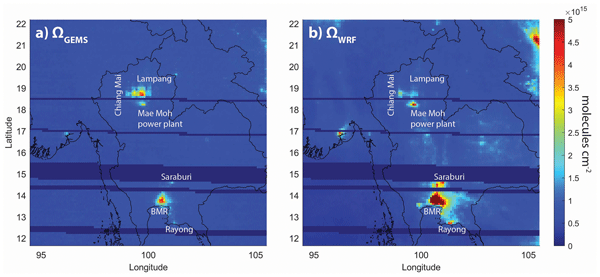
Abstract. Nitrogen oxides (NOx = NO + NO2) are key pollutants that contribute to ozone and secondary aerosol formation, posing environmental and health risks. Accurate simulation and forecasting of NOx pollution is essential for developing mitigation strategies. Local inventories in Thailand are infrequently updated, leading researchers to use global inventories such as CAMS-GLOB-ANT for simulation. Global inventories carry uncertainties due to assumptions in emission factors, outdated activity data, and coarse temporal resolution. To address these limitations, this study applies a top-down approach to update NOx emissions in Thailand using the iterative finite difference mass balance (IFDMB) method. Tropospheric NO2 vertical column densities (VCDs) from the GEMS are integrated with the WRF-Chem to refine CAMS-GLOB-ANT emissions for September 2023. The simulations with posterior emissions are evaluated against TROPOMI NO2 VCDs and surface NOx concentration. Results show that the baseline simulation overestimates NO2 VCDs across Thailand compared with GEMS, except in North Thailand. Consequently, IFDMB reduces NOx emissions across most regions but increases in the North. These adjustments improve model bias and error relative to GEMS. However, when evaluated against TROPOMI, we find an increase in the bias for North Thailand, likely due to discrepancies between GEMS and TROPOMI retrievals. Discrepancies between GEMS and TROPOMI highlight the importance of future calibration across satellite products. Comparisons to surface observations indicate that IFDMB shifts the NOx peak to later than observations. This is because observations are strongly influenced by local transportation sources, which are hard to observe and simulate by GEMS and the model, respectively.
-
Notice on discussion status
The requested preprint has a corresponding peer-reviewed final revised paper. You are encouraged to refer to the final revised version.
-
Preprint
(2001 KB)
-
Supplement
(1838 KB)
-
The requested preprint has a corresponding peer-reviewed final revised paper. You are encouraged to refer to the final revised version.
- Preprint
(2001 KB) - Metadata XML
-
Supplement
(1838 KB) - BibTeX
- EndNote
- Final revised paper


Journal article(s) based on this preprint
Interactive discussion
Status: closed
- RC1: 'Comment on egusphere-2026-2309', Anonymous Referee #1, 22 Jun 2026
-
RC2: 'Comment on egusphere-2026-2309', Anonymous Referee #2, 24 Jun 2026
The study by Thongsame uses a chemistry model and new geostationary satellite data to estimate nitrogen oxide emissions in Thailand. Overall, it is an interesting study using established methods to estimate these emissions. Secondary comparisons with TROPOMI and surface sites provide additional validation of the work. The discussion on the discrepancies between TROPOMI and GEMS are an interesting and valuable addition to the literature. The analysis is detailed, which suites the scope of ACP and suitable of publication subject to some minor corrections:
- In the abstract, GEMS does not “simulate” NO2 (Line 29).
- The authors state that GEO has higher spatial resolution than LEO. If oversampling is used, the LEO datasets can be higher resolutions (i.e. < 1 km) (Line 90).
- The discussion on the averaging kernels is unclear. Please add the equations used to apply the AKs and clear description. It would also be good to add a figure (e.g. in supporting information) comparing the GEMS and TropOMI AKs.
- Why is 230 hPa used for the tropopause (Line 167)? It will also shift in the day, which can be important. Please justify the reasoning behind this.
- Please expand on how the RMSE is calculated as the error term for GEMS data (Line 226)? Would the RMSE be based on the comparison of GEMS with a secondary data set?
- In Section 2.7, how are the metrics (NMB) calculated? Is this done using the observational error? I ask as the MB is used for the surface sites and no error term is available, so I assume the satellite metrics are normalised via the error term. Please make this clear what is used.
- In Section 3.1 and discussion of Figure 5, please add some more quantitative discussion as scientifically weaker as it is.
- Figure 6, would you not expect more iterations before the IFDMB converges. Iterations of 2-4 seems low or very quick to converge on a solution?
- A more detailed discussion on the differences between TropOMI and GEMS. Why can you not directly compare the two products? Would that not provide a systematic bias between the two instruments which other studies could use.
- For Section 3.5, could you not replace e.g. the GEMS apriori with that of TropOMI and recalculate the trop col NO2 around the TropOMI overpass time and GEMS hourly measurements. That would allow more direct and useful comparisons.
Citation: https://doi.org/10.5194/egusphere-2026-2309-RC2 -
AC1: 'Comment on egusphere-2026-2309', Worapop Thongsame, 13 Aug 2026
Dear Editor and Reviewers
Thank you for the opportunity and the great comments on our manuscript. We have carefully considered the comments from the reviewers and have incorporated the necessary revisions. Please find our detailed point-by-point responses in the referenced document named "Response to Reviewers.pdf".
For clarity, we have classified the responses using three colors: the original comments from the reviewers are in black italics, the original text from the manuscript is in normal black, our responses are in blue, and the revised text in the manuscript is in red.
We believe the manuscript has been significantly improved based on this feedback and hope it is now suitable for publication. Thank you for your time and consideration.
Peer review completion


Interactive discussion
Status: closed
- RC1: 'Comment on egusphere-2026-2309', Anonymous Referee #1, 22 Jun 2026
-
RC2: 'Comment on egusphere-2026-2309', Anonymous Referee #2, 24 Jun 2026
The study by Thongsame uses a chemistry model and new geostationary satellite data to estimate nitrogen oxide emissions in Thailand. Overall, it is an interesting study using established methods to estimate these emissions. Secondary comparisons with TROPOMI and surface sites provide additional validation of the work. The discussion on the discrepancies between TROPOMI and GEMS are an interesting and valuable addition to the literature. The analysis is detailed, which suites the scope of ACP and suitable of publication subject to some minor corrections:
- In the abstract, GEMS does not “simulate” NO2 (Line 29).
- The authors state that GEO has higher spatial resolution than LEO. If oversampling is used, the LEO datasets can be higher resolutions (i.e. < 1 km) (Line 90).
- The discussion on the averaging kernels is unclear. Please add the equations used to apply the AKs and clear description. It would also be good to add a figure (e.g. in supporting information) comparing the GEMS and TropOMI AKs.
- Why is 230 hPa used for the tropopause (Line 167)? It will also shift in the day, which can be important. Please justify the reasoning behind this.
- Please expand on how the RMSE is calculated as the error term for GEMS data (Line 226)? Would the RMSE be based on the comparison of GEMS with a secondary data set?
- In Section 2.7, how are the metrics (NMB) calculated? Is this done using the observational error? I ask as the MB is used for the surface sites and no error term is available, so I assume the satellite metrics are normalised via the error term. Please make this clear what is used.
- In Section 3.1 and discussion of Figure 5, please add some more quantitative discussion as scientifically weaker as it is.
- Figure 6, would you not expect more iterations before the IFDMB converges. Iterations of 2-4 seems low or very quick to converge on a solution?
- A more detailed discussion on the differences between TropOMI and GEMS. Why can you not directly compare the two products? Would that not provide a systematic bias between the two instruments which other studies could use.
- For Section 3.5, could you not replace e.g. the GEMS apriori with that of TropOMI and recalculate the trop col NO2 around the TropOMI overpass time and GEMS hourly measurements. That would allow more direct and useful comparisons.
Citation: https://doi.org/10.5194/egusphere-2026-2309-RC2 -
AC1: 'Comment on egusphere-2026-2309', Worapop Thongsame, 13 Aug 2026
Dear Editor and Reviewers
Thank you for the opportunity and the great comments on our manuscript. We have carefully considered the comments from the reviewers and have incorporated the necessary revisions. Please find our detailed point-by-point responses in the referenced document named "Response to Reviewers.pdf".
For clarity, we have classified the responses using three colors: the original comments from the reviewers are in black italics, the original text from the manuscript is in normal black, our responses are in blue, and the revised text in the manuscript is in red.
We believe the manuscript has been significantly improved based on this feedback and hope it is now suitable for publication. Thank you for your time and consideration.
Peer review completion
Journal article(s) based on this preprint
Viewed
| HTML | XML | Total | Supplement | BibTeX | EndNote | |
|---|---|---|---|---|---|---|
| 317 | 129 | 53 | 499 | 72 | 36 | 33 |
- HTML: 317
- PDF: 129
- XML: 53
- Total: 499
- Supplement: 72
- BibTeX: 36
- EndNote: 33
Viewed (geographical distribution)
| Country | # | Views | % |
|---|
| Total: | 0 |
| HTML: | 0 |
| PDF: | 0 |
| XML: | 0 |
- 1

Daven Henze
Gabriele Pfister
Rajesh Kumar
Mary Barth
The requested preprint has a corresponding peer-reviewed final revised paper. You are encouraged to refer to the final revised version.
- Preprint
(2001 KB) - Metadata XML
-
Supplement
(1838 KB) - BibTeX
- EndNote
- Final revised paper
Please find the attached file.