
the Creative Commons Attribution 4.0 License.
the Creative Commons Attribution 4.0 License.
 | 01 Jun 2026
An ESMValTool-based framework for sanity checks, physical consistency and climate fidelity during model development – ICONEval v1.0
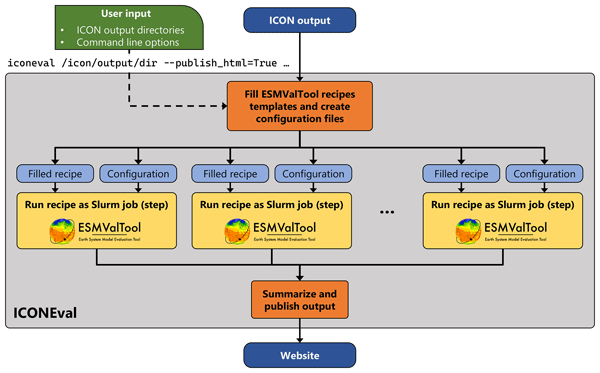
Abstract. Continuous evaluation and performance monitoring during the development of Earth System Models (ESMs) are essential to identify potential problems early, such as unrealistic behavior of climate-relevant quantities, insufficient skill in reproducing the observed basic climate state, or violations of physical laws. The latter is particularly important for the emerging class of hybrid machine learning (ML) enhanced ESMs, where data-driven components are integrated with physics-based model formulations. ESMs used for projections of future climate continue to increase in complexity and resolution. Efficient and user-friendly tools such as the Earth System Model Evaluation Tool (ESMValTool) can therefore greatly support the assessment of a model. So far, ESMValTool focused primarily on providing a broad collection of community-developed evaluation diagnostics and recipes, allowing users to perform a large variety of rather detailed assessments across different domains. A main application of the tool was the assessment of multiple ESMs, in particular those participating in the coupled model intercomparison project (CMIP). Here, we introduce ICONEval, an open-source evaluation framework using ESMValTool that complements existing capabilities by enabling rapid, reproducible, and physically informed assessments of model performance, also during development. ICONEval provides efficient parallel processing of ESMValTool recipes and can generate HTML summary reports allowing to easily automatize and visualize evaluation and monitoring of performance during model development. The new capabilities are grouped into three complementary categories: (1) sanity checks, (2) physical consistency checks, and (3) climate fidelity diagnostics. The sanity checks assess whether global mean values of climate-relevant variables are within the bounds derived from observational and reanalysis datasets. The physical consistency checks aim to identify potential violations of constraints imposed by fundamental physics such as conservation of total air mass, realistic variability of atmospheric water vapor with temperature or the temperature dependence of the cloud ice fraction. The climate fidelity diagnostics assess important climate variables from different ESM components (atmosphere, ocean, and land). Here, we demonstrate this extension of the ESMValTool capabilities by applying the new diagnostics to a historical simulation performed with the ICON-XPP model as an illustrative example. The three-step assessment presented here can be efficiently used to compare different model configurations or versions, for example when testing new or updated parameterizations, including hybrid ML-enhanced (MLe) ESMs, also supporting emerging community benchmarking standards such as ClimateBench.
Competing interests: At least one of the (co-)authors is a member of the editorial board of Geoscientific Model Development. The peer-review process was guided by an independent editor, and the authors also have no other competing interests to declare.
Publisher's note: Copernicus Publications remains neutral with regard to jurisdictional claims made in the text, published maps, institutional affiliations, or any other geographical representation in this paper. While Copernicus Publications makes every effort to include appropriate place names, the final responsibility lies with the authors. Views expressed in the text are those of the authors and do not necessarily reflect the views of the publisher.-
Notice on discussion status
The requested preprint has a corresponding peer-reviewed final revised paper. You are encouraged to refer to the final revised version.
-
Preprint
(5125 KB)
-
The requested preprint has a corresponding peer-reviewed final revised paper. You are encouraged to refer to the final revised version.
- Preprint
(5125 KB) - Metadata XML
- BibTeX
- EndNote
- Final revised paper


Journal article(s) based on this preprint
Interactive discussion
Status: closed
-
CEC1: 'Comment on egusphere-2026-2288', Astrid Kerkweg, 26 Jun 2026
- AC1: 'Reply on CEC1', Axel Lauer, 13 Aug 2026
-
RC1: 'Comment on egusphere-2026-2288', Jaydeep Singh, 29 Jun 2026
- AC2: 'Reply on RC1', Axel Lauer, 13 Aug 2026
-
RC2: 'Comment on egusphere-2026-2288', Anonymous Referee #2, 07 Jul 2026
In the paper, the authors introduce ICONEval, an open-source evaluation framework built on top of the Earth System Model Evaluation Tool (ESMValTool) designed for rapid, reproducible, and automated performance monitoring during the development of Earth System Models (ESMs). ICONEval introduces parallel processing and HTML summary reports categorized into three diagnostic pillars: sanity checks against observational bounds, fundamental physical consistency checks (e.g., mass conservation), and multi-domain climate fidelity diagnostics. The tool is demonstrated using the ICON-XPP model and is positioned as a highly efficient benchmarking utility for comparing model configurations, testing updated parameterizations, and assessing emerging hybrid machine learning-enhanced climate models.
This manuscript is well-suited for the journal's scope, as it introduces an open-source evaluation framework (ICONEval) that directly advances our ability to benchmark, monitor, and improve ESMs, including emerging hybrid machine learning configurations. The paper is well-prepared, presenting a highly structured and logical three-pillar approach—spanning sanity checks, physical consistency, and climate fidelity—that is clearly articulated and thoroughly demonstrated using the ICON-XPP model. Given the increasing complexity of modern climate modeling, the development of reproducible, automated, and customized tools for specific models is highly relevant to the journal’s audience and represents a timely, high-quality contribution to the community.
I suggest accepting the manuscript subject to the authors addressing the following a few specific comments.
Specific comments:
Line 145 and Figure 2: Still, it is not very clear to me that how the “reasonable” upper and lower limits (red lines in the figure) were defined, in particular with using multiple reference datasets. For example, for minimum, was the minimum monthly value across all years of global spatial average taken from each reference dataset, then minimum value among them was taken as the “reasonable minimum lower limit?” I suggest further clarifying it in the manuscript.
Figure 8a: While I understand there could be some artifact due to difference in the data frequency interval (i.e., ERA5 1 hourly while ICON-XPP 6 hourly), the sudden magnitude change over the pacific seems odd, which could have been resulted from incorrect local time handling. Could you please double check on this?
Figure 9. In addition to showing the difference field only, I suggest showing the full field from each data (ICON-XPP and ERA5) as well, so the pattern could be easily compared, like in Figure 10.
Figure 11. In the Historical experiment, year-to-year comparison between model and observation does not say much, as their matching is not even expected. Although the authors have described this in the manuscript (line 275-276), I wonder if it would be beneficial to re-emphasize this point in the figure caption so advise readers what to focus on the figure. One additional option could be comparing the standard deviation or variance values obtained from each time series as an indicator for the intensity of the variability, or trend line. The same comment applies to Figs. 12 and 14 as well. For Fig. 11, I am not sure how much useful information could be derived from the CMIP6 results in the background.
Citation: https://doi.org/10.5194/egusphere-2026-2288-RC2 - AC3: 'Reply on RC2', Axel Lauer, 13 Aug 2026
Peer review completion


Interactive discussion
Status: closed
-
CEC1: 'Comment on egusphere-2026-2288', Astrid Kerkweg, 26 Jun 2026
Dear Axel and Co-authors,
please note that GitLab links are not enough to refer to the code used. Thus, please cite the DOI of the respective ICON release. (I guess doi:10.35089/WDCC/IconRelease2025.10) in the code availability section. If this is not the correct DOI and the respective ICON (sub)version is not accessible via DOI please store the version in a permanent archive yourself or get the ICON C5 to provide also a doi for this subversion, and cite that DOI.
Best regards, Astrid Kerkweg (executive Editor of GMD)
Citation: https://doi.org/10.5194/egusphere-2026-2288-CEC1 - AC1: 'Reply on CEC1', Axel Lauer, 13 Aug 2026
-
RC1: 'Comment on egusphere-2026-2288', Jaydeep Singh, 29 Jun 2026
- AC2: 'Reply on RC1', Axel Lauer, 13 Aug 2026
-
RC2: 'Comment on egusphere-2026-2288', Anonymous Referee #2, 07 Jul 2026
In the paper, the authors introduce ICONEval, an open-source evaluation framework built on top of the Earth System Model Evaluation Tool (ESMValTool) designed for rapid, reproducible, and automated performance monitoring during the development of Earth System Models (ESMs). ICONEval introduces parallel processing and HTML summary reports categorized into three diagnostic pillars: sanity checks against observational bounds, fundamental physical consistency checks (e.g., mass conservation), and multi-domain climate fidelity diagnostics. The tool is demonstrated using the ICON-XPP model and is positioned as a highly efficient benchmarking utility for comparing model configurations, testing updated parameterizations, and assessing emerging hybrid machine learning-enhanced climate models.
This manuscript is well-suited for the journal's scope, as it introduces an open-source evaluation framework (ICONEval) that directly advances our ability to benchmark, monitor, and improve ESMs, including emerging hybrid machine learning configurations. The paper is well-prepared, presenting a highly structured and logical three-pillar approach—spanning sanity checks, physical consistency, and climate fidelity—that is clearly articulated and thoroughly demonstrated using the ICON-XPP model. Given the increasing complexity of modern climate modeling, the development of reproducible, automated, and customized tools for specific models is highly relevant to the journal’s audience and represents a timely, high-quality contribution to the community.
I suggest accepting the manuscript subject to the authors addressing the following a few specific comments.
Specific comments:
Line 145 and Figure 2: Still, it is not very clear to me that how the “reasonable” upper and lower limits (red lines in the figure) were defined, in particular with using multiple reference datasets. For example, for minimum, was the minimum monthly value across all years of global spatial average taken from each reference dataset, then minimum value among them was taken as the “reasonable minimum lower limit?” I suggest further clarifying it in the manuscript.
Figure 8a: While I understand there could be some artifact due to difference in the data frequency interval (i.e., ERA5 1 hourly while ICON-XPP 6 hourly), the sudden magnitude change over the pacific seems odd, which could have been resulted from incorrect local time handling. Could you please double check on this?
Figure 9. In addition to showing the difference field only, I suggest showing the full field from each data (ICON-XPP and ERA5) as well, so the pattern could be easily compared, like in Figure 10.
Figure 11. In the Historical experiment, year-to-year comparison between model and observation does not say much, as their matching is not even expected. Although the authors have described this in the manuscript (line 275-276), I wonder if it would be beneficial to re-emphasize this point in the figure caption so advise readers what to focus on the figure. One additional option could be comparing the standard deviation or variance values obtained from each time series as an indicator for the intensity of the variability, or trend line. The same comment applies to Figs. 12 and 14 as well. For Fig. 11, I am not sure how much useful information could be derived from the CMIP6 results in the background.
Citation: https://doi.org/10.5194/egusphere-2026-2288-RC2 - AC3: 'Reply on RC2', Axel Lauer, 13 Aug 2026
Peer review completion
Journal article(s) based on this preprint
Data sets
An ESMValTool-based framework for sanity checks, physical consistency and climate fidelity during model development – ICONEval v1.0 Axel Lauer, Manuel Schlund, Lisa Bock, Birgit Hassler, Gunnar Behrens, Bettina Gier, Lukas Lindenlaub, Stephan Lorenz, Jan-Hendrik Malles, Wolfgang A. Müller, Trang v. Pham, Katja Weigel, Guang Zeng, and Veronika Eyring https://doi.org/10.5281/zenodo.19664576
Model code and software
Earth System Model Evaluation Tool (ESMValTool) Andela, Bouwe; Broetz, Bjoern; de Mora, Lee; Drost, Niels; Eyring, Veronika; Koldunov, Nikolay; Lauer, Axel; Mueller, Benjamin; Predoi, Valeriu; Righi, Mattia; Schlund, Manuel; Vegas-Regidor, Javier; Zimmermann, Klaus; Adeniyi, Kemisola; Castellani, Giulia; Arnone, Enrico; Bellprat, Omar; Berg, Peter; Billows, Chris; Blockley, Ed; Bock, Lisa; Bodas-Salcedo, Alejandro; Caron, Louis-Philippe; Carvalhais, Nuno, Cionni, Irene; Cortesi, Nicola; Corti, Susanna; Crezee, Bas; Davin, Edouard Leopold; Davini, Paolo; Deser, Clara; Diblen, Faruk; Docquier, David; Dreyer, Laura; Ehbrecht, Carsten; Earnshaw, Paul; Geddes, Theo; Gier, Bettina; Gillett, Ed; Gonzalez-Reviriego, Nube; Goodman, Paul; Hagemann, Stefan; Hall, Sophie; Hardacre, Catherine; von Hardenberg, Jost; Hassler, Birgit; Heuer, Helge; Hogan, Emma; Hunter, Alasdair; Kadow, Christopher; Kindermann, Stephan; Koirala, Sujan; Kuehbacher, Birgit; Lledó, Llorenç; Lejeune, Quentin; Lembo, Valerio; Little, Bill; Loosveldt-Tomas, Saskia; Lorenz, Ruth; Lovato, Tomas; Lucarini, Valerio; Malinina, Elizaveta; Massonnet, François; Mohr, Christian Wilhelm; Amarjiit, Pandde; Parsons, Naomi; Pérez-Zanón, Núria; Phillips, Adam; Proft, Max; Russell, Joellen; Sandstad, Marit; Sellar, Alistair; Senftleben, Daniel; Serva, Federico; Sillmann, Jana; Stacke, Tobias; Storkey, Dave; Swaminathan, Ranjini; Tomkins, Katherine; Torralba, Verónica; Weigel, Katja; Sarauer, Ellen; Schulze, Kirsten; Roberts, Charles; Kalverla, Peter; Alidoost, Sarah; Verhoeven, Stefan; Vreede, Barbara; Smeets, Stef; Soares Siqueira, Abel; Kazeroni, Rémi; Potter, Jerry; Winterstein, Franziska; Beucher, Romain; Kraft, Jeremy; Ruhe, Lukas; Bonnet, Pauline; Munday, Gregory; Chun, Felicity; Ellis, Hannah https://doi.org/10.5281/zenodo.3401363
ICONEval Schlund, Manuel; Bock, Lisa https://doi.org/10.5281/zenodo.18937450
Viewed
| HTML | XML | Total | BibTeX | EndNote | |
|---|---|---|---|---|---|
| 205 | 181 | 28 | 414 | 21 | 22 |
- HTML: 205
- PDF: 181
- XML: 28
- Total: 414
- BibTeX: 21
- EndNote: 22
Viewed (geographical distribution)
| Country | # | Views | % |
|---|
| Total: | 0 |
| HTML: | 0 |
| PDF: | 0 |
| XML: | 0 |
- 1

Manuel Schlund
Lisa Bock
Birgit Hassler
Gunnar Behrens
Bettina Gier
Lukas Lindenlaub
Stephan Lorenz
Jan-Hendrik Malles
Wolfgang A. Müller
Trang van Pham
Katja Weigel
Guang Zeng
Veronika Eyring
The requested preprint has a corresponding peer-reviewed final revised paper. You are encouraged to refer to the final revised version.
- Preprint
(5125 KB) - Metadata XML
Dear Axel and Co-authors,
please note that GitLab links are not enough to refer to the code used. Thus, please cite the DOI of the respective ICON release. (I guess doi:10.35089/WDCC/IconRelease2025.10) in the code availability section. If this is not the correct DOI and the respective ICON (sub)version is not accessible via DOI please store the version in a permanent archive yourself or get the ICON C5 to provide also a doi for this subversion, and cite that DOI.
Best regards, Astrid Kerkweg (executive Editor of GMD)