
the Creative Commons Attribution 4.0 License.
the Creative Commons Attribution 4.0 License.
 | 22 Apr 2026
Relaxed Eddy Accumulation based Flux measurement of Atmospheric Inorganic Acidic Species over Cropland under the Long-Term Exposure to Chemical Industry Emissions in a Chinese Megacity
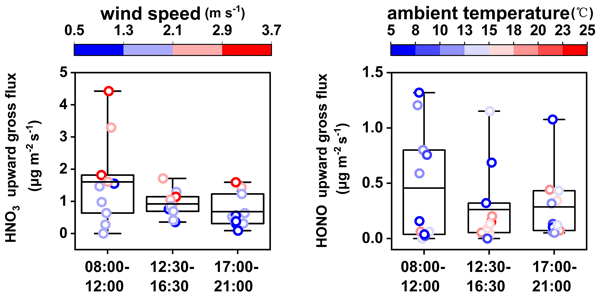
Abstract. China hosts a large number of industrial parks in densely populated areas, where pollutant emissions turn surrounding lands into high-deposition-load hotspots. Long-term exposure may alter physicochemical properties of soils and vegetation, leading to complex sink-source transitions of land surface. The lack of local flux data impedes integrated air-soil-water pollution control. We developed a Relaxed Eddy Accumulation system capable of simultaneous flux measurements of eight inorganic species (HNO3, HONO, SO2, HCl, nitrate, nitrite, sulfate, chloride). System characterization showed detection limits of 6.1×10⁻⁴–2.4×10⁻¹ μg m-2 s-1 and flux precisions of 3.0 %–29.5 % with main uncertainty contributions from mass analysis and lag time inaccuracy. Flux measurement conducted at a vegetable cropland adjacent to chemical industry facilities revealed that HONO and nitrate fluxes at this site were 1–2 orders of magnitude higher than those reports in the literature. Bidirectional fluxes of the species indicate the cropland acts as both source and sink; but winter average showed net emission fluxes only for HONO and nitrite (mean daily 53.0 and 11.5 μmol m-2 d-1). Gross upward emission fluxes of HNO3 and HONO were 1.1 ± 0.9 μg m-2 s-1 and 0.4 ± 0.4 μg m-2 s-1, respectively, during the winter observation period. HNO3 gross emissions were enhanced by elevated turbulence, while HONO emissions were promoted at lower ambient temperatures. This study provides observational constraints for acidic species flux parameterization over industrial-impacted croplands and informs air pollution control and agro-ecological protection strategies.
-
Notice on discussion status
The requested preprint has a corresponding peer-reviewed final revised paper. You are encouraged to refer to the final revised version.
-
Preprint
(2921 KB)
-
Supplement
(3939 KB)
-
The requested preprint has a corresponding peer-reviewed final revised paper. You are encouraged to refer to the final revised version.
- Preprint
(2921 KB) - Metadata XML
-
Supplement
(3939 KB) - BibTeX
- EndNote
- Final revised paper


Journal article(s) based on this preprint
Interactive discussion
Status: closed
-
RC1: 'Comment on egusphere-2026-2234', Anonymous Referee #1, 15 May 2026
- AC1: 'Reply on RC1', Huan Yu, 10 Jun 2026
-
RC2: 'Comment on egusphere-2026-2234', Anonymous Referee #2, 15 May 2026
The manuscript by Hua et al. addresses an important flux research gap through the self-designed Relaxed Eddy Accumulation (REA) system: the air-surface exchange of multiple inorganic acidic species over cropland chronically influenced by industrial emissions. The authors comprehensively evaluated the precision and detection limit of the REA system. They analyzed the bidirectional flux characteristics of target species, and further estimated the gross upward emission fluxes of HNO3 and HONO. The topic is original and practically valuable, and key findings are meaningful for regional air-soil-water pollution mitigation. The manuscript aligns with the scope of Atmospheric Chemistry and Physics. I recommend publication after the authors address the following questions.
(1) This manuscript employs the REA method to calculate fluxes and presents a relatively comprehensive uncertainty analysis. The β coefficient serves as a key parameter in flux estimation, but the current error estimation does not fully account for the β variability. I encourage the authors to include a complete the calculation process and uncertainty analysis for the β coefficient.
(2) Why was the threshold for distinguishing updrafts and downdrafts set to ±0.6σw instead of ±0.5σw or±0.7σw?
(3) This manuscript should incorporate more detailed background information on the sampling site and farmland conditions. For example, the manuscript should provide the exact latitude and longitude of the flux tower site, as well as the duration over which the cropland has been continuously affected by chemical industrial emissions. In addition, field conditions during the sampling campaign should be described in greater detail, including the crop growth stage and records of fertilization and irrigation practices. The absence of these critical details limits the comparability with previous agricultural flux studies.
(4) Figure captions should be checked for consistency. For example, the main text states that horizontal lines in Figure 2 mark means, whereas the supplementary figures use medians.
Citation: https://doi.org/10.5194/egusphere-2026-2234-RC2 - AC2: 'Reply on RC2', Huan Yu, 10 Jun 2026
Peer review completion


Interactive discussion
Status: closed
-
RC1: 'Comment on egusphere-2026-2234', Anonymous Referee #1, 15 May 2026
“Relaxed Eddy Accumulation based Flux measurement of Atmospheric Inorganic Acidic Species over Cropland under the Long-Term Exposure to Chemical Industry Emissions in a Chinese Megacity”
General Comments
This manuscript presents the development of a Relaxed Eddy Accumulation (REA) system for assessing the fluxes of inorganic acidic species over cropland located in the vicinity of an industrial zone within the Chinese megacity of Wuhan. The study was conducted during late autumn and early winter 2025, with particular focus on a subset of selected 11 days period spanning November-December 2025.
The authors clearly demonstrate the development of the instrument and provide a thorough description of the uncertainty calculations used to characterise the system, including both the REA sampling setup and the offline analytical procedures. The reported measurement precision ranged from 3–30%, with LOD between 6.1 × 10⁻⁴ and 2.4 × 10⁻¹ µg m-2 s-1 across the eight monitored species.
A key finding of the study is that the observed HONO and HNO3 fluxes were one to two orders of magnitude higher than values previously reported in the literature for similar landscapes.
The authors conclude that the strong positive nitric acid fluxes were enhanced under conditions of elevated turbulence, whereas the enhancement of nitrous acid fluxes appeared to be associated with lower ambient temperatures.
Specific comments
Although the authors predominantly present the fluxes in units of µg m-2 s-1, there are instances where inconsistent units appear to have been used, for example in Figure 3(a) (page 18) and line 326 (page 17). It is recommended that the authors review and correct all such instances to ensure consistency throughout the manuscript.
The results are primarily presented as “diurnal” plots, despite the fact that most of the 12-hour sampling period (08:00–21:00 local time) falls largely within daytime hours (typically 06:00–17:00, even during winter months). I would therefore advise against the use of the term “diurnal” to describe the results presented in this manuscript, as it does not accurately reflect the temporal coverage of the study.
An operational flow rate of 10 L min-1 resulting in a 3.1 s exchange time (page 7, lines 108-109) implies an internal denuder volume of approximately 0.5 L. However, the authors state on page 8, line 159 that the volume per denuder is 0.6 m3 ( (i.e. 600 L), which is inconsistent with the previous inference. The authors should clarify this discrepancy.
While the reviewer agrees with the authors that the positive morning HONO fluxes are associated with lower temperatures, the same relationship also appears to apply to HNO3 (as shown in Figure S5). However, the authors attribute the HNO3 behaviour exclusively to enhanced morning turbulence in Figure 6. This point requires further clarification, and the conclusions and abstract may need to be revised accordingly to reflect the broader interpretation.
Technical corrections
- Page 4, line 73: Typographical error: “.. an REA” should read “.. a REA”.
- Page 7, Figure 1: The locations and information for Tup and Tdown are not shown in either the figure or the corresponding caption.
- Page 15, line 303: The concentrations presented here are mean values, the authors should explicitly state this in the text.
- Page 16, Figure 2: Panels (a) and (b) are not labelled in the figure.
- Page 16, line 314: In Figure 3(a), “proportion” of flux should be replaced with “percentage” of flux. The authors should correct all similar instances throughout the manuscript (see also page 17, line 337).
- Page 16, line 315: The authors should also refer to Figure 3(b) in the text as part of the description of the mean ± SD values.
- Page 17, lines 337-338: Figure 2(b) does not present information on flux percentage, but rather the flux magnitude. Please clarify this in the text.
- Page 18, lines 344-346: This statement is not clearly described and should be rewritten for clarity.
- Page 19, Figure 3: The caption does not include descriptions for panels (a) and (b).
- Page 19, Figure 4: The downward fluxes are shown as negative values in the figure. This should be clarified either in the main text or in the figure caption.
- Page 20, Figure 5: A legend distinguishing upward and downward fluxes, similar to that used in Figure 4, should be added. I would also suggest changing the colours of R+ and R− to match the corresponding flux directions.
- Page 20, lines 387-388: The word “reaction” is duplicated.
- Figure S1 could be improved by adding annotations indicating the industrial area, as well as a distance scale on the map shown on the right-hand side.
- AC1: 'Reply on RC1', Huan Yu, 10 Jun 2026
-
RC2: 'Comment on egusphere-2026-2234', Anonymous Referee #2, 15 May 2026
The manuscript by Hua et al. addresses an important flux research gap through the self-designed Relaxed Eddy Accumulation (REA) system: the air-surface exchange of multiple inorganic acidic species over cropland chronically influenced by industrial emissions. The authors comprehensively evaluated the precision and detection limit of the REA system. They analyzed the bidirectional flux characteristics of target species, and further estimated the gross upward emission fluxes of HNO3 and HONO. The topic is original and practically valuable, and key findings are meaningful for regional air-soil-water pollution mitigation. The manuscript aligns with the scope of Atmospheric Chemistry and Physics. I recommend publication after the authors address the following questions.
(1) This manuscript employs the REA method to calculate fluxes and presents a relatively comprehensive uncertainty analysis. The β coefficient serves as a key parameter in flux estimation, but the current error estimation does not fully account for the β variability. I encourage the authors to include a complete the calculation process and uncertainty analysis for the β coefficient.
(2) Why was the threshold for distinguishing updrafts and downdrafts set to ±0.6σw instead of ±0.5σw or±0.7σw?
(3) This manuscript should incorporate more detailed background information on the sampling site and farmland conditions. For example, the manuscript should provide the exact latitude and longitude of the flux tower site, as well as the duration over which the cropland has been continuously affected by chemical industrial emissions. In addition, field conditions during the sampling campaign should be described in greater detail, including the crop growth stage and records of fertilization and irrigation practices. The absence of these critical details limits the comparability with previous agricultural flux studies.
(4) Figure captions should be checked for consistency. For example, the main text states that horizontal lines in Figure 2 mark means, whereas the supplementary figures use medians.
Citation: https://doi.org/10.5194/egusphere-2026-2234-RC2 - AC2: 'Reply on RC2', Huan Yu, 10 Jun 2026
Peer review completion
Journal article(s) based on this preprint
Viewed
| HTML | XML | Total | Supplement | BibTeX | EndNote | |
|---|---|---|---|---|---|---|
| 316 | 150 | 49 | 515 | 95 | 38 | 44 |
- HTML: 316
- PDF: 150
- XML: 49
- Total: 515
- Supplement: 95
- BibTeX: 38
- EndNote: 44
Viewed (geographical distribution)
| Country | # | Views | % |
|---|
| Total: | 0 |
| HTML: | 0 |
| PDF: | 0 |
| XML: | 0 |
- 1
Jingya Hua
Xinyu Wang
Yulian Wei
Jieya Sun
Zongjun Li
Zhongliang Huang
Qiongqiong Wang

The requested preprint has a corresponding peer-reviewed final revised paper. You are encouraged to refer to the final revised version.
- Preprint
(2921 KB) - Metadata XML
-
Supplement
(3939 KB) - BibTeX
- EndNote
- Final revised paper
“Relaxed Eddy Accumulation based Flux measurement of Atmospheric Inorganic Acidic Species over Cropland under the Long-Term Exposure to Chemical Industry Emissions in a Chinese Megacity”
General Comments
This manuscript presents the development of a Relaxed Eddy Accumulation (REA) system for assessing the fluxes of inorganic acidic species over cropland located in the vicinity of an industrial zone within the Chinese megacity of Wuhan. The study was conducted during late autumn and early winter 2025, with particular focus on a subset of selected 11 days period spanning November-December 2025.
The authors clearly demonstrate the development of the instrument and provide a thorough description of the uncertainty calculations used to characterise the system, including both the REA sampling setup and the offline analytical procedures. The reported measurement precision ranged from 3–30%, with LOD between 6.1 × 10⁻⁴ and 2.4 × 10⁻¹ µg m-2 s-1 across the eight monitored species.
A key finding of the study is that the observed HONO and HNO3 fluxes were one to two orders of magnitude higher than values previously reported in the literature for similar landscapes.
The authors conclude that the strong positive nitric acid fluxes were enhanced under conditions of elevated turbulence, whereas the enhancement of nitrous acid fluxes appeared to be associated with lower ambient temperatures.
Specific comments
Although the authors predominantly present the fluxes in units of µg m-2 s-1, there are instances where inconsistent units appear to have been used, for example in Figure 3(a) (page 18) and line 326 (page 17). It is recommended that the authors review and correct all such instances to ensure consistency throughout the manuscript.
The results are primarily presented as “diurnal” plots, despite the fact that most of the 12-hour sampling period (08:00–21:00 local time) falls largely within daytime hours (typically 06:00–17:00, even during winter months). I would therefore advise against the use of the term “diurnal” to describe the results presented in this manuscript, as it does not accurately reflect the temporal coverage of the study.
An operational flow rate of 10 L min-1 resulting in a 3.1 s exchange time (page 7, lines 108-109) implies an internal denuder volume of approximately 0.5 L. However, the authors state on page 8, line 159 that the volume per denuder is 0.6 m3 ( (i.e. 600 L), which is inconsistent with the previous inference. The authors should clarify this discrepancy.
While the reviewer agrees with the authors that the positive morning HONO fluxes are associated with lower temperatures, the same relationship also appears to apply to HNO3 (as shown in Figure S5). However, the authors attribute the HNO3 behaviour exclusively to enhanced morning turbulence in Figure 6. This point requires further clarification, and the conclusions and abstract may need to be revised accordingly to reflect the broader interpretation.
Technical corrections