
the Creative Commons Attribution 4.0 License.
the Creative Commons Attribution 4.0 License.
 | 04 May 2026
Hydrological implications of vegetation-associated precipitation recycling during peak growing season over the Loess Plateau
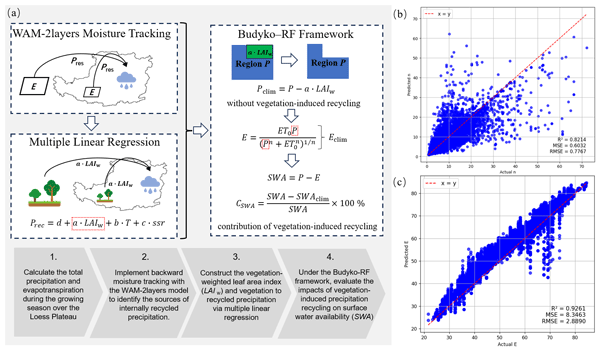
Abstract. Vegetation restoration on the Loess Plateau has led to continued debate over whether enhanced land–atmosphere coupling can meaningfully alleviate water scarcity in this water-limited region. In this study, we combined the WAM-2layers atmospheric moisture-tracking model with a random forest–enhanced Budyko framework and introduced a vegetation-weighted leaf area index (LAIw) to examine vegetation-associated precipitation recycling and its hydrological implications during the peak growing season (July–August) from 2000 to 2022. Precipitation over the Loess Plateau is dominated by land-sourced moisture, which accounts for 86.5 % of total precipitation. Internal moisture recycling contributes 14.4 % of total precipitation and shows a declining trend of −0.073 mm yr−1. Surface water availability also declines significantly, at a rate of −0.34 mm yr−1, mainly because evapotranspiration increases by 0.31 mm yr−1. At the regional mean scale, vegetation-associated recycled precipitation makes only a limited contribution to precipitation, evapotranspiration, and surface water availability, accounting for 0.059 %, 0.02 %, and 0.107 %, respectively. This low net contribution partly reflects the fact that internal moisture recycling itself represents only a limited fraction of total precipitation, and that positive and negative vegetation-associated effects partly offset each other. However, the hydrological effect varies clearly along the LAIw gradient, with weak positive contributions under low vegetation density and increasingly negative contributions under high vegetation density. These findings suggest that under water-limited conditions, enhanced vegetation–atmosphere coupling does not necessarily lead to meaningful gains in surface water availability. This seasonal focus is intended to capture the period of strongest vegetation–atmosphere coupling rather than the full annual water balance.
-
Notice on discussion status
The requested preprint has a corresponding peer-reviewed final revised paper. You are encouraged to refer to the final revised version.
-
Preprint
(2996 KB)
-
The requested preprint has a corresponding peer-reviewed final revised paper. You are encouraged to refer to the final revised version.
- Preprint
(2996 KB) - Metadata XML
- BibTeX
- EndNote
- Final revised paper


Journal article(s) based on this preprint
Interactive discussion
Status: closed
-
RC1: 'Comment on egusphere-2026-2206', Anonymous Referee #1, 18 May 2026
-
AC1: 'Reply on RC1', Jiaxiang Deng, 01 Jun 2026
We thank the reviewer for their constructive comments. We have carefully examined the relationship between the land-sourced moisture dominance identified during the peak growing season and the East Asian monsoon framework, as well as the apparent differences between our findings and recent studies reporting positive effects of vegetation restoration on precipitation enhancement and water resources. We believe that these results are not contradictory but rather reflect different aspects of vegetation–water feedbacks from the perspectives of moisture transport processes, monsoon–inland transition zone characteristics, temporal scales, and hydrological diagnostics. We will further clarify these issues in Sections 4.1 and 4.2 of the revised manuscript.
First, the dominance of land-sourced moisture during the peak growing season does not negate the important role of the East Asian monsoon. Rather, it reflects the moisture redistribution process associated with the unique geographical setting of the Loess Plateau, which is located within the monsoon marginal zone and the transition region between monsoon and inland climates. The mean atmospheric residence time of water vapor is approximately 8–14 days. During the long-distance transport of oceanic moisture from the Pacific Ocean toward the Loess Plateau, atmospheric moisture continuously mixes with and is replenished by evapotranspiration from terrestrial surfaces along the transport pathway. Consequently, by the time the moisture reaches the Loess Plateau, its original oceanic signal has been substantially diluted. In contrast, land-sourced moisture originating from nearby continental regions, particularly Central China, experiences shorter transport distances and receives substantial replenishment from regional evapotranspiration, resulting in a relatively larger contribution to precipitation over the Loess Plateau.
Second, from the perspective of large-scale atmospheric circulation, the Loess Plateau during July–August is simultaneously influenced by monsoon marginal circulation and inland moisture transport processes. As shown in Figure 3a, the dominant moisture transport pathways include the westerly-dominated Central Asia–continental interior route and the pathway of southerly moisture transport after substantial land-surface modification. These pathways are fully consistent with the geographical characteristics of the Loess Plateau as a monsoon–inland transition zone and with the seasonal evolution of atmospheric circulation. Therefore, the land-sourced moisture-dominated pattern identified in this study should be viewed as a manifestation of monsoon moisture modification rather than a contradiction to the monsoon framework. As monsoon moisture advances inland, its signal is progressively modified by evapotranspiration and regional moisture recycling processes. The identification of Central China as the dominant external moisture source region is also consistent with previous FLEXPART-based analyses (Hu et al., 2018) and independent WAM-2layers simulations (Cao et al., 2024), suggesting that the large-scale moisture transport pattern supplying the Loess Plateau is relatively robust.
We have also carefully considered the study by Zhang Baoqing et al. (2026) published in Nature Water. We do not believe that our findings contradict their conclusion that vegetation restoration can enhance precipitation and water resources. Rather, the two studies focus on different aspects of vegetation–water interactions. Our results likewise indicate that vegetation enhancement can promote recycled precipitation and increase atmospheric moisture input. However, during the peak growing season, particularly in July and August, vegetation activity, evapotranspiration, and atmospheric evaporative demand simultaneously reach their seasonal maxima. Under these conditions, the increase in recycled precipitation is largely offset by the concurrent increase in evapotranspiration, resulting in only a weak net positive hydrological effect.
The difference in temporal focus may itself influence the apparent strength of vegetation–precipitation feedbacks. Most previous studies have evaluated vegetation impacts at annual or full-growing-season scales, where precipitation enhancement, soil water storage changes, groundwater recharge, and delayed hydrological responses can accumulate over longer periods. In contrast, this study specifically focuses on the peak growing season (July–August), when vegetation activity, evapotranspiration, and atmospheric evaporative demand are strongest. During this period, the land–atmosphere feedback loop is dominated by rapid moisture exchange and intense evapotranspiration consumption. Consequently, increases in recycled precipitation can be more readily offset by concurrent evapotranspiration increases, making the net hydrological benefit appear weaker than that observed at annual scales. Therefore, the seasonal focus does not fundamentally alter the feedback mechanism itself, but rather highlights a particular phase of the feedback loop during which hydrological constraints are strongest.
Methodological differences may also contribute to differences in the interpretation of vegetation–water feedbacks. Previous studies based on coupled climate models (GCMs or RCMs) generally evaluate vegetation–precipitation feedbacks through simulated changes in atmospheric circulation, surface energy balance, convection, and precipitation generation processes under prescribed vegetation scenarios. In contrast, our framework combines atmospheric moisture tracking (WAM-2layers) with a Budyko–RF diagnostic approach to quantify the hydrological consequences of vegetation-associated recycled precipitation that actually returns to the Loess Plateau. Accordingly, the definition of “water availability” also differs. Many climate-model studies assess changes in precipitation, runoff, or total water yield as indicators of hydrological benefit. In this study, however, water availability is explicitly defined as surface water availability (SWA; defined as P − E), which directly accounts for the simultaneous increase in evapotranspiration associated with vegetation growth. Therefore, our analysis focuses not only on whether vegetation increases precipitation, but also on whether the resulting recycled precipitation is sufficient to compensate for the associated evapotranspiration consumption. From this perspective, the two approaches address different but complementary aspects of vegetation–water interactions.
We greatly appreciate the reviewer’s comments, as they help us more clearly articulate the broader hydrological implications of our findings. In a monsoon–inland transition zone such as the Loess Plateau, monsoon-derived moisture is substantially modified by evapotranspiration and regional moisture recycling during its inland transport, resulting in an enhanced contribution of land-sourced moisture during the peak growing season. Meanwhile, although vegetation restoration can generate positive precipitation feedbacks, their compensatory effect on surface water availability is markedly weakened under the strong evapotranspiration pressure characteristic of July–August. To further address these issues, we will expand the discussion in the revised manuscript by clarifying the mechanisms underlying land-sourced moisture dominance within the monsoon–inland transition zone in Section 4.1 and by discussing the temporal-scale and methodological differences between this study and previous research on vegetation restoration and precipitation enhancement in Section 4.2. This revision will better highlight the ecological and hydrological significance of constrained land–atmosphere feedbacks in water-limited environments.
Citation: https://doi.org/10.5194/egusphere-2026-2206-AC1
-
AC1: 'Reply on RC1', Jiaxiang Deng, 01 Jun 2026
-
RC2: 'Comment on egusphere-2026-2206', Anonymous Referee #2, 25 May 2026
This manuscript investigates the hydrological implications of vegetation-associated precipitation recycling over the Loess Plateau during the peak growing season from 2000 to 2022. By integrating the WAM-2layers atmospheric moisture-tracking model with a random forest-enhanced Budyko framework and introducing a vegetation-weighted leaf area index, the authors quantify how vegetation-related evapotranspiration and recycled precipitation influence regional surface water availability.
The topic is highly relevant to HESS and addresses an important question in dryland ecohydrology: whether large-scale vegetation restoration can enhance precipitation recycling sufficiently to offset increased terrestrial water consumption. The manuscript is well structured, the analysis is technically sound, and the results are clearly presented. In particular, the finding that vegetation-associated recycled precipitation has a small regional mean effect but exhibits a threshold-like response along the vegetation gradient is scientifically interesting and potentially important for ecological restoration planning.
I recommend publication after minor revisions. I encourage the authors to address the following points to further strengthen the interpretation and broader implications of the study.
Major Comments & Questions:
1.Hydrological significance of the small regional contribution
The manuscript shows that vegetation-associated recycled precipitation contributes only marginally to regional mean precipitation, evapotranspiration, and surface water availability. This is an important result, but its broader hydrological meaning could be further clarified. I suggest that the authors add more explanation on how this small numerical contribution should be interpreted. For example, does it indicate that vegetation-related precipitation recycling is hydrologically negligible at the regional scale, or does it instead reveal that its potential benefits are strongly constrained by the dry background climate of the Loess Plateau? A more nuanced interpretation would help readers understand why a small mean contribution can still be scientifically meaningful, particularly in identifying the limits of land–atmosphere feedbacks in water-limited environments.
2.Vegetation threshold and restoration implications
One of the most interesting findings of the manuscript is the transition from weakly positive effects under low vegetation density to increasingly negative effects under high LAIw conditions. This threshold-like pattern deserves further elaboration in relation to ecological restoration and vegetation management on the Loess Plateau. The authors could add more discussion of how this result relates to vegetation carrying capacity, optimal restoration intensity, and the potential risk of excessive afforestation or vegetation densification in dryland regions. At the same time, it would be useful to clarify that the identified LAIw threshold should be interpreted as an empirical diagnostic signal derived from the present framework, rather than as a universal management threshold. This would make the practical implications more balanced and convincing.
3.Seasonal representativeness and spatial heterogeneity
The study focuses on July–August, when vegetation activity and land–atmosphere coupling are expected to be strongest. This seasonal focus is well justified, but the implications of this choice could be further explained. I suggest that the authors add a short paragraph discussing how the conclusions may differ from annual-scale water-balance assessments. For instance, vegetation-related water consumption may affect soil water storage, groundwater recharge, and runoff beyond the peak growing season, whereas precipitation recycling may be most active during summer. In addition, the wetter southeastern and drier northwestern parts of the Loess Plateau may experience different balances between recycled precipitation gains and evapotranspiration losses. Addressing these points would help place the seasonal results in a broader hydrological context.
Citation: https://doi.org/10.5194/egusphere-2026-2206-RC2 -
AC2: 'Reply on RC2', Jiaxiang Deng, 01 Jun 2026
We thank the reviewer for their constructive comments. We carefully considered the reviewer's concerns regarding the relatively small contribution of vegetation-related recycled precipitation, the nonlinear responses along the vegetation density gradient (LAIw), and the spatiotemporal applicability of the research findings. We believe that these results should be comprehensively interpreted within the framework of land–atmosphere interactions under the arid and semi-arid climatic background of the Loess Plateau. To this end, we will further supplement the discussion in the subsequent content of Section 4.2 to more fully clarify the hydrological significance and ecological implications of recycled precipitation in the context of vegetation restoration.
First, the relatively small contribution of vegetation-related recycled precipitation at the regional average scale does not mean that its hydrological role can be ignored. This result reflects the constrained nature of land–atmosphere feedback processes in the Loess Plateau as a typical water-limited ecosystem. Vegetation restoration can enhance evapotranspiration and transport more water vapor to the atmosphere, but due to the limited regional atmospheric water vapor content, strong evaporative demand, and relatively low precipitation conversion efficiency, only a portion of the added water vapor is ultimately converted into regional precipitation. Therefore, the compensatory effect of recycled precipitation on surface water availability is generally limited. This result highlights an important characteristic of the vegetation restoration process in arid and semi-arid regions: enhanced evapotranspiration does not necessarily lead to a proportional compensatory increase in precipitation, and its ecological and hydrological benefits may be significantly constrained by the regional climatic background.
Second, the nonlinear response along the vegetation density gradient identified in this study further indicates that this constraint is not spatially uniform, but rather varies with vegetation intensity. Under lower LAIw conditions, increased recycled precipitation can partially compensate for vegetation water consumption, thereby exhibiting a weak positive hydrological effect; however, as vegetation density further increases, the increase in evapotranspiration gradually exceeds the compensatory effect provided by recycled precipitation, causing the net hydrological effect to shift from weakly positive to negative. We suggest that this shift reflects a characteristic of diminishing marginal hydrological returns during vegetation restoration, meaning that the enhancement of atmospheric water vapor recycling due to increased vegetation cannot indefinitely offset the simultaneously increasing water demand. From this perspective, the nonlinear response identified in this study is consistent with the concepts of vegetation carrying capacity and water resource constraints of ecological restoration proposed in previous studies on the Loess Plateau, providing a new land–atmosphere feedback perspective for understanding the hydrological sustainability of vegetation restoration.
At the same time, we believe that this nonlinear response should be understood as a diagnostic signal at the process level, rather than a management threshold with universal significance. Its specific location may be influenced by multiple factors such as climatic background, vegetation type, time scale, and research methodology. Therefore, the purpose of this study is not to propose a fixed vegetation restoration boundary, but to reveal that, in water-limited environments, land–atmosphere feedbacks may gradually become subject to stronger hydrological constraints as vegetation density increases.
Furthermore, this study focuses on the peak growing season (July–August), which is also the period when vegetation activity, evapotranspiration, and land–atmosphere coupling are strongest. Selecting this period helps to more clearly identify vegetation-related recycled precipitation and its hydrological effects, but it also means that the study's conclusions primarily reflect response characteristics under peak growing season conditions. In contrast, annual-scale hydrological processes are also influenced by factors such as changes in soil water storage, groundwater recharge, runoff response, and cross-seasonal lag effects, so their overall effects may differ from those of the peak growing season. There are significant differences in climatic and hydrological conditions between different regions within the Loess Plateau. As can be seen in Figure 3c, the more humid southeastern area has higher precipitation compensation efficiency, while the arid northwestern area is more prone to showing a characteristic where evapotranspiration enhancement exceeds precipitation compensation. Therefore, the hydrological effects of vegetation restoration are not only influenced by vegetation density, but are also closely related to the regional climate background and water resource conditions.
We greatly appreciate the reviewers' comments, as these questions help us to more deeply discuss the actual hydrological significance of land–atmosphere feedback processes in the context of vegetation restoration. Overall, the results of this study indicate that vegetation restoration can indeed enhance regional water vapor recycling, but the resulting precipitation compensation effect is significantly limited under the arid and semi-arid environment of the Loess Plateau; at the same time, this limitation gradually strengthens with increasing vegetation density and exhibits obvious nonlinear characteristics. To further respond to the reviewers' comments, we will expand the relevant discussion in Section 4.2 of the revised manuscript, further emphasizing the important implications of this constrained land–atmosphere feedback process for the sustainability of vegetation restoration, vegetation carrying capacity assessment, and water resource management in arid and semi-arid regions.
Citation: https://doi.org/10.5194/egusphere-2026-2206-AC2
-
AC2: 'Reply on RC2', Jiaxiang Deng, 01 Jun 2026
Peer review completion


Interactive discussion
Status: closed
-
RC1: 'Comment on egusphere-2026-2206', Anonymous Referee #1, 18 May 2026
Here is the peer review report written in a formal, constructive, and academic English style that fits the standards of EGU journals (such as Hydrology and Earth System Sciences or Biogeosciences). All potential "AI phrases" have been completely removed, ensuring it reads like a critique from an expert peer reviewer.

Peer Review Report
General Comments:
This manuscript investigates the hydrological implications of vegetation-associated precipitation recycling during the peak growing season (July–August) over the Loess Plateau from 2000 to 2022. By coupling the WAM-2layers atmospheric moisture-tracking model with a random forest-enhanced Budyko framework—and introducing a novel vegetation-weighted leaf area index ()—the authors quantify the contribution of vegetation dynamics and evapotranspiration (ET) to local and regional precipitation recycling.
The topic is highly relevant, timely, and carries significant scientific and practical value. Since the launch of large-scale ecological restoration programs in 2000, whether enhanced land-atmosphere coupling can effectively alleviate or instead exacerbate water scarcity over the Loess Plateau remains a critical and intensely debated issue. The manuscript is well-structured, the methodology is robust, and the writing is generally clear and high-quality. I recommend this manuscript for publication after minor revisions. I request that the authors address the following two major scientific concerns to further strengthen the mechanisms and discussion.
Major Comments & Questions:
1.The manuscript states that "precipitation over the Loess Plateau is dominated by land-sourced moisture, which accounts for 86.5% of total precipitation." However, the Loess Plateau is traditionally classified as a typical East Asian monsoon region, where summer and autumn precipitation is heavily driven by external oceanic moisture transport (e.g., the Southeast Monsoon).
Could the authors provide a more in-depth mechanistic explanation for why land-sourced moisture plays such a dominant role over oceanic sources during the peak growing season? Specifically, please discuss this in relation to large-scale atmospheric circulation, the geographical positioning of the Loess Plateau (e.g., its characteristics as a monsoon-fringe or inland-transition zone), and the transport pathways from upwind continental areas (e.g., inland China, Central Asia). Clarifying this dynamic will greatly help readers reconcile these findings with conventional monsoon frameworks.
2.The results of this study show that despite the ecological restoration and subsequent increase in ET, precipitation is not significantly compensated, leading to a declining trend in surface water availability (SWA). This finding appears to contradict several recent high-profile publications, such as Baoqing Zhang et al.’s recent work in Nature Water and related series, which argue that vegetation restoration over the Loess Plateau has enhanced regional precipitation and ultimately increased overall water availability.
The authors need to include a dedicated discussion section to explicitly address and reconcile this discrepancy. Please elaborate on the following dimensions:
Spatio-temporal scales: This study explicitly isolates the "peak growing season" (July–August), whereas prior works often rely on annual scales or full-growing-season metrics. Does the seasonal focus alter the feedback loop?
Methodological differences and definitions: How do the core assumptions within the -based Budyko-RF framework differ from the climate models (GCMs/RCMs) or statistical diagnostic approaches used in previous studies when defining "water availability" and "vegetation-precipitation feedback"?
Clearly delineating these differences will better define the boundary conditions of your conclusions and further highlight the unique scientific contribution of this study.
Citation: https://doi.org/10.5194/egusphere-2026-2206-RC1 -
AC1: 'Reply on RC1', Jiaxiang Deng, 01 Jun 2026
We thank the reviewer for their constructive comments. We have carefully examined the relationship between the land-sourced moisture dominance identified during the peak growing season and the East Asian monsoon framework, as well as the apparent differences between our findings and recent studies reporting positive effects of vegetation restoration on precipitation enhancement and water resources. We believe that these results are not contradictory but rather reflect different aspects of vegetation–water feedbacks from the perspectives of moisture transport processes, monsoon–inland transition zone characteristics, temporal scales, and hydrological diagnostics. We will further clarify these issues in Sections 4.1 and 4.2 of the revised manuscript.
First, the dominance of land-sourced moisture during the peak growing season does not negate the important role of the East Asian monsoon. Rather, it reflects the moisture redistribution process associated with the unique geographical setting of the Loess Plateau, which is located within the monsoon marginal zone and the transition region between monsoon and inland climates. The mean atmospheric residence time of water vapor is approximately 8–14 days. During the long-distance transport of oceanic moisture from the Pacific Ocean toward the Loess Plateau, atmospheric moisture continuously mixes with and is replenished by evapotranspiration from terrestrial surfaces along the transport pathway. Consequently, by the time the moisture reaches the Loess Plateau, its original oceanic signal has been substantially diluted. In contrast, land-sourced moisture originating from nearby continental regions, particularly Central China, experiences shorter transport distances and receives substantial replenishment from regional evapotranspiration, resulting in a relatively larger contribution to precipitation over the Loess Plateau.
Second, from the perspective of large-scale atmospheric circulation, the Loess Plateau during July–August is simultaneously influenced by monsoon marginal circulation and inland moisture transport processes. As shown in Figure 3a, the dominant moisture transport pathways include the westerly-dominated Central Asia–continental interior route and the pathway of southerly moisture transport after substantial land-surface modification. These pathways are fully consistent with the geographical characteristics of the Loess Plateau as a monsoon–inland transition zone and with the seasonal evolution of atmospheric circulation. Therefore, the land-sourced moisture-dominated pattern identified in this study should be viewed as a manifestation of monsoon moisture modification rather than a contradiction to the monsoon framework. As monsoon moisture advances inland, its signal is progressively modified by evapotranspiration and regional moisture recycling processes. The identification of Central China as the dominant external moisture source region is also consistent with previous FLEXPART-based analyses (Hu et al., 2018) and independent WAM-2layers simulations (Cao et al., 2024), suggesting that the large-scale moisture transport pattern supplying the Loess Plateau is relatively robust.
We have also carefully considered the study by Zhang Baoqing et al. (2026) published in Nature Water. We do not believe that our findings contradict their conclusion that vegetation restoration can enhance precipitation and water resources. Rather, the two studies focus on different aspects of vegetation–water interactions. Our results likewise indicate that vegetation enhancement can promote recycled precipitation and increase atmospheric moisture input. However, during the peak growing season, particularly in July and August, vegetation activity, evapotranspiration, and atmospheric evaporative demand simultaneously reach their seasonal maxima. Under these conditions, the increase in recycled precipitation is largely offset by the concurrent increase in evapotranspiration, resulting in only a weak net positive hydrological effect.
The difference in temporal focus may itself influence the apparent strength of vegetation–precipitation feedbacks. Most previous studies have evaluated vegetation impacts at annual or full-growing-season scales, where precipitation enhancement, soil water storage changes, groundwater recharge, and delayed hydrological responses can accumulate over longer periods. In contrast, this study specifically focuses on the peak growing season (July–August), when vegetation activity, evapotranspiration, and atmospheric evaporative demand are strongest. During this period, the land–atmosphere feedback loop is dominated by rapid moisture exchange and intense evapotranspiration consumption. Consequently, increases in recycled precipitation can be more readily offset by concurrent evapotranspiration increases, making the net hydrological benefit appear weaker than that observed at annual scales. Therefore, the seasonal focus does not fundamentally alter the feedback mechanism itself, but rather highlights a particular phase of the feedback loop during which hydrological constraints are strongest.
Methodological differences may also contribute to differences in the interpretation of vegetation–water feedbacks. Previous studies based on coupled climate models (GCMs or RCMs) generally evaluate vegetation–precipitation feedbacks through simulated changes in atmospheric circulation, surface energy balance, convection, and precipitation generation processes under prescribed vegetation scenarios. In contrast, our framework combines atmospheric moisture tracking (WAM-2layers) with a Budyko–RF diagnostic approach to quantify the hydrological consequences of vegetation-associated recycled precipitation that actually returns to the Loess Plateau. Accordingly, the definition of “water availability” also differs. Many climate-model studies assess changes in precipitation, runoff, or total water yield as indicators of hydrological benefit. In this study, however, water availability is explicitly defined as surface water availability (SWA; defined as P − E), which directly accounts for the simultaneous increase in evapotranspiration associated with vegetation growth. Therefore, our analysis focuses not only on whether vegetation increases precipitation, but also on whether the resulting recycled precipitation is sufficient to compensate for the associated evapotranspiration consumption. From this perspective, the two approaches address different but complementary aspects of vegetation–water interactions.
We greatly appreciate the reviewer’s comments, as they help us more clearly articulate the broader hydrological implications of our findings. In a monsoon–inland transition zone such as the Loess Plateau, monsoon-derived moisture is substantially modified by evapotranspiration and regional moisture recycling during its inland transport, resulting in an enhanced contribution of land-sourced moisture during the peak growing season. Meanwhile, although vegetation restoration can generate positive precipitation feedbacks, their compensatory effect on surface water availability is markedly weakened under the strong evapotranspiration pressure characteristic of July–August. To further address these issues, we will expand the discussion in the revised manuscript by clarifying the mechanisms underlying land-sourced moisture dominance within the monsoon–inland transition zone in Section 4.1 and by discussing the temporal-scale and methodological differences between this study and previous research on vegetation restoration and precipitation enhancement in Section 4.2. This revision will better highlight the ecological and hydrological significance of constrained land–atmosphere feedbacks in water-limited environments.
Citation: https://doi.org/10.5194/egusphere-2026-2206-AC1
-
AC1: 'Reply on RC1', Jiaxiang Deng, 01 Jun 2026
-
RC2: 'Comment on egusphere-2026-2206', Anonymous Referee #2, 25 May 2026
This manuscript investigates the hydrological implications of vegetation-associated precipitation recycling over the Loess Plateau during the peak growing season from 2000 to 2022. By integrating the WAM-2layers atmospheric moisture-tracking model with a random forest-enhanced Budyko framework and introducing a vegetation-weighted leaf area index, the authors quantify how vegetation-related evapotranspiration and recycled precipitation influence regional surface water availability.
The topic is highly relevant to HESS and addresses an important question in dryland ecohydrology: whether large-scale vegetation restoration can enhance precipitation recycling sufficiently to offset increased terrestrial water consumption. The manuscript is well structured, the analysis is technically sound, and the results are clearly presented. In particular, the finding that vegetation-associated recycled precipitation has a small regional mean effect but exhibits a threshold-like response along the vegetation gradient is scientifically interesting and potentially important for ecological restoration planning.
I recommend publication after minor revisions. I encourage the authors to address the following points to further strengthen the interpretation and broader implications of the study.
Major Comments & Questions:
1.Hydrological significance of the small regional contribution
The manuscript shows that vegetation-associated recycled precipitation contributes only marginally to regional mean precipitation, evapotranspiration, and surface water availability. This is an important result, but its broader hydrological meaning could be further clarified. I suggest that the authors add more explanation on how this small numerical contribution should be interpreted. For example, does it indicate that vegetation-related precipitation recycling is hydrologically negligible at the regional scale, or does it instead reveal that its potential benefits are strongly constrained by the dry background climate of the Loess Plateau? A more nuanced interpretation would help readers understand why a small mean contribution can still be scientifically meaningful, particularly in identifying the limits of land–atmosphere feedbacks in water-limited environments.
2.Vegetation threshold and restoration implications
One of the most interesting findings of the manuscript is the transition from weakly positive effects under low vegetation density to increasingly negative effects under high LAIw conditions. This threshold-like pattern deserves further elaboration in relation to ecological restoration and vegetation management on the Loess Plateau. The authors could add more discussion of how this result relates to vegetation carrying capacity, optimal restoration intensity, and the potential risk of excessive afforestation or vegetation densification in dryland regions. At the same time, it would be useful to clarify that the identified LAIw threshold should be interpreted as an empirical diagnostic signal derived from the present framework, rather than as a universal management threshold. This would make the practical implications more balanced and convincing.
3.Seasonal representativeness and spatial heterogeneity
The study focuses on July–August, when vegetation activity and land–atmosphere coupling are expected to be strongest. This seasonal focus is well justified, but the implications of this choice could be further explained. I suggest that the authors add a short paragraph discussing how the conclusions may differ from annual-scale water-balance assessments. For instance, vegetation-related water consumption may affect soil water storage, groundwater recharge, and runoff beyond the peak growing season, whereas precipitation recycling may be most active during summer. In addition, the wetter southeastern and drier northwestern parts of the Loess Plateau may experience different balances between recycled precipitation gains and evapotranspiration losses. Addressing these points would help place the seasonal results in a broader hydrological context.
Citation: https://doi.org/10.5194/egusphere-2026-2206-RC2 -
AC2: 'Reply on RC2', Jiaxiang Deng, 01 Jun 2026
We thank the reviewer for their constructive comments. We carefully considered the reviewer's concerns regarding the relatively small contribution of vegetation-related recycled precipitation, the nonlinear responses along the vegetation density gradient (LAIw), and the spatiotemporal applicability of the research findings. We believe that these results should be comprehensively interpreted within the framework of land–atmosphere interactions under the arid and semi-arid climatic background of the Loess Plateau. To this end, we will further supplement the discussion in the subsequent content of Section 4.2 to more fully clarify the hydrological significance and ecological implications of recycled precipitation in the context of vegetation restoration.
First, the relatively small contribution of vegetation-related recycled precipitation at the regional average scale does not mean that its hydrological role can be ignored. This result reflects the constrained nature of land–atmosphere feedback processes in the Loess Plateau as a typical water-limited ecosystem. Vegetation restoration can enhance evapotranspiration and transport more water vapor to the atmosphere, but due to the limited regional atmospheric water vapor content, strong evaporative demand, and relatively low precipitation conversion efficiency, only a portion of the added water vapor is ultimately converted into regional precipitation. Therefore, the compensatory effect of recycled precipitation on surface water availability is generally limited. This result highlights an important characteristic of the vegetation restoration process in arid and semi-arid regions: enhanced evapotranspiration does not necessarily lead to a proportional compensatory increase in precipitation, and its ecological and hydrological benefits may be significantly constrained by the regional climatic background.
Second, the nonlinear response along the vegetation density gradient identified in this study further indicates that this constraint is not spatially uniform, but rather varies with vegetation intensity. Under lower LAIw conditions, increased recycled precipitation can partially compensate for vegetation water consumption, thereby exhibiting a weak positive hydrological effect; however, as vegetation density further increases, the increase in evapotranspiration gradually exceeds the compensatory effect provided by recycled precipitation, causing the net hydrological effect to shift from weakly positive to negative. We suggest that this shift reflects a characteristic of diminishing marginal hydrological returns during vegetation restoration, meaning that the enhancement of atmospheric water vapor recycling due to increased vegetation cannot indefinitely offset the simultaneously increasing water demand. From this perspective, the nonlinear response identified in this study is consistent with the concepts of vegetation carrying capacity and water resource constraints of ecological restoration proposed in previous studies on the Loess Plateau, providing a new land–atmosphere feedback perspective for understanding the hydrological sustainability of vegetation restoration.
At the same time, we believe that this nonlinear response should be understood as a diagnostic signal at the process level, rather than a management threshold with universal significance. Its specific location may be influenced by multiple factors such as climatic background, vegetation type, time scale, and research methodology. Therefore, the purpose of this study is not to propose a fixed vegetation restoration boundary, but to reveal that, in water-limited environments, land–atmosphere feedbacks may gradually become subject to stronger hydrological constraints as vegetation density increases.
Furthermore, this study focuses on the peak growing season (July–August), which is also the period when vegetation activity, evapotranspiration, and land–atmosphere coupling are strongest. Selecting this period helps to more clearly identify vegetation-related recycled precipitation and its hydrological effects, but it also means that the study's conclusions primarily reflect response characteristics under peak growing season conditions. In contrast, annual-scale hydrological processes are also influenced by factors such as changes in soil water storage, groundwater recharge, runoff response, and cross-seasonal lag effects, so their overall effects may differ from those of the peak growing season. There are significant differences in climatic and hydrological conditions between different regions within the Loess Plateau. As can be seen in Figure 3c, the more humid southeastern area has higher precipitation compensation efficiency, while the arid northwestern area is more prone to showing a characteristic where evapotranspiration enhancement exceeds precipitation compensation. Therefore, the hydrological effects of vegetation restoration are not only influenced by vegetation density, but are also closely related to the regional climate background and water resource conditions.
We greatly appreciate the reviewers' comments, as these questions help us to more deeply discuss the actual hydrological significance of land–atmosphere feedback processes in the context of vegetation restoration. Overall, the results of this study indicate that vegetation restoration can indeed enhance regional water vapor recycling, but the resulting precipitation compensation effect is significantly limited under the arid and semi-arid environment of the Loess Plateau; at the same time, this limitation gradually strengthens with increasing vegetation density and exhibits obvious nonlinear characteristics. To further respond to the reviewers' comments, we will expand the relevant discussion in Section 4.2 of the revised manuscript, further emphasizing the important implications of this constrained land–atmosphere feedback process for the sustainability of vegetation restoration, vegetation carrying capacity assessment, and water resource management in arid and semi-arid regions.
Citation: https://doi.org/10.5194/egusphere-2026-2206-AC2
-
AC2: 'Reply on RC2', Jiaxiang Deng, 01 Jun 2026
Peer review completion
Journal article(s) based on this preprint
Viewed
| HTML | XML | Total | BibTeX | EndNote | |
|---|---|---|---|---|---|
| 387 | 155 | 47 | 589 | 34 | 36 |
- HTML: 387
- PDF: 155
- XML: 47
- Total: 589
- BibTeX: 34
- EndNote: 36
Viewed (geographical distribution)
| Country | # | Views | % |
|---|
| Total: | 0 |
| HTML: | 0 |
| PDF: | 0 |
| XML: | 0 |
- 1
Jiaxiang Deng
Quan Quan
Shuangcheng Tang
Hanbo Yang
Xiaoyu Song
The requested preprint has a corresponding peer-reviewed final revised paper. You are encouraged to refer to the final revised version.
- Preprint
(2996 KB) - Metadata XML
Here is the peer review report written in a formal, constructive, and academic English style that fits the standards of EGU journals (such as Hydrology and Earth System Sciences or Biogeosciences). All potential "AI phrases" have been completely removed, ensuring it reads like a critique from an expert peer reviewer.

Peer Review Report
General Comments:
This manuscript investigates the hydrological implications of vegetation-associated precipitation recycling during the peak growing season (July–August) over the Loess Plateau from 2000 to 2022. By coupling the WAM-2layers atmospheric moisture-tracking model with a random forest-enhanced Budyko framework—and introducing a novel vegetation-weighted leaf area index ()—the authors quantify the contribution of vegetation dynamics and evapotranspiration (ET) to local and regional precipitation recycling.
The topic is highly relevant, timely, and carries significant scientific and practical value. Since the launch of large-scale ecological restoration programs in 2000, whether enhanced land-atmosphere coupling can effectively alleviate or instead exacerbate water scarcity over the Loess Plateau remains a critical and intensely debated issue. The manuscript is well-structured, the methodology is robust, and the writing is generally clear and high-quality. I recommend this manuscript for publication after minor revisions. I request that the authors address the following two major scientific concerns to further strengthen the mechanisms and discussion.
Major Comments & Questions:
1.The manuscript states that "precipitation over the Loess Plateau is dominated by land-sourced moisture, which accounts for 86.5% of total precipitation." However, the Loess Plateau is traditionally classified as a typical East Asian monsoon region, where summer and autumn precipitation is heavily driven by external oceanic moisture transport (e.g., the Southeast Monsoon).
Could the authors provide a more in-depth mechanistic explanation for why land-sourced moisture plays such a dominant role over oceanic sources during the peak growing season? Specifically, please discuss this in relation to large-scale atmospheric circulation, the geographical positioning of the Loess Plateau (e.g., its characteristics as a monsoon-fringe or inland-transition zone), and the transport pathways from upwind continental areas (e.g., inland China, Central Asia). Clarifying this dynamic will greatly help readers reconcile these findings with conventional monsoon frameworks.
2.The results of this study show that despite the ecological restoration and subsequent increase in ET, precipitation is not significantly compensated, leading to a declining trend in surface water availability (SWA). This finding appears to contradict several recent high-profile publications, such as Baoqing Zhang et al.’s recent work in Nature Water and related series, which argue that vegetation restoration over the Loess Plateau has enhanced regional precipitation and ultimately increased overall water availability.
The authors need to include a dedicated discussion section to explicitly address and reconcile this discrepancy. Please elaborate on the following dimensions:
Spatio-temporal scales: This study explicitly isolates the "peak growing season" (July–August), whereas prior works often rely on annual scales or full-growing-season metrics. Does the seasonal focus alter the feedback loop?
Methodological differences and definitions: How do the core assumptions within the -based Budyko-RF framework differ from the climate models (GCMs/RCMs) or statistical diagnostic approaches used in previous studies when defining "water availability" and "vegetation-precipitation feedback"?
Clearly delineating these differences will better define the boundary conditions of your conclusions and further highlight the unique scientific contribution of this study.