
the Creative Commons Attribution 4.0 License.
the Creative Commons Attribution 4.0 License.
 | 08 May 2026
Consideration of radiation absorption by stems in forests for microclimate modeling
Abstract. Forest canopy models are used to simulate biosphere–atmosphere coupling in global climate models, as well as the microclimate influences of forests at the stand scale. It has recently been shown that wood structures store significant heat following radiation absorption and impact air temperature diurnal patterns inside canopies. Yet, radiation absorption by woody stems is not fully considered in current models. Here we modify the radiative transfer component of the CanVeg2 multilayer canopy model to include radiation absorption by woody stems. We evaluate the model modifications by comparing estimates against a validated 3D ray tracing radiative transfer model parametrized using ground lidar measurements, and against tower observations of albedo in four broadleaf forests. We found a very good agreement between the 1D and 3D models, and a good agreement between models and observations. Our approach provides a tractable and computationally efficient implementation of radiation absorption by woody stems to calculate biomass heat storage in canopy models.
-
Notice on discussion status
The requested preprint has a corresponding peer-reviewed final revised paper. You are encouraged to refer to the final revised version.
-
Preprint
(6641 KB)
-
Supplement
(5518 KB)
-
The requested preprint has a corresponding peer-reviewed final revised paper. You are encouraged to refer to the final revised version.
- Preprint
(6641 KB) - Metadata XML
-
Supplement
(5518 KB) - BibTeX
- EndNote
- Final revised paper


Journal article(s) based on this preprint
Interactive discussion
Status: closed
-
RC1: 'Comment on egusphere-2026-2201', Anonymous Referee #1, 16 May 2026
-
AC1: 'Reply on RC1', Martin Beland, 24 Jul 2026
Anonymous Referee #1
General Comments: Béland et al. developed the CanVeg2 model, which explicitly incorporates within-canopy woody structures and their storage effects on the forest microclimate. By correcting sub-canopy light and heat conditions, this model holds great potential for improving the predictive capabilities of Land Surface Models (LSMs). While the core scientific question is highly relevant, I believe the current version of the manuscript exhibits two major deficiencies that should be addressed before publication.
We thank the reviewer for the comments provided, replies are in bold
Major Concerns:
#1.Context-Specific Efficacy and Model Boundary Conditions: Although this study utilizes four distinct sites to demonstrate the superiority of CanVeg2 in simulating microclimate dynamics, the manuscript fails to clarify when and where the inclusion of woody structures is most critical. The authors should explicitly define the environmental or structural thresholds under which CanVeg2 provides the greatest improvement. For instance, if a site is characterized by a high leaf area index (LAI) but a low wood area index (WAI) or low woody biomass density, does CanVeg2 still outperform traditional models? This implies that CanVeg2's advantages may not be universal, but rather highly dependent on the relative dominance of woody structures in regulating the microclimate. A clearer justification of its contextual applicability is needed.
Available data published in Béland (2025) on the relation between leaf area index and wood area index in dense temperate and tropical deciduous forests show that, as one would expect, wood area index increases with increasing leaf area index, because leaves are supported by wood structures. A forest with high LAI and low WAI does not appear a realistic case to consider here. The paper does not consider low LAI cases like savannas, where the relative impact of stems on the radiative transfer may differ, this is mentioned on line 435.
Béland, M.: Mapping wood area in forests from ground lidar and estimating their light interception using radiative transfer modeling, Agric. For. Meteorol., 375, 110883, https://doi.org/10.1016/j.agrformet.2025.110883, 2025
#2.Impact on Carbon-Water Coupling Processes: The authors should conduct sensitivity experiments or diagnostic simulations to evaluate how the inclusion of woody structure parameters alters carbon and water coupling processes within CanVeg2. Specifically, under conditions of high woody biomass density, what is the quantitative difference in gross primary productivity (GPP) and evapotranspiration (ET) when accounting for stem-level radiation absorption versus ignoring it? Investigating these cascading effects on downstream ecohydrological fluxes would substantially strengthen the physical mechanism and value of the model.
We agree with the reviewer that more discussion on the implications for GPP of including stems is warranted. GPP is largely a function of PAR absorbed by leaves, while wood structures absorb small amounts of PAR, as shown in figure 2 (bottom). It is thus expected the inclusion of wood will have little effect on GPP estimates. To assess this, we ran the CanVeg2 model with and without the inclusion of wood at the Harvard Forest site between years 2016 and 2020, and as expected we found very small difference in GPP and ET from including wood in the radiative transfer module. These results are not shown in the paper as the implications for carbon and turbulent heat fluxes will be treated in detail in a subsequent paper and we prefer avoiding over complexifying this paper by introducing CanVeg2 model runs, a note was added to lines 500-514.
The inclusion of stems in a microclimate model affects more significantly the amount of radiation reaching the soil, both in the NIR and PAR. Figure 2 shows that the absence of stems in the radiative transfer model nearly doubles the amount of radiation absorbed by the soil in the NIR and PAR. This has significant implications for the energy balance at the soil-air interface, and energy budget of the entire canopy, and we will investigate further these implications in a subsequent paper.
Minor comments:
- Abstract: Why is it mentioned that the 1D and 3D models are similar? If they are indeed similar, what is the rationale or necessity for constructing a 3D model? Furthermore, are there any effective approaches or solutions to address this issue?
As mentioned on line 53, 3D models are more computationally expensive and require 3D data on leaf and wood area distribution, whereas 1D models require only 1D vertical profiles, making them more widely usable.
- Site Description: Could you provide a general description of the forest density across different sites? Forest density is highly likely to influence branch and stem distribution, which in turn could impact the PAR simulation.
We feel LAI is a more relevant to canopy structure descriptor than stem density for this study, these values are provided in section 3.1
- Figure 2: If the fraction of diffuse radiation increases, would it exert a significant impact on the structure? Currently, the proportion of direct radiation appears to be relatively high.
It is unclear what is meant here by “impact on the structure”, we will assume the reviewer refers to the structure of the absorbed radiation profiles. The reviewer is correct in suggesting the diffuse fraction of 20% is relatively high, and to clarify the effect of diffuse fraction on the absorbed radiation by wood, we conducted additional model runs using diffuse fractions of 50% and 80%. The results are shown in Supporting Information (figures S15 and S16), and indicate that the diffuse fractions has a negligible influence on the amount of radiation absorbed by stems both in the NIR and PAR. A note was added on lines 439-449.
- Figure 5: Although the proposed method shows improvements, a discrepancy still exists between the new broadband method and the ray-tracing method. From what perspectives or aspects can this discrepancy be mitigated or eliminated?
Factors potentially influencing the correspondence between measurements and modeled estimates are discussed on lines 490-496
- Results and Discussions: I would like to see more extensive discussions under varying scenarios incorporated into the manuscript. For instance, when the biomass/volume of branches and stems increases, in what specific aspects does the improved method enhance simulation accuracy? Alternatively, under different atmospheric conditions—such as varying diffuse radiation fractions, different amounts of incident light, and across different seasons—does the new method yield improvements in simulating PAR and its corresponding vertical profiles?
Radiation absorption by stems does occurs in forest canopies, and I suggest considering it in our models necessarily leads to improvements as long as the model is sound and reasonably parametrized. In this paper we provided extensive evidence that the model represents an improvement in two ways: 1) getting albedo model estimates closer to field measurements compared to the original Norman model, and 2) providing model estimates which were not previously available from 1D models: vertically resolved profiles of radiation absorption by stems. This is highlighted in lines 518-523.
In summary, additional discussions and results regarding the improvement of model performance should be included in the paper to better demonstrate the advancement and superiority of the proposed model.
Citation: https://doi.org/10.5194/egusphere-2026-2201-AC1
-
AC1: 'Reply on RC1', Martin Beland, 24 Jul 2026
-
RC2: 'Comment on egusphere-2026-2201', Run Zhong, 06 Jun 2026
This manuscript presents a potentially useful development for canopy radiative transfer and forest microclimate modelling by modifying the Norman radiative transfer model to explicitly include radiation absorption by woody structures. The topic is relevant to GMD and the problem is important: most canopy and land surface models do not explicitly partition absorbed shortwave radiation between foliage and woody biomass. The proposed development could therefore be valuable for modelling canopy energy balance, biomass heat storage, and within-canopy microclimate.
However, in its current form, I do not think the manuscript yet provides a sufficiently rigorous evaluation of the proposed model development. I therefore recommend acceptance subject to major revisions.
My main concern is that the central process introduced in the paper, namely radiation absorption by woody structures, is not directly validated. The evaluation relies primarily on comparison with the FLiESvox 3D ray-tracing model and on tower-based broadband albedo observations. The comparison with FLiESvox is useful as a model benchmark, but it is not an independent observational validation. Similarly, canopy albedo is an integrated quantity and cannot uniquely constrain the partitioning of absorbed radiation among leaves, wood, and soil. Different combinations of leaf optical properties, bark optical properties, clumping assumptions, and multiple-scattering treatments could potentially produce similar albedo values. Therefore, the current evaluation does not demonstrate that the simulated wood absorption is correct. The authors should substantially revise the wording throughout the manuscript to distinguish model benchmarking from observational validation, and they should explicitly acknowledge that wood absorption is only indirectly evaluated in the present study.
A second major concern is the treatment of the wood clumping index. The manuscript adopts a single value of Omega_w = 0.75, derived from leaf-off light transmission measurements at one temperate deciduous forest, and applies it to all four study sites, including the tropical Pasoh forest. This is a strong assumption. Woody element distribution is likely to vary with forest type, species composition, stand age, crown architecture, branch size distribution, and height within the canopy. A constant, vertically invariant Omega_w is therefore not well justified. At minimum, the manuscript should include a sensitivity analysis showing how the main results change for a plausible range of Omega_w values. Without such an analysis, it is difficult to assess whether the reported agreement with FLiESvox and the improvement in albedo are robust or partly the result of parameter tuning.
Third, the extension of recollision probability theory to broadleaf canopies is insufficiently justified. The implementation appears to have a substantial influence on NIR scattering and albedo, yet the physical basis for applying this treatment to broadleaf foliage is not convincingly established. The manuscript should either provide stronger theoretical and empirical support for this assumption or clearly frame it as an uncertain parameterization. A sensitivity test with and without this treatment, or with alternative strengths of the recollision effect, would be important for determining how much the conclusions depend on this assumption.
The manuscript sometimes presents the agreement between the modified Norman model and FLiESvox too strongly. Since both models use related structural inputs and some shared assumptions, agreement between them should not be interpreted as independent proof of physical correctness. The manuscript should avoid overstatements such as “validated” or “accurately reproduces” unless these claims are clearly limited to the model intercomparison framework. Terms such as “benchmark comparison” or “consistency with the 3D model” would be more appropriate.
The generality of the proposed method remains uncertain. All evaluation sites are broadleaf or broadleaf-dominated forests. The performance of the method in needleleaf forests, mixed forests, sparse canopies, savannas, boreal forests, and leaf-off conditions is not adequately demonstrated. The conclusions and implications for land surface models should therefore be toned down. The method may be promising, but its applicability across plant functional types remains to be tested.
Finally, the reproducibility of the model development should be improved. The manuscript states that data inputs and outputs are available, but the code availability statement appears incomplete, with a GitHub link to be inserted upon acceptance. For a GMD development paper, the model code, documentation, and example configuration should be available during review or at least provided in a clearly accessible archived form. I recommend that the authors provide the modified Norman model code, input files, and scripts necessary to reproduce the key figures before acceptance.
In summary, the manuscript addresses an important problem and proposes a potentially valuable model development. However, the current version relies too heavily on model-to-model comparison, lacks direct or sufficiently constraining observational validation of wood absorption, uses a weakly justified constant wood clumping parameter, and does not adequately explore the sensitivity of the results to key structural parameters. I therefore recommend acceptance subject to major revisions. The paper could become publishable if the authors add key sensitivity analyses, clarify the limits of their validation, improve reproducibility, and substantially moderate their claims.
Citation: https://doi.org/10.5194/egusphere-2026-2201-RC2 -
AC2: 'Reply on RC2', Martin Beland, 24 Jul 2026
Run Zhong Referee #2
This manuscript presents a potentially useful development for canopy radiative transfer and forest microclimate modelling by modifying the Norman radiative transfer model to explicitly include radiation absorption by woody structures. The topic is relevant to GMD and the problem is important: most canopy and land surface models do not explicitly partition absorbed shortwave radiation between foliage and woody biomass. The proposed development could therefore be valuable for modelling canopy energy balance, biomass heat storage, and within-canopy microclimate.
We thank the reviewer for the thorough review and raising several good points, replies are in bold
However, in its current form, I do not think the manuscript yet provides a sufficiently rigorous evaluation of the proposed model development. I therefore recommend acceptance subject to major revisions.
My main concern is that the central process introduced in the paper, namely radiation absorption by woody structures, is not directly validated. The evaluation relies primarily on comparison with the FLiESvox 3D ray-tracing model and on tower-based broadband albedo observations. The comparison with FLiESvox is useful as a model benchmark, but it is not an independent observational validation. Similarly, canopy albedo is an integrated quantity and cannot uniquely constrain the partitioning of absorbed radiation among leaves, wood, and soil. Different combinations of leaf optical properties, bark optical properties, clumping assumptions, and multiple-scattering treatments could potentially produce similar albedo values. Therefore, the current evaluation does not demonstrate that the simulated wood absorption is correct. The authors should substantially revise the wording throughout the manuscript to distinguish model benchmarking from observational validation, and they should explicitly acknowledge that wood absorption is only indirectly evaluated in the present study.
The reviewer is correct in stating the evaluation is partly based on a model to model evaluation. This comment ties with the comment below relating to the model validation, and the manuscript was modified to exclude the word validation. It is clear in the revised manuscript that the model is evaluated against the 3D model and albedo observations and not validated against direct measurements of wood radiation absorption, which is obviously practically impossible to achieve at the plot scale as mentioned on line 461.
A second major concern is the treatment of the wood clumping index. The manuscript adopts a single value of Omega_w = 0.75, derived from leaf-off light transmission measurements at one temperate deciduous forest, and applies it to all four study sites, including the tropical Pasoh forest. This is a strong assumption. Woody element distribution is likely to vary with forest type, species composition, stand age, crown architecture, branch size distribution, and height within the canopy. A constant, vertically invariant Omega_w is therefore not well justified. At minimum, the manuscript should include a sensitivity analysis showing how the main results change for a plausible range of Omega_w values. Without such an analysis, it is difficult to assess whether the reported agreement with FLiESvox and the improvement in albedo are robust or partly the result of parameter tuning.
The reviewer is correct in highlighting the uncertainty around applying the clumping factor for wood derived at one site. We performed additional model runs to assess how the stem radiation absorption changes with variations in omega wood. We used values of 0.6 and 0.9 for omega wood at all sites, and the results are presented in Supporting Information (figures S15 and S16), and show that decreasing the wood clumping factor to 0.6 (thus increasing the amount of clumping) leads to a decrease of about 16.5% in radiation absorption by wood, and this value is consistent across all sites and for NIR and PAR. Increasing the clumping factor to 0.9 increased the radiation absorption by wood by about 15.5%, and this value was also consistent cross sits and wavebands. A note was added to lines 439-449.
Third, the extension of recollision probability theory to broadleaf canopies is insufficiently justified. The implementation appears to have a substantial influence on NIR scattering and albedo, yet the physical basis for applying this treatment to broadleaf foliage is not convincingly established. The manuscript should either provide stronger theoretical and empirical support for this assumption or clearly frame it as an uncertain parameterization. A sensitivity test with and without this treatment, or with alternative strengths of the recollision effect, would be important for determining how much the conclusions depend on this assumption.
The suggested sensitivity analysis is already presented in figure 2 where results with and without applying the recollision probability are shown. We also highlight uncertainty on line 169, and mention the recollision probability is here considered an approximation on line 482. We added a sentence to further clarify on line 173.
The manuscript sometimes presents the agreement between the modified Norman model and FLiESvox too strongly. Since both models use related structural inputs and some shared assumptions, agreement between them should not be interpreted as independent proof of physical correctness. The manuscript should avoid overstatements such as “validated” or “accurately reproduces” unless these claims are clearly limited to the model intercomparison framework. Terms such as “benchmark comparison” or “consistency with the 3D model” would be more appropriate.
Several instances of “validated” were removed, “accurately reproduces” is considered appropriate and was maintained.
The generality of the proposed method remains uncertain. All evaluation sites are broadleaf or broadleaf-dominated forests. The performance of the method in needleleaf forests, mixed forests, sparse canopies, savannas, boreal forests, and leaf-off conditions is not adequately demonstrated. The conclusions and implications for land surface models should therefore be toned down. The method may be promising, but its applicability across plant functional types remains to be tested.
A note was added on line 538
Finally, the reproducibility of the model development should be improved. The manuscript states that data inputs and outputs are available, but the code availability statement appears incomplete, with a GitHub link to be inserted upon acceptance. For a GMD development paper, the model code, documentation, and example configuration should be available during review or at least provided in a clearly accessible archived form. I recommend that the authors provide the modified Norman model code, input files, and scripts necessary to reproduce the key figures before acceptance.
All codes and data have been made available
In summary, the manuscript addresses an important problem and proposes a potentially valuable model development. However, the current version relies too heavily on model-to-model comparison, lacks direct or sufficiently constraining observational validation of wood absorption, uses a weakly justified constant wood clumping parameter, and does not adequately explore the sensitivity of the results to key structural parameters. I therefore recommend acceptance subject to major revisions. The paper could become publishable if the authors add key sensitivity analyses, clarify the limits of their validation, improve reproducibility, and substantially moderate their claims.
Citation: https://doi.org/10.5194/egusphere-2026-2201-AC2
-
AC2: 'Reply on RC2', Martin Beland, 24 Jul 2026
-
CEC1: 'Comment on egusphere-2026-2201 - No compliance with the policy of the journal', Juan Antonio Añel, 21 Jun 2026
Dear authors,
Unfortunately, after checking your manuscript, it has come to our attention that it does not comply with our "Code and Data Policy".
https://www.geoscientific-model-development.net/policies/code_and_data_policy.htmlIn your "Code and Data Availability" statement you say that the code will be available upon acceptance of your manuscript. We can not accept this. Your manuscript should have never been accepted for Discussions because of it. Our policy clearly states that all the code and data necessary to replicate a manuscript must be published openly and freely to anyone before submission. Moreover, you state that the code will be made available through GitHub; however, GitHub is not a suitable repository for scientific publication. GitHub itself instructs authors to use other long-term archival and publishing alternatives, such as Zenodo.
Also, you must publish the Lidar data used for validation and comparison purposes in a repository we can accept.
Therefore, we are granting you a short time to solve this situation. You have to reply to this comment in a prompt manner with the information for the repositories containing all the models, code and data that you use to produce and replicate your manuscript. The reply must include the link and permanent identifier (e.g. DOI). Also, any future version of your manuscript must include the modified section with the new information.
I must note that if you do not fix this problem, we cannot continue with the peer-review process or accept your manuscript for publication in GMD.
Juan A. Añel
Geosci. Model Dev. Executive EditorCitation: https://doi.org/10.5194/egusphere-2026-2201-CEC1 -
AC3: 'Reply on CEC1', Martin Beland, 24 Jul 2026
Codes and data have been made available, and DOIs added to data availability section
Citation: https://doi.org/10.5194/egusphere-2026-2201-AC3
-
AC3: 'Reply on CEC1', Martin Beland, 24 Jul 2026
Peer review completion


Interactive discussion
Status: closed
-
RC1: 'Comment on egusphere-2026-2201', Anonymous Referee #1, 16 May 2026
General Comments: Béland et al. developed the CanVeg2 model, which explicitly incorporates within-canopy woody structures and their storage effects on the forest microclimate. By correcting sub-canopy light and heat conditions, this model holds great potential for improving the predictive capabilities of Land Surface Models (LSMs). While the core scientific question is highly relevant, I believe the current version of the manuscript exhibits two major deficiencies that should be addressed before publication.
Major Concerns:
#1.Context-Specific Efficacy and Model Boundary Conditions: Although this study utilizes four distinct sites to demonstrate the superiority of CanVeg2 in simulating microclimate dynamics, the manuscript fails to clarify when and where the inclusion of woody structures is most critical. The authors should explicitly define the environmental or structural thresholds under which CanVeg2 provides the greatest improvement. For instance, if a site is characterized by a high leaf area index (LAI) but a low wood area index (WAI) or low woody biomass density, does CanVeg2 still outperform traditional models? This implies that CanVeg2's advantages may not be universal, but rather highly dependent on the relative dominance of woody structures in regulating the microclimate. A clearer justification of its contextual applicability is needed.
#2.Impact on Carbon-Water Coupling Processes: The authors should conduct sensitivity experiments or diagnostic simulations to evaluate how the inclusion of woody structure parameters alters carbon and water coupling processes within CanVeg2. Specifically, under conditions of high woody biomass density, what is the quantitative difference in gross primary productivity (GPP) and evapotranspiration (ET) when accounting for stem-level radiation absorption versus ignoring it? Investigating these cascading effects on downstream ecohydrological fluxes would substantially strengthen the physical mechanism and value of the model.
Minor comments:
- Abstract: Why is it mentioned that the 1D and 3D models are similar? If they are indeed similar, what is the rationale or necessity for constructing a 3D model? Furthermore, are there any effective approaches or solutions to address this issue?
- Site Description: Could you provide a general description of the forest density across different sites? Forest density is highly likely to influence branch and stem distribution, which in turn could impact the PAR simulation.
- Figure 2: If the fraction of diffuse radiation increases, would it exert a significant impact on the structure? Currently, the proportion of direct radiation appears to be relatively high.
- Figure 5: Although the proposed method shows improvements, a discrepancy still exists between the new broadband method and the ray-tracing method. From what perspectives or aspects can this discrepancy be mitigated or eliminated?
- Results and Discussions: I would like to see more extensive discussions under varying scenarios incorporated into the manuscript. For instance, when the biomass/volume of branches and stems increases, in what specific aspects does the improved method enhance simulation accuracy? Alternatively, under different atmospheric conditions—such as varying diffuse radiation fractions, different amounts of incident light, and across different seasons—does the new method yield improvements in simulating PAR and its corresponding vertical profiles?
In summary, additional discussions and results regarding the improvement of model performance should be included in the paper to better demonstrate the advancement and superiority of the proposed model.
Citation: https://doi.org/10.5194/egusphere-2026-2201-RC1 -
AC1: 'Reply on RC1', Martin Beland, 24 Jul 2026
Anonymous Referee #1
General Comments: Béland et al. developed the CanVeg2 model, which explicitly incorporates within-canopy woody structures and their storage effects on the forest microclimate. By correcting sub-canopy light and heat conditions, this model holds great potential for improving the predictive capabilities of Land Surface Models (LSMs). While the core scientific question is highly relevant, I believe the current version of the manuscript exhibits two major deficiencies that should be addressed before publication.
We thank the reviewer for the comments provided, replies are in bold
Major Concerns:
#1.Context-Specific Efficacy and Model Boundary Conditions: Although this study utilizes four distinct sites to demonstrate the superiority of CanVeg2 in simulating microclimate dynamics, the manuscript fails to clarify when and where the inclusion of woody structures is most critical. The authors should explicitly define the environmental or structural thresholds under which CanVeg2 provides the greatest improvement. For instance, if a site is characterized by a high leaf area index (LAI) but a low wood area index (WAI) or low woody biomass density, does CanVeg2 still outperform traditional models? This implies that CanVeg2's advantages may not be universal, but rather highly dependent on the relative dominance of woody structures in regulating the microclimate. A clearer justification of its contextual applicability is needed.
Available data published in Béland (2025) on the relation between leaf area index and wood area index in dense temperate and tropical deciduous forests show that, as one would expect, wood area index increases with increasing leaf area index, because leaves are supported by wood structures. A forest with high LAI and low WAI does not appear a realistic case to consider here. The paper does not consider low LAI cases like savannas, where the relative impact of stems on the radiative transfer may differ, this is mentioned on line 435.
Béland, M.: Mapping wood area in forests from ground lidar and estimating their light interception using radiative transfer modeling, Agric. For. Meteorol., 375, 110883, https://doi.org/10.1016/j.agrformet.2025.110883, 2025
#2.Impact on Carbon-Water Coupling Processes: The authors should conduct sensitivity experiments or diagnostic simulations to evaluate how the inclusion of woody structure parameters alters carbon and water coupling processes within CanVeg2. Specifically, under conditions of high woody biomass density, what is the quantitative difference in gross primary productivity (GPP) and evapotranspiration (ET) when accounting for stem-level radiation absorption versus ignoring it? Investigating these cascading effects on downstream ecohydrological fluxes would substantially strengthen the physical mechanism and value of the model.
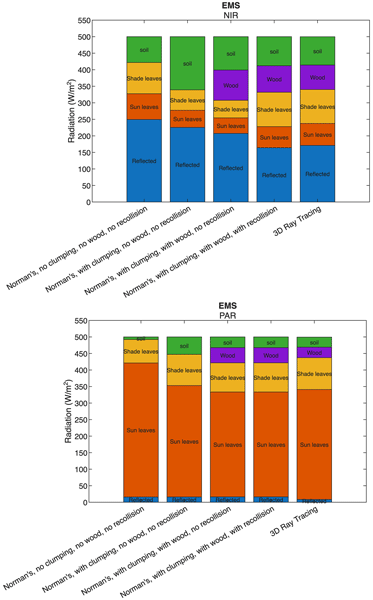
We agree with the reviewer that more discussion on the implications for GPP of including stems is warranted. GPP is largely a function of PAR absorbed by leaves, while wood structures absorb small amounts of PAR, as shown in figure 2 (bottom). It is thus expected the inclusion of wood will have little effect on GPP estimates. To assess this, we ran the CanVeg2 model with and without the inclusion of wood at the Harvard Forest site between years 2016 and 2020, and as expected we found very small difference in GPP and ET from including wood in the radiative transfer module. These results are not shown in the paper as the implications for carbon and turbulent heat fluxes will be treated in detail in a subsequent paper and we prefer avoiding over complexifying this paper by introducing CanVeg2 model runs, a note was added to lines 500-514.
The inclusion of stems in a microclimate model affects more significantly the amount of radiation reaching the soil, both in the NIR and PAR. Figure 2 shows that the absence of stems in the radiative transfer model nearly doubles the amount of radiation absorbed by the soil in the NIR and PAR. This has significant implications for the energy balance at the soil-air interface, and energy budget of the entire canopy, and we will investigate further these implications in a subsequent paper.
Minor comments:
- Abstract: Why is it mentioned that the 1D and 3D models are similar? If they are indeed similar, what is the rationale or necessity for constructing a 3D model? Furthermore, are there any effective approaches or solutions to address this issue?
As mentioned on line 53, 3D models are more computationally expensive and require 3D data on leaf and wood area distribution, whereas 1D models require only 1D vertical profiles, making them more widely usable.
- Site Description: Could you provide a general description of the forest density across different sites? Forest density is highly likely to influence branch and stem distribution, which in turn could impact the PAR simulation.
We feel LAI is a more relevant to canopy structure descriptor than stem density for this study, these values are provided in section 3.1
- Figure 2: If the fraction of diffuse radiation increases, would it exert a significant impact on the structure? Currently, the proportion of direct radiation appears to be relatively high.
It is unclear what is meant here by “impact on the structure”, we will assume the reviewer refers to the structure of the absorbed radiation profiles. The reviewer is correct in suggesting the diffuse fraction of 20% is relatively high, and to clarify the effect of diffuse fraction on the absorbed radiation by wood, we conducted additional model runs using diffuse fractions of 50% and 80%. The results are shown in Supporting Information (figures S15 and S16), and indicate that the diffuse fractions has a negligible influence on the amount of radiation absorbed by stems both in the NIR and PAR. A note was added on lines 439-449.
- Figure 5: Although the proposed method shows improvements, a discrepancy still exists between the new broadband method and the ray-tracing method. From what perspectives or aspects can this discrepancy be mitigated or eliminated?
Factors potentially influencing the correspondence between measurements and modeled estimates are discussed on lines 490-496
- Results and Discussions: I would like to see more extensive discussions under varying scenarios incorporated into the manuscript. For instance, when the biomass/volume of branches and stems increases, in what specific aspects does the improved method enhance simulation accuracy? Alternatively, under different atmospheric conditions—such as varying diffuse radiation fractions, different amounts of incident light, and across different seasons—does the new method yield improvements in simulating PAR and its corresponding vertical profiles?
Radiation absorption by stems does occurs in forest canopies, and I suggest considering it in our models necessarily leads to improvements as long as the model is sound and reasonably parametrized. In this paper we provided extensive evidence that the model represents an improvement in two ways: 1) getting albedo model estimates closer to field measurements compared to the original Norman model, and 2) providing model estimates which were not previously available from 1D models: vertically resolved profiles of radiation absorption by stems. This is highlighted in lines 518-523.
In summary, additional discussions and results regarding the improvement of model performance should be included in the paper to better demonstrate the advancement and superiority of the proposed model.
Citation: https://doi.org/10.5194/egusphere-2026-2201-AC1
-
RC2: 'Comment on egusphere-2026-2201', Run Zhong, 06 Jun 2026
This manuscript presents a potentially useful development for canopy radiative transfer and forest microclimate modelling by modifying the Norman radiative transfer model to explicitly include radiation absorption by woody structures. The topic is relevant to GMD and the problem is important: most canopy and land surface models do not explicitly partition absorbed shortwave radiation between foliage and woody biomass. The proposed development could therefore be valuable for modelling canopy energy balance, biomass heat storage, and within-canopy microclimate.
However, in its current form, I do not think the manuscript yet provides a sufficiently rigorous evaluation of the proposed model development. I therefore recommend acceptance subject to major revisions.
My main concern is that the central process introduced in the paper, namely radiation absorption by woody structures, is not directly validated. The evaluation relies primarily on comparison with the FLiESvox 3D ray-tracing model and on tower-based broadband albedo observations. The comparison with FLiESvox is useful as a model benchmark, but it is not an independent observational validation. Similarly, canopy albedo is an integrated quantity and cannot uniquely constrain the partitioning of absorbed radiation among leaves, wood, and soil. Different combinations of leaf optical properties, bark optical properties, clumping assumptions, and multiple-scattering treatments could potentially produce similar albedo values. Therefore, the current evaluation does not demonstrate that the simulated wood absorption is correct. The authors should substantially revise the wording throughout the manuscript to distinguish model benchmarking from observational validation, and they should explicitly acknowledge that wood absorption is only indirectly evaluated in the present study.
A second major concern is the treatment of the wood clumping index. The manuscript adopts a single value of Omega_w = 0.75, derived from leaf-off light transmission measurements at one temperate deciduous forest, and applies it to all four study sites, including the tropical Pasoh forest. This is a strong assumption. Woody element distribution is likely to vary with forest type, species composition, stand age, crown architecture, branch size distribution, and height within the canopy. A constant, vertically invariant Omega_w is therefore not well justified. At minimum, the manuscript should include a sensitivity analysis showing how the main results change for a plausible range of Omega_w values. Without such an analysis, it is difficult to assess whether the reported agreement with FLiESvox and the improvement in albedo are robust or partly the result of parameter tuning.
Third, the extension of recollision probability theory to broadleaf canopies is insufficiently justified. The implementation appears to have a substantial influence on NIR scattering and albedo, yet the physical basis for applying this treatment to broadleaf foliage is not convincingly established. The manuscript should either provide stronger theoretical and empirical support for this assumption or clearly frame it as an uncertain parameterization. A sensitivity test with and without this treatment, or with alternative strengths of the recollision effect, would be important for determining how much the conclusions depend on this assumption.
The manuscript sometimes presents the agreement between the modified Norman model and FLiESvox too strongly. Since both models use related structural inputs and some shared assumptions, agreement between them should not be interpreted as independent proof of physical correctness. The manuscript should avoid overstatements such as “validated” or “accurately reproduces” unless these claims are clearly limited to the model intercomparison framework. Terms such as “benchmark comparison” or “consistency with the 3D model” would be more appropriate.
The generality of the proposed method remains uncertain. All evaluation sites are broadleaf or broadleaf-dominated forests. The performance of the method in needleleaf forests, mixed forests, sparse canopies, savannas, boreal forests, and leaf-off conditions is not adequately demonstrated. The conclusions and implications for land surface models should therefore be toned down. The method may be promising, but its applicability across plant functional types remains to be tested.
Finally, the reproducibility of the model development should be improved. The manuscript states that data inputs and outputs are available, but the code availability statement appears incomplete, with a GitHub link to be inserted upon acceptance. For a GMD development paper, the model code, documentation, and example configuration should be available during review or at least provided in a clearly accessible archived form. I recommend that the authors provide the modified Norman model code, input files, and scripts necessary to reproduce the key figures before acceptance.
In summary, the manuscript addresses an important problem and proposes a potentially valuable model development. However, the current version relies too heavily on model-to-model comparison, lacks direct or sufficiently constraining observational validation of wood absorption, uses a weakly justified constant wood clumping parameter, and does not adequately explore the sensitivity of the results to key structural parameters. I therefore recommend acceptance subject to major revisions. The paper could become publishable if the authors add key sensitivity analyses, clarify the limits of their validation, improve reproducibility, and substantially moderate their claims.
Citation: https://doi.org/10.5194/egusphere-2026-2201-RC2 -
AC2: 'Reply on RC2', Martin Beland, 24 Jul 2026
Run Zhong Referee #2
This manuscript presents a potentially useful development for canopy radiative transfer and forest microclimate modelling by modifying the Norman radiative transfer model to explicitly include radiation absorption by woody structures. The topic is relevant to GMD and the problem is important: most canopy and land surface models do not explicitly partition absorbed shortwave radiation between foliage and woody biomass. The proposed development could therefore be valuable for modelling canopy energy balance, biomass heat storage, and within-canopy microclimate.
We thank the reviewer for the thorough review and raising several good points, replies are in bold
However, in its current form, I do not think the manuscript yet provides a sufficiently rigorous evaluation of the proposed model development. I therefore recommend acceptance subject to major revisions.
My main concern is that the central process introduced in the paper, namely radiation absorption by woody structures, is not directly validated. The evaluation relies primarily on comparison with the FLiESvox 3D ray-tracing model and on tower-based broadband albedo observations. The comparison with FLiESvox is useful as a model benchmark, but it is not an independent observational validation. Similarly, canopy albedo is an integrated quantity and cannot uniquely constrain the partitioning of absorbed radiation among leaves, wood, and soil. Different combinations of leaf optical properties, bark optical properties, clumping assumptions, and multiple-scattering treatments could potentially produce similar albedo values. Therefore, the current evaluation does not demonstrate that the simulated wood absorption is correct. The authors should substantially revise the wording throughout the manuscript to distinguish model benchmarking from observational validation, and they should explicitly acknowledge that wood absorption is only indirectly evaluated in the present study.
The reviewer is correct in stating the evaluation is partly based on a model to model evaluation. This comment ties with the comment below relating to the model validation, and the manuscript was modified to exclude the word validation. It is clear in the revised manuscript that the model is evaluated against the 3D model and albedo observations and not validated against direct measurements of wood radiation absorption, which is obviously practically impossible to achieve at the plot scale as mentioned on line 461.
A second major concern is the treatment of the wood clumping index. The manuscript adopts a single value of Omega_w = 0.75, derived from leaf-off light transmission measurements at one temperate deciduous forest, and applies it to all four study sites, including the tropical Pasoh forest. This is a strong assumption. Woody element distribution is likely to vary with forest type, species composition, stand age, crown architecture, branch size distribution, and height within the canopy. A constant, vertically invariant Omega_w is therefore not well justified. At minimum, the manuscript should include a sensitivity analysis showing how the main results change for a plausible range of Omega_w values. Without such an analysis, it is difficult to assess whether the reported agreement with FLiESvox and the improvement in albedo are robust or partly the result of parameter tuning.
The reviewer is correct in highlighting the uncertainty around applying the clumping factor for wood derived at one site. We performed additional model runs to assess how the stem radiation absorption changes with variations in omega wood. We used values of 0.6 and 0.9 for omega wood at all sites, and the results are presented in Supporting Information (figures S15 and S16), and show that decreasing the wood clumping factor to 0.6 (thus increasing the amount of clumping) leads to a decrease of about 16.5% in radiation absorption by wood, and this value is consistent across all sites and for NIR and PAR. Increasing the clumping factor to 0.9 increased the radiation absorption by wood by about 15.5%, and this value was also consistent cross sits and wavebands. A note was added to lines 439-449.
Third, the extension of recollision probability theory to broadleaf canopies is insufficiently justified. The implementation appears to have a substantial influence on NIR scattering and albedo, yet the physical basis for applying this treatment to broadleaf foliage is not convincingly established. The manuscript should either provide stronger theoretical and empirical support for this assumption or clearly frame it as an uncertain parameterization. A sensitivity test with and without this treatment, or with alternative strengths of the recollision effect, would be important for determining how much the conclusions depend on this assumption.
The suggested sensitivity analysis is already presented in figure 2 where results with and without applying the recollision probability are shown. We also highlight uncertainty on line 169, and mention the recollision probability is here considered an approximation on line 482. We added a sentence to further clarify on line 173.
The manuscript sometimes presents the agreement between the modified Norman model and FLiESvox too strongly. Since both models use related structural inputs and some shared assumptions, agreement between them should not be interpreted as independent proof of physical correctness. The manuscript should avoid overstatements such as “validated” or “accurately reproduces” unless these claims are clearly limited to the model intercomparison framework. Terms such as “benchmark comparison” or “consistency with the 3D model” would be more appropriate.
Several instances of “validated” were removed, “accurately reproduces” is considered appropriate and was maintained.
The generality of the proposed method remains uncertain. All evaluation sites are broadleaf or broadleaf-dominated forests. The performance of the method in needleleaf forests, mixed forests, sparse canopies, savannas, boreal forests, and leaf-off conditions is not adequately demonstrated. The conclusions and implications for land surface models should therefore be toned down. The method may be promising, but its applicability across plant functional types remains to be tested.
A note was added on line 538
Finally, the reproducibility of the model development should be improved. The manuscript states that data inputs and outputs are available, but the code availability statement appears incomplete, with a GitHub link to be inserted upon acceptance. For a GMD development paper, the model code, documentation, and example configuration should be available during review or at least provided in a clearly accessible archived form. I recommend that the authors provide the modified Norman model code, input files, and scripts necessary to reproduce the key figures before acceptance.
All codes and data have been made available
In summary, the manuscript addresses an important problem and proposes a potentially valuable model development. However, the current version relies too heavily on model-to-model comparison, lacks direct or sufficiently constraining observational validation of wood absorption, uses a weakly justified constant wood clumping parameter, and does not adequately explore the sensitivity of the results to key structural parameters. I therefore recommend acceptance subject to major revisions. The paper could become publishable if the authors add key sensitivity analyses, clarify the limits of their validation, improve reproducibility, and substantially moderate their claims.
Citation: https://doi.org/10.5194/egusphere-2026-2201-AC2
-
AC2: 'Reply on RC2', Martin Beland, 24 Jul 2026
-
CEC1: 'Comment on egusphere-2026-2201 - No compliance with the policy of the journal', Juan Antonio Añel, 21 Jun 2026
Dear authors,
Unfortunately, after checking your manuscript, it has come to our attention that it does not comply with our "Code and Data Policy".
https://www.geoscientific-model-development.net/policies/code_and_data_policy.htmlIn your "Code and Data Availability" statement you say that the code will be available upon acceptance of your manuscript. We can not accept this. Your manuscript should have never been accepted for Discussions because of it. Our policy clearly states that all the code and data necessary to replicate a manuscript must be published openly and freely to anyone before submission. Moreover, you state that the code will be made available through GitHub; however, GitHub is not a suitable repository for scientific publication. GitHub itself instructs authors to use other long-term archival and publishing alternatives, such as Zenodo.
Also, you must publish the Lidar data used for validation and comparison purposes in a repository we can accept.
Therefore, we are granting you a short time to solve this situation. You have to reply to this comment in a prompt manner with the information for the repositories containing all the models, code and data that you use to produce and replicate your manuscript. The reply must include the link and permanent identifier (e.g. DOI). Also, any future version of your manuscript must include the modified section with the new information.
I must note that if you do not fix this problem, we cannot continue with the peer-review process or accept your manuscript for publication in GMD.
Juan A. Añel
Geosci. Model Dev. Executive EditorCitation: https://doi.org/10.5194/egusphere-2026-2201-CEC1 -
AC3: 'Reply on CEC1', Martin Beland, 24 Jul 2026
Codes and data have been made available, and DOIs added to data availability section
Citation: https://doi.org/10.5194/egusphere-2026-2201-AC3
-
AC3: 'Reply on CEC1', Martin Beland, 24 Jul 2026
Peer review completion
Journal article(s) based on this preprint
Viewed
| HTML | XML | Total | Supplement | BibTeX | EndNote | |
|---|---|---|---|---|---|---|
| 373 | 152 | 46 | 571 | 73 | 42 | 41 |
- HTML: 373
- PDF: 152
- XML: 46
- Total: 571
- Supplement: 73
- BibTeX: 42
- EndNote: 41
Viewed (geographical distribution)
| Country | # | Views | % |
|---|
| Total: | 0 |
| HTML: | 0 |
| PDF: | 0 |
| XML: | 0 |
- 1
Martin Béland

Gordon Bonan
Hideki Kobayashi
Dennis Baldocchi
The requested preprint has a corresponding peer-reviewed final revised paper. You are encouraged to refer to the final revised version.
- Preprint
(6641 KB) - Metadata XML
-
Supplement
(5518 KB) - BibTeX
- EndNote
- Final revised paper
General Comments: Béland et al. developed the CanVeg2 model, which explicitly incorporates within-canopy woody structures and their storage effects on the forest microclimate. By correcting sub-canopy light and heat conditions, this model holds great potential for improving the predictive capabilities of Land Surface Models (LSMs). While the core scientific question is highly relevant, I believe the current version of the manuscript exhibits two major deficiencies that should be addressed before publication.
Major Concerns:
#1.Context-Specific Efficacy and Model Boundary Conditions: Although this study utilizes four distinct sites to demonstrate the superiority of CanVeg2 in simulating microclimate dynamics, the manuscript fails to clarify when and where the inclusion of woody structures is most critical. The authors should explicitly define the environmental or structural thresholds under which CanVeg2 provides the greatest improvement. For instance, if a site is characterized by a high leaf area index (LAI) but a low wood area index (WAI) or low woody biomass density, does CanVeg2 still outperform traditional models? This implies that CanVeg2's advantages may not be universal, but rather highly dependent on the relative dominance of woody structures in regulating the microclimate. A clearer justification of its contextual applicability is needed.
#2.Impact on Carbon-Water Coupling Processes: The authors should conduct sensitivity experiments or diagnostic simulations to evaluate how the inclusion of woody structure parameters alters carbon and water coupling processes within CanVeg2. Specifically, under conditions of high woody biomass density, what is the quantitative difference in gross primary productivity (GPP) and evapotranspiration (ET) when accounting for stem-level radiation absorption versus ignoring it? Investigating these cascading effects on downstream ecohydrological fluxes would substantially strengthen the physical mechanism and value of the model.
Minor comments:
In summary, additional discussions and results regarding the improvement of model performance should be included in the paper to better demonstrate the advancement and superiority of the proposed model.