
the Creative Commons Attribution 4.0 License.
the Creative Commons Attribution 4.0 License.
 | 24 Apr 2026
Bayesian Joint Retrieval of Soil Moisture from UAV L-Band Radiometry by Integrating RGB-TIR Priors and Footprint-Scale Texture
Abstract. Accurate field-scale soil moisture is essential for hydrological processes such as infiltration, land–atmosphere exchange, and agricultural water management. UAV-borne L-band radiometry offers a promising intermediate scale between in situ measurements and satellite observations, but retrieval remains ill-posed due to uncertainties in vegetation attenuation, surface temperature, and sub-footprint heterogeneity. This study develops an uncertainty-aware Bayesian retrieval framework that integrates dual-polarized UAV L-band brightness temperature with RGB and thermal infrared information through footprint-consistent priors. Optical fraction cover, thermal state, and texture descriptors are used to constrain vegetation optical depth and its uncertainty at the scale of the radiometric footprint. The method was evaluated over heterogeneous cropland in Pengzhou, China, using independent calibration (4 scenes, ∼1.3 ha) and validation datasets (6 scenes, ∼3.3 ha). The proposed approach reduced RMSE from ∼0.07 to ∼0.04 m3 m-3 and largely eliminated the systematic dry bias of the conventional τ–ω inversion. Analysis further shows that sub-footprint heterogeneity primarily increases uncertainty in vegetation attenuation, leading to representation error in soil moisture retrieval. These findings highlight that retrieval performance is fundamentally constrained by observation scale and surface heterogeneity. Overall, the study demonstrates that physically informed multi-source priors can improve both accuracy and interpretability, providing a pathway toward more reliable field-scale soil moisture estimation for hydrological applications.
Competing interests: At least one of the (co-)authors is a member of the editorial board of Hydrology and Earth System Sciences. The peer-review process was guided by an independent editor, and the authors also have no other competing interests to declare.
Publisher's note: Copernicus Publications remains neutral with regard to jurisdictional claims made in the text, published maps, institutional affiliations, or any other geographical representation in this paper. While Copernicus Publications makes every effort to include appropriate place names, the final responsibility lies with the authors. Views expressed in the text are those of the authors and do not necessarily reflect the views of the publisher.-
Notice on discussion status
The requested preprint has a corresponding peer-reviewed final revised paper. You are encouraged to refer to the final revised version.
-
Preprint
(1870 KB)
-
The requested preprint has a corresponding peer-reviewed final revised paper. You are encouraged to refer to the final revised version.
- Preprint
(1870 KB) - Metadata XML
- BibTeX
- EndNote
- Final revised paper


Journal article(s) based on this preprint
Interactive discussion
Status: closed
-
RC1: 'Comment on egusphere-2026-2193', Anonymous Referee #1, 27 May 2026
-
AC1: 'Reply on RC1', Zixi Li, 30 May 2026
Dear Referee #1,
We sincerely thank you for your careful and constructive comments on our manuscript. We appreciate your positive assessment of the physical motivation of the study, the integration of dual-polarized τ–ω retrieval with RGB–TIR-derived priors and footprint-scale texture information, and the discussion of retrieval ambiguity and uncertainty.
In the revised manuscript, we will provide a detailed point-to-point response to all comments and clearly indicate the corresponding changes. Below, we briefly summarize the main aspects that we will address in the revision.
First, we will revise the Introduction to provide a broader and more balanced review of existing soil moisture retrieval approaches, including empirical and machine-learning methods, physically based τ–ω retrievals, Bayesian inversion frameworks, and operational satellite algorithms. Additional relevant references will be added to better support the rationale of the study.
Second, we will clarify the novelty and positioning of the work. We will explicitly state that the main contribution is not the development of new microwave radiative transfer physics, but the integration of RGB–TIR-derived vegetation priors, footprint-scale texture descriptors, and Bayesian τ–ω inversion within a heterogeneity-aware UAV-based L-band retrieval framework.
Third, we will improve the methodological description of the Bayesian retrieval framework. We will clarify the two-stage construction of τ calibration targets and discuss how uncertainties in in-situ soil moisture, brightness temperature, effective temperature, roughness assumptions, and ancillary variables may affect these targets. We will also provide additional details on the Metropolis–Hastings implementation, including chains, acceptance rates, proposal distributions, parameter bounds, convergence assessment, and sensitivity to chain length. The effective temperature correction will also be described more explicitly.
Fourth, we will strengthen the Results section by expanding the scope of the validation experiments where possible and by adding scatter plots of retrieved versus observed soil moisture with 1:1 lines. These additions will help show whether the improvement occurs across the full moisture range or mainly reflects bias correction. We will also report the sample size for each crop class and, where feasible, provide confidence intervals or bootstrap-based uncertainty estimates for crop-specific comparisons.
Fifth, we will revise the discussion of texture effects and uncertainty behavior in a more cautious way. We will avoid overly mechanistic statements and clarify that the current regression and correlation analyses indicate physically plausible associations, rather than formal causal uncertainty propagation. Optical and thermal texture descriptors will be described as proxies for broader sub-footprint heterogeneity, and the weaker or scene-dependent role of thermal texture will be acknowledged.
Sixth, we will expand the discussion of sensitivity analysis, footprint representation, and hyperparameter selection. We will explain how calibrated hyperparameters were selected, discuss potential overfitting risks due to the limited dataset, and acknowledge that one-at-a-time sensitivity tests cannot fully capture parameter interactions or compensating effects. We will also discuss the statistical and practical significance of the difference between the elliptical and square footprint representations.
Seventh, we will strengthen the Limitations and Uncertainty section by more clearly separating the major uncertainty sources, including radiometer noise, TDR support mismatch, geolocation and co-registration uncertainty, thermal calibration uncertainty, vegetation prior uncertainty, and structural uncertainty in the τ–ω model. We will also emphasize the need for formal uncertainty propagation and variance decomposition in future work.
Finally, we will revise the Conclusions to better distinguish demonstrated findings, physically plausible interpretations, and future research directions. We will also check abbreviation definitions, improve explanations of remote-sensing-specific terms, consider adding a glossary or supplementary explanation, and ensure that the references follow HESS guidelines.
We sincerely appreciate your valuable suggestions. We believe that these revisions will improve the clarity, rigor, uncertainty interpretation, and overall presentation of the manuscript.
Citation: https://doi.org/10.5194/egusphere-2026-2193-AC1
-
AC1: 'Reply on RC1', Zixi Li, 30 May 2026
-
RC2: 'Comment on egusphere-2026-2193', Anonymous Referee #2, 28 May 2026
The authors developed a Bayesian retrieval framework for soil moisture estimation. The novelty of the manuscript relies on the utilization of UAV L-band brightness temperature and the RGB and thermal infrared information. The topic is interesting for different applications and for the community.
My main concern about the methodology is somehow not completely clear about the application of different algorithms, and then the evaluation of the presented framework is only through the RMSE and the standard deviation. Moreover, the application of this framework seems to be designed for local conditions. Even though the author recognised this limitation in the discussion section, it could be interesting to add how it can be transferred to other regions or areas.
I reviewed the paper, and I would highlight the following concerns:
Major comments:
- The framework has been developed to address the uncertainty in the retrieval information; however, the author limited the evaluation to computing the standard deviation. Other metrics or indicators could provide more detailed information about the uncertainty and their contributions to the final output.
- In subsection 2.3. The PoLRa flight provided information at a very high resolution (8 mm and 10cm), but subsequently, for validation purposes, the data were spatially aggregated to approximately 3 m. This raises a few questions: firstly, during spatial aggregation, the data may have been smoothed, particularly as the order of magnitude is so different; could you explain this in more detail? Secondly, how is spatial aggregation carried out? Could you provide further details on this step? Finally, if the data is aggregated, what is the main advantage of using very high-resolution data? Additionally, I suggest adding a scheme of the Validation procedure, because the text is sometimes confusing.
- Lines 165 to 173, this paragraph mentions that the aggregation step is central to the methodology. However, a more detailed explanation of this procedure is required, as the current text limits itself to merely mentioning it in that paragraph. This makes the methodology confusing and difficult to follow.
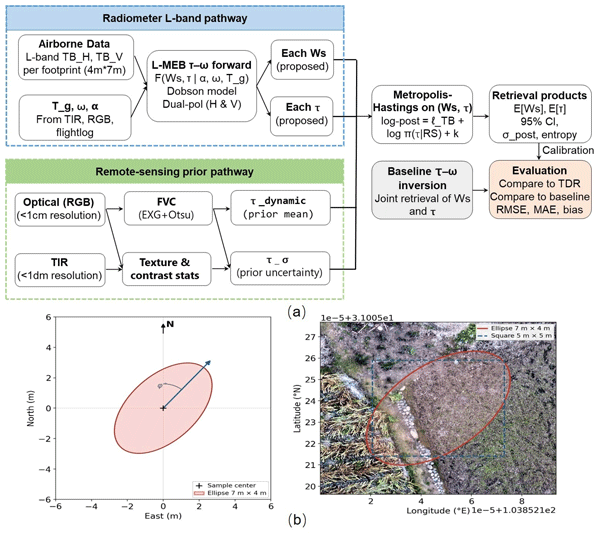
- Figure 3 presents the workflow of the paper. However, some steps are missing or could be included to expand the workflow. This would make the diagram easier to understand for the reader. For example, adding the validation process. And the comparison with the baseline is an important part of the paper.
- Lines 196 to 200. In this paragraph, mentioned that the single scattered albedo was parametrised and adjusted. This paragraph is somewhat confusing to understand; moreover, mentioned a physically reasonable range. How is this range defined? Is it based on the literature, or is it more a subjective range?
- Line 246: Posterior inference was performed through Metropolis-Hastings sampling in the two-dimensional state space. Could you elaborate more about this step? What does this algorithm involve, and, above all, what is meant by the term ‘posterior inference’?
- Please could you elaborate more about the calibration process and how the optimal parameters were defined?
- In the result section, some interpretations are not directly supported by the presented analyses, e.g., lines 302-306, 336- 339, 368-371
Minor comments:
- Many abbreviations are not defined in the text; some of them are widely used in the remote-sensing discipline. However, the text would improve by adding a glossary.
- Figure 2 could be improved by including the location of the areas
- Throughout the manuscript, the authors use the terms: metrics, statistics, and statistical metrics. Do these terms refer to similar metrics? If so, could the terms be standardised, or, if not, could the differences between them be specified?
- Figure 5, could you add proper labels to help the reader better understand the results?
- In the discussion section, some paragraphs are particularly long and hard to understand. I suggest reorganizing and splitting some of them.
I am willing to review a revised version of the manuscript. I hope that my comments are helpful in improving the overall quality of the work for both the authors and the journal.
Citation: https://doi.org/10.5194/egusphere-2026-2193-RC2 -
AC2: 'Reply on RC2', Zixi Li, 30 May 2026
Dear Referee #2,
We sincerely thank you for your careful and constructive review of our manuscript. We appreciate your recognition of the relevance of UAV L-band brightness temperature, RGB imagery, and thermal infrared information for soil moisture retrieval, as well as the potential value of this topic for related applications and the broader community. In the revised manuscript, we will provide a detailed point-to-point response to all comments and clearly indicate the corresponding revisions. Below, we briefly summarize the main aspects that we will address.
First, we will improve the clarity of the overall methodology. We will more clearly explain the role of different algorithms in the proposed framework, including the use of RGB and thermal infrared information, the Bayesian retrieval procedure, and the baseline comparison. We will also revise the workflow figure to include key missing steps, especially the validation process and comparison with baseline methods.
Second, we will provide a clearer description of the spatial aggregation and validation procedure. We will explain how the high-resolution UAV observations were aggregated to the validation scale, discuss possible smoothing effects during aggregation, and clarify why very high-resolution data remain useful after aggregation. To make this process easier to follow, we will add a schematic diagram of the validation workflow.
Third, we will clarify the calibration process, parameter selection, and Bayesian inference. We will explain how the optimal parameters were determined, how the physically reasonable parameter ranges were defined, and how the single-scattering albedo was parameterized and adjusted. We will also provide a clearer explanation of posterior inference and the Metropolis–Hastings sampling procedure used in the two-dimensional state space.
Fourth, we will strengthen the evaluation of retrieval performance and uncertainty. In addition to RMSE and posterior standard deviation, we will consider additional metrics or indicators to better describe retrieval uncertainty and its contribution to the final output. We will also revise interpretations in the Results section to ensure that all statements are directly supported by the presented analyses.
Fifth, we will expand the discussion of transferability and improve the presentation of the manuscript. We will add a clearer discussion of how the framework could be transferred to other regions or field conditions, including the need for local calibration, vegetation and thermal priors, and validation data. We will also define abbreviations more carefully, consider adding a glossary, improve Figure 2 and Figure 5, standardize the use of terms such as “metrics” and “statistics,” and reorganize long paragraphs in the Discussion section.
Thank you again for your valuable suggestions and your willingness to review a revised version of the manuscript. We believe that these revisions will improve the methodological clarity, validation design, uncertainty analysis, and readability of the paper.
Citation: https://doi.org/10.5194/egusphere-2026-2193-AC2
-
RC3: 'Comment on egusphere-2026-2193', Anonymous Referee #3, 31 May 2026
This manuscript presents an interesting study on field-scale soil moisture retrieval using UAV-borne L-band passive microwave radiometry integrated with RGB and thermal infrared information. Overall, this research is timely and potentially valuable for hydrological remote sensing, precision agriculture, and field-scale soil moisture monitoring. However, several important methodological and validation issues need to be addressed before the manuscript can be considered for publication.
Major comments
- Section 2.2 and Section 2.3: As described in these sections, the microwave observations were acquired by a DJI Matrice 600 platform carrying the PoLRa v3.1 L-band radiometer, and the effective microwave support area was estimated to be approximately 4 m × 7 m. However, the manuscript does not provide sufficient information on radiometric calibration, brightness-temperature uncertainty, incidence-angle control, antenna pattern, or footprint determination. Since the proposed method relies heavily on footprint-consistent aggregation of RGB-TIR features, these missing details may directly affect the credibility and reproducibility of the retrieval framework. Therefore, it is advised to provide the calibration procedure, TBH/TBV quality-control strategy, antenna footprint calculation, and uncertainty associated with the assumed footprint in the revised manuscript.
- Section 2.3 and Section 4.3: The calibration dataset includes only four scenes, approximately 1.3 ha, and 52 calibration points, while the independent validation dataset includes six scenes, approximately 3.3 ha, and 57 matched validation points collected over two consecutive days. These two days mainly represent pre- and post-rainfall conditions associated with a small rainfall event. Although this design is useful for a field-scale demonstration, it is not sufficient to demonstrate the general transferability of the proposed framework. The authors should moderate the related conclusions or provide additional validation across different crop growth stages, irrigation conditions, surface roughness states, and seasonal moisture regimes.
- Section 2.5 and Section 3.1: The baseline comparison is not sufficient to demonstrate the necessity of all components of the proposed framework. The principal baseline is a Dobson plus dual-parameter τ–ω inversion without the RGB-TIR Bayesian prior. This comparison shows that the full proposed method performs better than the unconstrained baseline, but it does not reveal which component mainly contributes to the improvement. It is advised to conduct additional experiments to help readers better understand whether all proposed components are necessary.
- Section 3.2 and Table 1: The manuscript reports very large improvements for several land-cover types. For example, wheat RMSE decreases from 0.0921 to 0.0088 m³ m⁻³, and maize RMSE decreases from 0.0857 to 0.0187 m³ m⁻³. These results are promising but may be strongly affected by the number of validation samples in each crop category. The manuscript should report the sample size for each land-cover type and provide confidence intervals for class-specific RMSE, MAE, and bias.
- Section 4.1: The manuscript shows that optical texture is significantly associated with τ uncertainty and absolute soil-moisture error, but its relationship with posterior soil-moisture standard deviation is relatively weak. As described in this section, part of the representation error may remain outside the posterior uncertainty term. However, the reliability of posterior uncertainty has not been fully evaluated. Therefore, it is advised to further assess posterior uncertainty using credible-interval coverage, calibration plots, or other uncertainty-validation diagnostics.
- Section 4.1 and Table 2: The manuscript reports that the ellipse footprint slightly outperforms the square footprint, with RMSE decreasing from 0.0443 to 0.0418 m³ m⁻³. The physical explanation is reasonable, but the numerical difference is small, only 0.0025 m³ m⁻³. The authors should report whether this difference is statistically significant and whether it holds across individual scenes, land-cover types, and moisture conditions. Additional tests using different footprint sizes or antenna-pattern-weighted aggregation would provide stronger evidence that footprint consistency is a major source of improvement.
Minor comments
- Section 2.3: The date format “03/04”, “04/04”, and “05/04” is confusing. Please use an unambiguous format, such as “2026-04-03”, “2026-04-04”, and “2026-04-05”.
- Figure 4: The authors should clarify whether the bootstrap confidence intervals were calculated by resampling validation points, scenes, or both.
- Table 1: Please add the number of samples for each land-cover class. This is essential for interpreting the reported crop-specific accuracy.
- Figure 5: It is advised to use a common color scale between the baseline and proposed retrievals to allow direct visual comparison in the soil moisture maps. In addition, the font size of the labels, color-bar tick values, and numerical annotations is too small, which reduces the readability of the figure.
Citation: https://doi.org/10.5194/egusphere-2026-2193-RC3 -
AC3: 'Reply on RC3', Zixi Li, 31 May 2026
Dear Referee #3,
We sincerely thank you for your careful and constructive assessment of our manuscript. We appreciate your recognition of the timeliness and potential value of UAV-borne L-band passive microwave radiometry combined with RGB and thermal infrared information for field-scale soil moisture retrieval. In the revised manuscript, we will provide a detailed point-to-point response to all comments and clearly indicate the corresponding revisions. Below, we briefly summarize the main aspects that we will address.
First, we will improve the description of the UAV radiometer observations and footprint determination. We will provide more details on radiometric calibration, TBH/TBV quality control, brightness-temperature uncertainty, incidence-angle control, antenna pattern, footprint calculation, and the uncertainty associated with the assumed 4 m × 7 m microwave support area.
Second, we will clarify the limitations of the current validation dataset and moderate the claims about transferability. We will more explicitly state that the current experiment provides a field-scale demonstration under limited pre- and post-rainfall conditions, rather than a full demonstration of general applicability across seasons and regions. Where possible, we will expand the validation analysis; otherwise, we will add a clearer discussion of the additional data needed to test the framework under different crop growth stages, irrigation conditions, surface roughness states, and moisture regimes.
Third, we will strengthen the comparison experiments to better evaluate the contribution of each component in the proposed framework. In addition to the current baseline comparison, we will consider additional ablation or sensitivity experiments to assess the roles of RGB-TIR-derived priors, Bayesian constraints, texture information, and footprint-consistent aggregation.
Fourth, we will improve the evaluation of uncertainty and class-specific performance. We will report the sample size for each land-cover type and provide confidence intervals for crop-specific RMSE, MAE, and bias where feasible. We will also further assess posterior uncertainty using additional diagnostics, such as credible-interval coverage, calibration plots, or related uncertainty-validation indicators, rather than relying only on posterior standard deviation.
Fifth, we will further examine the footprint-comparison results and improve figure presentation. We will test whether the performance difference between the elliptical and square footprints is statistically meaningful and whether it is consistent across scenes, land-cover types, and moisture conditions. We will also consider additional footprint-size or antenna-pattern-weighted aggregation tests where possible. In addition, we will revise the date format, clarify the bootstrap resampling strategy, add sample sizes to Table 1, improve the readability of Figure 5, and use a common color scale for direct comparison between baseline and proposed retrieval maps.
Thank you again for your valuable suggestions. We will carefully address these issues in the revised manuscript.
Citation: https://doi.org/10.5194/egusphere-2026-2193-AC3
Peer review completion


Interactive discussion
Status: closed
-
RC1: 'Comment on egusphere-2026-2193', Anonymous Referee #1, 27 May 2026
General Comments:
The manuscript presents a timely and physically meaningful framework that integrates dual-polarized τ-ω retrieval with RGB-TIR-derived priors and footprint-scale texture information for UAV-based L band soil moisture estimation. The study addresses several important challenges in passive microwave retrieval, particularly those associated with vegetation attenuation, support mismatch, and sub-footprint heterogeneity. One notable strength of the manuscript is that the discussion goes beyond reporting retrieval performance metrics and attempts to provide physical interpretation of retrieval ambiguity and uncertainty behavior.
The primary novelty of the study appears to arise from the integration of RGB-TIR priors, texture descriptors, and Bayesian inversion within a heterogeneity-aware retrieval framework, rather than from the introduction of fundamentally new microwave retrieval physics. This distinction could be stated more explicitly to avoid overstating originality. Nevertheless, the manuscript is generally well motivated, with clear context, rationale, and research objectives that are mostly supported through the subsequent analyses and discussion.
The manuscript contains several promising ideas regarding uncertainty-aware microwave retrieval. However, some interpretations appear somewhat stronger than what is directly supported by the presented analyses. In addition, although acknowledged in the limitations section, the dataset remains relatively limited in both temporal coverage and sample size and it also does not perform formal uncertainty propagation or variance decomposition to explicitly quantify the relative contribution of different uncertainty sources (e.g., radiometer noise, support mismatch, vegetation priors, or structural model error) to the total retrieval uncertainty.
Below are some specific comments that Authors should consider carefully to address and improve the manuscript and making it suitable for publication:
Specific Comments:
Introduction
- The introduction is generally well structured and clearly motivates the importance of vegetation attenuation, support mismatch and sub-footprint heterogeneity in passive microwave retrieval.
- However, this section would benefit from a broader discussion of existing retrieval approaches including their pros & cons and clearer distinction among empirical machine learning retrievals, physically constrained Bayesian retrieval frameworks, and operational satellite retrieval methods, particularly in the paragraph beginning around line 84. Paragraph started referring context of recent studies. However, only one study is cited. This paragraph should be supported by more relevant literature to reflect strong rationale of this study objectives.
Methods
- The overall Bayesian τ-ω retrieval framework is physically interpretable and scientifically reasonable.
- The validation dataset is relatively small, with 52 calibration points and 57 validation points over a restricted two-day validation period, although the authors acknowledge this limitation.
- The prior mean and uncertainty for vegetation optical depth τ are estimated from calibration data, and τ calibration targets are obtained by inverting the τ-ω model using in situ soil moisture. This creates a two-stage inversion dependency. Please explain how errors in in situ soil moisture, temperature, roughness, and brightness temperature propagate into these τ targets.
- Additional methodological detail is needed regarding the Bayesian implementation. The paper states that Metropolis-Hastings sampling used about 1,000 iterations with 200 burn-in samples and convergence was assessed from trace stability. Please provide acceptance rates, number of chains, proposal distributions, parameter bounds, convergence diagnostics, and sensitivity to chain length.
- Effective temperature Tg is treated as an effective vegetation–soil composite temperature and adjusted using thermal/optical indicators. Please provide the exact correction equation, bounds, and whether thermal calibration/emissivity correction was applied.
- The study uses standard deviation of optical luminance and thermal temperature as texture descriptors. This is clear and robust, but it may not fully represent real field textures, e.g., row orientation, canopy gaps, or aspect structure. The authors should either justify why standard deviation is sufficient or add more texture metrics as comparison.
Results
- The manuscript clearly demonstrates improvement in retrieval accuracy and reduction of dry bias. Crop-specific comparisons are found useful and informative.
- Current bar plots show RMSE, MAE, and bias well, but scatter plots with 1:1 lines would better reveal whether improvement occurs across the whole moisture range or mainly from bias correction.
- Please add scatter plots of retrieved vs observed soil moisture. Scatter plots of retrieved versus observed soil moisture would strengthen evaluation and help assess retrieval behavior across the full moisture range.
- Some land-cover-specific improvements, especially very large gains for wheat and maize may be based on small class sample sizes, but the number of samples per class is not reported. This makes it difficult to understand its robustness. Sample size for each crop class should be reported to better assess robustness of crop-specific improvements. Please add n, confidence intervals, or bootstrap uncertainty for each land-cover class.
- Thermal texture is significantly related to τ uncertainty but not to soil moisture error, while optical texture has stronger relationships. The discussion should more clearly state that the thermal contribution appears weaker or scene-dependent in this experiment.
- The 4 m x 7 m ellipse performs slightly better than a 5 m x 5 m square. This is a useful result, but the improvement is noticeably small. Please discuss whether this difference is statistically significant and how footprint size/shape uncertainty affects the results.
Discussions
- The discussion section is one of the stronger parts of the manuscript because it attempts physical interpretation rather than only reporting retrieval metrics. However, several interpretations become somewhat mechanistic despite being based mainly on regression/correlation analyses. The interpretation should therefore remain more cautious.
- The texture analysis provides useful exploratory insight into retrieval uncertainty under heterogeneous canopies. But, statements suggesting that heterogeneity “primarily enters the posterior through τ-related uncertainty” appear somewhat stronger than what can be rigorously concluded from the presented regression analyses alone.
- The observed relationships are physically plausible, but additional posterior covariance analysis or formal uncertainty decomposition would be needed to fully support mechanistic uncertainty propagation claims. Texture descriptors likely act as proxies for broader sub-footprint heterogeneity rather than uniquely causal drivers of retrieval uncertainty. Several discussion statements become somewhat mechanistic despite the absence of formal uncertainty decomposition or covariance analysis.
- The sensitivity analysis is useful and demonstrates that the retrieval framework is not excessively fragile to moderate hyperparameter perturbations. However, the current one-at-a-time sensitivity approach does not capture interaction of parameters, nonlinear coupling, or compensating effects among priors, likelihood weighting, and vegetation attenuation constraints. This limitation should be acknowledged more explicitly.
- The manuscript should also clarify how the “calibrated” hyperparameter settings were selected and whether there is risk of overfitting to the limited dataset.
- Stability conclusions based mainly on RMSE curves may be somewhat overstated without examining posterior uncertainty behavior or parameter identifiability. The manuscript argues that relatively flat RMSE curves indicate robustness. However, flat RMSE behavior may also reflect limited sensitivity of the chosen validation metric, compensating parameter effects, or relatively narrow perturbation ranges. Therefore, it would help to additionally examine posterior uncertainty behavior, parameter identifiability, or posterior distribution shifts, rather than RMSE alone.
Limitations and Uncertainty
- The limitations section is generally honest and well presented. The authors acknowledge issues related to limited sample size, restricted observation dates, lack of full seasonal coverage, and the absence of detailed decomposition of different error sources. However, the discussion could be strengthened by more clearly separating and discussing the major uncertainty sources at least, such as radiometer measurement noise, TDR support mismatch, geolocation/co-registration uncertainty, thermal calibration uncertainty, vegetation prior uncertainty, and structural uncertainty associated with the τ-ω model.
Conclusions
- The conclusions are generally consistent with the presented results. The importance of heterogeneity-aware retrieval is clearly articulated. The conclusion section would further benefit from more clear separation of demonstrated findings, physically plausible interpretation, and future research directions.
- Future studies should place greater emphasis on overcoming data scarcity issues, and performing formal uncertainty propagation through variance decomposition, which would further strengthen the findings of this study and improve the interpretability of the retrieval framework.
Minor/Editorial Comments:
- Several remote sensing discipline-oriented terminologies are introduced throughout the article without any context or broad overview of them for readers beyond remote sensing discipline or for general readers. Please add their brief description either in footnote or in a Glossary as part of Supplementary materials with properly citing it to see those from Supplementary materials.
- Double check first appearance of abbreviations/expansion and then abbreviations in subsequent sections.
- Please check reference style as per HESS guidelines.
Citation: https://doi.org/10.5194/egusphere-2026-2193-RC1 -
AC1: 'Reply on RC1', Zixi Li, 30 May 2026
Dear Referee #1,
We sincerely thank you for your careful and constructive comments on our manuscript. We appreciate your positive assessment of the physical motivation of the study, the integration of dual-polarized τ–ω retrieval with RGB–TIR-derived priors and footprint-scale texture information, and the discussion of retrieval ambiguity and uncertainty.
In the revised manuscript, we will provide a detailed point-to-point response to all comments and clearly indicate the corresponding changes. Below, we briefly summarize the main aspects that we will address in the revision.
First, we will revise the Introduction to provide a broader and more balanced review of existing soil moisture retrieval approaches, including empirical and machine-learning methods, physically based τ–ω retrievals, Bayesian inversion frameworks, and operational satellite algorithms. Additional relevant references will be added to better support the rationale of the study.
Second, we will clarify the novelty and positioning of the work. We will explicitly state that the main contribution is not the development of new microwave radiative transfer physics, but the integration of RGB–TIR-derived vegetation priors, footprint-scale texture descriptors, and Bayesian τ–ω inversion within a heterogeneity-aware UAV-based L-band retrieval framework.
Third, we will improve the methodological description of the Bayesian retrieval framework. We will clarify the two-stage construction of τ calibration targets and discuss how uncertainties in in-situ soil moisture, brightness temperature, effective temperature, roughness assumptions, and ancillary variables may affect these targets. We will also provide additional details on the Metropolis–Hastings implementation, including chains, acceptance rates, proposal distributions, parameter bounds, convergence assessment, and sensitivity to chain length. The effective temperature correction will also be described more explicitly.
Fourth, we will strengthen the Results section by expanding the scope of the validation experiments where possible and by adding scatter plots of retrieved versus observed soil moisture with 1:1 lines. These additions will help show whether the improvement occurs across the full moisture range or mainly reflects bias correction. We will also report the sample size for each crop class and, where feasible, provide confidence intervals or bootstrap-based uncertainty estimates for crop-specific comparisons.
Fifth, we will revise the discussion of texture effects and uncertainty behavior in a more cautious way. We will avoid overly mechanistic statements and clarify that the current regression and correlation analyses indicate physically plausible associations, rather than formal causal uncertainty propagation. Optical and thermal texture descriptors will be described as proxies for broader sub-footprint heterogeneity, and the weaker or scene-dependent role of thermal texture will be acknowledged.
Sixth, we will expand the discussion of sensitivity analysis, footprint representation, and hyperparameter selection. We will explain how calibrated hyperparameters were selected, discuss potential overfitting risks due to the limited dataset, and acknowledge that one-at-a-time sensitivity tests cannot fully capture parameter interactions or compensating effects. We will also discuss the statistical and practical significance of the difference between the elliptical and square footprint representations.
Seventh, we will strengthen the Limitations and Uncertainty section by more clearly separating the major uncertainty sources, including radiometer noise, TDR support mismatch, geolocation and co-registration uncertainty, thermal calibration uncertainty, vegetation prior uncertainty, and structural uncertainty in the τ–ω model. We will also emphasize the need for formal uncertainty propagation and variance decomposition in future work.
Finally, we will revise the Conclusions to better distinguish demonstrated findings, physically plausible interpretations, and future research directions. We will also check abbreviation definitions, improve explanations of remote-sensing-specific terms, consider adding a glossary or supplementary explanation, and ensure that the references follow HESS guidelines.
We sincerely appreciate your valuable suggestions. We believe that these revisions will improve the clarity, rigor, uncertainty interpretation, and overall presentation of the manuscript.
Citation: https://doi.org/10.5194/egusphere-2026-2193-AC1
-
RC2: 'Comment on egusphere-2026-2193', Anonymous Referee #2, 28 May 2026
The authors developed a Bayesian retrieval framework for soil moisture estimation. The novelty of the manuscript relies on the utilization of UAV L-band brightness temperature and the RGB and thermal infrared information. The topic is interesting for different applications and for the community.
My main concern about the methodology is somehow not completely clear about the application of different algorithms, and then the evaluation of the presented framework is only through the RMSE and the standard deviation. Moreover, the application of this framework seems to be designed for local conditions. Even though the author recognised this limitation in the discussion section, it could be interesting to add how it can be transferred to other regions or areas.
I reviewed the paper, and I would highlight the following concerns:
Major comments:
- The framework has been developed to address the uncertainty in the retrieval information; however, the author limited the evaluation to computing the standard deviation. Other metrics or indicators could provide more detailed information about the uncertainty and their contributions to the final output.
- In subsection 2.3. The PoLRa flight provided information at a very high resolution (8 mm and 10cm), but subsequently, for validation purposes, the data were spatially aggregated to approximately 3 m. This raises a few questions: firstly, during spatial aggregation, the data may have been smoothed, particularly as the order of magnitude is so different; could you explain this in more detail? Secondly, how is spatial aggregation carried out? Could you provide further details on this step? Finally, if the data is aggregated, what is the main advantage of using very high-resolution data? Additionally, I suggest adding a scheme of the Validation procedure, because the text is sometimes confusing.
- Lines 165 to 173, this paragraph mentions that the aggregation step is central to the methodology. However, a more detailed explanation of this procedure is required, as the current text limits itself to merely mentioning it in that paragraph. This makes the methodology confusing and difficult to follow.
- Figure 3 presents the workflow of the paper. However, some steps are missing or could be included to expand the workflow. This would make the diagram easier to understand for the reader. For example, adding the validation process. And the comparison with the baseline is an important part of the paper.
- Lines 196 to 200. In this paragraph, mentioned that the single scattered albedo was parametrised and adjusted. This paragraph is somewhat confusing to understand; moreover, mentioned a physically reasonable range. How is this range defined? Is it based on the literature, or is it more a subjective range?
- Line 246: Posterior inference was performed through Metropolis-Hastings sampling in the two-dimensional state space. Could you elaborate more about this step? What does this algorithm involve, and, above all, what is meant by the term ‘posterior inference’?
- Please could you elaborate more about the calibration process and how the optimal parameters were defined?
- In the result section, some interpretations are not directly supported by the presented analyses, e.g., lines 302-306, 336- 339, 368-371
Minor comments:
- Many abbreviations are not defined in the text; some of them are widely used in the remote-sensing discipline. However, the text would improve by adding a glossary.
- Figure 2 could be improved by including the location of the areas
- Throughout the manuscript, the authors use the terms: metrics, statistics, and statistical metrics. Do these terms refer to similar metrics? If so, could the terms be standardised, or, if not, could the differences between them be specified?
- Figure 5, could you add proper labels to help the reader better understand the results?
- In the discussion section, some paragraphs are particularly long and hard to understand. I suggest reorganizing and splitting some of them.
I am willing to review a revised version of the manuscript. I hope that my comments are helpful in improving the overall quality of the work for both the authors and the journal.
Citation: https://doi.org/10.5194/egusphere-2026-2193-RC2 -
AC2: 'Reply on RC2', Zixi Li, 30 May 2026
Dear Referee #2,
We sincerely thank you for your careful and constructive review of our manuscript. We appreciate your recognition of the relevance of UAV L-band brightness temperature, RGB imagery, and thermal infrared information for soil moisture retrieval, as well as the potential value of this topic for related applications and the broader community. In the revised manuscript, we will provide a detailed point-to-point response to all comments and clearly indicate the corresponding revisions. Below, we briefly summarize the main aspects that we will address.
First, we will improve the clarity of the overall methodology. We will more clearly explain the role of different algorithms in the proposed framework, including the use of RGB and thermal infrared information, the Bayesian retrieval procedure, and the baseline comparison. We will also revise the workflow figure to include key missing steps, especially the validation process and comparison with baseline methods.
Second, we will provide a clearer description of the spatial aggregation and validation procedure. We will explain how the high-resolution UAV observations were aggregated to the validation scale, discuss possible smoothing effects during aggregation, and clarify why very high-resolution data remain useful after aggregation. To make this process easier to follow, we will add a schematic diagram of the validation workflow.
Third, we will clarify the calibration process, parameter selection, and Bayesian inference. We will explain how the optimal parameters were determined, how the physically reasonable parameter ranges were defined, and how the single-scattering albedo was parameterized and adjusted. We will also provide a clearer explanation of posterior inference and the Metropolis–Hastings sampling procedure used in the two-dimensional state space.
Fourth, we will strengthen the evaluation of retrieval performance and uncertainty. In addition to RMSE and posterior standard deviation, we will consider additional metrics or indicators to better describe retrieval uncertainty and its contribution to the final output. We will also revise interpretations in the Results section to ensure that all statements are directly supported by the presented analyses.
Fifth, we will expand the discussion of transferability and improve the presentation of the manuscript. We will add a clearer discussion of how the framework could be transferred to other regions or field conditions, including the need for local calibration, vegetation and thermal priors, and validation data. We will also define abbreviations more carefully, consider adding a glossary, improve Figure 2 and Figure 5, standardize the use of terms such as “metrics” and “statistics,” and reorganize long paragraphs in the Discussion section.
Thank you again for your valuable suggestions and your willingness to review a revised version of the manuscript. We believe that these revisions will improve the methodological clarity, validation design, uncertainty analysis, and readability of the paper.
Citation: https://doi.org/10.5194/egusphere-2026-2193-AC2
-
RC3: 'Comment on egusphere-2026-2193', Anonymous Referee #3, 31 May 2026
This manuscript presents an interesting study on field-scale soil moisture retrieval using UAV-borne L-band passive microwave radiometry integrated with RGB and thermal infrared information. Overall, this research is timely and potentially valuable for hydrological remote sensing, precision agriculture, and field-scale soil moisture monitoring. However, several important methodological and validation issues need to be addressed before the manuscript can be considered for publication.
Major comments
- Section 2.2 and Section 2.3: As described in these sections, the microwave observations were acquired by a DJI Matrice 600 platform carrying the PoLRa v3.1 L-band radiometer, and the effective microwave support area was estimated to be approximately 4 m × 7 m. However, the manuscript does not provide sufficient information on radiometric calibration, brightness-temperature uncertainty, incidence-angle control, antenna pattern, or footprint determination. Since the proposed method relies heavily on footprint-consistent aggregation of RGB-TIR features, these missing details may directly affect the credibility and reproducibility of the retrieval framework. Therefore, it is advised to provide the calibration procedure, TBH/TBV quality-control strategy, antenna footprint calculation, and uncertainty associated with the assumed footprint in the revised manuscript.
- Section 2.3 and Section 4.3: The calibration dataset includes only four scenes, approximately 1.3 ha, and 52 calibration points, while the independent validation dataset includes six scenes, approximately 3.3 ha, and 57 matched validation points collected over two consecutive days. These two days mainly represent pre- and post-rainfall conditions associated with a small rainfall event. Although this design is useful for a field-scale demonstration, it is not sufficient to demonstrate the general transferability of the proposed framework. The authors should moderate the related conclusions or provide additional validation across different crop growth stages, irrigation conditions, surface roughness states, and seasonal moisture regimes.
- Section 2.5 and Section 3.1: The baseline comparison is not sufficient to demonstrate the necessity of all components of the proposed framework. The principal baseline is a Dobson plus dual-parameter τ–ω inversion without the RGB-TIR Bayesian prior. This comparison shows that the full proposed method performs better than the unconstrained baseline, but it does not reveal which component mainly contributes to the improvement. It is advised to conduct additional experiments to help readers better understand whether all proposed components are necessary.
- Section 3.2 and Table 1: The manuscript reports very large improvements for several land-cover types. For example, wheat RMSE decreases from 0.0921 to 0.0088 m³ m⁻³, and maize RMSE decreases from 0.0857 to 0.0187 m³ m⁻³. These results are promising but may be strongly affected by the number of validation samples in each crop category. The manuscript should report the sample size for each land-cover type and provide confidence intervals for class-specific RMSE, MAE, and bias.
- Section 4.1: The manuscript shows that optical texture is significantly associated with τ uncertainty and absolute soil-moisture error, but its relationship with posterior soil-moisture standard deviation is relatively weak. As described in this section, part of the representation error may remain outside the posterior uncertainty term. However, the reliability of posterior uncertainty has not been fully evaluated. Therefore, it is advised to further assess posterior uncertainty using credible-interval coverage, calibration plots, or other uncertainty-validation diagnostics.
- Section 4.1 and Table 2: The manuscript reports that the ellipse footprint slightly outperforms the square footprint, with RMSE decreasing from 0.0443 to 0.0418 m³ m⁻³. The physical explanation is reasonable, but the numerical difference is small, only 0.0025 m³ m⁻³. The authors should report whether this difference is statistically significant and whether it holds across individual scenes, land-cover types, and moisture conditions. Additional tests using different footprint sizes or antenna-pattern-weighted aggregation would provide stronger evidence that footprint consistency is a major source of improvement.
Minor comments
- Section 2.3: The date format “03/04”, “04/04”, and “05/04” is confusing. Please use an unambiguous format, such as “2026-04-03”, “2026-04-04”, and “2026-04-05”.
- Figure 4: The authors should clarify whether the bootstrap confidence intervals were calculated by resampling validation points, scenes, or both.
- Table 1: Please add the number of samples for each land-cover class. This is essential for interpreting the reported crop-specific accuracy.
- Figure 5: It is advised to use a common color scale between the baseline and proposed retrievals to allow direct visual comparison in the soil moisture maps. In addition, the font size of the labels, color-bar tick values, and numerical annotations is too small, which reduces the readability of the figure.
Citation: https://doi.org/10.5194/egusphere-2026-2193-RC3 -
AC3: 'Reply on RC3', Zixi Li, 31 May 2026
Dear Referee #3,
We sincerely thank you for your careful and constructive assessment of our manuscript. We appreciate your recognition of the timeliness and potential value of UAV-borne L-band passive microwave radiometry combined with RGB and thermal infrared information for field-scale soil moisture retrieval. In the revised manuscript, we will provide a detailed point-to-point response to all comments and clearly indicate the corresponding revisions. Below, we briefly summarize the main aspects that we will address.
First, we will improve the description of the UAV radiometer observations and footprint determination. We will provide more details on radiometric calibration, TBH/TBV quality control, brightness-temperature uncertainty, incidence-angle control, antenna pattern, footprint calculation, and the uncertainty associated with the assumed 4 m × 7 m microwave support area.
Second, we will clarify the limitations of the current validation dataset and moderate the claims about transferability. We will more explicitly state that the current experiment provides a field-scale demonstration under limited pre- and post-rainfall conditions, rather than a full demonstration of general applicability across seasons and regions. Where possible, we will expand the validation analysis; otherwise, we will add a clearer discussion of the additional data needed to test the framework under different crop growth stages, irrigation conditions, surface roughness states, and moisture regimes.
Third, we will strengthen the comparison experiments to better evaluate the contribution of each component in the proposed framework. In addition to the current baseline comparison, we will consider additional ablation or sensitivity experiments to assess the roles of RGB-TIR-derived priors, Bayesian constraints, texture information, and footprint-consistent aggregation.
Fourth, we will improve the evaluation of uncertainty and class-specific performance. We will report the sample size for each land-cover type and provide confidence intervals for crop-specific RMSE, MAE, and bias where feasible. We will also further assess posterior uncertainty using additional diagnostics, such as credible-interval coverage, calibration plots, or related uncertainty-validation indicators, rather than relying only on posterior standard deviation.
Fifth, we will further examine the footprint-comparison results and improve figure presentation. We will test whether the performance difference between the elliptical and square footprints is statistically meaningful and whether it is consistent across scenes, land-cover types, and moisture conditions. We will also consider additional footprint-size or antenna-pattern-weighted aggregation tests where possible. In addition, we will revise the date format, clarify the bootstrap resampling strategy, add sample sizes to Table 1, improve the readability of Figure 5, and use a common color scale for direct comparison between baseline and proposed retrieval maps.
Thank you again for your valuable suggestions. We will carefully address these issues in the revised manuscript.
Citation: https://doi.org/10.5194/egusphere-2026-2193-AC3
Peer review completion
Journal article(s) based on this preprint
Viewed
| HTML | XML | Total | BibTeX | EndNote | |
|---|---|---|---|---|---|
| 346 | 80 | 28 | 454 | 20 | 21 |
- HTML: 346
- PDF: 80
- XML: 28
- Total: 454
- BibTeX: 20
- EndNote: 21
Viewed (geographical distribution)
| Country | # | Views | % |
|---|
| Total: | 0 |
| HTML: | 0 |
| PDF: | 0 |
| XML: | 0 |
- 1
Yan Li

Peizhe Cheng
Fuqiang Tian
Yao Zhuang
The requested preprint has a corresponding peer-reviewed final revised paper. You are encouraged to refer to the final revised version.
- Preprint
(1870 KB) - Metadata XML
General Comments:
The manuscript presents a timely and physically meaningful framework that integrates dual-polarized τ-ω retrieval with RGB-TIR-derived priors and footprint-scale texture information for UAV-based L band soil moisture estimation. The study addresses several important challenges in passive microwave retrieval, particularly those associated with vegetation attenuation, support mismatch, and sub-footprint heterogeneity. One notable strength of the manuscript is that the discussion goes beyond reporting retrieval performance metrics and attempts to provide physical interpretation of retrieval ambiguity and uncertainty behavior.
The primary novelty of the study appears to arise from the integration of RGB-TIR priors, texture descriptors, and Bayesian inversion within a heterogeneity-aware retrieval framework, rather than from the introduction of fundamentally new microwave retrieval physics. This distinction could be stated more explicitly to avoid overstating originality. Nevertheless, the manuscript is generally well motivated, with clear context, rationale, and research objectives that are mostly supported through the subsequent analyses and discussion.
The manuscript contains several promising ideas regarding uncertainty-aware microwave retrieval. However, some interpretations appear somewhat stronger than what is directly supported by the presented analyses. In addition, although acknowledged in the limitations section, the dataset remains relatively limited in both temporal coverage and sample size and it also does not perform formal uncertainty propagation or variance decomposition to explicitly quantify the relative contribution of different uncertainty sources (e.g., radiometer noise, support mismatch, vegetation priors, or structural model error) to the total retrieval uncertainty.
Below are some specific comments that Authors should consider carefully to address and improve the manuscript and making it suitable for publication:
Specific Comments:
Introduction
Methods
Results
Discussions
Limitations and Uncertainty
Conclusions
Minor/Editorial Comments: