
the Creative Commons Attribution 4.0 License.
the Creative Commons Attribution 4.0 License.
 | 23 Apr 2026
Methanesulfonic and sulfuric acids are major contributors to tropical Indo-Pacific aerosol
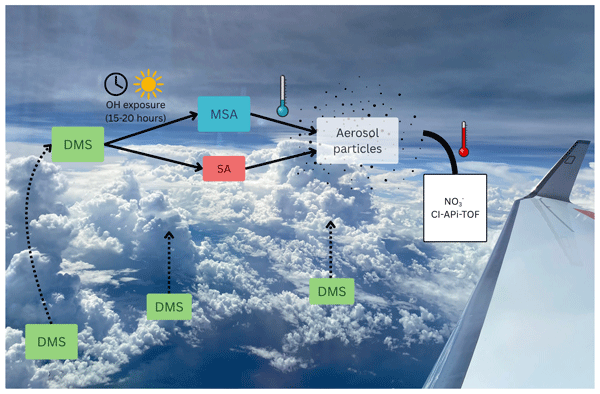
Abstract. In the marine environment dimethylsulfide (DMS) is the most abundant sulfur-containing trace gas. It serves as a key precursor to new particle formation and growth via its oxidation products, sulfuric acid (SA, H2SO4) and methanesulfonic acid (MSA, CH3SO3H). Here, we present measurements of MSA and SA in the Indo-Pacific region during the CAFE-Pacific (Chemistry of the Atmosphere Field Experiment in the Pacific) campaign in January–February 2024. The measurements were conducted on board the HALO (High Altitude and LOng-range) aircraft using nitrate mass spectrometry. We observe gas-phase concentrations of up to 4 × 107 cm-3 MSA and 6 × 107 cm-3 SA in the marine boundary layer. In the lower free troposphere, the MSA/SA ratio increases with altitude in agreement with the temperature-dependent DMS oxidation. At higher altitudes, adiabatic heating and subsequent evaporation of acidic particles within the instrument inlet enable the detection of both particle- and gas-phase MSA and SA. A detailed analysis of two flights shows that marine deep convection can lead to DMS transport from the boundary layer to the upper troposphere and subsequent particle formation and growth after approximately 10–20 hours of OH exposure aligning with the DMS lifetime determined by kinetic modelling. We frequently observe MSA concentrations significantly exceeding those of SA, suggesting that free-tropospheric particles – particularly over the Indo-Pacific Warm Pool – may be dominated by MSA. Our results imply that marine convection represents an important source of airborne particles in the upper tropical troposphere, one of the most pristine regions of Earth's atmosphere.
Competing interests: At least one of the (co-)authors is a member of the editorial board of Atmospheric Chemistry and Physics.
Publisher's note: Copernicus Publications remains neutral with regard to jurisdictional claims made in the text, published maps, institutional affiliations, or any other geographical representation in this paper. While Copernicus Publications makes every effort to include appropriate place names, the final responsibility lies with the authors. Views expressed in the text are those of the authors and do not necessarily reflect the views of the publisher.-
Notice on discussion status
The requested preprint has a corresponding peer-reviewed final revised paper. You are encouraged to refer to the final revised version.
-
Preprint
(25298 KB)
-
The requested preprint has a corresponding peer-reviewed final revised paper. You are encouraged to refer to the final revised version.
- Preprint
(25298 KB) - Metadata XML
- BibTeX
- EndNote
- Final revised paper


Journal article(s) based on this preprint
Interactive discussion
Status: closed
- RC1: 'Comment on egusphere-2026-2191', Anonymous Referee #1, 21 May 2026
-
RC2: 'Comment on egusphere-2026-2191', Anonymous Referee #2, 27 May 2026
This paper presents MSA and H2SO4 concentrations measured from the HALO aircraft over the Indo-Pacific. The dataset is highly valuable, the figures are beautifully presented, and the discussion is for the most part thorough and well judged. My comments below are offered in the spirit of strengthening an already strong manuscript, and once addressed I highly recommend this for publication in ACP.
Major comments
Title. My main comment is largely stylistic. The title makes a firm assertion: "Methanesulfonic and sulfuric acids are major contributors to tropical Indo-Pacific aerosol", yet throughout the manuscript the authors appropriately hedge their conclusions with "potentially", "suggesting", and similar, and discuss the relevant uncertainties carefully. The "are" in the title therefore reads as a slight overstatement, particularly when set against the abstract's own phrasing: "...suggesting that free-tropospheric particles particularly over the Indo-Pacific Warm Pool may be dominated by MSA." This does not undermine the paper in any way, but the title conveys a degree of certainty that the text itself is careful not to claim. I would encourage softening it to match the measured tone of the body.
Evaporation. My second comment concerns the substantial discussion given to evaporation of the particle phase into the gas phase, which for SA and MSA can cause gas-phase concentrations to increase by three orders of magnitude (and approaches four in Fig. 1/A2). This is framed largely as a positive in the manuscript, and to a degree it is, as it is what allows the authors to comment on aerosol composition below the lower cut of the C-AMS at all. However, the group's recent isoprene-nitrate work using the same instrument feels like something of an elephant in the room. I appreciate that this paper is not about isoprene nitrates, and that Curtius et al. 2024 (https://doi.org/10.1038/s41586-024-08192-4) concerns a different campaign, but it would be valuable to discuss whether comparable evaporative behaviour would be expected for isoprene nitrates. Curtius et al. in fact present data at the same altitudes at which the authors here expect their MSA and SA particles to evaporate entirely, so the question of cross-instrument artefact seems difficult to avoid. I recognise the volatilities of acids and organic nitrates may well differ, and that the evaporation here is tied to the particles' acidic state (Fig. A3) so the answer may be that nitrates behave differently; but that is for the authors to demonstrate rather than leave unaddressed.
Minor comments
Particle neutrality. The assumption that the sampled particles are acidic is fundamental to the paper, and is probably correct, but a few sentences setting out explicitly why the authors believe this would strengthen the argument. A demonstrated absence of NH4+ in the C-TOF-AMS data, for instance, would help support it directly.
Gas-phase model. Two points here. Firstly, I broadly agree with Reviewer 1, though I would regard an exhaustive revision of the underlying mechanism as somewhat out of scope here. Reviewer 1 is nonetheless right that the gas-phase-only model is not strictly comparable to measurements that capture both gas and particle phases, especially given the strong linear fit in Fig. 4, which itself demonstrates how much of the signal is evaporated particle.
Secondly, one point I would like the authors to clarify: they note that "incorporating dilution losses into the model would substantially reduce the predicted acid concentrations [and] would imply a missing source." Does this not suggest that the model only reproduces the observations because losses were omitted, i.e. that making the model more physically realistic would degrade, rather than improve, the agreement? If so, the agreement cannot also serve as validation of the measurements, and I would ask the authors to reconcile these two uses of the comparison.
K-means clustering (Fig. 8). It would be helpful to describe how the K-means clustering was applied. The two standard approaches are to cluster on the Euclidean distance between trajectories or on differences in trajectory angle (as offered, for example, by the two options in trajCluster in R), and the choice materially affects cluster membership. A note on the distance metric used, the trajectory features clustered on, and the basis for selecting nine clusters would aid reproducibility.
Convection. On p.20 the authors use five-day back-trajectories combined with satellite cloud observations to identify convective influence. This could usefully be fleshed out for us chemists with limited meteorological background. We would benefit from a clearer account of how convective contact is actually established from these two data sources.
Citation: https://doi.org/10.5194/egusphere-2026-2191-RC2 -
RC3: 'Comment on egusphere-2026-2191', Anonymous Referee #3, 27 May 2026
The comment was uploaded in the form of a supplement: https://egusphere.copernicus.org/preprints/2026/egusphere-2026-2191/egusphere-2026-2191-RC3-supplement.pdf
- AC1: 'Comment on egusphere-2026-2191', Hannah Klebach, 28 Jul 2026
Peer review completion


Interactive discussion
Status: closed
-
RC1: 'Comment on egusphere-2026-2191', Anonymous Referee #1, 21 May 2026
This paper measures methanesulfonic acid (MSA) and sulfuric acid (SA) in the tropical Indo-Pacific from 0-14 km in altitude using the HALO aircraft. MSA and SA were measured in both gas-phase and particle phase, however, due to the instrument limitations (evaporation of the species in the inlet), some of the data have been excluded, especially in the mid-troposphere. Additionally, zero-dimensional box modelling of the oxidation of DMS in the upper troposphere has been performed to compare with the observations.
Overall, I think this is a useful contribution to the field; due to the importance of MSA and SA for new particle formation (NPF) and contribution to cloud condensation nuclei (CCN), more fieldwork measurements, particularly in areas that have been underexplored, are important. The observations of MSA and SA in the upper troposphere that are likely due to deep convection were interesting, and the comparison of MSA and SA concentrations with time from convection (Figure 9) provides a nice insight into the possible chemistry and lifetime of these species in the upper troposphere.
The paper is well written and the figures are nice, however, the discussion on the formation of MSA and SA from DMS oxidation is lacking in depth, and the limitations of the model are understated. Further details on this are included in the following comments. In addition, some smaller technical comments are included.
Major comments:1. Due to the complicated nature of MSA formation, especially in the gas phase, the discussion of the formation of MSA from the gas phase should be expanded. This includes how MSA formation occurs from the complicated equilibrium chemistry of CH3SOx species. Whether CH3SOx species form MSA, SA or SO2 (which could eventually contribute to SA) depends on RO2, H-donors, NOx and temperature. This discussion, and how it impacts the results, is missing from this work. In the particle phase, MSA is primarily formed from aqueous reactions of MSIA, with MSIA formed due to the DMS addition pathway (OH or BrO initiated), and reaction of DMS and O3 in cloud droplets. Additionally, there seems to be a direct sulfate formation pathway from the uptake of HPMTF in aerosol/cloud droplets (Jernigan et al., 2024). Understanding these pathways is important for the interpretation of the results, and should be discussed in more detail.
2. Although some modelling of DMS has been included, I think there has been a lack of commentary on the DMS oxidation mechanisms in the literature, and the differences between them. The DMS mechanism from Shen et al. (2022) has been used in this modelling work, however there is no discussion on how that mechanism compares/differs from other DMS mechanisms in the literature, such as those from Jernigan et al. (2022), Ye et al. (2022), and Jacob et al. (2024, 2026). Specifically, Jacob et al. (2024) found that the mechanism from Shen et al. (2022) tended to underestimate SO2 concentrations when compared to other chamber studies and mechanisms. A mechanism comparison is particularly lacking in the discussion of model results from line 440 onwards, and the conclusion.
3. Line 432: 'Since we measure the combined gas and particle phase in the upper troposphere, we can directly compare our data to the model results.' I disagree with this. As mentioned previously in this paper, the major source of MSA in particle phase/cloud droplets is from aqueous phase reactions (Hoffmann et al, 2016). I understand that the observed results are a combination of both gas and aqueous phase, however, as this modelling does not include aqueous chemistry, it cannot be directly compared to the combined gas and particle phase. This should be made much clearer, and included in the discussion of the model results and conclusions.
Minor comments:
1. Since DMS concentrations were obtained from CAMS reanalysis, the plotting of NOx and SO2 would also be useful to investigate other sources of MSA and SA. In line 444 the influence of NOx (and O3) has been mentioned, however how that affects the results is lacking. This would be particularly helpful in the boundary layer runs with trajectories coming from land (and the comparison of Shen et al. 2022 simulations in lines 232-240).Technical comments:
Abstract: Space needed in dimethyl sulfide
Line 29: Space needed in dimethyl sulfide
Line 32: Slightly misleading, DMS can be oxidised to many other products (including SO2). Should have more depth in the atmospheric chemistry of DMS here, and cite more papers
Line 31: Missing a reference for 'The MSA formation from DMS is strongly temperature-dependent, with higher formation rates at cold temperatures'. If it is the Shen 2022 reference, this should be made clearer
Line 34: Again, slightly misleading, as from these papers it is the dominant source of MSA in cloud droplets/aerosol (which will be in a different form, MS^-)
Figure 3, line 3: I don't think 'Marine' should be capitalised here
Line 209: Instead of saying 'these rather high values', which is quite subjective, it would be better to compare where they lie within the literature/other observations.
Line 224: This is a confusing sentence, you should expand on it to make it more understandable
Line 231: I am not sure what a 'good' agreement between the model and observations are, can you quantify this? Additionally, although there is a similar trend with temperature, the modelled values mostly lie outside the 75th percentile, which I would not consider 'good'
Line 375: This is misleading, as the oxidation of DMS is a chemical source of SO2. If you are specifically referring to volcanic/anthropogenic SO2 sources, this should be clearer
Line 450: Again, not sure that you can say that the observations have 'good' agreement with the model, especially considering the limitations in comparing gas-phase chemistry to observed gas-phase and particle phase concentrationsReferences:
Jernigan, C. M., Rivard, M. J., Berkelhammer, M. B., and Bertram, T. H.: Sulfate and carbonyl sulfide production in aqueous reactions of hydroperoxymethyl thioformate, ACS ES&T Air, 1, 397–404, https://doi.org/10.1021/acsestair.3c00098, 2024.
Shen, J. et al.: High gas-phase methanesulfonic acid production in the OH-initiated oxidation of dimethyl sulfide at low temperatures, Environ. Sci. Technol., 56, 13931–13944, https://doi.org/10.1021/acs.est.2c05154, 2022.
Jernigan, C. M., Fite, C. H., Vereecken, L., Berkelhammer, M. B., Rollins, A. W., Rickly, P. S., Novelli, A., Taraborrelli, D., Holmes, C. D., and Bertram, T. H.: Efficient production of carbonyl sulfide in the low-NOx oxidation of dimethyl sulfide, Geophys. Res. Lett., 49, e2021GL096838, https://doi.org/10.1029/2021GL096838, 2022.
Ye, Q., Goss, M. B., Krechmer, J. E., Majluf, F., Zaytsev, A., Li, Y., Roscioli, J. R., Canagaratna, M., Keutsch, F. N., Heald, C. L., and Kroll, J. H.: Product distribution, kinetics, and aerosol formation from the OH oxidation of dimethyl sulfide under different RO2 regimes, Atmos. Chem. Phys., 22, 16003–16015, https://doi.org/10.5194/acp-22-16003-2022, 2022.
Jacob, L. S. D., Giorio, C., and Archibald, A. T.: Extension, development, and evaluation of the representation of the OH-initiated dimethyl sulfide (DMS) oxidation mechanism in the Master Chemical Mechanism (MCM) v3.3.1 framework, Atmos. Chem. Phys., 24, 3329–3347, https://doi.org/10.5194/acp-24-3329-2024, 2024.
Jacob, L. S. D., Harvey, B. E. H., Giorio, C., and Archibald, A. T.: Determining the key sources of uncertainty in dimethyl sulfide and methanethiol oxidation under tropical, temperate, and polar marine conditions, Atmos. Chem. Phys., 26, 3567–3587, https://doi.org/10.5194/acp-26-3567-2026, 2026.
Hoffmann, E. H., Tilgner, A., Schrödner, R., Bräuer, P., Wolke, R., and Herrmann, H.: An advanced modeling study on the impacts and atmospheric implications of multiphase dimethyl sulfide chemistry, P. Natl. Acad. Sci. USA, 113, 11776–11781, https://doi.org/10.1073/pnas.1606320113, 2016.Citation: https://doi.org/10.5194/egusphere-2026-2191-RC1 -
RC2: 'Comment on egusphere-2026-2191', Anonymous Referee #2, 27 May 2026
This paper presents MSA and H2SO4 concentrations measured from the HALO aircraft over the Indo-Pacific. The dataset is highly valuable, the figures are beautifully presented, and the discussion is for the most part thorough and well judged. My comments below are offered in the spirit of strengthening an already strong manuscript, and once addressed I highly recommend this for publication in ACP.
Major comments
Title. My main comment is largely stylistic. The title makes a firm assertion: "Methanesulfonic and sulfuric acids are major contributors to tropical Indo-Pacific aerosol", yet throughout the manuscript the authors appropriately hedge their conclusions with "potentially", "suggesting", and similar, and discuss the relevant uncertainties carefully. The "are" in the title therefore reads as a slight overstatement, particularly when set against the abstract's own phrasing: "...suggesting that free-tropospheric particles particularly over the Indo-Pacific Warm Pool may be dominated by MSA." This does not undermine the paper in any way, but the title conveys a degree of certainty that the text itself is careful not to claim. I would encourage softening it to match the measured tone of the body.
Evaporation. My second comment concerns the substantial discussion given to evaporation of the particle phase into the gas phase, which for SA and MSA can cause gas-phase concentrations to increase by three orders of magnitude (and approaches four in Fig. 1/A2). This is framed largely as a positive in the manuscript, and to a degree it is, as it is what allows the authors to comment on aerosol composition below the lower cut of the C-AMS at all. However, the group's recent isoprene-nitrate work using the same instrument feels like something of an elephant in the room. I appreciate that this paper is not about isoprene nitrates, and that Curtius et al. 2024 (https://doi.org/10.1038/s41586-024-08192-4) concerns a different campaign, but it would be valuable to discuss whether comparable evaporative behaviour would be expected for isoprene nitrates. Curtius et al. in fact present data at the same altitudes at which the authors here expect their MSA and SA particles to evaporate entirely, so the question of cross-instrument artefact seems difficult to avoid. I recognise the volatilities of acids and organic nitrates may well differ, and that the evaporation here is tied to the particles' acidic state (Fig. A3) so the answer may be that nitrates behave differently; but that is for the authors to demonstrate rather than leave unaddressed.
Minor comments
Particle neutrality. The assumption that the sampled particles are acidic is fundamental to the paper, and is probably correct, but a few sentences setting out explicitly why the authors believe this would strengthen the argument. A demonstrated absence of NH4+ in the C-TOF-AMS data, for instance, would help support it directly.
Gas-phase model. Two points here. Firstly, I broadly agree with Reviewer 1, though I would regard an exhaustive revision of the underlying mechanism as somewhat out of scope here. Reviewer 1 is nonetheless right that the gas-phase-only model is not strictly comparable to measurements that capture both gas and particle phases, especially given the strong linear fit in Fig. 4, which itself demonstrates how much of the signal is evaporated particle.
Secondly, one point I would like the authors to clarify: they note that "incorporating dilution losses into the model would substantially reduce the predicted acid concentrations [and] would imply a missing source." Does this not suggest that the model only reproduces the observations because losses were omitted, i.e. that making the model more physically realistic would degrade, rather than improve, the agreement? If so, the agreement cannot also serve as validation of the measurements, and I would ask the authors to reconcile these two uses of the comparison.
K-means clustering (Fig. 8). It would be helpful to describe how the K-means clustering was applied. The two standard approaches are to cluster on the Euclidean distance between trajectories or on differences in trajectory angle (as offered, for example, by the two options in trajCluster in R), and the choice materially affects cluster membership. A note on the distance metric used, the trajectory features clustered on, and the basis for selecting nine clusters would aid reproducibility.
Convection. On p.20 the authors use five-day back-trajectories combined with satellite cloud observations to identify convective influence. This could usefully be fleshed out for us chemists with limited meteorological background. We would benefit from a clearer account of how convective contact is actually established from these two data sources.
Citation: https://doi.org/10.5194/egusphere-2026-2191-RC2 -
RC3: 'Comment on egusphere-2026-2191', Anonymous Referee #3, 27 May 2026
The comment was uploaded in the form of a supplement: https://egusphere.copernicus.org/preprints/2026/egusphere-2026-2191/egusphere-2026-2191-RC3-supplement.pdf
- AC1: 'Comment on egusphere-2026-2191', Hannah Klebach, 28 Jul 2026
Peer review completion
Journal article(s) based on this preprint
Viewed
| HTML | XML | Total | BibTeX | EndNote | |
|---|---|---|---|---|---|
| 438 | 297 | 57 | 792 | 50 | 50 |
- HTML: 438
- PDF: 297
- XML: 57
- Total: 792
- BibTeX: 50
- EndNote: 50
Viewed (geographical distribution)
| Country | # | Views | % |
|---|
| Total: | 0 |
| HTML: | 0 |
| PDF: | 0 |
| XML: | 0 |
- 1
Hannah Klebach

Martin Heinritzi
Katharina Kaiser
Lisa Beck
Samuel Ruhl
Samira Atabakhsh
Nirvan Bhattacharyya
Lucía Caudillo-Plath
Philipp Joppe
Thomas Klimach
Peter Lloyd
Mira Pöhlker
Ulrich Pöschl
Sarah Richter
Douglas M. Russell
Johannes Schneider
Marcel Zauner-Wieczorek
Joachim Curtius
The requested preprint has a corresponding peer-reviewed final revised paper. You are encouraged to refer to the final revised version.
- Preprint
(25298 KB) - Metadata XML
This paper measures methanesulfonic acid (MSA) and sulfuric acid (SA) in the tropical Indo-Pacific from 0-14 km in altitude using the HALO aircraft. MSA and SA were measured in both gas-phase and particle phase, however, due to the instrument limitations (evaporation of the species in the inlet), some of the data have been excluded, especially in the mid-troposphere. Additionally, zero-dimensional box modelling of the oxidation of DMS in the upper troposphere has been performed to compare with the observations.
Overall, I think this is a useful contribution to the field; due to the importance of MSA and SA for new particle formation (NPF) and contribution to cloud condensation nuclei (CCN), more fieldwork measurements, particularly in areas that have been underexplored, are important. The observations of MSA and SA in the upper troposphere that are likely due to deep convection were interesting, and the comparison of MSA and SA concentrations with time from convection (Figure 9) provides a nice insight into the possible chemistry and lifetime of these species in the upper troposphere.
The paper is well written and the figures are nice, however, the discussion on the formation of MSA and SA from DMS oxidation is lacking in depth, and the limitations of the model are understated. Further details on this are included in the following comments. In addition, some smaller technical comments are included.
Major comments:
1. Due to the complicated nature of MSA formation, especially in the gas phase, the discussion of the formation of MSA from the gas phase should be expanded. This includes how MSA formation occurs from the complicated equilibrium chemistry of CH3SOx species. Whether CH3SOx species form MSA, SA or SO2 (which could eventually contribute to SA) depends on RO2, H-donors, NOx and temperature. This discussion, and how it impacts the results, is missing from this work. In the particle phase, MSA is primarily formed from aqueous reactions of MSIA, with MSIA formed due to the DMS addition pathway (OH or BrO initiated), and reaction of DMS and O3 in cloud droplets. Additionally, there seems to be a direct sulfate formation pathway from the uptake of HPMTF in aerosol/cloud droplets (Jernigan et al., 2024). Understanding these pathways is important for the interpretation of the results, and should be discussed in more detail.
2. Although some modelling of DMS has been included, I think there has been a lack of commentary on the DMS oxidation mechanisms in the literature, and the differences between them. The DMS mechanism from Shen et al. (2022) has been used in this modelling work, however there is no discussion on how that mechanism compares/differs from other DMS mechanisms in the literature, such as those from Jernigan et al. (2022), Ye et al. (2022), and Jacob et al. (2024, 2026). Specifically, Jacob et al. (2024) found that the mechanism from Shen et al. (2022) tended to underestimate SO2 concentrations when compared to other chamber studies and mechanisms. A mechanism comparison is particularly lacking in the discussion of model results from line 440 onwards, and the conclusion.
3. Line 432: 'Since we measure the combined gas and particle phase in the upper troposphere, we can directly compare our data to the model results.' I disagree with this. As mentioned previously in this paper, the major source of MSA in particle phase/cloud droplets is from aqueous phase reactions (Hoffmann et al, 2016). I understand that the observed results are a combination of both gas and aqueous phase, however, as this modelling does not include aqueous chemistry, it cannot be directly compared to the combined gas and particle phase. This should be made much clearer, and included in the discussion of the model results and conclusions.
Minor comments:
1. Since DMS concentrations were obtained from CAMS reanalysis, the plotting of NOx and SO2 would also be useful to investigate other sources of MSA and SA. In line 444 the influence of NOx (and O3) has been mentioned, however how that affects the results is lacking. This would be particularly helpful in the boundary layer runs with trajectories coming from land (and the comparison of Shen et al. 2022 simulations in lines 232-240).
Technical comments:
Abstract: Space needed in dimethyl sulfide
Line 29: Space needed in dimethyl sulfide
Line 32: Slightly misleading, DMS can be oxidised to many other products (including SO2). Should have more depth in the atmospheric chemistry of DMS here, and cite more papers
Line 31: Missing a reference for 'The MSA formation from DMS is strongly temperature-dependent, with higher formation rates at cold temperatures'. If it is the Shen 2022 reference, this should be made clearer
Line 34: Again, slightly misleading, as from these papers it is the dominant source of MSA in cloud droplets/aerosol (which will be in a different form, MS^-)
Figure 3, line 3: I don't think 'Marine' should be capitalised here
Line 209: Instead of saying 'these rather high values', which is quite subjective, it would be better to compare where they lie within the literature/other observations.
Line 224: This is a confusing sentence, you should expand on it to make it more understandable
Line 231: I am not sure what a 'good' agreement between the model and observations are, can you quantify this? Additionally, although there is a similar trend with temperature, the modelled values mostly lie outside the 75th percentile, which I would not consider 'good'
Line 375: This is misleading, as the oxidation of DMS is a chemical source of SO2. If you are specifically referring to volcanic/anthropogenic SO2 sources, this should be clearer
Line 450: Again, not sure that you can say that the observations have 'good' agreement with the model, especially considering the limitations in comparing gas-phase chemistry to observed gas-phase and particle phase concentrations
References:
Jernigan, C. M., Rivard, M. J., Berkelhammer, M. B., and Bertram, T. H.: Sulfate and carbonyl sulfide production in aqueous reactions of hydroperoxymethyl thioformate, ACS ES&T Air, 1, 397–404, https://doi.org/10.1021/acsestair.3c00098, 2024.
Shen, J. et al.: High gas-phase methanesulfonic acid production in the OH-initiated oxidation of dimethyl sulfide at low temperatures, Environ. Sci. Technol., 56, 13931–13944, https://doi.org/10.1021/acs.est.2c05154, 2022.
Jernigan, C. M., Fite, C. H., Vereecken, L., Berkelhammer, M. B., Rollins, A. W., Rickly, P. S., Novelli, A., Taraborrelli, D., Holmes, C. D., and Bertram, T. H.: Efficient production of carbonyl sulfide in the low-NOx oxidation of dimethyl sulfide, Geophys. Res. Lett., 49, e2021GL096838, https://doi.org/10.1029/2021GL096838, 2022.
Ye, Q., Goss, M. B., Krechmer, J. E., Majluf, F., Zaytsev, A., Li, Y., Roscioli, J. R., Canagaratna, M., Keutsch, F. N., Heald, C. L., and Kroll, J. H.: Product distribution, kinetics, and aerosol formation from the OH oxidation of dimethyl sulfide under different RO2 regimes, Atmos. Chem. Phys., 22, 16003–16015, https://doi.org/10.5194/acp-22-16003-2022, 2022.
Jacob, L. S. D., Giorio, C., and Archibald, A. T.: Extension, development, and evaluation of the representation of the OH-initiated dimethyl sulfide (DMS) oxidation mechanism in the Master Chemical Mechanism (MCM) v3.3.1 framework, Atmos. Chem. Phys., 24, 3329–3347, https://doi.org/10.5194/acp-24-3329-2024, 2024.
Jacob, L. S. D., Harvey, B. E. H., Giorio, C., and Archibald, A. T.: Determining the key sources of uncertainty in dimethyl sulfide and methanethiol oxidation under tropical, temperate, and polar marine conditions, Atmos. Chem. Phys., 26, 3567–3587, https://doi.org/10.5194/acp-26-3567-2026, 2026.
Hoffmann, E. H., Tilgner, A., Schrödner, R., Bräuer, P., Wolke, R., and Herrmann, H.: An advanced modeling study on the impacts and atmospheric implications of multiphase dimethyl sulfide chemistry, P. Natl. Acad. Sci. USA, 113, 11776–11781, https://doi.org/10.1073/pnas.1606320113, 2016.