
the Creative Commons Attribution 4.0 License.
the Creative Commons Attribution 4.0 License.
 | 19 May 2026
Brief Communication – InSAR Svalbard Ground Motion Service: Observing Surface Displacements in the High Arctic
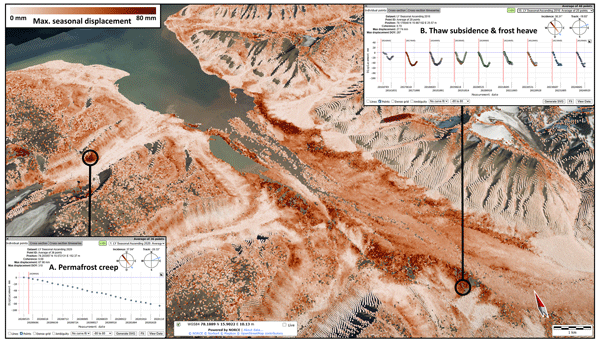
Abstract. The InSAR Svalbard Ground Motion Service (GMS) provides open-access surface displacement maps and time series in the Svalbard archipelago, derived from Sentinel-1 Interferometric Synthetic Aperture Radar (InSAR). The service provides seasonal products capturing short-term 2016–2024 displacements and interannual products documenting long-term 2018–2024 velocity trends. InSAR Svalbard covers five areas on Spitsbergen Island (Longyearbyen, Ny-Ålesund, Svea, Hornsund and Kapp Linné). The service consists in a web-based visualisation tool at https://svalbard.insar.no. The products are also distributed at https://doi.org/10.5281/zenodo.18442696. InSAR Svalbard establishes a foundation for geohazard assessment in Arctic regions and interdisciplinary research on permafrost dynamics, ground stability, and environmental changes.
-
Notice on discussion status
The requested preprint has a corresponding peer-reviewed final revised paper. You are encouraged to refer to the final revised version.
-
Preprint
(1205 KB)
-
The requested preprint has a corresponding peer-reviewed final revised paper. You are encouraged to refer to the final revised version.
- Preprint
(1205 KB) - Metadata XML
- BibTeX
- EndNote
- Final revised paper


Journal article(s) based on this preprint
Interactive discussion
Status: closed
-
RC1: 'Comment on egusphere-2026-2189', Anonymous Referee #1, 26 May 2026
- AC1: 'Reply on RC1', Line Rouyet, 24 Aug 2026
-
RC2: 'Comment on egusphere-2026-2189', Anonymous Referee #2, 08 Jun 2026
- AC2: 'Reply on RC2', Line Rouyet, 24 Aug 2026
Peer review completion


Interactive discussion
Status: closed
-
RC1: 'Comment on egusphere-2026-2189', Anonymous Referee #1, 26 May 2026
The InSAR Svalbard initiative represents a significant milestone for Arctic research. The manuscript presents its background and relevance in a clear and functional manner. Overall, I believe the paper is suitable for publication, pending minor revisions.
I would suggest that the handling editor consider elevating the manuscript to a Research Article, given the uniqueness and potential impact of the service proposed to users. In its current form, the paper gives the impression that additional technical detail could have been included, and that the reliance on external documentation is driven more by space constraints than by a deliberate stylistic choice.
For instance, a more detailed discussion of InSAR limitations in Chapter 3 would be valuable for technical readers, particularly in relation to the motion characteristics of the Svalbard archipelago. Similarly, the solutions adopted for the data viewer, currently only briefly described in Chapter 4, would likely be of interest to InSAR service providers and practitioners, and could be expanded.
Specific comments:
- Please clarify why the short-term observation periods differ between the two orbits.
- Please define what is meant by a “season.” In particular, specify how the “average” snow-free season is determined and characterized (e.g. using external models or RS data).
- If, due to article-type constraints, a more extensive description of limitations (ref. line 78) and WebGIS functionalities (ref. line 126) cannot be included, I recommend providing at least a concise list of key elements that users should focus on when consulting the external documentation.
- Does Svalbard have a pre-existing database of slow-moving processes? Clarifying this would help highlight the added value of the project (e.g., whether it provides an update or constitutes a first systematic mapping).
- With reference to line 179: the project clearly illustrates the operational burden and challenges associated with extending a continental-scale Ground Motion Service (GMS) to the Arctic environment. This can be commented.
Citation: https://doi.org/10.5194/egusphere-2026-2189-RC1 - AC1: 'Reply on RC1', Line Rouyet, 24 Aug 2026
-
RC2: 'Comment on egusphere-2026-2189', Anonymous Referee #2, 08 Jun 2026
- AC2: 'Reply on RC2', Line Rouyet, 24 Aug 2026
Peer review completion
Journal article(s) based on this preprint
Data sets
InSAR Svalbard WebGIS Marie Bredal et al. https://svalbard.insar.no
InSAR Svalbard Zenodo Dataset Marie Bredal et al. https://doi.org/10.5281/zenodo.18442696
InSAR Svalbard Product Description and User Manual Marie Bredal et al. https://svalbard.insar.no/docs/User-manual-InSAR-Svalbard.pdf
Viewed
| HTML | XML | Total | BibTeX | EndNote | |
|---|---|---|---|---|---|
| 306 | 122 | 29 | 457 | 20 | 24 |
- HTML: 306
- PDF: 122
- XML: 29
- Total: 457
- BibTeX: 20
- EndNote: 24
Viewed (geographical distribution)
| Country | # | Views | % |
|---|
| Total: | 0 |
| HTML: | 0 |
| PDF: | 0 |
| XML: | 0 |
- 1
Marie Bredal

Lotte Wendt
Heidi Hindberg
Daniel Stødle
Tom Rune Lauknes
Jelte van Oostveen
Yngvar Larsen
Gökhan Aslan
Emma Hauglin
John Dehls
Anja Sundal
Anna Odh
Dag Anders Moldestad
The requested preprint has a corresponding peer-reviewed final revised paper. You are encouraged to refer to the final revised version.
- Preprint
(1205 KB) - Metadata XML
The InSAR Svalbard initiative represents a significant milestone for Arctic research. The manuscript presents its background and relevance in a clear and functional manner. Overall, I believe the paper is suitable for publication, pending minor revisions.
I would suggest that the handling editor consider elevating the manuscript to a Research Article, given the uniqueness and potential impact of the service proposed to users. In its current form, the paper gives the impression that additional technical detail could have been included, and that the reliance on external documentation is driven more by space constraints than by a deliberate stylistic choice.
For instance, a more detailed discussion of InSAR limitations in Chapter 3 would be valuable for technical readers, particularly in relation to the motion characteristics of the Svalbard archipelago. Similarly, the solutions adopted for the data viewer, currently only briefly described in Chapter 4, would likely be of interest to InSAR service providers and practitioners, and could be expanded.
Specific comments: