
the Creative Commons Attribution 4.0 License.
the Creative Commons Attribution 4.0 License.
 | 24 Apr 2026
Insufficient mass spectrometric detection of synthesized peroxy acids from α-pinene ozonolysis
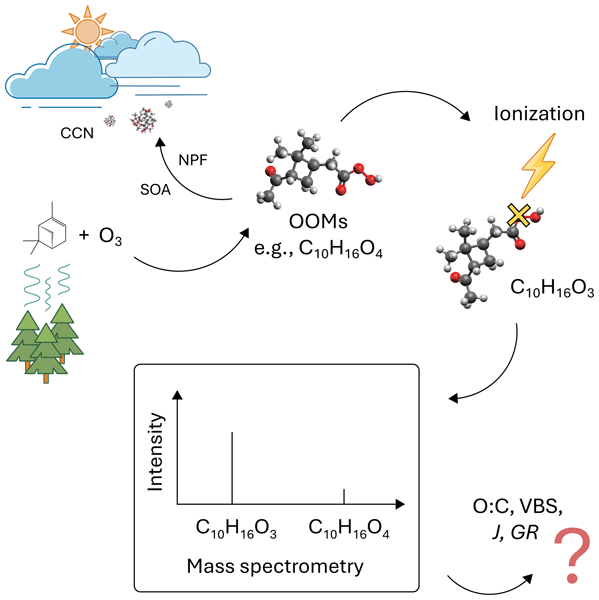
Abstract. Biogenic volatile organic compounds (BVOCs) are major precursors of secondary organic aerosol (SOA) and new particle formation (NPF), and therefore play an important role in the climate system, altering the abundance of cloud condensation nuclei (CCN). Ozonolysis of the most atmospherically abundant monoterpene, α-pinene, generates RO2 radicals which undergo autoxidation, resulting in the formation of oxygenated organic molecules (OOMs) with low volatility, an essential step in nucleation and early particle growth. However, quantitative interpretation of widely used mass spectrometric OOM measurements remains limited by reagent-ion selectivity and the lack of authentic monomeric standards, an issue that is particularly important for hydroperoxides and peroxy acids, which constitute a significant fraction of autoxidation products. Here, we synthesize two α-pinene-derived monomeric OOM standards, peroxy norpinonic acid (PNPA; C9H14O4) and peroxy pinonic acid (PPA; C10H16O4), and confirm their structures by 1H and 13C NMR. We then evaluate their detectability using a MION-Orbitrap operated with nitrate (NO3−) and uronium (CH5N2O+) chemical ionization and compare these gas-phase schemes to heated electrospray ionization (H-ESI). NMR shows that freshly prepared standards are dominated by peroxy acids and contain only a fraction of the corresponding carboxylic acids, whereas Orbitrap measurements consistently yield substantially lower peroxy-to-carboxylic-acid ratios. These ratios vary strongly across ionization modes, with greater apparent peroxy acid loss under harder (de)protonation and improved, though still incomplete, preservation under softer nitrate and uronium adduct formation, indicating that the decomposition originates during ionization. Notably, uronium provides significantly higher sensitivity for these moderately oxygenated compounds, complementing nitrate’s strong selectivity toward highly oxygenated molecules (HOMs). Together, our results suggest that peroxy acids formed via α-pinene autoxidation may be systematically under-quantified by commonly used mass spectrometric approaches, with implications for O:C assignments, volatility-basis-set derivations, and inferred atmospheric process rates of nucleation and early particle growth.
-
Notice on discussion status
The requested preprint has a corresponding peer-reviewed final revised paper. You are encouraged to refer to the final revised version.
-
Preprint
(1937 KB)
-
The requested preprint has a corresponding peer-reviewed final revised paper. You are encouraged to refer to the final revised version.
- Preprint
(1937 KB) - Metadata XML
- BibTeX
- EndNote
- Final revised paper


Journal article(s) based on this preprint
Interactive discussion
Status: closed
-
RC1: 'Comment on egusphere-2026-2187', Anonymous Referee #1, 16 Jun 2026
- AC1: 'Reply on RC1', Markus Tischberger, 02 Aug 2026
-
RC2: 'Comment on egusphere-2026-2187', Anonymous Referee #2, 19 Jun 2026
This manuscript describes the synthesis of measurement of 2 peroxy acid-carboxylic acid pairs (peroxy norpinonic acid/norpinonic acid and peroxy pinonic acid/pinonic acid). Commonly used mass spectrometric techniques are employed. The overall science question is important and timely because similar mass spectrometric methods are frequently used in chamber and field studies to identify the organic compounds that contribute to aerosol formation and growth. A lack of authentic molecular standards, however, has limited our ability to understand instrument response factors (i.e. calibration/sensitivity) and to identify how these molecules behave in instruments (i.e. do they stick to walls, fragment upon ionization, etc.). This work begins to address these questions and is an appropriate topic for the journal.
A main conclusion of the manuscript is that the peroxy acids undergo fragmentation due to ionization. While that very well may be the case, in my opinion, the evidence presented is not yet conclusive and further experiments may be required. Before I can recommend publication of the manuscript, I think that the following points require consideration.
Major Comments
- Much of the attribution that ionization is causing fragmentation comes from the observation that the carboxylic acid species is detected with higher intensity than the peroxy acid species and that the time behavior of the peroxy acid relative to the carboxylic acid is not what one would expect for compounds of different volatility. However, the relative intensities of response are unknown. For nitrate CIMS, these compounds are on the edge of what it is likely to detect well and sensitivities can be unpredictable. Since the carboxylic acids were synthesized as part of the peroxy acid synthesis, would it be possible to perform a standard addition like analysis where the carboxylic acid is spiked into the peroxy acid in order to confirm that the signal increases as expected? Measuring the carboxylic acid alone to see if the time response is as expected would also be beneficial.
- There are locations of elevated temperature that could be degrading the molecules. Has thermal degradation, for instance in the ion transfer tube, been ruled out by conducting experiments at different temperatures?
- Could the stainless steel inlet be influencing the decomposition of the compounds? A quick check could be replacing the PTFE tubing with SS tubing.
Minor Comments
- What is the source of the background (first 10ish minutes) in the uronium adduct mode in Figure 5?
- While overall there is effort not to generalize too much and to identify the limitations, there are some points in the manuscript where the implications seem to be extended a bit too far. The compounds measured here are lightly oxygenated and thus are not expected to be detected well by a nitrate CIMS. Further functionalized could also very well alter fragmentation pathways. I suggest a careful review of the manuscript to avoid over generalization. For example, on line 232 “imply” might be better changed to “suggest” and in the conclusions section the limitations should be discussed.
Technical Comments
- Figures 4 & 5: The two dark blue colors are challenging to distinguish on my monitor. Since two traces are shown in each figure, I suggest pairing a dark color with a light color in each subpanel rather than pairing dark with dark and light with light.
- Line 86: “PTFE tube connecting the evaporator to the stainless steel inlet measuring 70 mm.” Is the inlet or the PTFE tube 70 mm. How long is the other tube?
Citation: https://doi.org/10.5194/egusphere-2026-2187-RC2 - AC2: 'Reply on RC2', Markus Tischberger, 02 Aug 2026
Peer review completion


Interactive discussion
Status: closed
-
RC1: 'Comment on egusphere-2026-2187', Anonymous Referee #1, 16 Jun 2026
This manuscript addresses an important issue in atmospheric measurements by examining the limitations of widely used mass spectrometric OOM measurements, particularly those arising from reagent-ion selectivity and the lack of authentic monomeric standards for hydroperoxides and peroxy acids. The topic is timely and relevant, given the central role of OOMs in secondary organic aerosol formation and new particle growth. The results suggest that peroxy acids may be systematically underestimated due to ionization-related effects, which has important implications for interpreting OOM measurements. However, several aspects of interpretation and the broader atmospheric implications require further clarification.
The central conclusion of the manuscript is that peroxy acids formed during α-pinene oxidation are substantially underdetected by nitrate-CIMS due to decomposition or fragmentation associated with the ionization process. However, the evidence presented does not fully exclude alternative explanations related to the chemical stability of the synthesized standards during storage, handling, or sampling into the instrument. Can the authors provide additional experimental evidence demonstrating that the observed discrepancy between the NMR-derived concentrations and the mass spectrometric response originates specifically from the ionization step? For example, are there measurements under different ionization conditions or inlet residence times that would help isolate the source of the signal loss? Thermal decomposition, wall losses, or inlet-related processes could contribute to the observed discrepancies. Given the known instability of peroxy compounds, can the temperature of ion transfer tube affects the stability of the cluster? Also, I suppose the total signal of the products in nitrate CIMS is the sum of normalized signal intensities of deprotonated as well as the cluster. Does addition of all the related signals (deprotonated + cluster) reduces the discrepancy observed between NMR and MS-derived ratios?
The study relies on two monomeric compounds - peroxy norpinonic acid (PNPA) and peroxy pinonic acid (PPA). This point is particularly important because the broader atmospheric implications discussed in the manuscript rely on the assumption that the behavior of the investigated standards is representative of peroxy acids present in α-pinene ozonolysis and other HOM-forming systems. This study relies on a limited number of synthesized standards, and it is unclear to what extent the results can be generalized to the broader class of highly oxygenated atmospheric peroxy acids formed during α-pinene ozonolysis.
Minor comments
1. Expansion of term HOM should be consistently defined upon first use. For example, in Line 17, HOM is expanded as ‘highly oxygenated molecules’.
2. Figure 5 middle panel figure, why the signal(m/z 247 and 231) persist in the background of the uronium ionization experiments?
Citation: https://doi.org/10.5194/egusphere-2026-2187-RC1 - AC1: 'Reply on RC1', Markus Tischberger, 02 Aug 2026
-
RC2: 'Comment on egusphere-2026-2187', Anonymous Referee #2, 19 Jun 2026
This manuscript describes the synthesis of measurement of 2 peroxy acid-carboxylic acid pairs (peroxy norpinonic acid/norpinonic acid and peroxy pinonic acid/pinonic acid). Commonly used mass spectrometric techniques are employed. The overall science question is important and timely because similar mass spectrometric methods are frequently used in chamber and field studies to identify the organic compounds that contribute to aerosol formation and growth. A lack of authentic molecular standards, however, has limited our ability to understand instrument response factors (i.e. calibration/sensitivity) and to identify how these molecules behave in instruments (i.e. do they stick to walls, fragment upon ionization, etc.). This work begins to address these questions and is an appropriate topic for the journal.
A main conclusion of the manuscript is that the peroxy acids undergo fragmentation due to ionization. While that very well may be the case, in my opinion, the evidence presented is not yet conclusive and further experiments may be required. Before I can recommend publication of the manuscript, I think that the following points require consideration.
Major Comments
- Much of the attribution that ionization is causing fragmentation comes from the observation that the carboxylic acid species is detected with higher intensity than the peroxy acid species and that the time behavior of the peroxy acid relative to the carboxylic acid is not what one would expect for compounds of different volatility. However, the relative intensities of response are unknown. For nitrate CIMS, these compounds are on the edge of what it is likely to detect well and sensitivities can be unpredictable. Since the carboxylic acids were synthesized as part of the peroxy acid synthesis, would it be possible to perform a standard addition like analysis where the carboxylic acid is spiked into the peroxy acid in order to confirm that the signal increases as expected? Measuring the carboxylic acid alone to see if the time response is as expected would also be beneficial.
- There are locations of elevated temperature that could be degrading the molecules. Has thermal degradation, for instance in the ion transfer tube, been ruled out by conducting experiments at different temperatures?
- Could the stainless steel inlet be influencing the decomposition of the compounds? A quick check could be replacing the PTFE tubing with SS tubing.
Minor Comments
- What is the source of the background (first 10ish minutes) in the uronium adduct mode in Figure 5?
- While overall there is effort not to generalize too much and to identify the limitations, there are some points in the manuscript where the implications seem to be extended a bit too far. The compounds measured here are lightly oxygenated and thus are not expected to be detected well by a nitrate CIMS. Further functionalized could also very well alter fragmentation pathways. I suggest a careful review of the manuscript to avoid over generalization. For example, on line 232 “imply” might be better changed to “suggest” and in the conclusions section the limitations should be discussed.
Technical Comments
- Figures 4 & 5: The two dark blue colors are challenging to distinguish on my monitor. Since two traces are shown in each figure, I suggest pairing a dark color with a light color in each subpanel rather than pairing dark with dark and light with light.
- Line 86: “PTFE tube connecting the evaporator to the stainless steel inlet measuring 70 mm.” Is the inlet or the PTFE tube 70 mm. How long is the other tube?
Citation: https://doi.org/10.5194/egusphere-2026-2187-RC2 - AC2: 'Reply on RC2', Markus Tischberger, 02 Aug 2026
Peer review completion
Journal article(s) based on this preprint
Viewed
| HTML | XML | Total | BibTeX | EndNote | |
|---|---|---|---|---|---|
| 408 | 154 | 43 | 605 | 37 | 35 |
- HTML: 408
- PDF: 154
- XML: 43
- Total: 605
- BibTeX: 37
- EndNote: 35
Viewed (geographical distribution)
| Country | # | Views | % |
|---|
| Total: | 0 |
| HTML: | 0 |
| PDF: | 0 |
| XML: | 0 |
- 1
Markus Tischberger
Rulan Verma
Johanna Breinsperger
David Schachamayr
Marco Lair
Melanie Opacak
Peter Gärtner
Hinrich Grothe
Maximilian Kaiser

Dominik Stolzenburg
The requested preprint has a corresponding peer-reviewed final revised paper. You are encouraged to refer to the final revised version.
- Preprint
(1937 KB) - Metadata XML
This manuscript addresses an important issue in atmospheric measurements by examining the limitations of widely used mass spectrometric OOM measurements, particularly those arising from reagent-ion selectivity and the lack of authentic monomeric standards for hydroperoxides and peroxy acids. The topic is timely and relevant, given the central role of OOMs in secondary organic aerosol formation and new particle growth. The results suggest that peroxy acids may be systematically underestimated due to ionization-related effects, which has important implications for interpreting OOM measurements. However, several aspects of interpretation and the broader atmospheric implications require further clarification.
The central conclusion of the manuscript is that peroxy acids formed during α-pinene oxidation are substantially underdetected by nitrate-CIMS due to decomposition or fragmentation associated with the ionization process. However, the evidence presented does not fully exclude alternative explanations related to the chemical stability of the synthesized standards during storage, handling, or sampling into the instrument. Can the authors provide additional experimental evidence demonstrating that the observed discrepancy between the NMR-derived concentrations and the mass spectrometric response originates specifically from the ionization step? For example, are there measurements under different ionization conditions or inlet residence times that would help isolate the source of the signal loss? Thermal decomposition, wall losses, or inlet-related processes could contribute to the observed discrepancies. Given the known instability of peroxy compounds, can the temperature of ion transfer tube affects the stability of the cluster? Also, I suppose the total signal of the products in nitrate CIMS is the sum of normalized signal intensities of deprotonated as well as the cluster. Does addition of all the related signals (deprotonated + cluster) reduces the discrepancy observed between NMR and MS-derived ratios?
The study relies on two monomeric compounds - peroxy norpinonic acid (PNPA) and peroxy pinonic acid (PPA). This point is particularly important because the broader atmospheric implications discussed in the manuscript rely on the assumption that the behavior of the investigated standards is representative of peroxy acids present in α-pinene ozonolysis and other HOM-forming systems. This study relies on a limited number of synthesized standards, and it is unclear to what extent the results can be generalized to the broader class of highly oxygenated atmospheric peroxy acids formed during α-pinene ozonolysis.
Minor comments
1. Expansion of term HOM should be consistently defined upon first use. For example, in Line 17, HOM is expanded as ‘highly oxygenated molecules’.
2. Figure 5 middle panel figure, why the signal(m/z 247 and 231) persist in the background of the uronium ionization experiments?