
the Creative Commons Attribution 4.0 License.
the Creative Commons Attribution 4.0 License.
 | 27 Apr 2026
Increasing Sea Surface Temperature Suppresses Primary Marine Aerosol Production
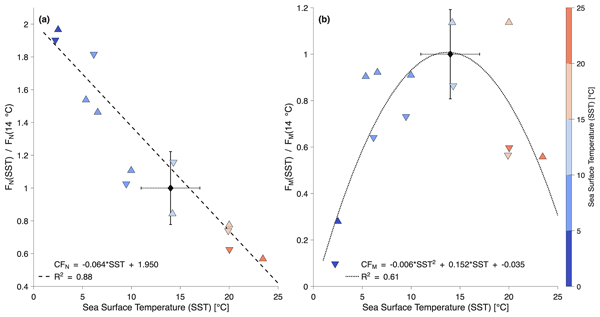
Abstract. Sea spray aerosol (SSA) influences climate through direct and indirect interactions with radiation. However, the magnitudes of these interactions remain poorly constrained, in part due to a lack of understanding of the influences of sea surface temperature (SST) on SSA production. There is no agreed-upon dependence of SSA production on SST despite numerous field, laboratory, and modeling investigations. In this study, these disagreements are addressed through a simple theoretical framework that describes the interfacial processes and contextualizes previous work. Next, we characterize the connection between SST, seawater bubble concentrations, SSA number concentrations, and SSA emission fluxes using measurements in the Scripps Ocean-Atmosphere Research Simulator (SOARS). This isolated ocean-atmosphere interaction system incorporates wind, waves, and SST controls to produce wave breaking under realistic and controlled conditions. In SOARS, increasing SST from 2 to 23 °C suppressed total subsurface bubble concentrations (between 6.17 and 830 µm) by a factor of 1.5, SSA number concentrations (between 0.008 and 20 µm) by a factor of 3, and SSA accumulation mode emission flux by a factor of 4. Using these trends, we derive SST-dependent number and mass emission flux correction factors for SSA source functions in climate models. While prior studies report both increases and decreases with SST, these controlled wind-wave-SST experiments demonstrate that increasing SST suppresses SSA production. Resolving this SST dependence is critical, as it directly alters marine aerosol burdens, cloud condensation nuclei, and radiative forcing, and provides a needed constraint missing from current parameterizations.
-
Notice on discussion status
The requested preprint has a corresponding peer-reviewed final revised paper. You are encouraged to refer to the final revised version.
-
Preprint
(1183 KB)
-
Supplement
(1006 KB)
-
The requested preprint has a corresponding peer-reviewed final revised paper. You are encouraged to refer to the final revised version.
- Preprint
(1183 KB) - Metadata XML
-
Supplement
(1006 KB) - BibTeX
- EndNote
- Final revised paper


Journal article(s) based on this preprint
Interactive discussion
Status: closed
-
RC1: 'Review of "Increasing Sea Surface Temperature Suppresses Primary Marine Aerosol Production" by Leibensperger et al.', Anonymous Referee #1, 19 May 2026
-
AC1: 'Reply on RC1', Raymond J. Leibensperger III, 29 Jun 2026
We thank the reviewer for their thoughtful and thorough comments. We have responded to each comment below. The major changes we have implemented include: adding a discussion of loss rates to the SI, adding section 3.7 "Temperature Hysteresis Effects" providing additional statistical tests and metrics to qualify every R2 value we report, and clarifying methodological choices and what is being presented. We believe we have addressed the reviewer’s concerns to the best of our abilities while keeping the manuscript focused. Further, we thank the reviewer as this manuscript is significantly stronger after these suggested edits. Please find responses to individual comments attached.
-
AC1: 'Reply on RC1', Raymond J. Leibensperger III, 29 Jun 2026
-
RC2: 'Comment on egusphere-2026-2142', Anonymous Referee #2, 11 Jun 2026
This manuscript systematically investigates the impact of sea surface temperature (SST) on sea spray aerosol (SSA) production by a combined wind–wave facility (the Scripps Ocean–Atmosphere Research Simulator, SOARS). SSA is the most prevalent aerosol and is essential to the radiation budget and climate system. The authors characterized the connection between SST, seawater bubble concentrations, SSA number concentrations, and SSA emission fluxes using measurements in the SOARS. This topic is a classic topic in ocean-atmosphere interaction and it is becoming more and more important in the future because of the ongoing global warming. The dataset presented in this study will be of broad interest to the modeling community. Nevertheless, I have several concerns that need to be addressed before the manuscript can be recommended for publication.
Major comments:
- Section 2.4: Different measurement periods were used for submicron and supermicron PNFDs. Submicron PNFDs were derived from the first 5 minutes of observations, while supermicron PNFDs used the full time series. Would the results change substantially if the full time series were also adopted for submicron PNFDs?
- In many figures (e.g., figures 3, 5, 6, figures S4, S6, etc.), the coefficients of determination are high (close to 1.0). However, several data points clearly deviate from the fitted lines. Please explain this discrepancy.
- I’m confused about the influence of SST on SSA production. Lines 250-251 state that ‘increasing SST reduces the amount of SSA produced without substantially altering the size distribution’, but lines 259-260 state that ‘This suggests a mechanistically driven (i.e., film vs. jet drop) size-dependent shift in production and indicates that increasing SSTs have a complex influence on the resulting SSA.’ Could the authors clarify whether the impact of SST on SSA production is straightforward or complex?
- Two SST-dependent emission correction factors are derived in this study: CFN for number flux and CFM for mass flux. These factors represent valuable outcomes. My question is: when applying them separately to the number and mass flux calculations within an SSA emission scheme, do the two corrected fluxes remain mutually consistent?
For instance, if CFN is first applied to the number flux dF/dr, the corrected number flux is written as dF/dr×CFN. The corresponding mass flux is then calculated as dF/dr×CFN×3/4πr^3×SSA_density.
Alternatively, if the number flux is first converted to mass flux as dF/dr×3/4πr^3×SSA_density, and CFM is applied subsequently, the final mass flux becomes dF/dr×3/4πr^3×SSA_density×CFM.
Could you clarify whether I am using these correction factors correctly? I tested the two approaches using the Gong (2003) scheme, and the results differ.
Additionally, could the authors discuss how these new factors differ from previous correction factors adopted in earth system models, such as those presented by Jaeglé et al., Grythe et al., and Sofiev et al.?
Minor comments:
- Lines 64-65: The statement “typically incorporate a positive correlation with SST (Grythe et al., 2014; Jaeglé et al., 2011; Song et al., 2023)” appears inconsistent with the content in Lines 53–54, where non-monotonic relationships are noted with the same reference: Jaeglé et al. (2011).
- Line 355, ‘particles whose emission rates increase with SST (Figure 7a, d)’, figure 7d dose not support this statement.
- Supplement section S5, equations S1 and S2 (lines 72 and 81) should be S2 and S3.
-
AC2: 'Reply on RC2', Raymond J. Leibensperger III, 29 Jun 2026
We thank the reviewer for their insightful comments. Many of which echo comments from reviewer 1, which have been addressed in the updated manuscript. In particular, we have added additional statistical analyses to better qualify the high coefficients of determination, have clarified the text to ensure consistency and not over-simplify the SSA-SST dependence, and improved the discussion of the CFs and their use cases. We believe the manuscript is significantly improved following the reviewer’s comments. Please find individual comments attached.
Peer review completion


Interactive discussion
Status: closed
-
RC1: 'Review of "Increasing Sea Surface Temperature Suppresses Primary Marine Aerosol Production" by Leibensperger et al.', Anonymous Referee #1, 19 May 2026
In this manuscript, the authors present a dataset collected using the Scripps Ocean–Atmosphere Research Simulator (SOARS), a combined wind–wave facility, to investigate the impact of sea surface temperature on sea spray aerosol production. This is a highly relevant scientific question. Studies on this topic date back to the 1980s, yet there remains significant disagreement in the literature regarding the nature of the SST dependence of SSA production. The topic is also of growing importance given that sea surface temperatures have increased due to global climate change and are expected to continue increasing in the future. Understanding the role of SST in determining sea spray aerosol production is therefore critical for assessing potential feedbacks within the climate system. The SOARS infrastructure used in this study is clearly state of the art, and the dataset presented here will be of broad interest to the marine aerosol community. That said, I feel there are a number of important issues that should be addressed before the manuscript can be recommended for publication. My major comments are given below, followed by a series of more minor points that I believe would further strengthen the manuscript.
Major comments
1) The title currently reads as a relatively universal conclusion, whereas the results themselves appear substantially more nuanced. In particular, the manuscript shows that supermicron responses are non-monotonic, number and mass exhibit different SST dependencies, and the inferred fluxes rely on size-dependent methodological assumptions. In addition, the experiments were conducted under a single wind speed, wave state, and seawater system. While I have no doubt that the advances presented in the manuscript are valuable and represent an important contribution towards resolving the SST–SSA question it is my view that the study is an incremental advance that builds upon an increasing body of literature suggesting that aerosol number and mass may respond differently to changing seawater temperature. I therefore suggest that the title be revised to better reflect the size-dependent and system-specific nature of the reported results.
2) The introduction currently frames the literature primarily in terms of conflicting positive, negative, or non-monotonic SST dependencies. However, in my view, this treatment substantially oversimplifies what is arguably one of the central challenges facing the SSA research community; that previous studies differ not only in the sign of their reported SST dependencies, but also in other important ways, such as the quantities measured (e.g., number, mass, AOD, sodium burden, flux), the particle size ranges considered, the experimental generation mechanisms employed and the degree to which aerosol losses and transport are constrained. To my mind these distinctions are critical because different SSA metrics and size regimes may respond differently to changing SST. Given this, I think that a more structured discussion of the literature, organised by methodology, size range, and measured quantity, would substantially strengthen the manuscript and provide better context for the contribution of the SOARS experiments.
3) A further issue concerns the role of the theoretical framework introduced in Section 3.1 and the supplementary matieral. The manuscript presents a coupled bubble–SSA framework (Eqs. S2–S8) describing the evolution of subsurface bubbles, surface bubbles, and aerosol concentration over time, and states that the governing concentration changes “can be determined experimentally.” However, so far as I can see, the manuscript does not appear to actually solve, constrain, or apply these equations quantitatively in the subsequent analysis. Instead, the results rely primarily on empirical regressions between SST and bulk aerosol metrics derived from binned observations. As currently presented, the framework therefore functions primarily as a conceptual interpretation tool rather than a mechanistic analysis framework. While this is not necessarily problematic and maybe completely intentional, I think that the manuscript should more clearly distinguish between the conceptual theoretical framework and the empirical regression analysis that ultimately underpins the reported SST dependencies and correction factors. Alternatively, if the authors intend the framework to play a mechanistic role in interpreting the data, then a more explicit application of the governing equations to the experimental observations would substantially strengthen the manuscript.
4) An important methodological issue concerns the derivation of submicron number fluxes from only the initial 5 minutes of the "Wind & Waves" period. This approach differs substantially from many laboratory sea spray generation studies, where fluxes are commonly inferred from steady-state aerosol concentrations and known "sweep" or carrier gas flows. In the present manuscript, the submicron flux estimate is instead based on the early-time slope of the concentration increase, effectively assuming that aerosol losses are negligible during this initial period. While this may well be a reasonable approximation, it is certainly not equivalent to a steady-state source-flux measurement. The inferred submicron PNFDs are therefore transient accumulation metrics rather than directly measured steady-state source strengths. Given this, the authors should more clearly explain how this method differs from traditional "flow-through" sea spray chamber approaches, justify the choice of the 5-minute fitting window, and discuss how sensitive the inferred fluxes are to this choice. It would also be useful to show whether the inferred SST dependence changes if alternative fitting windows are used. In addition and more genrally, the authors should discuss the limitations of estimating fluxes under non-steady-state conditions, particularly given that the strongest SST dependence is observed in the submicron regime where this transient method is applied. This distinction is important because the resulting correction factors may otherwise be interpreted as steady-state emission flux constraints for models, whereas they are more directly based on early-time aerosol accumulation rates in SOARS.
And further to this, while the manuscript explains that different flux-estimation methods are applied to different particle sizes, it does not adequately address the inconsistencies this may introduce when interpreting the results. Submicron fluxes, where the strongest SST suppression is reported, are inferred from the initial 5-minute buildup rate under the assumption of minimal losses. In contrast, larger particles are treated with approaches that more explicitly account for the finite residence times of particles, steady-state behaviour, and decay-derived particle loss rates. The authors should discuss how these methodological differences may affect comparisons across size ranges and the interpretation of the resulting SST-dependent correction factors.
5) Following from this point, another major issue concerns the decay periods. The authors state that decay periods were included and use decay-derived first-order loss rates for parts of the flux calculation, yet these decay data and fitted loss rates are not, as far as I can see, presented or analysed in sufficient detail in the current manuscript. Given that aerosol residence times and loss rates are central to the interpretation of concentration-to-flux conversion in SOARS, these data should be shown explicitly. At minimum, the manuscript should include representative decay curves, size-resolved loss rates, their SST dependence, and a discussion of how uncertainties in these loss rates propagate into the inferred PNFDs and PMFDs.
6) While the authors present information on aerosol sampling and transmission efficiencies, several aspects of the sampling system remain insufficiently characterised. In particular, the manuscript does not clearly specify the sampling height within the SOARS headspace or provide the full tubing geometry and residence times. These issues are especially important because supermicron particles are highly sensitive to gravitational settling, inertial deposition, and transport effects, and because surface area and volume moments are disproportionately influenced by the largest particles. The authors should therefore provide a more complete characterisation of the aerosol sampling system and discuss how uncertainties in transmission efficiency may influence the reported SST dependencies, particularly for the supermicron regime and higher-order moments. In addition, Figure S3 appears to show sampling efficiencies exceeding 100% over part of the supermicron size range. This is difficult to interpret as a simple particle transmission efficiency and should therefore be explained more clearly. Again, this issue is particularly important because the supermicron number, surface area, volume, PNFD, and PMFD results are all highly sensitive to size-dependent transmission corrections.
7) Another issue concerns the effective degree of replication in the SST analysis. Although the experiments include both cooling and warming trajectories with multiple individual operating periods, much of the analysis is ultimately condensed into five 5 °C SST bins. As a result, several of the fitted SST relationships and correction factors appear to rely on a relatively small number of effective temperature intervals. While binning is understandable for reducing variability and combining the warming/cooling datasets, it also obscures variability between individual experimental runs and limits assessment of hysteresis, system drift, and day-to-day reproducibility. I think that this issue is particularly important because laboratory SSA systems commonly exhibit non-negligible run-to-run variability, even under nominally identical operating conditions. The manuscript would therefore benefit from a clearer distinction between the underlying individual experimental measurements and the subsequent binned analyses, including more explicit discussion of the reproducibility of the observed SST trends as well as how the binning procedure influenced the fitted SST dependencies and associated uncertainties. In essence, I wonder how sensitive the reported correction factors would be to repeating the experiments under nominally identical conditions on different days or with a different seawater preparation.
8) The interpretation of the supermicron aerosol response would benefit from substantially more discussion. Throughout the manuscript, supermicron number, surface area, volume, and mass exhibit different, and in some cases non-monotonic, SST dependencies. It is therefore not always clear whether these differences primarily reflect genuine changes in SSA production physics, or shifts in particle size distributions, or size-dependent aerosol losses and transmission efficiencies, or, perhaps most critically, methodological differences in the flux estimation and fitting procedures. The manuscript would therefore benefit from a more explicit discussion of how much confidence can be placed in the supermicron trends and to what extent the observed differences between number, surface area, volume, and mass likely reflect physical versus methodological effects.
9) The discussion linking the abrupt 2–7 °C modal transition to marine gels and organic coatings currently feels somewhat speculative and would benefit from additional qualification. While this is certainly a plausible hypothesis, similar cold-SST accumulation-mode enhancement has been seen in previous studies using artificial seawater proxies (e.g. Zábori et al., 2012; Nielsen and Bilde, 2020; Salter et al., 2014, 2015). In addition, modal sharpening has also been observed in previous plunging-jet studies, including experiments conducted using artificial seawater systems with substantially reduced biological and organic complexity (e.g., Mårtensson et al., 2003; Salter et al., 2014, 2015). This suggests that at least part of the observed behaviour may arise from more fundamental changes in bubble-bursting physics, such as SST-dependent variations in viscosity, surface tension, bubble fragmentation, film drainage, or film/jet drop production efficiencies. The manuscript would therefore benefit from a more balanced discussion of alternative physical explanations and clearer acknowledgement that the present data do not yet uniquely support a marine-gel interpretation.
10) Some of the reported coefficients of determination appear inconsistent with the visual fit shown in the figures. For example, in Figure 3c the authors report R2=1.00, yet several plotted points appear visibly offset from the fitted line. The authors should clarify exactly how the R2 values were calculated, including whether they are based on binned means, weighted means, individual experimental points, or a different dataset from that shown in the figure. If weighted regressions are used, the authors should also clarify whether the plotted line and reported R2 correspond to the same data shown in the panel. More generally, reporting R2=1.00 for fits based on only five effective SST bins may give a misleading impression of precision, and the authors should consider reporting additional uncertainty metrics or showing fits to the individual experimental runs.
11) The conclusions state that the observed SST dependencies are consistent “regardless of temperature hysteresis, indicating that the magnitude of SST is more important than the direction of change.” However, the supplementary figures suggest that the warming and cooling trajectories may differ more substantially than implied by this statement. For example, in Figure S9 the fitted relationships for several modes differ appreciably between the cooling and warming experiments, both in curve shape and goodness-of-fit. The supermicron responses in particular appear substantially different between the two trajectories. While the overall qualitative SST tendencies may be broadly similar, the manuscript does not appear to quantitatively demonstrate that hysteresis effects are negligible. The authors should therefore provide a more explicit statistical comparison between the warming and cooling trajectories, quantify the degree of hysteresis, and, if appropriate, soften the corresponding conclusions in the manuscript. For example, the current statement that “the magnitude of SST is more important than the direction of change” appears somewhat stronger than is fully supported by the presented data.
Minor commentsAbstract, title, conclusions - In several places the manuscript refers to direct “suppression” of SSA production, whereas some of the measurements more directly constrain aerosol concentration trends or transient accumulation rates. Slightly more careful wording in parts of the manuscript would help align the conclusions with the quantities actually measured.
Section 2.4 and the results/discussion surrounding Figure 7 - The manuscript would benefit from more explicit terminology distinguishing concentration tendency, inferred flux, PNFD/PMFD, and steady-state source strength. Given that different size ranges use different inference methods, it is not always clear whether the reported quantities represent transient accumulation rates or steady-state aerosol production.
Section 2.4 and Figure 1 - While the authors provide a useful overview of the experimental sequence in Figure 1, because different particle size ranges use different flux-inference approaches (i.e. initial buildup, power-law fitting, and steady-state/decay-derived losses), I think that the manuscript would benefit from a more explicit schematic or workflow linking each size regime to its corresponding flux-inference methodology and fitting windows.
Figures 3, 5, 6, and 7 - Several of these figures show steady-state concentrations, while others show inferred fluxes. Because these quantities need not respond identically in SOARS, the manuscript would benefit from more explicit reminders in the figure captions and text regarding which interpretation applies to each figure.
Methods and figure captions throughout - It is not always immediately clear whether plotted points correspond to individual experimental runs, weighted averages, or 5 °C SST-bin means. The manuscript and figure captions would benefit from more explicit explanation of the binning procedure and how the cooling/warming datasets contribute to the combined fits.
Section 3.4 and Figure 8 - I think that the manuscript would benefit from more explicit discussion of how uncertainties associated with SST binning, loss-rate estimation, fitting-window selection, and transmission efficiencies propagate into the final SST correction-factor parameterisations.
Citation: https://doi.org/10.5194/egusphere-2026-2142-RC1 -
AC1: 'Reply on RC1', Raymond J. Leibensperger III, 29 Jun 2026
We thank the reviewer for their thoughtful and thorough comments. We have responded to each comment below. The major changes we have implemented include: adding a discussion of loss rates to the SI, adding section 3.7 "Temperature Hysteresis Effects" providing additional statistical tests and metrics to qualify every R2 value we report, and clarifying methodological choices and what is being presented. We believe we have addressed the reviewer’s concerns to the best of our abilities while keeping the manuscript focused. Further, we thank the reviewer as this manuscript is significantly stronger after these suggested edits. Please find responses to individual comments attached.
-
AC1: 'Reply on RC1', Raymond J. Leibensperger III, 29 Jun 2026
-
RC2: 'Comment on egusphere-2026-2142', Anonymous Referee #2, 11 Jun 2026
This manuscript systematically investigates the impact of sea surface temperature (SST) on sea spray aerosol (SSA) production by a combined wind–wave facility (the Scripps Ocean–Atmosphere Research Simulator, SOARS). SSA is the most prevalent aerosol and is essential to the radiation budget and climate system. The authors characterized the connection between SST, seawater bubble concentrations, SSA number concentrations, and SSA emission fluxes using measurements in the SOARS. This topic is a classic topic in ocean-atmosphere interaction and it is becoming more and more important in the future because of the ongoing global warming. The dataset presented in this study will be of broad interest to the modeling community. Nevertheless, I have several concerns that need to be addressed before the manuscript can be recommended for publication.
Major comments:
- Section 2.4: Different measurement periods were used for submicron and supermicron PNFDs. Submicron PNFDs were derived from the first 5 minutes of observations, while supermicron PNFDs used the full time series. Would the results change substantially if the full time series were also adopted for submicron PNFDs?
- In many figures (e.g., figures 3, 5, 6, figures S4, S6, etc.), the coefficients of determination are high (close to 1.0). However, several data points clearly deviate from the fitted lines. Please explain this discrepancy.
- I’m confused about the influence of SST on SSA production. Lines 250-251 state that ‘increasing SST reduces the amount of SSA produced without substantially altering the size distribution’, but lines 259-260 state that ‘This suggests a mechanistically driven (i.e., film vs. jet drop) size-dependent shift in production and indicates that increasing SSTs have a complex influence on the resulting SSA.’ Could the authors clarify whether the impact of SST on SSA production is straightforward or complex?
- Two SST-dependent emission correction factors are derived in this study: CFN for number flux and CFM for mass flux. These factors represent valuable outcomes. My question is: when applying them separately to the number and mass flux calculations within an SSA emission scheme, do the two corrected fluxes remain mutually consistent?
For instance, if CFN is first applied to the number flux dF/dr, the corrected number flux is written as dF/dr×CFN. The corresponding mass flux is then calculated as dF/dr×CFN×3/4πr^3×SSA_density.
Alternatively, if the number flux is first converted to mass flux as dF/dr×3/4πr^3×SSA_density, and CFM is applied subsequently, the final mass flux becomes dF/dr×3/4πr^3×SSA_density×CFM.
Could you clarify whether I am using these correction factors correctly? I tested the two approaches using the Gong (2003) scheme, and the results differ.
Additionally, could the authors discuss how these new factors differ from previous correction factors adopted in earth system models, such as those presented by Jaeglé et al., Grythe et al., and Sofiev et al.?
Minor comments:
- Lines 64-65: The statement “typically incorporate a positive correlation with SST (Grythe et al., 2014; Jaeglé et al., 2011; Song et al., 2023)” appears inconsistent with the content in Lines 53–54, where non-monotonic relationships are noted with the same reference: Jaeglé et al. (2011).
- Line 355, ‘particles whose emission rates increase with SST (Figure 7a, d)’, figure 7d dose not support this statement.
- Supplement section S5, equations S1 and S2 (lines 72 and 81) should be S2 and S3.
-
AC2: 'Reply on RC2', Raymond J. Leibensperger III, 29 Jun 2026
We thank the reviewer for their insightful comments. Many of which echo comments from reviewer 1, which have been addressed in the updated manuscript. In particular, we have added additional statistical analyses to better qualify the high coefficients of determination, have clarified the text to ensure consistency and not over-simplify the SSA-SST dependence, and improved the discussion of the CFs and their use cases. We believe the manuscript is significantly improved following the reviewer’s comments. Please find individual comments attached.
Peer review completion
Journal article(s) based on this preprint
Viewed
| HTML | XML | Total | Supplement | BibTeX | EndNote | |
|---|---|---|---|---|---|---|
| 483 | 250 | 56 | 789 | 110 | 58 | 57 |
- HTML: 483
- PDF: 250
- XML: 56
- Total: 789
- Supplement: 110
- BibTeX: 58
- EndNote: 57
Viewed (geographical distribution)
| Country | # | Views | % |
|---|
| Total: | 0 |
| HTML: | 0 |
| PDF: | 0 |
| XML: | 0 |
- 1
Raymond J. Leibensperger III
Justin D. Hamlin
Jena K. Herbst
Charbel Harb
Ke'La A. Kimble
Meinrat O. Andreae
Christopher Lee
Greg Sandstrom
M. Dale Stokes
Grant B. Deane

The requested preprint has a corresponding peer-reviewed final revised paper. You are encouraged to refer to the final revised version.
- Preprint
(1183 KB) - Metadata XML
-
Supplement
(1006 KB) - BibTeX
- EndNote
- Final revised paper
In this manuscript, the authors present a dataset collected using the Scripps Ocean–Atmosphere Research Simulator (SOARS), a combined wind–wave facility, to investigate the impact of sea surface temperature on sea spray aerosol production. This is a highly relevant scientific question. Studies on this topic date back to the 1980s, yet there remains significant disagreement in the literature regarding the nature of the SST dependence of SSA production. The topic is also of growing importance given that sea surface temperatures have increased due to global climate change and are expected to continue increasing in the future. Understanding the role of SST in determining sea spray aerosol production is therefore critical for assessing potential feedbacks within the climate system. The SOARS infrastructure used in this study is clearly state of the art, and the dataset presented here will be of broad interest to the marine aerosol community. That said, I feel there are a number of important issues that should be addressed before the manuscript can be recommended for publication. My major comments are given below, followed by a series of more minor points that I believe would further strengthen the manuscript.
Major comments
1) The title currently reads as a relatively universal conclusion, whereas the results themselves appear substantially more nuanced. In particular, the manuscript shows that supermicron responses are non-monotonic, number and mass exhibit different SST dependencies, and the inferred fluxes rely on size-dependent methodological assumptions. In addition, the experiments were conducted under a single wind speed, wave state, and seawater system. While I have no doubt that the advances presented in the manuscript are valuable and represent an important contribution towards resolving the SST–SSA question it is my view that the study is an incremental advance that builds upon an increasing body of literature suggesting that aerosol number and mass may respond differently to changing seawater temperature. I therefore suggest that the title be revised to better reflect the size-dependent and system-specific nature of the reported results.
2) The introduction currently frames the literature primarily in terms of conflicting positive, negative, or non-monotonic SST dependencies. However, in my view, this treatment substantially oversimplifies what is arguably one of the central challenges facing the SSA research community; that previous studies differ not only in the sign of their reported SST dependencies, but also in other important ways, such as the quantities measured (e.g., number, mass, AOD, sodium burden, flux), the particle size ranges considered, the experimental generation mechanisms employed and the degree to which aerosol losses and transport are constrained. To my mind these distinctions are critical because different SSA metrics and size regimes may respond differently to changing SST. Given this, I think that a more structured discussion of the literature, organised by methodology, size range, and measured quantity, would substantially strengthen the manuscript and provide better context for the contribution of the SOARS experiments.
3) A further issue concerns the role of the theoretical framework introduced in Section 3.1 and the supplementary matieral. The manuscript presents a coupled bubble–SSA framework (Eqs. S2–S8) describing the evolution of subsurface bubbles, surface bubbles, and aerosol concentration over time, and states that the governing concentration changes “can be determined experimentally.” However, so far as I can see, the manuscript does not appear to actually solve, constrain, or apply these equations quantitatively in the subsequent analysis. Instead, the results rely primarily on empirical regressions between SST and bulk aerosol metrics derived from binned observations. As currently presented, the framework therefore functions primarily as a conceptual interpretation tool rather than a mechanistic analysis framework. While this is not necessarily problematic and maybe completely intentional, I think that the manuscript should more clearly distinguish between the conceptual theoretical framework and the empirical regression analysis that ultimately underpins the reported SST dependencies and correction factors. Alternatively, if the authors intend the framework to play a mechanistic role in interpreting the data, then a more explicit application of the governing equations to the experimental observations would substantially strengthen the manuscript.
4) An important methodological issue concerns the derivation of submicron number fluxes from only the initial 5 minutes of the "Wind & Waves" period. This approach differs substantially from many laboratory sea spray generation studies, where fluxes are commonly inferred from steady-state aerosol concentrations and known "sweep" or carrier gas flows. In the present manuscript, the submicron flux estimate is instead based on the early-time slope of the concentration increase, effectively assuming that aerosol losses are negligible during this initial period. While this may well be a reasonable approximation, it is certainly not equivalent to a steady-state source-flux measurement. The inferred submicron PNFDs are therefore transient accumulation metrics rather than directly measured steady-state source strengths. Given this, the authors should more clearly explain how this method differs from traditional "flow-through" sea spray chamber approaches, justify the choice of the 5-minute fitting window, and discuss how sensitive the inferred fluxes are to this choice. It would also be useful to show whether the inferred SST dependence changes if alternative fitting windows are used. In addition and more genrally, the authors should discuss the limitations of estimating fluxes under non-steady-state conditions, particularly given that the strongest SST dependence is observed in the submicron regime where this transient method is applied. This distinction is important because the resulting correction factors may otherwise be interpreted as steady-state emission flux constraints for models, whereas they are more directly based on early-time aerosol accumulation rates in SOARS.
And further to this, while the manuscript explains that different flux-estimation methods are applied to different particle sizes, it does not adequately address the inconsistencies this may introduce when interpreting the results. Submicron fluxes, where the strongest SST suppression is reported, are inferred from the initial 5-minute buildup rate under the assumption of minimal losses. In contrast, larger particles are treated with approaches that more explicitly account for the finite residence times of particles, steady-state behaviour, and decay-derived particle loss rates. The authors should discuss how these methodological differences may affect comparisons across size ranges and the interpretation of the resulting SST-dependent correction factors.
5) Following from this point, another major issue concerns the decay periods. The authors state that decay periods were included and use decay-derived first-order loss rates for parts of the flux calculation, yet these decay data and fitted loss rates are not, as far as I can see, presented or analysed in sufficient detail in the current manuscript. Given that aerosol residence times and loss rates are central to the interpretation of concentration-to-flux conversion in SOARS, these data should be shown explicitly. At minimum, the manuscript should include representative decay curves, size-resolved loss rates, their SST dependence, and a discussion of how uncertainties in these loss rates propagate into the inferred PNFDs and PMFDs.
6) While the authors present information on aerosol sampling and transmission efficiencies, several aspects of the sampling system remain insufficiently characterised. In particular, the manuscript does not clearly specify the sampling height within the SOARS headspace or provide the full tubing geometry and residence times. These issues are especially important because supermicron particles are highly sensitive to gravitational settling, inertial deposition, and transport effects, and because surface area and volume moments are disproportionately influenced by the largest particles. The authors should therefore provide a more complete characterisation of the aerosol sampling system and discuss how uncertainties in transmission efficiency may influence the reported SST dependencies, particularly for the supermicron regime and higher-order moments. In addition, Figure S3 appears to show sampling efficiencies exceeding 100% over part of the supermicron size range. This is difficult to interpret as a simple particle transmission efficiency and should therefore be explained more clearly. Again, this issue is particularly important because the supermicron number, surface area, volume, PNFD, and PMFD results are all highly sensitive to size-dependent transmission corrections.
7) Another issue concerns the effective degree of replication in the SST analysis. Although the experiments include both cooling and warming trajectories with multiple individual operating periods, much of the analysis is ultimately condensed into five 5 °C SST bins. As a result, several of the fitted SST relationships and correction factors appear to rely on a relatively small number of effective temperature intervals. While binning is understandable for reducing variability and combining the warming/cooling datasets, it also obscures variability between individual experimental runs and limits assessment of hysteresis, system drift, and day-to-day reproducibility. I think that this issue is particularly important because laboratory SSA systems commonly exhibit non-negligible run-to-run variability, even under nominally identical operating conditions. The manuscript would therefore benefit from a clearer distinction between the underlying individual experimental measurements and the subsequent binned analyses, including more explicit discussion of the reproducibility of the observed SST trends as well as how the binning procedure influenced the fitted SST dependencies and associated uncertainties. In essence, I wonder how sensitive the reported correction factors would be to repeating the experiments under nominally identical conditions on different days or with a different seawater preparation.
8) The interpretation of the supermicron aerosol response would benefit from substantially more discussion. Throughout the manuscript, supermicron number, surface area, volume, and mass exhibit different, and in some cases non-monotonic, SST dependencies. It is therefore not always clear whether these differences primarily reflect genuine changes in SSA production physics, or shifts in particle size distributions, or size-dependent aerosol losses and transmission efficiencies, or, perhaps most critically, methodological differences in the flux estimation and fitting procedures. The manuscript would therefore benefit from a more explicit discussion of how much confidence can be placed in the supermicron trends and to what extent the observed differences between number, surface area, volume, and mass likely reflect physical versus methodological effects.
9) The discussion linking the abrupt 2–7 °C modal transition to marine gels and organic coatings currently feels somewhat speculative and would benefit from additional qualification. While this is certainly a plausible hypothesis, similar cold-SST accumulation-mode enhancement has been seen in previous studies using artificial seawater proxies (e.g. Zábori et al., 2012; Nielsen and Bilde, 2020; Salter et al., 2014, 2015). In addition, modal sharpening has also been observed in previous plunging-jet studies, including experiments conducted using artificial seawater systems with substantially reduced biological and organic complexity (e.g., Mårtensson et al., 2003; Salter et al., 2014, 2015). This suggests that at least part of the observed behaviour may arise from more fundamental changes in bubble-bursting physics, such as SST-dependent variations in viscosity, surface tension, bubble fragmentation, film drainage, or film/jet drop production efficiencies. The manuscript would therefore benefit from a more balanced discussion of alternative physical explanations and clearer acknowledgement that the present data do not yet uniquely support a marine-gel interpretation.
10) Some of the reported coefficients of determination appear inconsistent with the visual fit shown in the figures. For example, in Figure 3c the authors report R2=1.00, yet several plotted points appear visibly offset from the fitted line. The authors should clarify exactly how the R2 values were calculated, including whether they are based on binned means, weighted means, individual experimental points, or a different dataset from that shown in the figure. If weighted regressions are used, the authors should also clarify whether the plotted line and reported R2 correspond to the same data shown in the panel. More generally, reporting R2=1.00 for fits based on only five effective SST bins may give a misleading impression of precision, and the authors should consider reporting additional uncertainty metrics or showing fits to the individual experimental runs.
11) The conclusions state that the observed SST dependencies are consistent “regardless of temperature hysteresis, indicating that the magnitude of SST is more important than the direction of change.” However, the supplementary figures suggest that the warming and cooling trajectories may differ more substantially than implied by this statement. For example, in Figure S9 the fitted relationships for several modes differ appreciably between the cooling and warming experiments, both in curve shape and goodness-of-fit. The supermicron responses in particular appear substantially different between the two trajectories. While the overall qualitative SST tendencies may be broadly similar, the manuscript does not appear to quantitatively demonstrate that hysteresis effects are negligible. The authors should therefore provide a more explicit statistical comparison between the warming and cooling trajectories, quantify the degree of hysteresis, and, if appropriate, soften the corresponding conclusions in the manuscript. For example, the current statement that “the magnitude of SST is more important than the direction of change” appears somewhat stronger than is fully supported by the presented data.
Minor comments
Abstract, title, conclusions - In several places the manuscript refers to direct “suppression” of SSA production, whereas some of the measurements more directly constrain aerosol concentration trends or transient accumulation rates. Slightly more careful wording in parts of the manuscript would help align the conclusions with the quantities actually measured.
Section 2.4 and the results/discussion surrounding Figure 7 - The manuscript would benefit from more explicit terminology distinguishing concentration tendency, inferred flux, PNFD/PMFD, and steady-state source strength. Given that different size ranges use different inference methods, it is not always clear whether the reported quantities represent transient accumulation rates or steady-state aerosol production.
Section 2.4 and Figure 1 - While the authors provide a useful overview of the experimental sequence in Figure 1, because different particle size ranges use different flux-inference approaches (i.e. initial buildup, power-law fitting, and steady-state/decay-derived losses), I think that the manuscript would benefit from a more explicit schematic or workflow linking each size regime to its corresponding flux-inference methodology and fitting windows.
Figures 3, 5, 6, and 7 - Several of these figures show steady-state concentrations, while others show inferred fluxes. Because these quantities need not respond identically in SOARS, the manuscript would benefit from more explicit reminders in the figure captions and text regarding which interpretation applies to each figure.
Methods and figure captions throughout - It is not always immediately clear whether plotted points correspond to individual experimental runs, weighted averages, or 5 °C SST-bin means. The manuscript and figure captions would benefit from more explicit explanation of the binning procedure and how the cooling/warming datasets contribute to the combined fits.
Section 3.4 and Figure 8 - I think that the manuscript would benefit from more explicit discussion of how uncertainties associated with SST binning, loss-rate estimation, fitting-window selection, and transmission efficiencies propagate into the final SST correction-factor parameterisations.