
the Creative Commons Attribution 4.0 License.
the Creative Commons Attribution 4.0 License.
 | 22 Jan 2026
Opinion: Status, Plans and Needs of Southern Ocean Modelling
Abstract. In preparation for the SOOS/OCEAN:ICE Workshop on ice-ocean observation harmonization and future priorities agenda, a survey targeting the modelling community was conducted to assess research priorities for the Southern Ocean and Antarctica. This initiative specifically supports the design of field activities from the open Southern Ocean to the Antarctic shelf for the forthcoming Antarctica InSync campaign and is aligned with broader strategic planning efforts ahead of the next International Polar Year (IPY). The survey results are a useful basis to further communication between modeling and observing science communities. We believe this is crucial for optimizing campaign planning, achieving enhanced data usage and improving numerical experiments.
-
Notice on discussion status
The requested preprint has a corresponding peer-reviewed final revised paper. You are encouraged to refer to the final revised version.
-
Preprint
(993 KB)
-
The requested preprint has a corresponding peer-reviewed final revised paper. You are encouraged to refer to the final revised version.
- Preprint
(993 KB) - Metadata XML
- BibTeX
- EndNote
- Final revised paper


Journal article(s) based on this preprint
Interactive discussion
Status: closed
-
RC1: 'Comment on egusphere-2026-213', Anonymous Referee #1, 09 Feb 2026
The comment was uploaded in the form of a supplement: https://egusphere.copernicus.org/preprints/2026/egusphere-2026-213/egusphere-2026-213-RC1-supplement.pdf
-
AC1: 'Reply on RC1', Torge Martin, 27 Mar 2026
The comment was uploaded in the form of a supplement: https://egusphere.copernicus.org/preprints/2026/egusphere-2026-213/egusphere-2026-213-AC1-supplement.pdf
-
AC1: 'Reply on RC1', Torge Martin, 27 Mar 2026
-
RC2: 'Comment on egusphere-2026-213', Anonymous Referee #2, 12 Feb 2026
This is a well-written and thoughtful opinion piece. The abstract presents a nice layout of goals. I applaud the authors for this effort, as it is a useful contribution. I have only a couple of suggestions.
It is noted that the focus is primarily on climate modeling. Several caveats are given in the interpretations about the nature of the respondents and how this may influence the findings. Still, I think the piece would benefit from brief thoughts on how to engage stakeholders and how the results may vary by audience. What aspects are expected to change if the focus were shifted to seasonal to subseasonal scales? Models are tools, and it would be interesting to get broad stakeholder engagement and find out what they want from SO models. The responses depend on what the user's goals are, and it was telling that 40% of the respondents said ice sheet/shelf-ocean interaction is the key SO science topic.
The discussion distinguishing in situ vs gridded products is off-putting:
Line 217: ‘less valued’ is a poor word choice. You can’t have gridded products without in situ data and the respondents know this.
Line 244: ‘lesser use’: same thing as line 217. They are using it in gridded format, but they are using it.
Line 246: Maybe I am misunderstanding your inference here because I am struggling to link this to the survey questions, but I disagree with the interpretation. People know that gridded products are derived from in situ data. For example, it seems you are distinguishing between the Roemmich and Gilson mapped Argo product and Argo data, but not between the AVISO-mapped altimetry product and altimeters. I interpret the acknowledgement of the importance of in situ data as meaning they think the gridded products are important, not that they only want to have process study data. Respondents know they can’t have gridded products without in situ data.
Line 217: I would drop ‘The latter’ as all data go into many of the gridded products.
Line 220-227: Maybe this is more of a call for publishing open-source validation packages that incorporate data and help modelers use these data.
More specific comments:
Line 134: is the problem unique to “coarse-resolution” models?
Figure 2: The figure implies carbon uptake is in the pie explicitly, but the caption implies it is counted as ‘other’. Please reconcile this.
Line 181: Please clarify this. Did you mean ‘supporting model parameterization development’?
Line 200: I would change the wording here. These physical processes are fundamental prerequisites to address the ‘big questions’. You can’t address ice-ocean interactions without understanding ocean heat transport.
Line 253: I don’t see how caring about shelf processes (i.e. the main bias) is independent of calling for year-round observations. (Maybe I am getting lost comparing Figure 1 and Figure 3b, but regardless I don’t see desiring year-round obs being independent of any model bias.)
Line 260: This may not be justified as these (e.g. ‘sea ice’ or ‘radiative processes’) weren’t given as choices in the ‘most problematic ocean model bias’. I think sea ice - ocean interactions is a huge source of model uncertainty, but my response wouldn’t reflect my concern based on the questions asked. In fact, I may pick ‘mixing’ because that is related to sea ice - ocean interaction. I would give a caveat here that some of your impressions here may be due to the options given and the wording in the survey. (And this is a bit in conflict with Line 282-283, which seems to say sea ice is important.)
Line 289: Why only early-career?
Citation: https://doi.org/10.5194/egusphere-2026-213-RC2 -
AC2: 'Reply on RC2', Torge Martin, 27 Mar 2026
The comment was uploaded in the form of a supplement: https://egusphere.copernicus.org/preprints/2026/egusphere-2026-213/egusphere-2026-213-AC2-supplement.pdf
-
AC2: 'Reply on RC2', Torge Martin, 27 Mar 2026
-
RC3: 'Comment on egusphere-2026-213', Anonymous Referee #3, 28 Feb 2026
In this opinion piece, Martin et al. summarize the outcome from a questionaire on Southern Ocean modelling biases and needs that was answered by by of group of about 100 modellers, about half of them identifying as oceanographers, the rest modelling some other sub-field of the Antarctic and Southern Ocean climate system.
Aim of the questionnaire was to get an idea of what are considered the most pressing questions in Southern Ocean research by modellers with the purpose to bring that perspective early on into the upcoming IPY and Antarctica InSync programs, and to better align observational and modelling efforts.
With a fairly high turnout of responses to the questionaire and a range of specific modelling sub-communities involved, the opinion piece is certainly helpful for that purpose, although the authors do mention that a few modelling communities are under-represented in the answers.
In their analysis of the answers given, the authors discuss that a large fraction of the questionnaires mentions processes occurring on the shelves, such as the representation of shelf-ice cavities, and open ocean convection as two processes requiring more attention in model development and evaluation. Many of these are connected with improving parameterizations of processes in cavities, scale-aware mixing modelling, or of topographic overflows.
Concerning the scientific focus, the authors note that many of the respondents mentioned the role of the Southern Ocean for heat, freshwater, and carbon budgets, i.e. in some way or another the role of the Southern Ocean in the climate system. They mention that processes shaping the oceanic processes themselves, such as an understanding of the circulation are not mentioned as part of the big questions anymore.
Concerning the observational needs by the community community, the authors note somewhat of a disconnect between the stated use of mostly gridded data sets like the World Ocean Atlas, and a desire for more direct in-situ observations. The authors interpret this as a need for using in-situ data for better process understanding, while gridded products are preferred for model evaluation, despite their larger distance from 'real' observations. This is an interesting point.
It is important to note that the manuscript not only presents the outcome of the questionnaire but in each of the three main points adds some perspective from the authors of the opinion piece themselves. In the parts on the scientific focus this consists in adding aspects that the authors find important (I do I) but that haven't been mentioned. In other parts (especially on data requirements) it is somewhat unclear what is output from the questionaire and what is the authors opinion. So, while overall the analysis done in this opinion piece is quite helpful for the stated aims of aligning modelling and observational efforts, I feel that there should be a somewhat better separation in writing between the presentation of and the comments and opinions of the authors. This should be fairly easy to correct.
Citation: https://doi.org/10.5194/egusphere-2026-213-RC3 -
AC3: 'Reply on RC3', Torge Martin, 27 Mar 2026
The comment was uploaded in the form of a supplement: https://egusphere.copernicus.org/preprints/2026/egusphere-2026-213/egusphere-2026-213-AC3-supplement.pdf
-
AC3: 'Reply on RC3', Torge Martin, 27 Mar 2026
Peer review completion


Interactive discussion
Status: closed
-
RC1: 'Comment on egusphere-2026-213', Anonymous Referee #1, 09 Feb 2026
The comment was uploaded in the form of a supplement: https://egusphere.copernicus.org/preprints/2026/egusphere-2026-213/egusphere-2026-213-RC1-supplement.pdf
-
AC1: 'Reply on RC1', Torge Martin, 27 Mar 2026
The comment was uploaded in the form of a supplement: https://egusphere.copernicus.org/preprints/2026/egusphere-2026-213/egusphere-2026-213-AC1-supplement.pdf
-
AC1: 'Reply on RC1', Torge Martin, 27 Mar 2026
-
RC2: 'Comment on egusphere-2026-213', Anonymous Referee #2, 12 Feb 2026
This is a well-written and thoughtful opinion piece. The abstract presents a nice layout of goals. I applaud the authors for this effort, as it is a useful contribution. I have only a couple of suggestions.
It is noted that the focus is primarily on climate modeling. Several caveats are given in the interpretations about the nature of the respondents and how this may influence the findings. Still, I think the piece would benefit from brief thoughts on how to engage stakeholders and how the results may vary by audience. What aspects are expected to change if the focus were shifted to seasonal to subseasonal scales? Models are tools, and it would be interesting to get broad stakeholder engagement and find out what they want from SO models. The responses depend on what the user's goals are, and it was telling that 40% of the respondents said ice sheet/shelf-ocean interaction is the key SO science topic.
The discussion distinguishing in situ vs gridded products is off-putting:
Line 217: ‘less valued’ is a poor word choice. You can’t have gridded products without in situ data and the respondents know this.
Line 244: ‘lesser use’: same thing as line 217. They are using it in gridded format, but they are using it.
Line 246: Maybe I am misunderstanding your inference here because I am struggling to link this to the survey questions, but I disagree with the interpretation. People know that gridded products are derived from in situ data. For example, it seems you are distinguishing between the Roemmich and Gilson mapped Argo product and Argo data, but not between the AVISO-mapped altimetry product and altimeters. I interpret the acknowledgement of the importance of in situ data as meaning they think the gridded products are important, not that they only want to have process study data. Respondents know they can’t have gridded products without in situ data.
Line 217: I would drop ‘The latter’ as all data go into many of the gridded products.
Line 220-227: Maybe this is more of a call for publishing open-source validation packages that incorporate data and help modelers use these data.
More specific comments:
Line 134: is the problem unique to “coarse-resolution” models?
Figure 2: The figure implies carbon uptake is in the pie explicitly, but the caption implies it is counted as ‘other’. Please reconcile this.
Line 181: Please clarify this. Did you mean ‘supporting model parameterization development’?
Line 200: I would change the wording here. These physical processes are fundamental prerequisites to address the ‘big questions’. You can’t address ice-ocean interactions without understanding ocean heat transport.
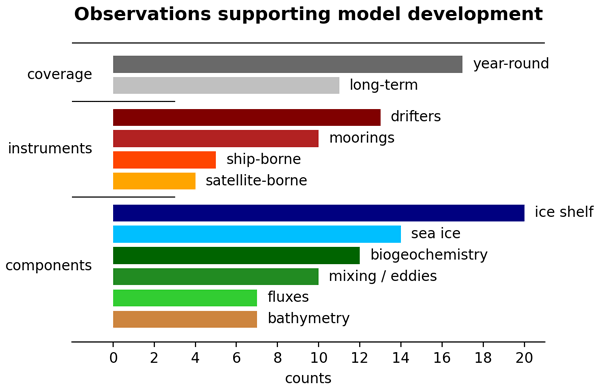
Line 253: I don’t see how caring about shelf processes (i.e. the main bias) is independent of calling for year-round observations. (Maybe I am getting lost comparing Figure 1 and Figure 3b, but regardless I don’t see desiring year-round obs being independent of any model bias.)
Line 260: This may not be justified as these (e.g. ‘sea ice’ or ‘radiative processes’) weren’t given as choices in the ‘most problematic ocean model bias’. I think sea ice - ocean interactions is a huge source of model uncertainty, but my response wouldn’t reflect my concern based on the questions asked. In fact, I may pick ‘mixing’ because that is related to sea ice - ocean interaction. I would give a caveat here that some of your impressions here may be due to the options given and the wording in the survey. (And this is a bit in conflict with Line 282-283, which seems to say sea ice is important.)
Line 289: Why only early-career?
Citation: https://doi.org/10.5194/egusphere-2026-213-RC2 -
AC2: 'Reply on RC2', Torge Martin, 27 Mar 2026
The comment was uploaded in the form of a supplement: https://egusphere.copernicus.org/preprints/2026/egusphere-2026-213/egusphere-2026-213-AC2-supplement.pdf
-
AC2: 'Reply on RC2', Torge Martin, 27 Mar 2026
-
RC3: 'Comment on egusphere-2026-213', Anonymous Referee #3, 28 Feb 2026
In this opinion piece, Martin et al. summarize the outcome from a questionaire on Southern Ocean modelling biases and needs that was answered by by of group of about 100 modellers, about half of them identifying as oceanographers, the rest modelling some other sub-field of the Antarctic and Southern Ocean climate system.
Aim of the questionnaire was to get an idea of what are considered the most pressing questions in Southern Ocean research by modellers with the purpose to bring that perspective early on into the upcoming IPY and Antarctica InSync programs, and to better align observational and modelling efforts.
With a fairly high turnout of responses to the questionaire and a range of specific modelling sub-communities involved, the opinion piece is certainly helpful for that purpose, although the authors do mention that a few modelling communities are under-represented in the answers.
In their analysis of the answers given, the authors discuss that a large fraction of the questionnaires mentions processes occurring on the shelves, such as the representation of shelf-ice cavities, and open ocean convection as two processes requiring more attention in model development and evaluation. Many of these are connected with improving parameterizations of processes in cavities, scale-aware mixing modelling, or of topographic overflows.
Concerning the scientific focus, the authors note that many of the respondents mentioned the role of the Southern Ocean for heat, freshwater, and carbon budgets, i.e. in some way or another the role of the Southern Ocean in the climate system. They mention that processes shaping the oceanic processes themselves, such as an understanding of the circulation are not mentioned as part of the big questions anymore.
Concerning the observational needs by the community community, the authors note somewhat of a disconnect between the stated use of mostly gridded data sets like the World Ocean Atlas, and a desire for more direct in-situ observations. The authors interpret this as a need for using in-situ data for better process understanding, while gridded products are preferred for model evaluation, despite their larger distance from 'real' observations. This is an interesting point.
It is important to note that the manuscript not only presents the outcome of the questionnaire but in each of the three main points adds some perspective from the authors of the opinion piece themselves. In the parts on the scientific focus this consists in adding aspects that the authors find important (I do I) but that haven't been mentioned. In other parts (especially on data requirements) it is somewhat unclear what is output from the questionaire and what is the authors opinion. So, while overall the analysis done in this opinion piece is quite helpful for the stated aims of aligning modelling and observational efforts, I feel that there should be a somewhat better separation in writing between the presentation of and the comments and opinions of the authors. This should be fairly easy to correct.
Citation: https://doi.org/10.5194/egusphere-2026-213-RC3 -
AC3: 'Reply on RC3', Torge Martin, 27 Mar 2026
The comment was uploaded in the form of a supplement: https://egusphere.copernicus.org/preprints/2026/egusphere-2026-213/egusphere-2026-213-AC3-supplement.pdf
-
AC3: 'Reply on RC3', Torge Martin, 27 Mar 2026
Peer review completion
Journal article(s) based on this preprint
Viewed
| HTML | XML | Total | BibTeX | EndNote | |
|---|---|---|---|---|---|
| 899 | 356 | 93 | 1,348 | 56 | 95 |
- HTML: 899
- PDF: 356
- XML: 93
- Total: 1,348
- BibTeX: 56
- EndNote: 95
Viewed (geographical distribution)
| Country | # | Views | % |
|---|
| Total: | 0 |
| HTML: | 0 |
| PDF: | 0 |
| XML: | 0 |
- 1

Carolina O. Dufour
Andrew J. S. Meijers
Alyce M. Hancock
The requested preprint has a corresponding peer-reviewed final revised paper. You are encouraged to refer to the final revised version.
- Preprint
(993 KB) - Metadata XML