
the Creative Commons Attribution 4.0 License.
the Creative Commons Attribution 4.0 License.
 | 22 Apr 2026
Impact of high-resolution soil erodibility datasets on dust simulations in WRF-Chem with the GOCART scheme
Abstract. Mineral dust is a major atmospheric aerosol influencing climate, air quality, and human health through radiative and microphysical processes. The Iberian Peninsula is frequently affected by North African dust intrusions, leading to episodic PM10 exceedances that challenge air quality forecasting. However, accurate representation of dust emissions remains limited by uncertainties in soil erodibility, land surface properties, and meteorological forcing.
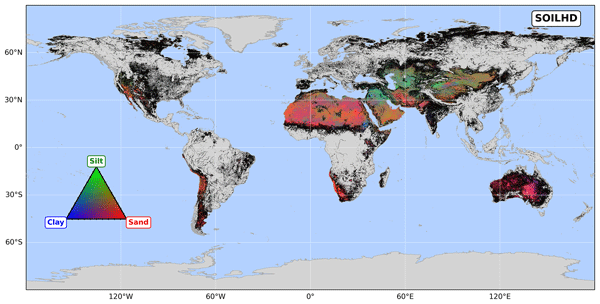
This study evaluates the impact of two high-resolution soil erodibility datasets on dust simulations using WRF-Chem with the GOCART scheme. The first dataset, EROD-HR, integrates fine-resolution topography (GMTED2010) to improve dust source representation at 0.0625 ° (~5 km) globally and 1 km over the Iberian Peninsula. The second dataset, SOILHD, further refines dust source characterization by incorporating high-resolution soil texture (sand, silt, clay fractions) and removing misclassified bare soil areas, reaching 1 km global resolution. Both datasets aim to better capture spatial heterogeneity of dust sources in semi-arid environments.
Simulations are conducted for five dust episodes between 2022 and 2025, covering local and long-range transport conditions. Model performance is evaluated against PM10 observations from the SINQLAIR network in the Region of Murcia. Results show improved representation of dust emissions, with better agreement in magnitude and timing of PM10 peaks at inland stations. Improvements are more limited at coastal and anthropogenically influenced sites, although statistical metrics (correlation, bias, RMSE) indicate consistent gains.
Overall, high-resolution erodibility datasets enhance WRF-Chem dust simulations by reducing biases and improving variability representation, highlighting the importance of detailed land-surface information for regional dust forecasting systems.
Competing interests: At least one of the (co-)authors is a member of the editorial board of Atmospheric Chemistry and Physics.
Publisher's note: Copernicus Publications remains neutral with regard to jurisdictional claims made in the text, published maps, institutional affiliations, or any other geographical representation in this paper. While Copernicus Publications makes every effort to include appropriate place names, the final responsibility lies with the authors. Views expressed in the text are those of the authors and do not necessarily reflect the views of the publisher.-
Notice on discussion status
The requested preprint has a corresponding peer-reviewed final revised paper. You are encouraged to refer to the final revised version.
-
Preprint
(25295 KB)
-
The requested preprint has a corresponding peer-reviewed final revised paper. You are encouraged to refer to the final revised version.
- Preprint
(25295 KB) - Metadata XML
- BibTeX
- EndNote
- Final revised paper


Journal article(s) based on this preprint
Interactive discussion
Status: closed
-
RC1: 'Comment on egusphere-2026-2127', I. Pérez, 08 May 2026
-
AC1: 'Reply on RC1', Leandro Segado-Moreno, 01 Jun 2026
Thank you for your comments. Here are our responses to them:
1. The authors should indicate the reason for the selection of such specific periods since there is a gap, from 2023 to 2024, which is not covered by this study. Moreover, a comment about the study representativeness would be acknowledged.
The selection of the simulation periods is primarily driven by the availability of completed model experiments and observational datasets associated with specific dust and PM10 episodes. Our first simulations for this work began in 2023, focusing on selected extreme PM10 events in the region. The study was later resumed in 2025, once a more complete and quality-controlled set of observational data from the monitoring network became available. As a result, the analysed periods are not continuous and correspond to well-defined case studies.
2. If selected periods correspond to pollution events, representative synoptic charts could be introduced to present the atmospheric circulation in such episodes.
Indeed, the synoptic conditions are important to properly contextualise the selected pollution episodes. Thank you for your comment. We will include in the Appendix a set of figures describing the synoptic evolution for each analysed period. These will include daily-mean fields of geopotential height at 500 hPa (Z500), temperature at 850 hPa (T850), and sea level pressure (SLP), covering the day of the PM10 peak and the surrounding days. In addition, we will add a figure showing the corresponding daily mean PM10 concentrations during these periods to better illustrate the temporal evolution of each event.
3. The Pearson correlation coefficient may be affected by outliers. Fig. 11b presents some accused outliers in some simulations. A comment about the response of the correlation coefficient could be introduced, i.e., the authors could comment if successful or poor correlations may be considered spurious due to the outlier influence. Perhaps, supplementary graphs could show the outlier weight in the correlations.
We appreciate your comment about this. Indeed, Pearson’s R can be sensitive to extreme values. However, in the context of this study, these “outliers” are not spurious measurements or anomalous points, but rather represent the extreme PM10 episodes that constitute the main focus of the analysis. The simulation periods were intentionally selected to evaluate the model performance during high-impact dust events, including both Saharan dust intrusions and local dust uplift episodes. Consequently, large PM10 concentrations and strong variability are expected features of the dataset. Excluding these values from the analysis would remove the most relevant part of the signal and would therefore not be appropriate for the objectives of this work.
This behavior can be clearly observed in Figs. 11 and D1 (in the new version of the manuscript), where many PM10 values are substantially above typical background concentrations. These high values are physically meaningful and correspond to observed and simulated dust events rather than statistical anomalies. We agree that Pearson correlation coefficients should be interpreted cautiously under highly episodic conditions. For this reason, the correlation analysis was complemented with additional statistical metrics such as RMSE and MBE, together with the inspection of temporal series and spatial PM10 distributions. This combined approach provides a more robust assessment of model performance and reduces the possibility of misleading interpretations based solely on correlation values.
To address your concerns about this, we will include an additional clarification in the revised manuscript discussing the limitations of Pearson correlation in event-based analyses characterized by extreme PM10 concentrations.
4. The authors could indicate the simulation that leads to the best results or, alternatively, the conditions to select one simulation type against the rest.
If your question is about which simulation episode should be selected, three of them (March 2022, April 2025, and November 2025) are associated with synoptic-scale situations characterised by low-pressure systems over the Atlantic that favour the advection of Saharan dust towards the IP. In particular, during the March 2022 event, the low-pressure system is located over northern Morocco, which enhances dust transport into the study region.
The remaining two cases (July 2022 and August 2025) correspond to more stable atmospheric conditions, with weak synoptic forcing and low wind speeds, which favour the accumulation of PM10. In the case of August 2025, the simulations indicate a local dust emission event over the southeastern Iberian Peninsula (as shown in the PM10 maps). These results are consistent with the observational data, which report a maximum concentration of 204.5 µg m⁻³ during this episode.
This particular case is therefore interpreted as a local dust uplift event, which is why it has been selected for a more detailed analysis. Specifically, it provides an opportunity to assess the ability of the newly developed SOILHD dataset to represent local-scale variability in dust emissions and its impact on PM10 concentrations.
All the mentioned changes will be present in the updated version of the manuscript. Once again, thank you for your suggestions.
Citation: https://doi.org/10.5194/egusphere-2026-2127-AC1
-
AC1: 'Reply on RC1', Leandro Segado-Moreno, 01 Jun 2026
-
RC2: 'Comment on egusphere-2026-2127', Anonymous Referee #2, 11 May 2026
This manuscript introduces two new erodibility maps to be used for dust emission within WRF-Chem configured to use GOCART for aerosols, building upon prior work by using a finer spatial resolution and considering soil type. These new dust emission configurations were evaluated against a control scenario using observations of PM10 from SINQLAIR network in southeastern Spain. It was evident that a great deal of effort went into generating the dust source maps, completing the modeling simulations, and comparing the output to observations. The manuscript itself still needs some work to better organize the content, explain to the reader what the figure is showing, and then tying everything together. There are figures barely mentioned in the text, and a good example of where the writing could be improved on this is Figure 11. The text jumps right in to say which configuration was best before introducing the timing of the event or discussing that all three simulations underestimate PM10 for the three days prior to maximum. After looking at the Appendix, it turns out on the first day, a bias is present at all stations, irrelevant of the dust source. I would encourage the authors to take a step back and re-read the paper from start to finish with a fresh set of eyes to ultimately improve the readability and help the reader understand the bigger picture.
Line 44: The Ginoux 2001 reference is specific to dust in GOCART coupled with GEOS. A more appropriate reference for GOCART itself should be used here, in addition to a reference on the coupling of GOCART to WRF-Chem.
-Line 51: Is EROD an acronym that should be defined?
-Line 53: Where is IP? Can the study region be introduced further?
-Paragraph beginning on like 59: Another recent paper that can be cited is at https://agupubs.onlinelibrary.wiley.com/doi/10.1029/2025JD045333?utm_source=researchgate.net&utm_medium=article/.
-Line 133-135: Friedl et al. 2002 is a relatively old reference for MODIS land surface characterization. What exactly was used to generate regions where does cannot be emitted? Can the surface type vary in time, for example from glaciers that retreat annually?
-Figures 1 -3: Can a colorbar be added for sand, silt, and clay erodibility? Maybe consider to an appendix or supplemental doc as they are not discussed in the text.
-Table 3: Are the mean and max temporal, spatial, or both?
-Equations 4-6: It is not necessary to include these equations as they are standard metrics.
-Figure 5: Can a reference box for the domains be added to at least one of the panels?
-Section 3.1: The organization of this section needs to be improved. The text jumps around from Figure 5 to 6, and then back to 5, with references to Figures 2 and 3 thrown in, then 7, and back to 5.
-Figure 8 is never referenced in the text. I would recommend taking this one out using a figure along the same lines for domain d03 showing the spatial map of PM10 but adding dots over the surface stations to get a visual representation of where and when the model performed well in section 3.2.
-Section beginning on line 329: Can a rationale be given for the purpose of looking at the vertical profiles? Can anything in the vertical profiles be connected back to the erodibility or emissions difference in the previous figures?
-Section 3.2/Figure 10: The interannual and spatial variability of these results should be further discussed more coherently and elaborated upon.
Figure 11: I am intrigued about the underestimate of PM10 from all dust emission configurations for August 23 through 25. Does this indicate that WFR-Chem could be underestimating something else that happens to be compensated?
Citation: https://doi.org/10.5194/egusphere-2026-2127-RC2 -
AC2: 'Reply on RC2', Leandro Segado-Moreno, 01 Jun 2026
Thank you for your comments and suggestions about the organization and cohesion of the manuscript. Here is a detailed response to them:
1. Line 44: The Ginoux 2001 reference is specific to dust in GOCART coupled with GEOS. A more appropriate reference for GOCART itself should be used here, in addition to a reference on the coupling of GOCART to WRF-Chem.
Thank you for your suggestion. For the new version of the manuscript, Chin et al., 2000 (https://doi.org/10.1029/2000JD900384) will be the new reference for the GOCART scheme, and on some occasions, Ginoux et al. 2001 is also considered. However, we couldn’t find a direct reference available for the implementation of GOCART into the WRF-Chem model. We know from bibliographic research and by other GOCART methodological papers that the implementation of GOCART into WRF-Chem occurred during the year 2009. For example, LeGrand et al., 2019 (https://doi.org/10.5194/gmd-12-131-2019) reads:
"... In 2009, GOCART aerosol physics, including algorithms for dust emissions, transport, dry deposition, and gravitational settling, were added to the Weather Research and Forecasting model with chemistry (WRF-Chem) framework."
But there is no direct reference to the implementation. If you know about this reference, we would be pleased to include it, and we appreciate if you posted it in a new comment.
2. Line 51: Is EROD an acronym that should be defined?
EROD is the default name for the soil erodibility variable used by WRF-Chem as an input for the GOCART dust emission scheme. A proper introduction to the name will be present in the new version of the manuscript.
3. Line 53: Where is IP? Can the study region be introduced further?
Thank you for the question. IP stands for Iberian Peninsula. The acronym is defined on line 28, and the spatial domain corresponds to domain d02 of our simulations (see Fig. 4). We will introduce this detail in a comment inside the new version of the manuscript.
4. Paragraph beginning on like 59: Another recent paper that can be cited is at https://agupubs.onlinelibrary.wiley.com/doi/10.1029/2025JD045333?utm_source=researchgate.net&utm_medium=article/.
The reference and a comment will be included in the new version of the manuscript. Thank you for your suggestion.
5. Line 133-135: Friedl et al. 2002 is a relatively old reference for MODIS land surface characterization. What exactly was used to generate regions where does cannot be emitted? Can the surface type vary in time, for example from glaciers that retreat annually?
For the EROD-HR dataset, we employed the GMTED2010 topography dataset (7.5 arcsec resolution) together with the MODIS land-use dataset available within the default geographical data distributed with the WRF Preprocessing System (WPS), which contains 20 land-use categories at 30 arcsec resolution. In particular, the “barren or sparsely vegetated” category was used to define potentially erodible areas. Therefore, the reference to Friedl et al., 2002 is appropriate in this context.
We acknowledge that more recent and detailed land-cover datasets are currently available and may provide a more realistic representation of barren and erodible surfaces, including time-varying features such as glacier retreat or seasonal snow cover. However, the primary objective of the EROD-HR dataset was not to generate a fully realistic or dynamically varying erodibility database, but rather to isolate and evaluate the impact of increasing the spatial resolution while preserving a methodology conceptually consistent with the default WRF-Chem erodibility approach.
The development of a more physically realistic and soil-aware erodibility dataset was instead the purpose of the SOILHD dataset. This dataset was constructed from two independent high-resolution sources. First, the natural bare erodible soil fraction was derived from the LCZ-based dataset of Demuzere et al., 2022 (https://doi.org/10.5194/essd-14-3835-2022), which provides land-cover information at 100m spatial resolution while explicitly excluding urban areas and permanent snow/ice surfaces. This dataset was conservatively interpolated to a 1km grid to generate a fractional bare-soil coverage for each model cell. Subsequently, soil-type information was incorporated using the SoilGrids250m dataset by Hengl et al., 2017 (https://doi.org/10.1371/journal.pone.0169748), from which three different soil texture layers were implemented within the erodibility framework.
6. Figures 1 -3: Can a colorbar be added for sand, silt, and clay erodibility? Maybe consider to an appendix or supplemental doc as they are not discussed in the text.
Thank you for this suggestion. Adding a conventional colorbar for sand, silt, and clay is not straightforward in this case, as the SOILHD erodibility maps (Figs. 1-3) are constructed from a ternary combination of the three soil fractions, where the final color at each grid point represents a unique mixture of sand, silt, and clay contributions rather than a single scalar field.
To address this and improve interpretability, we have revised Fig. 1 by including a ternary (triangular) diagram legend that explicitly represents the possible combinations of sand, silt, and clay fractions used in the SOILHD dataset. This allows the reader to directly relate the displayed colors to the underlying soil composition in a physically consistent manner.
In addition, we have expanded Appendix A to include the individual spatial distributions of each of the three soil components (sand, silt, and clay) as separate maps. These supplementary figures provide a more detailed view of the contribution of each texture class and complement the combined representation shown in the main figures.
7. Table 3: Are the mean and max temporal, spatial, or both?
They are both temporal and spatial (station-wise) means. A new caption has been added to Table 3 in the new version.
8. Equations 4-6: It is not necessary to include these equations as they are standard metrics.
The equations and their references alongside the text have been removed from the new version.
9. Figure 5: Can a reference box for the domains be added to at least one of the panels?
It is now added. Thanks for your suggestion.
10. Section 3.1: The organization of this section needs to be improved. The text jumps around from Figure 5 to 6, and then back to 5, with references to Figures 2 and 3 thrown in, then 7, and back to 5.
This section has been fully restructured, comments about Figs. 2 and 3 have been relocated to sec 2.2, and only some minor comments referencing the latter were included in this section. Additionally, Figures and Table 4 were commented on in order and more consistently.
11. Figure 8 is never referenced in the text. I would recommend taking this one out using a figure along the same lines for domain d03 showing the spatial map of PM10 but adding dots over the surface stations to get a visual representation of where and when the model performed well in section 3.2.
This figure has been added following your suggestions. The older figure has been moved to the Appendix.
12. Section beginning on line 329: Can a rationale be given for the purpose of looking at the vertical profiles? Can anything in the vertical profiles be connected back to the erodibility or emissions difference in the previous figures?
The following comment has been added to the new version:
"The motivation for analyzing the vertical structure is to assess whether the differences in surface erodibility translate not only into changes in near-surface concentrations, but also into modifications of the vertical redistribution of dust within the atmospheric column. In particular, changes in the erodibility field directly affect dust emission fluxes at the surface, which in turn influence the vertical mixing and uplift of particles through turbulent transport and boundary layer processes."
Thank you for this suggestion.
13. Section 3.2/Figure 10: The interannual and spatial variability of these results should be further discussed more coherently and elaborated upon.
We have carefully revisited Fig. 10 and identified a coding issue in the post-processing routine used to compute the statistical metrics. After correcting this error, the resulting figure shows improved and more consistent performance across most periods and model configurations.
The corresponding subsection has been fully revised to incorporate the updated results. In addition to correcting the values, we have restructured the discussion to provide a more coherent interpretation of the interannual and spatial variability, explicitly linking model performance differences to the distinct meteorological and emission regimes represented in each simulation period. Furthermore, to improve the clarity of the multi-period comparison, a Taylor diagram summarizing the site-averaged statistics for each experiment and period has been added to the Appendix. Finally, the conclusions have also been revised to improve clarity and match the new results.
14. Figure 11: I am intrigued about the underestimate of PM10 from all dust emission configurations for August 23 through 25. Does this indicate that WFR-Chem could be underestimating something else that happens to be compensated?
Thanks for the comment. The underestimation of PM10 between 23 and 25 August could be due to several factors, and at this stage, we cannot attribute it to a single clear cause. On the one hand, although a one-day spin-up period was used, it is possible that a longer time would be needed to fully equilibrate aerosol concentrations in the model under rapidly evolving conditions. This may affect the simulated background levels, particularly during the early phase of the episode. On the other hand, an important limitation of the present simulations is that only mineral dust emissions are included, while anthropogenic PM10 sources are not considered. This is likely to introduce a systematic negative bias, since observations show a persistent background level that never drops to zero (see Fig. 10 and F1 in the revised version). This background likely includes anthropogenic contributions that are not represented in the model, especially at inland stations with significant industrial activity such as LOR, where local anthropogenic emissions can substantially contribute to observed PM10 levels. The absence of these sources in the model could therefore partially explain the observed underestimation during this period.
Overall, this could explain part of the underestimation during those days and may also give the impression of some compensation effects when comparing the different emission configurations. In future work, we would like to address this by including anthropogenic emission inventories, as well as testing longer simulation periods and extended spin-up times to better capture background PM10 levels.
All the mentioned comments and changes will be introduced in the updated version of the manuscript. Once again, thank you for your suggestions and comments.
Citation: https://doi.org/10.5194/egusphere-2026-2127-AC2
-
AC2: 'Reply on RC2', Leandro Segado-Moreno, 01 Jun 2026
Peer review completion


Interactive discussion
Status: closed
-
RC1: 'Comment on egusphere-2026-2127', I. Pérez, 08 May 2026
This paper considers two improved databases that are used in a simulation model to investigate the particulate matter concentration. The study region considers the Iberian Peninsula and Northern Africa, although the analysis is focused on the southeast of the Iberian Peninsula. Five short simulation periods during the years 2022 and 2025were considered. Observations were obtained from 8 stations and the comparison between measured and modelled values was established with the correlation coefficient, MBE and RMSE. Since the paper is quite complete, only some minor changes should be introduced in the manuscript.
The authors should indicate the reason for the selection of such specific periods since there is a gap, from 2023 to 2024, which is not covered by this study. Moreover, a comment about the study representativeness would be acknowledged.
If selected periods correspond to pollution events, representative synoptic charts could be introduced to present the atmospheric circulation in such episodes.
The Pearson correlation coefficient may be affected by outliers. Fig. 11b presents some accused outliers in some simulations. A comment about the response of the correlation coefficient could be introduced, i.e., the authors could comment if successful or poor correlations may be considered spurious due to the outlier influence. Perhaps, supplementary graphs could show the outlier weight in the correlations.
The authors could indicate the simulation that leads to the best results or, alternatively, the conditions to select one simulation type against the rest.
Citation: https://doi.org/10.5194/egusphere-2026-2127-RC1 -
AC1: 'Reply on RC1', Leandro Segado-Moreno, 01 Jun 2026
Thank you for your comments. Here are our responses to them:
1. The authors should indicate the reason for the selection of such specific periods since there is a gap, from 2023 to 2024, which is not covered by this study. Moreover, a comment about the study representativeness would be acknowledged.
The selection of the simulation periods is primarily driven by the availability of completed model experiments and observational datasets associated with specific dust and PM10 episodes. Our first simulations for this work began in 2023, focusing on selected extreme PM10 events in the region. The study was later resumed in 2025, once a more complete and quality-controlled set of observational data from the monitoring network became available. As a result, the analysed periods are not continuous and correspond to well-defined case studies.
2. If selected periods correspond to pollution events, representative synoptic charts could be introduced to present the atmospheric circulation in such episodes.
Indeed, the synoptic conditions are important to properly contextualise the selected pollution episodes. Thank you for your comment. We will include in the Appendix a set of figures describing the synoptic evolution for each analysed period. These will include daily-mean fields of geopotential height at 500 hPa (Z500), temperature at 850 hPa (T850), and sea level pressure (SLP), covering the day of the PM10 peak and the surrounding days. In addition, we will add a figure showing the corresponding daily mean PM10 concentrations during these periods to better illustrate the temporal evolution of each event.
3. The Pearson correlation coefficient may be affected by outliers. Fig. 11b presents some accused outliers in some simulations. A comment about the response of the correlation coefficient could be introduced, i.e., the authors could comment if successful or poor correlations may be considered spurious due to the outlier influence. Perhaps, supplementary graphs could show the outlier weight in the correlations.
We appreciate your comment about this. Indeed, Pearson’s R can be sensitive to extreme values. However, in the context of this study, these “outliers” are not spurious measurements or anomalous points, but rather represent the extreme PM10 episodes that constitute the main focus of the analysis. The simulation periods were intentionally selected to evaluate the model performance during high-impact dust events, including both Saharan dust intrusions and local dust uplift episodes. Consequently, large PM10 concentrations and strong variability are expected features of the dataset. Excluding these values from the analysis would remove the most relevant part of the signal and would therefore not be appropriate for the objectives of this work.
This behavior can be clearly observed in Figs. 11 and D1 (in the new version of the manuscript), where many PM10 values are substantially above typical background concentrations. These high values are physically meaningful and correspond to observed and simulated dust events rather than statistical anomalies. We agree that Pearson correlation coefficients should be interpreted cautiously under highly episodic conditions. For this reason, the correlation analysis was complemented with additional statistical metrics such as RMSE and MBE, together with the inspection of temporal series and spatial PM10 distributions. This combined approach provides a more robust assessment of model performance and reduces the possibility of misleading interpretations based solely on correlation values.
To address your concerns about this, we will include an additional clarification in the revised manuscript discussing the limitations of Pearson correlation in event-based analyses characterized by extreme PM10 concentrations.
4. The authors could indicate the simulation that leads to the best results or, alternatively, the conditions to select one simulation type against the rest.
If your question is about which simulation episode should be selected, three of them (March 2022, April 2025, and November 2025) are associated with synoptic-scale situations characterised by low-pressure systems over the Atlantic that favour the advection of Saharan dust towards the IP. In particular, during the March 2022 event, the low-pressure system is located over northern Morocco, which enhances dust transport into the study region.
The remaining two cases (July 2022 and August 2025) correspond to more stable atmospheric conditions, with weak synoptic forcing and low wind speeds, which favour the accumulation of PM10. In the case of August 2025, the simulations indicate a local dust emission event over the southeastern Iberian Peninsula (as shown in the PM10 maps). These results are consistent with the observational data, which report a maximum concentration of 204.5 µg m⁻³ during this episode.
This particular case is therefore interpreted as a local dust uplift event, which is why it has been selected for a more detailed analysis. Specifically, it provides an opportunity to assess the ability of the newly developed SOILHD dataset to represent local-scale variability in dust emissions and its impact on PM10 concentrations.
All the mentioned changes will be present in the updated version of the manuscript. Once again, thank you for your suggestions.
Citation: https://doi.org/10.5194/egusphere-2026-2127-AC1
-
AC1: 'Reply on RC1', Leandro Segado-Moreno, 01 Jun 2026
-
RC2: 'Comment on egusphere-2026-2127', Anonymous Referee #2, 11 May 2026
This manuscript introduces two new erodibility maps to be used for dust emission within WRF-Chem configured to use GOCART for aerosols, building upon prior work by using a finer spatial resolution and considering soil type. These new dust emission configurations were evaluated against a control scenario using observations of PM10 from SINQLAIR network in southeastern Spain. It was evident that a great deal of effort went into generating the dust source maps, completing the modeling simulations, and comparing the output to observations. The manuscript itself still needs some work to better organize the content, explain to the reader what the figure is showing, and then tying everything together. There are figures barely mentioned in the text, and a good example of where the writing could be improved on this is Figure 11. The text jumps right in to say which configuration was best before introducing the timing of the event or discussing that all three simulations underestimate PM10 for the three days prior to maximum. After looking at the Appendix, it turns out on the first day, a bias is present at all stations, irrelevant of the dust source. I would encourage the authors to take a step back and re-read the paper from start to finish with a fresh set of eyes to ultimately improve the readability and help the reader understand the bigger picture.
Line 44: The Ginoux 2001 reference is specific to dust in GOCART coupled with GEOS. A more appropriate reference for GOCART itself should be used here, in addition to a reference on the coupling of GOCART to WRF-Chem.
-Line 51: Is EROD an acronym that should be defined?
-Line 53: Where is IP? Can the study region be introduced further?
-Paragraph beginning on like 59: Another recent paper that can be cited is at https://agupubs.onlinelibrary.wiley.com/doi/10.1029/2025JD045333?utm_source=researchgate.net&utm_medium=article/.
-Line 133-135: Friedl et al. 2002 is a relatively old reference for MODIS land surface characterization. What exactly was used to generate regions where does cannot be emitted? Can the surface type vary in time, for example from glaciers that retreat annually?
-Figures 1 -3: Can a colorbar be added for sand, silt, and clay erodibility? Maybe consider to an appendix or supplemental doc as they are not discussed in the text.
-Table 3: Are the mean and max temporal, spatial, or both?
-Equations 4-6: It is not necessary to include these equations as they are standard metrics.
-Figure 5: Can a reference box for the domains be added to at least one of the panels?
-Section 3.1: The organization of this section needs to be improved. The text jumps around from Figure 5 to 6, and then back to 5, with references to Figures 2 and 3 thrown in, then 7, and back to 5.
-Figure 8 is never referenced in the text. I would recommend taking this one out using a figure along the same lines for domain d03 showing the spatial map of PM10 but adding dots over the surface stations to get a visual representation of where and when the model performed well in section 3.2.
-Section beginning on line 329: Can a rationale be given for the purpose of looking at the vertical profiles? Can anything in the vertical profiles be connected back to the erodibility or emissions difference in the previous figures?
-Section 3.2/Figure 10: The interannual and spatial variability of these results should be further discussed more coherently and elaborated upon.
Figure 11: I am intrigued about the underestimate of PM10 from all dust emission configurations for August 23 through 25. Does this indicate that WFR-Chem could be underestimating something else that happens to be compensated?
Citation: https://doi.org/10.5194/egusphere-2026-2127-RC2 -
AC2: 'Reply on RC2', Leandro Segado-Moreno, 01 Jun 2026
Thank you for your comments and suggestions about the organization and cohesion of the manuscript. Here is a detailed response to them:
1. Line 44: The Ginoux 2001 reference is specific to dust in GOCART coupled with GEOS. A more appropriate reference for GOCART itself should be used here, in addition to a reference on the coupling of GOCART to WRF-Chem.
Thank you for your suggestion. For the new version of the manuscript, Chin et al., 2000 (https://doi.org/10.1029/2000JD900384) will be the new reference for the GOCART scheme, and on some occasions, Ginoux et al. 2001 is also considered. However, we couldn’t find a direct reference available for the implementation of GOCART into the WRF-Chem model. We know from bibliographic research and by other GOCART methodological papers that the implementation of GOCART into WRF-Chem occurred during the year 2009. For example, LeGrand et al., 2019 (https://doi.org/10.5194/gmd-12-131-2019) reads:
"... In 2009, GOCART aerosol physics, including algorithms for dust emissions, transport, dry deposition, and gravitational settling, were added to the Weather Research and Forecasting model with chemistry (WRF-Chem) framework."
But there is no direct reference to the implementation. If you know about this reference, we would be pleased to include it, and we appreciate if you posted it in a new comment.
2. Line 51: Is EROD an acronym that should be defined?
EROD is the default name for the soil erodibility variable used by WRF-Chem as an input for the GOCART dust emission scheme. A proper introduction to the name will be present in the new version of the manuscript.
3. Line 53: Where is IP? Can the study region be introduced further?
Thank you for the question. IP stands for Iberian Peninsula. The acronym is defined on line 28, and the spatial domain corresponds to domain d02 of our simulations (see Fig. 4). We will introduce this detail in a comment inside the new version of the manuscript.
4. Paragraph beginning on like 59: Another recent paper that can be cited is at https://agupubs.onlinelibrary.wiley.com/doi/10.1029/2025JD045333?utm_source=researchgate.net&utm_medium=article/.
The reference and a comment will be included in the new version of the manuscript. Thank you for your suggestion.
5. Line 133-135: Friedl et al. 2002 is a relatively old reference for MODIS land surface characterization. What exactly was used to generate regions where does cannot be emitted? Can the surface type vary in time, for example from glaciers that retreat annually?
For the EROD-HR dataset, we employed the GMTED2010 topography dataset (7.5 arcsec resolution) together with the MODIS land-use dataset available within the default geographical data distributed with the WRF Preprocessing System (WPS), which contains 20 land-use categories at 30 arcsec resolution. In particular, the “barren or sparsely vegetated” category was used to define potentially erodible areas. Therefore, the reference to Friedl et al., 2002 is appropriate in this context.
We acknowledge that more recent and detailed land-cover datasets are currently available and may provide a more realistic representation of barren and erodible surfaces, including time-varying features such as glacier retreat or seasonal snow cover. However, the primary objective of the EROD-HR dataset was not to generate a fully realistic or dynamically varying erodibility database, but rather to isolate and evaluate the impact of increasing the spatial resolution while preserving a methodology conceptually consistent with the default WRF-Chem erodibility approach.
The development of a more physically realistic and soil-aware erodibility dataset was instead the purpose of the SOILHD dataset. This dataset was constructed from two independent high-resolution sources. First, the natural bare erodible soil fraction was derived from the LCZ-based dataset of Demuzere et al., 2022 (https://doi.org/10.5194/essd-14-3835-2022), which provides land-cover information at 100m spatial resolution while explicitly excluding urban areas and permanent snow/ice surfaces. This dataset was conservatively interpolated to a 1km grid to generate a fractional bare-soil coverage for each model cell. Subsequently, soil-type information was incorporated using the SoilGrids250m dataset by Hengl et al., 2017 (https://doi.org/10.1371/journal.pone.0169748), from which three different soil texture layers were implemented within the erodibility framework.
6. Figures 1 -3: Can a colorbar be added for sand, silt, and clay erodibility? Maybe consider to an appendix or supplemental doc as they are not discussed in the text.
Thank you for this suggestion. Adding a conventional colorbar for sand, silt, and clay is not straightforward in this case, as the SOILHD erodibility maps (Figs. 1-3) are constructed from a ternary combination of the three soil fractions, where the final color at each grid point represents a unique mixture of sand, silt, and clay contributions rather than a single scalar field.
To address this and improve interpretability, we have revised Fig. 1 by including a ternary (triangular) diagram legend that explicitly represents the possible combinations of sand, silt, and clay fractions used in the SOILHD dataset. This allows the reader to directly relate the displayed colors to the underlying soil composition in a physically consistent manner.
In addition, we have expanded Appendix A to include the individual spatial distributions of each of the three soil components (sand, silt, and clay) as separate maps. These supplementary figures provide a more detailed view of the contribution of each texture class and complement the combined representation shown in the main figures.
7. Table 3: Are the mean and max temporal, spatial, or both?
They are both temporal and spatial (station-wise) means. A new caption has been added to Table 3 in the new version.
8. Equations 4-6: It is not necessary to include these equations as they are standard metrics.
The equations and their references alongside the text have been removed from the new version.
9. Figure 5: Can a reference box for the domains be added to at least one of the panels?
It is now added. Thanks for your suggestion.
10. Section 3.1: The organization of this section needs to be improved. The text jumps around from Figure 5 to 6, and then back to 5, with references to Figures 2 and 3 thrown in, then 7, and back to 5.
This section has been fully restructured, comments about Figs. 2 and 3 have been relocated to sec 2.2, and only some minor comments referencing the latter were included in this section. Additionally, Figures and Table 4 were commented on in order and more consistently.
11. Figure 8 is never referenced in the text. I would recommend taking this one out using a figure along the same lines for domain d03 showing the spatial map of PM10 but adding dots over the surface stations to get a visual representation of where and when the model performed well in section 3.2.
This figure has been added following your suggestions. The older figure has been moved to the Appendix.
12. Section beginning on line 329: Can a rationale be given for the purpose of looking at the vertical profiles? Can anything in the vertical profiles be connected back to the erodibility or emissions difference in the previous figures?
The following comment has been added to the new version:
"The motivation for analyzing the vertical structure is to assess whether the differences in surface erodibility translate not only into changes in near-surface concentrations, but also into modifications of the vertical redistribution of dust within the atmospheric column. In particular, changes in the erodibility field directly affect dust emission fluxes at the surface, which in turn influence the vertical mixing and uplift of particles through turbulent transport and boundary layer processes."
Thank you for this suggestion.
13. Section 3.2/Figure 10: The interannual and spatial variability of these results should be further discussed more coherently and elaborated upon.
We have carefully revisited Fig. 10 and identified a coding issue in the post-processing routine used to compute the statistical metrics. After correcting this error, the resulting figure shows improved and more consistent performance across most periods and model configurations.
The corresponding subsection has been fully revised to incorporate the updated results. In addition to correcting the values, we have restructured the discussion to provide a more coherent interpretation of the interannual and spatial variability, explicitly linking model performance differences to the distinct meteorological and emission regimes represented in each simulation period. Furthermore, to improve the clarity of the multi-period comparison, a Taylor diagram summarizing the site-averaged statistics for each experiment and period has been added to the Appendix. Finally, the conclusions have also been revised to improve clarity and match the new results.
14. Figure 11: I am intrigued about the underestimate of PM10 from all dust emission configurations for August 23 through 25. Does this indicate that WFR-Chem could be underestimating something else that happens to be compensated?
Thanks for the comment. The underestimation of PM10 between 23 and 25 August could be due to several factors, and at this stage, we cannot attribute it to a single clear cause. On the one hand, although a one-day spin-up period was used, it is possible that a longer time would be needed to fully equilibrate aerosol concentrations in the model under rapidly evolving conditions. This may affect the simulated background levels, particularly during the early phase of the episode. On the other hand, an important limitation of the present simulations is that only mineral dust emissions are included, while anthropogenic PM10 sources are not considered. This is likely to introduce a systematic negative bias, since observations show a persistent background level that never drops to zero (see Fig. 10 and F1 in the revised version). This background likely includes anthropogenic contributions that are not represented in the model, especially at inland stations with significant industrial activity such as LOR, where local anthropogenic emissions can substantially contribute to observed PM10 levels. The absence of these sources in the model could therefore partially explain the observed underestimation during this period.
Overall, this could explain part of the underestimation during those days and may also give the impression of some compensation effects when comparing the different emission configurations. In future work, we would like to address this by including anthropogenic emission inventories, as well as testing longer simulation periods and extended spin-up times to better capture background PM10 levels.
All the mentioned comments and changes will be introduced in the updated version of the manuscript. Once again, thank you for your suggestions and comments.
Citation: https://doi.org/10.5194/egusphere-2026-2127-AC2
-
AC2: 'Reply on RC2', Leandro Segado-Moreno, 01 Jun 2026
Peer review completion
Journal article(s) based on this preprint
Viewed
| HTML | XML | Total | BibTeX | EndNote | |
|---|---|---|---|---|---|
| 291 | 159 | 48 | 498 | 36 | 35 |
- HTML: 291
- PDF: 159
- XML: 48
- Total: 498
- BibTeX: 36
- EndNote: 35
Viewed (geographical distribution)
| Country | # | Views | % |
|---|
| Total: | 0 |
| HTML: | 0 |
| PDF: | 0 |
| XML: | 0 |
- 1
Leandro C. Segado-Moreno

Juan Pedro Montávez
Ginés Garnés-Morales
Eloisa Raluy-López
Pedro Jiménez-Guerrero
Rajesh Kumar
The requested preprint has a corresponding peer-reviewed final revised paper. You are encouraged to refer to the final revised version.
- Preprint
(25295 KB) - Metadata XML
This paper considers two improved databases that are used in a simulation model to investigate the particulate matter concentration. The study region considers the Iberian Peninsula and Northern Africa, although the analysis is focused on the southeast of the Iberian Peninsula. Five short simulation periods during the years 2022 and 2025were considered. Observations were obtained from 8 stations and the comparison between measured and modelled values was established with the correlation coefficient, MBE and RMSE. Since the paper is quite complete, only some minor changes should be introduced in the manuscript.
The authors should indicate the reason for the selection of such specific periods since there is a gap, from 2023 to 2024, which is not covered by this study. Moreover, a comment about the study representativeness would be acknowledged.
If selected periods correspond to pollution events, representative synoptic charts could be introduced to present the atmospheric circulation in such episodes.
The Pearson correlation coefficient may be affected by outliers. Fig. 11b presents some accused outliers in some simulations. A comment about the response of the correlation coefficient could be introduced, i.e., the authors could comment if successful or poor correlations may be considered spurious due to the outlier influence. Perhaps, supplementary graphs could show the outlier weight in the correlations.
The authors could indicate the simulation that leads to the best results or, alternatively, the conditions to select one simulation type against the rest.