
the Creative Commons Attribution 4.0 License.
the Creative Commons Attribution 4.0 License.
 | 19 May 2026
The development and duration of doldrums over the Great Barrier Reef
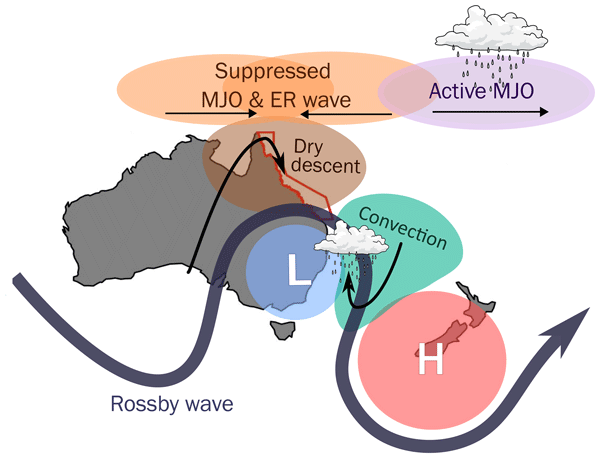
Abstract. Marine heatwaves and coral bleaching pose significant threats to the Great Barrier Reef (GBR), particularly during austral summer when atmospheric conditions can significantly enhance ocean surface warming. One such condition is the development of doldrums, characterised by weak winds and reduced cloud cover, which promote increased solar heating of the ocean surface. When these conditions persist, this buildup of heat can develop into marine heatwaves contributing to widespread coral bleaching. Despite these impacts, the formation and persistence of the doldrums remain poorly understood. Here, we identify doldrum events over the GBR through a K-means cluster analysis and investigate the tropical and extratropical interactions associated with their onset and maintenance. We show that doldrums formation is linked to the passage of a Rossby wave packet, in which a cyclonic anomaly and anomalous westerlies over eastern Australia disrupt the typical trade wind easterlies over the GBR. If the cyclonic anomaly propagates east quickly, the doldrums tend to cease; if the anomaly stalls, the doldrums tend to persist. These stalled Rossby wave packets are associated with repeated cyclonic Rossby wave breaking over Australia, which weakens the zonal flow and enhances blocking near New Zealand. Concurrently, favourable conditions are needed in the tropics to establish and maintain the doldrums. During longer doldrums, the slower-moving Madden-Julian Oscillation and Equatorial Rossby wave more frequently align their suppressed phases over the GBR, reinforcing anomalous westerlies to further counter the trade easterlies. Finally, Lagrangian trajectory analysis reveals that dry descending air within the doldrums typically originates in the mid-latitudes. Here, the positioning of the cyclonic anomaly or cut‑off low forces the parcels to sweep across southern Australia over the dry interior before reaching the GBR. Together, these results highlight the tropical-extratropical interactions that promote the doldrums persistence over the GBR and favours the development of both marine and terrestrial heatwaves.
-
Notice on discussion status
The requested preprint has a corresponding peer-reviewed final revised paper. You are encouraged to refer to the final revised version.
-
Preprint
(8385 KB)
-
The requested preprint has a corresponding peer-reviewed final revised paper. You are encouraged to refer to the final revised version.
- Preprint
(8385 KB) - Metadata XML
- BibTeX
- EndNote
- Final revised paper


Journal article(s) based on this preprint
Interactive discussion
Status: closed
- RC1: 'Comment on egusphere-2026-2114', Anonymous Referee #1, 13 Jul 2026
-
RC2: 'Comment on egusphere-2026-2114', Anonymous Referee #2, 28 Jul 2026
The comment was uploaded in the form of a supplement: https://egusphere.copernicus.org/preprints/2026/egusphere-2026-2114/egusphere-2026-2114-RC2-supplement.pdf
-
AC1: 'Comment on egusphere-2026-2114', Lara Richards, 04 Sep 2026
The comment was uploaded in the form of a supplement: https://egusphere.copernicus.org/preprints/2026/egusphere-2026-2114/egusphere-2026-2114-AC1-supplement.pdf
Peer review completion


Interactive discussion
Status: closed
- RC1: 'Comment on egusphere-2026-2114', Anonymous Referee #1, 13 Jul 2026
-
RC2: 'Comment on egusphere-2026-2114', Anonymous Referee #2, 28 Jul 2026
The comment was uploaded in the form of a supplement: https://egusphere.copernicus.org/preprints/2026/egusphere-2026-2114/egusphere-2026-2114-RC2-supplement.pdf
-
AC1: 'Comment on egusphere-2026-2114', Lara Richards, 04 Sep 2026
The comment was uploaded in the form of a supplement: https://egusphere.copernicus.org/preprints/2026/egusphere-2026-2114/egusphere-2026-2114-AC1-supplement.pdf
Peer review completion
Journal article(s) based on this preprint
Viewed
| HTML | XML | Total | BibTeX | EndNote | |
|---|---|---|---|---|---|
| 309 | 215 | 47 | 571 | 34 | 34 |
- HTML: 309
- PDF: 215
- XML: 47
- Total: 571
- BibTeX: 34
- EndNote: 34
Viewed (geographical distribution)
| Country | # | Views | % |
|---|
| Total: | 0 |
| HTML: | 0 |
| PDF: | 0 |
| XML: | 0 |
- 1
Lara S. Richards

Michael A. Barnes
Chenhui Jin
Fadhlil R. Muhammad
Daniel P. Harrison
Steven T. Siems
The requested preprint has a corresponding peer-reviewed final revised paper. You are encouraged to refer to the final revised version.
- Preprint
(8385 KB) - Metadata XML
Please find my review attached.