
the Creative Commons Attribution 4.0 License.
the Creative Commons Attribution 4.0 License.
 | 22 Apr 2026
Thermohaline gradients and frontal regimes in the northwestern Tropical Atlantic
Abstract. At the edge of the Amazon River plume, stirring by the North Brazil Current (NBC) and its eddies creates sharp surface thermohaline gradients on scales of O(1–100) km. This study provides a comprehensive picture of these gradients and fronts associated with the region's distinctive dynamics. Saildrone observations show that the plume amplifies density gradient variability at all scales from 1–100 km, with frontal sharpness up to 75x stronger inside the plume than outside, with differences reaching 100x at scales below 3 km. Partial temperature-salinity compensation and reinforcement act on density gradients, with net frontogenesis observed in both regions. To expand in-situ observations, we use a 1-km resolution CROCO simulation to assess the spatial distribution of surface fronts and their spatio-temporal variability. We characterize three distinct frontal regimes: broken-up fronts parallel to shore occupy the plume core over the continental shelf, thin elongated fronts associated with NBC-plume interactions connect nearshore and offshore regions, and pools of anisotropic fronts driven by the mixed-layer cycle are present offshore. Salinity dominates density gradients throughout the year north of 15 °N, whereas near-shore fronts exhibit seasonal shifts in temperature-salinity dominance linked to the Amazon discharge seasonality and NBC strength. Within the plume, freshwater filaments stirred by NBC rings systematically generate compensated fronts on their inner edge and reinforced fronts on their outer rim, a pattern with implications for energy cascades and tracer export.
-
Notice on discussion status
The requested preprint has a corresponding peer-reviewed final revised paper. You are encouraged to refer to the final revised version.
-
Preprint
(22767 KB)
-
The requested preprint has a corresponding peer-reviewed final revised paper. You are encouraged to refer to the final revised version.
- Preprint
(22767 KB) - Metadata XML
- BibTeX
- EndNote
- Final revised paper


Journal article(s) based on this preprint
Interactive discussion
Status: closed
-
RC1: 'Comment on egusphere-2026-2092', Maya Jakes, 19 May 2026
The comment was uploaded in the form of a supplement: https://egusphere.copernicus.org/preprints/2026/egusphere-2026-2092/egusphere-2026-2092-RC1-supplement.pdfCitation: https://doi.org/
10.5194/egusphere-2026-2092-RC1 - CC1: 'Reply on RC1', Dante Napolitano, 04 Jun 2026
-
AC1: 'Reply on RC1', Dante Napolitano, 08 Jul 2026
The comment was uploaded in the form of a supplement: https://egusphere.copernicus.org/preprints/2026/egusphere-2026-2092/egusphere-2026-2092-AC1-supplement.pdf
-
RC2: 'Comment on egusphere-2026-2092', Anonymous Referee #2, 17 Jun 2026
Review of
Thermohaline gradients and frontal regimes in the northwestern Tropical Atlantic
Napolitano et al.
Comments to authors
General overview:
This study investigates the characteristics of submesoscale frontogenesis associated with the Amazon River freshwater plume, with particular emphasis on whether the fronts are density-compensated or density-reinforced, using both observations and model analyses. The study uses state-of-the-art methods for analyzing and observing submesoscale fronts and provides insights, particularly for regions with abundant freshwater input. The fact that such a systematic analysis has been conducted using only physical surface data is commendable.
Although this work is of clear interest and is recommended reading even for researchers who do not primarily focus on this region, there are several aspects that may be difficult for first-time readers to follow, including insufficient explanations and occasionally unclear organization of the manuscript. Therefore, I recommend publication after the structure is improved and additional explanations are provided. Specific comments for the authors’ consideration are listed below.
Major comments:
- Organizing the manuscript into separate paragraph for methods, results, and discussion would make the main points much clearer.
I understand that the authors chose not to adopt a conventional structure (i.e., separate sections for methods, results, and discussion) in order to construct a narrative that transitions from observational findings to model analyses. However, there are several instances where these elements (methods, results, and discussion) are intermingled within a single paragraph. This structure unfortunately obscures the authors’ main arguments.
Moreover, in some part of the manuscript, it is unclear whether the statements reflect objective results or the authors’ interpretations. For example, interpretations based on observational analyses are sometimes difficult to clearly interpret conceptually until the corresponding model results are introduced.
The main relevant points are listed below. In addition to the points listed below, I encourage the authors to revise the manuscript, with attention to the roles of individual sentences and paragraphs.
- L92–93, “The accuracy of …”, etc.: It is important to discuss the accuracy and validity of the results, and I appreciate the authors’ balanced and careful stance. However, presenting such discussions within the same paragraph as the description of the results may lead to confusion in how the results are interpreted by readers. This content would be more appropriately placed in the discussion part.
- L95, “within the PLUME”: Omitting this sentence would allow the paragraph to more effectively present the scale dependence of the density gradient from a synoptic perspective.
- L113–115, “This shift suggests … and location).”: Since results and suggestion are intermingled, it would be better to separate them. While the energetic frontogenesis might be anticipated given the eddy-rich feature of the region, such a suggestion should not be presented alongside the results at this stage, as it is not yet supported by a direct examination of the flow field.
- L159 “Overall, …”: Is it correct to understand that this describes the symmetry between the top and bottom quadrants of Figure 3b and 3c? The same sentence also refers to a typical pattern of arched flows; does this imply that Figure 3 allows one to interpret the spatial (and/or temporal) distribution of frontogenesis and frontolysis? This is also related to the need for additional clarification regarding the spatiotemporal distribution of the data, as noted in Major Comment 2 below.
- L166–171 “In Figure 3b, …”: This point appears to mark the beginning of the discussion specific to the plume. It may be helpful to separate this into a new paragraph.
- L179–184 “At this point, …”: If this statement is presented in the context of results, it cannot be fully understood until the model-based results (specifically Figure 10) are introduced. At this stage, it should therefore be separated into a distinct paragraph and reorganized as part of the discussion, or framed as a motivation for the subsequent model analysis.
- L222–233 “We first … its seasonal cycle.”: This paragraph combines several elements, including the objective of the analysis in this section, the reason for selecting the snapshot, the philosophy behind using a single snapshot, and the definition of the PLUME in the model. The analytical objectives and factual descriptions should be clearly separated from methodological reasoning and interpretation, and presented in distinct paragraphs.
- L261–268 “From model … detailed in this study.”: This paragraph includes the methodology, validation results, and interpretation. While the validation presented here is important, I feel it would be better placed in the latter part of the subsection.
- L272–275 “The model also … of the plume.”: Is this part intended as discussion? Including it within the results section could lead to confusion.
- L369–384: The description of the seasonal variation based on Figure 9b (results) is intermingled with interpretation and discussion of scale dependence. Simply separating the results from the interpretation would make this section much clearer.
- L401–406: If this paragraph is intended to explain lines 179–184, stating this explicitly would help readers interpret the observational results.
- L447–452 “Compensated fronts, … and nitrogen budgets.”: This discussion seems to appear for the first time at this point in the manuscript, rather than being part of the summary or conclusions.
- The manuscript would become more readable by adding clearer explanations of the data and figures.
There are several places where the manuscript could be improved simply by referring to figures at appropriate points, adding brief explanations to the figures, and providing additional descriptions of the data. Relevant points are listed below:
- L19–20 “Influenced by … in winter and spring”: Referring to Figure 1 at this point would make it easier for the reader to form a clear understanding.
- L44 “boulevard de tourbillons”: This should be indicated in the figure.
- L63–84: Information on how the averaged data derived from the moving circle are distributed spatially is needed. This information is important for understanding whether the analysis captures the spatial variability of frontogenesis and frontolysis, their temporal evolution, or both. Is the data arranged such that it includes both frontogenesis and frontolysis at similar locations (temporal evolution), or can it be interpreted as capturing variations in a snapshot sense—that is, as a configuration suitable for examining spatial distributions?
- L175–177 “Taking every … mostly OUTSIDE.” Should Figure 3c be referenced here?
- L184 “pdfs”: Additional explanation is required.
- Figure 4: Can the broader tail on the reinforced side under frontolysis be explained? Does this imply that, rather than the distribution of density‑reinforced water masses, the flow field that induces deformation exerts a stronger influence?
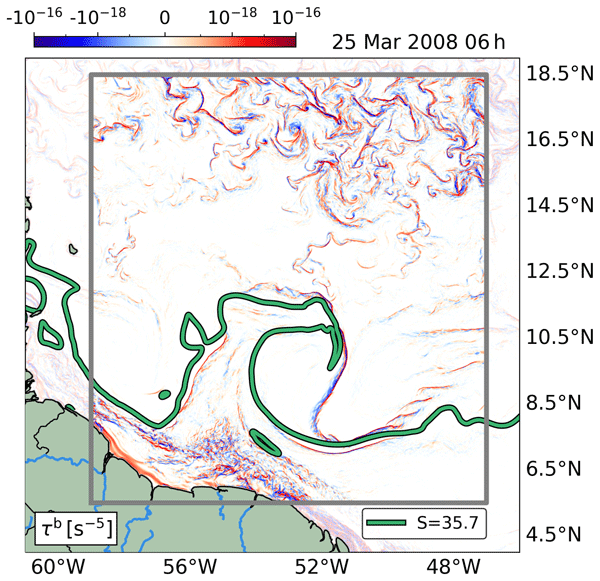
- L222 “We first … campaign.”: If the interpretation is that Figure 5a is similar to Figure 1a, please refer to the figure explicitly. Adding the saildrone tracks to Figure 5a would make the structural similarity easier to recognize.
- Figure 5a: Since this is an important fine-scale structure, I would appreciate it if the figure could be enlarged.
- Caption of Figure 5a “Model distribution of buoyancy sharpness”: Is this correctly defined as the quantity B? Using consistent terminology and expressions throughout would help reduce confusion.
- L273 “These gradients are mainly associated with the NBC”: Would this be clear by referring to one of the figures—Figure 8, for example?
- L357 “slowly moves poleward after a virtually stationary period between 9 and 12ºN”: Because the signal is not clear, it is difficult to identify which part of the figure is being referenced. Some visual guidance—such as adding dashed lines to the figure—would be helpful.
- L357–358 “probably entrained within mesoscale structures”: As noted above, if lines can be drawn on the Hovmöller diagram, an approximate propagation speed of the signal could be estimated. It would be interesting if this corresponds to the eddy propagation speed in this region.
- L369–384: Here, I understand that both the dominance of salinity versus temperature and their respective contributions to density compensation or reinforcement are key elements. Would it be possible to present a time series of Tu, similar to that shown in Figure 9b?
- L407 “The blowout of … 0.02 m–1.”: This sentence should be moved to the caption of Figure 10.
- L414–415 “The region being … dynamical responses:”: Is this description intended to refer to Figure 7?
- One concern throughout the manuscript is the contribution of submesoscale current other than frontogenesis, such as mixed layer instability and forced instability. The influences of atmospheric forcing and precipitation, which could act as generation mechanisms for such flows, should be addressed at the stage of observational data analysis. The discussion that explicitly engages with the results of this study appears to be introduced in the following sections.
- L368 “controlled by mixed-layer cycle”: Is there a contribution from variability in mixed‑layer depth driven by precipitation and atmospheric forcing as well as from mixed‑layer instabilities in the southern region, that is, within the PLUME and its immediate OUTSIDE?
Specific comments:
L116–117 “Having established … ”: Has the transition region been discussed earlier in the manuscript?
L150 “(f) and buoyancy (N2)”, etc.: Variables should be written in italics.
L157 “]-π/2, π/2[”: The notation used for the open interval appears to be nonstandard. I recommend revising it.
L197–200: This is an interesting point. The reinforced fronts are likely to generate strong density gradients, albeit transiently. Could the reinforced fronts be characterized as undergoing a super‑exponential frontal‑sharpening stage? Is it reasonable to interpret their development as being rapid, followed by a prompt breakdown due to instability?
L280 “temperature-dominated gradient”: Rather than being temperature‑dominated, does the distribution exhibit a broader tail on the density‑compensated side?
L325–326 “In our region, … due to the NBC.”: This is an interesting point. To what depth does the plume‑dominated frontogenesis and its associated forward energy cascade extend? Even if these processes are confined to the surface layer, explicitly describing this would help clarify the interpretation.
Caption of Figure 9 “within the PLUMEregion”: A space is needed between PLUME and region.
Citation: https://doi.org/10.5194/egusphere-2026-2092-RC2 -
AC2: 'Reply on RC2', Dante Napolitano, 08 Jul 2026
The comment was uploaded in the form of a supplement: https://egusphere.copernicus.org/preprints/2026/egusphere-2026-2092/egusphere-2026-2092-AC2-supplement.pdf
Peer review completion


Interactive discussion
Status: closed
-
RC1: 'Comment on egusphere-2026-2092', Maya Jakes, 19 May 2026
The comment was uploaded in the form of a supplement: https://egusphere.copernicus.org/preprints/2026/egusphere-2026-2092/egusphere-2026-2092-RC1-supplement.pdf
- CC1: 'Reply on RC1', Dante Napolitano, 04 Jun 2026
-
AC1: 'Reply on RC1', Dante Napolitano, 08 Jul 2026
The comment was uploaded in the form of a supplement: https://egusphere.copernicus.org/preprints/2026/egusphere-2026-2092/egusphere-2026-2092-AC1-supplement.pdf
-
RC2: 'Comment on egusphere-2026-2092', Anonymous Referee #2, 17 Jun 2026
Review of
Thermohaline gradients and frontal regimes in the northwestern Tropical Atlantic
Napolitano et al.
Comments to authors
General overview:
This study investigates the characteristics of submesoscale frontogenesis associated with the Amazon River freshwater plume, with particular emphasis on whether the fronts are density-compensated or density-reinforced, using both observations and model analyses. The study uses state-of-the-art methods for analyzing and observing submesoscale fronts and provides insights, particularly for regions with abundant freshwater input. The fact that such a systematic analysis has been conducted using only physical surface data is commendable.
Although this work is of clear interest and is recommended reading even for researchers who do not primarily focus on this region, there are several aspects that may be difficult for first-time readers to follow, including insufficient explanations and occasionally unclear organization of the manuscript. Therefore, I recommend publication after the structure is improved and additional explanations are provided. Specific comments for the authors’ consideration are listed below.
Major comments:
- Organizing the manuscript into separate paragraph for methods, results, and discussion would make the main points much clearer.
I understand that the authors chose not to adopt a conventional structure (i.e., separate sections for methods, results, and discussion) in order to construct a narrative that transitions from observational findings to model analyses. However, there are several instances where these elements (methods, results, and discussion) are intermingled within a single paragraph. This structure unfortunately obscures the authors’ main arguments.
Moreover, in some part of the manuscript, it is unclear whether the statements reflect objective results or the authors’ interpretations. For example, interpretations based on observational analyses are sometimes difficult to clearly interpret conceptually until the corresponding model results are introduced.
The main relevant points are listed below. In addition to the points listed below, I encourage the authors to revise the manuscript, with attention to the roles of individual sentences and paragraphs.
- L92–93, “The accuracy of …”, etc.: It is important to discuss the accuracy and validity of the results, and I appreciate the authors’ balanced and careful stance. However, presenting such discussions within the same paragraph as the description of the results may lead to confusion in how the results are interpreted by readers. This content would be more appropriately placed in the discussion part.
- L95, “within the PLUME”: Omitting this sentence would allow the paragraph to more effectively present the scale dependence of the density gradient from a synoptic perspective.
- L113–115, “This shift suggests … and location).”: Since results and suggestion are intermingled, it would be better to separate them. While the energetic frontogenesis might be anticipated given the eddy-rich feature of the region, such a suggestion should not be presented alongside the results at this stage, as it is not yet supported by a direct examination of the flow field.
- L159 “Overall, …”: Is it correct to understand that this describes the symmetry between the top and bottom quadrants of Figure 3b and 3c? The same sentence also refers to a typical pattern of arched flows; does this imply that Figure 3 allows one to interpret the spatial (and/or temporal) distribution of frontogenesis and frontolysis? This is also related to the need for additional clarification regarding the spatiotemporal distribution of the data, as noted in Major Comment 2 below.
- L166–171 “In Figure 3b, …”: This point appears to mark the beginning of the discussion specific to the plume. It may be helpful to separate this into a new paragraph.
- L179–184 “At this point, …”: If this statement is presented in the context of results, it cannot be fully understood until the model-based results (specifically Figure 10) are introduced. At this stage, it should therefore be separated into a distinct paragraph and reorganized as part of the discussion, or framed as a motivation for the subsequent model analysis.
- L222–233 “We first … its seasonal cycle.”: This paragraph combines several elements, including the objective of the analysis in this section, the reason for selecting the snapshot, the philosophy behind using a single snapshot, and the definition of the PLUME in the model. The analytical objectives and factual descriptions should be clearly separated from methodological reasoning and interpretation, and presented in distinct paragraphs.
- L261–268 “From model … detailed in this study.”: This paragraph includes the methodology, validation results, and interpretation. While the validation presented here is important, I feel it would be better placed in the latter part of the subsection.
- L272–275 “The model also … of the plume.”: Is this part intended as discussion? Including it within the results section could lead to confusion.
- L369–384: The description of the seasonal variation based on Figure 9b (results) is intermingled with interpretation and discussion of scale dependence. Simply separating the results from the interpretation would make this section much clearer.
- L401–406: If this paragraph is intended to explain lines 179–184, stating this explicitly would help readers interpret the observational results.
- L447–452 “Compensated fronts, … and nitrogen budgets.”: This discussion seems to appear for the first time at this point in the manuscript, rather than being part of the summary or conclusions.
- The manuscript would become more readable by adding clearer explanations of the data and figures.
There are several places where the manuscript could be improved simply by referring to figures at appropriate points, adding brief explanations to the figures, and providing additional descriptions of the data. Relevant points are listed below:
- L19–20 “Influenced by … in winter and spring”: Referring to Figure 1 at this point would make it easier for the reader to form a clear understanding.
- L44 “boulevard de tourbillons”: This should be indicated in the figure.
- L63–84: Information on how the averaged data derived from the moving circle are distributed spatially is needed. This information is important for understanding whether the analysis captures the spatial variability of frontogenesis and frontolysis, their temporal evolution, or both. Is the data arranged such that it includes both frontogenesis and frontolysis at similar locations (temporal evolution), or can it be interpreted as capturing variations in a snapshot sense—that is, as a configuration suitable for examining spatial distributions?
- L175–177 “Taking every … mostly OUTSIDE.” Should Figure 3c be referenced here?
- L184 “pdfs”: Additional explanation is required.
- Figure 4: Can the broader tail on the reinforced side under frontolysis be explained? Does this imply that, rather than the distribution of density‑reinforced water masses, the flow field that induces deformation exerts a stronger influence?
- L222 “We first … campaign.”: If the interpretation is that Figure 5a is similar to Figure 1a, please refer to the figure explicitly. Adding the saildrone tracks to Figure 5a would make the structural similarity easier to recognize.
- Figure 5a: Since this is an important fine-scale structure, I would appreciate it if the figure could be enlarged.
- Caption of Figure 5a “Model distribution of buoyancy sharpness”: Is this correctly defined as the quantity B? Using consistent terminology and expressions throughout would help reduce confusion.
- L273 “These gradients are mainly associated with the NBC”: Would this be clear by referring to one of the figures—Figure 8, for example?
- L357 “slowly moves poleward after a virtually stationary period between 9 and 12ºN”: Because the signal is not clear, it is difficult to identify which part of the figure is being referenced. Some visual guidance—such as adding dashed lines to the figure—would be helpful.
- L357–358 “probably entrained within mesoscale structures”: As noted above, if lines can be drawn on the Hovmöller diagram, an approximate propagation speed of the signal could be estimated. It would be interesting if this corresponds to the eddy propagation speed in this region.
- L369–384: Here, I understand that both the dominance of salinity versus temperature and their respective contributions to density compensation or reinforcement are key elements. Would it be possible to present a time series of Tu, similar to that shown in Figure 9b?
- L407 “The blowout of … 0.02 m–1.”: This sentence should be moved to the caption of Figure 10.
- L414–415 “The region being … dynamical responses:”: Is this description intended to refer to Figure 7?
- One concern throughout the manuscript is the contribution of submesoscale current other than frontogenesis, such as mixed layer instability and forced instability. The influences of atmospheric forcing and precipitation, which could act as generation mechanisms for such flows, should be addressed at the stage of observational data analysis. The discussion that explicitly engages with the results of this study appears to be introduced in the following sections.
- L368 “controlled by mixed-layer cycle”: Is there a contribution from variability in mixed‑layer depth driven by precipitation and atmospheric forcing as well as from mixed‑layer instabilities in the southern region, that is, within the PLUME and its immediate OUTSIDE?
Specific comments:
L116–117 “Having established … ”: Has the transition region been discussed earlier in the manuscript?
L150 “(f) and buoyancy (N2)”, etc.: Variables should be written in italics.
L157 “]-π/2, π/2[”: The notation used for the open interval appears to be nonstandard. I recommend revising it.
L197–200: This is an interesting point. The reinforced fronts are likely to generate strong density gradients, albeit transiently. Could the reinforced fronts be characterized as undergoing a super‑exponential frontal‑sharpening stage? Is it reasonable to interpret their development as being rapid, followed by a prompt breakdown due to instability?
L280 “temperature-dominated gradient”: Rather than being temperature‑dominated, does the distribution exhibit a broader tail on the density‑compensated side?
L325–326 “In our region, … due to the NBC.”: This is an interesting point. To what depth does the plume‑dominated frontogenesis and its associated forward energy cascade extend? Even if these processes are confined to the surface layer, explicitly describing this would help clarify the interpretation.
Caption of Figure 9 “within the PLUMEregion”: A space is needed between PLUME and region.
Citation: https://doi.org/10.5194/egusphere-2026-2092-RC2 -
AC2: 'Reply on RC2', Dante Napolitano, 08 Jul 2026
The comment was uploaded in the form of a supplement: https://egusphere.copernicus.org/preprints/2026/egusphere-2026-2092/egusphere-2026-2092-AC2-supplement.pdf
Peer review completion
Journal article(s) based on this preprint
Viewed
| HTML | XML | Total | BibTeX | EndNote | |
|---|---|---|---|---|---|
| 230 | 216 | 22 | 468 | 19 | 24 |
- HTML: 230
- PDF: 216
- XML: 22
- Total: 468
- BibTeX: 19
- EndNote: 24
Viewed (geographical distribution)
| Country | # | Views | % |
|---|
| Total: | 0 |
| HTML: | 0 |
| PDF: | 0 |
| XML: | 0 |
- 1
Dante C. Napolitano

Jonathan Gula
Solange Coadou-Chaventon
Sabrina Speich
Cesar B. Rocha
James C. McWilliams
Dongxiao Zhang
Xavier Carton
The requested preprint has a corresponding peer-reviewed final revised paper. You are encouraged to refer to the final revised version.
- Preprint
(22767 KB) - Metadata XML