
the Creative Commons Attribution 4.0 License.
the Creative Commons Attribution 4.0 License.
 | 19 May 2026
Anatomy and Impact of a High Arctic Atmospheric River Driving Extreme Winter Rain and Snowfall
Abstract. Atmospheric rivers (ARs) transport concentrated fluxes of heat and moisture poleward, driving temperature and precipitation extremes. Yet, their vertical structure in the High Arctic – where small thermodynamic perturbations govern rain-snow partitioning and cryospheric response – remains poorly constrained. Here we present atmospheric vapour isotope, radiosonde, and meteorological observations from Svalbard during a record-setting AR in March 2022. The AR developed in the northwest Atlantic when a deep "bomb" cyclone established a sustained conduit of poleward heat/moisture. Integrated vapour transport exceeded 450 kg m⁻¹ s⁻¹, with warming and enhanced moisture emerging ~2–6 km aloft before deepening through the lower-troposphere, tripling near-surface humidity. On 15 March, air temperatures rose to 5.6 °C accompanied by 43.9 mm rainfall – the highest daily March total on record. Concurrently, vapour δ18O (d-excess) attained its campaign maximum (minimum) and marine aerosol (Na+) concentrations spiked, constraining the geochemical signature of Atlantic moisture advection. The two-day AR event delivered ~0.5 Gt snowfall across Svalbard, locally equivalent to over 8% of net 2022 glacier accumulation and offsetting surface mass loss by ~7%. Although rainfall comprised less than one-third of the total precipitation, it impacted 60% of the glacierised terrain, driving winter rain-on-snow melt and densification across lower-elevation areas and altering snowpack structure. Our study underscores the vulnerability of Svalbard and other glacierised Arctic archipelagos to intensifying poleward moisture and heat transport by ARs, with substantial but nuanced impacts on glacier surface energy budget and mass balance through the delivery of anomalous winter rainfall, snowfall, and latent heat.
-
Notice on discussion status
The requested preprint has a corresponding peer-reviewed final revised paper. You are encouraged to refer to the final revised version.
-
Preprint
(1674 KB)
-
Supplement
(339 KB)
-
The requested preprint has a corresponding peer-reviewed final revised paper. You are encouraged to refer to the final revised version.
- Preprint
(1674 KB) - Metadata XML
-
Supplement
(339 KB) - BibTeX
- EndNote
- Final revised paper


Journal article(s) based on this preprint
Interactive discussion
Status: closed
-
RC1: 'Comment on egusphere-2026-2066', Jonathan Wille, 18 Jun 2026
-
AC1: 'Reply on RC1', Hannah Bailey, 02 Jul 2026
The comment was uploaded in the form of a supplement: https://egusphere.copernicus.org/preprints/2026/egusphere-2026-2066/egusphere-2026-2066-AC1-supplement.pdf
-
AC1: 'Reply on RC1', Hannah Bailey, 02 Jul 2026
-
RC2: 'Comment on egusphere-2026-2066', Anonymous Referee #2, 19 Jun 2026
The study by Bailey et al. presents a well-structured case study of an extreme atmospheric river (AR) event that affected Svalbard in mid-March 2022, followed by a cold air outbreak (CAO) at the end of March. The authors analyse the AR event using isotope measurements, radiosonde data, and meteorological observations from Svalbard, supported by reanalysis data. First, the manuscript provides an overview of the event in a climatological context, then examines the vertical structure of the AR, and finally discusses surface-based analysis in detail. Overall, this is an interesting and relevant case study that illustrates the impact of atmospheric rivers and related extreme events on polar regions. The results are clearly presented and provide a good overview of the key parameters associated with ARs.
Overall, I think, the manuscript is well written and addresses an important topic and is suitable for publication after addressing some specific concerns.
Specific comments:
1) Unlike the AR analysis, the COA analysis is comparatively limited and would benefit from a more detailed discussion, given its relevance to the evolution of the overall event. I think it would be interesting to include a comparison between the AR and the CAO. For example, to what extent was the CAO anomalous (or not) compared to typical Arctic cold air outbreaks? Is there any indication that the AR may have influenced or triggered the CAO?
2) The manuscript includes isotope measurements, which are a potentially interesting component of the study. However, the motivation for including them and their specific added value could be clarified. In particular, it would be helpful to explain more clearly what additional information they provide beyond the meteorological analysis, for example with regard to moisture source regions or transport pathways.
3) The discussion is sufficient, however, I suggest dividing it into several subsections to improve readability and provide a better overview. For examples:
-Precipitation characteristics and isotopic evidence
- Poleward moisture transport and AR structure A
- Atmospheric thermodynamic response and SEB
- Cryospheric response (melt, refreezing, snowpack)
Minor comments
L22, L88, L96: The measurement campaign is mentioned several times throughout the manuscript. It would be helpful to provide a brief introduction to the campaign, including its location and duration. If I understand correctly, the measurements were conducted at the NPI Zeppelin Observatory between 1 January and 31 May. Please clarify.
L76: I would like to clarify one point regarding the measurements. Are the stable isotope ratios derived from the measured water vapour isotope ratios? Also, is the temporal resolution approximately one second?
L96: Could you explain the motivation for using snowfall samples and explain their relevance to this study?
L126ff: The study uses both ERA5 and CARRA reanalysis data. What are their respective temporal and spatial resolutions? References for both datasets should also be provided. Currently, Hersbach et al. (2020) is cited repeatedly throughout the manuscript instead – it should be sufficient to cite it once.
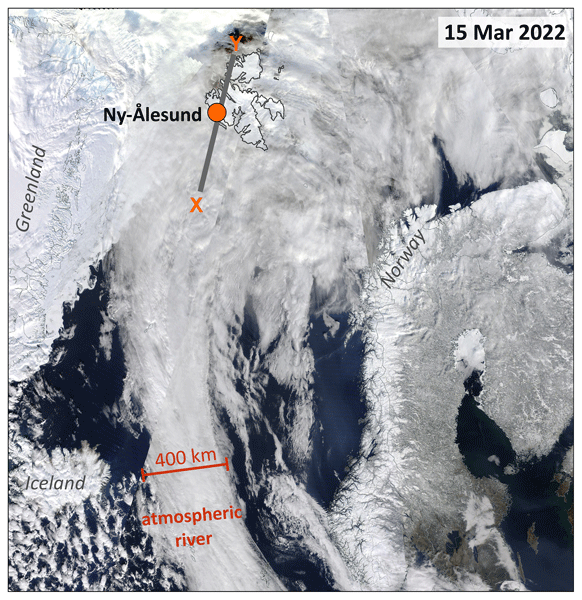
L136 and Figure 1: Could the transect be added to Figure 1? This would help the reader to identify its location and better follow the subsequent analysis more easily.
L176: Delete the citation Hersbach et al. (2020).
Figure 2: It would be informative to also show anomalies for IVT and precipitation to illustrate more clearly how exceptional this event was. In addition, I suggest using the same latitudinal range for all three panels to facilitate comparison.
L180ff: Please clarify how turbulence was diagnosed or calculated. Could you indicate where the negative potential vorticity mentioned in the text can be found?
Figure 3: I suggest incorporating the inset map shown from panel (c) already into panel (a). Furthermore, the cross section in Figure 3 is shown at 12 UTC, whereas Figure 2 shows conditions at 16 UTC. To improve consistency, I suggest using the same time step for both figures..
L192–193: How was the horizontal wavelength determined? What evidence supports the interpretation that the observed structure is consistent with orographically forced gravity waves?
L212: Figure 3e does not appear to be present. Please check the figure reference.
L215: Could you provide some context on whether the IWV values observed during this event were exceptionally high compared to climatological conditions?
L220: Please specify which anomalies are referred to here. Alternatively, do you mean temporal variability?
Figure 5: Please clarify whether the plotted values are daily means. Is there a particular reason for showing the time series from January to May? Since the focus is on the event in March, a shorter period similar to that shown in Figure 4 might be sufficient.
L275: Delete the citation Hersbach et al. (2020).
L288, L292: Delete the citation Hersbach et al. (2020).
Figure 7: Could you assess whether the displayed anomalies are statistically significant?
Figure 7: Delete the citation Hersbach et al. (2020) from the figure. Instead, indicate in the caption that the data are based on ERA5.
L320: Consider rephrasing to ‚during poleward transport‘ to ‚during the poleward transport‘
L321: Could you please elaborate on the implications of this result? Why is this finding important?
Citation: https://doi.org/10.5194/egusphere-2026-2066-RC2 -
AC2: 'Reply on RC2', Hannah Bailey, 07 Jul 2026
The comment was uploaded in the form of a supplement: https://egusphere.copernicus.org/preprints/2026/egusphere-2026-2066/egusphere-2026-2066-AC2-supplement.pdf
-
AC2: 'Reply on RC2', Hannah Bailey, 07 Jul 2026
Peer review completion


Interactive discussion
Status: closed
-
RC1: 'Comment on egusphere-2026-2066', Jonathan Wille, 18 Jun 2026
General comments
This study presents a detailed case study of an extreme atmospheric river (AR) event and subsequent cold air outbreak (CAO) that affected Svalbard in March 2022. Combining detailed analysis of the synoptic meteorology, glaciological impacts, surface conditions, and aerosol/moisture transport, the authors have made a holistic analysis using high-quality measurements to present to the reader the many different components of extreme weather events in polar regions. The authors demonstrate a good command of the existing literature and frame this event as a detailed example of how further extreme weather events will impact the Arctic glaciers and ice sheets. The results are robust and paint a complete picture of this extreme weather event from the dynamics to the glacier impacts. The discussion is sufficient, but would benefit of greater detail and further elaboration. Some suggestions are outlined in my Specific comments below.
Overall, I feel this manuscript is well written and the analysis is robust and timely. I would support publication after the following concerns are addressed.
Specific comments
- It could be valuable to include a comparison of Antarctic and Arctic AR behavior in the Discussion section. Particularly, the radiosonde measurements during AR landfalls discussed in Gorodetskaya et al. (2020) and Antarctic AR dynamics discussed in (Terpstra et al. 2021) are potentially interesting to compare against the results in this study. Also would be interesting to know if you observed a similar lifting/weakening of the low level jet as the AR moves poleward and over colder ocean waters as is often observed around Antarctica. A similar comparison could also be made with Antarctic water vapor isotope measurements during ARs (see Dutrievoz et al. 2026).
- There is only one brief mention of the cold air outbreak (CAO) in the Discussion section. It is very interesting that this very intense AR was followed by an exceptionally intense CAO shortly afterwards, but there is no discussion as to whether these two events are related. Is it possible to examine your datasets and determine how often intense ARs are followed by CAOs?
- The isotope and aerosol measurements are certainly interesting details, but I feel they exist in this study only as a detail. For instance, the concluding sentence at the end of the second paragraph in the discussion summarizes something that has already been observed many times before in previous Arctic AR events. Perhaps there is potential to use these results to support larger conclusions that can be mentioned in the Discussion section. Like do the aerosol and isotope measurements reveal anything about the source region of the moisture, something that is different from a regular cyclone event? Do the enhanced isotopes from this event have any paleoclimate significance? Like is this signal something to can be found in the ice core records of other extreme weather events. I am not suggesting making additional analysis although a moisture tagging analysis would be a good way to determine the origin of the moisture, but try diving a bit deeper to make further connections with other events and hypothesize the implications of these results.
Minor comments
Line 39-42: Mostly because of the timing, but it would be nice to mention the extreme Antarctic AR event in March 2022 as a co-occurring polar extreme on the other side of the planet (Wille et al. 2024a,b).
Line 108: Mention the years of the radiosonde record in the Methods.
Line 140: Please specify the resolution difference between CARRA and ERA5.
Line 181: Is there a figure that shows the potential vorticity? If not, you can just write “(not shown)”.
Line 195: Did you find a foehn wind within the lee-side flow?
Line 228: “collapsed” is not a very physically descriptive term. Perhaps “dissipated”?
Line 228: Can you state what quantile the IWV was within?
Line 264: I think it is worth mentioning here that the snow depth actually exceeded the pre-AR levels once the storm passed. Although the snow depth then decreases quickly around March 21st even though the temperatures remained below freezing. Any idea on what caused this?
Line 320: Rephrase to “during the poleward moisture transport”.
Line 321: Do you have any insight on the source region of the enhanced Na+ aerosol in reference to the trajectory of the AR?
Line 359: After taking into account the short-term increase in surface mass balance and then the enhanced melting potential from the ice layer formation and firn densification, can you make an educated guess as to whether this AR was a net positive or negative for the long-term surface mass balance?
References:
Dutrievoz, N., and Coauthors, 2026: Water vapour isotope anomalies during an atmospheric river event at Dome C, East Antarctica. The Cryosphere, 20, 1025–1046, https://doi.org/10.5194/tc-20-1025-2026.
Gorodetskaya, I. V., T. Silva, H. Schmithüsen, and N. Hirasawa, 2020: Atmospheric River Signatures in Radiosonde Profiles and Reanalyses at the Dronning Maud Land Coast, East Antarctica. Adv. Atmos. Sci., 37, 455–476, https://doi.org/10.1007/s00376-020-9221-8.
Terpstra, A., I. V. Gorodetskaya, and H. Sodemann, 2021: Linking Sub-Tropical Evaporation and Extreme Precipitation Over East Antarctica: An Atmospheric River Case Study. Journal of Geophysical Research: Atmospheres, 126, e2020JD033617, https://doi.org/10.1029/2020JD033617.
Wille, J. D., and Coauthors, 2024a: The Extraordinary March 2022 East Antarctica “Heat” Wave. Part I: Observations and Meteorological Drivers. Journal of Climate, 37, 757–778, https://doi.org/10.1175/JCLI-D-23-0175.1.
——, and Coauthors, 2024b: The Extraordinary March 2022 East Antarctica “Heat” Wave. Part II: Impacts on the Antarctic Ice Sheet. Journal of Climate, 37, 779–799, https://doi.org/10.1175/JCLI-D-23-0176.1.
Citation: https://doi.org/10.5194/egusphere-2026-2066-RC1 -
AC1: 'Reply on RC1', Hannah Bailey, 02 Jul 2026
The comment was uploaded in the form of a supplement: https://egusphere.copernicus.org/preprints/2026/egusphere-2026-2066/egusphere-2026-2066-AC1-supplement.pdf
-
RC2: 'Comment on egusphere-2026-2066', Anonymous Referee #2, 19 Jun 2026
The study by Bailey et al. presents a well-structured case study of an extreme atmospheric river (AR) event that affected Svalbard in mid-March 2022, followed by a cold air outbreak (CAO) at the end of March. The authors analyse the AR event using isotope measurements, radiosonde data, and meteorological observations from Svalbard, supported by reanalysis data. First, the manuscript provides an overview of the event in a climatological context, then examines the vertical structure of the AR, and finally discusses surface-based analysis in detail. Overall, this is an interesting and relevant case study that illustrates the impact of atmospheric rivers and related extreme events on polar regions. The results are clearly presented and provide a good overview of the key parameters associated with ARs.
Overall, I think, the manuscript is well written and addresses an important topic and is suitable for publication after addressing some specific concerns.
Specific comments:
1) Unlike the AR analysis, the COA analysis is comparatively limited and would benefit from a more detailed discussion, given its relevance to the evolution of the overall event. I think it would be interesting to include a comparison between the AR and the CAO. For example, to what extent was the CAO anomalous (or not) compared to typical Arctic cold air outbreaks? Is there any indication that the AR may have influenced or triggered the CAO?
2) The manuscript includes isotope measurements, which are a potentially interesting component of the study. However, the motivation for including them and their specific added value could be clarified. In particular, it would be helpful to explain more clearly what additional information they provide beyond the meteorological analysis, for example with regard to moisture source regions or transport pathways.
3) The discussion is sufficient, however, I suggest dividing it into several subsections to improve readability and provide a better overview. For examples:
-Precipitation characteristics and isotopic evidence
- Poleward moisture transport and AR structure A
- Atmospheric thermodynamic response and SEB
- Cryospheric response (melt, refreezing, snowpack)
Minor comments
L22, L88, L96: The measurement campaign is mentioned several times throughout the manuscript. It would be helpful to provide a brief introduction to the campaign, including its location and duration. If I understand correctly, the measurements were conducted at the NPI Zeppelin Observatory between 1 January and 31 May. Please clarify.
L76: I would like to clarify one point regarding the measurements. Are the stable isotope ratios derived from the measured water vapour isotope ratios? Also, is the temporal resolution approximately one second?
L96: Could you explain the motivation for using snowfall samples and explain their relevance to this study?
L126ff: The study uses both ERA5 and CARRA reanalysis data. What are their respective temporal and spatial resolutions? References for both datasets should also be provided. Currently, Hersbach et al. (2020) is cited repeatedly throughout the manuscript instead – it should be sufficient to cite it once.
L136 and Figure 1: Could the transect be added to Figure 1? This would help the reader to identify its location and better follow the subsequent analysis more easily.
L176: Delete the citation Hersbach et al. (2020).
Figure 2: It would be informative to also show anomalies for IVT and precipitation to illustrate more clearly how exceptional this event was. In addition, I suggest using the same latitudinal range for all three panels to facilitate comparison.
L180ff: Please clarify how turbulence was diagnosed or calculated. Could you indicate where the negative potential vorticity mentioned in the text can be found?
Figure 3: I suggest incorporating the inset map shown from panel (c) already into panel (a). Furthermore, the cross section in Figure 3 is shown at 12 UTC, whereas Figure 2 shows conditions at 16 UTC. To improve consistency, I suggest using the same time step for both figures..
L192–193: How was the horizontal wavelength determined? What evidence supports the interpretation that the observed structure is consistent with orographically forced gravity waves?
L212: Figure 3e does not appear to be present. Please check the figure reference.
L215: Could you provide some context on whether the IWV values observed during this event were exceptionally high compared to climatological conditions?
L220: Please specify which anomalies are referred to here. Alternatively, do you mean temporal variability?
Figure 5: Please clarify whether the plotted values are daily means. Is there a particular reason for showing the time series from January to May? Since the focus is on the event in March, a shorter period similar to that shown in Figure 4 might be sufficient.
L275: Delete the citation Hersbach et al. (2020).
L288, L292: Delete the citation Hersbach et al. (2020).
Figure 7: Could you assess whether the displayed anomalies are statistically significant?
Figure 7: Delete the citation Hersbach et al. (2020) from the figure. Instead, indicate in the caption that the data are based on ERA5.
L320: Consider rephrasing to ‚during poleward transport‘ to ‚during the poleward transport‘
L321: Could you please elaborate on the implications of this result? Why is this finding important?
Citation: https://doi.org/10.5194/egusphere-2026-2066-RC2 -
AC2: 'Reply on RC2', Hannah Bailey, 07 Jul 2026
The comment was uploaded in the form of a supplement: https://egusphere.copernicus.org/preprints/2026/egusphere-2026-2066/egusphere-2026-2066-AC2-supplement.pdf
-
AC2: 'Reply on RC2', Hannah Bailey, 07 Jul 2026
Peer review completion
Journal article(s) based on this preprint
Data sets
Ny-Ålesund Atmospheric Water Vapour Isotope Data (1 Jan–31 May 2022) Hannah Bailey et al. https://doi.org/10.5281/zenodo.18888749
Viewed
| HTML | XML | Total | Supplement | BibTeX | EndNote | |
|---|---|---|---|---|---|---|
| 295 | 127 | 31 | 453 | 50 | 25 | 23 |
- HTML: 295
- PDF: 127
- XML: 31
- Total: 453
- Supplement: 50
- BibTeX: 25
- EndNote: 23
Viewed (geographical distribution)
| Country | # | Views | % |
|---|
| Total: | 0 |
| HTML: | 0 |
| PDF: | 0 |
| XML: | 0 |
- 1

Jason E. Box
Ben G. Kopec
Valtteri Hyöky
Hannu Marttila
Jeffrey M. Welker
Jack Kohler
Dmitry V. Divine
Alun Hubbard
The requested preprint has a corresponding peer-reviewed final revised paper. You are encouraged to refer to the final revised version.
- Preprint
(1674 KB) - Metadata XML
-
Supplement
(339 KB) - BibTeX
- EndNote
- Final revised paper
General comments
This study presents a detailed case study of an extreme atmospheric river (AR) event and subsequent cold air outbreak (CAO) that affected Svalbard in March 2022. Combining detailed analysis of the synoptic meteorology, glaciological impacts, surface conditions, and aerosol/moisture transport, the authors have made a holistic analysis using high-quality measurements to present to the reader the many different components of extreme weather events in polar regions. The authors demonstrate a good command of the existing literature and frame this event as a detailed example of how further extreme weather events will impact the Arctic glaciers and ice sheets. The results are robust and paint a complete picture of this extreme weather event from the dynamics to the glacier impacts. The discussion is sufficient, but would benefit of greater detail and further elaboration. Some suggestions are outlined in my Specific comments below.
Overall, I feel this manuscript is well written and the analysis is robust and timely. I would support publication after the following concerns are addressed.
Specific comments
Minor comments
Line 39-42: Mostly because of the timing, but it would be nice to mention the extreme Antarctic AR event in March 2022 as a co-occurring polar extreme on the other side of the planet (Wille et al. 2024a,b).
Line 108: Mention the years of the radiosonde record in the Methods.
Line 140: Please specify the resolution difference between CARRA and ERA5.
Line 181: Is there a figure that shows the potential vorticity? If not, you can just write “(not shown)”.
Line 195: Did you find a foehn wind within the lee-side flow?
Line 228: “collapsed” is not a very physically descriptive term. Perhaps “dissipated”?
Line 228: Can you state what quantile the IWV was within?
Line 264: I think it is worth mentioning here that the snow depth actually exceeded the pre-AR levels once the storm passed. Although the snow depth then decreases quickly around March 21st even though the temperatures remained below freezing. Any idea on what caused this?
Line 320: Rephrase to “during the poleward moisture transport”.
Line 321: Do you have any insight on the source region of the enhanced Na+ aerosol in reference to the trajectory of the AR?
Line 359: After taking into account the short-term increase in surface mass balance and then the enhanced melting potential from the ice layer formation and firn densification, can you make an educated guess as to whether this AR was a net positive or negative for the long-term surface mass balance?
References:
Dutrievoz, N., and Coauthors, 2026: Water vapour isotope anomalies during an atmospheric river event at Dome C, East Antarctica. The Cryosphere, 20, 1025–1046, https://doi.org/10.5194/tc-20-1025-2026.
Gorodetskaya, I. V., T. Silva, H. Schmithüsen, and N. Hirasawa, 2020: Atmospheric River Signatures in Radiosonde Profiles and Reanalyses at the Dronning Maud Land Coast, East Antarctica. Adv. Atmos. Sci., 37, 455–476, https://doi.org/10.1007/s00376-020-9221-8.
Terpstra, A., I. V. Gorodetskaya, and H. Sodemann, 2021: Linking Sub-Tropical Evaporation and Extreme Precipitation Over East Antarctica: An Atmospheric River Case Study. Journal of Geophysical Research: Atmospheres, 126, e2020JD033617, https://doi.org/10.1029/2020JD033617.
Wille, J. D., and Coauthors, 2024a: The Extraordinary March 2022 East Antarctica “Heat” Wave. Part I: Observations and Meteorological Drivers. Journal of Climate, 37, 757–778, https://doi.org/10.1175/JCLI-D-23-0175.1.
——, and Coauthors, 2024b: The Extraordinary March 2022 East Antarctica “Heat” Wave. Part II: Impacts on the Antarctic Ice Sheet. Journal of Climate, 37, 779–799, https://doi.org/10.1175/JCLI-D-23-0176.1.