
the Creative Commons Attribution 4.0 License.
the Creative Commons Attribution 4.0 License.
 | 22 Apr 2026
Flying through the plasmasphere to optimize low energy ion measurements
Abstract. The Juice flyby of Earth in August 2024 gave us the first chance to evaluate the performance of the Jovian Plasma Dynamics and Composition analyzer (JDC) in environments similar to those expected at Jupiter. JDC is one of the sensors belonging to the Particle Environment Package (PEP) on the Juice spacecraft. It measures positive and negative ions as well as electrons in the energy range 1 eV/q to 35 keV/q. One of the most challenging observations at the final destination is those of the low energy ion populations in the tenuous ionospheres of Jupiter's icy moons. During the Juice flyby of Earth we discovered that the energies of the positive ions observed by JDC were not easy to interpret due to a problem with the energy sweep. Using measurements made on ground, we were able to reconstruct the observed energies and construct a new sweeping scheme that solves the problem and that will greatly improve future observations. We also used a simulation to explain the effects of the spacecraft velocity and spacecraft potential on the recorded positive ion fluxes when Juice passed through the Earth's plasmasphere. The study highlights the importance of in-flight calibrations for optimizing the scientific return. Planetary flybys give access to multiple low-energy particle populations besides the mono-energetic and highly directional solar wind.
Competing interests: At least one of the (co-)authors is a member of the editorial board of Annales Geophysicae. The peer-review process was guided by an independent editor, and the authors also have no other competing interests to declare.
Publisher's note: Copernicus Publications remains neutral with regard to jurisdictional claims made in the text, published maps, institutional affiliations, or any other geographical representation in this paper. While Copernicus Publications makes every effort to include appropriate place names, the final responsibility lies with the authors. Views expressed in the text are those of the authors and do not necessarily reflect the views of the publisher.-
Notice on discussion status
The requested preprint has a corresponding peer-reviewed final revised paper. You are encouraged to refer to the final revised version.
-
Preprint
(3441 KB)
-
The requested preprint has a corresponding peer-reviewed final revised paper. You are encouraged to refer to the final revised version.
- Preprint
(3441 KB) - Metadata XML
- BibTeX
- EndNote
- Final revised paper


Journal article(s) based on this preprint
Interactive discussion
Status: closed
-
RC1: 'Comment on egusphere-2026-2039', Anonymous Referee #1, 22 May 2026
The comment was uploaded in the form of a supplement: https://egusphere.copernicus.org/preprints/2026/egusphere-2026-2039/egusphere-2026-2039-RC1-supplement.pdfCitation: https://doi.org/
10.5194/egusphere-2026-2039-RC1 -
AC1: 'Reply on RC1', Gabriella Stenberg Wieser, 28 Jun 2026
The comment was uploaded in the form of a supplement: https://egusphere.copernicus.org/preprints/2026/egusphere-2026-2039/egusphere-2026-2039-AC1-supplement.pdf
-
AC1: 'Reply on RC1', Gabriella Stenberg Wieser, 28 Jun 2026
-
RC2: 'Comment on egusphere-2026-2039', Anonymous Referee #2, 23 May 2026
The authors of "Flying through the plasmasphere to optimize low energy ion measurements" utilize the Juice spacecraft's flyby of Earth to improve the measurement scheme of the JDC instrument. Observations from the low-energy plasmasphere revealed that the voltage stepping of the instrument differed substantially from expectation. Performing laboratory experiments with the ground-copy of the instrument, the authors demonstrate that the observations can be correctly re-ordered to remove these stepping artifacts, which are further validated by a simple numerical model of the expected plasmasphere observations. Understanding the origins of the stepping issue, the authors present new voltage stepping patterns to maximize the scientific return of the JDC instrument during Juice's primary science mission at the Jovian moons. This work highlights the value of in-flight calibration to identify, understand, and correct for instrument artifacts, and with the Juice spacecraft en route to the Jovian system, is timely. A few minor revisions are suggested.
- In section 2, the authors are recommended to describe how JDC makes measurements of negative ion and electrons. Although the focus of the work is on the positive ions observed during the Earth flyby, the manuscript makes mention in several places about the negative-charged particle measurements, including how the voltage stepping will affect them too (e.g., lines 261-263). A sentence or two description early in the work would help readers that are less familiar with this type of instrumentation.
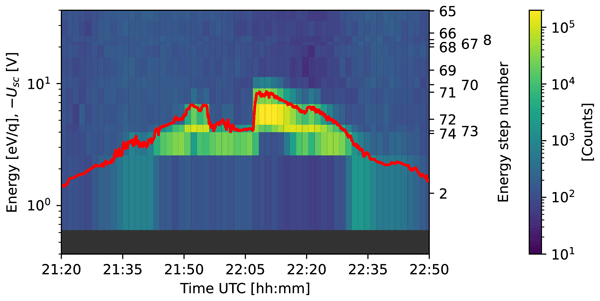
- Can the authors comment on the systematically low count rate below ~1 eV in Figure 5? The numerical simulation of the plasmasphere (Figure 7) suggests large fluxes may be present at these energies. Since the manuscript discusses the comparison between the re-ordered observations and the numerical simulation results, including the "holes" in the flux (line 225), it would be valuable for readers to understand if the low count rate in Figure 5 below ~1 eV is expected to be related to the actual plasmasphere (e.g., differences in ion species and temperatures) or an instrumental feature (e.g., related to geometric factor).
- A distinction between JDC's capability to resolve mass versus mass-per-charge would be beneficial to include in section 2. Traditionally, reflectron instruments are primarily capable of distinguishing species of different mass-per-charge. Does JDC enable resolution of mass and charge state? If so, that would be valuable to clarify since the plasmasphere can contain multiply charged species (e.g., line 104). If JDC only resolves mass-per-charge then it should be clarified if these plasmasphere observations are assumed to contain only singly charged species.
- To aid in readers' mapping the different voltage stepping presented in Figures 3-5 it is recommended that the vertical range in Figure 4 is lowered. Comparing Figures 3 and 5, voltage step 73 exhibits a substantial re-ordering from ~0.1 eV in Figure 3 to ~4 eV in Figure 4. Since this step contains some of the highest count rates it would be valuable for readers to compare the expected vs. actual voltages in Figure 4, however, this is below the vertical axis of the plot.
Technical corrections:
- It should be clarified if Figures 3 and 5 show counts (as listed in the figure caption) or counts-per-second (as suggested by the "cps" label). Showing counts would be helpful to readers since it illustrates the instrument sensitivity (e.g., the 1-count limit) and uncertainty (e.g., Poisson).
Citation: https://doi.org/10.5194/egusphere-2026-2039-RC2 -
AC2: 'Reply on RC2', Gabriella Stenberg Wieser, 28 Jun 2026
The comment was uploaded in the form of a supplement: https://egusphere.copernicus.org/preprints/2026/egusphere-2026-2039/egusphere-2026-2039-AC2-supplement.pdf
Peer review completion


Interactive discussion
Status: closed
-
RC1: 'Comment on egusphere-2026-2039', Anonymous Referee #1, 22 May 2026
The comment was uploaded in the form of a supplement: https://egusphere.copernicus.org/preprints/2026/egusphere-2026-2039/egusphere-2026-2039-RC1-supplement.pdf
-
AC1: 'Reply on RC1', Gabriella Stenberg Wieser, 28 Jun 2026
The comment was uploaded in the form of a supplement: https://egusphere.copernicus.org/preprints/2026/egusphere-2026-2039/egusphere-2026-2039-AC1-supplement.pdf
-
AC1: 'Reply on RC1', Gabriella Stenberg Wieser, 28 Jun 2026
-
RC2: 'Comment on egusphere-2026-2039', Anonymous Referee #2, 23 May 2026
The authors of "Flying through the plasmasphere to optimize low energy ion measurements" utilize the Juice spacecraft's flyby of Earth to improve the measurement scheme of the JDC instrument. Observations from the low-energy plasmasphere revealed that the voltage stepping of the instrument differed substantially from expectation. Performing laboratory experiments with the ground-copy of the instrument, the authors demonstrate that the observations can be correctly re-ordered to remove these stepping artifacts, which are further validated by a simple numerical model of the expected plasmasphere observations. Understanding the origins of the stepping issue, the authors present new voltage stepping patterns to maximize the scientific return of the JDC instrument during Juice's primary science mission at the Jovian moons. This work highlights the value of in-flight calibration to identify, understand, and correct for instrument artifacts, and with the Juice spacecraft en route to the Jovian system, is timely. A few minor revisions are suggested.
- In section 2, the authors are recommended to describe how JDC makes measurements of negative ion and electrons. Although the focus of the work is on the positive ions observed during the Earth flyby, the manuscript makes mention in several places about the negative-charged particle measurements, including how the voltage stepping will affect them too (e.g., lines 261-263). A sentence or two description early in the work would help readers that are less familiar with this type of instrumentation.
- Can the authors comment on the systematically low count rate below ~1 eV in Figure 5? The numerical simulation of the plasmasphere (Figure 7) suggests large fluxes may be present at these energies. Since the manuscript discusses the comparison between the re-ordered observations and the numerical simulation results, including the "holes" in the flux (line 225), it would be valuable for readers to understand if the low count rate in Figure 5 below ~1 eV is expected to be related to the actual plasmasphere (e.g., differences in ion species and temperatures) or an instrumental feature (e.g., related to geometric factor).
- A distinction between JDC's capability to resolve mass versus mass-per-charge would be beneficial to include in section 2. Traditionally, reflectron instruments are primarily capable of distinguishing species of different mass-per-charge. Does JDC enable resolution of mass and charge state? If so, that would be valuable to clarify since the plasmasphere can contain multiply charged species (e.g., line 104). If JDC only resolves mass-per-charge then it should be clarified if these plasmasphere observations are assumed to contain only singly charged species.
- To aid in readers' mapping the different voltage stepping presented in Figures 3-5 it is recommended that the vertical range in Figure 4 is lowered. Comparing Figures 3 and 5, voltage step 73 exhibits a substantial re-ordering from ~0.1 eV in Figure 3 to ~4 eV in Figure 4. Since this step contains some of the highest count rates it would be valuable for readers to compare the expected vs. actual voltages in Figure 4, however, this is below the vertical axis of the plot.
Technical corrections:
- It should be clarified if Figures 3 and 5 show counts (as listed in the figure caption) or counts-per-second (as suggested by the "cps" label). Showing counts would be helpful to readers since it illustrates the instrument sensitivity (e.g., the 1-count limit) and uncertainty (e.g., Poisson).
Citation: https://doi.org/10.5194/egusphere-2026-2039-RC2 -
AC2: 'Reply on RC2', Gabriella Stenberg Wieser, 28 Jun 2026
The comment was uploaded in the form of a supplement: https://egusphere.copernicus.org/preprints/2026/egusphere-2026-2039/egusphere-2026-2039-AC2-supplement.pdf
Peer review completion
Journal article(s) based on this preprint
Viewed
| HTML | XML | Total | BibTeX | EndNote | |
|---|---|---|---|---|---|
| 296 | 115 | 35 | 446 | 32 | 42 |
- HTML: 296
- PDF: 115
- XML: 35
- Total: 446
- BibTeX: 32
- EndNote: 42
Viewed (geographical distribution)
| Country | # | Views | % |
|---|
| Total: | 0 |
| HTML: | 0 |
| PDF: | 0 |
| XML: | 0 |
- 1
Gabriella Stenberg Wieser

Martin Wieser
Stas Barabash
Philipp Wittmann
Leif Kalla
Markus Fränz
Elias Roussos
Audrey Vorburger
Peter Wurz
Jan-Erik Wahlund
Pontus C. Brandt
Yoshifumi Futaana
Manabu Shimoyama
Angèle Pontoni
André Galli
Andreas Riedo
George Ho
Donald G. Mitchell
George Clark
Peter Kollmann
Malamati Gkioulidou
Leonardo Regoli
Norbert Krupp
Robert Wimmer-Schweingruber
Kazushi Asamura
Esa Kallio
Andrea Opitz
Manuel Grande
Andrew Coates
Geraint Jones
Theodoros Sarris
Andrey Fedorov
Nicolas André
Ján Baláž
The requested preprint has a corresponding peer-reviewed final revised paper. You are encouraged to refer to the final revised version.
- Preprint
(3441 KB) - Metadata XML