
the Creative Commons Attribution 4.0 License.
the Creative Commons Attribution 4.0 License.
 | 28 Apr 2026
Assessing the plausibility of unprecedented events: A process-based approach applied to month-long heatwaves in Western Europe
Abstract. Climate model based storylines of individual climate and weather events are increasingly used to quantify impacts, vulnerability, or stress-test infrastructure to inform adaptation decisions. Here, we present an approach to test the plausibility of unprecedented climate storylines based on physical conformity, internal consistency, and historical precedent. We apply this approach to assess the plausibility of month-long heatwaves in Western Europe that would exceed existing record temperatures by around 5 K. These heatwaves are based on model simulations using ensemble boosting, a computationally efficient method to simulate unprecedented events. We compare these unprecedented heatwaves with historical heatwaves in a reanalysis data set, using standardised anomalies relative to a time-evolving climatology of relevant physical variables such as temperature, 500 hPa geopotential height, surface solar radiation, and soil moisture. We show that these unprecedented heatwaves are associated with physical drivers similar to historical heatwaves, with anomalies that are more intense in magnitude but very similar in their temporal substructure. We also demonstrate that the relationships between different physical variables are internally consistent and exhibit many similarities with historical precedents. In this way, we show that these unprecedented long-lasting heatwaves cannot be ruled out as implausible, and thus highlight the need to anticipate such events when planning adaptation measures. Similar approaches can be used to assess the plausibility of unprecedented events in other variables.
Competing interests: At least one of the (co-)authors is a member of the editorial board of Weather and Climate Dynamics.
Publisher's note: Copernicus Publications remains neutral with regard to jurisdictional claims made in the text, published maps, institutional affiliations, or any other geographical representation in this paper. While Copernicus Publications makes every effort to include appropriate place names, the final responsibility lies with the authors. Views expressed in the text are those of the authors and do not necessarily reflect the views of the publisher.-
Notice on discussion status
The requested preprint has a corresponding peer-reviewed final revised paper. You are encouraged to refer to the final revised version.
-
Preprint
(10371 KB)
-
The requested preprint has a corresponding peer-reviewed final revised paper. You are encouraged to refer to the final revised version.
- Preprint
(10371 KB) - Metadata XML
- BibTeX
- EndNote
- Final revised paper


Journal article(s) based on this preprint
Interactive discussion
Status: closed
-
RC1: 'Comment on egusphere-2026-2005', Anonymous Referee #1, 02 Jul 2026
-
AC1: 'Reply on RC1', Florian E. Roemer, 02 Jul 2026
Thank you for your valuable feedback! We will add more analysis and discussion on the plausibility of absolute values.
Citation: https://doi.org/10.5194/egusphere-2026-2005-AC1
-
AC1: 'Reply on RC1', Florian E. Roemer, 02 Jul 2026
-
RC2: 'Comment on egusphere-2026-2005', Anonymous Referee #2, 14 Jul 2026
Referee report
Manuscript: “Assessing the plausibility of unprecedented events: A process-based approach applied to month-long heatwaves in Western Europe”
Recommendation: Major revisions
General comments: This manuscript addresses an important and timely question: how can the physical plausibility of unprecedented events generated by climate models and targeted sampling methods be assessed? This question is increasingly relevant given the growing use of climate storylines, large ensembles, rare-event algorithms, ensemble boosting, and related approaches to explore events outside the observational record.
The manuscript presents a comprehensive analysis of month-long Western European heatwaves generated using ensemble boosting with CESM2. The authors assess these events through comparisons with historical heatwaves in ERA5 and less extreme events in the CESM2 large ensemble, considering historical analogues, individual physical drivers, temporal persistence and substructure, and multivariate relationships.
I find the scientific question compelling and the analysis substantial. My main concerns relate to the conceptual framing of plausibility and the independence and strength of the evidence used to assess it. While the analyses provide multiple lines of evidence consistent with the simulated events being physically plausible, I am less convinced that the proposed framework provides a sufficiently stringent or falsifiable test of plausibility.
I therefore recommend major revisions aimed at sharpening the conceptual framework, distinguishing different levels of evidence more clearly, and developing a stronger synthesis of the main result. I believe that, with these revisions, the manuscript could make a valuable contribution.
Major comments
1. What would constitute evidence against plausibility?
My principal concern is that it remains unclear what outcome of the proposed analysis would lead the authors to conclude that a simulated event is physically implausible.
The framework appears somewhat asymmetric. Similarity to historical events is interpreted as evidence supporting plausibility, whereas the absence of a close historical analogue does not count strongly against plausibility because unprecedented events need not have historical analogues. Individual drivers within historically observed ranges support plausibility, whereas unprecedented combinations of drivers can be interpreted as “extreme anomalies of common drivers.” Internal consistency between variables also supports plausibility, although such consistency might at least partly be expected for events generated by a physically based climate model.
I therefore encourage the authors to address more explicitly the following question: what findings would cause the proposed framework to reject an event as physically implausible, or at least raise substantial concerns about its plausibility?
2. To what extent is the assessment independent of the model generating the events?
A related concern is the extent to which the analysis constitutes an independent test of plausibility rather than primarily a demonstration of internal consistency within CESM2.
The unprecedented events are generated by CESM2, and several components of the analysis compare these events with the CESM2 large ensemble. It is perhaps not surprising that events generated by a physically based model obey the physics of that model, exhibit internally consistent relationships between variables, and involve stronger or more persistent combinations of processes already operating in less extreme model events.
The comparison of moderate CESM2 heatwaves with ERA5 is a genuinely useful design element in this context. However, agreement for moderate events does not necessarily demonstrate that the model correctly represents the tails of the distributions, the persistence of circulation anomalies, nonlinear land–atmosphere feedbacks, or the combinations of drivers associated with 4σ events.
This concern is reinforced by the authors’ own persistence results (Sect. 3.3): CESM2 underestimates the persistence of Z500 (blocking) while overestimating the persistence of low soil moisture, and the authors conclude that the simulated events occur for “partly the wrong reasons.” The argument that these biases compensate is plausible but, as presented, largely qualitative. If the persistence mechanism that produces month-long duration is itself biased, this bears directly on whether the simulated magnitude and duration can be trusted, and it sits in some tension with the optimistic tenor of the abstract and conclusions.
I suggest that the authors distinguish much more explicitly throughout the manuscript between:
- model-internal evidence for consistency;
- evidence constrained by the historical climate record;
- evidence that can genuinely be considered independent of CESM2.
This distinction would substantially strengthen the conceptual basis of the paper.
3. ERA5 should not generally be treated as equivalent to observations
The manuscript frequently contrasts the simulated events with “historical” events and uses ERA5 as the basis for assessing external consistency. However, the degree to which ERA5 variables are constrained by observations differs substantially between variables.
Large-scale atmospheric circulation and temperature are relatively strongly constrained by assimilated observations. In contrast, quantities such as turbulent surface fluxes, soil moisture, precipitation, and aspects of surface radiation are much more strongly influenced by the underlying forecast and land-surface models. ERA5-Land is itself a model-based product driven by atmospheric forcing.
This distinction is important because some of these variables play a central role in the process-based plausibility assessment. Agreement between CESM2 and ERA5 for, for example, turbulent fluxes or soil moisture does not constitute the same level of independent evidence as agreement in large-scale atmospheric circulation. (The manuscript already notes at lines 396–397 that ERA5 does not close the surface energy budget, which underlines the point.)
4. Is the process-based analysis sufficiently process-based?
Given the central framing of the manuscript as a process-based assessment, I found some of the diagnostics relatively simple. Regionally averaged Z500, U500, V500, and ω500 are used as proxies for circulation, horizontal advection, and subsidence. The authors themselves correctly acknowledge that 30-day averaging can obscure important short-term processes and that Lagrangian approaches could provide a more direct analysis of the physical mechanisms.
This raises the question of whether a more explicit process analysis is needed to support the ambition of the manuscript. For example, trajectory analysis, temperature-tendency decomposition, circulation-regime diagnostics, or more explicit measures of blocking and persistence might provide stronger physical evidence. I do not necessarily suggest that all of these analyses are required. However, the authors should explain more clearly why the selected Eulerian diagnostics are sufficient to assess the physical plausibility of events that lie so far in the tail of the temperature distribution, especially since the persistence and blocking biases noted in Sect. 3.3 are precisely the kind of dynamical detail that region-averaged Eulerian proxies are least able to constrain.
5. Interpretation of the multivariate linear regression analysis
I am not fully convinced by the epistemic role of the multivariate linear regression analysis. From what I understand, the regression model is trained on more ordinary events and subsequently applied to highly extreme events outside the training distribution. Agreement between predicted and simulated temperature anomalies may be interesting, but disagreement would be difficult to interpret: it could indicate physical inconsistency, but it could equally indicate that nonlinear relationships become important in the tails or that the simple statistical model is inadequate. Conversely, agreement does not necessarily provide strong independent evidence for plausibility, because predictors and predictands ultimately originate from the same model physics.
These concerns are compounded by acknowledged features of the model itself: Collinearity between SSR and SM in ERA5, sensitivity to regression dilution, wide confidence intervals on the ERA5-trained coefficients, and the omission of nonlinear land–atmosphere effects, which together make me wary of the relatively strong conclusion that the events are “externally consistent from a multivariate perspective.” I suggest that the authors explain more explicitly what this analysis contributes that is not already demonstrated by the preceding process comparisons, and what possible result of the regression analysis would have counted as evidence against plausibility.
6. Independence and representativeness of the ten unprecedented heatwaves
Eight of the ten selected unprecedented heatwaves originate from the same parent heatwave ensemble (P1/2015), while the remaining two (U4, U8) originate from a second parent event (P2/2031). The manuscript acknowledges this fact (and shows in Fig. A1 that the TM time series remain distinguishable), but I think its implications deserve more discussion. Because the eight P1 members are boosted realisations of a single antecedent atmospheric state, they cannot be regarded as eight independent draws; the effective number of independent unprecedented events assessed here is closer to two. This substantially affects the generality of the conclusions.
This issue does not invalidate the analysis, but the manuscript should be much more explicit about whether its conclusions apply primarily to the plausibility of these particular boosted events, or more generally to unprecedented month-long Western European heatwaves. At present the language tends toward the latter while the evidence supports mainly the former.
Specific comments
Lines 37–44: The discussion of plausibility is useful, but I suggest introducing the issue of falsifiability or rejection criteria already here. The reader should understand from the outset what kind of evidence could count against plausibility.
Lines 46–56: The distinction between statistical and process-based approaches could be sharpened. In particular, it would be useful to explain whether the proposed framework is intended as an alternative to statistical model evaluation or as an additional layer of evidence.
Lines 121–140: The standardisation approach is sensible, but its limitations deserve more discussion. Standardising relative to a time-evolving climatology may obscure physically important changes in the underlying climate state; the later discussion of soil moisture and the shift from energy-limited to moisture-limited regimes (lines 283–288) illustrates precisely this issue. In addition, please make explicit that the requirement of a centred 31-year reference window restricts the ERA5 record used to 1965–2009 (lines 132–133). This excludes several of the most recent and most relevant record heatwaves (2015, 2018, 2019, 2022, and the 2025 event mentioned in the introduction) from both the reference climatology and the pool of historical analogues. Since “historical precedent” is one of the three pillars of the framework, the exclusion of the most extreme recent precedents is a material limitation that should be stated clearly and, ideally, mitigated (e.g. by discussing the trade-off against a longer but less-constrained reanalysis such as 20CR, which is already mentioned at lines 264–265).
Lines 186–204: Please clarify more explicitly what outcome of the multivariate regression analysis would be interpreted as evidence against plausibility.
Lines 215–223: This is an important conceptual paragraph. I suggest distinguishing more explicitly between internal model consistency and external empirical support. The current terminology of “internally” and “externally” consistent is useful, but “externally consistent” may overstate the independence of ERA5-based evidence for variables that are strongly model dependent.
Lines 224–267: The analogue analysis is interesting, but the methodological choices underlying the multivariate distance metric deserve more attention. How are the 13 variables weighted? How sensitive are the identified analogues to the selected domain, variables, and metric? Given spatial autocorrelation and very different process relevance among variables, it is not obvious that equal contributions to a Euclidean distance provide the most physically meaningful measure of similarity.
Lines 269–315: I found this one of the most interesting parts of the paper. The result that unprecedented temperatures emerge from unusually extreme combinations of familiar drivers could potentially be elevated to a more central position in the manuscript.
Lines 279–288: The discussion of soil moisture, evaporative fraction, and the changing land-atmosphere regime is particularly interesting. It also exposes a limitation of comparing standardised anomalies between historical and future climate states (the same anomaly implying energy-limited behaviour historically but moisture-limited behaviour in the future). I encourage the authors to discuss this more explicitly.
Lines 289–297: The authors acknowledge the limitations of the Eulerian analysis. Given the process-based framing of the paper, I wonder whether this should motivate additional analysis rather than being discussed primarily as a limitation.
Lines 298–315: The comparison between ERA5 and CESM2 should acknowledge explicitly that the different ERA5 variables have very different degrees of observational constraint. In particular, agreement in turbulent fluxes and soil moisture should not be interpreted in the same way as agreement in temperature or large-scale circulation.
Figure 4: This appears to contain one of the central scientific results, but the figure is visually dense and does not immediately communicate the main conclusion. I encourage the authors to consider a simpler synthesis figure demonstrating that unprecedented temperatures emerge from extreme combinations and persistence of largely familiar physical drivers.
Figures 2 and 3: These figures contain a very large amount of information (≈26 panels each). I wonder whether all variables are needed in the main manuscript. A more selective presentation of the dynamically most relevant variables might improve readability, with the complete figures moved to supplementary material.
Technical comments
The manuscript is generally well written, and I found relatively few purely technical issues.
- Table A2 (heatwave H3): the listed dates are inconsistent — day 1 = 1973-08-11 but day 30 = 1973-08-09, so the end date precedes the start date. Based on Table A3 (the analogue for U3 runs 1973-08-11 to 1973-09-09), “day 30” should read 1973-09-09. Please correct.
- Please use terminology such as “observational record,” “reanalysis,” and “observations” carefully and consistently. ERA5 should not generally be described as observations.
- Consider defining more clearly and consistently the terms “physical conformity,” “internal consistency,” and “historical precedent.” At present there seems some conceptual overlap between them.
- The number of abbreviations and variables introduced early in the manuscript contributes to the cognitive load. Consider whether all variables need to be introduced and analysed in the main text.
- Consider moving some methodological detail, particularly material already documented in previous ensemble-boosting publications, to an appendix or supplement.
Citation: https://doi.org/10.5194/egusphere-2026-2005-RC2 -
AC2: 'Reply on RC2', Florian E. Roemer, 15 Jul 2026
Thank you for your detailed feedback! We will revise the manuscript accordingly.
Citation: https://doi.org/10.5194/egusphere-2026-2005-AC2
Peer review completion


Interactive discussion
Status: closed
-
RC1: 'Comment on egusphere-2026-2005', Anonymous Referee #1, 02 Jul 2026
This manuscript introduces a rigorous and well-designed framework for evaluating the physical plausibility of unprecedented heat-wave events generated through ensemble boosting in climate models. The assessment is comprehensive, examining multiple variables that govern heat-wave evolution through comparisons with reanalysis across temporal evolution and bi- and multivariate relationships. The proposed methodology for evaluating ensemble-boosted events using reanalysis analogues is novel and strengthens the utility of ensemble boosting for climate-risk applications.
The study is a valuable addition to the literature. My only substantive concern is that evaluating plausibility exclusively in terms of standardized anomalies may conceal systematic biases in the model mean state or variability. Consequently, agreement in standardized anomalies does not necessarily imply agreement in the absolute physical state, which is often the quantity relevant for real-world impacts and decision making. The authors explain why this approach is necessary for assessing unprecedented events in future climates, and I agree with this reasoning. However, I think the manuscript would benefit from a more explicit discussion of this trade-off and its implications for interpreting the results in light of storylines, stress-testing and decision-making. With this clarification, I recommend acceptance following minor revision.
General comment:
Because events U1 and its reanalysis analog are generated during the historical period, and thus should have comparable background climates, I wonder whether the authors could also reproduce Fig.~2 using absolute fields rather than standardized anomalies. This would provide a useful illustration of the influence of systematic model biases and complement the anomaly-based analysis. The comparison could then be used to discuss an important limitation of the framework, namely that it primarily evaluates the plausibility of anomalies rather than the plausibility of the absolute physical state. This distinction is particularly relevant for applications such as stress testing and preparedness, where decisions are often based on absolute thresholds.
Minor comment:
Figure 3 labels U4 as originating from parent event P1 (2015), whereas Section 2.3, Table A1, and Figure 4 indicate that U4 originates from parent event P2 (2031). I suspect this is simply a labeling error.
Citation: https://doi.org/10.5194/egusphere-2026-2005-RC1 -
AC1: 'Reply on RC1', Florian E. Roemer, 02 Jul 2026
Thank you for your valuable feedback! We will add more analysis and discussion on the plausibility of absolute values.
Citation: https://doi.org/10.5194/egusphere-2026-2005-AC1
-
AC1: 'Reply on RC1', Florian E. Roemer, 02 Jul 2026
-
RC2: 'Comment on egusphere-2026-2005', Anonymous Referee #2, 14 Jul 2026
Referee report
Manuscript: “Assessing the plausibility of unprecedented events: A process-based approach applied to month-long heatwaves in Western Europe”
Recommendation: Major revisions
General comments: This manuscript addresses an important and timely question: how can the physical plausibility of unprecedented events generated by climate models and targeted sampling methods be assessed? This question is increasingly relevant given the growing use of climate storylines, large ensembles, rare-event algorithms, ensemble boosting, and related approaches to explore events outside the observational record.
The manuscript presents a comprehensive analysis of month-long Western European heatwaves generated using ensemble boosting with CESM2. The authors assess these events through comparisons with historical heatwaves in ERA5 and less extreme events in the CESM2 large ensemble, considering historical analogues, individual physical drivers, temporal persistence and substructure, and multivariate relationships.
I find the scientific question compelling and the analysis substantial. My main concerns relate to the conceptual framing of plausibility and the independence and strength of the evidence used to assess it. While the analyses provide multiple lines of evidence consistent with the simulated events being physically plausible, I am less convinced that the proposed framework provides a sufficiently stringent or falsifiable test of plausibility.
I therefore recommend major revisions aimed at sharpening the conceptual framework, distinguishing different levels of evidence more clearly, and developing a stronger synthesis of the main result. I believe that, with these revisions, the manuscript could make a valuable contribution.
Major comments
1. What would constitute evidence against plausibility?
My principal concern is that it remains unclear what outcome of the proposed analysis would lead the authors to conclude that a simulated event is physically implausible.
The framework appears somewhat asymmetric. Similarity to historical events is interpreted as evidence supporting plausibility, whereas the absence of a close historical analogue does not count strongly against plausibility because unprecedented events need not have historical analogues. Individual drivers within historically observed ranges support plausibility, whereas unprecedented combinations of drivers can be interpreted as “extreme anomalies of common drivers.” Internal consistency between variables also supports plausibility, although such consistency might at least partly be expected for events generated by a physically based climate model.
I therefore encourage the authors to address more explicitly the following question: what findings would cause the proposed framework to reject an event as physically implausible, or at least raise substantial concerns about its plausibility?
2. To what extent is the assessment independent of the model generating the events?
A related concern is the extent to which the analysis constitutes an independent test of plausibility rather than primarily a demonstration of internal consistency within CESM2.
The unprecedented events are generated by CESM2, and several components of the analysis compare these events with the CESM2 large ensemble. It is perhaps not surprising that events generated by a physically based model obey the physics of that model, exhibit internally consistent relationships between variables, and involve stronger or more persistent combinations of processes already operating in less extreme model events.
The comparison of moderate CESM2 heatwaves with ERA5 is a genuinely useful design element in this context. However, agreement for moderate events does not necessarily demonstrate that the model correctly represents the tails of the distributions, the persistence of circulation anomalies, nonlinear land–atmosphere feedbacks, or the combinations of drivers associated with 4σ events.
This concern is reinforced by the authors’ own persistence results (Sect. 3.3): CESM2 underestimates the persistence of Z500 (blocking) while overestimating the persistence of low soil moisture, and the authors conclude that the simulated events occur for “partly the wrong reasons.” The argument that these biases compensate is plausible but, as presented, largely qualitative. If the persistence mechanism that produces month-long duration is itself biased, this bears directly on whether the simulated magnitude and duration can be trusted, and it sits in some tension with the optimistic tenor of the abstract and conclusions.
I suggest that the authors distinguish much more explicitly throughout the manuscript between:
- model-internal evidence for consistency;
- evidence constrained by the historical climate record;
- evidence that can genuinely be considered independent of CESM2.
This distinction would substantially strengthen the conceptual basis of the paper.
3. ERA5 should not generally be treated as equivalent to observations
The manuscript frequently contrasts the simulated events with “historical” events and uses ERA5 as the basis for assessing external consistency. However, the degree to which ERA5 variables are constrained by observations differs substantially between variables.
Large-scale atmospheric circulation and temperature are relatively strongly constrained by assimilated observations. In contrast, quantities such as turbulent surface fluxes, soil moisture, precipitation, and aspects of surface radiation are much more strongly influenced by the underlying forecast and land-surface models. ERA5-Land is itself a model-based product driven by atmospheric forcing.
This distinction is important because some of these variables play a central role in the process-based plausibility assessment. Agreement between CESM2 and ERA5 for, for example, turbulent fluxes or soil moisture does not constitute the same level of independent evidence as agreement in large-scale atmospheric circulation. (The manuscript already notes at lines 396–397 that ERA5 does not close the surface energy budget, which underlines the point.)
4. Is the process-based analysis sufficiently process-based?
Given the central framing of the manuscript as a process-based assessment, I found some of the diagnostics relatively simple. Regionally averaged Z500, U500, V500, and ω500 are used as proxies for circulation, horizontal advection, and subsidence. The authors themselves correctly acknowledge that 30-day averaging can obscure important short-term processes and that Lagrangian approaches could provide a more direct analysis of the physical mechanisms.
This raises the question of whether a more explicit process analysis is needed to support the ambition of the manuscript. For example, trajectory analysis, temperature-tendency decomposition, circulation-regime diagnostics, or more explicit measures of blocking and persistence might provide stronger physical evidence. I do not necessarily suggest that all of these analyses are required. However, the authors should explain more clearly why the selected Eulerian diagnostics are sufficient to assess the physical plausibility of events that lie so far in the tail of the temperature distribution, especially since the persistence and blocking biases noted in Sect. 3.3 are precisely the kind of dynamical detail that region-averaged Eulerian proxies are least able to constrain.
5. Interpretation of the multivariate linear regression analysis
I am not fully convinced by the epistemic role of the multivariate linear regression analysis. From what I understand, the regression model is trained on more ordinary events and subsequently applied to highly extreme events outside the training distribution. Agreement between predicted and simulated temperature anomalies may be interesting, but disagreement would be difficult to interpret: it could indicate physical inconsistency, but it could equally indicate that nonlinear relationships become important in the tails or that the simple statistical model is inadequate. Conversely, agreement does not necessarily provide strong independent evidence for plausibility, because predictors and predictands ultimately originate from the same model physics.
These concerns are compounded by acknowledged features of the model itself: Collinearity between SSR and SM in ERA5, sensitivity to regression dilution, wide confidence intervals on the ERA5-trained coefficients, and the omission of nonlinear land–atmosphere effects, which together make me wary of the relatively strong conclusion that the events are “externally consistent from a multivariate perspective.” I suggest that the authors explain more explicitly what this analysis contributes that is not already demonstrated by the preceding process comparisons, and what possible result of the regression analysis would have counted as evidence against plausibility.
6. Independence and representativeness of the ten unprecedented heatwaves
Eight of the ten selected unprecedented heatwaves originate from the same parent heatwave ensemble (P1/2015), while the remaining two (U4, U8) originate from a second parent event (P2/2031). The manuscript acknowledges this fact (and shows in Fig. A1 that the TM time series remain distinguishable), but I think its implications deserve more discussion. Because the eight P1 members are boosted realisations of a single antecedent atmospheric state, they cannot be regarded as eight independent draws; the effective number of independent unprecedented events assessed here is closer to two. This substantially affects the generality of the conclusions.
This issue does not invalidate the analysis, but the manuscript should be much more explicit about whether its conclusions apply primarily to the plausibility of these particular boosted events, or more generally to unprecedented month-long Western European heatwaves. At present the language tends toward the latter while the evidence supports mainly the former.
Specific comments
Lines 37–44: The discussion of plausibility is useful, but I suggest introducing the issue of falsifiability or rejection criteria already here. The reader should understand from the outset what kind of evidence could count against plausibility.
Lines 46–56: The distinction between statistical and process-based approaches could be sharpened. In particular, it would be useful to explain whether the proposed framework is intended as an alternative to statistical model evaluation or as an additional layer of evidence.
Lines 121–140: The standardisation approach is sensible, but its limitations deserve more discussion. Standardising relative to a time-evolving climatology may obscure physically important changes in the underlying climate state; the later discussion of soil moisture and the shift from energy-limited to moisture-limited regimes (lines 283–288) illustrates precisely this issue. In addition, please make explicit that the requirement of a centred 31-year reference window restricts the ERA5 record used to 1965–2009 (lines 132–133). This excludes several of the most recent and most relevant record heatwaves (2015, 2018, 2019, 2022, and the 2025 event mentioned in the introduction) from both the reference climatology and the pool of historical analogues. Since “historical precedent” is one of the three pillars of the framework, the exclusion of the most extreme recent precedents is a material limitation that should be stated clearly and, ideally, mitigated (e.g. by discussing the trade-off against a longer but less-constrained reanalysis such as 20CR, which is already mentioned at lines 264–265).
Lines 186–204: Please clarify more explicitly what outcome of the multivariate regression analysis would be interpreted as evidence against plausibility.
Lines 215–223: This is an important conceptual paragraph. I suggest distinguishing more explicitly between internal model consistency and external empirical support. The current terminology of “internally” and “externally” consistent is useful, but “externally consistent” may overstate the independence of ERA5-based evidence for variables that are strongly model dependent.
Lines 224–267: The analogue analysis is interesting, but the methodological choices underlying the multivariate distance metric deserve more attention. How are the 13 variables weighted? How sensitive are the identified analogues to the selected domain, variables, and metric? Given spatial autocorrelation and very different process relevance among variables, it is not obvious that equal contributions to a Euclidean distance provide the most physically meaningful measure of similarity.
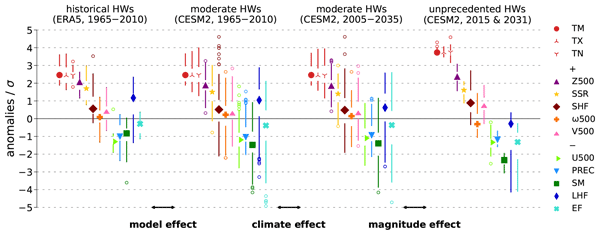
Lines 269–315: I found this one of the most interesting parts of the paper. The result that unprecedented temperatures emerge from unusually extreme combinations of familiar drivers could potentially be elevated to a more central position in the manuscript.
Lines 279–288: The discussion of soil moisture, evaporative fraction, and the changing land-atmosphere regime is particularly interesting. It also exposes a limitation of comparing standardised anomalies between historical and future climate states (the same anomaly implying energy-limited behaviour historically but moisture-limited behaviour in the future). I encourage the authors to discuss this more explicitly.
Lines 289–297: The authors acknowledge the limitations of the Eulerian analysis. Given the process-based framing of the paper, I wonder whether this should motivate additional analysis rather than being discussed primarily as a limitation.
Lines 298–315: The comparison between ERA5 and CESM2 should acknowledge explicitly that the different ERA5 variables have very different degrees of observational constraint. In particular, agreement in turbulent fluxes and soil moisture should not be interpreted in the same way as agreement in temperature or large-scale circulation.
Figure 4: This appears to contain one of the central scientific results, but the figure is visually dense and does not immediately communicate the main conclusion. I encourage the authors to consider a simpler synthesis figure demonstrating that unprecedented temperatures emerge from extreme combinations and persistence of largely familiar physical drivers.
Figures 2 and 3: These figures contain a very large amount of information (≈26 panels each). I wonder whether all variables are needed in the main manuscript. A more selective presentation of the dynamically most relevant variables might improve readability, with the complete figures moved to supplementary material.
Technical comments
The manuscript is generally well written, and I found relatively few purely technical issues.
- Table A2 (heatwave H3): the listed dates are inconsistent — day 1 = 1973-08-11 but day 30 = 1973-08-09, so the end date precedes the start date. Based on Table A3 (the analogue for U3 runs 1973-08-11 to 1973-09-09), “day 30” should read 1973-09-09. Please correct.
- Please use terminology such as “observational record,” “reanalysis,” and “observations” carefully and consistently. ERA5 should not generally be described as observations.
- Consider defining more clearly and consistently the terms “physical conformity,” “internal consistency,” and “historical precedent.” At present there seems some conceptual overlap between them.
- The number of abbreviations and variables introduced early in the manuscript contributes to the cognitive load. Consider whether all variables need to be introduced and analysed in the main text.
- Consider moving some methodological detail, particularly material already documented in previous ensemble-boosting publications, to an appendix or supplement.
Citation: https://doi.org/10.5194/egusphere-2026-2005-RC2 -
AC2: 'Reply on RC2', Florian E. Roemer, 15 Jul 2026
Thank you for your detailed feedback! We will revise the manuscript accordingly.
Citation: https://doi.org/10.5194/egusphere-2026-2005-AC2
Peer review completion
Journal article(s) based on this preprint
Data sets
Supplementary data for "Assessing the plausibility of unprecedented events: A process-based approach applied to month-long heatwaves in Western Europe" Florian E. Roemer et al. https://doi.org/10.5281/zenodo.19494785
Interactive computing environment
Supplementary code for "Assessing the plausibility of unprecedented events: A process-based approach applied to month-long heatwaves in Western Europe" Florian E. Roemer et al. https://doi.org/10.5281/zenodo.19492889
Viewed
| HTML | XML | Total | BibTeX | EndNote | |
|---|---|---|---|---|---|
| 403 | 258 | 32 | 693 | 51 | 45 |
- HTML: 403
- PDF: 258
- XML: 32
- Total: 693
- BibTeX: 51
- EndNote: 45
Viewed (geographical distribution)
| Country | # | Views | % |
|---|
| Total: | 0 |
| HTML: | 0 |
| PDF: | 0 |
| XML: | 0 |
- 1
Florian E. Roemer

Erich M. Fischer
Robin Noyelle
Reto Knutti
The requested preprint has a corresponding peer-reviewed final revised paper. You are encouraged to refer to the final revised version.
- Preprint
(10371 KB) - Metadata XML
This manuscript introduces a rigorous and well-designed framework for evaluating the physical plausibility of unprecedented heat-wave events generated through ensemble boosting in climate models. The assessment is comprehensive, examining multiple variables that govern heat-wave evolution through comparisons with reanalysis across temporal evolution and bi- and multivariate relationships. The proposed methodology for evaluating ensemble-boosted events using reanalysis analogues is novel and strengthens the utility of ensemble boosting for climate-risk applications.
The study is a valuable addition to the literature. My only substantive concern is that evaluating plausibility exclusively in terms of standardized anomalies may conceal systematic biases in the model mean state or variability. Consequently, agreement in standardized anomalies does not necessarily imply agreement in the absolute physical state, which is often the quantity relevant for real-world impacts and decision making. The authors explain why this approach is necessary for assessing unprecedented events in future climates, and I agree with this reasoning. However, I think the manuscript would benefit from a more explicit discussion of this trade-off and its implications for interpreting the results in light of storylines, stress-testing and decision-making. With this clarification, I recommend acceptance following minor revision.
General comment:
Because events U1 and its reanalysis analog are generated during the historical period, and thus should have comparable background climates, I wonder whether the authors could also reproduce Fig.~2 using absolute fields rather than standardized anomalies. This would provide a useful illustration of the influence of systematic model biases and complement the anomaly-based analysis. The comparison could then be used to discuss an important limitation of the framework, namely that it primarily evaluates the plausibility of anomalies rather than the plausibility of the absolute physical state. This distinction is particularly relevant for applications such as stress testing and preparedness, where decisions are often based on absolute thresholds.
Minor comment:
Figure 3 labels U4 as originating from parent event P1 (2015), whereas Section 2.3, Table A1, and Figure 4 indicate that U4 originates from parent event P2 (2031). I suspect this is simply a labeling error.