
the Creative Commons Attribution 4.0 License.
the Creative Commons Attribution 4.0 License.
 | 12 Jun 2026
Perchloric acid (HClO4) Drives Atmospheric New Particle Formation Enhanced by Dimethylamine, ammonia and Sulfuric Acid: Mechanisms and Implications
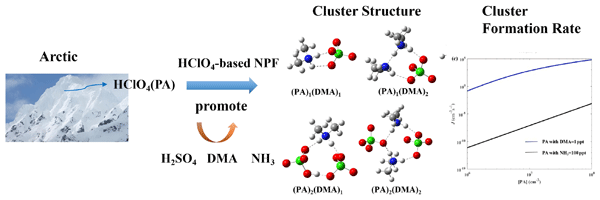
Abstract. Recent studies have revealed observations of atmospheric perchloric acid (HClO4, PA) in the Arctic. There are few studies of PA forming aerosol particles in coastal marine regions. We use quantum chemical calculations and Atmospheric Clusters Dynamic Code (ACDC) to compare the enhancement potential of dimethylamine (DMA), ammonia (NH3), and sulfuric acid (SA) for PA-based new particle formation (NPF). The results show that DMA and NH3 can strongly interact with PA in both directions through hydrogen bonding and proton transfer. Halogen bonding is not found in PA-DMA and PA-NH3 clusters. Even if the concentration of NH3 exceeds that of DMA by 10–100 orders of magnitude, the cluster formation rate of PA-DMA cluster formation is much higher than that of the PA-NH3 cluster system. Clusters with the same number of PA molecules as DMA molecules play a key role in the growth of PA-DMA clusters. Compared with the nucleation of PA with SA, PA nucleates more easily with alkaline gas. The present results reveal the potential for new particle formation of PA in the Arctic boundary layer.
-
Notice on discussion status
The requested preprint has a corresponding peer-reviewed final revised paper. You are encouraged to refer to the final revised version.
-
Preprint
(1284 KB)
-
Supplement
(3132 KB)
-
The requested preprint has a corresponding peer-reviewed final revised paper. You are encouraged to refer to the final revised version.
- Preprint
(1284 KB) - Metadata XML
-
Supplement
(3132 KB) - BibTeX
- EndNote
- Final revised paper


Journal article(s) based on this preprint
Interactive discussion
Status: closed
-
RC1: 'Comment on egusphere-2026-1986', Anonymous Referee #1, 27 Jun 2026
-
AC2: 'Reply on RC1', Qingzhu Zhang, 15 Jul 2026
Author responses and changes to Manuscript: egusphere-2025-165
Dear editor and reviewers:
We are very grateful for the constructive comments from the editor and reviewers on
our manuscript (ID: egusphere-2026-1986, original title: Perchloric acid (HClO4) Drives Atmospheric New Particle Formation Enhanced by Dimethylamine, ammonia and Sulfuric Acid: Mechanisms and Implications. We have studied these comments carefully and have made corresponding revisions which marked in red in the revised manuscript. The all comments and our replies are listed as follows:
<<Comments from Anonymous Reviewer #1>>
General Comments
Utilizing a combination of quantum chemical calculations and cluster dynamics simulations (ACDC), Wang et al. investigated the clustering mechanisms of perchloric acid (HClO4, PA) with sulfuric acid (SA), dimethylamine (DMA), or ammonia (NH3). The cluster configurational space is explored using standard methodologies, relying on the global search algorithm of the ABCluster program and narrowing down the generated configurations using a funneling approach. Single-point energy calculations were then performed at the DLPNO-CCSD(T)/aug-cc-pVTZ//ωB97X-D/6-31++G(d,p) level of theory, followed by the simulation of cluster formation rates and growth pathways using ACDC.
To further strengthen the work, I suggest expanding additional discussion to better emphasize the atmospheric implications of the findings. Additionally, some improvements to the formatting and language are needed. Overall, the study presents valuable computational results and provides useful insights into the chemical mechanisms of PA cluster formation and will be suitable for publication after minor revision. Therefore, I recommend a Minor Revision. Detailed comments are provided below.
Major Comments
Lines 30–34: “Halogen bonding is not found in PA-DMA and PA-NH3 Even if the concentration of NH3 exceeds that of DMA by 10–100 orders of magnitude, the cluster formation rate of PA-DMA cluster formation is much higher than that of the PA-NH3 cluster system. Clusters with the same number of PA molecules as DMA molecules play a key role in the growth of PA-DMA clusters. Compared with the nucleation of PA with SA, PA nucleates more easily with alkaline gas.”
Since halogen bonding is absent in all studied PA-containing clusters, repeatedly emphasizing this finding across multiple sections of the manuscript is unnecessary. Additionally, the observation that PA nucleates more easily with alkaline gases than with SA is an important and distinctive finding; this conclusion would be more impactful if introduced earlier in the abstract (e.g., at line 31).
>>Response: Thank you for your nice comment. PA nucleates more easily with alkaline gases than with SA. We have deleted “Halogen bonding is not found in PA-DMA and PA-NH3 clusters”.
Lines 74–77: “Previous studies have found that chloric acid makes a relatively small contribution to new particle formation (Wang et al., 2025). Perchloric acid is a major component of chloric acid, and its contribution to new particle formation requires further investigation.”
The research rationale requires further elaboration: the introduction does not provide a sufficiently discussion of the potential atmospheric significance of PA in new particle formation (NPF). The authors should clarify why, given that chloric acid shows limited contributions to NPF, the individual component PA is worth investigating separately.
>>Response: Thank you for your nice comment. Engsvang et al. found PA has a high nucleation potential(Engsvang et al., 2024), but the specific nucleation mechanism remain unclear. Perchloric acid is a major component of chlorine oxyacids, and its contribution to new particle formation requires further investigation(Engsvang et al., 2024).
Lines 101–106: “1000 structures with comparatively low energy were selected. In the multistep sampling scheme, the geometry optimization is carried out at the PM7, ωB97X-D/6-31+G(d,p) and ωB97X-D/6-31++G(d,p) levels of theory, and the single-point energy calculations are executed at the DLPNO-CCSD(T)/aug-cc-pVTZ level of theory based on the ωB97X-D/6-31++G(d,p) theory level.”
The manuscript describes the global minimum structure search and thermodynamic calculations but does not explain why specific methods, such as PM7 for pre-optimization, ωB97X-D for geometry optimization, and DLPNO-CCSD(T) for single-point energies, were selected. The authors should briefly justify the choice of each method and address their suitability for acid–base cluster systems. The authors are also encouraged to reference the supplementary information more systematically in the main text; while the supplementary material appears to include additional figures and computational details, these are not yet described or formally cited in the Methods section.
>>Response: Thank you for your nice comment. Many previous studies have adopted these methods and applied them to a wide range of acid-base cluster systems(Ning et al., 2026; Zhang et al., 2021; Liu et al., 2023). The initial structures will be modified and re-optimized until the optimization is successful in order to address convergence issues and failures, such as terminating with a false frequency in the optimization of the (PA)1-4(DMA)1-4, (PA)1-4(NH3)1-4 and (PA)1-4(SA)1-4 cluster geometries. In addition, these computational methods were also applied to CA-PA cluster systems (Figs. S13-S18).
Lines 112–113: “PA-DMA clusters’ free energy of formation (ΔG) is computed at various temperatures (238, 258, and 278 K).”
The study calculates ΔG values at 238 K, 258 K, and 278 K. However, the rationale for selecting these specific temperatures is not adequately explained in the context of the Arctic or mid-latitude marine boundary layer. Additionally, the figure caption for Figure 4 does not specify the concentrations of PA or DMA used when computing the actual Gibbs free energies.
>>Response: Thank you for your nice comment. Previous study (Liu et al., 2023) show detailed atmospheric conditions are 253 K at April-2015 in Greenland, 268 K at May-2013 in Ny-Ålesund and 290 K at Aug-2019 in Helsinki. The temperatures of 238 K, 258 K, and 278 K encompass both mid-latitude coastal regions (e.g., Mace Head) and high-latitude regions (e.g., Greenland). Actual Gibbs free energy of the PA-DMA clusters at 278, 258 and 238K of [PA] = 106 cm−3; [DMA] = 3 ppt.
Sections 3.3 and 3.4 – Atmospheric representativeness of simulated conditions:
One important issue in this study concerns the atmospheric representativeness of the simulated conditions. The PA concentration range used in the ACDC simulations (106 to 108 cm-3) is significantly higher than the concentrations recently observed in the Arctic atmosphere by Tham et al. (2023, Nature Communications, https://doi.org/10.1038/s41467-023-37387-y). As a result, the calculated nucleation rates likely overestimate what would occur under realistic atmospheric conditions. Furthermore, the concentration ranges assumed for SA and DMA are also not supported by observational references in the main text.
>>Response: Thank you for your nice comment. The concentration ranges of [PA], [SA], [DMA] and [NH3] were defined at 106 −108 cm−3, 106 −108 cm−3, 0.1−100 ppt and 1−100 ppt, respectively(Xie et al., 2017; Ge et al., 2011; Jen et al., 2014; Almeida et al., 2013). The concentration of DMA surpasses 3 parts per trillion by volume, according to experiments, and the nucleation rates of DMA are significantly higher than those of ambient ammonia (Almeida et al., 2013). We have revised Figure 5. The PA concentration of 106 to 108 cm-3 is indeed on the high side; it is used for computational simulations, not as an actual atmospheric value. Therefore, the PA range 104 to 108 cm-3 in our ACDC simulations was chosen to span the threshold over which PA-DMA nucleation becomes kinetically viable.
Lack of quantitative comparison with known nucleation systems:
The paper notes that the PA-DMA cluster system exhibits the fastest nucleation rate among the three systems studied, but it does not provide an in-depth quantitative comparison with other atmospherically important nucleation mechanisms. To demonstrate the significance of PA as a nucleation precursor, the authors should compare the PA-DMA system’s nucleation rates with those of well-established systems such as SA-DMA, SA-NH3, and iodine oxoacid-driven nucleation (e.g., HIO3-DMA), as reported in recent literature.
>>Response: Thank you for your nice comment. J values for the SA-DMA cluster system were about 10−5 - 100 cm−3 s−1 at 278 K, [DMA] = 1 ppt and [SA] = 106- 107 cm−3 (Xie et al., 2017). J values for the PA-DMA system were about 10−1 to 103 cm−3 s−1 at 278 K, [DMA] = 1 ppt and [PA] = 106 - 107 cm−3. Therefore, the cluster formation rate in the PA-DMA cluster system is 3 to 4 times higher than that in the SA-DMA cluster system.
Minor Comments
Title (line 3): The word “ammonia” is lowercase while all other compound names in the title (“Perchloric acid,” “Dimethylamine,” “Sulfuric Acid”) are capitalized.
>>Response: Thank you for your nice comment. We have change “ammonia” to “Ammonia”.
Line 72–73: The observed atmospheric concentration of PA is given as “3 × 10⁴–1 × 106 cm-1.” The unit cm-1 is incorrect for a number concentration.
>>Response: Thank you for your nice comment. We have change “cm-1” to “cm-3”.
Line 70–71: “Tham et al. shown the presence of PA in the Arctic region”, should be “Tham et al. showed the presence” or “Tham et al. have shown the presence.”
>>Response: Thank you for your nice comment. We have change “Tham et al. shown the presence of PA in the Arctic region” to “Tham et al. have shown the presence.”
Line 95: “…we used a multi-step global minimum sampling approach. the ABCluster software was employed…”, the word “the” begins a new sentence but is not capitalized.
>>Response: Thank you for your nice comment. We have change “the” to “The”.
Figure 6 (page 25): The three panels of Figure 6 are labelled “(A) Steady-state J, T = 238 K,” “(B) Steady-state J, T = 258 K,” and “(A) Steady-state J, T = 298 K.”
References (lines 377–382): The two references cited as “McGrath et al., 2012a” and “McGrath et al., 2012b” appear to be identical.
>>Response: Thank you for your nice comment. We have deleted McGrath et al., 2012a.
Line 107 vs. Reference (line 350–351): The main text states that “The PM7 and ωB97X-D computations were carried out utilizing the GAUSSIAN 09 program package,” yet the corresponding reference (Frisch et al., 2016) is for Gaussian 16, Revision A.03.
The unit “molec. cm-3” is used inconsistently throughout the manuscript. It appears in the caption of Figure 6 but is omitted in Figure 5 and in the body text of Section 3.3 (e.g., lines 213–216), where concentration values are given in cm-3 without the “molec.” qualifier.
>>Response: Thank you for your nice comment. We have change the corresponding reference.
Furthermore, the conclusion section does not follow the published author guide (https://www.atmospheric-chemistry-and-physics.net/policies/guidelines_for_authors.html).
To be published as a preprint, please address all of the referee's comments, revise the conclusion section, and place more focus on the atmospheric implications.
Also, the presentation quality requires significant improvement. I recommend that the authors seek out a professional language editing service.
If these points can be addressed the paper can advance to the preprint stage.
>>Response: Thank you for your nice comment. In a region where conventional sulfuric acid-amine/ammonia nucleation is often limited by low precursor concentrations, this PA-DMA pathway offers an additional source of ultrafine particles that can grow into cloud condensation nuclei. This has direct consequences for CCN budgets and, consequently, for cloud microphysical properties and shortwave radiative forcing over the Arctic and other remote marine environments.
This additional sink may influence the atmospheric residence time and vertical profile of HClO4, with potential ramifications for oxidative capacity and halogen-mediated chemistry in the polar troposphere. These findings underscore the need to revisit how chlorine-containing species are represented in global and regional climate models. Current Earth system models typically neglect HClO4 and its interaction with amines in aerosol nucleation schemes. Incorporating the PA-DMA nucleation mechanism, especially in high-latitude and marine domains, could improve simulations of aerosol-cloud-climate interactions.
Sincerely
Prof. Qingzhu Zhang
Environment Research Institute
Shandong University
Qingdao 266237
- R. China
Almeida, J., Schobesberger, S., Kürten, A., Ortega, I. K., Kupiainen-Määttä, O., Praplan, A. P., Adamov, A., Amorim, A., Bianchi, F., and Breitenlechner, M.: Molecular understanding of sulphuric acid–amine particle nucleation in the atmosphere, Nature, 502, 359–363, 2013.
Engsvang, M., Knattrup, Y., Kubecka, J., and Elm, J.: Chlorine Oxyacids Potentially Contribute to Arctic Aerosol Formation, Environmental Science & Technology Letters, 11, 101–105, 2024.
Ge, X., Wexler, A. S., and Clegg, S. L.: Atmospheric amines–Part II. Thermodynamic properties and gas/particle partitioning, Atmos. Environ., 45, 561–577, 2011.
Jen, C. N., McMurry, P. H., and Hanson, D. R.: Stabilization of sulfuric acid dimers by ammonia, methylamine, dimethylamine, and trimethylamine, Journal of Geophysical Research: Atmospheres, 119, 7502–7514, 2014.
Liu, L., Li, S., Zu, H., and Zhang, X.: Unexpectedly significant stabilizing mechanism of iodous acid on iodic acid nucleation under different atmospheric conditions, Science of The Total Environment, 859, 159832, 2023.
Ning, A., Mao, L., Zhao, B., Zu, H., Shen, J., Zhao, Y., Li, J., Deng, X., Liu, L., and Zhang, H.: Marine upper-tropospheric rapid particle formation dominated by methanesulfonic acid, Proceedings of the National Academy of Sciences, 123, e2606521123, 2026.
Xie, H.-B., Elm, J., Halonen, R., Myllys, N., Kurten, T., Kulmala, M., and Vehkamaki, H.: Atmospheric fate of monoethanolamine: enhancing new particle formation of sulfuric acid as an important removal process, Environmental science & technology, 51, 8422–8431, 2017.
Zhang, R., Shen, J., Xie, H.-B., Chen, J., and Elm, J.: The role of organic acids in new particle formation from methanesulfonic acid and methylamine, Atmospheric Chemistry and Physics Discussions, 2021, 1–18, 2021.
-
AC2: 'Reply on RC1', Qingzhu Zhang, 15 Jul 2026
-
RC2: 'Comment on egusphere-2026-1986', Jonas Elm, 30 Jun 2026
Wang et al studies the role of perchloric acid (PA) in atmospheric cluster formation involving sulfuric acid (SA), ammonia (NH3) and dimethylamine (DMA). The cluster configurations are searched with the ABCluster program and the applied computational methods are state-of-the-art for the problem at hand.
Overall, while the present study is interesting and the quantum chemical data is calculated at a decent level. However, I am missing some further interpretation of the results. I have three major critiques of the manuscript, that I would like the authors to address before I can recommend publication:
1) The introduction does not cover our knowledge on cluster formation from quantum chemical studies. I.e. what have other people done and how does the current work fit in.
2) The methods (albeit state-of-the-art) are not justified. The authors should explain why certain functionals/methods are chosen based on benchmarks.
3) The discussion is written in a very observant style and does not properly put in the literature into context.Each of these points are further elaborated in the comments below.
Comments
Line 30: “The results show that DMA and NH3 can strongly interact with PA in both directions through hydrogen bonding and proton transfer.”
I do not understand the “both directions” part of the sentence here.
Line 32: “Even if the concentration of NH3 exceeds that of DMA by 10-100 orders of magnitude, the cluster formation rate of PA-DMA cluster formation is much higher than that of the PA-NH3 cluster system.”
This is a consistent finding with other acid-base clusters. Please elaborate on that this is not a unique finding and refer to the relevant literature.
Line 35: “Clusters with the same number of PA molecules as DMA molecules play a key role in the growth of PA-DMA clusters.”
Similar to above, this is a usual property of acid-base clusters. Please elaborate on this aspect in the manuscript.
Line 37: “The present results reveal the potential for new particle formation of PA in the Arctic boundary layer.”
I believe PA clusters were also studied in the recent work by Engsvang et al. (https://scholar.google.dk/citations?user=mVvvA3wAAAAJ&hl=da&oi=ao). The current work should be put into context with this study. See more below.
Line 46: “At least 50% of the overall concentration of aerosol particles in the atmosphere is believed to be attributed to new particle formation (NPF) (Ehn et al., 2014).”
I do not believe this statement is a finding of Ehn et al 2014. Please find the original reference and give proper credit to the original work.
Line 61: “NPF can occur through a variety of nucleation pathways and involves important precursors like sulfuric acid (H2SO4), iodine oxoacids (HIOx, HIO2, and HIO3), low-volatility organic compounds, ammonia (NH3), and amines, as shown by laboratory experiments and theoretical calculations (He et al., 2023; He et al., 2021;Kirkby et al., 2023).”
As this is a theoretical study there should be specific emphasis on what we know about cluster formation from calculations. What studies have there been on sulfuric acid-base cluster and clusters involving iodine oxides/oxoacids. You should put the current work into context of the existing literature.
Line 74: “Previous studies have found that chloric acid makes a relatively small contribution to new particle formation (Wang et al., 2025).”
Quite a bit earlier than Wang et al. Engsvang (https://scholar.google.dk/citations?user=mVvvA3wAAAAJ&hl=da&oi=ao) studied both chloric/perchloric acid clusters with bases and other acids. This should be mentioned in the current work.
Line 75: “Perchloric acid is a major component of chloric acid, …”
I do not understand this sentence. Do you meant that chloric acid is a precursor to perchloric acid?
Line 79: “The concentration of DMA surpasses 3 parts per trillion by volume, according to experiments, and the nucleation rates of DMA are significantly higher than those of ambient ammonia (Almeida et al., 2013).”
From the abstract and introduction, I get the impression that the authors are targeting the Arctic. The work by Almeida et al. is from CLOUD chamber experiments. Is the concentration of DMA in the Arctic also reaching 3 ppt? The authors should clearly convey what region they are interested in modelling.
Computational methods:
- Funelling approach: The applied computational workflow follows a standard routine, which is inspired by the funnelling approaches by Temelso et al. (https://doi.org/10.1021/acs.jpca.7b11236) and Kubecka et al. (https://doi.org/10.1021/acs.jpca.9b03853). It would be worth mentioning these works in the paper for justifying the workflow. What parameters were used in the ABCluster calculations.
- Choice of DFT functional: Why did you choose the ωB97X-D functional for your study? Please justify your choice by referring to potential benchmarks that demonstrate that this functional performs well for atmospheric molecular clusters.
- Choice of basis set: Please justify the choice of the 6-31++G(d,p) basis set for the final geometry optimization and vibrational frequency calculations.
- DLPNO-CCSD(T)/aug-cc-pVTZ: Please justify that DLPNO-CCSD(T)/aug-cc-pVTZ yield sufficiently accurate binding energies of the clusters. Which PNO convergence criteria were used in the calculations and were (T) fully iteratively calculated?
Line 120: “The results of the experiments employing the birth and death equations and the conclusions of the ACDC simulations correspond well(Mcgrath et al., 2012b).”
I do not understand this sentence. Which experiments are you referring to here? Also, the references Mcgrath et al., 2012a and Mcgrath et al., 2012b appears to be the same.
Line 126: “According to the ACDC manual (Mcgrath et al., 2012b), a system size of 6 molecules is large enough.”
To the best of my knowledge there is no manual in that paper. However, there is a manual at Tinja Olenius’ GitHub page. However, I cannot find the mentioning of 6 molecule clusters being “large enough”. Consider deleting this sentence.
Line 127: “The resulting PA-DMA systems (PA)5(DMA)5 cluster is set as boundary clusters.”
This seems like an odd choice for the boundary clusters and will have an impact on the dynamics. If only the 5-5 cluster is allowed to grow out and contribute to the nucleation rate, the simulations will artificially not allow monomer collisions to contribute to the rate. Perhaps the (PA)5(DMA)4 cluster should also be added to the boundary clusters.
Line 128: “The concentration ranges of [PA], [SA], [DMA] and [NH3] were defined at 106 −108 cm−3, 106 −108 cm−3, 0.1−100 ppt and 1−100 ppt, respectively”
Could the authors elaborate on why these concentration ranges were chosen and what region it may correspond to? For instance, as written in line 72 the PA concentration has been detected in an upper limit of 106 molecules cm-3, so why is this the lower limit investigated?
Line 133: Section 3 is very descriptive in nature, without many explanations about the implications of the findings. In each subsection, when describing your findings, please put it into context in the broader field of atmospheric chemistry.
Line 136-156: In Figure 1 and the surrounding text, how does these trends compare to the (PA)1-2(DMA)1-2 cluster structures obtained by Engsvang et al? Do you see large differences in the obtained cluster structures and stabilities?
Line 142 and 153: “N−H...Cl−O”
I guess this should be “N−H...O−Cl”
Line 160: “… indicating that pure PA molecules are thermodynamically less susceptible to forming clusters.”
Less susceptible compared to what in this context? Do you mean not susceptible?
Line 164: “Furthermore, the negative correlation between temperature and the ΔG values of PA−DMA clusters is discovered (Figure S7, S8 and S9), suggesting that the stability of PA−DMA clusters diminishes as the temperature rises.”
This is a natural consequence of the clustering process. Upon clustering the enthalpy and entropy change is negative. Hence, the free energy will always be lower at lower temperature. I suggest you remove this sentence.
Line 168: “,… which suggests the possibility of collisional growth of DMA with (PA)1−4 clusters.”
Did you not just establish in line 160 that the (PA)1-4 clusters will not form?
Line 172: “The PA−SA cluster system exhibits the greatest ΔG values among the PA−DMA, PA−NH3, and PA−SA cluster systems, suggesting that it is a thermodynamically challenging system.”
“Thermodynamically challenging“ sounds a bit odd. Perhaps say “thermodynamically least stable” instead?
Line 180: “The evaporation rate of DMA-rich clusters is higher than that of PA-rich clusters, as illustrated in Fig. 3, suggesting that clusters with a high percentage of PA molecules are more stable.”
I would perhaps not say “a high percentage of PA molecules are more stable”. Consider saying “with more PA molecules are more stable” instead.
Line 197: “At 278 K, for the PA−DMA cluster system, (PA)1(DMA)1, (PA)2(DMA)2, (PA)3(DMA)3, and (PA)4(DMA)4 clusters are the primary pathways and the growth process is unimpeded.”
The fact that the clusters on diagonal has the lowest actual free energy has also been seen in other acid-base systems (Olenius et al (https://doi.org/10.1063/1.4819024 ) and Elm et al (https://doi.org/10.1021/acs.jpca.7b08962)). It would be good to discuss that this phenomenon is consistent with the literature.
Line 223: “As the temperature decreases (from 298 K to 258 K), the J value of the PA-DMA cluster system increases.”
As also discussed above, this is a direct consequence of lower T leading to a lower free energy and in turn leading to a lower evaporation rate. Please elaborate on this aspect.
Line 226: “The J value of the PA-DMA system is 1.65 cm−3 s−1 at 258 K, [DMA]=1 ppt and [PA]=106 cm−3.”
Please elaborate on what this finding tells us about the role of PA nucleation in the Arctic atmosphere. Is this competitive with other nucleation schemes such as iodine/sulfuric acid nucleation?
Line 244: “Eventually (PA)5(DMA)4 and (PA)5(DMA)5 clusters are stable enough to grow from the PA-DMA system.”
I do not understand how the (PA)5(DMA)4 cluster can grow out of the system. In the method section it was stated that only (PA)5(DMA)5 clusters were allowed to grow out.
Line 264: “, … thus promoting the rapid formation of …”
Technically, the free energies do not tell us anything about the formation rate. Perhaps remove the word “rapid” here.
Line 284: “This study extends this paradigm to a overlooked ocean-derived chlorinated precursor: perchloric acid.”
And line 300: “… previously unrecognized atmospheric “sink” for HClO4.”
This gives the impression that the authors are the first to state that perchloric acid could be important for nucleation in the marine atmosphere. This was also stated in the work by Engsvang et al. Please tone down such statements.
Citation: https://doi.org/10.5194/egusphere-2026-1986-RC2 -
AC1: 'Reply on RC2', Qingzhu Zhang, 15 Jul 2026
Author responses and changes to Manuscript: egusphere-2025-165
Dear reviewer Jonas Elm:
We are very grateful for the constructive comments from the editor and reviewers on
our manuscript (ID: egusphere-2026-1986, original title: Perchloric acid (HClO4) Drives Atmospheric New Particle Formation Enhanced by Dimethylamine, ammonia and Sulfuric Acid: Mechanisms and Implications. We have studied these comments carefully and have made corresponding revisions which marked in red in the revised manuscript. The all comments and our replies are listed as follows:
<<Comments from Reviewer Jonas Elm>>
Reviewer Comments
Wang et al studies the role of perchloric acid (PA) in atmospheric cluster formation involving sulfuric acid (SA), ammonia (NH3) and dimethylamine (DMA). The cluster configurations are searched with the ABCluster program and the applied computational methods are state-of-the-art for the problem at hand.
Overall, while the present study is interesting and the quantum chemical data is calculated at a decent level. However, I am missing some further interpretation of the results. I have three major critiques of the manuscript, that I would like the authors to address before I can recommend publication:
1) The introduction does not cover our knowledge on cluster formation from quantum chemical studies. I.e. what have other people done and how does the current work fit in.
>>Response: Thank you for your nice comment. Engsvang et al. found PA has a high nucleation potential(Engsvang et al., 2024), but the specific nucleation mechanism remain unclear.
2) The methods (albeit state-of-the-art) are not justified. The authors should explain why certain functionals/methods are chosen based on benchmarks.
Response: Thank you for your nice comment. Many previous studies have adopted these methods and applied them to a wide range of acid-base cluster systems(Ning et al., 2026; Zhang et al., 2021; Liu et al., 2023). The initial structures will be modified and re-optimized until the optimization is successful in order to address convergence issues and failures, such as terminating with a false frequency in the optimization of the (PA)1-4(DMA)1-4, (PA)1-4(NH3)1-4 and (PA)1-4(SA)1-4 cluster geometries. In addition, these computational methods were also applied to CA-PA cluster systems (Figs. S13-S18).
3) The discussion is written in a very observant style and does not properly put in the literature into context.
Response: Thank you for your nice comment.
Each of these points are further elaborated in the comments below.
Comments
Line 30: “The results show that DMA and NH3 can strongly interact with PA in both directions through hydrogen bonding and proton transfer.”
I do not understand the “both directions” part of the sentence here.
Response: Thank you for your nice comment. We have deleted “both directions”.
Line 32: “Even if the concentration of NH3 exceeds that of DMA by 10-100 orders of magnitude, the cluster formation rate of PA-DMA cluster formation is much higher than that of the PA-NH3 cluster system.”
This is a consistent finding with other acid-base clusters. Please elaborate on that this is not a unique finding and refer to the relevant literature.
Response: Thank you for your nice comment. The cluster formation rate of PA-DMA cluster formation is much higher than that of the PA-NH3 cluster system.This is not an isolated finding. For example, Ning et al. also found that the cluster formation rate of HIO3-DMA is higher than that of the HIO3-NH3 cluster system(Ning et al., 2022).
Line 35: “Clusters with the same number of PA molecules as DMA molecules play a key role in the growth of PA-DMA clusters.”
Similar to above, this is a usual property of acid-base clusters. Please elaborate on this aspect in the manuscript.
Response: Thank you for your nice comment.“Clusters with the same number of PA molecules as DMA molecules play a key role in the growth of PA-DMA clusters.”This is a usual property of acid-base clusters(Lu et al., 2020).
Line 37: “The present results reveal the potential for new particle formation of PA in the Arctic boundary layer.”
I believe PA clusters were also studied in the recent work by Engsvang et al. (https://scholar.google.dk/citations?user=mVvvA3wAAAAJ&hl=da&oi=ao). The current work should be put into context with this study. See more below.
Response: Thank you for your nice comment. Engsvang et al. found PA has a high nucleation potential(Engsvang et al., 2024).
Line 46: “At least 50% of the overall concentration of aerosol particles in the atmosphere is believed to be attributed to new particle formation (NPF) (Ehn et al., 2014).”
I do not believe this statement is a finding of Ehn et al 2014. Please find the original reference and give proper credit to the original work.
Response: Thank you for your nice comment. At least 50% of the overall concentration of aerosol particles in the atmosphere is believed to be attributed to new particle formation (NPF) (Gordon et al., 2017; Takegawa et al., 2020; Williamson et al., 2019; Zhang et al., 2012; Zhao et al., 2024).
Line 61: “NPF can occur through a variety of nucleation pathways and involves important precursors like sulfuric acid (H2SO4), iodine oxoacids (HIOx, HIO2, and HIO3), low-volatility organic compounds, ammonia (NH3), and amines, as shown by laboratory experiments and theoretical calculations (He et al., 2023; He et al., 2021;Kirkby et al., 2023).”
As this is a theoretical study there should be specific emphasis on what we know about cluster formation from calculations. What studies have there been on sulfuric acid-base cluster and clusters involving iodine oxides/oxoacids. You should put the current work into context of the existing literature.
Response: Thank you for your nice comment. Abundant atmospheric bases, such as ammonia (NH3) and alkylamines (methylamine (MA), dimethylamine (DMA), trimethylamine (TMA), and ethylenediamine (EDA) are recognized as important stabilizers for H2SO4-driven nucleation(Almeida et al., 2013; Elm, 2017). A recent theoretical study found that mixed iodic acid-iodous acid (IA-HIO2) clusters account for the rapid nucleation rate under neutral conditions due to the basicity of iodous acid (HIO2) and the production of strong halogen bonds(Zhang et al., 2022).
Line 74: “Previous studies have found that chloric acid makes a relatively small contribution to new particle formation (Wang et al., 2025).”
Quite a bit earlier than Wang et al. Engsvang (https://scholar.google.dk/citations?user=mVvvA3wAAAAJ&hl=da&oi=ao) studied both chloric/perchloric acid clusters with bases and other acids. This should be mentioned in the current work.
Response: Thank you for your nice comment. Engsvang et al. found PA has a high nucleation potential(Engsvang et al., 2024).
Line 75: “Perchloric acid is a major component of chloric acid, …”
I do not understand this sentence. Do you meant that chloric acid is a precursor to perchloric acid?
Response: Thank you for your nice comment. Perchloric acid is a major component of chlorine oxyacids.
Line 79: “The concentration of DMA surpasses 3 parts per trillion by volume, according to experiments, and the nucleation rates of DMA are significantly higher than those of ambient ammonia (Almeida et al., 2013).”
From the abstract and introduction, I get the impression that the authors are targeting the Arctic. The work by Almeida et al. is from CLOUD chamber experiments. Is the concentration of DMA in the Arctic also reaching 3 ppt? The authors should clearly convey what region they are interested in modelling.
Response: Thank you for your nice comment. During the Arctic summer, alkylamines have been detected at ppt levels(Ferrero et al., 2019). The concentration of dimethylamine (DMA) is estimated to be between 0.1 and 10 ppt.
Computational methods:
Funelling approach: The applied computational workflow follows a standard routine, which is inspired by the funnelling approaches by Temelso et al. (https://doi.org/10.1021/acs.jpca.7b11236) and Kubecka et al. (https://doi.org/10.1021/acs.jpca.9b03853). It would be worth mentioning these works in the paper for justifying the workflow. What parameters were used in the ABCluster calculations.
Choice of DFT functional: Why did you choose the ωB97X-D functional for your study? Please justify your choice by referring to potential benchmarks that demonstrate that this functional performs well for atmospheric molecular clusters.
Choice of basis set: Please justify the choice of the 6-31++G(d,p) basis set for the final geometry optimization and vibrational frequency calculations.
DLPNO-CCSD(T)/aug-cc-pVTZ: Please justify that DLPNO-CCSD(T)/aug-cc-pVTZ yield sufficiently accurate binding energies of the clusters. Which PNO convergence criteria were used in the calculations and were (T) fully iteratively calculated?
Response: Thank you for your nice comment. Many previous studies have adopted these methods and applied them to a wide range of acid-base cluster systems(Ning et al., 2026; Zhang et al., 2021; Liu et al., 2023). normal PNO was used in the calculations.
Line 120: “The results of the experiments employing the birth and death equations and the conclusions of the ACDC simulations correspond well(Mcgrath et al., 2012b).”
I do not understand this sentence. Which experiments are you referring to here? Also, the references Mcgrath et al., 2012a and Mcgrath et al., 2012b appears to be the same.
Response: Thank you for your nice comment. We have deleted Mcgrath et al., 2012a.
Line 126: “According to the ACDC manual (Mcgrath et al., 2012b), a system size of 6 molecules is large enough.”
To the best of my knowledge there is no manual in that paper. However, there is a manual at Tinja Olenius’ GitHub page. However, I cannot find the mentioning of 6 molecule clusters being “large enough”. Consider deleting this sentence.
Response: Thank you for your nice comment. We have deleted this sentence.
Line 127: “The resulting PA-DMA systems (PA)5(DMA)5 cluster is set as boundary clusters.”
This seems like an odd choice for the boundary clusters and will have an impact on the dynamics. If only the 5-5 cluster is allowed to grow out and contribute to the nucleation rate, the simulations will artificially not allow monomer collisions to contribute to the rate. Perhaps the (PA)5(DMA)4 cluster should also be added to the boundary clusters.
Response: Thank you for your nice comment. The resulting PA-DMA systems (PA)5(DMA)5 and (PA)5(DMA)4 clusters are set as boundary clusters.
Line 128: “The concentration ranges of [PA], [SA], [DMA] and [NH3] were defined at 106 −108 cm−3, 106 −108 cm−3, 0.1−100 ppt and 1−100 ppt, respectively”
Could the authors elaborate on why these concentration ranges were chosen and what region it may correspond to? For instance, as written in line 72 the PA concentration has been detected in an upper limit of 106 molecules cm-3, so why is this the lower limit investigated?
Response: Thank you for your nice comment. We have revised Figure 5. The PA concentration of 106 to 108 cm-3 is indeed on the high side; it is used for computational simulations, not as an actual atmospheric value. Therefore, the PA range 104 to 108 cm-3 in our ACDC simulations was chosen to span the threshold over which PA-DMA nucleation becomes kinetically viable.
Line 133: Section 3 is very descriptive in nature, without many explanations about the implications of the findings. In each subsection, when describing your findings, please put it into context in the broader field of atmospheric chemistry.
Response: Thank you for your nice comment. We have made several amendments to Section 3.
Line 136-156: In Figure 1 and the surrounding text, how does these trends compare to the (PA)1-2(DMA)1-2 cluster structures obtained by Engsvang et al? Do you see large differences in the obtained cluster structures and stabilities?
Response: Thank you for your nice comment. Upon comparison, no significant differences were found in terms of the clustering structure and its stability(Engsvang et al., 2024).
Line 142 and 153: “N−H...Cl−O”
I guess this should be “N−H...O−Cl”
Response: Thank you for your nice comment. We have changed to“N−H...O−Cl”.
Line 160: “… indicating that pure PA molecules are thermodynamically less susceptible to forming clusters.”
Less susceptible compared to what in this context? Do you mean not susceptible?
Response: Thank you for your nice comment. We have changed to “…indicating that pure PA molecules are thermodynamically susceptible to forming clusters.
Line 164: “Furthermore, the negative correlation between temperature and the ΔG values of PA−DMA clusters is discovered (Figure S7, S8 and S9), suggesting that the stability of PA−DMA clusters diminishes as the temperature rises.”
This is a natural consequence of the clustering process. Upon clustering the enthalpy and entropy change is negative. Hence, the free energy will always be lower at lower temperature. I suggest you remove this sentence.
Response: Thank you for your nice comment. We have remove this sentence.
Line 168: “,… which suggests the possibility of collisional growth of DMA with (PA)1−4 clusters.”
Did you not just establish in line 160 that the (PA)1-4 clusters will not form?
Response: Thank you for your nice comment. We have remove this sentence “which suggests the possibility of collisional growth of DMA with (PA)1−4 clusters.”
Line 172: “The PA−SA cluster system exhibits the greatest ΔG values among the PA−DMA, PA−NH3, and PA−SA cluster systems, suggesting that it is a thermodynamically challenging system.”
“Thermodynamically challenging“sounds a bit odd. Perhaps say “thermodynamically least stable” instead?
Response: Thank you for your nice comment. We have changed to “thermodynamically least stable”.
Line 180: “The evaporation rate of DMA-rich clusters is higher than that of PA-rich clusters, as illustrated in Fig. 3, suggesting that clusters with a high percentage of PA molecules are more stable.”
I would perhaps not say “a high percentage of PA molecules are more stable”. Consider saying “with more PA molecules are more stable” instead.
Response: Thank you for your nice comment. We have changed to “with more PA molecules are more stable”.
Line 197: “At 278 K, for the PA−DMA cluster system, (PA)1(DMA)1, (PA)2(DMA)2, (PA)3(DMA)3, and (PA)4(DMA)4 clusters are the primary pathways and the growth process is unimpeded.”
The fact that the clusters on diagonal has the lowest actual free energy has also been seen in other acid-base systems (Olenius et al (https://doi.org/10.1063/1.4819024 ) and Elm et al (https://doi.org/10.1021/acs.jpca.7b08962)). It would be good to discuss that this phenomenon is consistent with the literature.
Response: Thank you for your nice comment. The fact that the clusters on diagonal has the lowest actual free energy has also been seen in other acid-base systems (Olenius et al., 2013; Elm, 2017).
Line 223: “As the temperature decreases (from 298 K to 258 K), the J value of the PA-DMA cluster system increases.”
As also discussed above, this is a direct consequence of lower T leading to a lower free energy and in turn leading to a lower evaporation rate. Please elaborate on this aspect.
Response: Thank you for your nice comment. As also discussed above, this is a direct consequence of lower T leading to a lower free energy and in turn leading to a lower evaporation rate.
Line 226: “The J value of the PA-DMA system is 1.65 cm−3 s−1 at 258 K, [DMA]=1 ppt and [PA]=106 cm−3.”
Please elaborate on what this finding tells us about the role of PA nucleation in the Arctic atmosphere. Is this competitive with other nucleation schemes such as iodine/sulfuric acid nucleation?
Response: Thank you for your nice comment. J values for the SA-DMA cluster system were about 10−5 - 100 cm−3 s−1 at 278 K, [DMA] = 1 ppt and [SA] = 106- 107 cm−3 (Xie et al., 2017). J values for the PA-DMA system were about 10−1 to 103 cm−3 s−1 at 278 K, [DMA] = 1 ppt and [PA] = 106 - 107 cm−3. Therefore, the cluster formation rate in the PA-DMA cluster system is 3 to 4 times higher than that in the SA-DMA cluster system.
Line 244: “Eventually (PA)5(DMA)4 and (PA)5(DMA)5 clusters are stable enough to grow from the PA-DMA system.”
I do not understand how the (PA)5(DMA)4 cluster can grow out of the system. In the method section it was stated that only (PA)5(DMA)5 clusters were allowed to grow out.
Response: Thank you for your nice comment. We have changed to“Eventually (PA)5(DMA)5 clusters is stable enough to grow from the PA-DMA system.”
Line 264: “, … thus promoting the rapid formation of …”
Technically, the free energies do not tell us anything about the formation rate. Perhaps remove the word “rapid” here.
Response: Thank you for your nice comment. We have removed the word “rapid” here.
Line 284: “This study extends this paradigm to a overlooked ocean-derived chlorinated precursor: perchloric acid.”
And line 300: “… previously unrecognized atmospheric “sink” for HClO4.”
This gives the impression that the authors are the first to state that perchloric acid could be important for nucleation in the marine atmosphere. This was also stated in the work by Engsvang et al. Please tone down such statements.
Response: Thank you for your nice comment. We have deleted “This study extends this paradigm to a overlooked ocean-derived chlorinated precursor: perchloric acid.”
“… previously unrecognized atmospheric “sink” for HClO4.”In a region where conventional sulfuric acid-amine/ammonia nucleation is often limited by low precursor concentrations, this PA-DMA pathway offers an additional source of ultrafine particles that can grow into cloud condensation nuclei. This has direct consequences for CCN budgets and, consequently, for cloud microphysical properties and shortwave radiative forcing over the Arctic and other remote marine environments.
This additional sink may influence the atmospheric residence time and vertical profile of HClO4, with potential ramifications for oxidative capacity and halogen-mediated chemistry in the polar troposphere. These findings underscore the need to revisit how chlorine-containing species are represented in global and regional climate models. Current Earth system models typically neglect HClO4 and its interaction with amines in aerosol nucleation schemes. Incorporating the PA-DMA nucleation mechanism, especially in high-latitude and marine domains, could improve simulations of aerosol-cloud-climate interactions.
Sincerely
Prof. Qingzhu Zhang
Environment Research Institute
Shandong University
Qingdao 266237
- R. China
Almeida, J., Schobesberger, S., Kürten, A., Ortega, I. K., Kupiainen-Määttä, O., Praplan, A. P., Adamov, A., Amorim, A., Bianchi, F., and Breitenlechner, M.: Molecular understanding of sulphuric acid–amine particle nucleation in the atmosphere, Nature, 502, 359–363, 2013.
Elm, J.: Elucidating the limiting steps in sulfuric acid–base new particle formation, The Journal of Physical Chemistry A, 121, 8288–8295, 2017.
Engsvang, M., Knattrup, Y., Kubecka, J., and Elm, J.: Chlorine Oxyacids Potentially Contribute to Arctic Aerosol Formation, Environmental Science & Technology Letters, 11, 101–105, 2024.
Ferrero, L., Sangiorgi, G., Perrone, M. G., Rizzi, C., Cataldi, M., Markuszewski, P., Pakszys, P., Makuch, P., Petelski, T., and Becagli, S.: Chemical composition of aerosol over the Arctic Ocean from summer ARctic EXpedition (AREX) 2011–2012 cruises: ions, amines, elemental carbon, organic matter, polycyclic aromatic hydrocarbons, n-alkanes, metals, and rare earth elements, Atmosphere, 10, 54, 2019.
Gordon, H., Kirkby, J., Baltensperger, U., Bianchi, F., Breitenlechner, M., Curtius, J., Dias, A., Dommen, J., Donahue, N. M., and Dunne, E. M.: Causes and importance of new particle formation in the present‐day and preindustrial atmospheres, Journal of Geophysical Research: Atmospheres, 122, 8739–8760, 2017.
Liu, L., Li, S., Zu, H., and Zhang, X.: Unexpectedly significant stabilizing mechanism of iodous acid on iodic acid nucleation under different atmospheric conditions, Science of The Total Environment, 859, 159832, 2023.
Lu, Y., Liu, L., Ning, A., Yang, G., Liu, Y., Kurtén, T., Vehkamäki, H., Zhang, X., and Wang, L.: Atmospheric sulfuric acid‐dimethylamine nucleation enhanced by trifluoroacetic acid, Geophysical Research Letters, 47, e2019GL085627, 2020.
Ning, A., Liu, L., Zhang, S., Yu, F., Du, L., Ge, M., and Zhang, X.: The critical role of dimethylamine in the rapid formation of iodic acid particles in marine areas, npj Climate and Atmospheric Science, 5, 92, 2022.
Ning, A., Mao, L., Zhao, B., Zu, H., Shen, J., Zhao, Y., Li, J., Deng, X., Liu, L., and Zhang, H.: Marine upper-tropospheric rapid particle formation dominated by methanesulfonic acid, Proceedings of the National Academy of Sciences, 123, e2606521123, 2026.
Olenius, T., Kupiainen-Määttä, O., Ortega, I., Kurtén, T., and Vehkamäki, H.: Free energy barrier in the growth of sulfuric acid–ammonia and sulfuric acid–dimethylamine clusters, The Journal of chemical physics, 139, 2013.
Takegawa, N., Seto, T., Moteki, N., Koike, M., Oshima, N., Adachi, K., Kita, K., Takami, A., and Kondo, Y.: Enhanced new particle formation above the marine boundary layer over the Yellow Sea: Potential impacts on cloud condensation nuclei, Journal of Geophysical Research: Atmospheres, 125, e2019JD031448, 2020.
Williamson, C. J., Kupc, A., Axisa, D., Bilsback, K. R., Bui, T., Campuzano-Jost, P., Dollner, M., Froyd, K. D., Hodshire, A. L., and Jimenez, J. L.: A large source of cloud condensation nuclei from new particle formation in the tropics, Nature, 574, 399–403, 2019.
Xie, H.-B., Elm, J., Halonen, R., Myllys, N., Kurten, T., Kulmala, M., and Vehkamaki, H.: Atmospheric fate of monoethanolamine: enhancing new particle formation of sulfuric acid as an important removal process, Environmental science & technology, 51, 8422–8431, 2017.
Zhang, R., Khalizov, A., Wang, L., Hu, M., and Xu, W.: Nucleation and growth of nanoparticles in the atmosphere, Chemical reviews, 112, 1957–2011, 2012.
Zhang, R., Shen, J., Xie, H.-B., Chen, J., and Elm, J.: The role of organic acids in new particle formation from methanesulfonic acid and methylamine, Atmospheric Chemistry and Physics Discussions, 2021, 1–18, 2021.
Zhang, R., Xie, H.-B., Ma, F., Chen, J., Iyer, S., Simon, M., Heinritzi, M., Shen, J., Tham, Y. J., and Kurten, T.: Critical role of iodous acid in neutral iodine oxoacid nucleation, Environmental Science & Technology, 56, 14166–14177, 2022.
Zhao, B., Donahue, N. M., Zhang, K., Mao, L., Shrivastava, M., Ma, P.-L., Shen, J., Wang, S., Sun, J., and Gordon, H.: Global variability in atmospheric new particle formation mechanisms, Nature, 631, 98–105, 2024.
Peer review completion


Interactive discussion
Status: closed
-
RC1: 'Comment on egusphere-2026-1986', Anonymous Referee #1, 27 Jun 2026
General Comments
Utilizing a combination of quantum chemical calculations and cluster dynamics simulations (ACDC), Wang et al. investigated the clustering mechanisms of perchloric acid (HClO4, PA) with sulfuric acid (SA), dimethylamine (DMA), or ammonia (NH3). The cluster configurational space is explored using standard methodologies, relying on the global search algorithm of the ABCluster program and narrowing down the generated configurations using a funneling approach. Single-point energy calculations were then performed at the DLPNO-CCSD(T)/aug-cc-pVTZ//ωB97X-D/6-31++G(d,p) level of theory, followed by the simulation of cluster formation rates and growth pathways using ACDC.
To further strengthen the work, I suggest expanding additional discussion to better emphasize the atmospheric implications of the findings. Additionally, some improvements to the formatting and language are needed. Overall, the study presents valuable computational results and provides useful insights into the chemical mechanisms of PA cluster formation and will be suitable for publication after minor revision. Therefore, I recommend a Minor Revision. Detailed comments are provided below.
Major Comments
- Lines 30–34: “Halogen bonding is not found in PA-DMA and PA-NH3 Even if the concentration of NH3 exceeds that of DMA by 10–100 orders of magnitude, the cluster formation rate of PA-DMA cluster formation is much higher than that of the PA-NH3 cluster system. Clusters with the same number of PA molecules as DMA molecules play a key role in the growth of PA-DMA clusters. Compared with the nucleation of PA with SA, PA nucleates more easily with alkaline gas.”
Since halogen bonding is absent in all studied PA-containing clusters, repeatedly emphasizing this finding across multiple sections of the manuscript is unnecessary. Additionally, the observation that PA nucleates more easily with alkaline gases than with SA is an important and distinctive finding; this conclusion would be more impactful if introduced earlier in the abstract (e.g., at line 31).
- Lines 74–77: “Previous studies have found that chloric acid makes a relatively small contribution to new particle formation (Wang et al., 2025). Perchloric acid is a major component of chloric acid, and its contribution to new particle formation requires further investigation.”
The research rationale requires further elaboration: the introduction does not provide a sufficiently discussion of the potential atmospheric significance of PA in new particle formation (NPF). The authors should clarify why, given that chloric acid shows limited contributions to NPF, the individual component PA is worth investigating separately.
- Lines 101–106: “1000 structures with comparatively low energy were selected. In the multistep sampling scheme, the geometry optimization is carried out at the PM7, ωB97X-D/6-31+G(d,p) and ωB97X-D/6-31++G(d,p) levels of theory, and the single-point energy calculations are executed at the DLPNO-CCSD(T)/aug-cc-pVTZ level of theory based on the ωB97X-D/6-31++G(d,p) theory level.”
The manuscript describes the global minimum structure search and thermodynamic calculations but does not explain why specific methods, such as PM7 for pre-optimization, ωB97X-D for geometry optimization, and DLPNO-CCSD(T) for single-point energies, were selected. The authors should briefly justify the choice of each method and address their suitability for acid–base cluster systems. The authors are also encouraged to reference the supplementary information more systematically in the main text; while the supplementary material appears to include additional figures and computational details, these are not yet described or formally cited in the Methods section.
- Lines 112–113: “PA-DMA clusters’ free energy of formation (ΔG) is computed at various temperatures (238, 258, and 278 K).”
The study calculates ΔG values at 238 K, 258 K, and 278 K. However, the rationale for selecting these specific temperatures is not adequately explained in the context of the Arctic or mid-latitude marine boundary layer. Additionally, the figure caption for Figure 4 does not specify the concentrations of PA or DMA used when computing the actual Gibbs free energies.
- Sections 3.3 and 3.4 – Atmospheric representativeness of simulated conditions:
One important issue in this study concerns the atmospheric representativeness of the simulated conditions. The PA concentration range used in the ACDC simulations (106 to 108 cm-3) is significantly higher than the concentrations recently observed in the Arctic atmosphere by Tham et al. (2023, Nature Communications, https://doi.org/10.1038/s41467-023-37387-y). As a result, the calculated nucleation rates likely overestimate what would occur under realistic atmospheric conditions. Furthermore, the concentration ranges assumed for SA and DMA are also not supported by observational references in the main text.
- Lack of quantitative comparison with known nucleation systems:
The paper notes that the PA-DMA cluster system exhibits the fastest nucleation rate among the three systems studied, but it does not provide an in-depth quantitative comparison with other atmospherically important nucleation mechanisms. To demonstrate the significance of PA as a nucleation precursor, the authors should compare the PA-DMA system’s nucleation rates with those of well-established systems such as SA-DMA, SA-NH3, and iodine oxoacid-driven nucleation (e.g., HIO3-DMA), as reported in recent literature.
Minor Comments
- Title (line 3): The word “ammonia” is lowercase while all other compound names in the title (“Perchloric acid,” “Dimethylamine,” “Sulfuric Acid”) are capitalized.
- Line 72–73: The observed atmospheric concentration of PA is given as “3 × 10⁴–1 × 106 cm-1.” The unit cm-1 is incorrect for a number concentration.
- Line 70–71: “Tham et al. shown the presence of PA in the Arctic region”, should be “Tham et al. showed the presence” or “Tham et al. have shown the presence.”
- Line 95: “…we used a multi-step global minimum sampling approach. the ABCluster software was employed…”, the word “the” begins a new sentence but is not capitalized.
- Figure 6 (page 25): The three panels of Figure 6 are labelled “(A) Steady-state J, T = 238 K,” “(B) Steady-state J, T = 258 K,” and “(A) Steady-state J, T = 298 K.”
- References (lines 377–382): The two references cited as “McGrath et al., 2012a” and “McGrath et al., 2012b” appear to be identical.
- Line 107 vs. Reference (line 350–351): The main text states that “The PM7 and ωB97X-D computations were carried out utilizing the GAUSSIAN 09 program package,” yet the corresponding reference (Frisch et al., 2016) is for Gaussian 16, Revision A.03.
- The unit “molec. cm-3” is used inconsistently throughout the manuscript. It appears in the caption of Figure 6 but is omitted in Figure 5 and in the body text of Section 3.3 (e.g., lines 213–216), where concentration values are given in cm-3 without the “molec.” qualifier.
Citation: https://doi.org/10.5194/egusphere-2026-1986-RC1 -
AC2: 'Reply on RC1', Qingzhu Zhang, 15 Jul 2026
Author responses and changes to Manuscript: egusphere-2025-165
Dear editor and reviewers:
We are very grateful for the constructive comments from the editor and reviewers on
our manuscript (ID: egusphere-2026-1986, original title: Perchloric acid (HClO4) Drives Atmospheric New Particle Formation Enhanced by Dimethylamine, ammonia and Sulfuric Acid: Mechanisms and Implications. We have studied these comments carefully and have made corresponding revisions which marked in red in the revised manuscript. The all comments and our replies are listed as follows:
<<Comments from Anonymous Reviewer #1>>
General Comments
Utilizing a combination of quantum chemical calculations and cluster dynamics simulations (ACDC), Wang et al. investigated the clustering mechanisms of perchloric acid (HClO4, PA) with sulfuric acid (SA), dimethylamine (DMA), or ammonia (NH3). The cluster configurational space is explored using standard methodologies, relying on the global search algorithm of the ABCluster program and narrowing down the generated configurations using a funneling approach. Single-point energy calculations were then performed at the DLPNO-CCSD(T)/aug-cc-pVTZ//ωB97X-D/6-31++G(d,p) level of theory, followed by the simulation of cluster formation rates and growth pathways using ACDC.
To further strengthen the work, I suggest expanding additional discussion to better emphasize the atmospheric implications of the findings. Additionally, some improvements to the formatting and language are needed. Overall, the study presents valuable computational results and provides useful insights into the chemical mechanisms of PA cluster formation and will be suitable for publication after minor revision. Therefore, I recommend a Minor Revision. Detailed comments are provided below.
Major Comments
Lines 30–34: “Halogen bonding is not found in PA-DMA and PA-NH3 Even if the concentration of NH3 exceeds that of DMA by 10–100 orders of magnitude, the cluster formation rate of PA-DMA cluster formation is much higher than that of the PA-NH3 cluster system. Clusters with the same number of PA molecules as DMA molecules play a key role in the growth of PA-DMA clusters. Compared with the nucleation of PA with SA, PA nucleates more easily with alkaline gas.”
Since halogen bonding is absent in all studied PA-containing clusters, repeatedly emphasizing this finding across multiple sections of the manuscript is unnecessary. Additionally, the observation that PA nucleates more easily with alkaline gases than with SA is an important and distinctive finding; this conclusion would be more impactful if introduced earlier in the abstract (e.g., at line 31).
>>Response: Thank you for your nice comment. PA nucleates more easily with alkaline gases than with SA. We have deleted “Halogen bonding is not found in PA-DMA and PA-NH3 clusters”.
Lines 74–77: “Previous studies have found that chloric acid makes a relatively small contribution to new particle formation (Wang et al., 2025). Perchloric acid is a major component of chloric acid, and its contribution to new particle formation requires further investigation.”
The research rationale requires further elaboration: the introduction does not provide a sufficiently discussion of the potential atmospheric significance of PA in new particle formation (NPF). The authors should clarify why, given that chloric acid shows limited contributions to NPF, the individual component PA is worth investigating separately.
>>Response: Thank you for your nice comment. Engsvang et al. found PA has a high nucleation potential(Engsvang et al., 2024), but the specific nucleation mechanism remain unclear. Perchloric acid is a major component of chlorine oxyacids, and its contribution to new particle formation requires further investigation(Engsvang et al., 2024).
Lines 101–106: “1000 structures with comparatively low energy were selected. In the multistep sampling scheme, the geometry optimization is carried out at the PM7, ωB97X-D/6-31+G(d,p) and ωB97X-D/6-31++G(d,p) levels of theory, and the single-point energy calculations are executed at the DLPNO-CCSD(T)/aug-cc-pVTZ level of theory based on the ωB97X-D/6-31++G(d,p) theory level.”
The manuscript describes the global minimum structure search and thermodynamic calculations but does not explain why specific methods, such as PM7 for pre-optimization, ωB97X-D for geometry optimization, and DLPNO-CCSD(T) for single-point energies, were selected. The authors should briefly justify the choice of each method and address their suitability for acid–base cluster systems. The authors are also encouraged to reference the supplementary information more systematically in the main text; while the supplementary material appears to include additional figures and computational details, these are not yet described or formally cited in the Methods section.
>>Response: Thank you for your nice comment. Many previous studies have adopted these methods and applied them to a wide range of acid-base cluster systems(Ning et al., 2026; Zhang et al., 2021; Liu et al., 2023). The initial structures will be modified and re-optimized until the optimization is successful in order to address convergence issues and failures, such as terminating with a false frequency in the optimization of the (PA)1-4(DMA)1-4, (PA)1-4(NH3)1-4 and (PA)1-4(SA)1-4 cluster geometries. In addition, these computational methods were also applied to CA-PA cluster systems (Figs. S13-S18).
Lines 112–113: “PA-DMA clusters’ free energy of formation (ΔG) is computed at various temperatures (238, 258, and 278 K).”
The study calculates ΔG values at 238 K, 258 K, and 278 K. However, the rationale for selecting these specific temperatures is not adequately explained in the context of the Arctic or mid-latitude marine boundary layer. Additionally, the figure caption for Figure 4 does not specify the concentrations of PA or DMA used when computing the actual Gibbs free energies.
>>Response: Thank you for your nice comment. Previous study (Liu et al., 2023) show detailed atmospheric conditions are 253 K at April-2015 in Greenland, 268 K at May-2013 in Ny-Ålesund and 290 K at Aug-2019 in Helsinki. The temperatures of 238 K, 258 K, and 278 K encompass both mid-latitude coastal regions (e.g., Mace Head) and high-latitude regions (e.g., Greenland). Actual Gibbs free energy of the PA-DMA clusters at 278, 258 and 238K of [PA] = 106 cm−3; [DMA] = 3 ppt.
Sections 3.3 and 3.4 – Atmospheric representativeness of simulated conditions:
One important issue in this study concerns the atmospheric representativeness of the simulated conditions. The PA concentration range used in the ACDC simulations (106 to 108 cm-3) is significantly higher than the concentrations recently observed in the Arctic atmosphere by Tham et al. (2023, Nature Communications, https://doi.org/10.1038/s41467-023-37387-y). As a result, the calculated nucleation rates likely overestimate what would occur under realistic atmospheric conditions. Furthermore, the concentration ranges assumed for SA and DMA are also not supported by observational references in the main text.
>>Response: Thank you for your nice comment. The concentration ranges of [PA], [SA], [DMA] and [NH3] were defined at 106 −108 cm−3, 106 −108 cm−3, 0.1−100 ppt and 1−100 ppt, respectively(Xie et al., 2017; Ge et al., 2011; Jen et al., 2014; Almeida et al., 2013). The concentration of DMA surpasses 3 parts per trillion by volume, according to experiments, and the nucleation rates of DMA are significantly higher than those of ambient ammonia (Almeida et al., 2013). We have revised Figure 5. The PA concentration of 106 to 108 cm-3 is indeed on the high side; it is used for computational simulations, not as an actual atmospheric value. Therefore, the PA range 104 to 108 cm-3 in our ACDC simulations was chosen to span the threshold over which PA-DMA nucleation becomes kinetically viable.
Lack of quantitative comparison with known nucleation systems:
The paper notes that the PA-DMA cluster system exhibits the fastest nucleation rate among the three systems studied, but it does not provide an in-depth quantitative comparison with other atmospherically important nucleation mechanisms. To demonstrate the significance of PA as a nucleation precursor, the authors should compare the PA-DMA system’s nucleation rates with those of well-established systems such as SA-DMA, SA-NH3, and iodine oxoacid-driven nucleation (e.g., HIO3-DMA), as reported in recent literature.
>>Response: Thank you for your nice comment. J values for the SA-DMA cluster system were about 10−5 - 100 cm−3 s−1 at 278 K, [DMA] = 1 ppt and [SA] = 106- 107 cm−3 (Xie et al., 2017). J values for the PA-DMA system were about 10−1 to 103 cm−3 s−1 at 278 K, [DMA] = 1 ppt and [PA] = 106 - 107 cm−3. Therefore, the cluster formation rate in the PA-DMA cluster system is 3 to 4 times higher than that in the SA-DMA cluster system.
Minor Comments
Title (line 3): The word “ammonia” is lowercase while all other compound names in the title (“Perchloric acid,” “Dimethylamine,” “Sulfuric Acid”) are capitalized.
>>Response: Thank you for your nice comment. We have change “ammonia” to “Ammonia”.
Line 72–73: The observed atmospheric concentration of PA is given as “3 × 10⁴–1 × 106 cm-1.” The unit cm-1 is incorrect for a number concentration.
>>Response: Thank you for your nice comment. We have change “cm-1” to “cm-3”.
Line 70–71: “Tham et al. shown the presence of PA in the Arctic region”, should be “Tham et al. showed the presence” or “Tham et al. have shown the presence.”
>>Response: Thank you for your nice comment. We have change “Tham et al. shown the presence of PA in the Arctic region” to “Tham et al. have shown the presence.”
Line 95: “…we used a multi-step global minimum sampling approach. the ABCluster software was employed…”, the word “the” begins a new sentence but is not capitalized.
>>Response: Thank you for your nice comment. We have change “the” to “The”.
Figure 6 (page 25): The three panels of Figure 6 are labelled “(A) Steady-state J, T = 238 K,” “(B) Steady-state J, T = 258 K,” and “(A) Steady-state J, T = 298 K.”
References (lines 377–382): The two references cited as “McGrath et al., 2012a” and “McGrath et al., 2012b” appear to be identical.
>>Response: Thank you for your nice comment. We have deleted McGrath et al., 2012a.
Line 107 vs. Reference (line 350–351): The main text states that “The PM7 and ωB97X-D computations were carried out utilizing the GAUSSIAN 09 program package,” yet the corresponding reference (Frisch et al., 2016) is for Gaussian 16, Revision A.03.
The unit “molec. cm-3” is used inconsistently throughout the manuscript. It appears in the caption of Figure 6 but is omitted in Figure 5 and in the body text of Section 3.3 (e.g., lines 213–216), where concentration values are given in cm-3 without the “molec.” qualifier.
>>Response: Thank you for your nice comment. We have change the corresponding reference.
Furthermore, the conclusion section does not follow the published author guide (https://www.atmospheric-chemistry-and-physics.net/policies/guidelines_for_authors.html).
To be published as a preprint, please address all of the referee's comments, revise the conclusion section, and place more focus on the atmospheric implications.
Also, the presentation quality requires significant improvement. I recommend that the authors seek out a professional language editing service.
If these points can be addressed the paper can advance to the preprint stage.
>>Response: Thank you for your nice comment. In a region where conventional sulfuric acid-amine/ammonia nucleation is often limited by low precursor concentrations, this PA-DMA pathway offers an additional source of ultrafine particles that can grow into cloud condensation nuclei. This has direct consequences for CCN budgets and, consequently, for cloud microphysical properties and shortwave radiative forcing over the Arctic and other remote marine environments.
This additional sink may influence the atmospheric residence time and vertical profile of HClO4, with potential ramifications for oxidative capacity and halogen-mediated chemistry in the polar troposphere. These findings underscore the need to revisit how chlorine-containing species are represented in global and regional climate models. Current Earth system models typically neglect HClO4 and its interaction with amines in aerosol nucleation schemes. Incorporating the PA-DMA nucleation mechanism, especially in high-latitude and marine domains, could improve simulations of aerosol-cloud-climate interactions.
Sincerely
Prof. Qingzhu Zhang
Environment Research Institute
Shandong University
Qingdao 266237
- R. China
Almeida, J., Schobesberger, S., Kürten, A., Ortega, I. K., Kupiainen-Määttä, O., Praplan, A. P., Adamov, A., Amorim, A., Bianchi, F., and Breitenlechner, M.: Molecular understanding of sulphuric acid–amine particle nucleation in the atmosphere, Nature, 502, 359–363, 2013.
Engsvang, M., Knattrup, Y., Kubecka, J., and Elm, J.: Chlorine Oxyacids Potentially Contribute to Arctic Aerosol Formation, Environmental Science & Technology Letters, 11, 101–105, 2024.
Ge, X., Wexler, A. S., and Clegg, S. L.: Atmospheric amines–Part II. Thermodynamic properties and gas/particle partitioning, Atmos. Environ., 45, 561–577, 2011.
Jen, C. N., McMurry, P. H., and Hanson, D. R.: Stabilization of sulfuric acid dimers by ammonia, methylamine, dimethylamine, and trimethylamine, Journal of Geophysical Research: Atmospheres, 119, 7502–7514, 2014.
Liu, L., Li, S., Zu, H., and Zhang, X.: Unexpectedly significant stabilizing mechanism of iodous acid on iodic acid nucleation under different atmospheric conditions, Science of The Total Environment, 859, 159832, 2023.
Ning, A., Mao, L., Zhao, B., Zu, H., Shen, J., Zhao, Y., Li, J., Deng, X., Liu, L., and Zhang, H.: Marine upper-tropospheric rapid particle formation dominated by methanesulfonic acid, Proceedings of the National Academy of Sciences, 123, e2606521123, 2026.
Xie, H.-B., Elm, J., Halonen, R., Myllys, N., Kurten, T., Kulmala, M., and Vehkamaki, H.: Atmospheric fate of monoethanolamine: enhancing new particle formation of sulfuric acid as an important removal process, Environmental science & technology, 51, 8422–8431, 2017.
Zhang, R., Shen, J., Xie, H.-B., Chen, J., and Elm, J.: The role of organic acids in new particle formation from methanesulfonic acid and methylamine, Atmospheric Chemistry and Physics Discussions, 2021, 1–18, 2021.
-
RC2: 'Comment on egusphere-2026-1986', Jonas Elm, 30 Jun 2026
Wang et al studies the role of perchloric acid (PA) in atmospheric cluster formation involving sulfuric acid (SA), ammonia (NH3) and dimethylamine (DMA). The cluster configurations are searched with the ABCluster program and the applied computational methods are state-of-the-art for the problem at hand.
Overall, while the present study is interesting and the quantum chemical data is calculated at a decent level. However, I am missing some further interpretation of the results. I have three major critiques of the manuscript, that I would like the authors to address before I can recommend publication:
1) The introduction does not cover our knowledge on cluster formation from quantum chemical studies. I.e. what have other people done and how does the current work fit in.
2) The methods (albeit state-of-the-art) are not justified. The authors should explain why certain functionals/methods are chosen based on benchmarks.
3) The discussion is written in a very observant style and does not properly put in the literature into context.Each of these points are further elaborated in the comments below.
Comments
Line 30: “The results show that DMA and NH3 can strongly interact with PA in both directions through hydrogen bonding and proton transfer.”
I do not understand the “both directions” part of the sentence here.
Line 32: “Even if the concentration of NH3 exceeds that of DMA by 10-100 orders of magnitude, the cluster formation rate of PA-DMA cluster formation is much higher than that of the PA-NH3 cluster system.”
This is a consistent finding with other acid-base clusters. Please elaborate on that this is not a unique finding and refer to the relevant literature.
Line 35: “Clusters with the same number of PA molecules as DMA molecules play a key role in the growth of PA-DMA clusters.”
Similar to above, this is a usual property of acid-base clusters. Please elaborate on this aspect in the manuscript.
Line 37: “The present results reveal the potential for new particle formation of PA in the Arctic boundary layer.”
I believe PA clusters were also studied in the recent work by Engsvang et al. (https://scholar.google.dk/citations?user=mVvvA3wAAAAJ&hl=da&oi=ao). The current work should be put into context with this study. See more below.
Line 46: “At least 50% of the overall concentration of aerosol particles in the atmosphere is believed to be attributed to new particle formation (NPF) (Ehn et al., 2014).”
I do not believe this statement is a finding of Ehn et al 2014. Please find the original reference and give proper credit to the original work.
Line 61: “NPF can occur through a variety of nucleation pathways and involves important precursors like sulfuric acid (H2SO4), iodine oxoacids (HIOx, HIO2, and HIO3), low-volatility organic compounds, ammonia (NH3), and amines, as shown by laboratory experiments and theoretical calculations (He et al., 2023; He et al., 2021;Kirkby et al., 2023).”
As this is a theoretical study there should be specific emphasis on what we know about cluster formation from calculations. What studies have there been on sulfuric acid-base cluster and clusters involving iodine oxides/oxoacids. You should put the current work into context of the existing literature.
Line 74: “Previous studies have found that chloric acid makes a relatively small contribution to new particle formation (Wang et al., 2025).”
Quite a bit earlier than Wang et al. Engsvang (https://scholar.google.dk/citations?user=mVvvA3wAAAAJ&hl=da&oi=ao) studied both chloric/perchloric acid clusters with bases and other acids. This should be mentioned in the current work.
Line 75: “Perchloric acid is a major component of chloric acid, …”
I do not understand this sentence. Do you meant that chloric acid is a precursor to perchloric acid?
Line 79: “The concentration of DMA surpasses 3 parts per trillion by volume, according to experiments, and the nucleation rates of DMA are significantly higher than those of ambient ammonia (Almeida et al., 2013).”
From the abstract and introduction, I get the impression that the authors are targeting the Arctic. The work by Almeida et al. is from CLOUD chamber experiments. Is the concentration of DMA in the Arctic also reaching 3 ppt? The authors should clearly convey what region they are interested in modelling.
Computational methods:
- Funelling approach: The applied computational workflow follows a standard routine, which is inspired by the funnelling approaches by Temelso et al. (https://doi.org/10.1021/acs.jpca.7b11236) and Kubecka et al. (https://doi.org/10.1021/acs.jpca.9b03853). It would be worth mentioning these works in the paper for justifying the workflow. What parameters were used in the ABCluster calculations.
- Choice of DFT functional: Why did you choose the ωB97X-D functional for your study? Please justify your choice by referring to potential benchmarks that demonstrate that this functional performs well for atmospheric molecular clusters.
- Choice of basis set: Please justify the choice of the 6-31++G(d,p) basis set for the final geometry optimization and vibrational frequency calculations.
- DLPNO-CCSD(T)/aug-cc-pVTZ: Please justify that DLPNO-CCSD(T)/aug-cc-pVTZ yield sufficiently accurate binding energies of the clusters. Which PNO convergence criteria were used in the calculations and were (T) fully iteratively calculated?
Line 120: “The results of the experiments employing the birth and death equations and the conclusions of the ACDC simulations correspond well(Mcgrath et al., 2012b).”
I do not understand this sentence. Which experiments are you referring to here? Also, the references Mcgrath et al., 2012a and Mcgrath et al., 2012b appears to be the same.
Line 126: “According to the ACDC manual (Mcgrath et al., 2012b), a system size of 6 molecules is large enough.”
To the best of my knowledge there is no manual in that paper. However, there is a manual at Tinja Olenius’ GitHub page. However, I cannot find the mentioning of 6 molecule clusters being “large enough”. Consider deleting this sentence.
Line 127: “The resulting PA-DMA systems (PA)5(DMA)5 cluster is set as boundary clusters.”
This seems like an odd choice for the boundary clusters and will have an impact on the dynamics. If only the 5-5 cluster is allowed to grow out and contribute to the nucleation rate, the simulations will artificially not allow monomer collisions to contribute to the rate. Perhaps the (PA)5(DMA)4 cluster should also be added to the boundary clusters.
Line 128: “The concentration ranges of [PA], [SA], [DMA] and [NH3] were defined at 106 −108 cm−3, 106 −108 cm−3, 0.1−100 ppt and 1−100 ppt, respectively”
Could the authors elaborate on why these concentration ranges were chosen and what region it may correspond to? For instance, as written in line 72 the PA concentration has been detected in an upper limit of 106 molecules cm-3, so why is this the lower limit investigated?
Line 133: Section 3 is very descriptive in nature, without many explanations about the implications of the findings. In each subsection, when describing your findings, please put it into context in the broader field of atmospheric chemistry.
Line 136-156: In Figure 1 and the surrounding text, how does these trends compare to the (PA)1-2(DMA)1-2 cluster structures obtained by Engsvang et al? Do you see large differences in the obtained cluster structures and stabilities?
Line 142 and 153: “N−H...Cl−O”
I guess this should be “N−H...O−Cl”
Line 160: “… indicating that pure PA molecules are thermodynamically less susceptible to forming clusters.”
Less susceptible compared to what in this context? Do you mean not susceptible?
Line 164: “Furthermore, the negative correlation between temperature and the ΔG values of PA−DMA clusters is discovered (Figure S7, S8 and S9), suggesting that the stability of PA−DMA clusters diminishes as the temperature rises.”
This is a natural consequence of the clustering process. Upon clustering the enthalpy and entropy change is negative. Hence, the free energy will always be lower at lower temperature. I suggest you remove this sentence.
Line 168: “,… which suggests the possibility of collisional growth of DMA with (PA)1−4 clusters.”
Did you not just establish in line 160 that the (PA)1-4 clusters will not form?
Line 172: “The PA−SA cluster system exhibits the greatest ΔG values among the PA−DMA, PA−NH3, and PA−SA cluster systems, suggesting that it is a thermodynamically challenging system.”
“Thermodynamically challenging“ sounds a bit odd. Perhaps say “thermodynamically least stable” instead?
Line 180: “The evaporation rate of DMA-rich clusters is higher than that of PA-rich clusters, as illustrated in Fig. 3, suggesting that clusters with a high percentage of PA molecules are more stable.”
I would perhaps not say “a high percentage of PA molecules are more stable”. Consider saying “with more PA molecules are more stable” instead.
Line 197: “At 278 K, for the PA−DMA cluster system, (PA)1(DMA)1, (PA)2(DMA)2, (PA)3(DMA)3, and (PA)4(DMA)4 clusters are the primary pathways and the growth process is unimpeded.”
The fact that the clusters on diagonal has the lowest actual free energy has also been seen in other acid-base systems (Olenius et al (https://doi.org/10.1063/1.4819024 ) and Elm et al (https://doi.org/10.1021/acs.jpca.7b08962)). It would be good to discuss that this phenomenon is consistent with the literature.
Line 223: “As the temperature decreases (from 298 K to 258 K), the J value of the PA-DMA cluster system increases.”
As also discussed above, this is a direct consequence of lower T leading to a lower free energy and in turn leading to a lower evaporation rate. Please elaborate on this aspect.
Line 226: “The J value of the PA-DMA system is 1.65 cm−3 s−1 at 258 K, [DMA]=1 ppt and [PA]=106 cm−3.”
Please elaborate on what this finding tells us about the role of PA nucleation in the Arctic atmosphere. Is this competitive with other nucleation schemes such as iodine/sulfuric acid nucleation?
Line 244: “Eventually (PA)5(DMA)4 and (PA)5(DMA)5 clusters are stable enough to grow from the PA-DMA system.”
I do not understand how the (PA)5(DMA)4 cluster can grow out of the system. In the method section it was stated that only (PA)5(DMA)5 clusters were allowed to grow out.
Line 264: “, … thus promoting the rapid formation of …”
Technically, the free energies do not tell us anything about the formation rate. Perhaps remove the word “rapid” here.
Line 284: “This study extends this paradigm to a overlooked ocean-derived chlorinated precursor: perchloric acid.”
And line 300: “… previously unrecognized atmospheric “sink” for HClO4.”
This gives the impression that the authors are the first to state that perchloric acid could be important for nucleation in the marine atmosphere. This was also stated in the work by Engsvang et al. Please tone down such statements.
Citation: https://doi.org/10.5194/egusphere-2026-1986-RC2 -
AC1: 'Reply on RC2', Qingzhu Zhang, 15 Jul 2026
Author responses and changes to Manuscript: egusphere-2025-165
Dear reviewer Jonas Elm:
We are very grateful for the constructive comments from the editor and reviewers on
our manuscript (ID: egusphere-2026-1986, original title: Perchloric acid (HClO4) Drives Atmospheric New Particle Formation Enhanced by Dimethylamine, ammonia and Sulfuric Acid: Mechanisms and Implications. We have studied these comments carefully and have made corresponding revisions which marked in red in the revised manuscript. The all comments and our replies are listed as follows:
<<Comments from Reviewer Jonas Elm>>
Reviewer Comments
Wang et al studies the role of perchloric acid (PA) in atmospheric cluster formation involving sulfuric acid (SA), ammonia (NH3) and dimethylamine (DMA). The cluster configurations are searched with the ABCluster program and the applied computational methods are state-of-the-art for the problem at hand.
Overall, while the present study is interesting and the quantum chemical data is calculated at a decent level. However, I am missing some further interpretation of the results. I have three major critiques of the manuscript, that I would like the authors to address before I can recommend publication:
1) The introduction does not cover our knowledge on cluster formation from quantum chemical studies. I.e. what have other people done and how does the current work fit in.
>>Response: Thank you for your nice comment. Engsvang et al. found PA has a high nucleation potential(Engsvang et al., 2024), but the specific nucleation mechanism remain unclear.
2) The methods (albeit state-of-the-art) are not justified. The authors should explain why certain functionals/methods are chosen based on benchmarks.
Response: Thank you for your nice comment. Many previous studies have adopted these methods and applied them to a wide range of acid-base cluster systems(Ning et al., 2026; Zhang et al., 2021; Liu et al., 2023). The initial structures will be modified and re-optimized until the optimization is successful in order to address convergence issues and failures, such as terminating with a false frequency in the optimization of the (PA)1-4(DMA)1-4, (PA)1-4(NH3)1-4 and (PA)1-4(SA)1-4 cluster geometries. In addition, these computational methods were also applied to CA-PA cluster systems (Figs. S13-S18).
3) The discussion is written in a very observant style and does not properly put in the literature into context.
Response: Thank you for your nice comment.
Each of these points are further elaborated in the comments below.
Comments
Line 30: “The results show that DMA and NH3 can strongly interact with PA in both directions through hydrogen bonding and proton transfer.”
I do not understand the “both directions” part of the sentence here.
Response: Thank you for your nice comment. We have deleted “both directions”.
Line 32: “Even if the concentration of NH3 exceeds that of DMA by 10-100 orders of magnitude, the cluster formation rate of PA-DMA cluster formation is much higher than that of the PA-NH3 cluster system.”
This is a consistent finding with other acid-base clusters. Please elaborate on that this is not a unique finding and refer to the relevant literature.
Response: Thank you for your nice comment. The cluster formation rate of PA-DMA cluster formation is much higher than that of the PA-NH3 cluster system.This is not an isolated finding. For example, Ning et al. also found that the cluster formation rate of HIO3-DMA is higher than that of the HIO3-NH3 cluster system(Ning et al., 2022).
Line 35: “Clusters with the same number of PA molecules as DMA molecules play a key role in the growth of PA-DMA clusters.”
Similar to above, this is a usual property of acid-base clusters. Please elaborate on this aspect in the manuscript.
Response: Thank you for your nice comment.“Clusters with the same number of PA molecules as DMA molecules play a key role in the growth of PA-DMA clusters.”This is a usual property of acid-base clusters(Lu et al., 2020).
Line 37: “The present results reveal the potential for new particle formation of PA in the Arctic boundary layer.”
I believe PA clusters were also studied in the recent work by Engsvang et al. (https://scholar.google.dk/citations?user=mVvvA3wAAAAJ&hl=da&oi=ao). The current work should be put into context with this study. See more below.
Response: Thank you for your nice comment. Engsvang et al. found PA has a high nucleation potential(Engsvang et al., 2024).
Line 46: “At least 50% of the overall concentration of aerosol particles in the atmosphere is believed to be attributed to new particle formation (NPF) (Ehn et al., 2014).”
I do not believe this statement is a finding of Ehn et al 2014. Please find the original reference and give proper credit to the original work.
Response: Thank you for your nice comment. At least 50% of the overall concentration of aerosol particles in the atmosphere is believed to be attributed to new particle formation (NPF) (Gordon et al., 2017; Takegawa et al., 2020; Williamson et al., 2019; Zhang et al., 2012; Zhao et al., 2024).
Line 61: “NPF can occur through a variety of nucleation pathways and involves important precursors like sulfuric acid (H2SO4), iodine oxoacids (HIOx, HIO2, and HIO3), low-volatility organic compounds, ammonia (NH3), and amines, as shown by laboratory experiments and theoretical calculations (He et al., 2023; He et al., 2021;Kirkby et al., 2023).”
As this is a theoretical study there should be specific emphasis on what we know about cluster formation from calculations. What studies have there been on sulfuric acid-base cluster and clusters involving iodine oxides/oxoacids. You should put the current work into context of the existing literature.
Response: Thank you for your nice comment. Abundant atmospheric bases, such as ammonia (NH3) and alkylamines (methylamine (MA), dimethylamine (DMA), trimethylamine (TMA), and ethylenediamine (EDA) are recognized as important stabilizers for H2SO4-driven nucleation(Almeida et al., 2013; Elm, 2017). A recent theoretical study found that mixed iodic acid-iodous acid (IA-HIO2) clusters account for the rapid nucleation rate under neutral conditions due to the basicity of iodous acid (HIO2) and the production of strong halogen bonds(Zhang et al., 2022).
Line 74: “Previous studies have found that chloric acid makes a relatively small contribution to new particle formation (Wang et al., 2025).”
Quite a bit earlier than Wang et al. Engsvang (https://scholar.google.dk/citations?user=mVvvA3wAAAAJ&hl=da&oi=ao) studied both chloric/perchloric acid clusters with bases and other acids. This should be mentioned in the current work.
Response: Thank you for your nice comment. Engsvang et al. found PA has a high nucleation potential(Engsvang et al., 2024).
Line 75: “Perchloric acid is a major component of chloric acid, …”
I do not understand this sentence. Do you meant that chloric acid is a precursor to perchloric acid?
Response: Thank you for your nice comment. Perchloric acid is a major component of chlorine oxyacids.
Line 79: “The concentration of DMA surpasses 3 parts per trillion by volume, according to experiments, and the nucleation rates of DMA are significantly higher than those of ambient ammonia (Almeida et al., 2013).”
From the abstract and introduction, I get the impression that the authors are targeting the Arctic. The work by Almeida et al. is from CLOUD chamber experiments. Is the concentration of DMA in the Arctic also reaching 3 ppt? The authors should clearly convey what region they are interested in modelling.
Response: Thank you for your nice comment. During the Arctic summer, alkylamines have been detected at ppt levels(Ferrero et al., 2019). The concentration of dimethylamine (DMA) is estimated to be between 0.1 and 10 ppt.
Computational methods:
Funelling approach: The applied computational workflow follows a standard routine, which is inspired by the funnelling approaches by Temelso et al. (https://doi.org/10.1021/acs.jpca.7b11236) and Kubecka et al. (https://doi.org/10.1021/acs.jpca.9b03853). It would be worth mentioning these works in the paper for justifying the workflow. What parameters were used in the ABCluster calculations.
Choice of DFT functional: Why did you choose the ωB97X-D functional for your study? Please justify your choice by referring to potential benchmarks that demonstrate that this functional performs well for atmospheric molecular clusters.
Choice of basis set: Please justify the choice of the 6-31++G(d,p) basis set for the final geometry optimization and vibrational frequency calculations.
DLPNO-CCSD(T)/aug-cc-pVTZ: Please justify that DLPNO-CCSD(T)/aug-cc-pVTZ yield sufficiently accurate binding energies of the clusters. Which PNO convergence criteria were used in the calculations and were (T) fully iteratively calculated?
Response: Thank you for your nice comment. Many previous studies have adopted these methods and applied them to a wide range of acid-base cluster systems(Ning et al., 2026; Zhang et al., 2021; Liu et al., 2023). normal PNO was used in the calculations.
Line 120: “The results of the experiments employing the birth and death equations and the conclusions of the ACDC simulations correspond well(Mcgrath et al., 2012b).”
I do not understand this sentence. Which experiments are you referring to here? Also, the references Mcgrath et al., 2012a and Mcgrath et al., 2012b appears to be the same.
Response: Thank you for your nice comment. We have deleted Mcgrath et al., 2012a.
Line 126: “According to the ACDC manual (Mcgrath et al., 2012b), a system size of 6 molecules is large enough.”
To the best of my knowledge there is no manual in that paper. However, there is a manual at Tinja Olenius’ GitHub page. However, I cannot find the mentioning of 6 molecule clusters being “large enough”. Consider deleting this sentence.
Response: Thank you for your nice comment. We have deleted this sentence.
Line 127: “The resulting PA-DMA systems (PA)5(DMA)5 cluster is set as boundary clusters.”
This seems like an odd choice for the boundary clusters and will have an impact on the dynamics. If only the 5-5 cluster is allowed to grow out and contribute to the nucleation rate, the simulations will artificially not allow monomer collisions to contribute to the rate. Perhaps the (PA)5(DMA)4 cluster should also be added to the boundary clusters.
Response: Thank you for your nice comment. The resulting PA-DMA systems (PA)5(DMA)5 and (PA)5(DMA)4 clusters are set as boundary clusters.
Line 128: “The concentration ranges of [PA], [SA], [DMA] and [NH3] were defined at 106 −108 cm−3, 106 −108 cm−3, 0.1−100 ppt and 1−100 ppt, respectively”
Could the authors elaborate on why these concentration ranges were chosen and what region it may correspond to? For instance, as written in line 72 the PA concentration has been detected in an upper limit of 106 molecules cm-3, so why is this the lower limit investigated?
Response: Thank you for your nice comment. We have revised Figure 5. The PA concentration of 106 to 108 cm-3 is indeed on the high side; it is used for computational simulations, not as an actual atmospheric value. Therefore, the PA range 104 to 108 cm-3 in our ACDC simulations was chosen to span the threshold over which PA-DMA nucleation becomes kinetically viable.
Line 133: Section 3 is very descriptive in nature, without many explanations about the implications of the findings. In each subsection, when describing your findings, please put it into context in the broader field of atmospheric chemistry.
Response: Thank you for your nice comment. We have made several amendments to Section 3.
Line 136-156: In Figure 1 and the surrounding text, how does these trends compare to the (PA)1-2(DMA)1-2 cluster structures obtained by Engsvang et al? Do you see large differences in the obtained cluster structures and stabilities?
Response: Thank you for your nice comment. Upon comparison, no significant differences were found in terms of the clustering structure and its stability(Engsvang et al., 2024).
Line 142 and 153: “N−H...Cl−O”
I guess this should be “N−H...O−Cl”
Response: Thank you for your nice comment. We have changed to“N−H...O−Cl”.
Line 160: “… indicating that pure PA molecules are thermodynamically less susceptible to forming clusters.”
Less susceptible compared to what in this context? Do you mean not susceptible?
Response: Thank you for your nice comment. We have changed to “…indicating that pure PA molecules are thermodynamically susceptible to forming clusters.
Line 164: “Furthermore, the negative correlation between temperature and the ΔG values of PA−DMA clusters is discovered (Figure S7, S8 and S9), suggesting that the stability of PA−DMA clusters diminishes as the temperature rises.”
This is a natural consequence of the clustering process. Upon clustering the enthalpy and entropy change is negative. Hence, the free energy will always be lower at lower temperature. I suggest you remove this sentence.
Response: Thank you for your nice comment. We have remove this sentence.
Line 168: “,… which suggests the possibility of collisional growth of DMA with (PA)1−4 clusters.”
Did you not just establish in line 160 that the (PA)1-4 clusters will not form?
Response: Thank you for your nice comment. We have remove this sentence “which suggests the possibility of collisional growth of DMA with (PA)1−4 clusters.”
Line 172: “The PA−SA cluster system exhibits the greatest ΔG values among the PA−DMA, PA−NH3, and PA−SA cluster systems, suggesting that it is a thermodynamically challenging system.”
“Thermodynamically challenging“sounds a bit odd. Perhaps say “thermodynamically least stable” instead?
Response: Thank you for your nice comment. We have changed to “thermodynamically least stable”.
Line 180: “The evaporation rate of DMA-rich clusters is higher than that of PA-rich clusters, as illustrated in Fig. 3, suggesting that clusters with a high percentage of PA molecules are more stable.”
I would perhaps not say “a high percentage of PA molecules are more stable”. Consider saying “with more PA molecules are more stable” instead.
Response: Thank you for your nice comment. We have changed to “with more PA molecules are more stable”.
Line 197: “At 278 K, for the PA−DMA cluster system, (PA)1(DMA)1, (PA)2(DMA)2, (PA)3(DMA)3, and (PA)4(DMA)4 clusters are the primary pathways and the growth process is unimpeded.”
The fact that the clusters on diagonal has the lowest actual free energy has also been seen in other acid-base systems (Olenius et al (https://doi.org/10.1063/1.4819024 ) and Elm et al (https://doi.org/10.1021/acs.jpca.7b08962)). It would be good to discuss that this phenomenon is consistent with the literature.
Response: Thank you for your nice comment. The fact that the clusters on diagonal has the lowest actual free energy has also been seen in other acid-base systems (Olenius et al., 2013; Elm, 2017).
Line 223: “As the temperature decreases (from 298 K to 258 K), the J value of the PA-DMA cluster system increases.”
As also discussed above, this is a direct consequence of lower T leading to a lower free energy and in turn leading to a lower evaporation rate. Please elaborate on this aspect.
Response: Thank you for your nice comment. As also discussed above, this is a direct consequence of lower T leading to a lower free energy and in turn leading to a lower evaporation rate.
Line 226: “The J value of the PA-DMA system is 1.65 cm−3 s−1 at 258 K, [DMA]=1 ppt and [PA]=106 cm−3.”
Please elaborate on what this finding tells us about the role of PA nucleation in the Arctic atmosphere. Is this competitive with other nucleation schemes such as iodine/sulfuric acid nucleation?
Response: Thank you for your nice comment. J values for the SA-DMA cluster system were about 10−5 - 100 cm−3 s−1 at 278 K, [DMA] = 1 ppt and [SA] = 106- 107 cm−3 (Xie et al., 2017). J values for the PA-DMA system were about 10−1 to 103 cm−3 s−1 at 278 K, [DMA] = 1 ppt and [PA] = 106 - 107 cm−3. Therefore, the cluster formation rate in the PA-DMA cluster system is 3 to 4 times higher than that in the SA-DMA cluster system.
Line 244: “Eventually (PA)5(DMA)4 and (PA)5(DMA)5 clusters are stable enough to grow from the PA-DMA system.”
I do not understand how the (PA)5(DMA)4 cluster can grow out of the system. In the method section it was stated that only (PA)5(DMA)5 clusters were allowed to grow out.
Response: Thank you for your nice comment. We have changed to“Eventually (PA)5(DMA)5 clusters is stable enough to grow from the PA-DMA system.”
Line 264: “, … thus promoting the rapid formation of …”
Technically, the free energies do not tell us anything about the formation rate. Perhaps remove the word “rapid” here.
Response: Thank you for your nice comment. We have removed the word “rapid” here.
Line 284: “This study extends this paradigm to a overlooked ocean-derived chlorinated precursor: perchloric acid.”
And line 300: “… previously unrecognized atmospheric “sink” for HClO4.”
This gives the impression that the authors are the first to state that perchloric acid could be important for nucleation in the marine atmosphere. This was also stated in the work by Engsvang et al. Please tone down such statements.
Response: Thank you for your nice comment. We have deleted “This study extends this paradigm to a overlooked ocean-derived chlorinated precursor: perchloric acid.”
“… previously unrecognized atmospheric “sink” for HClO4.”In a region where conventional sulfuric acid-amine/ammonia nucleation is often limited by low precursor concentrations, this PA-DMA pathway offers an additional source of ultrafine particles that can grow into cloud condensation nuclei. This has direct consequences for CCN budgets and, consequently, for cloud microphysical properties and shortwave radiative forcing over the Arctic and other remote marine environments.
This additional sink may influence the atmospheric residence time and vertical profile of HClO4, with potential ramifications for oxidative capacity and halogen-mediated chemistry in the polar troposphere. These findings underscore the need to revisit how chlorine-containing species are represented in global and regional climate models. Current Earth system models typically neglect HClO4 and its interaction with amines in aerosol nucleation schemes. Incorporating the PA-DMA nucleation mechanism, especially in high-latitude and marine domains, could improve simulations of aerosol-cloud-climate interactions.
Sincerely
Prof. Qingzhu Zhang
Environment Research Institute
Shandong University
Qingdao 266237
- R. China
Almeida, J., Schobesberger, S., Kürten, A., Ortega, I. K., Kupiainen-Määttä, O., Praplan, A. P., Adamov, A., Amorim, A., Bianchi, F., and Breitenlechner, M.: Molecular understanding of sulphuric acid–amine particle nucleation in the atmosphere, Nature, 502, 359–363, 2013.
Elm, J.: Elucidating the limiting steps in sulfuric acid–base new particle formation, The Journal of Physical Chemistry A, 121, 8288–8295, 2017.
Engsvang, M., Knattrup, Y., Kubecka, J., and Elm, J.: Chlorine Oxyacids Potentially Contribute to Arctic Aerosol Formation, Environmental Science & Technology Letters, 11, 101–105, 2024.
Ferrero, L., Sangiorgi, G., Perrone, M. G., Rizzi, C., Cataldi, M., Markuszewski, P., Pakszys, P., Makuch, P., Petelski, T., and Becagli, S.: Chemical composition of aerosol over the Arctic Ocean from summer ARctic EXpedition (AREX) 2011–2012 cruises: ions, amines, elemental carbon, organic matter, polycyclic aromatic hydrocarbons, n-alkanes, metals, and rare earth elements, Atmosphere, 10, 54, 2019.
Gordon, H., Kirkby, J., Baltensperger, U., Bianchi, F., Breitenlechner, M., Curtius, J., Dias, A., Dommen, J., Donahue, N. M., and Dunne, E. M.: Causes and importance of new particle formation in the present‐day and preindustrial atmospheres, Journal of Geophysical Research: Atmospheres, 122, 8739–8760, 2017.
Liu, L., Li, S., Zu, H., and Zhang, X.: Unexpectedly significant stabilizing mechanism of iodous acid on iodic acid nucleation under different atmospheric conditions, Science of The Total Environment, 859, 159832, 2023.
Lu, Y., Liu, L., Ning, A., Yang, G., Liu, Y., Kurtén, T., Vehkamäki, H., Zhang, X., and Wang, L.: Atmospheric sulfuric acid‐dimethylamine nucleation enhanced by trifluoroacetic acid, Geophysical Research Letters, 47, e2019GL085627, 2020.
Ning, A., Liu, L., Zhang, S., Yu, F., Du, L., Ge, M., and Zhang, X.: The critical role of dimethylamine in the rapid formation of iodic acid particles in marine areas, npj Climate and Atmospheric Science, 5, 92, 2022.
Ning, A., Mao, L., Zhao, B., Zu, H., Shen, J., Zhao, Y., Li, J., Deng, X., Liu, L., and Zhang, H.: Marine upper-tropospheric rapid particle formation dominated by methanesulfonic acid, Proceedings of the National Academy of Sciences, 123, e2606521123, 2026.
Olenius, T., Kupiainen-Määttä, O., Ortega, I., Kurtén, T., and Vehkamäki, H.: Free energy barrier in the growth of sulfuric acid–ammonia and sulfuric acid–dimethylamine clusters, The Journal of chemical physics, 139, 2013.
Takegawa, N., Seto, T., Moteki, N., Koike, M., Oshima, N., Adachi, K., Kita, K., Takami, A., and Kondo, Y.: Enhanced new particle formation above the marine boundary layer over the Yellow Sea: Potential impacts on cloud condensation nuclei, Journal of Geophysical Research: Atmospheres, 125, e2019JD031448, 2020.
Williamson, C. J., Kupc, A., Axisa, D., Bilsback, K. R., Bui, T., Campuzano-Jost, P., Dollner, M., Froyd, K. D., Hodshire, A. L., and Jimenez, J. L.: A large source of cloud condensation nuclei from new particle formation in the tropics, Nature, 574, 399–403, 2019.
Xie, H.-B., Elm, J., Halonen, R., Myllys, N., Kurten, T., Kulmala, M., and Vehkamaki, H.: Atmospheric fate of monoethanolamine: enhancing new particle formation of sulfuric acid as an important removal process, Environmental science & technology, 51, 8422–8431, 2017.
Zhang, R., Khalizov, A., Wang, L., Hu, M., and Xu, W.: Nucleation and growth of nanoparticles in the atmosphere, Chemical reviews, 112, 1957–2011, 2012.
Zhang, R., Shen, J., Xie, H.-B., Chen, J., and Elm, J.: The role of organic acids in new particle formation from methanesulfonic acid and methylamine, Atmospheric Chemistry and Physics Discussions, 2021, 1–18, 2021.
Zhang, R., Xie, H.-B., Ma, F., Chen, J., Iyer, S., Simon, M., Heinritzi, M., Shen, J., Tham, Y. J., and Kurten, T.: Critical role of iodous acid in neutral iodine oxoacid nucleation, Environmental Science & Technology, 56, 14166–14177, 2022.
Zhao, B., Donahue, N. M., Zhang, K., Mao, L., Shrivastava, M., Ma, P.-L., Shen, J., Wang, S., Sun, J., and Gordon, H.: Global variability in atmospheric new particle formation mechanisms, Nature, 631, 98–105, 2024.
Peer review completion
Journal article(s) based on this preprint
Viewed
| HTML | XML | Total | Supplement | BibTeX | EndNote | |
|---|---|---|---|---|---|---|
| 207 | 52 | 26 | 285 | 47 | 20 | 22 |
- HTML: 207
- PDF: 52
- XML: 26
- Total: 285
- Supplement: 47
- BibTeX: 20
- EndNote: 22
Viewed (geographical distribution)
| Country | # | Views | % |
|---|
| Total: | 0 |
| HTML: | 0 |
| PDF: | 0 |
| XML: | 0 |
- 1
Shengming Wang
Xiangli Shi

Qingzhu Zhang
Wenxing Wang
The requested preprint has a corresponding peer-reviewed final revised paper. You are encouraged to refer to the final revised version.
- Preprint
(1284 KB) - Metadata XML
-
Supplement
(3132 KB) - BibTeX
- EndNote
- Final revised paper
General Comments
Utilizing a combination of quantum chemical calculations and cluster dynamics simulations (ACDC), Wang et al. investigated the clustering mechanisms of perchloric acid (HClO4, PA) with sulfuric acid (SA), dimethylamine (DMA), or ammonia (NH3). The cluster configurational space is explored using standard methodologies, relying on the global search algorithm of the ABCluster program and narrowing down the generated configurations using a funneling approach. Single-point energy calculations were then performed at the DLPNO-CCSD(T)/aug-cc-pVTZ//ωB97X-D/6-31++G(d,p) level of theory, followed by the simulation of cluster formation rates and growth pathways using ACDC.
To further strengthen the work, I suggest expanding additional discussion to better emphasize the atmospheric implications of the findings. Additionally, some improvements to the formatting and language are needed. Overall, the study presents valuable computational results and provides useful insights into the chemical mechanisms of PA cluster formation and will be suitable for publication after minor revision. Therefore, I recommend a Minor Revision. Detailed comments are provided below.
Major Comments
Since halogen bonding is absent in all studied PA-containing clusters, repeatedly emphasizing this finding across multiple sections of the manuscript is unnecessary. Additionally, the observation that PA nucleates more easily with alkaline gases than with SA is an important and distinctive finding; this conclusion would be more impactful if introduced earlier in the abstract (e.g., at line 31).
The research rationale requires further elaboration: the introduction does not provide a sufficiently discussion of the potential atmospheric significance of PA in new particle formation (NPF). The authors should clarify why, given that chloric acid shows limited contributions to NPF, the individual component PA is worth investigating separately.
The manuscript describes the global minimum structure search and thermodynamic calculations but does not explain why specific methods, such as PM7 for pre-optimization, ωB97X-D for geometry optimization, and DLPNO-CCSD(T) for single-point energies, were selected. The authors should briefly justify the choice of each method and address their suitability for acid–base cluster systems. The authors are also encouraged to reference the supplementary information more systematically in the main text; while the supplementary material appears to include additional figures and computational details, these are not yet described or formally cited in the Methods section.
The study calculates ΔG values at 238 K, 258 K, and 278 K. However, the rationale for selecting these specific temperatures is not adequately explained in the context of the Arctic or mid-latitude marine boundary layer. Additionally, the figure caption for Figure 4 does not specify the concentrations of PA or DMA used when computing the actual Gibbs free energies.
One important issue in this study concerns the atmospheric representativeness of the simulated conditions. The PA concentration range used in the ACDC simulations (106 to 108 cm-3) is significantly higher than the concentrations recently observed in the Arctic atmosphere by Tham et al. (2023, Nature Communications, https://doi.org/10.1038/s41467-023-37387-y). As a result, the calculated nucleation rates likely overestimate what would occur under realistic atmospheric conditions. Furthermore, the concentration ranges assumed for SA and DMA are also not supported by observational references in the main text.
The paper notes that the PA-DMA cluster system exhibits the fastest nucleation rate among the three systems studied, but it does not provide an in-depth quantitative comparison with other atmospherically important nucleation mechanisms. To demonstrate the significance of PA as a nucleation precursor, the authors should compare the PA-DMA system’s nucleation rates with those of well-established systems such as SA-DMA, SA-NH3, and iodine oxoacid-driven nucleation (e.g., HIO3-DMA), as reported in recent literature.
Minor Comments