
the Creative Commons Attribution 4.0 License.
the Creative Commons Attribution 4.0 License.
 | 22 Jan 2026
Experimental assessment of benthic foraminifera as salinity bioindicators: Integrating morphological and eDNA approaches
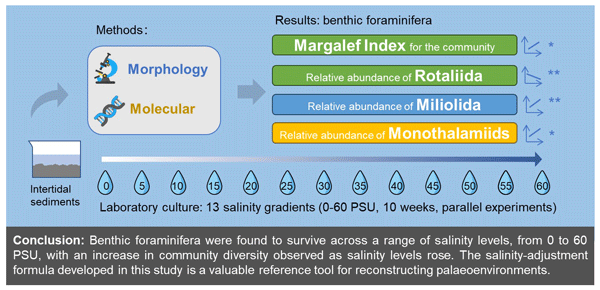
Abstract. Benthic foraminifera are extensively used as bioindicators for paleoenvironmental reconstruction, yet environmental DNA (eDNA) analysis provides a powerful lens to uncover their community diversity and environmental responses. Currently, quantitative experimental studies on their responses to salinity gradients are scarce. Here, sediments from the intertidal zone of Qingdao Bay were subjected to a 10-week controlled culture across 13 salinity levels (0–60 psu), and community dynamics were analysed using both morphological and eDNA approaches. Foraminifera exhibited high tolerance to extreme low (0 psu) and high (60 psu) salinities, and community diversity (Margalef index) increased significantly with salinity (p < 0.05). The relative abundance of calcified Rotaliida declined with increasing salinity (p < 0.01), allowing for the establishment of a robust linear regression model. The eDNA analysis revealed that soft-bodied Monothalamiids – often overlooked morphologically – reached up to 76.2 % relative abundance (average 56.1 %). In contrast, the salinity-driven increase in high-Mg calcite-shelled Milioliida was observed only through morphological analysis. These results demonstrate the distinct but complementary nature of morphological and molecular methods. This study addresses the scarcity of experimental constraints on salinity responses, offering a calibrated reference for applying foraminifera in both ecological assessment and paleo-reconstruction.
-
Notice on discussion status
The requested preprint has a corresponding peer-reviewed final revised paper. You are encouraged to refer to the final revised version.
-
Preprint
(1438 KB)
-
The requested preprint has a corresponding peer-reviewed final revised paper. You are encouraged to refer to the final revised version.
- Preprint
(1438 KB) - Metadata XML
- BibTeX
- EndNote
- Final revised paper


Journal article(s) based on this preprint
Interactive discussion
Status: closed
-
RC1: 'Comment on egusphere-2026-196', Anonymous Referee #1, 31 Jan 2026
-
AC1: 'Reply on RC1', Yanli Lei, 09 Feb 2026
We appreciate the reviewer’s time and their insightful assessment of this study. Their professional suggestions have been invaluable in improving the quality of our manuscript. Our responses to the specific points are provided below.
- We sincerely thank the reviewer for raising this critical point regarding taxonomic assignment and validation.
1.1 Taxonomic Classification Methodology:
In the original manuscript, we omitted the detailed parameters for taxonomic annotation. We have now clarified this in the revised Methods section. Specifically, after quality filtering, OTUs with fewer than 10 reads or present in fewer than 3 samples were removed to minimize artifacts. The representative sequences of the remaining OTUs were taxonomically annotated using BLASTn (version 2.7.1) against the Protist Ribosomal Reference database (PR2) (Guillou et al., 2012). OTUs identified as Foraminifera but unable to be assigned to specific major orders were categorized as "Others".
1.2. Phylogenetic Analysis and Micro-diversity:
We fully agree that a phylogenetic analysis provides essential proof of the taxonomic affiliations.
Since our dataset contains nearly 2,000 OTUs, constructing a single tree with all sequences would result in visual clutter and make interpretation difficult. Therefore, to verify the classification and visualize micro-diversity as requested, we selected the top 50 most abundant OTUs to represent the community structure (comprising 20 Rotaliida, 20 Monothalamids, 5 Textulariida, and 5 Milioliida). We constructed a Maximum Likelihood tree (Supplementary Fig. S1) using these representative OTUs alongside corresponding reference sequences extracted from the PR2 database, rooted with Gromia oviformis as the outgroup.
The resulting tree confirms that our OTUs cluster consistently with known foraminiferal lineages, validating our taxonomic assignments. Furthermore, it reveals high micro-diversity within dominant groups, particularly in the Ammonia (Rotaliida) and Ovammia (Monothalamids) clades.
- Thank you for your suggestions. We will add detailed morphological and eDNA data to the supplementary materials of the manuscript and include the numerical values for total abundance at the top of the bar chart in Figure 3A.
The responses to the specific comments are as follows:
line 58 (and line 75-76): Yes, it should be phrased as "13 different salinity levels." Thank you for pointing this out.
line 84: We used the Guillard f/2 medium for algal culture, and this will be added to the manuscript.
lines 108-110: In this study, the amplified target fragment was 380 bp in length. Paired-end sequencing with 250 bp reads was employed, resulting in a potential overlapping region of approximately 120 bp between forward and reverse reads. Thank you for this thoughtful suggestion. These technical details will be incorporated into the main text.
lines 111-114: OTUs with fewer than 10 reads or appearing in fewer than 3 samples were removed to eliminate potential contaminants. Representative sequences were extracted from the OTU table and taxonomically annotated against the PR2 database (Protist Ribosomal Reference Database, Guillou et al., 2012) using BLAST (version 2.7.1). OTUs not classified under Foraminifera (rank 3 in the PR2 database) were subsequently discarded. We will also include the detailed workflow in the corresponding section of the manuscript.
lines 115-116: We appreciate your feedback. The original description was indeed too brief, and we have revised the relevant section in the manuscript to provide a more detailed explanation. “The OTU table was used to quantify the species number and relative abundance of each foraminifera taxon under different salinity conditions, as well as the alpha diversity indices of the community. Spearman correlation analysis between each taxon (as well as community diversity) and salinity was performed using SPSS software. For data showing significant correlations, figures were generated in Origin with linear fitting equations, plotted using a 95% confidence interval.”
Figure 2: Yes, the samples were fixed and stained with Rose Bengal dye to differentiate living organisms. As mentioned in Section 2.2 (Materials and Methods), we have incorporated this point into the figure caption based on your suggestion to enhance reader comprehension.
Figure 5: Thank you for the opportunity to clarify Figure 5. We have revised the figure legend to address your questions directly.
The chord diagram visually compares the foraminiferal community composition revealed by eDNA (Molecular) versus morphological methods. Each outer semicircle represents a method’s dataset, independently normalized to 100% to show its internal taxonomic proportions. The inner colored arcs represent taxa; their width equals the sum of that taxon’s relative abundance from both methods, indicating its overall detection strength across the study. The connecting ribbons show how each taxon’s abundance is partitioned between the two methods—ribbon width at the connection point equals its relative abundance within that method.
You correctly interpreted the key patterns: eDNA was dominated by Monothalamiids, Rotaliida, and “Others,” with minimal signal from Textulariida and Milioliida, which were primarily detected morphologically. A wide ribbon connecting to a large outer segment (e.g., Rotaliida to Morphology) confirms that taxon as a major component of that method’s community.
line 171: In this study, OTUs annotated as Foraminifera yet unassigned at the Order level or lower were collectively categorized as "Others." As for the detailed explanation regarding the phylogenetic tree, it has been addressed in the response to the first point; please refer to that section.
line 204: Thank you for pointing out the missing reference. We have now added the appropriate citation to the manuscript.
In environments with low salt concentrations, there is a demonstrable decline in the feeding and metabolic efficiency of foraminifera (Nigam et al., 2006; Sujata et al., 2011). Conversely, the collective of foraminifera exhibits a higher degree of tolerance to physiological stress induced by elevated levels of salinity (Debenay, 1990; Gull et al., 2025).
Debenay, J.-P.: Recent foraminiferal assemblages and their distribution relative to environmental stress in the paralic environments of West Africa (Cape Timiris to Ebrie Lagoon), J. Foraminifer. Res., 20(3):267–282, https://doi.org/10.2113/gsjfr.20.3.267, 1990.
Gull, H. M., Tawabini, B. S., Amao, A. O., Prayudi, S. D., Ayranci, K., and Kaminski, M. A.: Benthic Foraminiferal Response to a Salinity Gradient in the Uqair Hypersaline Lagoonal System, Gulf Coast of Saudi Arabia, Micropaleontology, 71(3):261–279, https://doi.org/10.47894/mpal.71.3.04, 2025.
Nigam, R., Saraswat, R., and Kurtarkar Raikar, S.: Laboratory experiment to study the effect of salinity variations on benthic foraminiferal species – Pararotalia nipponica (Asano), J. Geol. Soc. India, 67:41–46, https://doi.org/10.1007/BF02709367, 2006.
Sujata, K. R., Nigam, R., Saraswat, L., and Rajeev, N.: Regeneration and abnormality in benthic foraminifera Rosalina leei: Implications in reconstructing past salinity changes, Riv. Ital. Paleontol. Stratigr., 117(2):309–318, https://doi.org/10.13130/2039-4942/5970, 2011.
line 228: Thank you for your suggestion. We have implemented it by annotating the abundance values directly above the corresponding bars in Figure 3A, which enhances clarity for readers. As shown, the data confirm that foraminiferal abundance is lower under low-salinity conditions compared to moderate- and high-salinity conditions.
line 230: We thank you for their careful observation regarding Figure 3B. You are absolutely correct that Figure 3B shows that the Milioliida group consists of only one species (Quinqueloculina seminula) and this species richness remains constant across salinities. However, the discussion in Line 230 refers specifically to the "relative abundance" (proportion of the total community) rather than species richness. As illustrated in Figure 3A, the relative abundance of Milioliida clearly increases with salinity (from ~0% at 0 psu to ~45% at 55 psu), which aligns with our discussion on biomineralization mechanisms favoring high-Mg calcite in hypersaline waters.
Changes in Manuscript:
To prevent future confusion, we have modified the sentence to explicitly cite Figure 3A and clarified the distinction between abundance and richness:
"At higher salinities, the formation of shells was found to be more favorable for Milioliida, thereby explaining the higher relative abundance observed at elevated salinities in classical morphological analyses (Fig. 3A)."
line 249: Thank you for this important clarification regarding terminology. We agree that eDNA sequencing primarily identifies Operational Taxonomic Units (OTUs) rather than biological species directly.
Changes in Manuscript: "Firstly, while morphological analysis in this experiment identified only 13 species, the eDNA method demonstrated considerable sensitivity, identifying 1,977 OTUs which were annotated to 103 species, thereby better reflecting the diversity within the foraminiferan group."
line 262: We agree with you that the diversity of Milioliida in the morphological dataset is very low (only one species). In the original text, we used the term "relatively monotypic" to describe this. To be more precise and address your comment, we have revised the sentence to explicitly acknowledge that this group consists of a single species, while emphasizing that its high relative abundance (which eDNA failed to capture) is the key insight provided by morphology.
Revised text:" In the eDNA dataset, the porcelaneous Milioliida group constituted a negligible proportion of the total reads; consequently, the community response to salinity gradients within this group could not be detected. In contrast, a statistical analysis of classical morphology reveals that (Fig. 3A/B), although the Milioliida assemblage is monospecific (represented only by Quinqueloculina seminula), its abundance is substantial, constituting a high proportion of the total biological count."
lines 263-265: Thank you for your suggestion. This statistical description is based on the results presented in Figures 3A/B. Detailed quantitative data on foraminiferal abundance will be provided in the Supplementary Materials. Please refer to the specific language revisions in the previous response (Line 262).
lines 277-280: Thank you for providing the references; they are greatly helpful for our manuscript and future research. We have incorporated the suggested content and made the following revisions:
To address this challenge, environmental RNA (eRNA) has emerged as a promising tool for identifying metabolically active communities, due to its rapid degradation outside living cells which better reflects contemporary biological activity (Chen et al., 2025; Qiao et al., 2025). Although eRNA methodology in foraminiferal research is still evolving and not yet standardized, recent studies—such as those revealing anaerobic metabolic adaptations in subseafloor foraminifera and the role of primary production in shaping benthic eukaryotic interactions—highlight its potential to uncover physiological and ecological responses inaccessible to traditional approaches. The continued development and integration of eRNA with controlled laboratory culture systems will help directly resolve how salinity fluctuations influence active foraminiferal community structure and function, thereby extending the findings of this study toward more mechanistic, ecophysiologically meaningful insights.
General comments: Thank you for your suggestion. We will carefully review the manuscript. The term "in situ" has been revised as advised.
-
AC1: 'Reply on RC1', Yanli Lei, 09 Feb 2026
-
RC2: 'Comment on egusphere-2026-196', Christopher Lowery, 02 Feb 2026
This paper by Cao and others describes a culturing experiment of benthic foraminifera collected from the inter-tidal zone of Qingdao Bay and exposed to a range of salinities. The cultured populations were then examined by traditional morphometric techniques and via eDNA sequencing. These analyses agreed in the broad results but differed in interesting and revealing ways, particularly the dominance of organic-walled monothalamids that don’t show up in morphological datasets, and in the abundance of miliolids, which represent a small sliver of the genetic diversity but a large portion of the tests in some high salinity samples. This is a very cool study! I definitely think it deserves to be published in Biogeosciences, but I think some changes need to be made first.
First, and most importantly, I’m sorry if I missed this but I did not see any Data Availability Statement, nor any data tables associated with this paper. I was specifically looking for foraminiferal count data, but I also don’t see DNA data included anywhere in whatever format that is usually provided. I am not familiar with this journal’s data policies but in my opinion raw data MUST be provided as a supplement or linked to in a recognized online repository. Additionally, the total abundance of foraminifera (and of each species) for each culture should be included somewhere, perhaps as a 5th panel in Figure 3.
Second, the sampling methodology needs to be explained further. How was the mud collected? How much material? Was it split 13 ways for the individual cultures, or were 13 samples taken? Was it sieved prior to culturing? What was the volume per culture? Etc.
Finally, I think there could be more discussion of the strength of this morphology + DNA approach. What are we missing when we only use one or the other? What does this mean for our understanding of benthic foraminiferal assemblages?
I have some other comments and suggestions below, by line number. I am not a DNA specialist and so unfortunately was not able to evaluate those methods and results. I would be happy to review a revised version of this manuscript.
Sincerely,
Chris Lowery
University of Texas at Austin
Line 10 – not sure “yet” is the right word here. Maybe “and”
Line 11 – what do you mean “their” responses? Foraminifera? eDNA? It would be good to clarify. If you mean foraminifera broadly, you might also consider adding a clause at the start of this sentence that says something like “Foraminifera are commonly used to assess salinity changes in estuary settings, but quantitative experimental studies of their responses to salinity gradients are scarce.” I think it highlighting the widespread recognition of the importance of salinity in estuarine benthic forams will help emphasize the importance of your study.
Line 13 (and throughout) – PSU is an acronym should be capitalized
Line 15 – diversity “increased significantly” but by how much? Would be good to state the value here (ditto with the relative abundance of Rotaliida in the next line).
Line 22 – check this figure for grammatical errors (“were found to be survived”)
Line 30-32 – need some citations for these field observations
Line 33 – Streblus has been synonymized with Ammonia (which you use later on through the text). Please be consistent.
Line 49 – might be good here to mention the group of foraminifera that are widespread but fail to fossilize, as foreshadowing of your results
Line 67 – how many samples were collected? How far apart were they? How much material was collected? What was the sampling technique? How reflective is the intertidal zone of conditions in the rest of the bay? If the cultures weren’t all done on the same sample split 13 ways that should be stated (and would be a potential source of error). Also, was the sample sieved before culturing? Was this an already mature adult population that you subjected to a range of salinities or were these gametes that grew to adulthood during the experiment?
Line 69 – if the precision of the refractometer is 1 per mil., why are you reporting a salinity to a precision of 0.1 per mil?
Figure 1 – do you have a photo of the sampling location? You’ve got a bit of room here (and a lot of unused space in the map box) to include a photo of the sampling area. It would also be helpful to show a much closer map view of the sampling location. Finally, the scale bar is barely readable, and should be much larger.
Line 76 – what do you mean salinity “gradients?” Aren’t these just salinity *values* for the individual dishes?
Line 86 – how was pH maintained? (e.g., was a buffer added?)
Line 92 – I don’t know what ISO 23040:2021 is. Can you briefly explain the steps from Rose Bengal staining to species identification here? Also, did you use a consistent volume of sediment across all replicates? Did you count the dead assemblage too? Also, did you examine the living foraminifera in original intertidal sample to obtain a baseline with which to compare the population at these different salinities? I’m curious how similar/different the cultured communities are from the natural one.
Line 125-127 – did the total abundance of foraminifera show any trend across salinity gradients? It would be interesting to see the total numbers of foraminifera reported here too.
Line 129 – “the total” number of species? Or number of individuals?
Line 161 – cool! What are the names of those 103 species?
Figure 5 – what do the colors in (A) represent?
Line 170-176 – I’m not a DNA person so forgive me if this is obvious but the eDNA analysis is on bulk sediments from the sample, right? Wouldn’t this include a significant number of sequences from specimens that were alive prior to sample collection? Obviously there are trends here with salinity but this relict DNA would represent some error, right? Can you talk here about how that may affect your results, and how you deal with it? Especially given how, e.g., miliolids show different abundance trends compared to the morphological data.
Line 197-201 – I feel like this discussion of salinity response in Ammonia is missing the context of the range of interpreted ecophenotypes often associated with this genus (Ammonia tepida, e.g.) and the extensive cryptic diversity within this genus (see, for example, Goetz et al., 2025, JFR https://doi.org/10.61551/gsjfr.55.1.45). Given the taxonomic complexity of this genus I think it would also be very interesting to compare your DNA results with existing genetic data and species designations.
Line 205-207 – is this positive relationship between salinity and diversity also true in the wild? Has anyone done a thorough study of living populations in Qingdao Bay? Just based on marginal marine habitats I’m familiar with in the Gulf of Mexico region, there are a lot of low-diversity, high-salinity assemblages (for example see Poag’s book: https://books.google.com/books?id=HsUbBgAAQBAJ&lpg=PP8&ots=I0zTbcLg9O&dq=poag%20gulf%20of%20mexico%20foraminifera&lr&pg=PP1#v=onepage&q=poag%20gulf%20of%20mexico%20foraminifera&f=false). I think it would really strengthen your paper
Line 214 – “primitive” seems needlessly normative here.
Line 227 – what do you mean “it can be deduced?” Presumably you have count data that show this directly? (again, I think it would be helpful to show these count data, and also they need to be included as a supplemental table or uploaded to an online repository).
Line 228 – what’s the evidence that the tests dissolved?
Line 230-231 – If the tests dissolved (or didn’t dissolve, in the high salinity sample) wouldn’t the DNA results show the same relative abundance in both, since presumably the starting stocks were the same?
Line 238-239 – benthic foraminiferal assemblages have been used as a paleosalinity indicator before, and it would be good to cite some of those studies here.
Line 240-241 – Impact of salinity of Mg/Ca derived temperature has been known since at least Lea et al., 1999; see review in Katz et al. (2010 JFR https://doi.org/10.2113/gsjfr.40.2.165)
Line 247 – “it has been demonstrated” – by whom?
Line 250 – I think the large proportion on monothalamids here is a really cool result and something to highlight in this paper, and something you can tease out a bit more in the discussion: what does it mean for traditional foraminiferal analyses if we’re consistently missing this apparently large group? What are we missing about benthic foram ecosystems?
Line 286 – what functional relationships were identified?
Line 289-291 – do you mean reconstruction of environments in Qingdao Bay or generally? I think I would be cautious of assuming these linear relationships hold true across all estuary environments, since there are a lot of different local controls on foram populations. At the very least, it would be good to have further discussion in the Discussion about how applicable these results might be more broadly.
Citation: https://doi.org/10.5194/egusphere-2026-196-RC2 -
AC2: 'Reply on RC2', Yanli Lei, 03 Mar 2026
We would like to sincerely thank Dr. Christopher Lowery for his positive evaluation of our study and his constructive comments. Our detailed responses to his specific suggestions are presented below.
- We fully agree with you regarding the critical importance of data transparency and apologize for the omission of these datasets in the initial submission. To address this, we have now compiled the raw morphological count data and the eDNA OTU tables, which will be provided as Supplementary Tables in the revised manuscript. Furthermore, regarding the visualization of total abundance, we have modified Figure 3A to display the total abundance values directly above each bar. We would also like to clarify that since our statistical analyses focused primarily on community-level parameters or the relative abundance of major taxonomic groups, detailed species-level abundance was not visualized in the main figures; however, these specific data are now fully accessible in the Supplementary Tables for reference.
- We appreciate your request for further details on our sampling and experimental setup, which we have now fully clarified in the revised Methods section. To obtain a representative initial community, surface sediments (top 0–2 cm) were collected from approximately 20 random locations within the intertidal zone of Qingdao Bay and pooled into a single composite sample. Upon returning to the laboratory, this composite sample was gently homogenized. Crucially, prior to culturing, the sediment was wet-sieved through a 300-mesh (~48 μm) silk screen using gentle seawater flow. This pre-treatment step was essential to remove fine clay particles and excess organic detritus, thereby preventing pore-water hypoxia and bacterial overgrowth (which could lead to sediment fouling) during the long-term static culture.
From this processed sediment, an initial subsample (~50 g) was preserved as the baseline (T0), and the remaining material was divided into 13 equal aliquots for the salinity gradient experiment. Each aliquot (approximately 50 g wet weight) was placed in a sterilized glass crystallizing dish (10 cm diameter) and covered with an equivalent volume of salinity-adjusted seawater. At the conclusion of the 10-week culture period, each sample was split, with approximately 20 g allocated for morphological analysis and 20 g reserved for eDNA extraction.
- We appreciate your suggestion to deepen the discussion on the strengths of this combined approach. In the revised manuscript, we have expanded Section 4.3 to explicitly address the trade-offs and necessity of coupling these methods. We highlight that morphological analysis alone introduces a significant bias by failing to detect soft-shelled taxa; our eDNA results demonstrated that Monothalamiids constitute a substantial proportion of the community abundance, representing a critical ecological component that would be entirely overlooked in traditional surveys. Conversely, the eDNA method in our study yielded low sequence counts for the Milioliida group, obscuring their response patterns. Morphology was therefore essential to visualize their dynamics, revealing that Milioliida are sensitive to low salinity (maintaining < 20% relative abundance at 5–20 PSU) but exhibit remarkable tolerance to hypersaline conditions, with relative abundances remaining high (~40%) at 40–60 PSU and peaking at 55 PSU. Furthermore, we clarified the observation at 0 PSU, where the relative abundance of Milioliida appeared slightly higher than at 5 PSU; this is an artifact resulting from the sharp decline in the total community abundance under extreme freshwater stress, rather than a preference for freshwater.
Finally, our discussion now emphasizes that while morphology remains the standard for reconstructing fossilizable assemblages, eDNA provides indispensable insights into the "hidden" soft-bodied diversity. Only by integrating both datasets can we achieve a holistic understanding of benthic foraminiferal responses to environmental stress.
Below, we provide point-by-point responses to the reviewer's specific suggestions, organized by line number.
Line 10: We appreciate this correction. We concur that ‘and’ provides a better logical flow here and have modified the text accordingly.
Line 11: We thank the reviewer for this insightful suggestion. We fully agree that the proposed revision not only resolves the ambiguity regarding the term "their" but also better contextualizes the study by highlighting the importance of foraminifera in estuarine settings. We have adopted the phrasing suggested by the reviewer in the revised Abstract.
Changes in Manuscript: The sentence has been rephrased as follows:
"Foraminifera are commonly used to assess salinity changes in estuary settings, but quantitative experimental studies on their responses to salinity gradients are scarce."
Line 13 (and throughout): We thank you for pointing this out. We apologize for the oversight and have capitalized the acronym as "PSU" throughout the revised manuscript.
Line 15: Thank you for this suggestion to improve quantitative clarity. Since our conclusions are based on two independent datasets (morphological and molecular) that yield distinct numerical ranges, providing a single value in the Abstract could be misleading. To address this, we have:
Revised the Abstract to emphasize that the reported trends are consistent, significant, and quantitatively robust across both methods;
Added full quantitative results (e.g., percentage changes, regression coefficients) in the Results section (Section 3.1&3.2, Fig. 3, and Supplementary Table).
This approach maintains conciseness in the Abstract while providing complete numerical transparency in the main text.
Line 22: Thank you for the correction. This sentence in the manuscript will be revised to: "Benthic foraminifera were found to survive across a range of salinity levels."
Line 30-32: Thank you for your suggestion. We will add the relevant reference (Boltovskoy et al., 1991) to the manuscript.
Line 33: We thank you for pointing out this nomenclatural inconsistency. According to the World Foraminifera Database (WoRMS) and following Loeblich & Tappan (1987), Streblus Fischer de Waldheim, 1817 is an objective junior synonym of Ammonia Brünnich, 1771. We have therefore standardized the genus name to Ammonia throughout the manuscript.
Line 49: We thank you for this insightful suggestion. As foreshadowing of our eDNA results—which reveal high relative abundances of Monothalamiids undetected by morphological analysis—we have revised the Introduction to explicitly mention that soft-bodied Monothalamous foraminifera, despite their modern-day ecological prevalence, are virtually absent from the fossil record due to their non‑mineralized tests. This modification strengthens the logical link between the methodological rationale and our key findings.
Line69: Thank you for your careful observation. The refractometer has a precision of 1 PSU, and the value of 0.1 PSU was obtained by visual estimation (interpolation) between scale markings. We have now added a clarification in the Methods section: (measured by handheld refractometer, precision ±1‰, interpolated to 0.1 PSU).
Figure 1: Thank you for this helpful suggestion. We have revised Figure 1 accordingly: (1) a panoramic photograph of the sampling site and a close-up image of the surface sediment have been added to the blank space within the map box; (2) the scale bar has been manually redrawn, enlarged, and bolded for better readability. We believe these modifications significantly improve the clarity and visual appeal of the figure. You can see the revised figure in supplementary materials of this Author Comment.
Line 76: Thank you for pointing this out. We agree that the term “gradients” was imprecise in this context. As noted by another reviewer, what we refer to are in fact discrete salinity levels (5, 10, 15, …, 60 PSU) established in individual culture dishes. We have therefore replaced all instances of “salinity gradients” with “salinity levels” throughout the manuscript to accurately reflect the experimental design.
Line 86: Thank you for your question. In this study, salinity was the primary variable under investigation, and pH was not actively adjusted. To maintain stable culture conditions, at least half of the overlying seawater—previously adjusted to the corresponding salinity level—was replaced every three days. During this period, pH was monitored but not manipulated.
Line 92: Thank you for your detailed and constructive questions regarding our foraminiferal processing methodology. We have now expanded the description in the Methods section to provide a complete and transparent workflow. Specifically:
Samples were fixed and stained for 48 hours using a mixture of 95% ethanol and 1 g/L Rose Bengal to distinguish living specimens at the time of collection. After staining, samples were dried at 50 °C for 12 hours, weighed, and wrapped in 300‑mesh sieve netting, then soaked and rinsed in seawater. Foraminifera were concentrated by flotation using carbon tetrachloride (CCl4), followed by a second drying step. The residues were then dry‑sieved through 0.150 mm and 0.063 mm mesh screens and split into two size fractions: >0.150 mm and 0.063–0.150 mm (Fontanier et al., 2002; Jian et al., 1999). The 0.063-0.150 mm fraction, consisting mainly of juveniles and very small specimens, was not picked. All stained (i.e., living) individuals from the >0.150 mm fraction were hand‑picked under a stereomicroscope. Although all specimens were counted, only Rose Bengal‑stained individuals were included in the final community analyses.
To provide a baseline for comparison, the original intertidal sediment samples were processed identically. The pre‑experimental community composition is shown as “T0” in Figure 3. A/B. Complete description of this protocol has now been added to the revised Methods section.
We thank the reviewer again for helping us improve the clarity and reproducibility of our methodology.
Line 125-127: Thank you for this insightful question. The total abundance of foraminifera showed a clear increasing trend with rising salinity. To make this pattern more accessible to readers, we have now added the total abundance values directly above the corresponding bars in Figure 3A. This addition clearly illustrates the positive relationship between salinity and foraminiferal abundance, complementing the relative abundance data already presented.
Line 129: In our manuscript, “the total” refers to the total number of individuals for morphological data, and total number of reads for eDNA data. Accordingly, relative abundance is defined as the proportion of individuals (or reads) belonging to a specific taxonomic group relative to the total foraminiferal individuals (or total reads) in a given sample. We have now added these definitions explicitly in the Methods section to avoid any ambiguity. We appreciate your careful reading and helpful suggestion.
Line 161: Thank you for your interest. The eDNA analysis yielded a total of 103 annotated species; however, listing all species names in the main text would be excessively lengthy. Since our statistical analyses are primarily based on community-level parameters and relative abundances of major taxonomic groups, we have provided the complete OTU table, including all species annotations and read counts, in the Supplementary Materials (Table S2). Readers interested in the detailed species composition can refer to this file.
Figure 5: Thank you for pointing this out. The colored curves in Figure 5A represent individual samples from each salinity treatment, including replicates. We have now added a clear explanation in the figure legend to avoid any confusion.
Line 170-176: Thank you for raising this important methodological concern. You are absolutely correct that eDNA extracted from bulk sediments may include relic DNA from specimens that were alive prior to sample collection or even from dead individuals, which is a well-recognized limitation of sediment-based eDNA approaches. To minimize the impact of this legacy DNA and ensure comparability across treatments, we thoroughly homogenized the original sediment and split it equally into each culture dish prior to the start of the experiment. Therefore, all salinity treatments began with the same initial sediment pool and thus an identical baseline eDNA signal. Any differences observed at the end of the culture period can therefore be primarily attributed to differential responses of the foraminiferal community to the salinity treatments during the incubation.
We fully acknowledge that relic DNA may still introduce background noise and potentially dampen the detection of rapid community shifts. This may partly explain the discrepancy between morphological and eDNA data for certain groups, such as the Miliolida. In the morphological dataset (Fig. 3A), Miliolida showed a clear increase in relative abundance with increasing salinity, consistent with their known preference for hypersaline conditions. In contrast, their eDNA signal was consistently low across most salinity treatments, making trends difficult to discern (Fig. 3C). Nevertheless, a closer examination of the eDNA data reveals that the relative abundance of Miliolida did increase from 0.29% at 0 PSU to 1.23% at 60 PSU, indicating that the same directional trend—though much weaker—is still detectable. The attenuated signal may reflect lower DNA extraction efficiency, faster DNA degradation, or lower ribosomal copy numbers in this group, compounded by the masking effect of relic DNA from other taxa.
We have now expanded the Discussion section to explicitly address this limitation, its potential impact on our interpretations, and the methodological steps we took to ensure treatment comparability. These additions are integrated with the detailed sediment processing protocol already included in the Methods in response to your earlier comments.
We thank the reviewer again for pushing us to critically evaluate the interpretation of eDNA signals in experimental sediment systems.
Line 197-201: We sincerely thank you for this insightful comment and for directing us to the important work of Goetz et al. (2025). We agree that the extensive cryptic diversity within the genus Ammonia is a critical context often missing in discussions of its ecological tolerance. As suggested, we have now incorporated this perspective into the Discussion. The revised text acknowledges that the broad salinity ranges reported for Ammonia tepida and A. beccarii in the literature may represent composite signals from multiple cryptic species, rather than the plasticity of a single biological entity.
Regarding the reviewer's suggestion to compare our DNA results with existing genetic data: while we fully agree this is a fascinating and important direction, we believe a rigorous, species-level phylogenetic comparison is beyond the scope of the current manuscript. Our eDNA metabarcoding approach was designed to assess community-level diversity patterns across salinity gradients, and the current dataset—while robust for this purpose—does not provide the single-species resolution required for detailed taxonomic revision. We have therefore framed this as a key future research priority in the revised Discussion. We are grateful for this suggestion and believe it significantly strengthens our manuscript by clearly defining its scope and acknowledging its limitations.
Line 205-207: We thank you for this insightful comment and for referencing Poag’s classic work on the Gulf of Mexico. We fully agree with the reviewer and Poag (1981) that in hypersaline environments (e.g., Laguna Madre), diversity often declines due to physiological stress, similar to what is observed in low-salinity estuaries. The relationship between salinity and diversity is generally non-linear (hump-shaped) across a full global spectrum.
In our study, the "positive correlation" (Margalef index vs. Salinity) is primarily driven by the steep increase in diversity from hyposaline (0–20 PSU) to marine/hypersaline (35–60 PSU) conditions. At 0–20 PSU: Strong osmotic stress severely limits survival, resulting in extremely low diversity. At 35–60 PSU: While this is hypersaline, for the specific taxa in Qingdao Bay (e.g., opportunistic Quinqueloculina), this range appears to be within their tolerance limit or even favorable for biomineralization, thus sustaining a relatively higher diversity compared to the lethal freshwater end. However, we acknowledge that if salinity increased further (e.g., >70 PSU), diversity would likely drop, consistent with Poag's model.
Regarding the wild populations in Qingdao Bay, Lei et al. (2017) conducted a thorough field survey in this specific intertidal zone. They reported that salinity (ranging from 31 to 38 PSU in their study) was positively correlated with species diversity, as freshwater input from rainfall/runoff acts as the primary disturbance. Our experimental results validate this local field trend but extend the understanding to extreme limits.
Line 214: We appreciate your attention to the terminology. We agree that the term "primitive" carries normative connotations that are inappropriate in an evolutionary context. Our intention was to refer to the fact that Miliolida represents a lineage that diverged early in foraminiferal evolution and retains specific ancestral calcification traits (high-Mg calcite), as discussed in Bentov et al. (2006).
We have replaced "evolutionarily primitive" with "representing an early-diverging lineage" to be more scientifically precise and neutral.
Line 227: We agree with the reviewer that the phrase "it can be deduced" was imprecise, given that we have direct count data supporting this observation.
As mentioned in our response to your previous comment regarding data availability, we have now included the raw count data in Supplementary Table S1, and explicitly labeled the total abundance values above the bars in Figure 3A.
We have rephrased the sentence to be direct and fact-based, removing the speculative tone. The sentence now reads: "Our quantitative data directly show that, in conditions of low salinity, there was a sharp decline in the abundance of foraminifera."
Line 228: We thank the reviewer for this critical observation. We acknowledge that we did not perform specific taphonomy analyses to quantify dissolution features (etching or breakage) on the tests in this study. The statement was intended as a mechanistic inference to explain the observed sharp decline in Milioliida and the relative dominance of Rotaliida under low salinity. This inference is based on well-established geochemical principles: the high-Mg calcite skeletons of Milioliida are chemically more soluble in hyposaline (often lower saturation state) waters compared to the low-Mg calcite of Rotaliida (e.g., Ammonia), as documented by previous studies (e.g., various citations in the previous paragraph). We have revised the manuscript: “Among these, the high-magnesium calcite shells of porcelaneous Miliolida were prone to dissolution, whereas the low-magnesium calcite shells of hyaline Rotaliida resisted dissolution more readily,”
Line 230-231: We appreciate this insightful question, which highlights the fundamental differences between morphological and molecular signals in our long-term experiment. It is important to note that although the starting stocks were identical, the 10-week culture period allowed for significant biological turnover and community divergence driven by physiological selection. In low-salinity conditions, Milioliida likely experienced high mortality and population collapse due to osmotic stress—in addition to test dissolution—which would result in the degradation of their DNA over time, rather than its preservation.
Furthermore, the consistently low eDNA reads for Milioliida, even in high-salinity groups where morphological analysis confirmed their thriving populations, indicate a systematic methodological bias (e.g., lower PCR amplification efficiency or extraction challenges for porcelaneous taxa). Consequently, the discrepancy between datasets is not because dissolution obscured the DNA signal, but rather because eDNA methods failed to capture Milioliida effectively due to primer bias, while morphological counts accurately reflected their high abundance in favorable hypersaline conditions. This distinction underscores the critical necessity of coupling morphology with eDNA to correct for such molecular "blind spots."
Line 238-239: Thank you for this helpful suggestion. We agree that acknowledging previous successful applications of benthic foraminifera as paleosalinity indicators provides essential context and support for our statement.
We have added key references to the revised manuscript, including Murray (2006) for general ecological distribution patterns and Strachan et al. (2015) for quantitative transfer functions. The revised sentence now reads: "Therefore, after controlling for temperature effects, foraminifera also serve as amplifiers of salinity variations, enabling salinity determination based on specific species assemblages (Murray, 2006; Strachan et al., 2015)."
Line 240-241: We thank you for pointing out these foundational references. We fully acknowledge that the impact of salinity on Mg/Ca-derived temperatures is a well-established phenomenon. We have revised the sentence to explicitly cite Lea et al. (1999) and the review by Katz et al. (2010). We have also adjusted the tone to state that our findings reinforce the importance of this established practice, rather than presenting it as a novel recommendation.
"Given that salinity influences Mg/Ca-based thermometry (e.g., Lea et al., 1999; Katz et al., 2010), our results further underscore the necessity of conducting foraminiferal composition analyses to constrain salinity backgrounds, thereby enhancing the accuracy of paleo-oceanic temperature reconstructions."
Line 247: Thank you for pointing this out. We have cited Pawlowski et al. (2014) in the revised manuscript to substantiate the statement regarding the power of molecular methods in describing diversity.
Line 250: We appreciate your positive assessment of this finding. We fully agree that the dominance of Monothalamiids is a critical result that reveals significant gaps in our understanding of benthic ecosystems when relying solely on traditional methods. In the revised Section 4.3, we have expanded the discussion to explicitly address these implications. Specifically, we argue that overlooking this group leads to a severe underestimation of total benthic standing stock and biodiversity, particularly in stressed environments where they appear to replace calcified taxa as the dominant guild.
Furthermore, we discuss how this omission can lead to a misinterpretation of ecosystem resilience. While morphological data showing a decline in calcified taxa might be interpreted as a "system collapse" under salinity stress, our molecular data reveal a functional shift towards a soft-bodied community rather than a total loss of biological activity. We also note that ignoring this "hidden majority" limits our understanding of energy flow in the benthic food web, as soft-bodied taxa likely exhibit distinct turnover rates and trophic roles compared to their shelled counterparts.
Line 286: Thank you for pointing out this ambiguity. By "functional relationships," we intended to refer to the quantitative linear regression models we established between salinity and specific biotic parameters (Rotaliida abundance and Margalef index).
We agree that the original phrasing was vague and potentially confusing (as "functional" can also imply ecological functioning). We have rephrased the sentence to be precise: "...Specifically, robust linear regression models were established linking salinity to both the relative abundance of Rotaliida and community diversity."
Line 289-291: We appreciate you for raising this important point regarding the applicability of our regression models. We fully agree that estuarine environments are complex and that local controls (e.g., temperature, food availability, distinct genotypes) can influence foraminiferal responses. We do not intend to claim that the exact linear coefficients derived from Qingdao Bay are universally applicable to all estuaries globally without local validation.
Instead, we propose that: The quantitative regression models serve as a robust, locally-calibrated proxy specifically for the Yellow Sea and Bohai Sea regions, where such experimental data are scarce. The biological trends (e.g., the positive correlation of diversity with salinity; the distinct tolerance limits of Rotaliida vs. Milioliida) provide a general reference framework for understanding physiological constraints in similar temperate marginal marine systems. We have revised the Conclusion to specify that these relationships are most applicable to "marginal marine environments, particularly in the Yellow Sea region." We have also added a sentence in the Discussion (Section 4.1) acknowledging the need for regional calibration when applying these proxies broadly.
-
AC2: 'Reply on RC2', Yanli Lei, 03 Mar 2026
Peer review completion


Interactive discussion
Status: closed
-
RC1: 'Comment on egusphere-2026-196', Anonymous Referee #1, 31 Jan 2026
The manuscript of Cao et al reports a study on foraminifera diversity in coastal sediments as assessed by morphological and molecular techniques, across a gradient of 13 different salinities. They collected more than 9000 foraminifera specimens and produced a large dataset which could be subjected to statistical analysis. They found correlations between foraminifera biodiversity and salinity which could be useful for interpreting paleo-salinities in sediment core records. The application of barcoded high throughput illumina sequencing to foraminifera was impressive and I think the conclusions are supported by the results, but there is key of information missing in the methods regarding taxonomic annotation of the DNA data. The are two major issues for the authors to consider when revising their manuscript:1. Phylogenetic analysis : Currently, there is no explanation in the methods how the authors determined the taxonomic affiliation of the sequences. What database was used ? How were they compared (BLASTn?). This is essential information that is lacking and needs to be added. The authors should subject their foraminifera OTUs to a phylogenetic analysis, aligning them against known Foraminifera species sequences and then present the tree as a proof that the sequences indeed are related to those groups. It will also show any patterns in micro-diversity within the groups that could be interesting.
2. Quantitative results of the abundance of foraminifera groups should be presented. It is unclear whether this is displayed in Fig 3A or not. If Fig 3A is showing the relative abundance across 1000s of counted foraminifera this should be stated. The number of counted tests should be written as numbers at the top of each bar chart so the reader can see how many were counted at each salinity.
Specific comments on the text:
line 58 (and line 75-76): Do you mean 13 salinity gradients or 13 different salinities (and the use of the 13 different salinities represents a gradient?)
line 84: What was the medium used to grow the algae?
lines 108-110: For readers unfamiliar with the amplicon size, please state the size of the amplified product and the length of the paired end sequencing reads and how much overlap between forward and reverse pairs was possible (important for determining quality). It is stated on lines 159-160 (380 base pairs) but would be good to put it here in the methods as well.
lines 111-114: There is key information missing here, how were the foraminifera OTUs taxonomically annotated and assigned to the different groups? Please provide a detailed description, and also apply a phylogenetic method for assigning the taxonomy.
lines 115-116: These sentences appear to be fragments or incompletely edited sections of text. Please revise or remove.
Figure 2: Do these cells have a stain applied to them (rose bengal)? Please specify in the legend.
figure 5: It is unclear to me what the "Chord diagram" is representing. Please add more information to the legend. What do the numbers on the ring represent? How are the different pieces of the ring connected and what do the connections represent? Does it imply that only Monothalamiids and Rotaliida and "others" were detected with eDNA but not Textulariida? What does it mean that the connecting strands only fit to a smaller or large piece of the outer rims?
line 171: How was this done? Were phylogenetic trees used for this ? I didn't see any trees presented, and no text is in the methods regarding how taxonomy was assigned to the OTUs.
line 204: Please provide a citation
line 228: Please cite the figure showing the decline in the abundance of foraminifera. The manuscript does not show any figure or table displaying the total abundance of foraminifera in the different salinities. Fig 3B only shows species diversity, is Fig 3A showing the total numbers of foarms counted on a relative scale? The authors must have the total numbers of forms that they found (they counted 9000, at least this is what they write). This should be displayed somehow so readers can see how the total abundance of foraminifera increased or decreased across the gradient.
line 230: Figure 3B does not show this, rather there is only 1 species of Miliolida that is constant across all salinities. Please clarify.
line 249: The DNA does not identify species it identifies OTUs, please correct.
line 262: The morphological data show also very low diversity of Milioliida, only one species (in Fig 3B).
lines 263-265: where is the result of this statistical analysis presented in the manuscript? Please cite it here in the text. What do you mean "their numbers are substantial"? Is this the total number of observed tests? The authors should provide a figure showing the quantitative data on total numbers of tests observed. Or is this what is displayed in Fig 3A on a relative scale? Its unclear
lines 277-280: You should also cite these recent papers that used RNA (eRNA) to study active benthic foraminifera, to provide a more comprehensive overview :
DOI: 10.1126/sciadv.adt2147
doi.org/10.1038/s41396-020-0708-1General comments: Check the manuscript for typos, grammatical mistakes, and capitalize "in situ".
Citation: https://doi.org/10.5194/egusphere-2026-196-RC1 -
AC1: 'Reply on RC1', Yanli Lei, 09 Feb 2026
We appreciate the reviewer’s time and their insightful assessment of this study. Their professional suggestions have been invaluable in improving the quality of our manuscript. Our responses to the specific points are provided below.
- We sincerely thank the reviewer for raising this critical point regarding taxonomic assignment and validation.
1.1 Taxonomic Classification Methodology:
In the original manuscript, we omitted the detailed parameters for taxonomic annotation. We have now clarified this in the revised Methods section. Specifically, after quality filtering, OTUs with fewer than 10 reads or present in fewer than 3 samples were removed to minimize artifacts. The representative sequences of the remaining OTUs were taxonomically annotated using BLASTn (version 2.7.1) against the Protist Ribosomal Reference database (PR2) (Guillou et al., 2012). OTUs identified as Foraminifera but unable to be assigned to specific major orders were categorized as "Others".
1.2. Phylogenetic Analysis and Micro-diversity:
We fully agree that a phylogenetic analysis provides essential proof of the taxonomic affiliations.
Since our dataset contains nearly 2,000 OTUs, constructing a single tree with all sequences would result in visual clutter and make interpretation difficult. Therefore, to verify the classification and visualize micro-diversity as requested, we selected the top 50 most abundant OTUs to represent the community structure (comprising 20 Rotaliida, 20 Monothalamids, 5 Textulariida, and 5 Milioliida). We constructed a Maximum Likelihood tree (Supplementary Fig. S1) using these representative OTUs alongside corresponding reference sequences extracted from the PR2 database, rooted with Gromia oviformis as the outgroup.
The resulting tree confirms that our OTUs cluster consistently with known foraminiferal lineages, validating our taxonomic assignments. Furthermore, it reveals high micro-diversity within dominant groups, particularly in the Ammonia (Rotaliida) and Ovammia (Monothalamids) clades.
- Thank you for your suggestions. We will add detailed morphological and eDNA data to the supplementary materials of the manuscript and include the numerical values for total abundance at the top of the bar chart in Figure 3A.
The responses to the specific comments are as follows:
line 58 (and line 75-76): Yes, it should be phrased as "13 different salinity levels." Thank you for pointing this out.
line 84: We used the Guillard f/2 medium for algal culture, and this will be added to the manuscript.
lines 108-110: In this study, the amplified target fragment was 380 bp in length. Paired-end sequencing with 250 bp reads was employed, resulting in a potential overlapping region of approximately 120 bp between forward and reverse reads. Thank you for this thoughtful suggestion. These technical details will be incorporated into the main text.
lines 111-114: OTUs with fewer than 10 reads or appearing in fewer than 3 samples were removed to eliminate potential contaminants. Representative sequences were extracted from the OTU table and taxonomically annotated against the PR2 database (Protist Ribosomal Reference Database, Guillou et al., 2012) using BLAST (version 2.7.1). OTUs not classified under Foraminifera (rank 3 in the PR2 database) were subsequently discarded. We will also include the detailed workflow in the corresponding section of the manuscript.
lines 115-116: We appreciate your feedback. The original description was indeed too brief, and we have revised the relevant section in the manuscript to provide a more detailed explanation. “The OTU table was used to quantify the species number and relative abundance of each foraminifera taxon under different salinity conditions, as well as the alpha diversity indices of the community. Spearman correlation analysis between each taxon (as well as community diversity) and salinity was performed using SPSS software. For data showing significant correlations, figures were generated in Origin with linear fitting equations, plotted using a 95% confidence interval.”
Figure 2: Yes, the samples were fixed and stained with Rose Bengal dye to differentiate living organisms. As mentioned in Section 2.2 (Materials and Methods), we have incorporated this point into the figure caption based on your suggestion to enhance reader comprehension.
Figure 5: Thank you for the opportunity to clarify Figure 5. We have revised the figure legend to address your questions directly.
The chord diagram visually compares the foraminiferal community composition revealed by eDNA (Molecular) versus morphological methods. Each outer semicircle represents a method’s dataset, independently normalized to 100% to show its internal taxonomic proportions. The inner colored arcs represent taxa; their width equals the sum of that taxon’s relative abundance from both methods, indicating its overall detection strength across the study. The connecting ribbons show how each taxon’s abundance is partitioned between the two methods—ribbon width at the connection point equals its relative abundance within that method.
You correctly interpreted the key patterns: eDNA was dominated by Monothalamiids, Rotaliida, and “Others,” with minimal signal from Textulariida and Milioliida, which were primarily detected morphologically. A wide ribbon connecting to a large outer segment (e.g., Rotaliida to Morphology) confirms that taxon as a major component of that method’s community.
line 171: In this study, OTUs annotated as Foraminifera yet unassigned at the Order level or lower were collectively categorized as "Others." As for the detailed explanation regarding the phylogenetic tree, it has been addressed in the response to the first point; please refer to that section.
line 204: Thank you for pointing out the missing reference. We have now added the appropriate citation to the manuscript.
In environments with low salt concentrations, there is a demonstrable decline in the feeding and metabolic efficiency of foraminifera (Nigam et al., 2006; Sujata et al., 2011). Conversely, the collective of foraminifera exhibits a higher degree of tolerance to physiological stress induced by elevated levels of salinity (Debenay, 1990; Gull et al., 2025).
Debenay, J.-P.: Recent foraminiferal assemblages and their distribution relative to environmental stress in the paralic environments of West Africa (Cape Timiris to Ebrie Lagoon), J. Foraminifer. Res., 20(3):267–282, https://doi.org/10.2113/gsjfr.20.3.267, 1990.
Gull, H. M., Tawabini, B. S., Amao, A. O., Prayudi, S. D., Ayranci, K., and Kaminski, M. A.: Benthic Foraminiferal Response to a Salinity Gradient in the Uqair Hypersaline Lagoonal System, Gulf Coast of Saudi Arabia, Micropaleontology, 71(3):261–279, https://doi.org/10.47894/mpal.71.3.04, 2025.
Nigam, R., Saraswat, R., and Kurtarkar Raikar, S.: Laboratory experiment to study the effect of salinity variations on benthic foraminiferal species – Pararotalia nipponica (Asano), J. Geol. Soc. India, 67:41–46, https://doi.org/10.1007/BF02709367, 2006.
Sujata, K. R., Nigam, R., Saraswat, L., and Rajeev, N.: Regeneration and abnormality in benthic foraminifera Rosalina leei: Implications in reconstructing past salinity changes, Riv. Ital. Paleontol. Stratigr., 117(2):309–318, https://doi.org/10.13130/2039-4942/5970, 2011.
line 228: Thank you for your suggestion. We have implemented it by annotating the abundance values directly above the corresponding bars in Figure 3A, which enhances clarity for readers. As shown, the data confirm that foraminiferal abundance is lower under low-salinity conditions compared to moderate- and high-salinity conditions.
line 230: We thank you for their careful observation regarding Figure 3B. You are absolutely correct that Figure 3B shows that the Milioliida group consists of only one species (Quinqueloculina seminula) and this species richness remains constant across salinities. However, the discussion in Line 230 refers specifically to the "relative abundance" (proportion of the total community) rather than species richness. As illustrated in Figure 3A, the relative abundance of Milioliida clearly increases with salinity (from ~0% at 0 psu to ~45% at 55 psu), which aligns with our discussion on biomineralization mechanisms favoring high-Mg calcite in hypersaline waters.
Changes in Manuscript:
To prevent future confusion, we have modified the sentence to explicitly cite Figure 3A and clarified the distinction between abundance and richness:
"At higher salinities, the formation of shells was found to be more favorable for Milioliida, thereby explaining the higher relative abundance observed at elevated salinities in classical morphological analyses (Fig. 3A)."
line 249: Thank you for this important clarification regarding terminology. We agree that eDNA sequencing primarily identifies Operational Taxonomic Units (OTUs) rather than biological species directly.
Changes in Manuscript: "Firstly, while morphological analysis in this experiment identified only 13 species, the eDNA method demonstrated considerable sensitivity, identifying 1,977 OTUs which were annotated to 103 species, thereby better reflecting the diversity within the foraminiferan group."
line 262: We agree with you that the diversity of Milioliida in the morphological dataset is very low (only one species). In the original text, we used the term "relatively monotypic" to describe this. To be more precise and address your comment, we have revised the sentence to explicitly acknowledge that this group consists of a single species, while emphasizing that its high relative abundance (which eDNA failed to capture) is the key insight provided by morphology.
Revised text:" In the eDNA dataset, the porcelaneous Milioliida group constituted a negligible proportion of the total reads; consequently, the community response to salinity gradients within this group could not be detected. In contrast, a statistical analysis of classical morphology reveals that (Fig. 3A/B), although the Milioliida assemblage is monospecific (represented only by Quinqueloculina seminula), its abundance is substantial, constituting a high proportion of the total biological count."
lines 263-265: Thank you for your suggestion. This statistical description is based on the results presented in Figures 3A/B. Detailed quantitative data on foraminiferal abundance will be provided in the Supplementary Materials. Please refer to the specific language revisions in the previous response (Line 262).
lines 277-280: Thank you for providing the references; they are greatly helpful for our manuscript and future research. We have incorporated the suggested content and made the following revisions:
To address this challenge, environmental RNA (eRNA) has emerged as a promising tool for identifying metabolically active communities, due to its rapid degradation outside living cells which better reflects contemporary biological activity (Chen et al., 2025; Qiao et al., 2025). Although eRNA methodology in foraminiferal research is still evolving and not yet standardized, recent studies—such as those revealing anaerobic metabolic adaptations in subseafloor foraminifera and the role of primary production in shaping benthic eukaryotic interactions—highlight its potential to uncover physiological and ecological responses inaccessible to traditional approaches. The continued development and integration of eRNA with controlled laboratory culture systems will help directly resolve how salinity fluctuations influence active foraminiferal community structure and function, thereby extending the findings of this study toward more mechanistic, ecophysiologically meaningful insights.
General comments: Thank you for your suggestion. We will carefully review the manuscript. The term "in situ" has been revised as advised.
-
AC1: 'Reply on RC1', Yanli Lei, 09 Feb 2026
-
RC2: 'Comment on egusphere-2026-196', Christopher Lowery, 02 Feb 2026
This paper by Cao and others describes a culturing experiment of benthic foraminifera collected from the inter-tidal zone of Qingdao Bay and exposed to a range of salinities. The cultured populations were then examined by traditional morphometric techniques and via eDNA sequencing. These analyses agreed in the broad results but differed in interesting and revealing ways, particularly the dominance of organic-walled monothalamids that don’t show up in morphological datasets, and in the abundance of miliolids, which represent a small sliver of the genetic diversity but a large portion of the tests in some high salinity samples. This is a very cool study! I definitely think it deserves to be published in Biogeosciences, but I think some changes need to be made first.
First, and most importantly, I’m sorry if I missed this but I did not see any Data Availability Statement, nor any data tables associated with this paper. I was specifically looking for foraminiferal count data, but I also don’t see DNA data included anywhere in whatever format that is usually provided. I am not familiar with this journal’s data policies but in my opinion raw data MUST be provided as a supplement or linked to in a recognized online repository. Additionally, the total abundance of foraminifera (and of each species) for each culture should be included somewhere, perhaps as a 5th panel in Figure 3.
Second, the sampling methodology needs to be explained further. How was the mud collected? How much material? Was it split 13 ways for the individual cultures, or were 13 samples taken? Was it sieved prior to culturing? What was the volume per culture? Etc.
Finally, I think there could be more discussion of the strength of this morphology + DNA approach. What are we missing when we only use one or the other? What does this mean for our understanding of benthic foraminiferal assemblages?
I have some other comments and suggestions below, by line number. I am not a DNA specialist and so unfortunately was not able to evaluate those methods and results. I would be happy to review a revised version of this manuscript.
Sincerely,
Chris Lowery
University of Texas at Austin
Line 10 – not sure “yet” is the right word here. Maybe “and”
Line 11 – what do you mean “their” responses? Foraminifera? eDNA? It would be good to clarify. If you mean foraminifera broadly, you might also consider adding a clause at the start of this sentence that says something like “Foraminifera are commonly used to assess salinity changes in estuary settings, but quantitative experimental studies of their responses to salinity gradients are scarce.” I think it highlighting the widespread recognition of the importance of salinity in estuarine benthic forams will help emphasize the importance of your study.
Line 13 (and throughout) – PSU is an acronym should be capitalized
Line 15 – diversity “increased significantly” but by how much? Would be good to state the value here (ditto with the relative abundance of Rotaliida in the next line).
Line 22 – check this figure for grammatical errors (“were found to be survived”)
Line 30-32 – need some citations for these field observations
Line 33 – Streblus has been synonymized with Ammonia (which you use later on through the text). Please be consistent.
Line 49 – might be good here to mention the group of foraminifera that are widespread but fail to fossilize, as foreshadowing of your results
Line 67 – how many samples were collected? How far apart were they? How much material was collected? What was the sampling technique? How reflective is the intertidal zone of conditions in the rest of the bay? If the cultures weren’t all done on the same sample split 13 ways that should be stated (and would be a potential source of error). Also, was the sample sieved before culturing? Was this an already mature adult population that you subjected to a range of salinities or were these gametes that grew to adulthood during the experiment?
Line 69 – if the precision of the refractometer is 1 per mil., why are you reporting a salinity to a precision of 0.1 per mil?
Figure 1 – do you have a photo of the sampling location? You’ve got a bit of room here (and a lot of unused space in the map box) to include a photo of the sampling area. It would also be helpful to show a much closer map view of the sampling location. Finally, the scale bar is barely readable, and should be much larger.
Line 76 – what do you mean salinity “gradients?” Aren’t these just salinity *values* for the individual dishes?
Line 86 – how was pH maintained? (e.g., was a buffer added?)
Line 92 – I don’t know what ISO 23040:2021 is. Can you briefly explain the steps from Rose Bengal staining to species identification here? Also, did you use a consistent volume of sediment across all replicates? Did you count the dead assemblage too? Also, did you examine the living foraminifera in original intertidal sample to obtain a baseline with which to compare the population at these different salinities? I’m curious how similar/different the cultured communities are from the natural one.
Line 125-127 – did the total abundance of foraminifera show any trend across salinity gradients? It would be interesting to see the total numbers of foraminifera reported here too.
Line 129 – “the total” number of species? Or number of individuals?
Line 161 – cool! What are the names of those 103 species?
Figure 5 – what do the colors in (A) represent?
Line 170-176 – I’m not a DNA person so forgive me if this is obvious but the eDNA analysis is on bulk sediments from the sample, right? Wouldn’t this include a significant number of sequences from specimens that were alive prior to sample collection? Obviously there are trends here with salinity but this relict DNA would represent some error, right? Can you talk here about how that may affect your results, and how you deal with it? Especially given how, e.g., miliolids show different abundance trends compared to the morphological data.
Line 197-201 – I feel like this discussion of salinity response in Ammonia is missing the context of the range of interpreted ecophenotypes often associated with this genus (Ammonia tepida, e.g.) and the extensive cryptic diversity within this genus (see, for example, Goetz et al., 2025, JFR https://doi.org/10.61551/gsjfr.55.1.45). Given the taxonomic complexity of this genus I think it would also be very interesting to compare your DNA results with existing genetic data and species designations.
Line 205-207 – is this positive relationship between salinity and diversity also true in the wild? Has anyone done a thorough study of living populations in Qingdao Bay? Just based on marginal marine habitats I’m familiar with in the Gulf of Mexico region, there are a lot of low-diversity, high-salinity assemblages (for example see Poag’s book: https://books.google.com/books?id=HsUbBgAAQBAJ&lpg=PP8&ots=I0zTbcLg9O&dq=poag%20gulf%20of%20mexico%20foraminifera&lr&pg=PP1#v=onepage&q=poag%20gulf%20of%20mexico%20foraminifera&f=false). I think it would really strengthen your paper
Line 214 – “primitive” seems needlessly normative here.
Line 227 – what do you mean “it can be deduced?” Presumably you have count data that show this directly? (again, I think it would be helpful to show these count data, and also they need to be included as a supplemental table or uploaded to an online repository).
Line 228 – what’s the evidence that the tests dissolved?
Line 230-231 – If the tests dissolved (or didn’t dissolve, in the high salinity sample) wouldn’t the DNA results show the same relative abundance in both, since presumably the starting stocks were the same?
Line 238-239 – benthic foraminiferal assemblages have been used as a paleosalinity indicator before, and it would be good to cite some of those studies here.
Line 240-241 – Impact of salinity of Mg/Ca derived temperature has been known since at least Lea et al., 1999; see review in Katz et al. (2010 JFR https://doi.org/10.2113/gsjfr.40.2.165)
Line 247 – “it has been demonstrated” – by whom?
Line 250 – I think the large proportion on monothalamids here is a really cool result and something to highlight in this paper, and something you can tease out a bit more in the discussion: what does it mean for traditional foraminiferal analyses if we’re consistently missing this apparently large group? What are we missing about benthic foram ecosystems?
Line 286 – what functional relationships were identified?
Line 289-291 – do you mean reconstruction of environments in Qingdao Bay or generally? I think I would be cautious of assuming these linear relationships hold true across all estuary environments, since there are a lot of different local controls on foram populations. At the very least, it would be good to have further discussion in the Discussion about how applicable these results might be more broadly.
Citation: https://doi.org/10.5194/egusphere-2026-196-RC2 -
AC2: 'Reply on RC2', Yanli Lei, 03 Mar 2026
We would like to sincerely thank Dr. Christopher Lowery for his positive evaluation of our study and his constructive comments. Our detailed responses to his specific suggestions are presented below.
- We fully agree with you regarding the critical importance of data transparency and apologize for the omission of these datasets in the initial submission. To address this, we have now compiled the raw morphological count data and the eDNA OTU tables, which will be provided as Supplementary Tables in the revised manuscript. Furthermore, regarding the visualization of total abundance, we have modified Figure 3A to display the total abundance values directly above each bar. We would also like to clarify that since our statistical analyses focused primarily on community-level parameters or the relative abundance of major taxonomic groups, detailed species-level abundance was not visualized in the main figures; however, these specific data are now fully accessible in the Supplementary Tables for reference.
- We appreciate your request for further details on our sampling and experimental setup, which we have now fully clarified in the revised Methods section. To obtain a representative initial community, surface sediments (top 0–2 cm) were collected from approximately 20 random locations within the intertidal zone of Qingdao Bay and pooled into a single composite sample. Upon returning to the laboratory, this composite sample was gently homogenized. Crucially, prior to culturing, the sediment was wet-sieved through a 300-mesh (~48 μm) silk screen using gentle seawater flow. This pre-treatment step was essential to remove fine clay particles and excess organic detritus, thereby preventing pore-water hypoxia and bacterial overgrowth (which could lead to sediment fouling) during the long-term static culture.
From this processed sediment, an initial subsample (~50 g) was preserved as the baseline (T0), and the remaining material was divided into 13 equal aliquots for the salinity gradient experiment. Each aliquot (approximately 50 g wet weight) was placed in a sterilized glass crystallizing dish (10 cm diameter) and covered with an equivalent volume of salinity-adjusted seawater. At the conclusion of the 10-week culture period, each sample was split, with approximately 20 g allocated for morphological analysis and 20 g reserved for eDNA extraction.
- We appreciate your suggestion to deepen the discussion on the strengths of this combined approach. In the revised manuscript, we have expanded Section 4.3 to explicitly address the trade-offs and necessity of coupling these methods. We highlight that morphological analysis alone introduces a significant bias by failing to detect soft-shelled taxa; our eDNA results demonstrated that Monothalamiids constitute a substantial proportion of the community abundance, representing a critical ecological component that would be entirely overlooked in traditional surveys. Conversely, the eDNA method in our study yielded low sequence counts for the Milioliida group, obscuring their response patterns. Morphology was therefore essential to visualize their dynamics, revealing that Milioliida are sensitive to low salinity (maintaining < 20% relative abundance at 5–20 PSU) but exhibit remarkable tolerance to hypersaline conditions, with relative abundances remaining high (~40%) at 40–60 PSU and peaking at 55 PSU. Furthermore, we clarified the observation at 0 PSU, where the relative abundance of Milioliida appeared slightly higher than at 5 PSU; this is an artifact resulting from the sharp decline in the total community abundance under extreme freshwater stress, rather than a preference for freshwater.
Finally, our discussion now emphasizes that while morphology remains the standard for reconstructing fossilizable assemblages, eDNA provides indispensable insights into the "hidden" soft-bodied diversity. Only by integrating both datasets can we achieve a holistic understanding of benthic foraminiferal responses to environmental stress.
Below, we provide point-by-point responses to the reviewer's specific suggestions, organized by line number.
Line 10: We appreciate this correction. We concur that ‘and’ provides a better logical flow here and have modified the text accordingly.
Line 11: We thank the reviewer for this insightful suggestion. We fully agree that the proposed revision not only resolves the ambiguity regarding the term "their" but also better contextualizes the study by highlighting the importance of foraminifera in estuarine settings. We have adopted the phrasing suggested by the reviewer in the revised Abstract.
Changes in Manuscript: The sentence has been rephrased as follows:
"Foraminifera are commonly used to assess salinity changes in estuary settings, but quantitative experimental studies on their responses to salinity gradients are scarce."
Line 13 (and throughout): We thank you for pointing this out. We apologize for the oversight and have capitalized the acronym as "PSU" throughout the revised manuscript.
Line 15: Thank you for this suggestion to improve quantitative clarity. Since our conclusions are based on two independent datasets (morphological and molecular) that yield distinct numerical ranges, providing a single value in the Abstract could be misleading. To address this, we have:
Revised the Abstract to emphasize that the reported trends are consistent, significant, and quantitatively robust across both methods;
Added full quantitative results (e.g., percentage changes, regression coefficients) in the Results section (Section 3.1&3.2, Fig. 3, and Supplementary Table).
This approach maintains conciseness in the Abstract while providing complete numerical transparency in the main text.
Line 22: Thank you for the correction. This sentence in the manuscript will be revised to: "Benthic foraminifera were found to survive across a range of salinity levels."
Line 30-32: Thank you for your suggestion. We will add the relevant reference (Boltovskoy et al., 1991) to the manuscript.
Line 33: We thank you for pointing out this nomenclatural inconsistency. According to the World Foraminifera Database (WoRMS) and following Loeblich & Tappan (1987), Streblus Fischer de Waldheim, 1817 is an objective junior synonym of Ammonia Brünnich, 1771. We have therefore standardized the genus name to Ammonia throughout the manuscript.
Line 49: We thank you for this insightful suggestion. As foreshadowing of our eDNA results—which reveal high relative abundances of Monothalamiids undetected by morphological analysis—we have revised the Introduction to explicitly mention that soft-bodied Monothalamous foraminifera, despite their modern-day ecological prevalence, are virtually absent from the fossil record due to their non‑mineralized tests. This modification strengthens the logical link between the methodological rationale and our key findings.
Line69: Thank you for your careful observation. The refractometer has a precision of 1 PSU, and the value of 0.1 PSU was obtained by visual estimation (interpolation) between scale markings. We have now added a clarification in the Methods section: (measured by handheld refractometer, precision ±1‰, interpolated to 0.1 PSU).
Figure 1: Thank you for this helpful suggestion. We have revised Figure 1 accordingly: (1) a panoramic photograph of the sampling site and a close-up image of the surface sediment have been added to the blank space within the map box; (2) the scale bar has been manually redrawn, enlarged, and bolded for better readability. We believe these modifications significantly improve the clarity and visual appeal of the figure. You can see the revised figure in supplementary materials of this Author Comment.
Line 76: Thank you for pointing this out. We agree that the term “gradients” was imprecise in this context. As noted by another reviewer, what we refer to are in fact discrete salinity levels (5, 10, 15, …, 60 PSU) established in individual culture dishes. We have therefore replaced all instances of “salinity gradients” with “salinity levels” throughout the manuscript to accurately reflect the experimental design.
Line 86: Thank you for your question. In this study, salinity was the primary variable under investigation, and pH was not actively adjusted. To maintain stable culture conditions, at least half of the overlying seawater—previously adjusted to the corresponding salinity level—was replaced every three days. During this period, pH was monitored but not manipulated.
Line 92: Thank you for your detailed and constructive questions regarding our foraminiferal processing methodology. We have now expanded the description in the Methods section to provide a complete and transparent workflow. Specifically:
Samples were fixed and stained for 48 hours using a mixture of 95% ethanol and 1 g/L Rose Bengal to distinguish living specimens at the time of collection. After staining, samples were dried at 50 °C for 12 hours, weighed, and wrapped in 300‑mesh sieve netting, then soaked and rinsed in seawater. Foraminifera were concentrated by flotation using carbon tetrachloride (CCl4), followed by a second drying step. The residues were then dry‑sieved through 0.150 mm and 0.063 mm mesh screens and split into two size fractions: >0.150 mm and 0.063–0.150 mm (Fontanier et al., 2002; Jian et al., 1999). The 0.063-0.150 mm fraction, consisting mainly of juveniles and very small specimens, was not picked. All stained (i.e., living) individuals from the >0.150 mm fraction were hand‑picked under a stereomicroscope. Although all specimens were counted, only Rose Bengal‑stained individuals were included in the final community analyses.
To provide a baseline for comparison, the original intertidal sediment samples were processed identically. The pre‑experimental community composition is shown as “T0” in Figure 3. A/B. Complete description of this protocol has now been added to the revised Methods section.
We thank the reviewer again for helping us improve the clarity and reproducibility of our methodology.
Line 125-127: Thank you for this insightful question. The total abundance of foraminifera showed a clear increasing trend with rising salinity. To make this pattern more accessible to readers, we have now added the total abundance values directly above the corresponding bars in Figure 3A. This addition clearly illustrates the positive relationship between salinity and foraminiferal abundance, complementing the relative abundance data already presented.
Line 129: In our manuscript, “the total” refers to the total number of individuals for morphological data, and total number of reads for eDNA data. Accordingly, relative abundance is defined as the proportion of individuals (or reads) belonging to a specific taxonomic group relative to the total foraminiferal individuals (or total reads) in a given sample. We have now added these definitions explicitly in the Methods section to avoid any ambiguity. We appreciate your careful reading and helpful suggestion.
Line 161: Thank you for your interest. The eDNA analysis yielded a total of 103 annotated species; however, listing all species names in the main text would be excessively lengthy. Since our statistical analyses are primarily based on community-level parameters and relative abundances of major taxonomic groups, we have provided the complete OTU table, including all species annotations and read counts, in the Supplementary Materials (Table S2). Readers interested in the detailed species composition can refer to this file.
Figure 5: Thank you for pointing this out. The colored curves in Figure 5A represent individual samples from each salinity treatment, including replicates. We have now added a clear explanation in the figure legend to avoid any confusion.
Line 170-176: Thank you for raising this important methodological concern. You are absolutely correct that eDNA extracted from bulk sediments may include relic DNA from specimens that were alive prior to sample collection or even from dead individuals, which is a well-recognized limitation of sediment-based eDNA approaches. To minimize the impact of this legacy DNA and ensure comparability across treatments, we thoroughly homogenized the original sediment and split it equally into each culture dish prior to the start of the experiment. Therefore, all salinity treatments began with the same initial sediment pool and thus an identical baseline eDNA signal. Any differences observed at the end of the culture period can therefore be primarily attributed to differential responses of the foraminiferal community to the salinity treatments during the incubation.
We fully acknowledge that relic DNA may still introduce background noise and potentially dampen the detection of rapid community shifts. This may partly explain the discrepancy between morphological and eDNA data for certain groups, such as the Miliolida. In the morphological dataset (Fig. 3A), Miliolida showed a clear increase in relative abundance with increasing salinity, consistent with their known preference for hypersaline conditions. In contrast, their eDNA signal was consistently low across most salinity treatments, making trends difficult to discern (Fig. 3C). Nevertheless, a closer examination of the eDNA data reveals that the relative abundance of Miliolida did increase from 0.29% at 0 PSU to 1.23% at 60 PSU, indicating that the same directional trend—though much weaker—is still detectable. The attenuated signal may reflect lower DNA extraction efficiency, faster DNA degradation, or lower ribosomal copy numbers in this group, compounded by the masking effect of relic DNA from other taxa.
We have now expanded the Discussion section to explicitly address this limitation, its potential impact on our interpretations, and the methodological steps we took to ensure treatment comparability. These additions are integrated with the detailed sediment processing protocol already included in the Methods in response to your earlier comments.
We thank the reviewer again for pushing us to critically evaluate the interpretation of eDNA signals in experimental sediment systems.
Line 197-201: We sincerely thank you for this insightful comment and for directing us to the important work of Goetz et al. (2025). We agree that the extensive cryptic diversity within the genus Ammonia is a critical context often missing in discussions of its ecological tolerance. As suggested, we have now incorporated this perspective into the Discussion. The revised text acknowledges that the broad salinity ranges reported for Ammonia tepida and A. beccarii in the literature may represent composite signals from multiple cryptic species, rather than the plasticity of a single biological entity.
Regarding the reviewer's suggestion to compare our DNA results with existing genetic data: while we fully agree this is a fascinating and important direction, we believe a rigorous, species-level phylogenetic comparison is beyond the scope of the current manuscript. Our eDNA metabarcoding approach was designed to assess community-level diversity patterns across salinity gradients, and the current dataset—while robust for this purpose—does not provide the single-species resolution required for detailed taxonomic revision. We have therefore framed this as a key future research priority in the revised Discussion. We are grateful for this suggestion and believe it significantly strengthens our manuscript by clearly defining its scope and acknowledging its limitations.
Line 205-207: We thank you for this insightful comment and for referencing Poag’s classic work on the Gulf of Mexico. We fully agree with the reviewer and Poag (1981) that in hypersaline environments (e.g., Laguna Madre), diversity often declines due to physiological stress, similar to what is observed in low-salinity estuaries. The relationship between salinity and diversity is generally non-linear (hump-shaped) across a full global spectrum.
In our study, the "positive correlation" (Margalef index vs. Salinity) is primarily driven by the steep increase in diversity from hyposaline (0–20 PSU) to marine/hypersaline (35–60 PSU) conditions. At 0–20 PSU: Strong osmotic stress severely limits survival, resulting in extremely low diversity. At 35–60 PSU: While this is hypersaline, for the specific taxa in Qingdao Bay (e.g., opportunistic Quinqueloculina), this range appears to be within their tolerance limit or even favorable for biomineralization, thus sustaining a relatively higher diversity compared to the lethal freshwater end. However, we acknowledge that if salinity increased further (e.g., >70 PSU), diversity would likely drop, consistent with Poag's model.
Regarding the wild populations in Qingdao Bay, Lei et al. (2017) conducted a thorough field survey in this specific intertidal zone. They reported that salinity (ranging from 31 to 38 PSU in their study) was positively correlated with species diversity, as freshwater input from rainfall/runoff acts as the primary disturbance. Our experimental results validate this local field trend but extend the understanding to extreme limits.
Line 214: We appreciate your attention to the terminology. We agree that the term "primitive" carries normative connotations that are inappropriate in an evolutionary context. Our intention was to refer to the fact that Miliolida represents a lineage that diverged early in foraminiferal evolution and retains specific ancestral calcification traits (high-Mg calcite), as discussed in Bentov et al. (2006).
We have replaced "evolutionarily primitive" with "representing an early-diverging lineage" to be more scientifically precise and neutral.
Line 227: We agree with the reviewer that the phrase "it can be deduced" was imprecise, given that we have direct count data supporting this observation.
As mentioned in our response to your previous comment regarding data availability, we have now included the raw count data in Supplementary Table S1, and explicitly labeled the total abundance values above the bars in Figure 3A.
We have rephrased the sentence to be direct and fact-based, removing the speculative tone. The sentence now reads: "Our quantitative data directly show that, in conditions of low salinity, there was a sharp decline in the abundance of foraminifera."
Line 228: We thank the reviewer for this critical observation. We acknowledge that we did not perform specific taphonomy analyses to quantify dissolution features (etching or breakage) on the tests in this study. The statement was intended as a mechanistic inference to explain the observed sharp decline in Milioliida and the relative dominance of Rotaliida under low salinity. This inference is based on well-established geochemical principles: the high-Mg calcite skeletons of Milioliida are chemically more soluble in hyposaline (often lower saturation state) waters compared to the low-Mg calcite of Rotaliida (e.g., Ammonia), as documented by previous studies (e.g., various citations in the previous paragraph). We have revised the manuscript: “Among these, the high-magnesium calcite shells of porcelaneous Miliolida were prone to dissolution, whereas the low-magnesium calcite shells of hyaline Rotaliida resisted dissolution more readily,”
Line 230-231: We appreciate this insightful question, which highlights the fundamental differences between morphological and molecular signals in our long-term experiment. It is important to note that although the starting stocks were identical, the 10-week culture period allowed for significant biological turnover and community divergence driven by physiological selection. In low-salinity conditions, Milioliida likely experienced high mortality and population collapse due to osmotic stress—in addition to test dissolution—which would result in the degradation of their DNA over time, rather than its preservation.
Furthermore, the consistently low eDNA reads for Milioliida, even in high-salinity groups where morphological analysis confirmed their thriving populations, indicate a systematic methodological bias (e.g., lower PCR amplification efficiency or extraction challenges for porcelaneous taxa). Consequently, the discrepancy between datasets is not because dissolution obscured the DNA signal, but rather because eDNA methods failed to capture Milioliida effectively due to primer bias, while morphological counts accurately reflected their high abundance in favorable hypersaline conditions. This distinction underscores the critical necessity of coupling morphology with eDNA to correct for such molecular "blind spots."
Line 238-239: Thank you for this helpful suggestion. We agree that acknowledging previous successful applications of benthic foraminifera as paleosalinity indicators provides essential context and support for our statement.
We have added key references to the revised manuscript, including Murray (2006) for general ecological distribution patterns and Strachan et al. (2015) for quantitative transfer functions. The revised sentence now reads: "Therefore, after controlling for temperature effects, foraminifera also serve as amplifiers of salinity variations, enabling salinity determination based on specific species assemblages (Murray, 2006; Strachan et al., 2015)."
Line 240-241: We thank you for pointing out these foundational references. We fully acknowledge that the impact of salinity on Mg/Ca-derived temperatures is a well-established phenomenon. We have revised the sentence to explicitly cite Lea et al. (1999) and the review by Katz et al. (2010). We have also adjusted the tone to state that our findings reinforce the importance of this established practice, rather than presenting it as a novel recommendation.
"Given that salinity influences Mg/Ca-based thermometry (e.g., Lea et al., 1999; Katz et al., 2010), our results further underscore the necessity of conducting foraminiferal composition analyses to constrain salinity backgrounds, thereby enhancing the accuracy of paleo-oceanic temperature reconstructions."
Line 247: Thank you for pointing this out. We have cited Pawlowski et al. (2014) in the revised manuscript to substantiate the statement regarding the power of molecular methods in describing diversity.
Line 250: We appreciate your positive assessment of this finding. We fully agree that the dominance of Monothalamiids is a critical result that reveals significant gaps in our understanding of benthic ecosystems when relying solely on traditional methods. In the revised Section 4.3, we have expanded the discussion to explicitly address these implications. Specifically, we argue that overlooking this group leads to a severe underestimation of total benthic standing stock and biodiversity, particularly in stressed environments where they appear to replace calcified taxa as the dominant guild.
Furthermore, we discuss how this omission can lead to a misinterpretation of ecosystem resilience. While morphological data showing a decline in calcified taxa might be interpreted as a "system collapse" under salinity stress, our molecular data reveal a functional shift towards a soft-bodied community rather than a total loss of biological activity. We also note that ignoring this "hidden majority" limits our understanding of energy flow in the benthic food web, as soft-bodied taxa likely exhibit distinct turnover rates and trophic roles compared to their shelled counterparts.
Line 286: Thank you for pointing out this ambiguity. By "functional relationships," we intended to refer to the quantitative linear regression models we established between salinity and specific biotic parameters (Rotaliida abundance and Margalef index).
We agree that the original phrasing was vague and potentially confusing (as "functional" can also imply ecological functioning). We have rephrased the sentence to be precise: "...Specifically, robust linear regression models were established linking salinity to both the relative abundance of Rotaliida and community diversity."
Line 289-291: We appreciate you for raising this important point regarding the applicability of our regression models. We fully agree that estuarine environments are complex and that local controls (e.g., temperature, food availability, distinct genotypes) can influence foraminiferal responses. We do not intend to claim that the exact linear coefficients derived from Qingdao Bay are universally applicable to all estuaries globally without local validation.
Instead, we propose that: The quantitative regression models serve as a robust, locally-calibrated proxy specifically for the Yellow Sea and Bohai Sea regions, where such experimental data are scarce. The biological trends (e.g., the positive correlation of diversity with salinity; the distinct tolerance limits of Rotaliida vs. Milioliida) provide a general reference framework for understanding physiological constraints in similar temperate marginal marine systems. We have revised the Conclusion to specify that these relationships are most applicable to "marginal marine environments, particularly in the Yellow Sea region." We have also added a sentence in the Discussion (Section 4.1) acknowledging the need for regional calibration when applying these proxies broadly.
-
AC2: 'Reply on RC2', Yanli Lei, 03 Mar 2026
Peer review completion
Journal article(s) based on this preprint
Viewed
| HTML | XML | Total | BibTeX | EndNote | |
|---|---|---|---|---|---|
| 1,101 | 547 | 140 | 1,788 | 65 | 143 |
- HTML: 1,101
- PDF: 547
- XML: 140
- Total: 1,788
- BibTeX: 65
- EndNote: 143
Viewed (geographical distribution)
| Country | # | Views | % |
|---|
| Total: | 0 |
| HTML: | 0 |
| PDF: | 0 |
| XML: | 0 |
- 1
Yifei Cao
Wenlong Fa
The requested preprint has a corresponding peer-reviewed final revised paper. You are encouraged to refer to the final revised version.
- Preprint
(1438 KB) - Metadata XML
The manuscript of Cao et al reports a study on foraminifera diversity in coastal sediments as assessed by morphological and molecular techniques, across a gradient of 13 different salinities. They collected more than 9000 foraminifera specimens and produced a large dataset which could be subjected to statistical analysis. They found correlations between foraminifera biodiversity and salinity which could be useful for interpreting paleo-salinities in sediment core records. The application of barcoded high throughput illumina sequencing to foraminifera was impressive and I think the conclusions are supported by the results, but there is key of information missing in the methods regarding taxonomic annotation of the DNA data. The are two major issues for the authors to consider when revising their manuscript:
1. Phylogenetic analysis : Currently, there is no explanation in the methods how the authors determined the taxonomic affiliation of the sequences. What database was used ? How were they compared (BLASTn?). This is essential information that is lacking and needs to be added. The authors should subject their foraminifera OTUs to a phylogenetic analysis, aligning them against known Foraminifera species sequences and then present the tree as a proof that the sequences indeed are related to those groups. It will also show any patterns in micro-diversity within the groups that could be interesting.
2. Quantitative results of the abundance of foraminifera groups should be presented. It is unclear whether this is displayed in Fig 3A or not. If Fig 3A is showing the relative abundance across 1000s of counted foraminifera this should be stated. The number of counted tests should be written as numbers at the top of each bar chart so the reader can see how many were counted at each salinity.
Specific comments on the text:
line 58 (and line 75-76): Do you mean 13 salinity gradients or 13 different salinities (and the use of the 13 different salinities represents a gradient?)
line 84: What was the medium used to grow the algae?
lines 108-110: For readers unfamiliar with the amplicon size, please state the size of the amplified product and the length of the paired end sequencing reads and how much overlap between forward and reverse pairs was possible (important for determining quality). It is stated on lines 159-160 (380 base pairs) but would be good to put it here in the methods as well.
lines 111-114: There is key information missing here, how were the foraminifera OTUs taxonomically annotated and assigned to the different groups? Please provide a detailed description, and also apply a phylogenetic method for assigning the taxonomy.
lines 115-116: These sentences appear to be fragments or incompletely edited sections of text. Please revise or remove.
Figure 2: Do these cells have a stain applied to them (rose bengal)? Please specify in the legend.
figure 5: It is unclear to me what the "Chord diagram" is representing. Please add more information to the legend. What do the numbers on the ring represent? How are the different pieces of the ring connected and what do the connections represent? Does it imply that only Monothalamiids and Rotaliida and "others" were detected with eDNA but not Textulariida? What does it mean that the connecting strands only fit to a smaller or large piece of the outer rims?
line 171: How was this done? Were phylogenetic trees used for this ? I didn't see any trees presented, and no text is in the methods regarding how taxonomy was assigned to the OTUs.
line 204: Please provide a citation
line 228: Please cite the figure showing the decline in the abundance of foraminifera. The manuscript does not show any figure or table displaying the total abundance of foraminifera in the different salinities. Fig 3B only shows species diversity, is Fig 3A showing the total numbers of foarms counted on a relative scale? The authors must have the total numbers of forms that they found (they counted 9000, at least this is what they write). This should be displayed somehow so readers can see how the total abundance of foraminifera increased or decreased across the gradient.
line 230: Figure 3B does not show this, rather there is only 1 species of Miliolida that is constant across all salinities. Please clarify.
line 249: The DNA does not identify species it identifies OTUs, please correct.
line 262: The morphological data show also very low diversity of Milioliida, only one species (in Fig 3B).
lines 263-265: where is the result of this statistical analysis presented in the manuscript? Please cite it here in the text. What do you mean "their numbers are substantial"? Is this the total number of observed tests? The authors should provide a figure showing the quantitative data on total numbers of tests observed. Or is this what is displayed in Fig 3A on a relative scale? Its unclear
lines 277-280: You should also cite these recent papers that used RNA (eRNA) to study active benthic foraminifera, to provide a more comprehensive overview :
DOI: 10.1126/sciadv.adt2147
doi.org/10.1038/s41396-020-0708-1
General comments: Check the manuscript for typos, grammatical mistakes, and capitalize "in situ".