
the Creative Commons Attribution 4.0 License.
the Creative Commons Attribution 4.0 License.
 | 14 Apr 2026
An Integrated Synchronous Online Analyzer for Gaseous and Particulate Reactive Oxygen Species (ROS): Development, Characterization and Field Observations
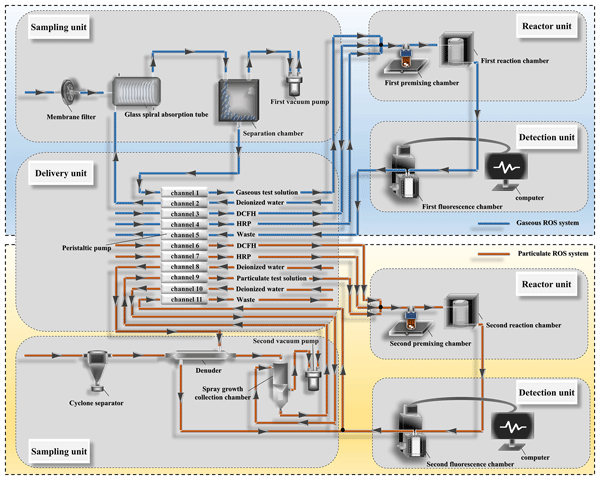
Abstract. An integrated online analyzer was developed for in situ, synchronous quantification of reactive oxygen species (ROS) in gaseous and particulate phases. Gaseous ROS (ROSg) are absorbed by a glass spiral absorption tube, whereas particulate ROS (ROSp) are collected at ambient temperature using a rotating wet annular denuder (WAD) for gas removal followed by a spray growth collection chamber. The collected solutions are analyzed using a fluorescence probe method, and the resulting fluorescent signal is recorded using a compact LED-PMT module (470/520 nm) and LabVIEW-based acquisition. The system achieved high stability (RSD 0.37 % over 10 h), fast tracking (7 min response), good repeatability (RSD 0.57 %, n = 10), and robust linearity (y ≈ 0.1x, R2 = 0.99) with detection limits of 0.07 ppbv (ROSg) and 0.006 µg m-3 (ROSp) expressed as H2O2 equivalents. Field deployment in Beijing across four seasons revealed pronounced seasonal, diurnal, and pollution-regime dependence. ROSg and ROSp were highest in spring, while autumn exhibited the lowest levels despite severe PM2.5 pollution. During humid autumn haze, enhanced aerosol water and secondary inorganic accumulation coincided with only modest ROSg growth and constrained ROSp, indicating rapid multiphase turnover and efficient condensed-phase loss. In contrast, ozone-driven pollution in spring and summer strengthened photochemical production and gas-particle coupling, increasing ROS in both phases. Both ROSg and ROSp declined coherently during pollution clean-up, linking ROS variability to coupled changes in oxidation, partitioning, and removal.
Competing interests: Keding Lu is a member of the editorial board of Atmospheric Measurement Techniques. The authors have no other competing interests to declare.
Publisher's note: Copernicus Publications remains neutral with regard to jurisdictional claims made in the text, published maps, institutional affiliations, or any other geographical representation in this paper. While Copernicus Publications makes every effort to include appropriate place names, the final responsibility lies with the authors. Views expressed in the text are those of the authors and do not necessarily reflect the views of the publisher.-
Notice on discussion status
The requested preprint has a corresponding peer-reviewed final revised paper. You are encouraged to refer to the final revised version.
-
Preprint
(2337 KB)
-
Supplement
(593 KB)
-
The requested preprint has a corresponding peer-reviewed final revised paper. You are encouraged to refer to the final revised version.
- Preprint
(2337 KB) - Metadata XML
-
Supplement
(593 KB) - BibTeX
- EndNote
- Final revised paper


Journal article(s) based on this preprint
Interactive discussion
Status: closed
-
RC1: 'Comment on egusphere-2026-1955', Anonymous Referee #1, 03 May 2026
- AC1: 'Reply on RC1', Keding Lu, 15 Jun 2026
-
RC2: 'Comment on egusphere-2026-1955', Anonymous Referee #2, 15 May 2026
This manuscript presents an integrated online analyzer for the synchronous measurement of gaseous and particulate reactive oxygen species, based on the DCFH-HRP fluorescence method, together with a four-season field campaign in Beijing. The synchronous dual-phase capability and the seasonal dataset are useful contributions. However, several issues regarding methodological rigor, the reliability of key performance metrics, and the interpretation of the field data should be addressed.
Major Comments
- Definition and chemical selectivity of the measurement. The DCFH-HRP system responds very differently to different ROS species, and after wet-chemical absorption the instrument effectively quantifies only the water-soluble, DCFH-reactive subset of ROS. I suggest the authors state explicitly what operationally-defined quantity is measured, and revise the wording in the Abstract and Conclusions (e.g., "DCFH-reactive water-soluble ROS, as H₂O₂ equivalents") so the values are not read as total ROS.
- Collection efficiencies (γp). Eq. 2.5 includes Mwall (wall-deposited material) in the numerator, but this fraction is recovered only by offline rinsing and does not enter the detection path during routine operation. The effective online efficiency would be closer to 81.72%, implying the reported ROSp values may be underestimated by ~10%. Please either (1) adopt Mcol / (Mcol + Mwall + Mfilter) as the collection efficiency and revise the ROSp values throughout the manuscript accordingly, (2) demonstrate that wall deposits could be eventually detected, or (3) explicitly discuss the direction and magnitude of this bias.
- Interference assessment relies largely on the literature. Section 3.3 discusses O₃, NO, SO₂, and Fe interferences almost entirely from prior studies, without tests on this instrument. Since the present configuration (pH 7.0, 10 µM DCFH, 2 units mL⁻¹ HRP) differs from those works, I recommend adding at least some direct interference tests. Also, in lines 315–318, you mention that "In fluorescence-based H₂O₂ detection, SO₂ can interfere with fluorophore formation through acid-catalyzed reactions. This interference can be fully suppressed by adding formaldehyde." Please clarify whether formaldehyde is actually used for SO₂ suppression in this study; if so, it does not appear in the flow schematic.
- Correlation versus causation in the field interpretation. Several mechanistic interpretations in Section 4 rest on relatively weak correlations. Please provide p-values (or confidence intervals) and sample sizes, and consider tempering the mechanistic claims for relationships with |r| < 0.3.
- Mismatch between calibration range and ambient concentrations. The calibration covers atmospheric equivalents of 2.88–14.41 ppbv (ROSg) and 0.29–1.49 µg m⁻³ (ROSp), yet essentially all seasonal-mean field values fall below or close to the lowest calibration point. Low-concentration linearity is unverified; reagent auto-oxidation and blank-subtraction errors contribute proportionally more at low signal, and the near-zero-intercept calibration becomes sensitive to small intercept errors. I recognize the campaign has concluded; nonetheless, it would be valuable to perform a low-range verification at the current instrument state and use any campaign QA/QC records to constrain drift.
- Contradiction with previous Beijing observations. Huang et al. (2016), using a closely related instrument at a rural Beijing site, found ROS higher in winter than spring; the present study (urban Beijing) finds spring highest and autumn lowest. Please discuss the possible reasons for the opposite seasonal ranking.
Minor Comments
- Eq. 2.3. The factor (T₀/T)(P₀/P) appears inverted; it should read (T₀/T)(P/P₀). Please correct and confirm whether the reported ROSg values were affected.
- Table 1. The bolded optimal row for temperature effects is 37 °C, whereas the text (line 234) states 40 °C was selected. Please reconcile.
- A short paragraph acknowledging the methodological limitations would be a useful addition in the conclusion section.
Citation: https://doi.org/10.5194/egusphere-2026-1955-RC2 - AC2: 'Reply on RC2', Keding Lu, 15 Jun 2026
Peer review completion


Interactive discussion
Status: closed
-
RC1: 'Comment on egusphere-2026-1955', Anonymous Referee #1, 03 May 2026
This manuscript presents the development and application of an integrated online system for simultaneous measurements of gaseous and particulate reactive oxygen species (ROS). As ROS is a key driver of atmospheric oxidative potential and associated health impacts, the ability to measure gas-phase and particle-phase ROS synchronously is valuable for improving our understanding of atmospheric chemistry and exposure pathways. Overall, this work is within the scope of AMT, the developed instrument is well-characterized, and the four-season field observation validates the robust application of the instrument. However, several issues need to be addressed before publication.
- The paper would be strengthened by a direct comparison table of the present instrument vs. earlier online ROS analyzers (e.g., the instrument by Huang et al., AE, 2016; King and Weber, AMT, 2013). Compare the key parameters: time resolution, LOD for gas and particle phase, reagent consumption, portability, and major artifacts. Also, clarify how the present system differs from the earlier instruments.
- The authors did interference assessments with individual species. However, in the real atmosphere, these soluble species coexist, and do the authors also test with the mixture of all these soluble species (i.e., O3, NOx, SO2, and transition metals)?
- All ROS concentrations are expressed as “H2O2 equivalents” using H2O2 standards. Given that ambient ROS comprises a mixture of peroxides, radicals, and possibly other oxidants, the authors should clarify the sensitivity of the DCFH probe to different types of ROS and discuss the possible limitations of using the DCFH assay.
- The ROSp collection efficiency (91.2%) was derived from recovery experiments with three fractions (chamber liquid, wall rinse, backup filter). Was this efficiency constant over the range of ambient PM loads and compositions? High PM loading might alter wall loss or droplet growth efficiency. Also, please clarify the reproducibility of the efficiency measurement (e.g., triplicate tests) and whether it was rechecked after extended field use.
- Line 134: “~0.13 s” residence time in the glass spiral absorber. How was this estimated? Provide the calculation or a reference.
- Please provide a brief introduction about the field site used for instrument validation.
- Line 344, ROSg and ROSp have the same seasonal pattern, why “whereas” is in the sentence?
Citation: https://doi.org/10.5194/egusphere-2026-1955-RC1 - AC1: 'Reply on RC1', Keding Lu, 15 Jun 2026
-
RC2: 'Comment on egusphere-2026-1955', Anonymous Referee #2, 15 May 2026
This manuscript presents an integrated online analyzer for the synchronous measurement of gaseous and particulate reactive oxygen species, based on the DCFH-HRP fluorescence method, together with a four-season field campaign in Beijing. The synchronous dual-phase capability and the seasonal dataset are useful contributions. However, several issues regarding methodological rigor, the reliability of key performance metrics, and the interpretation of the field data should be addressed.
Major Comments
- Definition and chemical selectivity of the measurement. The DCFH-HRP system responds very differently to different ROS species, and after wet-chemical absorption the instrument effectively quantifies only the water-soluble, DCFH-reactive subset of ROS. I suggest the authors state explicitly what operationally-defined quantity is measured, and revise the wording in the Abstract and Conclusions (e.g., "DCFH-reactive water-soluble ROS, as H₂O₂ equivalents") so the values are not read as total ROS.
- Collection efficiencies (γp). Eq. 2.5 includes Mwall (wall-deposited material) in the numerator, but this fraction is recovered only by offline rinsing and does not enter the detection path during routine operation. The effective online efficiency would be closer to 81.72%, implying the reported ROSp values may be underestimated by ~10%. Please either (1) adopt Mcol / (Mcol + Mwall + Mfilter) as the collection efficiency and revise the ROSp values throughout the manuscript accordingly, (2) demonstrate that wall deposits could be eventually detected, or (3) explicitly discuss the direction and magnitude of this bias.
- Interference assessment relies largely on the literature. Section 3.3 discusses O₃, NO, SO₂, and Fe interferences almost entirely from prior studies, without tests on this instrument. Since the present configuration (pH 7.0, 10 µM DCFH, 2 units mL⁻¹ HRP) differs from those works, I recommend adding at least some direct interference tests. Also, in lines 315–318, you mention that "In fluorescence-based H₂O₂ detection, SO₂ can interfere with fluorophore formation through acid-catalyzed reactions. This interference can be fully suppressed by adding formaldehyde." Please clarify whether formaldehyde is actually used for SO₂ suppression in this study; if so, it does not appear in the flow schematic.
- Correlation versus causation in the field interpretation. Several mechanistic interpretations in Section 4 rest on relatively weak correlations. Please provide p-values (or confidence intervals) and sample sizes, and consider tempering the mechanistic claims for relationships with |r| < 0.3.
- Mismatch between calibration range and ambient concentrations. The calibration covers atmospheric equivalents of 2.88–14.41 ppbv (ROSg) and 0.29–1.49 µg m⁻³ (ROSp), yet essentially all seasonal-mean field values fall below or close to the lowest calibration point. Low-concentration linearity is unverified; reagent auto-oxidation and blank-subtraction errors contribute proportionally more at low signal, and the near-zero-intercept calibration becomes sensitive to small intercept errors. I recognize the campaign has concluded; nonetheless, it would be valuable to perform a low-range verification at the current instrument state and use any campaign QA/QC records to constrain drift.
- Contradiction with previous Beijing observations. Huang et al. (2016), using a closely related instrument at a rural Beijing site, found ROS higher in winter than spring; the present study (urban Beijing) finds spring highest and autumn lowest. Please discuss the possible reasons for the opposite seasonal ranking.
Minor Comments
- Eq. 2.3. The factor (T₀/T)(P₀/P) appears inverted; it should read (T₀/T)(P/P₀). Please correct and confirm whether the reported ROSg values were affected.
- Table 1. The bolded optimal row for temperature effects is 37 °C, whereas the text (line 234) states 40 °C was selected. Please reconcile.
- A short paragraph acknowledging the methodological limitations would be a useful addition in the conclusion section.
Citation: https://doi.org/10.5194/egusphere-2026-1955-RC2 - AC2: 'Reply on RC2', Keding Lu, 15 Jun 2026
Peer review completion
Journal article(s) based on this preprint
Data sets
An Integrated Synchronous Online Analyzer for Gaseous and Particulate Reactive Oxygen Species (ROS): Development, Characterization and Field Observations Yihui Wang https://doi.org/10.5281/zenodo.19446597
Viewed
| HTML | XML | Total | Supplement | BibTeX | EndNote | |
|---|---|---|---|---|---|---|
| 331 | 178 | 53 | 562 | 74 | 46 | 43 |
- HTML: 331
- PDF: 178
- XML: 53
- Total: 562
- Supplement: 74
- BibTeX: 46
- EndNote: 43
Viewed (geographical distribution)
| Country | # | Views | % |
|---|
| Total: | 0 |
| HTML: | 0 |
| PDF: | 0 |
| XML: | 0 |
- 1
Yihui Wang
Huan Song
Huabin Dong
Shiyi Chen

The requested preprint has a corresponding peer-reviewed final revised paper. You are encouraged to refer to the final revised version.
- Preprint
(2337 KB) - Metadata XML
-
Supplement
(593 KB) - BibTeX
- EndNote
- Final revised paper
This manuscript presents the development and application of an integrated online system for simultaneous measurements of gaseous and particulate reactive oxygen species (ROS). As ROS is a key driver of atmospheric oxidative potential and associated health impacts, the ability to measure gas-phase and particle-phase ROS synchronously is valuable for improving our understanding of atmospheric chemistry and exposure pathways. Overall, this work is within the scope of AMT, the developed instrument is well-characterized, and the four-season field observation validates the robust application of the instrument. However, several issues need to be addressed before publication.