
the Creative Commons Attribution 4.0 License.
the Creative Commons Attribution 4.0 License.
 | 16 Apr 2026
Improved representation of isoprene-derived secondary organic aerosol in CAM6-Chem reveals regional contrasts in its long-term changes over China
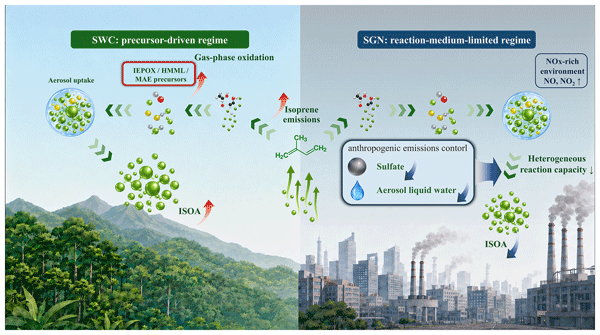
Abstract. Isoprene-derived secondary organic aerosol (ISOA) is an important component of atmospheric organic aerosol, but its formation remains incompletely represented in global chemical models, creating uncertainty in ISOA changes and their drivers. In this study, we updated the explicit isoprene chemistry scheme in Community Atmosphere Model version 6 with comprehensive tropospheric and stratospheric chemistry (CAM6-Chem) by adding isoprene epoxydiols reactive uptake to aerosol liquid water under low-NOx conditions and key gas-phase precursors and subsequent heterogeneous processes under high-NOx conditions. Evaluation against ground-based observations shows that the updated model better reproduces the concentrations and compositional structure of four ISOA subspecies, rather than only one in the default model. At the bulk aerosol level, the update alleviates the underestimation of SOA over China, improving normalized mean bias from −76.7 % to −50.0 %. ISOA formation in China is governed by NOx-dependent competition between the low- and high-NOx pathways, with the former remaining dominant at the national scale. Long-term analysis for 2000–2019 shows a weak national-mean ISOA trend due to offsetting regional changes of opposite signs. The most pronounced increase occurs in Southwest China, where enhanced biogenic isoprene emissions account for 61.92 % of ISOA increase, whereas the strongest decrease occurs in the Shaanxi–Gansu–Ningxia region, where increasing anthropogenic nitrogen oxides (NOx) emissions and declining sulfate account for 48.96 % and 45.11 % of the decrease, respectively. These results highlight the regional heterogeneity of ISOA changes in China and the importance of jointly representing precursor supply and heterogeneous reaction conditions in simulating ISOA formation and trends.
Competing interests: At least one of the (co-)authors is a member of the editorial board of Atmospheric Chemistry and Physics. The peer-review process was guided by an independent editor, and the authors also have no other competing interests to declare.
Publisher's note: Copernicus Publications remains neutral with regard to jurisdictional claims made in the text, published maps, institutional affiliations, or any other geographical representation in this paper. While Copernicus Publications makes every effort to include appropriate place names, the final responsibility lies with the authors. Views expressed in the text are those of the authors and do not necessarily reflect the views of the publisher.-
Notice on discussion status
The requested preprint has a corresponding peer-reviewed final revised paper. You are encouraged to refer to the final revised version.
-
Preprint
(5866 KB)
-
Supplement
(6812 KB)
-
The requested preprint has a corresponding peer-reviewed final revised paper. You are encouraged to refer to the final revised version.
- Preprint
(5866 KB) - Metadata XML
-
Supplement
(6812 KB) - BibTeX
- EndNote
- Final revised paper


Journal article(s) based on this preprint
Interactive discussion
Status: closed
-
RC1: 'Comment on egusphere-2026-1954', Anonymous Referee #1, 05 May 2026
-
AC1: 'Reply on RC1', Wenxin Zhang, 05 Jul 2026
The comment was uploaded in the form of a supplement: https://egusphere.copernicus.org/preprints/2026/egusphere-2026-1954/egusphere-2026-1954-AC1-supplement.pdf
-
AC1: 'Reply on RC1', Wenxin Zhang, 05 Jul 2026
-
RC2: 'Comment on egusphere-2026-1954', Anonymous Referee #2, 06 May 2026
The authors have updated CAM6‑Chem’s treatment of isoprene-derived secondary organic aerosol by explicitly representing low- and high‑NOₓ formation pathways, including IEPOX uptake and key heterogeneous processes. These updates substantially improve agreement with observed ISOA composition and reduce the model’s SOA underestimation over China. Their results show that ISOA formation is controlled by regional contrasts.
This manuscript presents an important modeling study that addresses a recognized limitation in current global modeling. The work is appropriate for publication in ACP. I have minor comments that would strengthening the manuscript prior to acceptance.
line 140: was there an evaluation of the MPAN addition on gas phase performance? Not sure if any obs data is available, if so something that could be added to the SI
Figure 2a,b - can you move the legend so it interferes with data on plot
figure 2b - hard to see the changes maybe show differences instead of values
figure 2c - hard to see what changed from the update; also hard to see numbers in the pie chartfigure 3c - this is difficult to read consider portraying in a different way
line 233 - could you expand more on this underestimation exploring space/time of the error. Also were certain times/locations more improved by your updates than others?
line 305 - you include compositional data in the plot but don't discuss it here. suggest adding some text
line 308 - missing the OH data?
Figure 4b - missing the OH data?
line 341 quantify "increases markedly"
figure 5 - pink and yellow seem to wash out on my screen suggest different colors; yellow bar hard to see; maybe put yellow bar on 2nd y axis and represent the ratio as a floating number value above the bars
Table 1 - caption spell out SWC SCN
Figure 8 - no need to make all these plots different colors since they are in different panels. some of the lighter colors harder to see
line 500 - could you expand on the future impacts in other regions where IEPOX SOA could be a major source (SE USA, Central Africa, Amazon, etc)
consider adding to intro and discussion these recent refs:
Ng A.E.*, Chen Y., Green J., Farrell S., Surratt J.D., Ault A.P., Turpin B.J., Vizuete W.C (2025) “Regional-Scale Modeling Parameterizations for Secondary Organic Aerosol Formation from Isoprene Epoxydiols: Experimentally Based Evaluation and Optimization” ACS ES&T Air, 2, 11, 2625–2637, https://doi.org/10.1021/acsestair.5c00258Farrell S.L.*, Rasool Q.Z., Pye H.O.T., Zhang Y., Li Y., Chen Y., Wang C.T., Zhang H., Schmedding R., Shiraiwa M., Greene J., Budisulistiorini S.H., Jimenez J.L., Hu W., Surratt J.D., Vizuete W.C (2025) “Simulated reductions in Heterogeneous Isoprene Epoxydiol Reactive Uptake from aerosol morphology in the contiguous United States using the Community Multiscale Air Quality Model (CMAQv5.3.2)” EGUsphere, https://doi.org/10.5194/egusphere-2025-2253
Schmedding, R.*, Rasool, Q.Z.*, Zhang, Y., Pye, H.O.T., Zhang, H., Chen, Y., Surratt, J.D., Lopez-Hilfiker, F.D., Thornton, J.A., Goldstein, A.H. and Vizuete, W.C (2020) “Predicting secondary organic aerosol phase state and viscosity and its effect on multiphase chemistry in a regional-scale air quality model.” Atmospheric Chemistry and Physics 20(13): 8201-8225.
Citation: https://doi.org/10.5194/egusphere-2026-1954-RC2 -
AC2: 'Reply on RC2', Wenxin Zhang, 05 Jul 2026
The comment was uploaded in the form of a supplement: https://egusphere.copernicus.org/preprints/2026/egusphere-2026-1954/egusphere-2026-1954-AC2-supplement.pdf
-
AC2: 'Reply on RC2', Wenxin Zhang, 05 Jul 2026
-
RC3: 'Comment on egusphere-2026-1954', Anonymous Referee #3, 08 May 2026
The comment was uploaded in the form of a supplement: https://egusphere.copernicus.org/preprints/2026/egusphere-2026-1954/egusphere-2026-1954-RC3-supplement.pdf
-
AC3: 'Reply on RC3', Wenxin Zhang, 05 Jul 2026
The comment was uploaded in the form of a supplement: https://egusphere.copernicus.org/preprints/2026/egusphere-2026-1954/egusphere-2026-1954-AC3-supplement.pdf
-
AC3: 'Reply on RC3', Wenxin Zhang, 05 Jul 2026
-
RC4: 'Comment on egusphere-2026-1954', Anonymous Referee #4, 08 May 2026
This work by Zhang et al. (2026) assesses the impacts of incorporating additional isoprene chemistry into CAM6-Chem. Isoprene’s low-NOx pathway was updated and a high-NOx pathway was introduced. Comparison with observational data revealed improvements in composition and isoprene-derived secondary organic aerosol (ISOA) representation. A spatial analysis, which revealed opposite trends in different regions, provided insight into the weak national-mean ISOA trend in China.
This study addressed a relevant and important research question and conducted a broad range of analyses to substantiate the claim that their updates to the CAM6-Chem isoprene oxidation mechanism led to improved ISOA representation over China. Clarity could be improved in some areas and some figures require editing.
Major Comments
- This study assesses the impact of expanding the representation of ISOA subspecies in CAM6-Chem from one to four. Though it is briefly mentioned that “discrepancies in the fractional contributions of individual species” exist between the observed and modeled ISOA subspecies, more thoroughly addressing the significant overestimation in AIEOSN is necessary. Why might this be occurring? Since AIEOSN is the only ISOA subspecies present in the pre-updated and updated model, it might be insightful to show a comparison of AIEOSN concentrations before and after the update, if possible.
- The conclusion that the model updates improved SOA and OA representation is strongly substantiated by the comparison of normalized mean biases (NMB) with and without the updated isoprene chemistry. These NMB are calculated with observational OA/POA/SOA data from across China during 2013-2019. It may be helpful to expand on the calculation of these NMB (in [Lines 251-252]), given the different time periods and site-specific measurements. In [Line 251], the improvement of SOA representation is said to be “mainly owing to improved ISOA simulation”. This implies that there may be other factors contributing to this improvement. If this is the case, it would be helpful to expand on this further.
Technical Corrections/Suggestions
[Line 142] Need to define “MACR”.
[Eq 4] Need to define “k_org”.
[Lines 192-195] I’m assuming AIETET, AIEOSN, AHMGA, AHMOSN stand for Aerosol from IEPOX – tetrols, Aerosol from IEPOX – organosulfate/nitrate, Aerosol from HMML/MAE – glyceric acid, and Aerosol from HMML/MAE – organosulfate/nitrate. It’d be helpful to explicitly include this so readers can more easily understand the subsequent references/analyses. Could these be named something more intuitive? Such as AIEAQ, AIEOSN, AHMAQ, AHMOSN? Referring to IEPOX’s and HMML/MAE’s aqueous and organosulfate/nitrate pathways?
[Fig. 1] What is the difference between the dashed & solid arrows? Defining abbreviations in the figure caption would be helpful (at least for AeroWater, AIETET, AIEOSN, AHMGA, AHMOSN).
[Fig. 2a] It may be helpful to include a description of what the dark and light gray lines represent. I’d also modify this plot so that points aren’t being cut off (as seen on the x-axis). As for the legend, it would be helpful to modify it so that data points aren’t obscuring the text and so that the example markers in the legend can’t be mistaken for actual data.
[Fig. 2b] Same recommendation for legend as above. Include what the dark gray and light gray dashed lines represent in the figure caption.
[Fig. 2c] You specify what the rows represent in the figure caption; to be consistent, maybe do the same with the columns.
[Fig. 3] Adding titles above each plot and enlarging colorbar titles would be helpful. For part c, I’d move the legend to the top so that “AHMGA” isn’t obscured. Can you make a second legend circle size (in addition to the 60 ng/m^3 circle) that more closely resembles the largest pie chart in the plot?
[Fig. 4b] [OH] curve is missing! I’d clarify that you’re referring to background aerosol properties (not ISOA properties) in the caption.
[Table 1] It may be helpful to add a vertical line between the SWC and SGN results.
[Fig. 8] Include what the dashed curves represent in the figure caption.
[Line 529] A closing parenthesis is missing.
For clarity, I would replace the double-negative phrasing when describing percent changes (“decreased by -X%” → “decreased by X%” or “changed by -X%”).
Citation: https://doi.org/10.5194/egusphere-2026-1954-RC4 -
AC4: 'Reply on RC4', Wenxin Zhang, 05 Jul 2026
The comment was uploaded in the form of a supplement: https://egusphere.copernicus.org/preprints/2026/egusphere-2026-1954/egusphere-2026-1954-AC4-supplement.pdf
Peer review completion


Interactive discussion
Status: closed
-
RC1: 'Comment on egusphere-2026-1954', Anonymous Referee #1, 05 May 2026
Review of Improved representation of isoprene-derived secondary organic aerosol in CAM6-Chem reveals regional contrasts in its long-term changes over China by Wenxin Zhang et al.,
This manuscript presents an updated representation of isoprene-derived secondary organic aerosol (ISOA) in CAM6-Chem, incorporating both the IEPOX (low-NOx) pathway and the MAE/HMML (high-NOx) pathway, along with an explicit treatment of aerosol liquid water in multiphase chemistry. The authors evaluate the updated mechanism against multiple observational datasets and use it to investigate long-term (2000–2019) ISOA trends across China.
The study finds that while national-mean ISOA trends are weak, they mask strong regional contrasts, with increasing ISOA mass in Southwest China (SWC) driven primarily by enhanced biogenic isoprene emissions and decreasing ISOA in the Shaanxi–Gansu–Ningxia region (SGN) driven by declining sulfate and changing NOx emissions. Overall, this is a careful and well-executed modeling study that addresses a known gap in global models. The manuscript is suitable for ACP, but several aspects require clarification and strengthening before publication.
Major Comments
- The manuscript contains an important underlying idea that ISOA formation reflects a balance between precursor supply (e.g., isoprene, NOx) and heterogeneous reaction capacity (e.g., sulfate, aerosol liquid water, acidity). However, this is not fully developed into a clear conceptual framework. For example, on lines 369–373, the authors note that increases in isoprene emissions coincide with decreases in sulfate and aerosol liquid water, implying competing controls on ISOA formation. Similarly, the regional contrast between SWC and SGN is interpreted in terms of precursor supply versus reaction medium limitations (e.g., lines 410–417). These are strong and insightful points, but they need to be synthesized into a broader framework.
Consider explicitly framing the results in terms of regimes (e.g., precursor-limited vs. reaction-medium-limited ISOA formation) and summarizing this in a conceptual schematic or synthesis figure. - The manuscript relies heavily on multiple linear regression to quantify the relative importance of drivers. For example, in the supplement (Text S1), the authors state that isoprene emissions account for ~49.9% of the relative importance of ISOA variability in SWC based on standardized regression coefficients. Similarly, in the main text (Section 3.3), regression-based contributions are used to attribute long-term trends. While these diagnostics are useful, the predictors (e.g., sulfate, aerosol water, emissions) are likely to be strongly covarying over time, which complicates interpretation. Because aerosol liquid water is calculated thermodynamically within MOSAIC from inorganic aerosol composition, including sulfate, sulfate and aerosol liquid water are not fully independent predictors. This should be acknowledged in the regression interpretation, particularly where sulfate and aerosol liquid water are both treated as separate explanatory variables. Please clarify that regression-based importance reflects statistical association rather than strict causality and discuss potential collinearity among predictors. I suggest tempering the language when assigning quantitative contributions. For example, replace “accounts for X%” with “is strongly associated with” or “emerges as a leading statistical predictor” while also discussing the potential impact of predictor covariance on the interpretation.
- Several key assumptions and uncertainties are central to the modeling framework and should be more clearly discussed. For example, lines 151–153, HMML and MAE are assumed to have the same solubility and diffusivity as IEPOX and lines 196–198, SOA yields from epoxide uptake are assumed to be 100% and treated as non-volatile. These assumptions are consistent with prior studies but introduce uncertainty in both magnitude and trends of ISOA that shape interpretation.How do these assumptions influence the reported findings concerning the relative importance of high-NOx vs. low-NOx pathways, sensitivity to sulfate and aerosol liquid water and long-term trend attributions?
- The updated model improves SOA representation but still exhibits substantial positive bias for key tracers (e.g., lines 232–233, normalized mean biases of 47.4% (AIETET) and 81.6% (AHMGA) are reported). While the manuscript notes that similar biases exist in previous studies, the causes of these discrepancies are not explored in detail. Provide additional discussion of possible sources of bias such as: missing competing loss pathways, uncertainties in heterogeneous uptake, representation of precursor chemistry.
- The manuscript focuses on China, which is appropriate given the emissions context. However, the findings likely have broader implications. For example, on lines 80–85, the authors discuss prior work linking sulfate reductions to declines in ISOA in the United States. The present results extend this by showing that inclusion of high-NOx pathways can alter both magnitude and attribution of ISOA trends. What may be inferred for the US or other regions based on the findings reported here?
Minor Comments
- Some sections could be streamlined for clarity (e.g., repeated discussion of pathway sensitivities).
- Consider adding a synthesis figure summarizing regional drivers of ISOA trends.
- A brief summary of the regression approach in the main text (currently primarily in the supplement) would improve accessibility.
- Line 230: “We validated the simulated AIETET against ….” Validated should be evaluated.
- Line 308 / Figure 4b imprecise wording: The authors state that “Aerosol pH also varies substantially through the year and is relatively higher in late spring and early summer.” However, Fig. 4b presents standardized seasonal cycles (z-scores), not aerosol pH values. Therefore, the figure does not show the actual pH magnitude or allow the reader to assess whether pH is chemically “high” in an absolute sense. Please either revise the wording to indicate that standardized pH anomalies are higher in late spring/early summer, or provide actual monthly pH values, perhaps in the supplement.
P.S. I really love the spatial differences in Figure 3a vs. 3b!
Citation: https://doi.org/10.5194/egusphere-2026-1954-RC1 -
AC1: 'Reply on RC1', Wenxin Zhang, 05 Jul 2026
The comment was uploaded in the form of a supplement: https://egusphere.copernicus.org/preprints/2026/egusphere-2026-1954/egusphere-2026-1954-AC1-supplement.pdf
- The manuscript contains an important underlying idea that ISOA formation reflects a balance between precursor supply (e.g., isoprene, NOx) and heterogeneous reaction capacity (e.g., sulfate, aerosol liquid water, acidity). However, this is not fully developed into a clear conceptual framework. For example, on lines 369–373, the authors note that increases in isoprene emissions coincide with decreases in sulfate and aerosol liquid water, implying competing controls on ISOA formation. Similarly, the regional contrast between SWC and SGN is interpreted in terms of precursor supply versus reaction medium limitations (e.g., lines 410–417). These are strong and insightful points, but they need to be synthesized into a broader framework.
-
RC2: 'Comment on egusphere-2026-1954', Anonymous Referee #2, 06 May 2026
The authors have updated CAM6‑Chem’s treatment of isoprene-derived secondary organic aerosol by explicitly representing low- and high‑NOₓ formation pathways, including IEPOX uptake and key heterogeneous processes. These updates substantially improve agreement with observed ISOA composition and reduce the model’s SOA underestimation over China. Their results show that ISOA formation is controlled by regional contrasts.
This manuscript presents an important modeling study that addresses a recognized limitation in current global modeling. The work is appropriate for publication in ACP. I have minor comments that would strengthening the manuscript prior to acceptance.
line 140: was there an evaluation of the MPAN addition on gas phase performance? Not sure if any obs data is available, if so something that could be added to the SI
Figure 2a,b - can you move the legend so it interferes with data on plot
figure 2b - hard to see the changes maybe show differences instead of values
figure 2c - hard to see what changed from the update; also hard to see numbers in the pie chartfigure 3c - this is difficult to read consider portraying in a different way
line 233 - could you expand more on this underestimation exploring space/time of the error. Also were certain times/locations more improved by your updates than others?
line 305 - you include compositional data in the plot but don't discuss it here. suggest adding some text
line 308 - missing the OH data?
Figure 4b - missing the OH data?
line 341 quantify "increases markedly"
figure 5 - pink and yellow seem to wash out on my screen suggest different colors; yellow bar hard to see; maybe put yellow bar on 2nd y axis and represent the ratio as a floating number value above the bars
Table 1 - caption spell out SWC SCN
Figure 8 - no need to make all these plots different colors since they are in different panels. some of the lighter colors harder to see
line 500 - could you expand on the future impacts in other regions where IEPOX SOA could be a major source (SE USA, Central Africa, Amazon, etc)
consider adding to intro and discussion these recent refs:
Ng A.E.*, Chen Y., Green J., Farrell S., Surratt J.D., Ault A.P., Turpin B.J., Vizuete W.C (2025) “Regional-Scale Modeling Parameterizations for Secondary Organic Aerosol Formation from Isoprene Epoxydiols: Experimentally Based Evaluation and Optimization” ACS ES&T Air, 2, 11, 2625–2637, https://doi.org/10.1021/acsestair.5c00258Farrell S.L.*, Rasool Q.Z., Pye H.O.T., Zhang Y., Li Y., Chen Y., Wang C.T., Zhang H., Schmedding R., Shiraiwa M., Greene J., Budisulistiorini S.H., Jimenez J.L., Hu W., Surratt J.D., Vizuete W.C (2025) “Simulated reductions in Heterogeneous Isoprene Epoxydiol Reactive Uptake from aerosol morphology in the contiguous United States using the Community Multiscale Air Quality Model (CMAQv5.3.2)” EGUsphere, https://doi.org/10.5194/egusphere-2025-2253
Schmedding, R.*, Rasool, Q.Z.*, Zhang, Y., Pye, H.O.T., Zhang, H., Chen, Y., Surratt, J.D., Lopez-Hilfiker, F.D., Thornton, J.A., Goldstein, A.H. and Vizuete, W.C (2020) “Predicting secondary organic aerosol phase state and viscosity and its effect on multiphase chemistry in a regional-scale air quality model.” Atmospheric Chemistry and Physics 20(13): 8201-8225.
Citation: https://doi.org/10.5194/egusphere-2026-1954-RC2 -
AC2: 'Reply on RC2', Wenxin Zhang, 05 Jul 2026
The comment was uploaded in the form of a supplement: https://egusphere.copernicus.org/preprints/2026/egusphere-2026-1954/egusphere-2026-1954-AC2-supplement.pdf
-
AC2: 'Reply on RC2', Wenxin Zhang, 05 Jul 2026
-
RC3: 'Comment on egusphere-2026-1954', Anonymous Referee #3, 08 May 2026
The comment was uploaded in the form of a supplement: https://egusphere.copernicus.org/preprints/2026/egusphere-2026-1954/egusphere-2026-1954-RC3-supplement.pdf
-
AC3: 'Reply on RC3', Wenxin Zhang, 05 Jul 2026
The comment was uploaded in the form of a supplement: https://egusphere.copernicus.org/preprints/2026/egusphere-2026-1954/egusphere-2026-1954-AC3-supplement.pdf
-
AC3: 'Reply on RC3', Wenxin Zhang, 05 Jul 2026
-
RC4: 'Comment on egusphere-2026-1954', Anonymous Referee #4, 08 May 2026
This work by Zhang et al. (2026) assesses the impacts of incorporating additional isoprene chemistry into CAM6-Chem. Isoprene’s low-NOx pathway was updated and a high-NOx pathway was introduced. Comparison with observational data revealed improvements in composition and isoprene-derived secondary organic aerosol (ISOA) representation. A spatial analysis, which revealed opposite trends in different regions, provided insight into the weak national-mean ISOA trend in China.
This study addressed a relevant and important research question and conducted a broad range of analyses to substantiate the claim that their updates to the CAM6-Chem isoprene oxidation mechanism led to improved ISOA representation over China. Clarity could be improved in some areas and some figures require editing.
Major Comments
- This study assesses the impact of expanding the representation of ISOA subspecies in CAM6-Chem from one to four. Though it is briefly mentioned that “discrepancies in the fractional contributions of individual species” exist between the observed and modeled ISOA subspecies, more thoroughly addressing the significant overestimation in AIEOSN is necessary. Why might this be occurring? Since AIEOSN is the only ISOA subspecies present in the pre-updated and updated model, it might be insightful to show a comparison of AIEOSN concentrations before and after the update, if possible.
- The conclusion that the model updates improved SOA and OA representation is strongly substantiated by the comparison of normalized mean biases (NMB) with and without the updated isoprene chemistry. These NMB are calculated with observational OA/POA/SOA data from across China during 2013-2019. It may be helpful to expand on the calculation of these NMB (in [Lines 251-252]), given the different time periods and site-specific measurements. In [Line 251], the improvement of SOA representation is said to be “mainly owing to improved ISOA simulation”. This implies that there may be other factors contributing to this improvement. If this is the case, it would be helpful to expand on this further.
Technical Corrections/Suggestions
[Line 142] Need to define “MACR”.
[Eq 4] Need to define “k_org”.
[Lines 192-195] I’m assuming AIETET, AIEOSN, AHMGA, AHMOSN stand for Aerosol from IEPOX – tetrols, Aerosol from IEPOX – organosulfate/nitrate, Aerosol from HMML/MAE – glyceric acid, and Aerosol from HMML/MAE – organosulfate/nitrate. It’d be helpful to explicitly include this so readers can more easily understand the subsequent references/analyses. Could these be named something more intuitive? Such as AIEAQ, AIEOSN, AHMAQ, AHMOSN? Referring to IEPOX’s and HMML/MAE’s aqueous and organosulfate/nitrate pathways?
[Fig. 1] What is the difference between the dashed & solid arrows? Defining abbreviations in the figure caption would be helpful (at least for AeroWater, AIETET, AIEOSN, AHMGA, AHMOSN).
[Fig. 2a] It may be helpful to include a description of what the dark and light gray lines represent. I’d also modify this plot so that points aren’t being cut off (as seen on the x-axis). As for the legend, it would be helpful to modify it so that data points aren’t obscuring the text and so that the example markers in the legend can’t be mistaken for actual data.
[Fig. 2b] Same recommendation for legend as above. Include what the dark gray and light gray dashed lines represent in the figure caption.
[Fig. 2c] You specify what the rows represent in the figure caption; to be consistent, maybe do the same with the columns.
[Fig. 3] Adding titles above each plot and enlarging colorbar titles would be helpful. For part c, I’d move the legend to the top so that “AHMGA” isn’t obscured. Can you make a second legend circle size (in addition to the 60 ng/m^3 circle) that more closely resembles the largest pie chart in the plot?
[Fig. 4b] [OH] curve is missing! I’d clarify that you’re referring to background aerosol properties (not ISOA properties) in the caption.
[Table 1] It may be helpful to add a vertical line between the SWC and SGN results.
[Fig. 8] Include what the dashed curves represent in the figure caption.
[Line 529] A closing parenthesis is missing.
For clarity, I would replace the double-negative phrasing when describing percent changes (“decreased by -X%” → “decreased by X%” or “changed by -X%”).
Citation: https://doi.org/10.5194/egusphere-2026-1954-RC4 -
AC4: 'Reply on RC4', Wenxin Zhang, 05 Jul 2026
The comment was uploaded in the form of a supplement: https://egusphere.copernicus.org/preprints/2026/egusphere-2026-1954/egusphere-2026-1954-AC4-supplement.pdf
Peer review completion
Journal article(s) based on this preprint
Viewed
| HTML | XML | Total | Supplement | BibTeX | EndNote | |
|---|---|---|---|---|---|---|
| 342 | 174 | 36 | 552 | 141 | 54 | 54 |
- HTML: 342
- PDF: 174
- XML: 36
- Total: 552
- Supplement: 141
- BibTeX: 54
- EndNote: 54
Viewed (geographical distribution)
| Country | # | Views | % |
|---|
| Total: | 0 |
| HTML: | 0 |
| PDF: | 0 |
| XML: | 0 |
- 1
Wenxin Zhang
Xinyue Shao

Minghuai Wang
The requested preprint has a corresponding peer-reviewed final revised paper. You are encouraged to refer to the final revised version.
- Preprint
(5866 KB) - Metadata XML
-
Supplement
(6812 KB) - BibTeX
- EndNote
- Final revised paper
Review of Improved representation of isoprene-derived secondary organic aerosol in CAM6-Chem reveals regional contrasts in its long-term changes over China by Wenxin Zhang et al.,
This manuscript presents an updated representation of isoprene-derived secondary organic aerosol (ISOA) in CAM6-Chem, incorporating both the IEPOX (low-NOx) pathway and the MAE/HMML (high-NOx) pathway, along with an explicit treatment of aerosol liquid water in multiphase chemistry. The authors evaluate the updated mechanism against multiple observational datasets and use it to investigate long-term (2000–2019) ISOA trends across China.
The study finds that while national-mean ISOA trends are weak, they mask strong regional contrasts, with increasing ISOA mass in Southwest China (SWC) driven primarily by enhanced biogenic isoprene emissions and decreasing ISOA in the Shaanxi–Gansu–Ningxia region (SGN) driven by declining sulfate and changing NOx emissions. Overall, this is a careful and well-executed modeling study that addresses a known gap in global models. The manuscript is suitable for ACP, but several aspects require clarification and strengthening before publication.
Major Comments
Consider explicitly framing the results in terms of regimes (e.g., precursor-limited vs. reaction-medium-limited ISOA formation) and summarizing this in a conceptual schematic or synthesis figure.
Minor Comments
P.S. I really love the spatial differences in Figure 3a vs. 3b!