
the Creative Commons Attribution 4.0 License.
the Creative Commons Attribution 4.0 License.
 | 14 Apr 2026
Evaluation of smoke mass concentration within the PBL based on observations of fluorescence lidar with several discreet channels
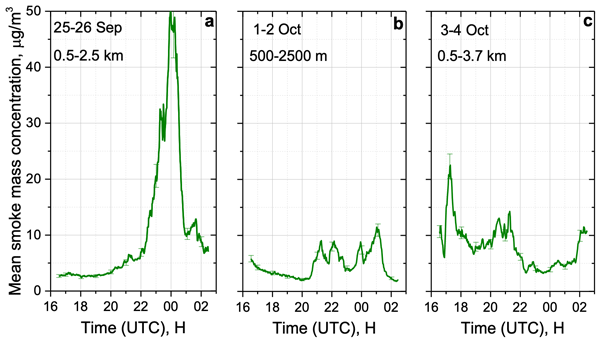
Abstract. Elevated concentrations of smoke within the planetary boundary layer (PBL) represent a significant health hazard, making its monitoring essential. This study demonstrates that a multi-channel fluorescence lidar can effectively analyze smoke–urban aerosol mixtures and retrieve smoke mass concentration. The method is based on the fundamentally distinct fluorescence spectra of the two aerosol types, with an estimated detection threshold on the order of 0.1 µg · m-3. Measurements performed over Moscow with a five-channel fluorescence lidar in 2023–2024 captured numerous smoke episodes across a wide altitude range from spring through autumn. In 2024 alone, smoke was detected in 59 out of 67 measurement sessions between April to October. Back-trajectory analysis indicates that most events were associated with long-range transport over Atlantic, with only 12 episodes originating from fires in southern Russia. Focusing on smoke within the PBL, the results show that long-range transported smoke from North American wildfires can descend and mix with this layer, contributing mass concentrations on the order of 1 µg · m-3. In contrast, regional wildfires in southern Russia led to substantially higher concentrations, with smoke mass in the PBL reaching up to 50 µg · m-3 during observed episodes.
-
Notice on discussion status
The requested preprint has a corresponding peer-reviewed final revised paper. You are encouraged to refer to the final revised version.
-
Preprint
(3791 KB)
-
The requested preprint has a corresponding peer-reviewed final revised paper. You are encouraged to refer to the final revised version.
- Preprint
(3791 KB) - Metadata XML
- BibTeX
- EndNote
- Final revised paper


Journal article(s) based on this preprint
Interactive discussion
Status: closed
-
RC1: 'Comment on egusphere-2026-1949', Anonymous Referee #1, 17 May 2026
-
AC1: 'Reply on RC1', Igor Veselovskii, 03 Jun 2026
The comment was uploaded in the form of a supplement: https://egusphere.copernicus.org/preprints/2026/egusphere-2026-1949/egusphere-2026-1949-AC1-supplement.pdf
-
AC1: 'Reply on RC1', Igor Veselovskii, 03 Jun 2026
-
RC2: 'Comment on egusphere-2026-1949', Anonymous Referee #2, 23 May 2026
The manuscript presents a useful method to discriminate smoke and urban aerosols using a five‑channel fluorescence lidar. The authors apply a linear separation of fluorescence signals and apply the POLIPHON algorithm to convert retrieved smoke fractions into mass concentrations. The technique is presented through multiple case studies with emphasis on smoke within the planetary boundary layer (PBL). Overall, the approach appears very promising, innovative and relevant for the discrimination of smoke/urban aerosols.
My recommendation is that the manuscript can be published after a few minor revisions. The dataset and overall concept are strong. The methodology and equations are well presented. A few minor points need further elaboration (clarify small methodological details and provide brief sensitivity checks) before publication.
Minor comments:
- One minor suggestion that may worth clarification is the selection of the fluorescence threshold. It would be helpful to know how this threshold was chosen and how sensitive the smoke/urban separation is to that specific choice.
- Another aspect that may deserve further discussion is the stability of the reference spectra under varying humidity conditions. In particular, it would be useful to know whether any sensitivity tests were performed for high-RH cases or if they will be part of another article maybe. Since humidity can influence both backscatter and fluorescence, it would also be helpful to comment on the expected bias in the retrieved smoke mass under humid conditions. Even a brief estimate or qualitative discussion would strengthen the interpretation.
- The linear separation approach is interesting, but a short justification of why it remains robust in mixed aerosol conditions would improve the methodology section. This is especially relevant where smoke and urban aerosols may strongly overlap. Moreover, the definition of the background or urban aerosol state could maybe be described in slightly more detail. It would also be interesting to indicate how sensitive the results are to that definition.
- Finally, for the case studies, a short statement on how representative the selected events are of the full dataset would improve the overall context. This would help to understand whether the examples shown are typical or more exceptional.
Technical suggestions:
- Line 125: Omit typo “:”.
- L183-183: I suggest changing the time label “23:00-24:00” to “23:00-00:00”.
- Figure 13: In the caption add “00:15-01:15 UTC”
- Figure 21: In the caption and Fig. 21a, I suggest changing the time label “24:00” to “00:00”.
Citation: https://doi.org/10.5194/egusphere-2026-1949-RC2 -
AC2: 'Reply on RC2', Igor Veselovskii, 03 Jun 2026
The comment was uploaded in the form of a supplement: https://egusphere.copernicus.org/preprints/2026/egusphere-2026-1949/egusphere-2026-1949-AC2-supplement.pdf
Peer review completion


Interactive discussion
Status: closed
-
RC1: 'Comment on egusphere-2026-1949', Anonymous Referee #1, 17 May 2026
Review of manuscript entitled “Evaluation of smoke mass concentration within the PBL based on observations of fluorescence lidar with several discreet channels” by Igor Veselovskii et al.
This study presents a novel method to separate smoke and urban aerosols from their mixtures using a 355-nm fluorescence lidar with five discreet channels, and to retrieve the mass concentration of smoke. The authors assume that the total measured fluorescence backscattering at a given wavelength can be linearly divided into the contributions from smoke and urban aerosol. Specifically, these contributions are calculated by multiplying fluorescence backscattering of pure smoke or pure urban aerosol (serving as reference values) by their respective coefficients, denoted as a and b, which are determined using the least squares method (Eq. (1)). This validity of this approach is verified by applying the fluorescence capacity of pure smoke and pure urban aerosol to calculate their respective backscattering at 355 nm, and then reconstructing the elastic backscatter at 355 nm. Then, using the derived backscatter of smoke and urban aerosol at 355 nm along with several parameters (particle density, lidar ratio, and extinction-to-volume conversion factor), the mass concentration of smoke is finally obtained via the POLIPHON method. The urban aerosol mass concentration is not retrieved due to the lack of a reliable and stable conversion factor.
Several case studies are presented, including long-range transported smoke from north America and southern Russia, as well as an extreme pollution event, demonstrating the feasibility of the proposed method. Using multi-channel fluorescence lidar further advances aerosol classification and enables the quantification of smoke mass concentration from aerosol mixtures. Overall, the method is sound and the manuscript is well-written. The authors have made significant contributions to the development of discreet-channel spectrally resolved fluorescence lidar and its application in aerosol studies. The manuscript can be accepted after minor revision. Some minor comments are given below.
- One concern is that the method is generally applicable only under relatively dry atmospheric conditions with RH below 70%, as high humidity can include hygroscopic growth and fluorescence quenching. A noted by the authors, this may lead to an underestimation of the derived smoke backscatter and, consequently, the smoke mass concentration, which is currently difficult to assess accurately. While the hygroscopic growth effect can potentially be quantified, could the authors consider quantitively investigating the impact of fluorescence quenching as well (is it feasible?), in order to extend the applicability of the proposed method to a wider range of atmospheric conditions? It would be also be beneficial to specify the applicable RH range in the abstract.
- In this study, the pre-required fluorescence capacity G for pure smoke and pure urban aerosol is calculated on a case-by-case basis, meaning that these values are case-specific and may vary depending on factors such as the smoke source, aging level, chemical composition, and so on. Is it possible to provide an analysis (either in this paper or in future work) that discusses typical G values that could be used for general classifications of smoke types (e.g., from north America and southern Russia, nearly-fresh partial-aged, and fully-aged, …)? Furthermore, is it feasible to obtain G values for pure smoke and pure urban aerosol for each case (in some cases, values from adjacent days may need to be used)? Are the G values for pure smoke highly variable from case to case?
- The manuscript presents a large number of figures and values across multiple cases. It would be helpful to include a summary table at the end of the result section, listing all key information, including the parameter values for each case.
Technical suggestions:
- L32, for spectral-resolved approach, a recently-published paper (Huang et al., 2025, doi: 1021/acs.est.5c00028) is also relevant.
- L47-48, for unaffected spectral shape, Liu et al. (2022) is also relevant (doi: 10.1109/TGRS.2022.3166191).
- L110, add ‘2024’ after ‘in September’
- L137, ‘only for smoke’, it would be better to mention aging level of the smoke particles
- Caption of Fig. 2., ‘five-day’ -> ‘six-day’
- L176, ‘2000 m’, as seen from Fig. 2, it is more likely linked to the green curve (i.e., 3500 m).
- L 181, add the launch time of radiosonde after ‘radiosonde’.
- L289, in the caption of Fig. 10, the period 02:30-03:30 was not the appearance of smoke plume (according to Fig. 8-9). Please confirm.
- L297, ‘accurately’->‘well’
Citation: https://doi.org/10.5194/egusphere-2026-1949-RC1 -
AC1: 'Reply on RC1', Igor Veselovskii, 03 Jun 2026
The comment was uploaded in the form of a supplement: https://egusphere.copernicus.org/preprints/2026/egusphere-2026-1949/egusphere-2026-1949-AC1-supplement.pdf
-
RC2: 'Comment on egusphere-2026-1949', Anonymous Referee #2, 23 May 2026
The manuscript presents a useful method to discriminate smoke and urban aerosols using a five‑channel fluorescence lidar. The authors apply a linear separation of fluorescence signals and apply the POLIPHON algorithm to convert retrieved smoke fractions into mass concentrations. The technique is presented through multiple case studies with emphasis on smoke within the planetary boundary layer (PBL). Overall, the approach appears very promising, innovative and relevant for the discrimination of smoke/urban aerosols.
My recommendation is that the manuscript can be published after a few minor revisions. The dataset and overall concept are strong. The methodology and equations are well presented. A few minor points need further elaboration (clarify small methodological details and provide brief sensitivity checks) before publication.
Minor comments:
- One minor suggestion that may worth clarification is the selection of the fluorescence threshold. It would be helpful to know how this threshold was chosen and how sensitive the smoke/urban separation is to that specific choice.
- Another aspect that may deserve further discussion is the stability of the reference spectra under varying humidity conditions. In particular, it would be useful to know whether any sensitivity tests were performed for high-RH cases or if they will be part of another article maybe. Since humidity can influence both backscatter and fluorescence, it would also be helpful to comment on the expected bias in the retrieved smoke mass under humid conditions. Even a brief estimate or qualitative discussion would strengthen the interpretation.
- The linear separation approach is interesting, but a short justification of why it remains robust in mixed aerosol conditions would improve the methodology section. This is especially relevant where smoke and urban aerosols may strongly overlap. Moreover, the definition of the background or urban aerosol state could maybe be described in slightly more detail. It would also be interesting to indicate how sensitive the results are to that definition.
- Finally, for the case studies, a short statement on how representative the selected events are of the full dataset would improve the overall context. This would help to understand whether the examples shown are typical or more exceptional.
Technical suggestions:
- Line 125: Omit typo “:”.
- L183-183: I suggest changing the time label “23:00-24:00” to “23:00-00:00”.
- Figure 13: In the caption add “00:15-01:15 UTC”
- Figure 21: In the caption and Fig. 21a, I suggest changing the time label “24:00” to “00:00”.
Citation: https://doi.org/10.5194/egusphere-2026-1949-RC2 -
AC2: 'Reply on RC2', Igor Veselovskii, 03 Jun 2026
The comment was uploaded in the form of a supplement: https://egusphere.copernicus.org/preprints/2026/egusphere-2026-1949/egusphere-2026-1949-AC2-supplement.pdf
Peer review completion
Journal article(s) based on this preprint
Viewed
| HTML | XML | Total | BibTeX | EndNote | |
|---|---|---|---|---|---|
| 333 | 151 | 45 | 529 | 43 | 41 |
- HTML: 333
- PDF: 151
- XML: 45
- Total: 529
- BibTeX: 43
- EndNote: 41
Viewed (geographical distribution)
| Country | # | Views | % |
|---|
| Total: | 0 |
| HTML: | 0 |
| PDF: | 0 |
| XML: | 0 |
- 1
Igor Veselovskii

Mikhail Korenskiy
Boris Barchunov
Nikita Kasianik
Qiaoyun Hu
Philippe Goloub
Thierry Podvin
The requested preprint has a corresponding peer-reviewed final revised paper. You are encouraged to refer to the final revised version.
- Preprint
(3791 KB) - Metadata XML
Review of manuscript entitled “Evaluation of smoke mass concentration within the PBL based on observations of fluorescence lidar with several discreet channels” by Igor Veselovskii et al.
This study presents a novel method to separate smoke and urban aerosols from their mixtures using a 355-nm fluorescence lidar with five discreet channels, and to retrieve the mass concentration of smoke. The authors assume that the total measured fluorescence backscattering at a given wavelength can be linearly divided into the contributions from smoke and urban aerosol. Specifically, these contributions are calculated by multiplying fluorescence backscattering of pure smoke or pure urban aerosol (serving as reference values) by their respective coefficients, denoted as a and b, which are determined using the least squares method (Eq. (1)). This validity of this approach is verified by applying the fluorescence capacity of pure smoke and pure urban aerosol to calculate their respective backscattering at 355 nm, and then reconstructing the elastic backscatter at 355 nm. Then, using the derived backscatter of smoke and urban aerosol at 355 nm along with several parameters (particle density, lidar ratio, and extinction-to-volume conversion factor), the mass concentration of smoke is finally obtained via the POLIPHON method. The urban aerosol mass concentration is not retrieved due to the lack of a reliable and stable conversion factor.
Several case studies are presented, including long-range transported smoke from north America and southern Russia, as well as an extreme pollution event, demonstrating the feasibility of the proposed method. Using multi-channel fluorescence lidar further advances aerosol classification and enables the quantification of smoke mass concentration from aerosol mixtures. Overall, the method is sound and the manuscript is well-written. The authors have made significant contributions to the development of discreet-channel spectrally resolved fluorescence lidar and its application in aerosol studies. The manuscript can be accepted after minor revision. Some minor comments are given below.
Technical suggestions: