
the Creative Commons Attribution 4.0 License.
the Creative Commons Attribution 4.0 License.
 | 29 Apr 2026
Impact of blowing snow on the surface radiation balance near the western margin of the Greenland Ice Sheet
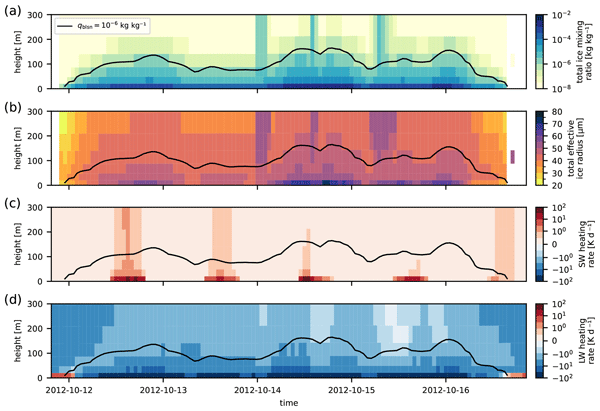
Abstract. Blowing snow sublimation is a key boundary-layer process on the Greenland Ice Sheet that removes and redistributes snow and thereby influences the surface energy balance. However, the direct radiative impacts of blowing snow are often not included in (regional) climate models. This study investigates the influence of blowing snow on the surface radiation balance at observational site S10 near the western margin of the Greenland Ice Sheet using the regional climate model RACMO2.4p1. The radiative properties of the blowing snow layer are described as a low-level ice cloud using the blowing snow mixing ratio, effective radius, and blowing snow cloud fraction, which are taken from the blowing snow routine. Model experiments, both including and excluding blowing snow in the forcing of the stand-alone radiation scheme, are compared to quantify the impact of blowing snow on the surface radiation balance and evaluated against observational data. Our results indicate that blowing snow enhances longwave emissivity and reduces shortwave transmissivity of the near-surface atmosphere, leading to a mean increase of 5.8 W m−2 in downwelling longwave radiation and a mean decrease of 1.2 W m−2 in downwelling shortwave radiation at the surface during blowing snow events. Including blowing snow in the radiation scheme improves the simulated surface radiation balance in RACMO2.4p1. The blowing snow routine underestimates peak horizontal transport fluxes by 69 to 79 % during the short observational period in summer. We recommend coupling blowing snow and radiation schemes in climate models to account for the influence of blowing snow on the local climate and the surface mass balance of the Greenland Ice Sheet.
Competing interests: At least one of the (co-)authors is a member of the editorial board of The Cryosphere. The peer-review process was guided by an independent editor, and the authors also have no other competing interests to declare.
Publisher's note: Copernicus Publications remains neutral with regard to jurisdictional claims made in the text, published maps, institutional affiliations, or any other geographical representation in this paper. While Copernicus Publications makes every effort to include appropriate place names, the final responsibility lies with the authors. Views expressed in the text are those of the authors and do not necessarily reflect the views of the publisher.-
Notice on discussion status
The requested preprint has a corresponding peer-reviewed final revised paper. You are encouraged to refer to the final revised version.
-
Preprint
(4620 KB)
-
The requested preprint has a corresponding peer-reviewed final revised paper. You are encouraged to refer to the final revised version.
- Preprint
(4620 KB) - Metadata XML
- BibTeX
- EndNote
- Final revised paper


Journal article(s) based on this preprint
Interactive discussion
Status: closed
-
RC1: 'Comment on egusphere-2026-1926', Anonymous Referee #1, 08 Jun 2026
- AC1: 'Reply on RC1', Samuel Tax, 07 Aug 2026
-
RC2: 'Comment on egusphere-2026-1926', Charles Amory, 15 Jul 2026
The comment was uploaded in the form of a supplement: https://egusphere.copernicus.org/preprints/2026/egusphere-2026-1926/egusphere-2026-1926-RC2-supplement.pdf
- AC2: 'Reply on RC2', Samuel Tax, 07 Aug 2026
Peer review completion


Interactive discussion
Status: closed
-
RC1: 'Comment on egusphere-2026-1926', Anonymous Referee #1, 08 Jun 2026
This is a well-written manuscript on a topic that is important for Arctic climates. I only have a few minor comments that should be addressed:
- Line 54 and the Figure 1 caption: You should mention that the K in "K-transect" is for "Kangerlussuaq"- Line 227-228: Coddington et al. (2016; doi:/10.1175/BAMS-D-14-00265.1) updates the solar constant to be approx. 1361 W/m² - rather than 1366 W/m².
- Lines 360-366. It is a good first approximation to use cloud ice optics. To improve on this, the modelled optical diameter of snow (e.g. Decharme et al. 2026; doi:10.5194/tc-10-853-2016) could be used. This will typically be higher that cloud ice particles since snow particles - particularly in Arctic climate - has longer lifetimes during which they can break off smaller crystals, and melt and refreeze.
Citation: https://doi.org/10.5194/egusphere-2026-1926-RC1 - AC1: 'Reply on RC1', Samuel Tax, 07 Aug 2026
-
RC2: 'Comment on egusphere-2026-1926', Charles Amory, 15 Jul 2026
The comment was uploaded in the form of a supplement: https://egusphere.copernicus.org/preprints/2026/egusphere-2026-1926/egusphere-2026-1926-RC2-supplement.pdf
- AC2: 'Reply on RC2', Samuel Tax, 07 Aug 2026
Peer review completion
Journal article(s) based on this preprint
Viewed
| HTML | XML | Total | BibTeX | EndNote | |
|---|---|---|---|---|---|
| 415 | 128 | 46 | 589 | 56 | 53 |
- HTML: 415
- PDF: 128
- XML: 46
- Total: 589
- BibTeX: 56
- EndNote: 53
Viewed (geographical distribution)
| Country | # | Views | % |
|---|
| Total: | 0 |
| HTML: | 0 |
| PDF: | 0 |
| XML: | 0 |
- 1

Maurice van Tiggelen
Thirza N. Feenstra
Paul C. J. P. Smeets
Srinidhi N. Gadde
Christiaan T. van Dalum
Willem Jan van de Berg
Michiel R. van den Broeke
The requested preprint has a corresponding peer-reviewed final revised paper. You are encouraged to refer to the final revised version.
- Preprint
(4620 KB) - Metadata XML
This is a well-written manuscript on a topic that is important for Arctic climates. I only have a few minor comments that should be addressed:
- Line 54 and the Figure 1 caption: You should mention that the K in "K-transect" is for "Kangerlussuaq"
- Line 227-228: Coddington et al. (2016; doi:/10.1175/BAMS-D-14-00265.1) updates the solar constant to be approx. 1361 W/m² - rather than 1366 W/m².
- Lines 360-366. It is a good first approximation to use cloud ice optics. To improve on this, the modelled optical diameter of snow (e.g. Decharme et al. 2026; doi:10.5194/tc-10-853-2016) could be used. This will typically be higher that cloud ice particles since snow particles - particularly in Arctic climate - has longer lifetimes during which they can break off smaller crystals, and melt and refreeze.