
the Creative Commons Attribution 4.0 License.
the Creative Commons Attribution 4.0 License.
 | 16 Apr 2026
Glacier surges on James Ross Island, Antarctica, and their relationship with climate
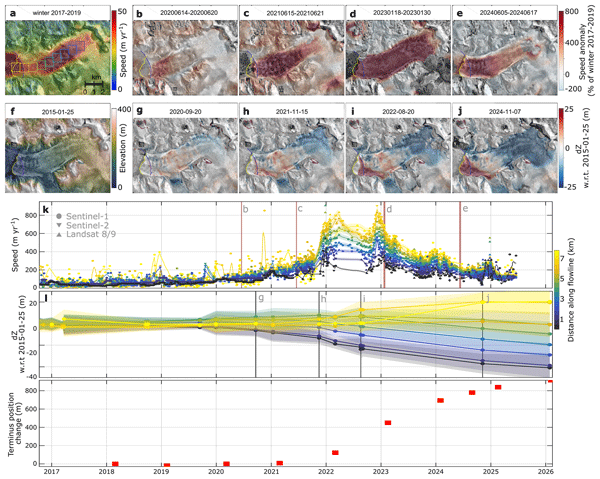
Abstract. Although the Antarctic Peninsula has a similar climate to that of other regions hosting surge-type glaciers, only one glacier surge has been previously observed in this region. We examined ice surface velocity, elevation and terminus position changes of Antarctic Peninsula glaciers to identify glacier surges. This revealed only four surges from three glaciers, all on James Ross Island. Gourdon Glacier surged from 2005 to 2007 then again from 2013 to 2018, Kotick Glacier surged during 2013 to 2017 and Whisky Glacier surged from 2020 to 2024. All four surges were characterised by significant advances in glacier terminus position and, for the latter three surges where observations are more abundant, at least an order-of-magnitude speed-up and mass transfer from upper to lower parts of each glacier. The landform record and historical imagery suggest additional surges of Kotick Glacier and Gourdon Glacier may have occurred in the second half of the 20th century. Reanalyses, reconstructions and observations of air temperature suggest that atmospheric warming since 1940 has increasingly exposed these and neighbouring glaciers on the northern tip of the Antarctic Peninsula and its surrounding islands to conditions that are typical of surge-type glaciers globally. Climate projections indicate that future warming will expose more glaciers on the Peninsula to climatic conditions conducive to surging until the mid-20th century, after which the surge-conducive area remains steady under Shared Socioeconomic Pathway (SSP) 2-4.5 and declines under SSP5-8.5. This suggests that surges on the Antarctic Peninsula may become more common over the coming decades, motivating continued monitoring.
Competing interests: At least one of the (co-)authors is a member of the editorial board of The Cryosphere.
Publisher's note: Copernicus Publications remains neutral with regard to jurisdictional claims made in the text, published maps, institutional affiliations, or any other geographical representation in this paper. While Copernicus Publications makes every effort to include appropriate place names, the final responsibility lies with the authors. Views expressed in the text are those of the authors and do not necessarily reflect the views of the publisher.-
Notice on discussion status
The requested preprint has a corresponding peer-reviewed final revised paper. You are encouraged to refer to the final revised version.
-
Preprint
(2509 KB)
-
Supplement
(39456 KB)
-
The requested preprint has a corresponding peer-reviewed final revised paper. You are encouraged to refer to the final revised version.
- Preprint
(2509 KB) - Metadata XML
-
Supplement
(39456 KB) - BibTeX
- EndNote
- Final revised paper


Journal article(s) based on this preprint
Interactive discussion
Status: closed
-
RC1: 'Comment on egusphere-2026-1894', Anonymous Referee #1, 26 May 2026
- AC1: 'Reply on RC1', Benjamin Davison, 29 Jun 2026
-
RC2: 'Comment on egusphere-2026-1894', Ellyn Enderlin, 04 Jun 2026
Summary
The first half of the paper presents an overview of recent surges for three glaciers on James Ross Island based on detailed remote sensing observations and the second half of the paper examines the likelihood of additional surging around Antarctica based on the Surging Climatic Envelope (SCE). The glacier surges are mostly identified using detailed velocity records produced in-house using optical and SAR images, with additional velocities from ITS_LIVE. Surface elevation changes, terminus positions, and geomorphic features are also used to facilitate surge detection in the 21st century and to infer surges that may have occurred in the 20th century. The SCE analysis for the study glaciers compares the SCE of Gullet et al. (2025) to ERA5 reanalysis outputs to determine how long the James Ross Island glaciers have fallen within the climate envelope that is conducive to surging. The paper later builds on this analysis to consider the SCE around all of Antarctica for two Shared Socioeconomic Pathways and the implications regarding surging.
The 21st century observations for the surging glaciers are terrific and it was interesting to see what surges look like for these glaciers. I appreciated the inclusion of the longer-term observations and I think the authors sufficiently conveyed uncertainty regarding interpretation of older, sparser records. I think that framing surges in this region in regards to the SCE is useful as well, but I found parts of SCE discussion to be a bit too hand-wavey and generalized. In particular, the authors state that the SCE is probably not appropriate for the ice sheet but then spend a decent amount of text describing the SCE in relation to the ice sheet. The paper could be strengthened if it was streamlined to remove the broader Antarctic SCE discussion and keep the focus more on the Antarctic Peninsula and islands nearby.
Several recommendations are provided below. I do not consider any of my recommendations to be “major revisions” since I do not recommend any methodological revisions, but the recommended removal of the Antarctic SCE discussion is also not necessarily a minor revision.
Comments:
- line 19: Replace “Kotick Glacier surged during” to “Kotick Glacier surged from”
- lines 59-76: References to Terleth et al. (2025; doi: 10.1029/2024GL112514) should be added in this paragraph because that paper describes updates to the enthalpy balance framework to include seasonality in surface melting relevant to this paper.
- line 93: You state that you used these data to identify potential surges. Did you put together the same records for all glaciers on James Ross Island? Did you use a subset of the data (e.g., velocity records) to identify the surges and then compile the other observations in support? How did you identify the surges? Did you use an automated threshold-based approach, manual checks, something in between?
- line 108: I think the velocity records look terrific but I am wondering what percentage of the data are from your in-house dataset generation and what percentage are from ITS_LIVE? Based on the description of the datasets used in-house, it is not clear why both datasets are needed because they both use the same image platforms for velocity generation. Please include more justification here regarding use of both datasets.
- line 140: It would be helpful to know what envelopes you used for the magnitude and direction filtering. Were they based on the median +/- some multiple of the MAD? You point to a reference that presumably explains the method more but a little more detail here would be useful.
- lines 142-152: Are the results of the analysis sensitive to the size of the smoothing ROI? 1km seems to span at least half the width of the glacier in some places based on the figures shown for each glacier. How did you decide on the threshold of data coverage of 33% percent to decide if you were going to infill missing values? Am I correct in interpreting that “finite values” means that you obtained velocity estimates for those pixels (i.e., they are non-NaN)? Also, I know that the individual velocity rasters can be quite noisy and so I understand the rationale behind filling holes with a fit to time-averaged data, but I am concerned that the multi-year average rasters could be biased due to temporal averaging during periods when the velocities change dramatically. I’d love to see an example of the variability in speed within the ROI when the ROI is dominated by finite values and one when the ROI has filled values over >50% of the area. If you normalized the ROI speeds by the mean for each ROI snapshot, that would help the reader get a sense for whether the infilling procedure biases speeds.
- line 187: I don’t follow this description. Are the glaciers in Guillet et al. (2025) grouped by geographic region and you are only using data from regions that have a high concentration of surging glaciers?
- line 202: Why did you smooth the data with a 36-month moving mean?
- Figures 2,4,5: I love these figures but there is a lot going on in them and they are not entirely consistent with each other. My main recommendation is to standardize how the data are shown. Figures 4 and 5 are fairly consistent in regard to the speed and elevation timeseries but Figure 2 is very different. Why are the data in Figure 2 shown at so many points along the centerline but the other figures show data averaged over boxes in select locations? I like the how the data are shown in Figure 2 a bit more but you could have the data points with a larger spacing so that the speed timeseries are easier to interpret. Then I would show the sampling ROIs as boxes like in Figures 4 and 5. For those figures, it would be helpful to show speeds for regularly-spaced points along the centerline instead of at a single location to get a sense for surge propagation.
- lines 311-312: Please add references to the surges at Sít’ Kusá in Alaska as well, which becomes marine-terminating when it surges but is mostly protected from the ocean during quiescence by a subaerial shoal. It is also in Alaska and has ~1.5 year-long surges and has been well-studied in recent years. See Nolan et al. (2021; doi:1017/jog.2021.29) and Liu et al., (2024; doi: 10.1017/ jog.2023.99)
- lines 363-366: You may want to point back to Variegated Glacier here as well because the Eisen references that you mention earlier point to changes in Variegated’s recurrence interval over time and the glacier is notably “overdue” for a surge.
- Figure 7: I really struggled with some aspects of this figure. I think panel a is interesting and I follow the scatterplot and underlying contours, but the inset was a bit more difficult to interpret. The horizontal position of the inset is independent of precipitation, correct? It is just the vertical positioning that matters? I would move it to a location along the right side of the plot rather than within the plot. Since I recommend that the broader Antarctic SCE discussion is dropped, I would eliminate panels b, d, e. If you keep the Antarctic SCE interpretation, at least remove panel b.
- line 474: Here and elsewhere you say the SCE “contracted” southward. I recommend rephrasing to say it “shifted”.
- Throughout the discussion and the figures therein, I recommend limiting the focus on the SCE to the glaciers along the peninsula. This trimming will keep the paper more focused and is more appropriate given that the SCE may not be valid for the ice sheet.
Citation: https://doi.org/10.5194/egusphere-2026-1894-RC2 - AC2: 'Reply on RC2', Benjamin Davison, 29 Jun 2026
Peer review completion


Interactive discussion
Status: closed
-
RC1: 'Comment on egusphere-2026-1894', Anonymous Referee #1, 26 May 2026
General comments
The authors present a study on recent glacier surges on James Ross Island, northern Antarctic Peninsula region, based on satellite observations of ice flow velocity, surface elevation change and terminus position. The report on the glacier surges is complemented by an extended account on the potential occurrence of surge-type glaciers on the Antarctic Peninsula and in other regions of Antarctica in the 1940 to 2150 time frame, using a predictor based on meteorological reanalysis data, respectively climate model projections under two different warming scenarios.
The analysis of the satellite data revealed four surges on three glaciers during the period 2005 to 2025. For one of the potential surges (Gourdon Glacier 2005) the data base is rather thin, insufficient for definite proof of a surge. Another case of ice flow acceleration (Kotick Glacier 2015) has been reported by Stinger et al. (2025) as a potential surge and surveyed with an enhanced data base by Davidson et al. (Section 3.3 of this manuscript). The discovery and description of surges in Antarctica is a topic of significant interest per se. Beyond that, detailed descriptions of surges are able to provide valuable information on the dynamic response of glaciers to changes of glacier mass, glacier geometry and climate. In case of the surges presented in the manuscript, the analysis of driving factors for the individual surges is partly affected by the limited quality and completeness of velocity data which vary between individual glaciers and time periods. For one event (Whisky Glacier) the drainage of a subglacial lake has been identified as one of the main triggers.
At large, the presented work on the James Ross Island surges opens up a new topic in the context of Antarctic glacier studies, contributing to the understanding of the multifaceted dynamic behaviour of the glaciers. The manuscript would benefit from more detailed descriptions of surge evolution in space and time and discussion on possible mechanisms for triggering and sustaining the different surges. Estimates on the transfer of ice mass induced by the surges would also be of interest.
The presentation on the potential occurrence of glacier surges in various region of Antarctica conveys rather limited new information. The probability for the occurrence of surge-type glaciers is computed using the Surging Climatic Envelope (SCE) which has been defined by the climate conditions of regions with surging glaciers observed during the last several decades. Based on the SCE and climate reanalysis data and climate projections, occurrence probabilities in between 1940 and 2150 are computed. For selected years probability levels are delineated in maps of the Antarctic Peninsula and Antarctica. Taking into account that the current version of the SCE is based on valley glaciers, it is rather questionable if it is applicable for exploring the potential surge occurrence for outlet glaciers and ice streams of Antarctica and if the surge behaviour will be of relevance for future losses of the Antarctic ice mass. In view of these issues, I recommend shortening the sections dealing with the climatic envelope for surges.
Further Comments
Information on glacier properties: Main attributes of the three glaciers should be specified, including glacier size, hypsometry, altitude of equilibrium line, estimates of surface mass balance parameters. The size of the floating terminus section and grounding line location before and after the surge should also be quoted (if existing). In this context, possible impacts of oceanic forcing may be addressed.
Fig. 1 a and b: Please check the orientation of the marker for the North direction.
Fig 1 c (Kotick Glacier): Please add a km scale.
Fig. 1, upper right panel: Hardly possible capturing the exact location and setting of the study glaciers within the surface velocity image. I recommend showing this image separately in larger size.
Line 142 – 152: Taking into account the mismatch between the large size of the velocity estimation windows in comparison to the comparatively small size of the surging glaciers and the complex ice motion patterns during surges, the error estimates should be re-considered. The scatter of velocity data points in points in Fig 2 is also an indication for higher uncertainties.
Section 2.2 Surface elevation change: Please provide an error estimate for the calculated surface elevation change.
Line 220 to 222: Please specify the locations to which the velocities of 40, 200 and 800 m/yr refer. Fig. 2k shows a large spread of velocities at any time.
Line 231: Changes of the terminus position are shown in Fig. 2m.
Section 3.2, Gourdon Glacier: Whereas the data base for the terminus advance in 2005 is rather thin, the data of the 2013 to 2017 event represents a convenient basis for exploring in detail the different phases of the surge and the progress of velocity changes and mass transfer along the terminus. For this task, velocities along the central flowline may be shown on different dates, or time series of velocity at several points in different sections of the glacier, rather than only for one point as shown in Fig. 4k.
Line 268 – 270: Please explain the processes causing thickening in the upper reaches of the glacier and continuous lowering downstream, and how this is reflected in estimates of the mass transfer.
Kotik Glacier, Line 273 – 283 and Figure 5: The data presented in Figures 5k and 5l and the discussion do not provide sufficient information for clearly describing the development and progress of the surge and for exploring possible driving mechanisms. Time series of surface velocity and elevation change should be shown also for other sections of the glacier rather than only for one point on the lower terminus. Another issue to be explained is the cause for the rather constant gradual decrease of surface elevation between 2015 and 2025 (Fig. 5), in spite of a large drop of velocity in 2017.
Citation: https://doi.org/10.5194/egusphere-2026-1894-RC1 - AC1: 'Reply on RC1', Benjamin Davison, 29 Jun 2026
-
RC2: 'Comment on egusphere-2026-1894', Ellyn Enderlin, 04 Jun 2026
Summary
The first half of the paper presents an overview of recent surges for three glaciers on James Ross Island based on detailed remote sensing observations and the second half of the paper examines the likelihood of additional surging around Antarctica based on the Surging Climatic Envelope (SCE). The glacier surges are mostly identified using detailed velocity records produced in-house using optical and SAR images, with additional velocities from ITS_LIVE. Surface elevation changes, terminus positions, and geomorphic features are also used to facilitate surge detection in the 21st century and to infer surges that may have occurred in the 20th century. The SCE analysis for the study glaciers compares the SCE of Gullet et al. (2025) to ERA5 reanalysis outputs to determine how long the James Ross Island glaciers have fallen within the climate envelope that is conducive to surging. The paper later builds on this analysis to consider the SCE around all of Antarctica for two Shared Socioeconomic Pathways and the implications regarding surging.
The 21st century observations for the surging glaciers are terrific and it was interesting to see what surges look like for these glaciers. I appreciated the inclusion of the longer-term observations and I think the authors sufficiently conveyed uncertainty regarding interpretation of older, sparser records. I think that framing surges in this region in regards to the SCE is useful as well, but I found parts of SCE discussion to be a bit too hand-wavey and generalized. In particular, the authors state that the SCE is probably not appropriate for the ice sheet but then spend a decent amount of text describing the SCE in relation to the ice sheet. The paper could be strengthened if it was streamlined to remove the broader Antarctic SCE discussion and keep the focus more on the Antarctic Peninsula and islands nearby.
Several recommendations are provided below. I do not consider any of my recommendations to be “major revisions” since I do not recommend any methodological revisions, but the recommended removal of the Antarctic SCE discussion is also not necessarily a minor revision.
Comments:
- line 19: Replace “Kotick Glacier surged during” to “Kotick Glacier surged from”
- lines 59-76: References to Terleth et al. (2025; doi: 10.1029/2024GL112514) should be added in this paragraph because that paper describes updates to the enthalpy balance framework to include seasonality in surface melting relevant to this paper.
- line 93: You state that you used these data to identify potential surges. Did you put together the same records for all glaciers on James Ross Island? Did you use a subset of the data (e.g., velocity records) to identify the surges and then compile the other observations in support? How did you identify the surges? Did you use an automated threshold-based approach, manual checks, something in between?
- line 108: I think the velocity records look terrific but I am wondering what percentage of the data are from your in-house dataset generation and what percentage are from ITS_LIVE? Based on the description of the datasets used in-house, it is not clear why both datasets are needed because they both use the same image platforms for velocity generation. Please include more justification here regarding use of both datasets.
- line 140: It would be helpful to know what envelopes you used for the magnitude and direction filtering. Were they based on the median +/- some multiple of the MAD? You point to a reference that presumably explains the method more but a little more detail here would be useful.
- lines 142-152: Are the results of the analysis sensitive to the size of the smoothing ROI? 1km seems to span at least half the width of the glacier in some places based on the figures shown for each glacier. How did you decide on the threshold of data coverage of 33% percent to decide if you were going to infill missing values? Am I correct in interpreting that “finite values” means that you obtained velocity estimates for those pixels (i.e., they are non-NaN)? Also, I know that the individual velocity rasters can be quite noisy and so I understand the rationale behind filling holes with a fit to time-averaged data, but I am concerned that the multi-year average rasters could be biased due to temporal averaging during periods when the velocities change dramatically. I’d love to see an example of the variability in speed within the ROI when the ROI is dominated by finite values and one when the ROI has filled values over >50% of the area. If you normalized the ROI speeds by the mean for each ROI snapshot, that would help the reader get a sense for whether the infilling procedure biases speeds.
- line 187: I don’t follow this description. Are the glaciers in Guillet et al. (2025) grouped by geographic region and you are only using data from regions that have a high concentration of surging glaciers?
- line 202: Why did you smooth the data with a 36-month moving mean?
- Figures 2,4,5: I love these figures but there is a lot going on in them and they are not entirely consistent with each other. My main recommendation is to standardize how the data are shown. Figures 4 and 5 are fairly consistent in regard to the speed and elevation timeseries but Figure 2 is very different. Why are the data in Figure 2 shown at so many points along the centerline but the other figures show data averaged over boxes in select locations? I like the how the data are shown in Figure 2 a bit more but you could have the data points with a larger spacing so that the speed timeseries are easier to interpret. Then I would show the sampling ROIs as boxes like in Figures 4 and 5. For those figures, it would be helpful to show speeds for regularly-spaced points along the centerline instead of at a single location to get a sense for surge propagation.
- lines 311-312: Please add references to the surges at Sít’ Kusá in Alaska as well, which becomes marine-terminating when it surges but is mostly protected from the ocean during quiescence by a subaerial shoal. It is also in Alaska and has ~1.5 year-long surges and has been well-studied in recent years. See Nolan et al. (2021; doi:1017/jog.2021.29) and Liu et al., (2024; doi: 10.1017/ jog.2023.99)
- lines 363-366: You may want to point back to Variegated Glacier here as well because the Eisen references that you mention earlier point to changes in Variegated’s recurrence interval over time and the glacier is notably “overdue” for a surge.
- Figure 7: I really struggled with some aspects of this figure. I think panel a is interesting and I follow the scatterplot and underlying contours, but the inset was a bit more difficult to interpret. The horizontal position of the inset is independent of precipitation, correct? It is just the vertical positioning that matters? I would move it to a location along the right side of the plot rather than within the plot. Since I recommend that the broader Antarctic SCE discussion is dropped, I would eliminate panels b, d, e. If you keep the Antarctic SCE interpretation, at least remove panel b.
- line 474: Here and elsewhere you say the SCE “contracted” southward. I recommend rephrasing to say it “shifted”.
- Throughout the discussion and the figures therein, I recommend limiting the focus on the SCE to the glaciers along the peninsula. This trimming will keep the paper more focused and is more appropriate given that the SCE may not be valid for the ice sheet.
Citation: https://doi.org/10.5194/egusphere-2026-1894-RC2 - AC2: 'Reply on RC2', Benjamin Davison, 29 Jun 2026
Peer review completion
Journal article(s) based on this preprint
Viewed
| HTML | XML | Total | Supplement | BibTeX | EndNote | |
|---|---|---|---|---|---|---|
| 507 | 299 | 33 | 839 | 92 | 38 | 45 |
- HTML: 507
- PDF: 299
- XML: 33
- Total: 839
- Supplement: 92
- BibTeX: 38
- EndNote: 45
Viewed (geographical distribution)
| Country | # | Views | % |
|---|
| Total: | 0 |
| HTML: | 0 |
| PDF: | 0 |
| XML: | 0 |
- 1
Benjamin J. Davison

Andrew J. Sole
Gregoire Guillet
Douglas I. Benn
Jonathan Kingslake
Jeremy C. Ely
Stephen J. Livingstone
Christopher D. Stringer
Jonathan L. Carrivick
Anna E. Hogg
The requested preprint has a corresponding peer-reviewed final revised paper. You are encouraged to refer to the final revised version.
- Preprint
(2509 KB) - Metadata XML
-
Supplement
(39456 KB) - BibTeX
- EndNote
- Final revised paper
General comments
The authors present a study on recent glacier surges on James Ross Island, northern Antarctic Peninsula region, based on satellite observations of ice flow velocity, surface elevation change and terminus position. The report on the glacier surges is complemented by an extended account on the potential occurrence of surge-type glaciers on the Antarctic Peninsula and in other regions of Antarctica in the 1940 to 2150 time frame, using a predictor based on meteorological reanalysis data, respectively climate model projections under two different warming scenarios.
The analysis of the satellite data revealed four surges on three glaciers during the period 2005 to 2025. For one of the potential surges (Gourdon Glacier 2005) the data base is rather thin, insufficient for definite proof of a surge. Another case of ice flow acceleration (Kotick Glacier 2015) has been reported by Stinger et al. (2025) as a potential surge and surveyed with an enhanced data base by Davidson et al. (Section 3.3 of this manuscript). The discovery and description of surges in Antarctica is a topic of significant interest per se. Beyond that, detailed descriptions of surges are able to provide valuable information on the dynamic response of glaciers to changes of glacier mass, glacier geometry and climate. In case of the surges presented in the manuscript, the analysis of driving factors for the individual surges is partly affected by the limited quality and completeness of velocity data which vary between individual glaciers and time periods. For one event (Whisky Glacier) the drainage of a subglacial lake has been identified as one of the main triggers.
At large, the presented work on the James Ross Island surges opens up a new topic in the context of Antarctic glacier studies, contributing to the understanding of the multifaceted dynamic behaviour of the glaciers. The manuscript would benefit from more detailed descriptions of surge evolution in space and time and discussion on possible mechanisms for triggering and sustaining the different surges. Estimates on the transfer of ice mass induced by the surges would also be of interest.
The presentation on the potential occurrence of glacier surges in various region of Antarctica conveys rather limited new information. The probability for the occurrence of surge-type glaciers is computed using the Surging Climatic Envelope (SCE) which has been defined by the climate conditions of regions with surging glaciers observed during the last several decades. Based on the SCE and climate reanalysis data and climate projections, occurrence probabilities in between 1940 and 2150 are computed. For selected years probability levels are delineated in maps of the Antarctic Peninsula and Antarctica. Taking into account that the current version of the SCE is based on valley glaciers, it is rather questionable if it is applicable for exploring the potential surge occurrence for outlet glaciers and ice streams of Antarctica and if the surge behaviour will be of relevance for future losses of the Antarctic ice mass. In view of these issues, I recommend shortening the sections dealing with the climatic envelope for surges.
Further Comments
Information on glacier properties: Main attributes of the three glaciers should be specified, including glacier size, hypsometry, altitude of equilibrium line, estimates of surface mass balance parameters. The size of the floating terminus section and grounding line location before and after the surge should also be quoted (if existing). In this context, possible impacts of oceanic forcing may be addressed.
Fig. 1 a and b: Please check the orientation of the marker for the North direction.
Fig 1 c (Kotick Glacier): Please add a km scale.
Fig. 1, upper right panel: Hardly possible capturing the exact location and setting of the study glaciers within the surface velocity image. I recommend showing this image separately in larger size.
Line 142 – 152: Taking into account the mismatch between the large size of the velocity estimation windows in comparison to the comparatively small size of the surging glaciers and the complex ice motion patterns during surges, the error estimates should be re-considered. The scatter of velocity data points in points in Fig 2 is also an indication for higher uncertainties.
Section 2.2 Surface elevation change: Please provide an error estimate for the calculated surface elevation change.
Line 220 to 222: Please specify the locations to which the velocities of 40, 200 and 800 m/yr refer. Fig. 2k shows a large spread of velocities at any time.
Line 231: Changes of the terminus position are shown in Fig. 2m.
Section 3.2, Gourdon Glacier: Whereas the data base for the terminus advance in 2005 is rather thin, the data of the 2013 to 2017 event represents a convenient basis for exploring in detail the different phases of the surge and the progress of velocity changes and mass transfer along the terminus. For this task, velocities along the central flowline may be shown on different dates, or time series of velocity at several points in different sections of the glacier, rather than only for one point as shown in Fig. 4k.
Line 268 – 270: Please explain the processes causing thickening in the upper reaches of the glacier and continuous lowering downstream, and how this is reflected in estimates of the mass transfer.
Kotik Glacier, Line 273 – 283 and Figure 5: The data presented in Figures 5k and 5l and the discussion do not provide sufficient information for clearly describing the development and progress of the surge and for exploring possible driving mechanisms. Time series of surface velocity and elevation change should be shown also for other sections of the glacier rather than only for one point on the lower terminus. Another issue to be explained is the cause for the rather constant gradual decrease of surface elevation between 2015 and 2025 (Fig. 5), in spite of a large drop of velocity in 2017.