
the Creative Commons Attribution 4.0 License.
the Creative Commons Attribution 4.0 License.
 | 14 Apr 2026
Polarization Calibration of Spaceborne Lidar Using Dense Cirrus–Scattered Solar Background with Molecular Scattering Correction
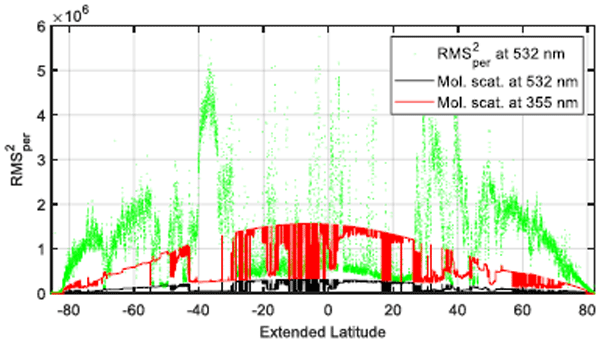
Abstract. Accurate calibration is essential for spaceborne polarization-sensitive lidars, as biases in depolarization ratio measurements can significantly affect the retrieval of cloud and aerosol properties. A polarization calibration technique based on solar background signals scattered by optically thick ice clouds (OTIC) provides a semi-continuous daytime calibration capability that complements onboard pseudo-depolarizer (PD) methods. This method was successfully applied to data from the Cloud-Aerosol Transport System (CATS) lidar at 1064 nm, where molecular scattering effects are negligible. However, at shorter wavelengths, molecular scattering of sunlight between the lidar and the OTIC layer polarizes the background signal and introduces systematic biases. We present a molecular scattering correction (MSC) scheme based on vector radiative transfer modeling (VRTM) to account for this effect and demonstrate its performance using observations from the Cloud-Aerosol Lidar with Orthogonal Polarization (CALIOP). The results show that molecular scattering introduces a daytime bias of approximately 1 % at 532 nm, which is effectively removed by the VRTM-based MSC, yielding close agreement with onboard PD calibrations. For the Earth Cloud, Aerosol and Radiation Explorer (EarthCARE) Atmospheric Lidar (ATLID) operating at 355 nm, model calculations indicate that molecular scattering contributions can be more than five times larger than at 532 nm, underscoring the necessity of applying an MSC when the OTIC calibration technique is employed. Together, these results establish the OTIC calibration technique, combined with MSC, as a robust approach for achieving accurate polarization calibration across current and future spaceborne lidar missions.
-
Notice on discussion status
The requested preprint has a corresponding peer-reviewed final revised paper. You are encouraged to refer to the final revised version.
-
Preprint
(5353 KB)
-
The requested preprint has a corresponding peer-reviewed final revised paper. You are encouraged to refer to the final revised version.
- Preprint
(5353 KB) - Metadata XML
- BibTeX
- EndNote
- Final revised paper


Journal article(s) based on this preprint
Interactive discussion
Status: closed
-
RC1: 'Comment on egusphere-2026-1876', Anonymous Referee #1, 15 May 2026
-
AC1: 'Reply on RC1', Zhaoyan Liu, 16 Jul 2026
Dear Reviewer
We sincerely thank you for you valuable comments, which greatly improved the quality of this manuscript. We highly appreciate the time and effort they devoted to reviewing our work.
Please see the attached file containing our responses to each of your comments.
Best regards,
-
AC1: 'Reply on RC1', Zhaoyan Liu, 16 Jul 2026
-
RC2: 'Comment on egusphere-2026-1876', Anonymous Referee #2, 21 Jun 2026
This paper discusses a method for evaluating calibration constant (gain ratios) with higher precision by removing the contribution of scattering from atmospheric molecules, as an improvement upon the existing method (OTIC calibration technique) that uses sunlight scattered by optically thick ice clouds to perform polarization calibration of space-borne polarization lidar. The paper also demonstrates the effectiveness of this method using actual satellite observation data (CALIOP); it also discusses the applicability of this method to other satellite lidars (ADCL, ATLID). The description is clear, and the paper contains all the information necessary for understanding it, with neither excess nor deficiency. Considering the novelty and applicability of the method proposed in this paper, as well as the quality of its description, it is recommended that this paper be published in AMT.
It does not appear that a major revision is necessary. Several minor points are listed below.
L61: λ-4 => λ4 ?
L114-L127: In this part, it would be less confusing if you first explained that there are two methods for calculating PGR: one based on received photons (Eq. A5) and one using RMS (Eq. A8). It would then be easier to understand if you explained that CALIOP adopted Eq. A8 due to system constraints.
L133, Eq. 6: What does the “c” in RMSc stand for?
L133, Eq. 6: BDDR => BDR?
L128-L155: The sudden introduction of "BDR" in the text is somewhat confusing. If additional explanation were provided—including the relationship between Equation (7) and Equation (2)—the connection between the first half of Section 2 and this part would become clearer, which would likely deepen the reader’s understanding.
L292: “The method can also be applied to ADCL/DQ-1 to calibrate its HSRL 532 nm polarization measurements.”
In L253–L257, it appears that the application of OTIC is described as “challenging”—doesn’t this contradict the description here?
Fig.2 & Fig. 5: The image looks a little blurry. Is it a resolution issue?
Fig.3: Around ±80 degrees, the RMS ratio values appear to be widely scattered. Is this normal? It also appears that the latitudes at which the values are scattered differ somewhat from those in Fig. 2(d).
Citation: https://doi.org/10.5194/egusphere-2026-1876-RC2 -
AC2: 'Reply on RC2', Zhaoyan Liu, 16 Jul 2026
Dear Reviewer
We sincerely thank you for your valuable comments, which greatly improved the quality of this manuscript. We highly appreciate the time and effort they devoted to reviewing our work.
Please see the attached file containing our responses to each of your comments.
Best regards,
Zhaoyan
-
AC2: 'Reply on RC2', Zhaoyan Liu, 16 Jul 2026
Peer review completion


Interactive discussion
Status: closed
-
RC1: 'Comment on egusphere-2026-1876', Anonymous Referee #1, 15 May 2026
The manuscript describes a technique to assess the polarization gain ratio of spaceborne lidar systems using the unpolarized backscattered light by optically thick ice clouds. This method is very valuable to calibrate the polarization sensitive parts of lidar systems in space and to deliver observations of the depolarization ratio with high accuracy as needed for correct aerosol typing. Having an atmospheric target outside of the onboard calibration possibilities is extremely useful to control the polarization gain ratio once the lidar is deployed in space. Besides the application to CALIPSO, the opportunities for ACDL and ATLID are shortly discussed – the present study will support these ongoing space missions. The paper is clearly written and fits well in the scope of AMT. I would recommend publication after addressing minor revisions.
Minor comments:
- Although the original Liu et al., 2004, paper already discussed it, it would be valuable to highlight the application to airborne lidar calibration as well. It would be especially important for those lidars which do not operate at 1064 nm and have to correct for molecular scattering. Here, the distance between the lidar and the optically thick ice cloud has to be taken into account. Similar to Sect. 3.2, I would recommend to add a Sect. 3.3 shortly discussing the application to airborne lidars.
- Line 105: Here, the manuscript refers suddenly to the appendix. Some more lines would be nice to smoothen the transition from L104 to L105 and to introduce shortly the appendix.
- Fig 2, especially 2c+d could be improved. The resolution is low and, in the legend, I just see (very small) grey dots. Furthermore, the fraction of 0.17 mentioned in line 175 is hard to imagine from Fig 2c (maybe in the tropics we see a high fraction of BDR).
- L258 – 266 You may cite Donovan et al., AMT 2024 for the description of the primary ATLID algorithms.
Technical corrections
- Affiliations: The county is missing for all affiliations: USA – I suppose.
- Date format: I know that the version month-day-year is commonly used in US. However, it would be more logical to use day-month-year as done in line 234. Please harmonize.
- Subscripts in the formula should not be italic (see e.g., eq 1 + 2) except for counting indices.
- RMS – abbreviation is not introduced.
- Fig 3 caption – you want to refer to Fig 2 not 3 in line 205.
- L225 refers to eq 6 whereas L233 (figure caption) refers to eq 5 for the PGR with and without MSC.
- L288 There is a typo in Version 4.5
- L307 [26] probably refers to a reference. It seems to be copied from another document.
- L308 PIN ?
Citation: https://doi.org/10.5194/egusphere-2026-1876-RC1 -
AC1: 'Reply on RC1', Zhaoyan Liu, 16 Jul 2026
Dear Reviewer
We sincerely thank you for you valuable comments, which greatly improved the quality of this manuscript. We highly appreciate the time and effort they devoted to reviewing our work.
Please see the attached file containing our responses to each of your comments.
Best regards,
-
RC2: 'Comment on egusphere-2026-1876', Anonymous Referee #2, 21 Jun 2026
This paper discusses a method for evaluating calibration constant (gain ratios) with higher precision by removing the contribution of scattering from atmospheric molecules, as an improvement upon the existing method (OTIC calibration technique) that uses sunlight scattered by optically thick ice clouds to perform polarization calibration of space-borne polarization lidar. The paper also demonstrates the effectiveness of this method using actual satellite observation data (CALIOP); it also discusses the applicability of this method to other satellite lidars (ADCL, ATLID). The description is clear, and the paper contains all the information necessary for understanding it, with neither excess nor deficiency. Considering the novelty and applicability of the method proposed in this paper, as well as the quality of its description, it is recommended that this paper be published in AMT.
It does not appear that a major revision is necessary. Several minor points are listed below.
L61: λ-4 => λ4 ?
L114-L127: In this part, it would be less confusing if you first explained that there are two methods for calculating PGR: one based on received photons (Eq. A5) and one using RMS (Eq. A8). It would then be easier to understand if you explained that CALIOP adopted Eq. A8 due to system constraints.
L133, Eq. 6: What does the “c” in RMSc stand for?
L133, Eq. 6: BDDR => BDR?
L128-L155: The sudden introduction of "BDR" in the text is somewhat confusing. If additional explanation were provided—including the relationship between Equation (7) and Equation (2)—the connection between the first half of Section 2 and this part would become clearer, which would likely deepen the reader’s understanding.
L292: “The method can also be applied to ADCL/DQ-1 to calibrate its HSRL 532 nm polarization measurements.”
In L253–L257, it appears that the application of OTIC is described as “challenging”—doesn’t this contradict the description here?
Fig.2 & Fig. 5: The image looks a little blurry. Is it a resolution issue?
Fig.3: Around ±80 degrees, the RMS ratio values appear to be widely scattered. Is this normal? It also appears that the latitudes at which the values are scattered differ somewhat from those in Fig. 2(d).
Citation: https://doi.org/10.5194/egusphere-2026-1876-RC2 -
AC2: 'Reply on RC2', Zhaoyan Liu, 16 Jul 2026
Dear Reviewer
We sincerely thank you for your valuable comments, which greatly improved the quality of this manuscript. We highly appreciate the time and effort they devoted to reviewing our work.
Please see the attached file containing our responses to each of your comments.
Best regards,
Zhaoyan
-
AC2: 'Reply on RC2', Zhaoyan Liu, 16 Jul 2026
Peer review completion
Journal article(s) based on this preprint
Viewed
| HTML | XML | Total | BibTeX | EndNote | |
|---|---|---|---|---|---|
| 369 | 161 | 59 | 589 | 47 | 43 |
- HTML: 369
- PDF: 161
- XML: 59
- Total: 589
- BibTeX: 47
- EndNote: 43
Viewed (geographical distribution)
| Country | # | Views | % |
|---|
| Total: | 0 |
| HTML: | 0 |
| PDF: | 0 |
| XML: | 0 |
- 1

Mark A. Vaughan
Pengwang Zhai
Anne Emilie Garnier
Shan Zeng
Sharon D. Rodier
Yongxiang Hu
Ali H. Omar
Charles R. Trepte
The requested preprint has a corresponding peer-reviewed final revised paper. You are encouraged to refer to the final revised version.
- Preprint
(5353 KB) - Metadata XML
The manuscript describes a technique to assess the polarization gain ratio of spaceborne lidar systems using the unpolarized backscattered light by optically thick ice clouds. This method is very valuable to calibrate the polarization sensitive parts of lidar systems in space and to deliver observations of the depolarization ratio with high accuracy as needed for correct aerosol typing. Having an atmospheric target outside of the onboard calibration possibilities is extremely useful to control the polarization gain ratio once the lidar is deployed in space. Besides the application to CALIPSO, the opportunities for ACDL and ATLID are shortly discussed – the present study will support these ongoing space missions. The paper is clearly written and fits well in the scope of AMT. I would recommend publication after addressing minor revisions.
Minor comments:
Technical corrections