
the Creative Commons Attribution 4.0 License.
the Creative Commons Attribution 4.0 License.
 | 17 Apr 2026
Quantitative insights into regime-dependent aerosol pH variability in an ammonia-rich urban atmosphere from explainable machine learning
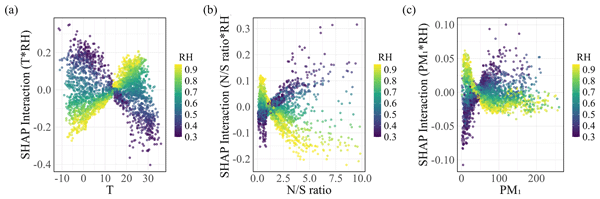
Abstract. Aerosol acidity (pH) plays a crucial role in atmospheric chemistry. Meteorological conditions and chemical properties jointly contribute to pH variation, yet their behavior differs across environmental regimes and remain incompletely understood. Here, we integrate machine learning with interpretable model analyses, field observations, and thermodynamic modeling to quantitatively assess the relative contributions and associations of key factors to aerosol pH variability in an ammonia-rich urban atmosphere. Temperature exhibits a strong negative contribution to pH variation, with an average decrease of ~0.6 units per 10 °C increase. Excess ammonia, nitrate-to-sulfate mass ratio (N/S), and PM1 mass loading are positively associated with pH, showing stronger sensitivities at lower values and diminishing responses at higher levels. In contrast, the contribution of relative humidity (RH) depends strongly on its interactions with temperature, aerosol composition, and mass loading, resulting in pronounced regime-dependent reversals. Higher RH is associated with enhanced aerosol acidity under low-temperature (< 15 °C), nitrate-dominant (N/S > 1.25), or high-mass (PM1 > 50 μg m-3) conditions, whereas the opposite tendency occurs under warmer, sulfate-dominant, or low-mass regimes. This study provides new quantitative insights into the coupled meteorological and chemical modulation of pH and highlight the importance of multifactor interactions in understanding aerosol acidity variability in real-world atmospheres.
-
Notice on discussion status
The requested preprint has a corresponding peer-reviewed final revised paper. You are encouraged to refer to the final revised version.
-
Preprint
(1921 KB)
-
Supplement
(1263 KB)
-
The requested preprint has a corresponding peer-reviewed final revised paper. You are encouraged to refer to the final revised version.
- Preprint
(1921 KB) - Metadata XML
-
Supplement
(1263 KB) - BibTeX
- EndNote
- Final revised paper


Journal article(s) based on this preprint
Interactive discussion
Status: closed
- RC1: 'Comment on egusphere-2026-1855', Anonymous Referee #1, 11 May 2026
- RC2: 'Comment on egusphere-2026-1855', Anonymous Referee #2, 25 Jun 2026
- AC1: 'Comment on egusphere-2026-1855', Ru-Jin Huang, 25 Jul 2026
Peer review completion


Interactive discussion
Status: closed
-
RC1: 'Comment on egusphere-2026-1855', Anonymous Referee #1, 11 May 2026
This study investigated the key factors to aerosol pH variability based on machine learning with SHAP. Especially, they found the regime-dependent influence of RH due to interactions with other factors, which is less investigated before. In general, this study is based on promising new method, and found interesting results. However, the breadth and depth of this study needs to be improved before it can be accepted.
(1) How will the threshold of the regimes vary with sites? There're many public available datasets for aerosol acidity calculations (e.g., https://doi.org/10.5194/acp-19-9309-2019), and such investigations should be easy with established methods.
(2) Accordingly, more in-depth explanation of the regime-depedent interactions should be applied. Current explanations are too general, and the conclusions and patterns can hardly be confidentially applied to other scenarios. At least, whether and why it applies to all ammonia-Rich urban atmosphere, as outlined in the title, should be discussed and investigated in more detail.Citation: https://doi.org/10.5194/egusphere-2026-1855-RC1 - RC2: 'Comment on egusphere-2026-1855', Anonymous Referee #2, 25 Jun 2026
- AC1: 'Comment on egusphere-2026-1855', Ru-Jin Huang, 25 Jul 2026
Peer review completion
Journal article(s) based on this preprint
Viewed
| HTML | XML | Total | Supplement | BibTeX | EndNote | |
|---|---|---|---|---|---|---|
| 350 | 145 | 56 | 551 | 80 | 53 | 45 |
- HTML: 350
- PDF: 145
- XML: 56
- Total: 551
- Supplement: 80
- BibTeX: 53
- EndNote: 45
Viewed (geographical distribution)
| Country | # | Views | % |
|---|
| Total: | 0 |
| HTML: | 0 |
| PDF: | 0 |
| XML: | 0 |
- 1
Jing Duan
Ting Wang
Ru-Jin Huang

Jingye Ren
Haobin Zhong
Chunshui Lin
Yanan Zhan
Huabin Huang
Yongjie Li
The requested preprint has a corresponding peer-reviewed final revised paper. You are encouraged to refer to the final revised version.
- Preprint
(1921 KB) - Metadata XML
-
Supplement
(1263 KB) - BibTeX
- EndNote
- Final revised paper
This study investigated the key factors to aerosol pH variability based on machine learning with SHAP. Especially, they found the regime-dependent influence of RH due to interactions with other factors, which is less investigated before. In general, this study is based on promising new method, and found interesting results. However, the breadth and depth of this study needs to be improved before it can be accepted.
(1) How will the threshold of the regimes vary with sites? There're many public available datasets for aerosol acidity calculations (e.g., https://doi.org/10.5194/acp-19-9309-2019), and such investigations should be easy with established methods.
(2) Accordingly, more in-depth explanation of the regime-depedent interactions should be applied. Current explanations are too general, and the conclusions and patterns can hardly be confidentially applied to other scenarios. At least, whether and why it applies to all ammonia-Rich urban atmosphere, as outlined in the title, should be discussed and investigated in more detail.