
the Creative Commons Attribution 4.0 License.
the Creative Commons Attribution 4.0 License.
 | 27 Apr 2026
Contrasting Nighttime Heterogeneous and Daytime Photochemical Aging Drive the Optical Evolution of Black Carbon
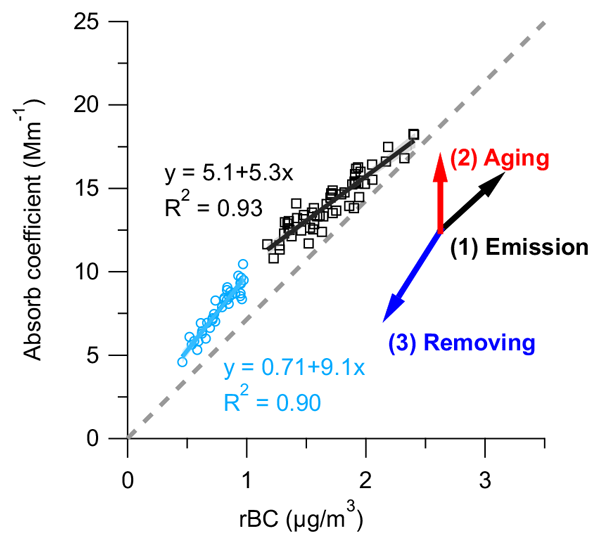
Abstract. Black carbon (BC) play a critical role in the climate system, yet their atmospheric aging processes and consequent optical impacts in real-world atmospheres remain insufficiently understood. In this study, we present integrated single-particle measurements using a single particle soot photometer (SP2) and a single-particle aerosol mass spectrometer (SPAMS) during a field campaign in urban Shenzhen, China. The mean refractory BC (rBC) concentration was 1.2 μg m⁻³, with core mass median diameters (MMD) of 155–170 nm. The diurnal variation in the coating-to-core mass ratio (MR) indicated that BC underwent continuous aging. Nighttime aging was primarily driven by heterogeneous nitrate uptake, whereas daytime photochemical aging was characterized by condensation of nitrate, sulfate, and oxidized organics. Despite their distinct mechanisms, both aging pathways elevated the MR and produced similar net enhancements in the mass absorption cross section (MAC) with an overnight increase of ~0.8 m² g⁻¹ and a daytime increase of ~1.0 m² g⁻¹. These comparable net increments were due to the offsetting effect of intensive fresh emissions during the day. Specifically, the MAC enhancement rates driven by nighttime heterogeneous reactions and daytime photochemical aging were determined to be 0.34 and 0.59 m² g⁻¹ h⁻¹, respectively. This study provides direct observational evidence of diurnally contrasting BC aging pathways and quantitatively constrains the optical enhancement rates under real urban conditions.
-
Notice on discussion status
The requested preprint has a corresponding peer-reviewed final revised paper. You are encouraged to refer to the final revised version.
-
Preprint
(751 KB)
-
Supplement
(598 KB)
-
The requested preprint has a corresponding peer-reviewed final revised paper. You are encouraged to refer to the final revised version.
- Preprint
(751 KB) - Metadata XML
-
Supplement
(598 KB) - BibTeX
- EndNote
- Final revised paper


Journal article(s) based on this preprint
Interactive discussion
Status: closed
-
RC1: 'Comment on egusphere-2026-1850', Anonymous Referee #1, 22 May 2026
-
AC1: 'Reply on RC1', Xin Yang, 23 Jul 2026
The comment was uploaded in the form of a supplement: https://egusphere.copernicus.org/preprints/2026/egusphere-2026-1850/egusphere-2026-1850-AC1-supplement.pdf
-
AC1: 'Reply on RC1', Xin Yang, 23 Jul 2026
-
RC2: 'Comment on egusphere-2026-1850', Anonymous Referee #2, 20 Jun 2026
This manuscript presents integrated SP2, SPAMS, and PAX observations to examine diurnally contrasting black-carbon aging pathways and their optical consequences in urban Shenzhen. The topic is important, the combined single-particle physical and chemical measurements are valuable, and the attempt to quantify separate nighttime and daytime MAC enhancement rates under ambient conditions is a clear strength. Overall, the study is scientifically valuable and largely convincing. I suggest that the authors make a minor revision to better quantify the uncertainty of the optical interpretation, clarify several methodological details, and slightly temper a few mechanistic statements. These revisions would improve the robustness and broader usefulness of the manuscript without changing its main conclusions.
- The daytime and nighttime MAC enhancement rates are important and useful. Because the calculation depends on the fresh-BC MAC, MR > 3 threshold, fcoated, and the regression method used to separate aging from fresh emissions, please provide a brief discussion on uncertainty or sensitivity analysis. This does not need to be extensive, but it would make the reported 0.34 and 0.59 m2 g-1 h-1 rates more useful for comparison with other studies.
- The manuscript states that MAC values were adjusted to reduce BrC influence, with details in the Supplement. Since the optical result is central to the paper, please briefly summarize the correction method and its likely magnitude in the main text. If the BrC contribution is small during the selected period, a simple quantitative statement would be sufficient.
- BC absorption enhancement remains a major source of uncertainty in aerosol radiative forcing estimates, while recent modeling studies have made important progress in constraining BC optical properties in global models. For example, Chen et al. (2023, https://doi.org/10.1029/2022MS003501) developed an aerosol optical module with observation-constrained BC properties for global climate models. Given the observational enhancement rates reported here, the authors may briefly discuss whether and how these results could inform numerical model optimization, such as constraints on aging timescales, coating-dependent MAC enhancement, or diurnal parameterizations of BC optical properties.
- The claim that BC specifically promotes sulfate formation is interesting but needs stronger support. Since SPAMS relative peak areas are semi-quantitative and detection efficiencies vary across particle types, please discuss whether the enhanced sulfate variability in BC-containing particles could be influenced by sampling or ionization biases.
- Clarify whether all optical and single-particle data are averaged to the same time resolution before regression and diurnal analysis.
- Several wording issues should be corrected, for example 'exhibt', 'that that', 'removing processes', and 'changes in the MR provides'.
- The conclusion should state more explicitly that the reported rates mainly apply to thickly coated BC under the selected urban episode.
Citation: https://doi.org/10.5194/egusphere-2026-1850-RC2 -
AC2: 'Reply on RC2', Xin Yang, 23 Jul 2026
The comment was uploaded in the form of a supplement: https://egusphere.copernicus.org/preprints/2026/egusphere-2026-1850/egusphere-2026-1850-AC2-supplement.pdf
Peer review completion


Interactive discussion
Status: closed
-
RC1: 'Comment on egusphere-2026-1850', Anonymous Referee #1, 22 May 2026
Review of “Contrasting Nighttime Heterogeneous and Daytime Photochemical Aging Drive the Optical Evolution of Black Carbon”
This manuscript presents an integrated analysis of refractory black carbon (rBC) measurements from an SP2, single-particle chemical information from SPAMS, and bulk aerosol optical measurements from a PAX during an urban field campaign in Shenzhen. The main contribution of the study is the attempt to connect diurnal changes in rBC coating state and chemical composition with corresponding changes in light absorption, and to distinguish between nighttime heterogeneous aging and daytime photochemical aging pathways. The dataset is valuable, and the combined SP2–SPAMS–PAX perspective has the potential to provide useful observational constraints on the evolution of BC mixing state and optical properties in an urban environment.
However, I have several concerns about the strength of the mechanistic interpretation. In particular, some of the proposed aging pathways are plausible but not fully demonstrated by the available measurements. I recommend that the authors revise the manuscript to more clearly distinguish between direct observations, inferred relationships, and mechanistic attribution. Additional sensitivity analyses and more cautious wording would substantially strengthen the paper.
Major comments
1 The explanation for the daytime secondary coating-thickness mode needs stronger support.The manuscript reports the emergence of a daytime secondary mode in coating thickness, around 60 nm, and attributes this to accelerated photochemical aging of a subset of BC particles and the effect of PBL expansion, which dilutes freshly emitted BC and thereby increases the relative contribution of aged particles. This explanation as written it is not fully convincing.
The explanation invoking PBL dilution is not physically sufficient as written. Uniform dilution would reduce the concentrations of all coating-thickness classes proportionally and would not change the normalized coating-thickness distribution or generate a secondary mode. The observed daytime secondary maximum would require a change in the relative contributions of distinct BC populations, for example entrainment/mixing of more aged particles from aloft, preferential dispersion of fresh near-surface emissions, or rapid aging of a subset of particles. The authors should clarify which mechanism they intend and provide supporting evidence. Alternatively, the interpretation should be softened and framed as one possible explanation rather than a demonstrated mechanism.2 The nighttime nitrate aging mechanism is over-attributed to N2O5 hydrolysis. The manuscript argues that nighttime aging is driven by heterogeneous nitrate uptake, likely through NO3/N2O5 chemistry and subsequent N2O5 hydrolysis on BC surfaces. While this pathway is certainly possible under nighttime urban conditions, the presented observations do not seem sufficient to uniquely identify it as the dominant mechanism.
An alternative explanation is thermodynamic partitioning of nitrate during cooler nighttime conditions, especially involving HNO3/NH4NO3. If temperature decreases and aerosol liquid water or ammonium availability favors particulate nitrate, then increased nitrate on BC-containing particles could occur without requiring N2O5 hydrolysis as the dominant pathway. The authors should discuss this possibility explicitly. If they wish to maintain the N2O5 interpretation, they should provide additional evidence, such as constraints from O3, NO2, RH, temperature, aerosol liquid water, nitrate partitioning calculations, or other indicators that distinguish heterogeneous N2O5 chemistry from nighttime partitioning.
A more cautious framing would be that nighttime nitrate accumulation is consistent with heterogeneous nitrogen chemistry, potentially including N2O5 hydrolysis, but that thermodynamic partitioning of nitrate may also contribute.
3 The claim that BC surfaces specifically promote sulfate formation should be softened or better supported.
The manuscript states that enhanced sulfate signals in BC-containing particles indicate that the BC surface specifically promotes sulfate formation. This is an interesting possibility, but the current evidence appears indirect. SPAMS relative peak areas provide valuable particle-level chemical information, but they are not direct formation-rate measurements. Differences between BC-containing and non-BC particles could also reflect particle size, source covariance, condensation/coagulation history, detection efficiency, classification biases, or differences in mixing state rather than surface-catalyzed sulfate production specifically.
The authors should either provide stronger support for this claim or rephrase it more cautiously. For example, they could state that the observations are “consistent with preferential sulfate accumulation on BC-containing particles” rather than concluding that BC surfaces specifically promote sulfate formation.
4 Role of coagulation in BC mixing-state evolution.
The discussion focuses primarily on condensation and heterogeneous uptake as mechanisms that increase rBC coating thickness and MR. However, coagulation between BC-containing and non-BC particles can also transfer secondary material to the BC-containing population and contribute to internal mixing. This distinction is important because an increase in nitrate, sulfate, ammonium, or organic material associated with BC-containing particles does not necessarily imply that these species formed or condensed directly on BC surfaces. It may also reflect coagulation with pre-existing non-BC particles that already contain these species. The authors should discuss whether coagulation is expected to be important under the observed number concentrations and timescales, and how it could affect their interpretation of daytime and nighttime aging mechanisms. At minimum, the manuscript should acknowledge that SP2/SPAMS observations of increased coating or enhanced secondary ion signals on BC-containing particles cannot unambiguously distinguish condensation/heterogeneous uptake from coagulation-driven mixing.5 The derived MR and coating thickness are central to the manuscript, but the associated uncertainties need more discussion.
The authors appropriately note that MR is not directly measured but is estimated from SP2-derived quantities using a core–shell Mie model, assumed refractive indices, and assumed densities. However, MR and coating thickness are then used heavily throughout the interpretation, including the discussion of diurnal aging, the MR > 3 threshold, and the calculation of MAC for thickly coated BC.
The authors should provide a clearer uncertainty discussion for the inferred coating thickness and MR. In particular, the assumed rBC core refractive index m = 2.26 + 1.26i should be accompanied by the wavelength. Since this value is high compared with commonly used visible-wavelength BC refractive indices, the authors should clarify that it is used for the SP2 scattering/LEO retrieval, presumably at 1064 nm, and not for interpreting the 532 nm optical measurements. A sensitivity test or discussion of the effect of alternative core refractive indices, coating refractive index, coating density, core density, and core–shell morphology would make the paper more robust.
6 The fresh-BC MAC baseline of 7.13 m^2 g^{-1} is important and should be treated more cautiously.
The manuscript estimates a fresh-BC MAC by extrapolating the relationship between MAC and the fraction of thickly coated particles to zero thickly coated fraction. This value is then used as the baseline in Eq. 4 to estimate excess absorption due to aging. Because this baseline directly affects the inferred absorption enhancement and the subsequent MAC calculations for thickly coated BC, the uncertainty in this value should be discussed more explicitly.
The intercept-based fresh-BC MAC is an empirical estimate, not a direct measurement of freshly emitted BC. The authors should provide the uncertainty in the intercept and discuss how sensitive the derived b_abs^E, MAC_thickly, and enhancement rates are to the choice of baseline MAC. This is especially important because the reported diurnal MAC changes are relatively modest, on the order of 0.8–1.0 m^2 g^{-1}.
7 The optical enhancement “rates” should be framed as apparent rates rather than intrinsic process-specific rates.
The manuscript reports nighttime and daytime MAC enhancement rates and attributes them to nighttime heterogeneous aging and daytime photochemical aging, respectively. However, the observed bulk optical evolution is also influenced by emissions, dilution, PBL evolution, and removal processes. The authors acknowledge that removal cannot be fully isolated, but the language in the conclusions still implies a stronger process-level attribution than the measurements can support.
I suggest referring to these as “apparent” or “campaign-specific” enhancement rates associated with the observed nighttime and daytime periods. The authors should avoid implying that these are intrinsic kinetic rates of nitrate-driven or photochemical aging unless additional process-level constraints are provided.
8 The BrC correction at 532 nm should be summarized more clearly in the main text.
The MAC is calculated from PAX absorption at 532 nm divided by SP2-derived rBC mass. The authors correctly note that brown carbon may also absorb at 532 nm and that a correction was applied, with details in the Supporting Information. Because the paper’s conclusions depend on relatively subtle MAC changes, the main text should include enough information for the reader to evaluate whether residual BrC absorption could influence the reported diurnal trends.
At minimum, the authors should briefly summarize the correction method, its magnitude, and whether the correction varies systematically between daytime and nighttime. This is particularly relevant because daytime photochemical aging and organic aerosol formation could plausibly affect BrC absorption.
9 The “natural chamber” framing should be used with caution.
The selected period appears to be relatively dominated by local emissions and minimally affected by long-range transport, which makes it useful for studying diurnal aging. However, the term “natural chamber” may give the impression of a more closed system than is warranted. The period still includes strong diurnal variations in emissions, boundary-layer dynamics, non-zero wind speed, dilution, and removal. I suggest either softening this language or explicitly acknowledging the limitations of the analogy.
Minor comments and technical corrections
- In Section 2.2, where the rBC core refractive index m = 2.26 + 1.26i is introduced, please specify the wavelength. It should also be clear that this refractive index is used in the SP2 coating retrieval and not in the 532 nm PAX-based MAC analysis.
- In Eq. 4, the asterisk should be replaced by a proper multiplication sign or centered dot.
- Figure 1: Please explain C1, C2, and C3 in the figure caption. The reader should not have to infer from the text that these refer to trajectory clusters.
- Figure 2: It would be useful to know whether the diurnal variations shown are robust when the data are split by the trajectory clusters C1, C2, and C3, or at least whether the selected local-emissions period behaves similarly to the full-period diurnal average. If the main conclusions are based on the C2/local period, this should be made visually and methodologically clear.
- Figure 6: Please define the blue symbols in the caption and/or legend.
- The reported MAC values and MAC enhancement rates should be put into context with previous studies. For example, how do the inferred fresh-BC MAC, observed MAC range, and enhancement rates compare with prior urban SP2/PAX or SP2/photoacoustic studies?
- The manuscript should be careful with wording such as “direct observational evidence” when the conclusion depends on multiple inferred quantities, including coating thickness from LEO fitting, MR from assumed densities and core–shell geometry, and BrC-corrected MAC from bulk absorption.
- Some statements would benefit from being changed from causal to observational language. For example, “BC enhances sulfate formation” could be revised to “BC-containing particles showed enhanced sulfate signals” unless the causal mechanism is directly demonstrated.
- Please clarify whether the MR > 3 threshold from Liu et al. (2017) is expected to apply quantitatively to this dataset, source region, and SP2 retrieval approach, or whether it is used only as a qualitative indicator of thick coating.
- The manuscript would benefit from a concise uncertainty paragraph summarizing the main uncertainties in the derived quantities: rBC mass calibration, coating thickness, MR, BrC correction, fresh-BC MAC baseline, and inferred enhancement rates. I do not necessarily expect a comprehensive uncertainty propagation, but the manuscript should include a clearer qualitative or semi-quantitative discussion of the dominant uncertainties affecting the SP2-derived coating thickness/MR and the inferred MAC enhancement rates.
Citation: https://doi.org/10.5194/egusphere-2026-1850-RC1 -
AC1: 'Reply on RC1', Xin Yang, 23 Jul 2026
The comment was uploaded in the form of a supplement: https://egusphere.copernicus.org/preprints/2026/egusphere-2026-1850/egusphere-2026-1850-AC1-supplement.pdf
-
RC2: 'Comment on egusphere-2026-1850', Anonymous Referee #2, 20 Jun 2026
This manuscript presents integrated SP2, SPAMS, and PAX observations to examine diurnally contrasting black-carbon aging pathways and their optical consequences in urban Shenzhen. The topic is important, the combined single-particle physical and chemical measurements are valuable, and the attempt to quantify separate nighttime and daytime MAC enhancement rates under ambient conditions is a clear strength. Overall, the study is scientifically valuable and largely convincing. I suggest that the authors make a minor revision to better quantify the uncertainty of the optical interpretation, clarify several methodological details, and slightly temper a few mechanistic statements. These revisions would improve the robustness and broader usefulness of the manuscript without changing its main conclusions.
- The daytime and nighttime MAC enhancement rates are important and useful. Because the calculation depends on the fresh-BC MAC, MR > 3 threshold, fcoated, and the regression method used to separate aging from fresh emissions, please provide a brief discussion on uncertainty or sensitivity analysis. This does not need to be extensive, but it would make the reported 0.34 and 0.59 m2 g-1 h-1 rates more useful for comparison with other studies.
- The manuscript states that MAC values were adjusted to reduce BrC influence, with details in the Supplement. Since the optical result is central to the paper, please briefly summarize the correction method and its likely magnitude in the main text. If the BrC contribution is small during the selected period, a simple quantitative statement would be sufficient.
- BC absorption enhancement remains a major source of uncertainty in aerosol radiative forcing estimates, while recent modeling studies have made important progress in constraining BC optical properties in global models. For example, Chen et al. (2023, https://doi.org/10.1029/2022MS003501) developed an aerosol optical module with observation-constrained BC properties for global climate models. Given the observational enhancement rates reported here, the authors may briefly discuss whether and how these results could inform numerical model optimization, such as constraints on aging timescales, coating-dependent MAC enhancement, or diurnal parameterizations of BC optical properties.
- The claim that BC specifically promotes sulfate formation is interesting but needs stronger support. Since SPAMS relative peak areas are semi-quantitative and detection efficiencies vary across particle types, please discuss whether the enhanced sulfate variability in BC-containing particles could be influenced by sampling or ionization biases.
- Clarify whether all optical and single-particle data are averaged to the same time resolution before regression and diurnal analysis.
- Several wording issues should be corrected, for example 'exhibt', 'that that', 'removing processes', and 'changes in the MR provides'.
- The conclusion should state more explicitly that the reported rates mainly apply to thickly coated BC under the selected urban episode.
Citation: https://doi.org/10.5194/egusphere-2026-1850-RC2 -
AC2: 'Reply on RC2', Xin Yang, 23 Jul 2026
The comment was uploaded in the form of a supplement: https://egusphere.copernicus.org/preprints/2026/egusphere-2026-1850/egusphere-2026-1850-AC2-supplement.pdf
Peer review completion
Journal article(s) based on this preprint
Viewed
| HTML | XML | Total | Supplement | BibTeX | EndNote | |
|---|---|---|---|---|---|---|
| 464 | 132 | 54 | 650 | 70 | 44 | 42 |
- HTML: 464
- PDF: 132
- XML: 54
- Total: 650
- Supplement: 70
- BibTeX: 44
- EndNote: 42
Viewed (geographical distribution)
| Country | # | Views | % |
|---|
| Total: | 0 |
| HTML: | 0 |
| PDF: | 0 |
| XML: | 0 |
- 1
Yin Zhang

Yaling Zeng
Baohua Cai
Ke Yang
Yu Yan
Xin Yuan
Tianlong Hu
Chen Wang
Tzung-May Fu
Huizhong Shen
Jianhuai Ye
The requested preprint has a corresponding peer-reviewed final revised paper. You are encouraged to refer to the final revised version.
- Preprint
(751 KB) - Metadata XML
-
Supplement
(598 KB) - BibTeX
- EndNote
- Final revised paper
Review of “Contrasting Nighttime Heterogeneous and Daytime Photochemical Aging Drive the Optical Evolution of Black Carbon”
This manuscript presents an integrated analysis of refractory black carbon (rBC) measurements from an SP2, single-particle chemical information from SPAMS, and bulk aerosol optical measurements from a PAX during an urban field campaign in Shenzhen. The main contribution of the study is the attempt to connect diurnal changes in rBC coating state and chemical composition with corresponding changes in light absorption, and to distinguish between nighttime heterogeneous aging and daytime photochemical aging pathways. The dataset is valuable, and the combined SP2–SPAMS–PAX perspective has the potential to provide useful observational constraints on the evolution of BC mixing state and optical properties in an urban environment.
However, I have several concerns about the strength of the mechanistic interpretation. In particular, some of the proposed aging pathways are plausible but not fully demonstrated by the available measurements. I recommend that the authors revise the manuscript to more clearly distinguish between direct observations, inferred relationships, and mechanistic attribution. Additional sensitivity analyses and more cautious wording would substantially strengthen the paper.
Major comments
1 The explanation for the daytime secondary coating-thickness mode needs stronger support.The manuscript reports the emergence of a daytime secondary mode in coating thickness, around 60 nm, and attributes this to accelerated photochemical aging of a subset of BC particles and the effect of PBL expansion, which dilutes freshly emitted BC and thereby increases the relative contribution of aged particles. This explanation as written it is not fully convincing.
The explanation invoking PBL dilution is not physically sufficient as written. Uniform dilution would reduce the concentrations of all coating-thickness classes proportionally and would not change the normalized coating-thickness distribution or generate a secondary mode. The observed daytime secondary maximum would require a change in the relative contributions of distinct BC populations, for example entrainment/mixing of more aged particles from aloft, preferential dispersion of fresh near-surface emissions, or rapid aging of a subset of particles. The authors should clarify which mechanism they intend and provide supporting evidence. Alternatively, the interpretation should be softened and framed as one possible explanation rather than a demonstrated mechanism.
2 The nighttime nitrate aging mechanism is over-attributed to N2O5 hydrolysis. The manuscript argues that nighttime aging is driven by heterogeneous nitrate uptake, likely through NO3/N2O5 chemistry and subsequent N2O5 hydrolysis on BC surfaces. While this pathway is certainly possible under nighttime urban conditions, the presented observations do not seem sufficient to uniquely identify it as the dominant mechanism.
An alternative explanation is thermodynamic partitioning of nitrate during cooler nighttime conditions, especially involving HNO3/NH4NO3. If temperature decreases and aerosol liquid water or ammonium availability favors particulate nitrate, then increased nitrate on BC-containing particles could occur without requiring N2O5 hydrolysis as the dominant pathway. The authors should discuss this possibility explicitly. If they wish to maintain the N2O5 interpretation, they should provide additional evidence, such as constraints from O3, NO2, RH, temperature, aerosol liquid water, nitrate partitioning calculations, or other indicators that distinguish heterogeneous N2O5 chemistry from nighttime partitioning.
A more cautious framing would be that nighttime nitrate accumulation is consistent with heterogeneous nitrogen chemistry, potentially including N2O5 hydrolysis, but that thermodynamic partitioning of nitrate may also contribute.
3 The claim that BC surfaces specifically promote sulfate formation should be softened or better supported.
The manuscript states that enhanced sulfate signals in BC-containing particles indicate that the BC surface specifically promotes sulfate formation. This is an interesting possibility, but the current evidence appears indirect. SPAMS relative peak areas provide valuable particle-level chemical information, but they are not direct formation-rate measurements. Differences between BC-containing and non-BC particles could also reflect particle size, source covariance, condensation/coagulation history, detection efficiency, classification biases, or differences in mixing state rather than surface-catalyzed sulfate production specifically.
The authors should either provide stronger support for this claim or rephrase it more cautiously. For example, they could state that the observations are “consistent with preferential sulfate accumulation on BC-containing particles” rather than concluding that BC surfaces specifically promote sulfate formation.
4 Role of coagulation in BC mixing-state evolution.
The discussion focuses primarily on condensation and heterogeneous uptake as mechanisms that increase rBC coating thickness and MR. However, coagulation between BC-containing and non-BC particles can also transfer secondary material to the BC-containing population and contribute to internal mixing. This distinction is important because an increase in nitrate, sulfate, ammonium, or organic material associated with BC-containing particles does not necessarily imply that these species formed or condensed directly on BC surfaces. It may also reflect coagulation with pre-existing non-BC particles that already contain these species. The authors should discuss whether coagulation is expected to be important under the observed number concentrations and timescales, and how it could affect their interpretation of daytime and nighttime aging mechanisms. At minimum, the manuscript should acknowledge that SP2/SPAMS observations of increased coating or enhanced secondary ion signals on BC-containing particles cannot unambiguously distinguish condensation/heterogeneous uptake from coagulation-driven mixing.
5 The derived MR and coating thickness are central to the manuscript, but the associated uncertainties need more discussion.
The authors appropriately note that MR is not directly measured but is estimated from SP2-derived quantities using a core–shell Mie model, assumed refractive indices, and assumed densities. However, MR and coating thickness are then used heavily throughout the interpretation, including the discussion of diurnal aging, the MR > 3 threshold, and the calculation of MAC for thickly coated BC.
The authors should provide a clearer uncertainty discussion for the inferred coating thickness and MR. In particular, the assumed rBC core refractive index m = 2.26 + 1.26i should be accompanied by the wavelength. Since this value is high compared with commonly used visible-wavelength BC refractive indices, the authors should clarify that it is used for the SP2 scattering/LEO retrieval, presumably at 1064 nm, and not for interpreting the 532 nm optical measurements. A sensitivity test or discussion of the effect of alternative core refractive indices, coating refractive index, coating density, core density, and core–shell morphology would make the paper more robust.
6 The fresh-BC MAC baseline of 7.13 m^2 g^{-1} is important and should be treated more cautiously.
The manuscript estimates a fresh-BC MAC by extrapolating the relationship between MAC and the fraction of thickly coated particles to zero thickly coated fraction. This value is then used as the baseline in Eq. 4 to estimate excess absorption due to aging. Because this baseline directly affects the inferred absorption enhancement and the subsequent MAC calculations for thickly coated BC, the uncertainty in this value should be discussed more explicitly.
The intercept-based fresh-BC MAC is an empirical estimate, not a direct measurement of freshly emitted BC. The authors should provide the uncertainty in the intercept and discuss how sensitive the derived b_abs^E, MAC_thickly, and enhancement rates are to the choice of baseline MAC. This is especially important because the reported diurnal MAC changes are relatively modest, on the order of 0.8–1.0 m^2 g^{-1}.
7 The optical enhancement “rates” should be framed as apparent rates rather than intrinsic process-specific rates.
The manuscript reports nighttime and daytime MAC enhancement rates and attributes them to nighttime heterogeneous aging and daytime photochemical aging, respectively. However, the observed bulk optical evolution is also influenced by emissions, dilution, PBL evolution, and removal processes. The authors acknowledge that removal cannot be fully isolated, but the language in the conclusions still implies a stronger process-level attribution than the measurements can support.
I suggest referring to these as “apparent” or “campaign-specific” enhancement rates associated with the observed nighttime and daytime periods. The authors should avoid implying that these are intrinsic kinetic rates of nitrate-driven or photochemical aging unless additional process-level constraints are provided.
8 The BrC correction at 532 nm should be summarized more clearly in the main text.
The MAC is calculated from PAX absorption at 532 nm divided by SP2-derived rBC mass. The authors correctly note that brown carbon may also absorb at 532 nm and that a correction was applied, with details in the Supporting Information. Because the paper’s conclusions depend on relatively subtle MAC changes, the main text should include enough information for the reader to evaluate whether residual BrC absorption could influence the reported diurnal trends.
At minimum, the authors should briefly summarize the correction method, its magnitude, and whether the correction varies systematically between daytime and nighttime. This is particularly relevant because daytime photochemical aging and organic aerosol formation could plausibly affect BrC absorption.
9 The “natural chamber” framing should be used with caution.
The selected period appears to be relatively dominated by local emissions and minimally affected by long-range transport, which makes it useful for studying diurnal aging. However, the term “natural chamber” may give the impression of a more closed system than is warranted. The period still includes strong diurnal variations in emissions, boundary-layer dynamics, non-zero wind speed, dilution, and removal. I suggest either softening this language or explicitly acknowledging the limitations of the analogy.
Minor comments and technical corrections