
the Creative Commons Attribution 4.0 License.
the Creative Commons Attribution 4.0 License.
 | 23 Apr 2026
Turbulence and mixing along a microtidal and stratified estuary-shelf transition
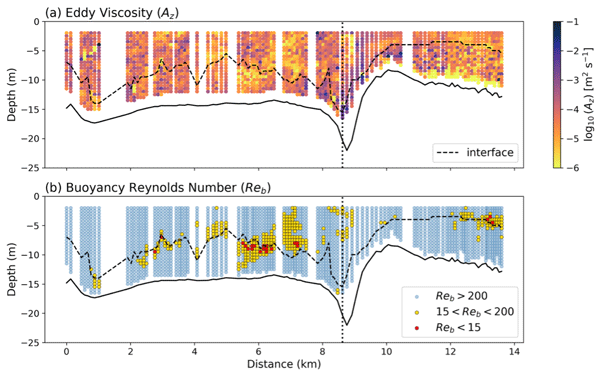
Abstract. This study investigates the hydrodynamic and mixing processes at the estuary–shelf transition of a microtidal system, and the buoyant plume generated at the Patos Lagoon mouth (Brazil). Using measurements of turbulent kinetic energy (TKE) dissipation (ϵ), current velocities, salinity, and temperature collected during a high-discharge period (∼9,400 m³ s-1), we characterize the spatial evolution of turbulence and mixing along the channel, from the source to the buoyancy-driven plume region. Observations show that the jetty-constrained inlet acts as a morphological nozzle, forcing the flow to remain supercritical (Fri > 1) for several kilometres onto the inner shelf. Despite strong stratification, intense shear-driven turbulence was observed, with TKE dissipation rates (ε) reaching 10-3 W kg-1 near the mouth, comparable to values reported in high-energy mesotidal and macrotidal systems. Analysis of the buoyancy Reynolds number (Reb) and the gradient Richardson number (Ri) indicates that inertial forcing overcomes buoyancy suppression, maintaining a predominantly turbulent regime (Reb > 200) at the plume front. These results demonstrate that, in narrow, high-discharge estuarine outlets, morphological confinement and sustained supercritical flow govern the near-field evolution of buoyant plumes, maintaining vigorous mixing even under pronounced density stratification.
-
Notice on discussion status
The requested preprint has a corresponding peer-reviewed final revised paper. You are encouraged to refer to the final revised version.
-
Preprint
(3299 KB)
-
The requested preprint has a corresponding peer-reviewed final revised paper. You are encouraged to refer to the final revised version.
- Preprint
(3299 KB) - Metadata XML
- BibTeX
- EndNote
- Final revised paper


Journal article(s) based on this preprint
Interactive discussion
Status: closed
-
RC1: 'Comment on egusphere-2026-1840', Daniel MacDonald, 22 May 2026
- AC1: 'Reply on RC1', Carlos Schettini, 13 Jul 2026
-
RC2: 'Comment on egusphere-2026-1840', Óscar Álvarez-Silva, 30 May 2026
General comment
This manuscript presents detailed observations of hydrodynamics, turbulence, and mixing processes at the estuary–shelf transition of the Patos Lagoon inlet. The manuscript is generally well structured and scientifically relevant. The observational effort is significant, and direct turbulence measurements in microtidal estuarine/plume systems remain relatively scarce, so the dataset presented here is valuable for publication. The discussion about the coexistence of strong stratification and energetic turbulence is particularly interesting and contributes to the broader understanding of estuarine mixing processes. I believe the manuscript has strong potential; however, several aspects still require clarification and further development before publication. The manuscript presents strong observational descriptions, but the physical interpretation could be developed more deeply in several sections. Some conclusions currently appear stronger than what is directly supported by the observations.
Specific comments
General context of experiments:
- The manuscript states that discharge through the estuary mouth is not directly proportional to the tributaries' discharge because wind strongly modulates the system. However, the study requires some context of the sampled conditions within the wind–discharge regime space. How representative are the observed conditions? What is the probability of occurrence of the sampled scenario? If sufficient historical data are available, a two-dimensional probability distribution of discharge and wind conditions, indicating the position of the sampled event, would greatly strengthen the interpretation
- The role of wind is mostly discussed in terms of inflow/outflow modulation. However, the manuscript does not sufficiently discuss the possible influence of wind on turbulence generation, vertical shear, or plume mixing. Is the wind effect totally negligible?
Ri vs Reb:
- The manuscript introduces Ri and Reb as central parameters controlling the interpretation of mixing. However, the conceptual distinction between the two parameters should be developed in more detail. At several points, Reb appears to be treated as a superior replacement for Ri, but the underlying physical reasoning is not fully established.
- Several regions of the estuary and plume exhibit Ri values indicative of stability while elevated Reb values persist. This is one of the most interesting findings of the study and deserves a deeper physical discussion. Why does this discrepancy take place?
- The manuscript argues that Reb provides a more robust description of turbulent conditions than Ri. However, Reb is substantially more difficult to estimate observationally because it requires direct turbulence measurements. The authors should discuss the practical implications of this result for studies lacking microstructure instrumentation.
- The threshold values Reb = 15 and Reb = 200 play a central role in interpreting the results. However, these thresholds may be subject to limitations similar to those associated with the classical Ri = 0.25 criterion. Additional discussion of the origin, applicability, and uncertainty of these threshold values would strengthen the manuscript because several conclusions depend on them.
- In the conclusions, the authors suggest that Reb is more effective than Ri at identifying suppression of mixing under supercritical conditions. This is a very interesting conclusion, but it requires more development and support.
Chanel geometry and turbulence:
- Section 5.2 and Figure 12 constitute a central component of the analysis by highlighting a potential relationship between channel morphology and TKE dissipation. However, the evidence currently presented does not appear sufficiently strong to establish a causal relationship. There is certainly a co-occurrence between the increase in cross-sectional area between km 4 and 6 and a reduction in TKE dissipation, but this alone does not demonstrate cause and effect. The strongest increase in TKE dissipation near the inlet does not appear to coincide exactly with the location of maximum lateral constriction. Dissipation remains relatively stable across the narrowest section and increases most strongly immediately downstream of the channel exit. Then, probably the observed enhancement of turbulence may be associated with plume lift-off (vertical contraction of the flow) rather than with lateral confinement imposed by the jetties. Are there additional observations supporting the influence of channel widening on the hydrodynamics? It may be useful to quantify this relationship using a correlation analysis, possibly after smoothing and normalizing both variables.
Lateral circulation:
- The lateral circulation pattern is very interesting. A more detailed discussion of the mechanisms underlying this circulation and the possible implications for turbulence and mixing would improve the manuscript.
Technical comments
- Lines 38-39: River plumes are not necessarily shallow features; this is only true for surface-advected plumes. Here, and later in Section 5.3, the manuscript would benefit from contextualizing the plume as a surface-advected plume. Relevant references include Yankovsky and Chapman (1997) and Yankovsky et al. (2022).
- Line 44: clarify that you are referring to the densimetric Froude number or the internal Froude number.
- Lines 47–49: Here and elsewhere throughout the manuscript, several important statements are not supported by references. Additional citations to key previous studies would strengthen the scientific context.
- Lines 50–51: This sentence suggests that hydraulic jumps are a primary focus of the study, whereas they are only discussed as a possible interpretation. Consider rephrasing.
- Lines 56–57: The term "near-field" is more common in the plume literature. I recommend using it consistently throughout the manuscript.
- Lines 65–67: River plumes are among the most extensively studied coastal phenomena. This statement should be revised. Perhaps the intended meaning is that direct turbulence measurements within river plumes remain relatively scarce.
- Lines 77–79: I am not entirely convinced that the manuscript explicitly addresses these research questions. Related results are presented, but the discussion does not return to these questions directly.
- Lines 231–232: Why is the larger estimate removed rather than the smaller one? What percentage of the dataset was discarded under this criterion? In other words, how frequently did the two probes differ by more than two orders of magnitude?
- Lines 266–267: Please provide a more detailed explanation of Rf. Equations 4 and 5 would benefit from additional details regarding the physical meaning of the parameters, their typical ranges, and the interpretation of extreme values.
- Verify whether Equation 8 uses U or ΔU. Additionally, define Δρ explicitly.
- Figure 5: Verify that the histogram bars correspond correctly to their associated axes. The bars appear slightly displaced relative to the data distribution in the central panel.
- Figure 6: I am not convinced that this figure provides information beyond what is already shown in Figure 4 or that it plays a significant role in the discussion. Consider removing it. The same for Figure 11.
- Section 4.3: The title "Jetties segment" is confusing. More generally, I don’t think that this section is essential to the manuscript.
- Section 5.1: Some of this information appears methodological in nature and may be more appropriate in the Methods section.
- Lines 587–588: better explain what is meant by the "stratification-dominated regime" described in Barros et al. (2025).
- Lines 633–635: This explanation is difficult to follow. Consider rephrasing for clarity.
- Line 636: The concept of the near-field plume is not applicable within the laterally confined estuary.
- Lines 704–706: How do you reconcile the interpretation that mixing is partially suppressed by stratification with the statement that "mixing efficiency is maximized"? What is meant by "pycnocline erosion"?
- Lines 740–741: The statement that the spatial evolution of turbulence is consistent with the sustained supercritical regime requires further explanation. How are these processes linked?
Citation: https://doi.org/10.5194/egusphere-2026-1840-RC2 - AC2: 'Reply on RC2', Carlos Schettini, 13 Jul 2026
Peer review completion


Interactive discussion
Status: closed
-
RC1: 'Comment on egusphere-2026-1840', Daniel MacDonald, 22 May 2026
This paper describes the results of a recent observational campaign at the mouth of the Patos Lagoon in southern Brazil, describing measurements of density, velocity and turbulence through the outlet and into the adjacent coastal shelf region. The manuscript reads very much like the combination of a thesis, in that there is sometimes too much fundamental detail, and a technical report, in that the majority of the paper is a presentation of the data. In this regard, the paper is lacking specific hypotheses or dynamical interpretation that is novel. However, it does represent a valuable contribution, and effectively illustrates that, for the most part, the outlets of microtidal systems behave similarly to those of meso- and macro-tidal environments. While this is not surprising, given that the essential structure of the outflow is driven by flow dynamics at shorter temporal scales that are relatively agnostic to the larger scale mechanisms setting up the overlying pressure gradients that drive the flow (such as tides, wind, etc.) data from a microtidal system to illustrate this is valuable.
Overall, I would recommend that the manuscript could be strengthened by focusing even more on this aspect, streamlining much of the more general introductory discussion regarding plumes and turbulence, and providing a more focused introduction on the differences between microtidal and other systems and why these systems may or may not be fundamentally different from most of the previously studied plumes. In my opinion, this is a more valuable focus than the “morphological nozzle” perspective. In this regard it is always valuable to have data from a wider variety of plume systems available in the literature, and the data collection and presentation is valuable.
Some more specific comments are included below:
Section 1 (roughly lines 60-80): These paragraphs provide an introduction to the microtidal system, but a broader and more detailed exploration of how these systems are different from meso and macro-tidal systems would be valuable, including why we might (or might not) expect the outflow dynamics to be different? Expanding on the time scale of flow reversal in the lagoon-channel-shelf system would be valuable (meterological scales of days vs tidal scales of hours) and how this affects the system. Presumably, there is more time to allow for dynamics to come to a quasi steady-state. Also, the nature of the receiving waters on the shelf might change (?), particularly since the ambient is not getting refreshed by the tides on a 12 hour cycle. Focusing more on these aspects of the study may strengthen the contribution.
Section 3 (general): This section reads much like a thesis, particularly in the data analysis section, where much of the material presented would be familiar to most readers, and definitions could be presented in a more streamlined manner.
Section 3.2.4 (lines ~300): Defining the interface depth for the calculation of Fr_i is a notoriously difficult process that is rarely, if ever, accomplished in an effective manner in the literature. In this case, the authors use two definitions for inside and outside of the channel, which may be warranted, but presents difficulties in interpretation. Overall, the general trends of Fr_i are probably more valuable than the actual values (discussed more below in the context of Figure 13). I would suggest providing more context to this discussion, including how much different definitions of the interface depth affect the results.
Line 341: Please clarify if the gauged river discharge is at a section that is completely fresh.
Figure 2: A key aspect of the microtidal system appears to be longer time scales to allow for the flow dynamics to reach a more consistent steady state. This is shown in figure 2 to some extent, but could be emphasized more in the text, particularly the paragraph at lines 350-360. These issues are addressed somewhat later (lines 550-555) but it would be a benefit to emphasize this earlier.
Figure 4 (and related discussion): These panels illustrate the challenges of defining the interfacial layer. Clearly, in the channel, there is a weak layer separation. But both layers seen in the channel, “lift off” at the mouth. So is the channel really a two layer system, or a weakly stratified single layer?
Section 4: In general, the presentation of collected data is good, however, it may not be necessary to show as much detail, which might allow the section to be streamlined. For example, epsilon might be sufficient – showing eddy visocity is somewhat redundant and does not necessarily add to the narrative. In Figure 9, it may not be necessary to show all the components of Ri independently.
Section 5.3: The discussion of Froude number is biased significantly by the choice of interface depth, but the trends in the Fround number are probably more valuable than the actual values. Most theory (see Farmer and Armi 1986, Armi and Farmer 1986, and many other later papers) would suggest that Fr~1 at the liftoff location, but this is not seen in Figure 13. Perhaps other definitions of h might recalibrate the values to be consistent with theory? Also, given the dramatic difference between the layer composition inside and outside the mouth, it is slightly misleading to plot Fr as a continuous progression. This section could be strengthened by acknowledging some of these issues. In general, the trend of Fr, particularly outside the mouth is consistent with earlier studies of near-field plumes, and also with the profile of epsilon shown in Figure 12 (perhaps figures 12 and 13 should be combined in some way).
Lines 630-635: Note that internal hydraulic jumps are rarely seen in plume observations, but Froude numbers more often reduce gradually over a significant spatial scale as the plume spreads and deepens. This is discussed in this paragraph, but the emphasis on hydraulic jumps (or their absence) may be overstated.
Lines 644-648: An exact starting point for the mid-field is hard to define, but it could be argued that the mid-field may start around 11-12 km as Fr is on a downward trend and the interface depth begins to decrease, both suggesting that the intensely energetic near field/lift-off region is beginning to weaken.
Table 2: While the list of references is valuable, I am not sure that the differences in epsilon are significant enough to warrant a table (often the difference between 10-3 and 10-4 might be somewhat subjective). Note also that the reference to Spicer (2022) is more closely associated with the Merrimack than the Columbia River, as indicated in the table.
Lines 715-720: The discussion about Ri dependence is valuable. It should be noted that the scale over which the critical value of ¼ is valid may be quite small, and below the resolution of your data set. Thus, your values of Ri may be more of a bulk Richardson number, for which turbulence can be generated and sustained at values higher than ¼. We recently published a paper on this topic which you might find interesting:
MacDonald, D.G., and L. Goodman, 2026. Defining an appropriate range of scales for application of the gradient Richardson number, with implications for observations of stratified shear turbulence at laboratory and ocean scales. Frontiers in Marine Science. 13:1758561. doi: 10.3389/fmars.2026.1758561
Overall, I think the data set is strong and provides a valuable contribution as a reference point for micro-tidal outflows. I recommend that the manuscript be strengthed by streamlining the paper (particularly the introduction and discussion sections) and focusing primarily on the micro-tidal aspect of the results, which is the most novel.
Dan MacDonald
Citation: https://doi.org/10.5194/egusphere-2026-1840-RC1 - AC1: 'Reply on RC1', Carlos Schettini, 13 Jul 2026
-
RC2: 'Comment on egusphere-2026-1840', Óscar Álvarez-Silva, 30 May 2026
General comment
This manuscript presents detailed observations of hydrodynamics, turbulence, and mixing processes at the estuary–shelf transition of the Patos Lagoon inlet. The manuscript is generally well structured and scientifically relevant. The observational effort is significant, and direct turbulence measurements in microtidal estuarine/plume systems remain relatively scarce, so the dataset presented here is valuable for publication. The discussion about the coexistence of strong stratification and energetic turbulence is particularly interesting and contributes to the broader understanding of estuarine mixing processes. I believe the manuscript has strong potential; however, several aspects still require clarification and further development before publication. The manuscript presents strong observational descriptions, but the physical interpretation could be developed more deeply in several sections. Some conclusions currently appear stronger than what is directly supported by the observations.
Specific comments
General context of experiments:
- The manuscript states that discharge through the estuary mouth is not directly proportional to the tributaries' discharge because wind strongly modulates the system. However, the study requires some context of the sampled conditions within the wind–discharge regime space. How representative are the observed conditions? What is the probability of occurrence of the sampled scenario? If sufficient historical data are available, a two-dimensional probability distribution of discharge and wind conditions, indicating the position of the sampled event, would greatly strengthen the interpretation
- The role of wind is mostly discussed in terms of inflow/outflow modulation. However, the manuscript does not sufficiently discuss the possible influence of wind on turbulence generation, vertical shear, or plume mixing. Is the wind effect totally negligible?
Ri vs Reb:
- The manuscript introduces Ri and Reb as central parameters controlling the interpretation of mixing. However, the conceptual distinction between the two parameters should be developed in more detail. At several points, Reb appears to be treated as a superior replacement for Ri, but the underlying physical reasoning is not fully established.
- Several regions of the estuary and plume exhibit Ri values indicative of stability while elevated Reb values persist. This is one of the most interesting findings of the study and deserves a deeper physical discussion. Why does this discrepancy take place?
- The manuscript argues that Reb provides a more robust description of turbulent conditions than Ri. However, Reb is substantially more difficult to estimate observationally because it requires direct turbulence measurements. The authors should discuss the practical implications of this result for studies lacking microstructure instrumentation.
- The threshold values Reb = 15 and Reb = 200 play a central role in interpreting the results. However, these thresholds may be subject to limitations similar to those associated with the classical Ri = 0.25 criterion. Additional discussion of the origin, applicability, and uncertainty of these threshold values would strengthen the manuscript because several conclusions depend on them.
- In the conclusions, the authors suggest that Reb is more effective than Ri at identifying suppression of mixing under supercritical conditions. This is a very interesting conclusion, but it requires more development and support.
Chanel geometry and turbulence:
- Section 5.2 and Figure 12 constitute a central component of the analysis by highlighting a potential relationship between channel morphology and TKE dissipation. However, the evidence currently presented does not appear sufficiently strong to establish a causal relationship. There is certainly a co-occurrence between the increase in cross-sectional area between km 4 and 6 and a reduction in TKE dissipation, but this alone does not demonstrate cause and effect. The strongest increase in TKE dissipation near the inlet does not appear to coincide exactly with the location of maximum lateral constriction. Dissipation remains relatively stable across the narrowest section and increases most strongly immediately downstream of the channel exit. Then, probably the observed enhancement of turbulence may be associated with plume lift-off (vertical contraction of the flow) rather than with lateral confinement imposed by the jetties. Are there additional observations supporting the influence of channel widening on the hydrodynamics? It may be useful to quantify this relationship using a correlation analysis, possibly after smoothing and normalizing both variables.
Lateral circulation:
- The lateral circulation pattern is very interesting. A more detailed discussion of the mechanisms underlying this circulation and the possible implications for turbulence and mixing would improve the manuscript.
Technical comments
- Lines 38-39: River plumes are not necessarily shallow features; this is only true for surface-advected plumes. Here, and later in Section 5.3, the manuscript would benefit from contextualizing the plume as a surface-advected plume. Relevant references include Yankovsky and Chapman (1997) and Yankovsky et al. (2022).
- Line 44: clarify that you are referring to the densimetric Froude number or the internal Froude number.
- Lines 47–49: Here and elsewhere throughout the manuscript, several important statements are not supported by references. Additional citations to key previous studies would strengthen the scientific context.
- Lines 50–51: This sentence suggests that hydraulic jumps are a primary focus of the study, whereas they are only discussed as a possible interpretation. Consider rephrasing.
- Lines 56–57: The term "near-field" is more common in the plume literature. I recommend using it consistently throughout the manuscript.
- Lines 65–67: River plumes are among the most extensively studied coastal phenomena. This statement should be revised. Perhaps the intended meaning is that direct turbulence measurements within river plumes remain relatively scarce.
- Lines 77–79: I am not entirely convinced that the manuscript explicitly addresses these research questions. Related results are presented, but the discussion does not return to these questions directly.
- Lines 231–232: Why is the larger estimate removed rather than the smaller one? What percentage of the dataset was discarded under this criterion? In other words, how frequently did the two probes differ by more than two orders of magnitude?
- Lines 266–267: Please provide a more detailed explanation of Rf. Equations 4 and 5 would benefit from additional details regarding the physical meaning of the parameters, their typical ranges, and the interpretation of extreme values.
- Verify whether Equation 8 uses U or ΔU. Additionally, define Δρ explicitly.
- Figure 5: Verify that the histogram bars correspond correctly to their associated axes. The bars appear slightly displaced relative to the data distribution in the central panel.
- Figure 6: I am not convinced that this figure provides information beyond what is already shown in Figure 4 or that it plays a significant role in the discussion. Consider removing it. The same for Figure 11.
- Section 4.3: The title "Jetties segment" is confusing. More generally, I don’t think that this section is essential to the manuscript.
- Section 5.1: Some of this information appears methodological in nature and may be more appropriate in the Methods section.
- Lines 587–588: better explain what is meant by the "stratification-dominated regime" described in Barros et al. (2025).
- Lines 633–635: This explanation is difficult to follow. Consider rephrasing for clarity.
- Line 636: The concept of the near-field plume is not applicable within the laterally confined estuary.
- Lines 704–706: How do you reconcile the interpretation that mixing is partially suppressed by stratification with the statement that "mixing efficiency is maximized"? What is meant by "pycnocline erosion"?
- Lines 740–741: The statement that the spatial evolution of turbulence is consistent with the sustained supercritical regime requires further explanation. How are these processes linked?
Citation: https://doi.org/10.5194/egusphere-2026-1840-RC2 - AC2: 'Reply on RC2', Carlos Schettini, 13 Jul 2026
Peer review completion
Journal article(s) based on this preprint
Viewed
| HTML | XML | Total | BibTeX | EndNote | |
|---|---|---|---|---|---|
| 272 | 227 | 47 | 546 | 33 | 43 |
- HTML: 272
- PDF: 227
- XML: 47
- Total: 546
- BibTeX: 33
- EndNote: 43
Viewed (geographical distribution)
| Country | # | Views | % |
|---|
| Total: | 0 |
| HTML: | 0 |
| PDF: | 0 |
| XML: | 0 |
- 1
Débora Barros
Lauren Ross
Carlos A. F. Schettini

The requested preprint has a corresponding peer-reviewed final revised paper. You are encouraged to refer to the final revised version.
- Preprint
(3299 KB) - Metadata XML
This paper describes the results of a recent observational campaign at the mouth of the Patos Lagoon in southern Brazil, describing measurements of density, velocity and turbulence through the outlet and into the adjacent coastal shelf region. The manuscript reads very much like the combination of a thesis, in that there is sometimes too much fundamental detail, and a technical report, in that the majority of the paper is a presentation of the data. In this regard, the paper is lacking specific hypotheses or dynamical interpretation that is novel. However, it does represent a valuable contribution, and effectively illustrates that, for the most part, the outlets of microtidal systems behave similarly to those of meso- and macro-tidal environments. While this is not surprising, given that the essential structure of the outflow is driven by flow dynamics at shorter temporal scales that are relatively agnostic to the larger scale mechanisms setting up the overlying pressure gradients that drive the flow (such as tides, wind, etc.) data from a microtidal system to illustrate this is valuable.
Overall, I would recommend that the manuscript could be strengthened by focusing even more on this aspect, streamlining much of the more general introductory discussion regarding plumes and turbulence, and providing a more focused introduction on the differences between microtidal and other systems and why these systems may or may not be fundamentally different from most of the previously studied plumes. In my opinion, this is a more valuable focus than the “morphological nozzle” perspective. In this regard it is always valuable to have data from a wider variety of plume systems available in the literature, and the data collection and presentation is valuable.
Some more specific comments are included below:
Section 1 (roughly lines 60-80): These paragraphs provide an introduction to the microtidal system, but a broader and more detailed exploration of how these systems are different from meso and macro-tidal systems would be valuable, including why we might (or might not) expect the outflow dynamics to be different? Expanding on the time scale of flow reversal in the lagoon-channel-shelf system would be valuable (meterological scales of days vs tidal scales of hours) and how this affects the system. Presumably, there is more time to allow for dynamics to come to a quasi steady-state. Also, the nature of the receiving waters on the shelf might change (?), particularly since the ambient is not getting refreshed by the tides on a 12 hour cycle. Focusing more on these aspects of the study may strengthen the contribution.
Section 3 (general): This section reads much like a thesis, particularly in the data analysis section, where much of the material presented would be familiar to most readers, and definitions could be presented in a more streamlined manner.
Section 3.2.4 (lines ~300): Defining the interface depth for the calculation of Fr_i is a notoriously difficult process that is rarely, if ever, accomplished in an effective manner in the literature. In this case, the authors use two definitions for inside and outside of the channel, which may be warranted, but presents difficulties in interpretation. Overall, the general trends of Fr_i are probably more valuable than the actual values (discussed more below in the context of Figure 13). I would suggest providing more context to this discussion, including how much different definitions of the interface depth affect the results.
Line 341: Please clarify if the gauged river discharge is at a section that is completely fresh.
Figure 2: A key aspect of the microtidal system appears to be longer time scales to allow for the flow dynamics to reach a more consistent steady state. This is shown in figure 2 to some extent, but could be emphasized more in the text, particularly the paragraph at lines 350-360. These issues are addressed somewhat later (lines 550-555) but it would be a benefit to emphasize this earlier.
Figure 4 (and related discussion): These panels illustrate the challenges of defining the interfacial layer. Clearly, in the channel, there is a weak layer separation. But both layers seen in the channel, “lift off” at the mouth. So is the channel really a two layer system, or a weakly stratified single layer?
Section 4: In general, the presentation of collected data is good, however, it may not be necessary to show as much detail, which might allow the section to be streamlined. For example, epsilon might be sufficient – showing eddy visocity is somewhat redundant and does not necessarily add to the narrative. In Figure 9, it may not be necessary to show all the components of Ri independently.
Section 5.3: The discussion of Froude number is biased significantly by the choice of interface depth, but the trends in the Fround number are probably more valuable than the actual values. Most theory (see Farmer and Armi 1986, Armi and Farmer 1986, and many other later papers) would suggest that Fr~1 at the liftoff location, but this is not seen in Figure 13. Perhaps other definitions of h might recalibrate the values to be consistent with theory? Also, given the dramatic difference between the layer composition inside and outside the mouth, it is slightly misleading to plot Fr as a continuous progression. This section could be strengthened by acknowledging some of these issues. In general, the trend of Fr, particularly outside the mouth is consistent with earlier studies of near-field plumes, and also with the profile of epsilon shown in Figure 12 (perhaps figures 12 and 13 should be combined in some way).
Lines 630-635: Note that internal hydraulic jumps are rarely seen in plume observations, but Froude numbers more often reduce gradually over a significant spatial scale as the plume spreads and deepens. This is discussed in this paragraph, but the emphasis on hydraulic jumps (or their absence) may be overstated.
Lines 644-648: An exact starting point for the mid-field is hard to define, but it could be argued that the mid-field may start around 11-12 km as Fr is on a downward trend and the interface depth begins to decrease, both suggesting that the intensely energetic near field/lift-off region is beginning to weaken.
Table 2: While the list of references is valuable, I am not sure that the differences in epsilon are significant enough to warrant a table (often the difference between 10-3 and 10-4 might be somewhat subjective). Note also that the reference to Spicer (2022) is more closely associated with the Merrimack than the Columbia River, as indicated in the table.
Lines 715-720: The discussion about Ri dependence is valuable. It should be noted that the scale over which the critical value of ¼ is valid may be quite small, and below the resolution of your data set. Thus, your values of Ri may be more of a bulk Richardson number, for which turbulence can be generated and sustained at values higher than ¼. We recently published a paper on this topic which you might find interesting:
MacDonald, D.G., and L. Goodman, 2026. Defining an appropriate range of scales for application of the gradient Richardson number, with implications for observations of stratified shear turbulence at laboratory and ocean scales. Frontiers in Marine Science. 13:1758561. doi: 10.3389/fmars.2026.1758561
Overall, I think the data set is strong and provides a valuable contribution as a reference point for micro-tidal outflows. I recommend that the manuscript be strengthed by streamlining the paper (particularly the introduction and discussion sections) and focusing primarily on the micro-tidal aspect of the results, which is the most novel.
Dan MacDonald