
the Creative Commons Attribution 4.0 License.
the Creative Commons Attribution 4.0 License.
 | 05 May 2026
Supporting climate change adaptation worldwide: A web application for exploring uncertain future changes in water resources
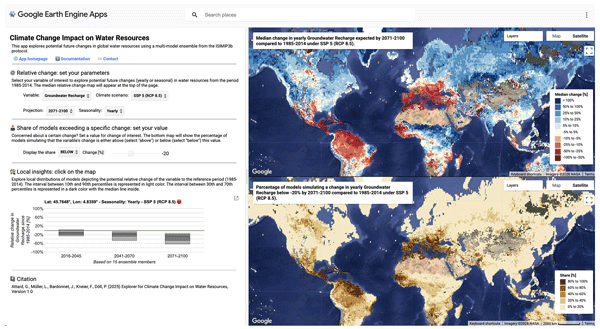
Abstract. While adaptation to changing water resources due to climate change is necessary everywhere, information about their potential future changes has not been easily accessible to most climate change adaptation processes. The free interactive web application Climate Change Impact of Water Resources (CCIWR) Explorer presents the output of a multi-model ensemble of global hydrological models. It provides state-of-the-art information to support participatory climate change adaptation processes worldwide. What makes the CCIWR Explorer unique is its ability to inform climate change adaptation decisions that account for stakeholder risk aversion. It not only shows the projected median future change in total water resources, groundwater resources, and evapotranspiration in the four seasons or annually, but also which fraction of the ensemble members project a change that stakeholders consider hazardous. Three visualizations are provided: Two map views as well as “Local Insights”, percentile boxes showing the range of future changes in individual 0.5° grid cells. The Explorer was evaluated regarding effectiveness, efficiency, operability, user engagement, and beneficialness. This was achieved through an online user survey, in which 21 pilot users familiarized themselves with the web application by completing two tasks before evaluating various aspects of the Explorer. On average, user satisfaction was high. Satisfaction and the number of correct answers are positively correlated with user expertise. Based on experiences with using multi-model ensemble projections to inform stakeholders in three participatory processes, we recommend that experts, such as water engineers and climate managers, consult the CCIWR Explorer to inform stakeholders. The Explorer is also suited to direct use by university students and researchers.
-
Notice on discussion status
The requested preprint has a corresponding peer-reviewed final revised paper. You are encouraged to refer to the final revised version.
-
Preprint
(1677 KB)
-
Supplement
(7837 KB)
-
The requested preprint has a corresponding peer-reviewed final revised paper. You are encouraged to refer to the final revised version.
- Preprint
(1677 KB) - Metadata XML
-
Supplement
(7837 KB) - BibTeX
- EndNote
- Final revised paper


Journal article(s) based on this preprint
Interactive discussion
Status: closed
-
RC1: 'Comment on egusphere-2026-1829', Anonymous Referee #1, 05 Jun 2026
- AC1: 'Reply on RC1', Petra Döll, 17 Aug 2026
-
RC2: 'Comment on egusphere-2026-1829', Anonymous Referee #2, 20 Jul 2026
The manuscript “Supporting climate change adaptation worldwide: A web application for exploring uncertain future changes in water resources” introduces the web application Climate Change Impact of Water Resources (CCIWR) Explorer. The web application is designed to support climate change adaptation in the water sector by communicating multi-model ensemble (MME) uncertainty in future water resources. The manuscripts reports on a pilot user survey evaluating CCIWR Explorer’s quality in use. Overall, the paper is relevant, with a clear applied focus and a commitment to transparency (open code and survey materials).
The paper introduces a web-based tool, the CCIWR Explorer. The purpose of the tool is to help users understand and utilize uncertain projections of future changes in water resources at global scale, with a particular focus on groundwater recharge and related variables. The tool displays map-based information and percentile plots for different time periods and scenarios, allowing users to explore the plausible range of future changes for their region of interest.
The documentation accompanying the Explorer explains the app’s purpose, applicability, content, and guidance on how to use its information for local climate change adaptation processes.
The authors explicitly position the tool within participatory climate change adaptation work, drawing on recent experiences in communicating uncertain climate hazards in participatory processes and on previous work on quantifying and communicating uncertain hazards. To evaluate the Explorer, the authors conduct an online pilot user survey (21 respondents) built around ISO/IEC 25019 quality-in-use criteria.
The authors address the practical need of how to communicate uncertain future changes in water resources in a way that supports adaptation decisions. The title and initial framing clearly state this application-oriented focus. The linkage to participatory climate change adaptation in the water sector is explicit with references to recent practical projects and experiences.
It is good to see the incorporation of pilot user feedback into both the documentation and the tool design. For instance, a user suggestion to add the survey tasks as documentation examples was directly implemented, turning well-designed survey tasks into a tutorial. The detailed response table shows which suggestions were implemented, partially implemented, or rejected with justification. This iterative design process—particularly the revision of the documentation to better guide users through interpretation of the outputs and to add a tutorial—enhances the credibility of the tool’s usability claims.
The authors provide the questionnaire, survey results, original and revised documentation, and the web application code as supplementary material, with a clear data availability statement and link.
The linkage to participatory climate change adaptation in the water sector is explicit and consistent throughout, with references to recent practical projects and experiences.
User satisfaction and intention to reuse the tool appear generally positive; only 3 out of 21 participants indicated they did not intend to consult the Explorer again. Participants provided detailed qualitative feedback on documentation, maps, and “Local Insights” plots, much of which the authors incorporated into a revised documentation and minor feature refinements.
The paper concludes that the CCIWR Explorer is a functioning, low-budget tool that can support local adaptation processes under uncertainty and underscores the value of carefully designed user surveys for evaluating climate data and decision-support web tools.
I find the article worth to be published, if the following major concerns are addressed in a revised manuscript:
- The pilot survey includes 21 participants recruited via professional and student mailing lists, LinkedIn, and personal contacts. While this is reasonable for an initial usability test, the authors claim about effectiveness, efficiency, and satisfaction would benefit from a more explicit discussion of limitations related to sample size and selection bias. For example, many participants appear to have pre-existing knowledge of percentiles and MME applications in climate studies. This may mean the evaluation over-represents technically literate users compared to typical stakeholders in adaptation processes (e.g., municipal planners, community representatives). Therefor, I recommend a) to add a short subsection explicitly discussing how the sampling strategy might affect generalizability of the findings to broader user groups (non-experts, practitioners with limited quantitative training), and b) to adjust any general conclusions about the tool’s effectiveness beyond the user profile actually represented in the survey.
- For many practitioners, especially outside climate or hydrology research, explicit formulas and visual aids can reduce cognitive load and increase trust. I suggest: a) reconsider including at least simplified versions of key equations in an appendix or “advanced” section of the documentation, clearly linked to the verbal explanation, to bridge both audiences (non-experts and technically interested users) and b) consider adding examples (using concrete locations and variables) that walk through map interpretation and “Local Insights” percentile boxes, showing how to move from visual output to adaptation-relevant conclusions. This would reinforce the app’s educational value and better support uptake in teaching (as exemplified by the hydrogeography class use case) and stakeholder workshops.
- The paper emphasizes that the Explorer is designed to help users “understand and embrace” uncertainty from MMEs and use this information for robust decisions. It also references prior work showing the usefulness of presenting distributions of potential future changes via percentile boxes. While this conceptual framing is fair, it would be interesting to explicitly address a) how different user groups interpret the percentile information (e.g., P10, P30, P70, P90) and whether misinterpretations were observed in the survey tasks; b) whether and how users were guided away from over-interpreting median values as “most likely” outcome, especially under deep uncertainty, and c) how the interface and documentation deal with potential confusion between statistical uncertainty, scenario uncertainty, and model uncertainty. If the revised manuscript includes such discussion elsewhere, it would be helpful to cross-reference it clearly from the evaluation section, since this is central to the app’s core claim: supporting adaptation “under uncertainty” rather than despite or ignoring it.
- While most participants were familiar with percentiles and MMEs, it will be useful to explicitly define “Local Insights” in the main text the first time it appears, and to briefly explain what each percentile line represents in practical terms (e.g., “10% of model simulations show changes more extreme than this line”). And importantly, please justify why you have chosen “local insights” on gridcell level? I wonder if this is useful for the users, at all. I question the usability for two reasons: a) the gridcells are very coarse 0.5 x 0.5 deg and b) users often operate on administrative or geographic scales such as county, city or catchment level.
Citation: https://doi.org/10.5194/egusphere-2026-1829-RC2 - AC2: 'Reply on RC2', Petra Döll, 17 Aug 2026
Peer review completion


Interactive discussion
Status: closed
-
RC1: 'Comment on egusphere-2026-1829', Anonymous Referee #1, 05 Jun 2026
This well-written paper provides an introduction to and evaluation of a web-based tool, designed by the authors, to support climate change adaptation: the Climate Change Impact of Water Resources (CCIWR) Explorer. While very thorough and informative in introducing the tool and in sharing the results of the evaluation, the scope of the paper is perhaps somewhat limited. Specifically, the paper currently does not put forth a larger argument/main point as part of an effort to address gaps in existing knowledge in geoscience communication. Prompting questions for the authors are whether and how they can apply the evaluation toward a more generalizable purpose (e.g., lessons learned that apply broadly to the advancement of geoscience communication and beyond the improvement specifically of this tool). There is one comment made at the end of the paper to this effect (pg. 21, starting line 495), but it does not quite offer readers a great deal of insight into the reasons why the evaluation of web-based tools is important.
Discussion section 5.1 (starting pg. 14): Here the paper seems to lose its central thread. Rather than discuss the results of the evaluation within existing, relevant literature, there is additional data introduced (i.e., results of discussions in different participatory processes for water management). It seems that for this data to be included in the paper, the approaches/methods used to engage groups and frame discussions should be included within the methods section, and the results of those discussions should be included in the results section. The purpose of the discussion section would then be to discuss the combined results in relation to the existing literature that gives framing to the entirety of the paper (again, the larger argument/main point/gaps in knowledge addressed).
Pg. 15, line 229: The transition between paragraphs is unclear. From here it also becomes a bit difficult to understand the discussion section as it goes into detail about the participatory workshops for which thorough description of methods, etc., is not previously provided (see prior comment). Some of the approach/methods is embedded within this text but not all of it is explained (e.g., line 322 makes reference to previous interviews with stakeholder representatives but it is unclear when, with whom, and for what purpose, etc.).
Similarly, Section 5.2 does not currently contain discussion of results but rather introduces new information (i.e., comparison of CCIWR Explorer with other tools). This comparison is a somewhat difficult to follow in the absence of visual aids.
In sum, it is clear that the authors have put forth significant effort to develop and refine the CCIWR Explorer through different forms of evaluation. To streamline this paper in a way that clearly lays out the different phases of evaluation (in methods and results) and then discusses the combined results in relation to an overarching point the authors choose to make will strengthen it greatly.
Citation: https://doi.org/10.5194/egusphere-2026-1829-RC1 - AC1: 'Reply on RC1', Petra Döll, 17 Aug 2026
-
RC2: 'Comment on egusphere-2026-1829', Anonymous Referee #2, 20 Jul 2026
The manuscript “Supporting climate change adaptation worldwide: A web application for exploring uncertain future changes in water resources” introduces the web application Climate Change Impact of Water Resources (CCIWR) Explorer. The web application is designed to support climate change adaptation in the water sector by communicating multi-model ensemble (MME) uncertainty in future water resources. The manuscripts reports on a pilot user survey evaluating CCIWR Explorer’s quality in use. Overall, the paper is relevant, with a clear applied focus and a commitment to transparency (open code and survey materials).
The paper introduces a web-based tool, the CCIWR Explorer. The purpose of the tool is to help users understand and utilize uncertain projections of future changes in water resources at global scale, with a particular focus on groundwater recharge and related variables. The tool displays map-based information and percentile plots for different time periods and scenarios, allowing users to explore the plausible range of future changes for their region of interest.
The documentation accompanying the Explorer explains the app’s purpose, applicability, content, and guidance on how to use its information for local climate change adaptation processes.
The authors explicitly position the tool within participatory climate change adaptation work, drawing on recent experiences in communicating uncertain climate hazards in participatory processes and on previous work on quantifying and communicating uncertain hazards. To evaluate the Explorer, the authors conduct an online pilot user survey (21 respondents) built around ISO/IEC 25019 quality-in-use criteria.
The authors address the practical need of how to communicate uncertain future changes in water resources in a way that supports adaptation decisions. The title and initial framing clearly state this application-oriented focus. The linkage to participatory climate change adaptation in the water sector is explicit with references to recent practical projects and experiences.
It is good to see the incorporation of pilot user feedback into both the documentation and the tool design. For instance, a user suggestion to add the survey tasks as documentation examples was directly implemented, turning well-designed survey tasks into a tutorial. The detailed response table shows which suggestions were implemented, partially implemented, or rejected with justification. This iterative design process—particularly the revision of the documentation to better guide users through interpretation of the outputs and to add a tutorial—enhances the credibility of the tool’s usability claims.
The authors provide the questionnaire, survey results, original and revised documentation, and the web application code as supplementary material, with a clear data availability statement and link.
The linkage to participatory climate change adaptation in the water sector is explicit and consistent throughout, with references to recent practical projects and experiences.
User satisfaction and intention to reuse the tool appear generally positive; only 3 out of 21 participants indicated they did not intend to consult the Explorer again. Participants provided detailed qualitative feedback on documentation, maps, and “Local Insights” plots, much of which the authors incorporated into a revised documentation and minor feature refinements.
The paper concludes that the CCIWR Explorer is a functioning, low-budget tool that can support local adaptation processes under uncertainty and underscores the value of carefully designed user surveys for evaluating climate data and decision-support web tools.
I find the article worth to be published, if the following major concerns are addressed in a revised manuscript:
- The pilot survey includes 21 participants recruited via professional and student mailing lists, LinkedIn, and personal contacts. While this is reasonable for an initial usability test, the authors claim about effectiveness, efficiency, and satisfaction would benefit from a more explicit discussion of limitations related to sample size and selection bias. For example, many participants appear to have pre-existing knowledge of percentiles and MME applications in climate studies. This may mean the evaluation over-represents technically literate users compared to typical stakeholders in adaptation processes (e.g., municipal planners, community representatives). Therefor, I recommend a) to add a short subsection explicitly discussing how the sampling strategy might affect generalizability of the findings to broader user groups (non-experts, practitioners with limited quantitative training), and b) to adjust any general conclusions about the tool’s effectiveness beyond the user profile actually represented in the survey.
- For many practitioners, especially outside climate or hydrology research, explicit formulas and visual aids can reduce cognitive load and increase trust. I suggest: a) reconsider including at least simplified versions of key equations in an appendix or “advanced” section of the documentation, clearly linked to the verbal explanation, to bridge both audiences (non-experts and technically interested users) and b) consider adding examples (using concrete locations and variables) that walk through map interpretation and “Local Insights” percentile boxes, showing how to move from visual output to adaptation-relevant conclusions. This would reinforce the app’s educational value and better support uptake in teaching (as exemplified by the hydrogeography class use case) and stakeholder workshops.
- The paper emphasizes that the Explorer is designed to help users “understand and embrace” uncertainty from MMEs and use this information for robust decisions. It also references prior work showing the usefulness of presenting distributions of potential future changes via percentile boxes. While this conceptual framing is fair, it would be interesting to explicitly address a) how different user groups interpret the percentile information (e.g., P10, P30, P70, P90) and whether misinterpretations were observed in the survey tasks; b) whether and how users were guided away from over-interpreting median values as “most likely” outcome, especially under deep uncertainty, and c) how the interface and documentation deal with potential confusion between statistical uncertainty, scenario uncertainty, and model uncertainty. If the revised manuscript includes such discussion elsewhere, it would be helpful to cross-reference it clearly from the evaluation section, since this is central to the app’s core claim: supporting adaptation “under uncertainty” rather than despite or ignoring it.
- While most participants were familiar with percentiles and MMEs, it will be useful to explicitly define “Local Insights” in the main text the first time it appears, and to briefly explain what each percentile line represents in practical terms (e.g., “10% of model simulations show changes more extreme than this line”). And importantly, please justify why you have chosen “local insights” on gridcell level? I wonder if this is useful for the users, at all. I question the usability for two reasons: a) the gridcells are very coarse 0.5 x 0.5 deg and b) users often operate on administrative or geographic scales such as county, city or catchment level.
Citation: https://doi.org/10.5194/egusphere-2026-1829-RC2 - AC2: 'Reply on RC2', Petra Döll, 17 Aug 2026
Peer review completion
Journal article(s) based on this preprint
Model code and software
Web Application Climate Change Impact on Water Resources Explorer Guillaume Attard https://drive.google.com/file/d/1FZvI9sufoQ7LhkUyZ0Ani8xLHywX9iGL/view?usp=drive_link
Viewed
| HTML | XML | Total | Supplement | BibTeX | EndNote | |
|---|---|---|---|---|---|---|
| 218 | 88 | 34 | 340 | 35 | 27 | 31 |
- HTML: 218
- PDF: 88
- XML: 34
- Total: 340
- Supplement: 35
- BibTeX: 27
- EndNote: 31
Viewed (geographical distribution)
| Country | # | Views | % |
|---|
| Total: | 0 |
| HTML: | 0 |
| PDF: | 0 |
| XML: | 0 |
- 1

Guillaume Attard
Fabian Kneier
Laura Müller
The requested preprint has a corresponding peer-reviewed final revised paper. You are encouraged to refer to the final revised version.
- Preprint
(1677 KB) - Metadata XML
-
Supplement
(7837 KB) - BibTeX
- EndNote
- Final revised paper
This well-written paper provides an introduction to and evaluation of a web-based tool, designed by the authors, to support climate change adaptation: the Climate Change Impact of Water Resources (CCIWR) Explorer. While very thorough and informative in introducing the tool and in sharing the results of the evaluation, the scope of the paper is perhaps somewhat limited. Specifically, the paper currently does not put forth a larger argument/main point as part of an effort to address gaps in existing knowledge in geoscience communication. Prompting questions for the authors are whether and how they can apply the evaluation toward a more generalizable purpose (e.g., lessons learned that apply broadly to the advancement of geoscience communication and beyond the improvement specifically of this tool). There is one comment made at the end of the paper to this effect (pg. 21, starting line 495), but it does not quite offer readers a great deal of insight into the reasons why the evaluation of web-based tools is important.
Discussion section 5.1 (starting pg. 14): Here the paper seems to lose its central thread. Rather than discuss the results of the evaluation within existing, relevant literature, there is additional data introduced (i.e., results of discussions in different participatory processes for water management). It seems that for this data to be included in the paper, the approaches/methods used to engage groups and frame discussions should be included within the methods section, and the results of those discussions should be included in the results section. The purpose of the discussion section would then be to discuss the combined results in relation to the existing literature that gives framing to the entirety of the paper (again, the larger argument/main point/gaps in knowledge addressed).
Pg. 15, line 229: The transition between paragraphs is unclear. From here it also becomes a bit difficult to understand the discussion section as it goes into detail about the participatory workshops for which thorough description of methods, etc., is not previously provided (see prior comment). Some of the approach/methods is embedded within this text but not all of it is explained (e.g., line 322 makes reference to previous interviews with stakeholder representatives but it is unclear when, with whom, and for what purpose, etc.).
Similarly, Section 5.2 does not currently contain discussion of results but rather introduces new information (i.e., comparison of CCIWR Explorer with other tools). This comparison is a somewhat difficult to follow in the absence of visual aids.
In sum, it is clear that the authors have put forth significant effort to develop and refine the CCIWR Explorer through different forms of evaluation. To streamline this paper in a way that clearly lays out the different phases of evaluation (in methods and results) and then discusses the combined results in relation to an overarching point the authors choose to make will strengthen it greatly.