
the Creative Commons Attribution 4.0 License.
the Creative Commons Attribution 4.0 License.
 | 04 May 2026
High nitrous oxide isotopic variability during denitrification by Pseudomonas species bearing NirK and NirS
Abstract. Nitrous oxide (N₂O) isotopocules provide key insights into microbial nitrogen cycling, but their interpretation requires well-constrained values for both oxygen isotope signatures (δ¹⁸O–N₂O) and intramolecular ¹⁵N site preference (SP) associated with N₂O production pathways. Site preference is widely used to distinguish N₂O formation pathways because bacterial denitrification is generally assumed to yield SP values near 0 ‰ through canonical NorB-mediated NO reduction. However, the extent to which SP remains stable across physiological states and changing NO reduction pathways remains poorly constrained. Likewise, interpretation of δ¹⁸O–N₂O associated with denitrification requires understanding the relative contributions of branching kinetic isotope effects and oxygen atom exchange between nitrite and water during N₂O formation.
Here, we investigated N₂O isotopic signatures during denitrification by Pseudomonas aureofaciens (NirK-bearing) and Pseudomonas chlororaphis (NirS-bearing) under active-growth and resuspension conditions using quantum cascade laser absorption spectroscopy (QCLAS) and isotope ratio mass spectrometry (IRMS). SP tracked canonical NorB-mediated NO reduction but transiently increased above +10 ‰ during early N₂O production, indicating temporary activity of alternative NO reductases. These dynamics were only resolved through continuous QCLAS measurements, highlighting the importance of time-resolved isotopic observations. While SP remains a useful indicator of NO reduction mechanisms, these results show that even within denitrification, shifts between NO reduction pathways may lead to variable SP signatures.
In parallel, we quantified oxygen atom exchange between nitrite and water using incubations prepared in natural-abundance and ¹⁸O-enriched water. Contrary to expectations from denitrifier-method studies, P. aureofaciens exhibited substantial and highly variable oxygen-atom exchange (38–100 %), far exceeding previously reported values (<9 %). In contrast, P. chlororaphis showed consistently high but less variable exchange (~66 %). Resuspension experiments reproduced the characteristic low- and high-exchange behavior reported for these strains under denitrifier-method conditions, demonstrating that these exchange values are specific to the methodological framework and not representative of actively growing systems. These results show that oxygen atom exchange is not governed solely by nitrite reductase identity (NirS vs. NirK) but is strongly modulated by physiological state and metabolic context. As a result, δ¹⁸O–N₂O cannot be interpreted as a fixed tracer of denitrification pathways outside the constrained conditions of the denitrifier method.
Together, these findings suggest that denitrifying bacteria may generate N₂O with a broader range of δ¹⁸O–N₂O and SP than previously assumed. This calls for a reassessment of N₂O isotopocule interpretations and emphasizes the need to integrate isotopic measurements with physiological and biochemical constraints.
-
Notice on discussion status
The requested preprint has a corresponding peer-reviewed final revised paper. You are encouraged to refer to the final revised version.
-
Preprint
(2065 KB)
-
The requested preprint has a corresponding peer-reviewed final revised paper. You are encouraged to refer to the final revised version.
- Preprint
(2065 KB) - Metadata XML
- BibTeX
- EndNote
- Final revised paper


Journal article(s) based on this preprint
Interactive discussion
Status: closed
-
RC1: 'Comment on egusphere-2026-1824', Anonymous Referee #1, 12 May 2026
-
AC1: 'Reply on RC1', Noémy Chénier, 21 Jul 2026
The comment was uploaded in the form of a supplement: https://egusphere.copernicus.org/preprints/2026/egusphere-2026-1824/egusphere-2026-1824-AC1-supplement.pdf
-
AC1: 'Reply on RC1', Noémy Chénier, 21 Jul 2026
-
RC2: 'Comment on egusphere-2026-1824', Anonymous Referee #2, 19 Jun 2026
Review of “High nitrous oxide isotopic variability during denitrification by Psuedomonas species bearing NirK and NirS” by Chenier et al.
Summary
This study presents an examination of N2O production by two denitrifying bacterial strains lacking nitrous reductase. The study tests several of the assumptions about the nature of N2O production signals deduced from isotopes of N2O in a number of useful experimental contexts, including both closed and open type systems and using both laser based and mass spectrometric analytical tools. By analyzing the product N2O continuously over the course of nitrate consumption, the authors demonstrate that N2O site preference is not constant, but rather shifts over the course of the culture’s consumption of nitrate. The authors also examine the nature of O isotopes in product N2O, demonstrating that growth status (exponential vs stationary phase) and growth conditions (closed bottle vs gas flushed system) have strong impacts on the degree of O atom exchange with water and hence the resulting d18O of the N2O. While the study largely examines these two cultures in the context of their utility in the very popular denitrifier method, they demonstrate that these large shifts and deviations do not appear when following the classic method protocols. Rather, their results more importantly point to a wider range of expected N2O compositions from processes (such as denitrification) that stem from physiological changes in the bacteria themselves – dynamics that may easily occur under a wide range of natural settings. This type of exploration of microbial physiological state and its impact on isotope expression is critical and sorely lacking in our current understanding of isotope dynamics and its extension to field studies. The study does a great job of demonstrating impacts of growth states and conditions on the physiological expression of isotope effects.
Overall, the paper is a very thorough and interesting exploration of microbial metabolic products and how they are influenced by different growth conditions. This study has important implications for environmental studies and delves into relevant aspects that are understudied in studies of environmental systems.
A final note - the paper could probably be shortened by ~10% without any loss of content. There are some repetitive aspects throughout.
Major Comments
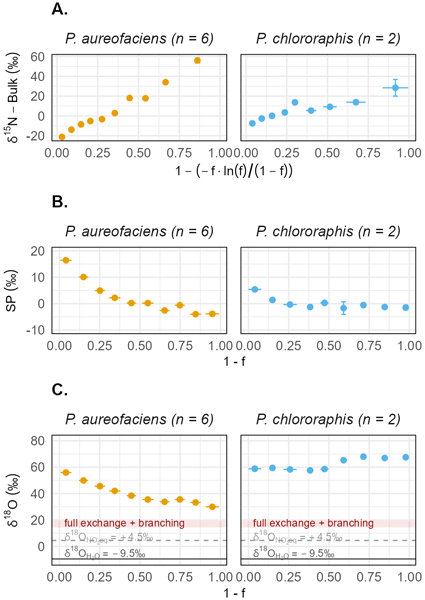
My biggest question/concern is regarding the use of a closed system accumulated product framework for interpreting the ‘gas-flushed’ experiments (described in Section 2.2.3). Figure 2B shows that N2O levels in the bottle were transient (e.g., continuously flushed). If N2O really is continuously swept out of the culture and analyzed by QCLDAS, then these measurements would represent point measurements of the ‘instantaneous product.’ I am confused about how the Rayleigh accumulated product approach is applied to this open type of analytical system. Perhaps the authors are mathematically ‘accumulating’ the N2O in a mass balance manner, such that the evolving N2O composition truly does represent the integrated accumulating product N2O. But if so, then this was lost on me and should be clarified. If this is not the case then I am confused about what is being shown in Figure 3A. The authors clearly understand the dynamics here as they describe ‘conventional accumulated product’ calculations in other portions of the paper. If they truly are measuring the instantaneous product, then the regression of d15Nbulk of N2O should be linearized against -ln(f). If the instantaneous product is regressed against (-f * ln (f))/(1-f), the plot will look quasi-linear (as in Figure 3A), but the slope would not be equivalent to the isotope effect in this case. It would be much higher. Note that in the individual experiments shown (13 – 19) in the Appendix B – the curvature of d15N is very clear toward the end – as would be expected. As such, I’m not sure the isotope effects reported on P13 L9-13 are correct. But it is also possible I have misunderstood. Either way I think there needs to be some clarity here.
How widely has the notion of NirS and NirK imparting differing O atom exchange dynamics really been assumed and/or applied in other studies? I understand that this is an important outcome of your study, but don’t necessarily feel that this distinction between NirS and NirK is truly ‘canonical’ as described in the paper numerous times. I would recommend toning this down a little bit maybe?
Did the GasMet FTIR Analyzer ever see any NO? Were there any variations in NO dynamics that could be connected with accumulation of intermediates or dynamics of N2O SP, for example? P16 L8.
Is there any speculation about how these growth states and conditions could be impacting intracellular pH (which of course has a big impact on abiotic NO2- -water equilibration rates)? With respect to nitrite-water exchange in general – is this considered to be abiotic or enzyme-catalyzed and why?
I enjoyed the discussion about alternative NOR enzymes that could be involved!
Minor Comments
P1 L23: perhaps use ‘suggesting’ instead of ‘indicating?’
P1 L35: “physiological state and metabolic context” – could you be a little bit more specific? In the paper this is explored in more detail obviously, but it could be helpful to mention what specific aspects are being investigated.
P7 L11: extraneous period
P10 L 29: Do the low yields imply that the culture died? NO3- was not completely consumed? Or some other product accumulated? Were the cultures not happy with the continuous N2 bubbling?
Figure 2: what is the timescale? Days?
P17 L10: I think I would disagree that there was comparatively ‘little sensitivity’ in the P. chlororaphis culture, they still shifted by 10-20 ‰.
Figure 6: For the GF cultures – are these endpoint measurements – or mass integrated d18O values? For oxygen isotopes of N2O, does this actually matter? In theory, all else being constant, the d18O of N2O should hold steady (and it doesn’t as noted in P. aureofaciens Fig 3C). But here in Figure 6 the ‘final’ values of N2O are indicated (single time point) and compared with closed batch values – which are integrated values of the entire reaction. It feels a bit like comparing apples to oranges, so to speak. Still useful, but there are nuanced differences.
P18 L12: What is the value used for this branching effect and how was it determined (35‰)? Note it might be useful to remind readers that there are three individual branching effects that impact N2O (branching during NO3- reduction, during NO2- reduction and during NO reduction). Also has been referred to as “O atom abstraction” isotope effects. For example P19 L19 – “the intercept approximates the sum of the nitrite-water equilibrium isotope effect and the branching isotope effect.” – here I think we are considering the 2nd and 3rd downstream branching isotope effects, rather than the 1st effect at NO3- reduction. Some clarification would be good for the reader.
P18 L36 - unnecessary comma after 'values.’
Figure 9 - I’m not sure this figure is critical for the paper if space is required. I feel like the point is already well made in the corresponding text.
P23 L20: perhaps again use ‘suggest’ transient activity instead of ‘indicate’?
Citation: https://doi.org/10.5194/egusphere-2026-1824-RC2 -
AC2: 'Reply on RC2', Noémy Chénier, 21 Jul 2026
The comment was uploaded in the form of a supplement: https://egusphere.copernicus.org/preprints/2026/egusphere-2026-1824/egusphere-2026-1824-AC2-supplement.pdf
-
AC2: 'Reply on RC2', Noémy Chénier, 21 Jul 2026
Peer review completion


Interactive discussion
Status: closed
-
RC1: 'Comment on egusphere-2026-1824', Anonymous Referee #1, 12 May 2026
Review
High nitrous oxide isotopic variability during denitrification by Pseudomonas species bearing NirK and NirS
Dear authors,
This is a very valuable manuscript indicating the possible experimental artefacts in defining the isotope effects associated with different microbial pathways. It contains important new findings which provide better understanding of the observed variability in the isotope values typical for various denitrification pathways. Your in-depth experimental approach utilizing different incubation strategies unravel so far unknown mechanisms that govern the isotope signature of N2O.
The manuscript is mostly well structured and clear, I have only a few suggestions for structure enhancements. I am missing a data table with the original measured values, that could be placed in the supplementary information or as a repository file.
I think that very important point in this work is the responsible formulation of conclusions and assessment of applicability of these new results into the general definition of isotope characterisation of N2O denitrification pathways. How should we interpret these results? These are just 2 bacterial strains showing some unusual isotope values in very artificial experimental conditions, which are very distinct from natural environmental studies, where we deal with lower substrate availability, lower fluxes, microbes interactions, process limitations. The current ranges for N2O isotope mixing endmember for denitrification are based on controlled incubation experiments favouring denitrification, where quite homogenous isotope values have been reported for SP and d18O values (Toyoda et al., 2017, Lewicka-Szczebak et al, 2014, 2017, Yu et al., 2020). After figuring out that in natural soil incubations we mostly deal with near complete O-isotope exchange (Lewicka-Szczebak et al., 2016, Kool et al., 2007), indeed later pure culture studies showed large variations in this exchange between various microbial strains (Rohe et al., 2017, Haslun et al., 2018), however still maintaining differences between bacterial and fungal denitrification. Current findings arise further questions on this issue, but are the new values representative for typical conditions or are rather an experimental artefact? These new values must be surely taken into account by conducting experiments but do they have direct impact in the N2O analyses in natural soil and water environments?
Specific comments:
Some publications cited in the manuscript are missing in the bibliography, eg: Denman et al., 2007, Lewicka-Szczebak et al., 2016, Ostrom et al., 2011, Ye et al., 1991,
P2, L 25-56 „and upstream processes” - unclear and a bit confusing, what these processes are.
P3, L3 I would add a problem on comparability of the experiments of pure culture studies and whole-soil or water communities. This seems to have a critical impact on the extent of O-exchange. While pure-culture studies show significant variations (Rohe et al., 2017, Haslun et al., 2018), whole-soil incubations favoring denitrification conditions typically show almost complete exchange (Lewicka-Szczebak et al., 2016; Kool et al., 2007). I suppose that the process rates, inter-microbial relations and low substrate concentrations in comparison to pure-culture studies play here a crucial role.
P4, L6 I think that the “resuspension assay” needs a bit more explanation. I suppose that you meant to resemble the bacterial denitrification method, but it may not be clear to all readers how it is performed, that the bacteria are grown, washed and placed in known nitrate solution, right? Please add some more details on this. And I would also add the information that this treatment is done as in usual bacterial denitrification approach (if I am right on that)
P5, L5 “pelleted cultures” – not clear to me, what this means, just lyophilized bacteria?
P5, L7 “replaced KNO₃ with USGS32, USGS34, IAEA-N3” – this is not clear, which KNO3? In above sentence you say “ defined nitrate medium”, is it KNO3? What are USGS32, USGS34, IAEA-N3? Not every reader has to know, that you refer to isotope standards abbreviations. Better say sth like: “… was prepared in the same way as stationary-phase resuspension incubations but replacing the defined nitrate solution with international nitrate isotope standards usually applied for bacterial-denitrification analytical procedure (USGS32, USGS34, IAEA-N3)”
P5, L10 I feel that integration of this sub-chapter with the previous one would increase the clarity and eliminate some of above questions and unnecessary repetitions – in this chapter 2.1.3 you do not only say about media but also explain how the experimental approaches were conducted. This chapter explains some above questions, integrating into one would save some repetitions.
P5, L17 “pelleted” – how the cultures were pelleted, with centrifugation?
P5, L22 “rather than to reproduce the exact conditions of the bacterial denitrifier method” – really? Why not? It is important comparison, and very needed, and your procedure is indeed the same as usually applied in the bacterial denitrification method, so I do not understand why you say this.
P6, L 13 I wonder what are your standards and how they were calibrated, I guess it must be self-produced standards, but the calibration of SP value of -93 permil is very challenging because normally the calibration scale is not so wide. How sure are you about this value? This is important because if this value is not perfectly right your isotope calibration may be significantly biased, since this point is far away from your samples. I wonder why you apply this strange standard? The commercially available medical N2O has typically the SP value near 0 per mil, and would be here a perfect addition to your STD1 and STD3. Please check how much your SP values will differ if you omit the STD2 from your normalization.
P7, L 12 – “N2O concentrations dropped below 50 ppm” – are you sure – 50 ppm is you limit for isotope analysis? Such huge concentration? (And later line 20)
P10, L16 Regression line method to quantify O-exchange was applied in Snider et al., 2009 and Lewicka-Szczebak et al., 2016
P12, Fig.3 I think it would be clearer if the X-Axis was the same for all 3 panels, it can be simplified or complete Raileigh equation for all, the trends will be the same and equally visible.
P13, L 9-11 This very large range of enrichment factors is very surprising, I would double check all the values and calculations, because on the graph the fractionation seems quite stable. Have you calculated with initial substrate isotope signature or have you taken into account the increasing delta value of nitrate? Note that for both approaches different equations should be applied (see eg. Denk et al, 2017 – Eq 9 and 10). Since in your experimental approach you are dealing with instantaneous product (delta pi) you need to calculate the instantaneous substrate isotopic signature (delta s) for each (delta pi). The last point with very low nitrate residual fraction may provide biased results, due to complete reaction, and should be disregarded from calculating mean values. It would be interesting to see the graph, like Fig.3 with calculated epsilon values depending on the residual fraction. Your unique continuous data are here an excellent chance to investigate this dynamic. If the epsilon value is really so variable with residual fraction, the time-series of this change would be very interesting. Unfortunately, there are no original data given so that I could check the values myself.
P18, L 10-13 What value do you assume for branching? For equilibrated you used 10-15 permil (equilibrated nitrite – N2O) and for no-equilibration it makes 38 permil (nitrate-N2O). Is this difference due to additional effect by the nitrate-nitrite reduction step? I think you should provide values of branching effect that you assume here and any citation for these.
P21, L37-38 This statement actually only refers to P. aureofaciens. P. chlororaphis shows absolutely stable O-exchange across all experimental conditions. From your results I would say that rather high exchange is typical for these both strains but for P.aureofaciens the resuspension experiments create specific conditions that massively limit the O-exchange.
P22, L20 Any conclusions why such differences are possible? For P.aureofaciens – from complete exchange in closed batch incubation to almost no exchange in resuspension experiments. These approaches are not so much different… was it the incubation time that differs? Is it the period of no nitrate available for bacteria in resuspension method for 24 hours – after this “hungry” period nitrate is rapidly consumed and therefore exchange is so low? Any conclusion here what the governing difference between these approaches could be ?
P22, L22 Also in Rohe et al., 2017
P23, Conclusion section
In this section it is very important to reasonably asses the significance of your findings into general field application of N2O isotopes in pathways partitioning. Should we increase the typical SP-denitrification values with all possibly SP values demonstrated here? These are probably very rare cases in natural conditions (if ever applicable) and would actually make the isotope N2O source -partitioning useless, because SP-ranges of nitrification and denitrification would overlap. It is reasonable to take these results into account? Which conditions in natural field studies could possibly enhance the untypical isotope values for N2O originating from denitrification.
Are the elevated SP values at the beginning of the experiment not just an experimental artefact with no real impact on the real condition isotope characteristics? The initial experimental condition - before an equilibrium is established - show very distinct values – for all isotope values. Are these not very temporary values which do not occur when we deal with constant dynamic equilibrium conditions in natural environments?
P24, L2-4 Please publish your original data in accessible form in public repository. These are very important and complex measurements and possibly other researchers may need to perform further calculations with the data, eg. to add your findings into the common literature database on isotope fractionation factors.
From the dataset that you present in your current manuscript, the check of your calculated isotope effects is not possible – e.g. I tried to roughly check the epsilon15N values that you referred, and this is not possible with the available data. Please make sure that all the needed values for the calculation are provided in the repository files.
Citation: https://doi.org/10.5194/egusphere-2026-1824-RC1 -
AC1: 'Reply on RC1', Noémy Chénier, 21 Jul 2026
The comment was uploaded in the form of a supplement: https://egusphere.copernicus.org/preprints/2026/egusphere-2026-1824/egusphere-2026-1824-AC1-supplement.pdf
-
AC1: 'Reply on RC1', Noémy Chénier, 21 Jul 2026
-
RC2: 'Comment on egusphere-2026-1824', Anonymous Referee #2, 19 Jun 2026
Review of “High nitrous oxide isotopic variability during denitrification by Psuedomonas species bearing NirK and NirS” by Chenier et al.
Summary
This study presents an examination of N2O production by two denitrifying bacterial strains lacking nitrous reductase. The study tests several of the assumptions about the nature of N2O production signals deduced from isotopes of N2O in a number of useful experimental contexts, including both closed and open type systems and using both laser based and mass spectrometric analytical tools. By analyzing the product N2O continuously over the course of nitrate consumption, the authors demonstrate that N2O site preference is not constant, but rather shifts over the course of the culture’s consumption of nitrate. The authors also examine the nature of O isotopes in product N2O, demonstrating that growth status (exponential vs stationary phase) and growth conditions (closed bottle vs gas flushed system) have strong impacts on the degree of O atom exchange with water and hence the resulting d18O of the N2O. While the study largely examines these two cultures in the context of their utility in the very popular denitrifier method, they demonstrate that these large shifts and deviations do not appear when following the classic method protocols. Rather, their results more importantly point to a wider range of expected N2O compositions from processes (such as denitrification) that stem from physiological changes in the bacteria themselves – dynamics that may easily occur under a wide range of natural settings. This type of exploration of microbial physiological state and its impact on isotope expression is critical and sorely lacking in our current understanding of isotope dynamics and its extension to field studies. The study does a great job of demonstrating impacts of growth states and conditions on the physiological expression of isotope effects.
Overall, the paper is a very thorough and interesting exploration of microbial metabolic products and how they are influenced by different growth conditions. This study has important implications for environmental studies and delves into relevant aspects that are understudied in studies of environmental systems.
A final note - the paper could probably be shortened by ~10% without any loss of content. There are some repetitive aspects throughout.
Major Comments
My biggest question/concern is regarding the use of a closed system accumulated product framework for interpreting the ‘gas-flushed’ experiments (described in Section 2.2.3). Figure 2B shows that N2O levels in the bottle were transient (e.g., continuously flushed). If N2O really is continuously swept out of the culture and analyzed by QCLDAS, then these measurements would represent point measurements of the ‘instantaneous product.’ I am confused about how the Rayleigh accumulated product approach is applied to this open type of analytical system. Perhaps the authors are mathematically ‘accumulating’ the N2O in a mass balance manner, such that the evolving N2O composition truly does represent the integrated accumulating product N2O. But if so, then this was lost on me and should be clarified. If this is not the case then I am confused about what is being shown in Figure 3A. The authors clearly understand the dynamics here as they describe ‘conventional accumulated product’ calculations in other portions of the paper. If they truly are measuring the instantaneous product, then the regression of d15Nbulk of N2O should be linearized against -ln(f). If the instantaneous product is regressed against (-f * ln (f))/(1-f), the plot will look quasi-linear (as in Figure 3A), but the slope would not be equivalent to the isotope effect in this case. It would be much higher. Note that in the individual experiments shown (13 – 19) in the Appendix B – the curvature of d15N is very clear toward the end – as would be expected. As such, I’m not sure the isotope effects reported on P13 L9-13 are correct. But it is also possible I have misunderstood. Either way I think there needs to be some clarity here.
How widely has the notion of NirS and NirK imparting differing O atom exchange dynamics really been assumed and/or applied in other studies? I understand that this is an important outcome of your study, but don’t necessarily feel that this distinction between NirS and NirK is truly ‘canonical’ as described in the paper numerous times. I would recommend toning this down a little bit maybe?
Did the GasMet FTIR Analyzer ever see any NO? Were there any variations in NO dynamics that could be connected with accumulation of intermediates or dynamics of N2O SP, for example? P16 L8.
Is there any speculation about how these growth states and conditions could be impacting intracellular pH (which of course has a big impact on abiotic NO2- -water equilibration rates)? With respect to nitrite-water exchange in general – is this considered to be abiotic or enzyme-catalyzed and why?
I enjoyed the discussion about alternative NOR enzymes that could be involved!
Minor Comments
P1 L23: perhaps use ‘suggesting’ instead of ‘indicating?’
P1 L35: “physiological state and metabolic context” – could you be a little bit more specific? In the paper this is explored in more detail obviously, but it could be helpful to mention what specific aspects are being investigated.
P7 L11: extraneous period
P10 L 29: Do the low yields imply that the culture died? NO3- was not completely consumed? Or some other product accumulated? Were the cultures not happy with the continuous N2 bubbling?
Figure 2: what is the timescale? Days?
P17 L10: I think I would disagree that there was comparatively ‘little sensitivity’ in the P. chlororaphis culture, they still shifted by 10-20 ‰.
Figure 6: For the GF cultures – are these endpoint measurements – or mass integrated d18O values? For oxygen isotopes of N2O, does this actually matter? In theory, all else being constant, the d18O of N2O should hold steady (and it doesn’t as noted in P. aureofaciens Fig 3C). But here in Figure 6 the ‘final’ values of N2O are indicated (single time point) and compared with closed batch values – which are integrated values of the entire reaction. It feels a bit like comparing apples to oranges, so to speak. Still useful, but there are nuanced differences.
P18 L12: What is the value used for this branching effect and how was it determined (35‰)? Note it might be useful to remind readers that there are three individual branching effects that impact N2O (branching during NO3- reduction, during NO2- reduction and during NO reduction). Also has been referred to as “O atom abstraction” isotope effects. For example P19 L19 – “the intercept approximates the sum of the nitrite-water equilibrium isotope effect and the branching isotope effect.” – here I think we are considering the 2nd and 3rd downstream branching isotope effects, rather than the 1st effect at NO3- reduction. Some clarification would be good for the reader.
P18 L36 - unnecessary comma after 'values.’
Figure 9 - I’m not sure this figure is critical for the paper if space is required. I feel like the point is already well made in the corresponding text.
P23 L20: perhaps again use ‘suggest’ transient activity instead of ‘indicate’?
Citation: https://doi.org/10.5194/egusphere-2026-1824-RC2 -
AC2: 'Reply on RC2', Noémy Chénier, 21 Jul 2026
The comment was uploaded in the form of a supplement: https://egusphere.copernicus.org/preprints/2026/egusphere-2026-1824/egusphere-2026-1824-AC2-supplement.pdf
-
AC2: 'Reply on RC2', Noémy Chénier, 21 Jul 2026
Peer review completion
Journal article(s) based on this preprint
Viewed
| HTML | XML | Total | BibTeX | EndNote | |
|---|---|---|---|---|---|
| 493 | 94 | 49 | 636 | 47 | 37 |
- HTML: 493
- PDF: 94
- XML: 49
- Total: 636
- BibTeX: 47
- EndNote: 37
Viewed (geographical distribution)
| Country | # | Views | % |
|---|
| Total: | 0 |
| HTML: | 0 |
| PDF: | 0 |
| XML: | 0 |
- 1

Paul M. Magyar
Jakob Zopfi
Claudia Frey
Thomas Kuhn
Moritz F. Lehmann
The requested preprint has a corresponding peer-reviewed final revised paper. You are encouraged to refer to the final revised version.
- Preprint
(2065 KB) - Metadata XML
Review
High nitrous oxide isotopic variability during denitrification by Pseudomonas species bearing NirK and NirS
Dear authors,
This is a very valuable manuscript indicating the possible experimental artefacts in defining the isotope effects associated with different microbial pathways. It contains important new findings which provide better understanding of the observed variability in the isotope values typical for various denitrification pathways. Your in-depth experimental approach utilizing different incubation strategies unravel so far unknown mechanisms that govern the isotope signature of N2O.
The manuscript is mostly well structured and clear, I have only a few suggestions for structure enhancements. I am missing a data table with the original measured values, that could be placed in the supplementary information or as a repository file.
I think that very important point in this work is the responsible formulation of conclusions and assessment of applicability of these new results into the general definition of isotope characterisation of N2O denitrification pathways. How should we interpret these results? These are just 2 bacterial strains showing some unusual isotope values in very artificial experimental conditions, which are very distinct from natural environmental studies, where we deal with lower substrate availability, lower fluxes, microbes interactions, process limitations. The current ranges for N2O isotope mixing endmember for denitrification are based on controlled incubation experiments favouring denitrification, where quite homogenous isotope values have been reported for SP and d18O values (Toyoda et al., 2017, Lewicka-Szczebak et al, 2014, 2017, Yu et al., 2020). After figuring out that in natural soil incubations we mostly deal with near complete O-isotope exchange (Lewicka-Szczebak et al., 2016, Kool et al., 2007), indeed later pure culture studies showed large variations in this exchange between various microbial strains (Rohe et al., 2017, Haslun et al., 2018), however still maintaining differences between bacterial and fungal denitrification. Current findings arise further questions on this issue, but are the new values representative for typical conditions or are rather an experimental artefact? These new values must be surely taken into account by conducting experiments but do they have direct impact in the N2O analyses in natural soil and water environments?
Specific comments:
Some publications cited in the manuscript are missing in the bibliography, eg: Denman et al., 2007, Lewicka-Szczebak et al., 2016, Ostrom et al., 2011, Ye et al., 1991,
P2, L 25-56 „and upstream processes” - unclear and a bit confusing, what these processes are.
P3, L3 I would add a problem on comparability of the experiments of pure culture studies and whole-soil or water communities. This seems to have a critical impact on the extent of O-exchange. While pure-culture studies show significant variations (Rohe et al., 2017, Haslun et al., 2018), whole-soil incubations favoring denitrification conditions typically show almost complete exchange (Lewicka-Szczebak et al., 2016; Kool et al., 2007). I suppose that the process rates, inter-microbial relations and low substrate concentrations in comparison to pure-culture studies play here a crucial role.
P4, L6 I think that the “resuspension assay” needs a bit more explanation. I suppose that you meant to resemble the bacterial denitrification method, but it may not be clear to all readers how it is performed, that the bacteria are grown, washed and placed in known nitrate solution, right? Please add some more details on this. And I would also add the information that this treatment is done as in usual bacterial denitrification approach (if I am right on that)
P5, L5 “pelleted cultures” – not clear to me, what this means, just lyophilized bacteria?
P5, L7 “replaced KNO₃ with USGS32, USGS34, IAEA-N3” – this is not clear, which KNO3? In above sentence you say “ defined nitrate medium”, is it KNO3? What are USGS32, USGS34, IAEA-N3? Not every reader has to know, that you refer to isotope standards abbreviations. Better say sth like: “… was prepared in the same way as stationary-phase resuspension incubations but replacing the defined nitrate solution with international nitrate isotope standards usually applied for bacterial-denitrification analytical procedure (USGS32, USGS34, IAEA-N3)”
P5, L10 I feel that integration of this sub-chapter with the previous one would increase the clarity and eliminate some of above questions and unnecessary repetitions – in this chapter 2.1.3 you do not only say about media but also explain how the experimental approaches were conducted. This chapter explains some above questions, integrating into one would save some repetitions.
P5, L17 “pelleted” – how the cultures were pelleted, with centrifugation?
P5, L22 “rather than to reproduce the exact conditions of the bacterial denitrifier method” – really? Why not? It is important comparison, and very needed, and your procedure is indeed the same as usually applied in the bacterial denitrification method, so I do not understand why you say this.
P6, L 13 I wonder what are your standards and how they were calibrated, I guess it must be self-produced standards, but the calibration of SP value of -93 permil is very challenging because normally the calibration scale is not so wide. How sure are you about this value? This is important because if this value is not perfectly right your isotope calibration may be significantly biased, since this point is far away from your samples. I wonder why you apply this strange standard? The commercially available medical N2O has typically the SP value near 0 per mil, and would be here a perfect addition to your STD1 and STD3. Please check how much your SP values will differ if you omit the STD2 from your normalization.
P7, L 12 – “N2O concentrations dropped below 50 ppm” – are you sure – 50 ppm is you limit for isotope analysis? Such huge concentration? (And later line 20)
P10, L16 Regression line method to quantify O-exchange was applied in Snider et al., 2009 and Lewicka-Szczebak et al., 2016
P12, Fig.3 I think it would be clearer if the X-Axis was the same for all 3 panels, it can be simplified or complete Raileigh equation for all, the trends will be the same and equally visible.
P13, L 9-11 This very large range of enrichment factors is very surprising, I would double check all the values and calculations, because on the graph the fractionation seems quite stable. Have you calculated with initial substrate isotope signature or have you taken into account the increasing delta value of nitrate? Note that for both approaches different equations should be applied (see eg. Denk et al, 2017 – Eq 9 and 10). Since in your experimental approach you are dealing with instantaneous product (delta pi) you need to calculate the instantaneous substrate isotopic signature (delta s) for each (delta pi). The last point with very low nitrate residual fraction may provide biased results, due to complete reaction, and should be disregarded from calculating mean values. It would be interesting to see the graph, like Fig.3 with calculated epsilon values depending on the residual fraction. Your unique continuous data are here an excellent chance to investigate this dynamic. If the epsilon value is really so variable with residual fraction, the time-series of this change would be very interesting. Unfortunately, there are no original data given so that I could check the values myself.
P18, L 10-13 What value do you assume for branching? For equilibrated you used 10-15 permil (equilibrated nitrite – N2O) and for no-equilibration it makes 38 permil (nitrate-N2O). Is this difference due to additional effect by the nitrate-nitrite reduction step? I think you should provide values of branching effect that you assume here and any citation for these.
P21, L37-38 This statement actually only refers to P. aureofaciens. P. chlororaphis shows absolutely stable O-exchange across all experimental conditions. From your results I would say that rather high exchange is typical for these both strains but for P.aureofaciens the resuspension experiments create specific conditions that massively limit the O-exchange.
P22, L20 Any conclusions why such differences are possible? For P.aureofaciens – from complete exchange in closed batch incubation to almost no exchange in resuspension experiments. These approaches are not so much different… was it the incubation time that differs? Is it the period of no nitrate available for bacteria in resuspension method for 24 hours – after this “hungry” period nitrate is rapidly consumed and therefore exchange is so low? Any conclusion here what the governing difference between these approaches could be ?
P22, L22 Also in Rohe et al., 2017
P23, Conclusion section
In this section it is very important to reasonably asses the significance of your findings into general field application of N2O isotopes in pathways partitioning. Should we increase the typical SP-denitrification values with all possibly SP values demonstrated here? These are probably very rare cases in natural conditions (if ever applicable) and would actually make the isotope N2O source -partitioning useless, because SP-ranges of nitrification and denitrification would overlap. It is reasonable to take these results into account? Which conditions in natural field studies could possibly enhance the untypical isotope values for N2O originating from denitrification.
Are the elevated SP values at the beginning of the experiment not just an experimental artefact with no real impact on the real condition isotope characteristics? The initial experimental condition - before an equilibrium is established - show very distinct values – for all isotope values. Are these not very temporary values which do not occur when we deal with constant dynamic equilibrium conditions in natural environments?
P24, L2-4 Please publish your original data in accessible form in public repository. These are very important and complex measurements and possibly other researchers may need to perform further calculations with the data, eg. to add your findings into the common literature database on isotope fractionation factors.
From the dataset that you present in your current manuscript, the check of your calculated isotope effects is not possible – e.g. I tried to roughly check the epsilon15N values that you referred, and this is not possible with the available data. Please make sure that all the needed values for the calculation are provided in the repository files.