
the Creative Commons Attribution 4.0 License.
the Creative Commons Attribution 4.0 License.
 | 20 Apr 2026
Development of the CCPP-Based GEFS-Aerosols Component in the Unified Forecast System for Subseasonal Prediction (UFS-Chem v1.0)
Abstract. The Global Ensemble Forecast System (GEFS) version 12 has been operational at the National Centers for Environmental Prediction since September 2020, with GEFS-Aerosols serving as its global aerosol forecasting member. In 2023, GEFS-Aerosols was upgraded to version 12.3 in operations, incorporating improvements to wet deposition, anthropogenic and biomass burning emissions, aerosol optical depth calculations, and the FENGSHA dust emission scheme. While GEFS-Aerosols provides valuable operational aerosol forecasts on medium-range timescales, its one-way coupling strategy restricts aerosol–atmosphere interactions to prescribed climatological fields, thereby precluding fully interactive aerosol feedbacks for extended-range prediction. To overcome this limitation, we develop the Unified Forecast System coupled with Chemistry (UFS-Chem), which incorporates the Configurable Atmospheric Chemistry (CATChem) library and modeling component to include both aerosol and gas-phase chemistry schemes. In the current UFS-Chem configuration, the aerosol component is based on the operational GEFS-Aerosols v12.3 and implemented using the Common Community Physics Package (CCPP) framework. Relative to GEFS-Aerosols v12.3, UFS-Chem incorporates several enhancements, including inline aerosol radiative feedback, inline large-scale wet deposition, and updated FENGSHA dust scheme. In particular, the integration of inline large-scale wet deposition and aerosol indirect effects through the Thompson aerosol-aware microphysics scheme improves the representation of aerosol–cloud interactions and supports weather and subseasonal-to-seasonal forecasting when fully coupled with ocean, sea ice, land, and wave components. The performance of UFS-Chem in weather and subseasonal prediction is evaluated against reanalysis data, ground-based measurements, and satellite observations. The relative impacts of aerosol radiative and indirect feedback on weather and subseasonal predictions are investigated and quantified, advancing our understanding of how aerosol–radiation and aerosol–cloud interactions influence forecast skill across timescales.
-
Notice on discussion status
The requested preprint has a corresponding peer-reviewed final revised paper. You are encouraged to refer to the final revised version.
-
Preprint
(6795 KB)
-
The requested preprint has a corresponding peer-reviewed final revised paper. You are encouraged to refer to the final revised version.
- Preprint
(6795 KB) - Metadata XML
- BibTeX
- EndNote
- Final revised paper


Journal article(s) based on this preprint
Interactive discussion
Status: closed
-
RC1: 'Comment on egusphere-2026-1807', Anonymous Referee #1, 19 May 2026
-
AC1: 'Reply on RC1', Li Zhang, 10 Jul 2026
The comment was uploaded in the form of a supplement: https://egusphere.copernicus.org/preprints/2026/egusphere-2026-1807/egusphere-2026-1807-AC1-supplement.pdf
-
AC1: 'Reply on RC1', Li Zhang, 10 Jul 2026
-
RC2: 'Comment on egusphere-2026-1807', Anonymous Referee #2, 15 Jun 2026
General comments:
The authors developed the GEFS-Aerosols component in the Unified Forecast System coupled with Chemistry (UFS-Chem) for the Global Ensemble Forecast System (GEFS). The GEFS-Aerosols component incorporated improvements to anthropogenic and biomass burning emissions, aerosol optical depth calculations, as well as inline aerosol radiative feedback, inline large-scale wet deposition, and updated dust scheme. The UFS-Chem performance with respect to weather and subseasonal predictions are evaluated against MERRA-2 reanalysis, ground-based measurements, and satellite observations. The authors quantified the relative impacts of aerosol radiative and indirect feedback on weather and subseasonal predictions. The results are very helpful in terms of understanding of how aerosol–radiation-cloud interactions affect model forecast skills. The paper is well organized and very well written. I recommend acceptance for publication with minor revisions.
Specific comments:
L75-78: “Notable examples include the Goddard Chemistry Aerosol Radiation and Transport (GOCART) model (Chin et al., 2000), which provided one of the first global representations of aerosol processes, and the subsequent development of National Aeronautics and Space Administration (NASA)'s Goddard Earth Observing System Composition Forecast (GEOS-CF) system, which delivers global operational forecasts of aerosols and atmospheric composition (Colarco et al., 2010; Keller et al., 2021).”
I suggest including the GEOS-FP system first and then GEOS-CF here (see https://gmao.gsfc.nasa.gov/gmao-products/) with additional references for GEOS-FP.
L181: remove “. The MODIS Collection 6.1… from the Aqua satellite”, and change it to “, which is available…”
L242-245: Large-scale wet deposition is mentioned here. How about convective scavenging?
L361-363: edits - “(e.g., large-scale precipitation)”. The statement needs some references.
L396: “Table 2, and no indirect feedback”
L397-398: Are “CYC_OWR” and “SUB_OWR” defined at this point?
L504: remove “of”
Table 1: typos – “Molde”, “COCART”, “CDES” (3 places). Indicate L65 and L127 are vertical levels.
Table 2: typo – “Subseanal”, “Subseanal”. Explain Experiment names.
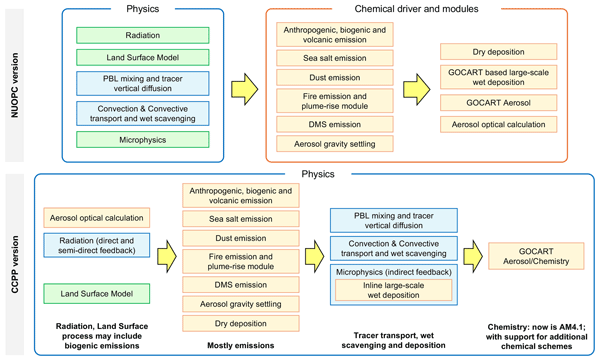
Figure 1: GOCART is an aerosol module – why is it called “GOCART chemistry” (2 places)? Also, “Chemistry is GOCART and AM4.1” – do you mean “Chemistry is AM4.1”?
Figure 2 caption: indicate the region (North America).
Figure 4 caption: define the experiment acronyms.
Figure 5 caption: explain NIFA, NWFA etc. in the caption.
Figure 10: TOA net radiative flux bias relative to CERES…
There are a lot of acronyms in this paper. Perhaps consider including a list in the Supplement.
Citation: https://doi.org/10.5194/egusphere-2026-1807-RC2 -
AC2: 'Reply on RC2', Li Zhang, 10 Jul 2026
The comment was uploaded in the form of a supplement: https://egusphere.copernicus.org/preprints/2026/egusphere-2026-1807/egusphere-2026-1807-AC2-supplement.pdf
-
AC2: 'Reply on RC2', Li Zhang, 10 Jul 2026
Peer review completion


Interactive discussion
Status: closed
-
RC1: 'Comment on egusphere-2026-1807', Anonymous Referee #1, 19 May 2026
This paper presents UFS-Chem, a new forecast model with inline aerosol–radiation and aerosol–cloud interactions under the CCPP framework. Overall, the manuscript is well written and clearly structured. However, I have several major concerns that require clarification prior to publication.
Major comments:
1. What is the computational cost for UFS-Chem compared with v12.3? It would be useful to provide a quantitative number
2. Why are all the discussion periods in August only? The balance between direct and indirect aerosol effects varies by season.
3. Why do Figures 2–3 present the time period of August 2021, but Figures 4 and 6 are for August 2016? The inconsistency in evaluation periods is confusing. Also, why do Figures 2–3 focus on v12.3 rather than demonstrating UFS-Chem performance directly?
4. Figure 4: I wonder why CYC_IWR generates such a huge bias near central Africa? Do you have any explanation for this?
5. The transition from v12.3 to UFS-Chem incorporates changes to the coupling framework, physics suite (GFSv15→GFSv17), vertical levels (65→127), microphysics, land model, and convection scheme simultaneously. The paper cannot attribute benefits to CCPP coupling specifically versus the physics upgrade. Please acknowledge this limitation explicitly.
6. Figures 10–12: Why does EXP1 improve the cloud fraction bias but worsen the TOA flux and SST biases, whereas EXP2 corrects all of them? Do the EXP2 improvements reflect better physics or a new balance of compensating errors?
7. Figure 11: A better evaluation for the indirect effect implementation would be to compare against cloud liquid water path and droplet effective radius.
Minor comments:
Figure 6: please add quantitative annotations (global mean bias) on each panel. It is hard to tell which experiment performs better as presented.
Table 4: It would be more effective to present Table 4 as a scatter plot. Also, do you have any explanation for the few stations where v12.3 degrades?
L288: add a reference for the Baker–Schepanski map
L288–289: What is the sea salt emission scheme? Does wave model coupling influence sea salt production?
L306–307: Wave model uncoupling for the 6-year experiments: does this affect SST or surface flux results?
L376: What are the mass-to-number conversion parameters for mapping GOCART mass to CCN/INP?
Typos: Table 1: First column, sixth row: “GEFS-COCART” -> “GEFS-GOCART"; “CDES”-> “CEDS”
Citation: https://doi.org/10.5194/egusphere-2026-1807-RC1 -
AC1: 'Reply on RC1', Li Zhang, 10 Jul 2026
The comment was uploaded in the form of a supplement: https://egusphere.copernicus.org/preprints/2026/egusphere-2026-1807/egusphere-2026-1807-AC1-supplement.pdf
-
AC1: 'Reply on RC1', Li Zhang, 10 Jul 2026
-
RC2: 'Comment on egusphere-2026-1807', Anonymous Referee #2, 15 Jun 2026
General comments:
The authors developed the GEFS-Aerosols component in the Unified Forecast System coupled with Chemistry (UFS-Chem) for the Global Ensemble Forecast System (GEFS). The GEFS-Aerosols component incorporated improvements to anthropogenic and biomass burning emissions, aerosol optical depth calculations, as well as inline aerosol radiative feedback, inline large-scale wet deposition, and updated dust scheme. The UFS-Chem performance with respect to weather and subseasonal predictions are evaluated against MERRA-2 reanalysis, ground-based measurements, and satellite observations. The authors quantified the relative impacts of aerosol radiative and indirect feedback on weather and subseasonal predictions. The results are very helpful in terms of understanding of how aerosol–radiation-cloud interactions affect model forecast skills. The paper is well organized and very well written. I recommend acceptance for publication with minor revisions.
Specific comments:
L75-78: “Notable examples include the Goddard Chemistry Aerosol Radiation and Transport (GOCART) model (Chin et al., 2000), which provided one of the first global representations of aerosol processes, and the subsequent development of National Aeronautics and Space Administration (NASA)'s Goddard Earth Observing System Composition Forecast (GEOS-CF) system, which delivers global operational forecasts of aerosols and atmospheric composition (Colarco et al., 2010; Keller et al., 2021).”
I suggest including the GEOS-FP system first and then GEOS-CF here (see https://gmao.gsfc.nasa.gov/gmao-products/) with additional references for GEOS-FP.
L181: remove “. The MODIS Collection 6.1… from the Aqua satellite”, and change it to “, which is available…”
L242-245: Large-scale wet deposition is mentioned here. How about convective scavenging?
L361-363: edits - “(e.g., large-scale precipitation)”. The statement needs some references.
L396: “Table 2, and no indirect feedback”
L397-398: Are “CYC_OWR” and “SUB_OWR” defined at this point?
L504: remove “of”
Table 1: typos – “Molde”, “COCART”, “CDES” (3 places). Indicate L65 and L127 are vertical levels.
Table 2: typo – “Subseanal”, “Subseanal”. Explain Experiment names.
Figure 1: GOCART is an aerosol module – why is it called “GOCART chemistry” (2 places)? Also, “Chemistry is GOCART and AM4.1” – do you mean “Chemistry is AM4.1”?
Figure 2 caption: indicate the region (North America).
Figure 4 caption: define the experiment acronyms.
Figure 5 caption: explain NIFA, NWFA etc. in the caption.
Figure 10: TOA net radiative flux bias relative to CERES…
There are a lot of acronyms in this paper. Perhaps consider including a list in the Supplement.
Citation: https://doi.org/10.5194/egusphere-2026-1807-RC2 -
AC2: 'Reply on RC2', Li Zhang, 10 Jul 2026
The comment was uploaded in the form of a supplement: https://egusphere.copernicus.org/preprints/2026/egusphere-2026-1807/egusphere-2026-1807-AC2-supplement.pdf
-
AC2: 'Reply on RC2', Li Zhang, 10 Jul 2026
Peer review completion
Journal article(s) based on this preprint
Viewed
| HTML | XML | Total | BibTeX | EndNote | |
|---|---|---|---|---|---|
| 442 | 202 | 58 | 702 | 54 | 52 |
- HTML: 442
- PDF: 202
- XML: 58
- Total: 702
- BibTeX: 54
- EndNote: 52
Viewed (geographical distribution)
| Country | # | Views | % |
|---|
| Total: | 0 |
| HTML: | 0 |
| PDF: | 0 |
| XML: | 0 |
- 1

Haiqin Li
Georg A. Grell
Partha S. Bhattacharjee
Gonzalo A. Ferrada
Benjamin W. Green
Shan Sun
Ligia Bernardet
Anders Jensen
Barry Baker
Jordan Schnell
Ravan Ahmadov
Samuel Trahan
Dustin Swales
Anning Cheng
Fanglin Yang
Rebecca H. Schwantes
Brian C. McDonald
Dominikus Heinzeller
Shobha Kondragunta
The requested preprint has a corresponding peer-reviewed final revised paper. You are encouraged to refer to the final revised version.
- Preprint
(6795 KB) - Metadata XML
This paper presents UFS-Chem, a new forecast model with inline aerosol–radiation and aerosol–cloud interactions under the CCPP framework. Overall, the manuscript is well written and clearly structured. However, I have several major concerns that require clarification prior to publication.
Major comments:
1. What is the computational cost for UFS-Chem compared with v12.3? It would be useful to provide a quantitative number
2. Why are all the discussion periods in August only? The balance between direct and indirect aerosol effects varies by season.
3. Why do Figures 2–3 present the time period of August 2021, but Figures 4 and 6 are for August 2016? The inconsistency in evaluation periods is confusing. Also, why do Figures 2–3 focus on v12.3 rather than demonstrating UFS-Chem performance directly?
4. Figure 4: I wonder why CYC_IWR generates such a huge bias near central Africa? Do you have any explanation for this?
5. The transition from v12.3 to UFS-Chem incorporates changes to the coupling framework, physics suite (GFSv15→GFSv17), vertical levels (65→127), microphysics, land model, and convection scheme simultaneously. The paper cannot attribute benefits to CCPP coupling specifically versus the physics upgrade. Please acknowledge this limitation explicitly.
6. Figures 10–12: Why does EXP1 improve the cloud fraction bias but worsen the TOA flux and SST biases, whereas EXP2 corrects all of them? Do the EXP2 improvements reflect better physics or a new balance of compensating errors?
7. Figure 11: A better evaluation for the indirect effect implementation would be to compare against cloud liquid water path and droplet effective radius.
Minor comments:
Figure 6: please add quantitative annotations (global mean bias) on each panel. It is hard to tell which experiment performs better as presented.
Table 4: It would be more effective to present Table 4 as a scatter plot. Also, do you have any explanation for the few stations where v12.3 degrades?
L288: add a reference for the Baker–Schepanski map
L288–289: What is the sea salt emission scheme? Does wave model coupling influence sea salt production?
L306–307: Wave model uncoupling for the 6-year experiments: does this affect SST or surface flux results?
L376: What are the mass-to-number conversion parameters for mapping GOCART mass to CCN/INP?
Typos: Table 1: First column, sixth row: “GEFS-COCART” -> “GEFS-GOCART"; “CDES”-> “CEDS”