
the Creative Commons Attribution 4.0 License.
the Creative Commons Attribution 4.0 License.
 | 08 May 2026
Turbulent atmospheric particle fluxes in the high Arctic: Surface type dependence and variability
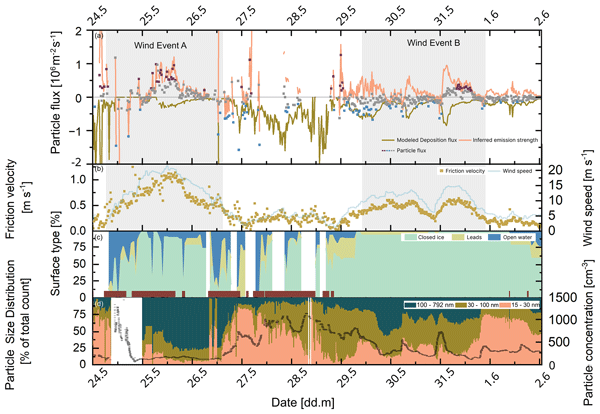
Abstract. The Arctic is warming at a significantly faster rate than the global average, which is affecting local climate processes. Aerosol particles play a central role by influencing the energy balance directly through the scattering and absorption of solar radiation and indirectly by acting as cloud condensation nuclei. However, the processes that control aerosol concentrations, such as the mechanisms governing vertical particle exchange, are not well understood, particularly over sea ice. During the ARTofMELT campaign in spring 2023, five weeks of continuous eddy covariance measurements of turbulent particle fluxes were conducted in the High Arctic to investigate the spatial and temporal variability of particle sources and sinks over three surface types. Overall, net particle deposition dominated, with median deposition fluxes of −0.02 × 10⁶m-2 s-1 over closed ice. This confirms the role of ice surfaces as a particle sink under low to moderate turbulence. Under strong winds, net particle emission fluxes of up to 0.98 × 10⁶m-2 s-1 were observed over closed ice surfaces, which are likely linked to processes involving blowing snow. A mixture of emission and deposition was observed over leads and open water surfaces. These observations highlight how surface heterogeneity and turbulence intensity can influence particle exchange in the High Arctic. As sea ice retreats and the extent of open water increases, local particle sources are expected to become more relevant to Arctic aerosol budgets and cloud processes. The results provide observational constraints on particle fluxes, helping to reduce related uncertainties in Arctic model simulations.
Competing interests: At least one of the (co-)authors is a member of the editorial board of Atmospheric Chemistry and Physics. The peer-review process was guided by an independent editor, and the authors also have no other competing interests to declare.
Publisher's note: Copernicus Publications remains neutral with regard to jurisdictional claims made in the text, published maps, institutional affiliations, or any other geographical representation in this paper. While Copernicus Publications makes every effort to include appropriate place names, the final responsibility lies with the authors. Views expressed in the text are those of the authors and do not necessarily reflect the views of the publisher.-
Notice on discussion status
The requested preprint has a corresponding peer-reviewed final revised paper. You are encouraged to refer to the final revised version.
-
Preprint
(68741 KB)
-
The requested preprint has a corresponding peer-reviewed final revised paper. You are encouraged to refer to the final revised version.
- Preprint
(68741 KB) - Metadata XML
- BibTeX
- EndNote
- Final revised paper


Journal article(s) based on this preprint
Interactive discussion
Status: closed
-
RC1: 'Comment on egusphere-2026-1792', Anonymous Referee #1, 09 Jun 2026
-
AC1: 'Reply on RC1', Theresa Mathes, 31 Aug 2026
The comment was uploaded in the form of a supplement: https://egusphere.copernicus.org/preprints/2026/egusphere-2026-1792/egusphere-2026-1792-AC1-supplement.pdf
-
AC1: 'Reply on RC1', Theresa Mathes, 31 Aug 2026
-
RC2: 'Comment on egusphere-2026-1792', Anonymous Referee #2, 12 Jul 2026
The manuscript aims to investigate the variability of turbulent particle fluxes over three surface types using five weeks of continuous eddy covariance measurements in the High Arctic obtained during the Atmospheric Rivers and the Onset of Arctic Sea Ice Melt (ARTofMELT) campaign. The main conclusion of the study is that 'while net particle deposition is observed to dominate over the packed ice, both emission and deposition are equally observed over leads and open water, underlining the importance of surface heterogeneity and turbulence intensity for the exchange of fluxes in the High Arctic'. The manuscript is mostly well written but needs some additional editing work for better readability to the general reader (mostly pointed out by the other reviewer). The dataset presented could be a valuable resource for advancing the understanding of particle flux dynamics in the Arctic.
My major concern is related to the way surface characterization has been done. Since the main conclusion of the study depends upon the classification of surface types using onboard imagery, more clarity is needed in the manuscript regarding the number of images in a flux period from each camera, image quality, area selected, internal variability in surface type, image sampling, and uncertainty in classification of the surface types using the said algorithm. Further, a solid justification to choose the so-called WAKE algorithm in place of various well-documented and validated open-source image processing algorithms for sea surface identification is needed.
Overall, I am satisfied with the scientific idea and analysis presented in the paper and recommend acceptance of the paper after the above clarification.
Citation: https://doi.org/10.5194/egusphere-2026-1792-RC2 -
AC2: 'Reply on RC2', Theresa Mathes, 31 Aug 2026
The comment was uploaded in the form of a supplement: https://egusphere.copernicus.org/preprints/2026/egusphere-2026-1792/egusphere-2026-1792-AC2-supplement.pdf
-
AC2: 'Reply on RC2', Theresa Mathes, 31 Aug 2026
Peer review completion


Interactive discussion
Status: closed
-
RC1: 'Comment on egusphere-2026-1792', Anonymous Referee #1, 09 Jun 2026
This manuscript presents eddy covariance measurements of turbulent particle fluxes in the High Arctic from the the ARTofMELT campaign. This manuscript describes a technically competent measurement campaign that yields results broadly consistent with prior studies. It is reported that net deposition dominates over closed ice (median -0.02 × 10⁶ m⁻² s⁻¹), while emission events up to 0.98 × 10⁶ m⁻² s⁻¹ occur during high-wind conditions associated with blowing snow. The manuscript was interesting and nice to read and the resulting dataset is potentially valuable to further the understanding of dynamics governing particle fluxes in the Arctic.
However, in its current form, the manuscript reads primarily as a data description rather than a hypothesis-driven scientific investigation. The analysis remains superficial, and the conclusions do not offer the substantial new mechanistic or process-level insights required for publication in Atmospheric Chemistry and Physics, for which (citing the Aims & Scope of the journal):
“Articles should have important and clearly argued implications for our understanding of the state and behaviour of the atmosphere and climate or present substantial new insights into the atmosphere's role in other parts of the Earth system.”
Because the manuscript does not present significant insights or testable hypothesis, but is rather a dataset and campaign measurement description, I recommend rejection, with the suggestion that the authors consider a more specialized journal after major revision. Below I provide a non‑exhaustive list of methodological issues and suggestions to strengthen the results, should the authors choose to revise for another venue.
As a further note: Michael Tjernström and Birgit Wehner do not appear to meet the criteria for co‑authorship. I suggest removing them from the author list unless their role is clarified and justified.
Major comments:
- The authors use an empirical wind‑speed/temperature threshold to define blowing snow. As one of the implied claims in the article is that emission events are linked to blowing snow, the authors should provide direct evidence or explicitly acknowledge this as a major caveat. Additionally, other possible causes of emission events should be explored through further data analysis.
- The inference of emissions as measured net flux minus modelled deposition involves significant uncertainty. The manuscript should explicitly quantify the contribution of both deposition model error and measurement error to the final emission estimates.
- Size distribution data are available but are used only to correct total particle losses and to model size‑dependent deposition. The manuscript does not explore whether emission and deposition events show distinct size signatures. This is a missed opportunity.
- The authors exclude pollution events according to certain criteria, which effectively removes concentration peaks from the analysis. As can be seen in Fig. 4c, many peaks are excluded, but the rising and declining concentrations before and after those peaks are not. Not excluding these transitional periods may bias the fluxes. The authors should either exclude them as well (with a suitable buffer) or correct for remaining contamination. They should also consider improving the exclusion criteria; in this sense, particle size distribution could help identify ship exhaust events.
- Because one of the main scopes appears to be the characterization of emission processes, Sections 3.2 and 3.3 could be merged. Similarly, Figures 8 and 9 could likely be combined (using kernel density estimation instead of histograms to improve visualization). Figures 10a and 10e could be made larger and represented within the same panel.
- Section 3.5 attempts to estimate Arctic‑wide net particle fluxes and project changes to 2040 using median springtime fluxes from a single campaign. This analysis is far too simplified and should either be developed much more thoroughly or, preferably, removed entirely.
Specific line comments:
L1-4: This part of the abstract seems overly general and could be tailored better to the manuscript
L6: The terms “spatial and temporal” appear several times throughout the manuscript, but the study considers mostly surface‑dependent variability. I suggest removing these terms throughout the manuscript
L6-7: specify surface types here
L13-14: “The results … similations” indicates only one of the potentialities of the dataset, so this sentence should not be definitive
L20-31: this section is too general and should be better tailored to the manuscript scope or summarized
L52: numerical models are mentioned, but the authors should be more specific in this regard, citing the actual models they refer to
L73-74: the authors claim that this dataset is one of the longest dataset for the Arctic region. If this claim is to be made, the duration of other datasets should be explicitly stated in the introduction
L78-79: similarly to the abstract, “The results might provide…”
L86-91: A map would be much clearer than this explanation. It would also allow to represent clearly further information, such as dominating surface type, or meteorological classification (I’m referring to classification 1-6 in Fig. 4)
L157: Depending on whether and how the scope of the manuscript is redefined, the authors might consider moving Figure 2 to the supplementary material/appendix, and to summarize the corresponding methodology paragraphs
L164: The authors should specify how the high-frequency losses were corrected
L222-223: “Particle fluxes … atmospheric stability” is unnecessary
L230 (and following): units should be always reported the first time a variable appears
L247: The same roughness length is applied to all surface types, but including a z0 that varies with surface type should be a fairly low-effort improvement
L253: what does e0 depend on?
L285: The separation between meteorological periods could be made clearer by extending the dotted lines at the top all the way down through the panels
L299-302: These concentration averages might be currently overestimated. The authors should revise this part after improving the exclusion criteria for pollution periods
L339-354: Why are boxplots presented here instead of the usual plots? Why are the authors presenting binned regression analysis rather than analysis on the actual observations, which would be much simpler and more transparent?
L353-354: The authors appear to consider only linear correlation (given that they use binned quantities). Do other relationships emerge when the actual non‑binned data are considered?
L371: Why do other studies in Figure 7 report multiple values while for the current study there is just one?
L421-424: How often do negative values appear? Could the author explore attribute causes more consistently? These instances seem to constitute a non-negligible fraction of the data
L454: It could be useful to specify particle sizes here
L478-495: As mentioned above, this section appears redundant and superficial. I suggest removing it and summarizing it (if at all) as part of the conclusions or future directions
Citation: https://doi.org/10.5194/egusphere-2026-1792-RC1 -
AC1: 'Reply on RC1', Theresa Mathes, 31 Aug 2026
The comment was uploaded in the form of a supplement: https://egusphere.copernicus.org/preprints/2026/egusphere-2026-1792/egusphere-2026-1792-AC1-supplement.pdf
-
RC2: 'Comment on egusphere-2026-1792', Anonymous Referee #2, 12 Jul 2026
The manuscript aims to investigate the variability of turbulent particle fluxes over three surface types using five weeks of continuous eddy covariance measurements in the High Arctic obtained during the Atmospheric Rivers and the Onset of Arctic Sea Ice Melt (ARTofMELT) campaign. The main conclusion of the study is that 'while net particle deposition is observed to dominate over the packed ice, both emission and deposition are equally observed over leads and open water, underlining the importance of surface heterogeneity and turbulence intensity for the exchange of fluxes in the High Arctic'. The manuscript is mostly well written but needs some additional editing work for better readability to the general reader (mostly pointed out by the other reviewer). The dataset presented could be a valuable resource for advancing the understanding of particle flux dynamics in the Arctic.
My major concern is related to the way surface characterization has been done. Since the main conclusion of the study depends upon the classification of surface types using onboard imagery, more clarity is needed in the manuscript regarding the number of images in a flux period from each camera, image quality, area selected, internal variability in surface type, image sampling, and uncertainty in classification of the surface types using the said algorithm. Further, a solid justification to choose the so-called WAKE algorithm in place of various well-documented and validated open-source image processing algorithms for sea surface identification is needed.
Overall, I am satisfied with the scientific idea and analysis presented in the paper and recommend acceptance of the paper after the above clarification.
Citation: https://doi.org/10.5194/egusphere-2026-1792-RC2 -
AC2: 'Reply on RC2', Theresa Mathes, 31 Aug 2026
The comment was uploaded in the form of a supplement: https://egusphere.copernicus.org/preprints/2026/egusphere-2026-1792/egusphere-2026-1792-AC2-supplement.pdf
-
AC2: 'Reply on RC2', Theresa Mathes, 31 Aug 2026
Peer review completion
Journal article(s) based on this preprint
Viewed
| HTML | XML | Total | BibTeX | EndNote | |
|---|---|---|---|---|---|
| 465 | 124 | 60 | 649 | 56 | 57 |
- HTML: 465
- PDF: 124
- XML: 60
- Total: 649
- BibTeX: 56
- EndNote: 57
Viewed (geographical distribution)
| Country | # | Views | % |
|---|
| Total: | 0 |
| HTML: | 0 |
| PDF: | 0 |
| XML: | 0 |
- 1
Theresa Mathes

Ian Brooks
Sonja Murto
Michael Tjernström
Julia Kojoj
Paul Zieger
John Prytherch
Birgit Wehner
Andreas Held
The requested preprint has a corresponding peer-reviewed final revised paper. You are encouraged to refer to the final revised version.
- Preprint
(68741 KB) - Metadata XML
This manuscript presents eddy covariance measurements of turbulent particle fluxes in the High Arctic from the the ARTofMELT campaign. This manuscript describes a technically competent measurement campaign that yields results broadly consistent with prior studies. It is reported that net deposition dominates over closed ice (median -0.02 × 10⁶ m⁻² s⁻¹), while emission events up to 0.98 × 10⁶ m⁻² s⁻¹ occur during high-wind conditions associated with blowing snow. The manuscript was interesting and nice to read and the resulting dataset is potentially valuable to further the understanding of dynamics governing particle fluxes in the Arctic.
However, in its current form, the manuscript reads primarily as a data description rather than a hypothesis-driven scientific investigation. The analysis remains superficial, and the conclusions do not offer the substantial new mechanistic or process-level insights required for publication in Atmospheric Chemistry and Physics, for which (citing the Aims & Scope of the journal):
“Articles should have important and clearly argued implications for our understanding of the state and behaviour of the atmosphere and climate or present substantial new insights into the atmosphere's role in other parts of the Earth system.”
Because the manuscript does not present significant insights or testable hypothesis, but is rather a dataset and campaign measurement description, I recommend rejection, with the suggestion that the authors consider a more specialized journal after major revision. Below I provide a non‑exhaustive list of methodological issues and suggestions to strengthen the results, should the authors choose to revise for another venue.
As a further note: Michael Tjernström and Birgit Wehner do not appear to meet the criteria for co‑authorship. I suggest removing them from the author list unless their role is clarified and justified.
Major comments:
Specific line comments:
L1-4: This part of the abstract seems overly general and could be tailored better to the manuscript
L6: The terms “spatial and temporal” appear several times throughout the manuscript, but the study considers mostly surface‑dependent variability. I suggest removing these terms throughout the manuscript
L6-7: specify surface types here
L13-14: “The results … similations” indicates only one of the potentialities of the dataset, so this sentence should not be definitive
L20-31: this section is too general and should be better tailored to the manuscript scope or summarized
L52: numerical models are mentioned, but the authors should be more specific in this regard, citing the actual models they refer to
L73-74: the authors claim that this dataset is one of the longest dataset for the Arctic region. If this claim is to be made, the duration of other datasets should be explicitly stated in the introduction
L78-79: similarly to the abstract, “The results might provide…”
L86-91: A map would be much clearer than this explanation. It would also allow to represent clearly further information, such as dominating surface type, or meteorological classification (I’m referring to classification 1-6 in Fig. 4)
L157: Depending on whether and how the scope of the manuscript is redefined, the authors might consider moving Figure 2 to the supplementary material/appendix, and to summarize the corresponding methodology paragraphs
L164: The authors should specify how the high-frequency losses were corrected
L222-223: “Particle fluxes … atmospheric stability” is unnecessary
L230 (and following): units should be always reported the first time a variable appears
L247: The same roughness length is applied to all surface types, but including a z0 that varies with surface type should be a fairly low-effort improvement
L253: what does e0 depend on?
L285: The separation between meteorological periods could be made clearer by extending the dotted lines at the top all the way down through the panels
L299-302: These concentration averages might be currently overestimated. The authors should revise this part after improving the exclusion criteria for pollution periods
L339-354: Why are boxplots presented here instead of the usual plots? Why are the authors presenting binned regression analysis rather than analysis on the actual observations, which would be much simpler and more transparent?
L353-354: The authors appear to consider only linear correlation (given that they use binned quantities). Do other relationships emerge when the actual non‑binned data are considered?
L371: Why do other studies in Figure 7 report multiple values while for the current study there is just one?
L421-424: How often do negative values appear? Could the author explore attribute causes more consistently? These instances seem to constitute a non-negligible fraction of the data
L454: It could be useful to specify particle sizes here
L478-495: As mentioned above, this section appears redundant and superficial. I suggest removing it and summarizing it (if at all) as part of the conclusions or future directions