
the Creative Commons Attribution 4.0 License.
the Creative Commons Attribution 4.0 License.
 | 18 May 2026
Efficient formation of aqueous secondary organic aerosols from the hydroxyl radical reaction with fenchol, borneol, and menthol
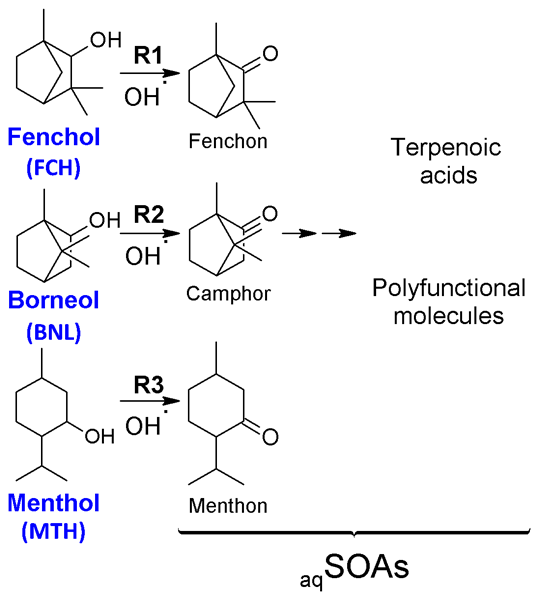
Abstract. Aqueous-phase oxidation of oxygenated monoterpenes can contribute to the formation of secondary organic aerosol (SOA) from biogenic volatile organic compounds. Still, the quantitative and mechanistic data for such precursors are limited. In this study, the aqueous-phase reactions of three atmospherically relevant, saturated terpenoic alcohols (TAs) – fenchol, borneol, and menthol – with hydroxyl radicals (OH) were investigated using a photochemical reactor combined with GC/MS and LC/ToF-MS analyses and kinetic modeling. The objectives were to elucidate reaction mechanisms, identify oxidation products, and quantify yields of aqueous SOA (aqSOA) under atmospherically relevant conditions. Comprehensive product analysis revealed that oxidation proceeds via H-atom abstraction, yielding a wide range of multifunctional products. In addition to previously reported products, this work first identified functionalized terpenoic acids formed as second-generation products, providing new evidence for the formation of low-volatility compounds from aqueous OH reaction with TAs. The molar yields of quantified products approached unity (0.88–0.99), indicating near-complete closure of the carbon balance. Based on these data, explicit kinetic box models were developed that successfully reproduced the measured temporal evolution of reactants. Modelled aqSOA yields ranged from 10% to 70%, depending on liquid water content and reaction coordinate, representing the first quantitative estimates for the three TAs under investigation. The results demonstrate that aqueous oxidation of semi-volatile terpenoids can efficiently generate low-volatility products contributing to SOA formation. These findings highlight the importance of multiphase processing of oxygenated terpenoids and provide new mechanistic and quantitative data for atmospheric models.
-
Notice on discussion status
The requested preprint has a corresponding peer-reviewed final revised paper. You are encouraged to refer to the final revised version.
-
Preprint
(1870 KB)
-
Supplement
(1706 KB)
-
The requested preprint has a corresponding peer-reviewed final revised paper. You are encouraged to refer to the final revised version.
- Preprint
(1870 KB) - Metadata XML
-
Supplement
(1706 KB) - BibTeX
- EndNote
- Final revised paper


Journal article(s) based on this preprint
Interactive discussion
Status: closed
-
RC1: 'Comment on egusphere-2026-1788', Anonymous Referee #1, 28 May 2026
-
RC2: 'Reply on RC1', Anonymous Referee #2, 09 Jun 2026
The presented work examines the OH radical reactions of three terpenoic mono alcohols in the aqueous phase. The study is designed as a combination of experimental and model work and aims at the elucidation of reaction mechanisms and the kinetic evaluation of the investigated conversions. The experiments are very useful and help to estimate the influence of aqueous-phase chemistry in the formation of secondary organic aerosols. The addition of the kinetic evaluation allows the modelling of these pathways under realistic conditions to test the competition of aqueous channels to gas-phase conversion. As the formation of SOA is often regarded as pure condensation of gas-phase reaction products up to now, this work helps to evaluate multiphase chemistry. Although in general very useful, sections of this work should be revised before publication. The most important part would be section 3.1, which includes the discussion of the presented pathways. That part lacks detail and does not seem to be derived from comprehensive discussion of theoretically possible pathways. If the authors can convincingly address the comments below, the manuscript might be suitable for publication.
Major comments
- Section 3.1 The experimental analysis are done by GCMS. Some of the products were identified by authentic standards, but it seems that for the vast majority, the observed ions and corresponding fragmentation pattern was used to derive closed shell products and consequently, derive the reaction pathway. It is not clear to me what the rationalization was for the specific reaction pathway. This should be described in much more detail.
- More to that point, the investigated compounds show some structural similarity with bridging carbon atoms in some and methyl groups. Yet, the presented reaction scheme is quite different for the different compounds. Especially H-atoms geminal to the hydroxyl group, secondary and tertiary carbons behave very differently. The authors showed results from the structure-activity-relationship calculation, but interestingly did not follow the results from that discussion in the pathways. It is very crucial for the presented pathways to explain why the pathways are not more similar and what the choice of products in the presented scheme is based on. It seems that OH does not attack at tertiary carbon atoms. Do the authors have any explanation or hypothesis?
- For the formation of camphoric acid, the authors present a formation pathway. Shouldn’t there be a closed shell intermediate product after the β-scission?
- As detailed in section 2.4, some of the quantifications were done by authentic standards, some by surrogate standards and some by fitting of the kinetic model to the experimental results. As this approach might be useful in specific cases it also opens the question how reliable the results are. If the fitted model results are used for that purpose, the model input directly influence the result. The authors should clearly describe, what assumptions they used and how the quantification was done in detail. At the very least, all compounds that were quantified by model results should be clearly marked. Otherwise, the prominent claim of almost achieved mass-closure should be toned down a bit.
- The introduction should be clearer structured, the authors jump from VOC to SOA formation back to VOC estimated emissions.
- I would suggest to start the results part with a general section and then move to a description of the analytical results before introducing the derived pathways.
- In line 71 it is stated that organic oxidation leads to new particle formation and it sounds as if that is the main fate of organics. I would suggest to restructure and if at all, mention NPF from organics as current topic of research that might occur in specific cases.
- For the case of Menthol in scheme 6 and the table S10 not all products are listed with the respective ions. This makes it hard to judge the scientific soundness of the presented results in the scheme.
- L 339 I am not sure how well partial rate coefficients can fit to yields as the both parameters are very different
Minor comments:
References in the text are often just added to the sentence (Lines 154;169; 214; 220; 270 aso.) I would suggest to include them in the respective sentence to make the relation clear. Especially in Line 297 it is not clear if the reference is to the scheme in the respective publication or in this manuscript
The tables in the SI are not in the same order as the schemes in the manuscript which makes it hard to follow.
L 264. There should be no hyphen before HO2
L269 feasible does not seem to be the right adjective as it describes if something is possible to do, not to occur
Scheme 6: the product from reaction path II has a methyl group instead of the hydroxylgroup.
Table 1 subscripted text seems incomplete. I would not use ‘neutrals’ for the non-acidic compounds
SI line 14 it seems the references to the tables are wrong
SI Figure S6 the caption states that partial rate coefficients are shown, but the axis shows a relative reactivity, which is not a rate. Furthermore, the conditions for that prediction should be stated
Citation: https://doi.org/10.5194/egusphere-2026-1788-RC2 - AC2: 'Reply on RC2', Bartlomiej Witkowski, 31 Jul 2026
- AC1: 'Reply on RC1', Bartlomiej Witkowski, 31 Jul 2026
-
RC2: 'Reply on RC1', Anonymous Referee #2, 09 Jun 2026
Peer review completion


Post-review adjustments


Interactive discussion
Status: closed
-
RC1: 'Comment on egusphere-2026-1788', Anonymous Referee #1, 28 May 2026
The manuscript investigated the aqueous-phase reactions of three saturated terpenoic alcohols (fenchol, borneol, and menthol) with hydroxyl radicals, encompassing reaction mechanisms, product identification, kinetic box model development, and the quantification of aqueous secondary organic aerosol (aqSOA) yields. The results indicate that aqueous-phase oxidation favors hydrogen atom abstraction from the carbon skeleton, yielding multifunctional, non-acidic products and smaller but atmospherically important fractions of low-volatility terpenoic acids. Additionally, this study reports for the first time the aqueous-phase reaction mechanisms and aqSOA yields for these three precursors. Overall, the findings demonstrate that oxygenated monoterpenes can be efficient precursors of aqSOA. This study provides mechanistic insights and quantitative parameters that improve the representation of multiphase SOA formation in atmospheric models and underscore the importance of multiphase processing of oxygenated terpenoids. I might support this manuscript for publication after implementation of my comments below.
Specific comments:
- The introduction provides a relatively brief overview of the sources and environmental significance of oxygenated monoterpene alcohols in the ambient atmosphere. It is recommended to supplement this section with information on their major emission sources and typical concentration levels to enhance the practical relevance of the study. Furthermore, the rationale for selecting the three model compounds (fenchol, borneol, and menthol) is insufficiently justified. The representativeness of these compounds should be clarified from the perspectives of structural characteristics and atmospheric relevance.
- The end of the introduction should more clearly outline the research objectives and main contents of this study to improve structural clarity. Some transitions between paragraphs appear somewhat abrupt; transitional sentences may be added to strengthen logical coherence. Meanwhile, the overall background description could be appropriately condensed to highlight the research gap and its connection to the present work, thereby making the introduction more concise and focused.
- The description of the product quantification method is relatively brief. The qualitative basis, quantification methods, and calibration curves for GC-MS and LC-MS analyses are not fully provided. It is recommended to further clarify the selection of quantitative standard reference materials and the sources of uncertainty.
- In Chapter 3, Sections 3.1–3.3 discuss in detail the reaction mechanisms of fenchol, borneol, and menthol with hydroxyl radicals, respectively. It is recommended to reorganize and consolidate these sections, either merging the mechanisms of individual compounds into a single section or setting them as subsections. Subsequently, the title of Section 3.4 remains “Mechanism of OH reaction with fenchol, borneol, and menthol,” which is highly repetitive of the preceding sections. However, the actual core content of this section mainly focuses on the summary and comparison of product yields as well as the analysis of gas-water phase differences, which belongs to comparative analysis or comprehensive discussion.
- The paragraph division is overly fragmented, with many paragraphs consisting of only one or two short sentences, which affects reading coherence. It is recommended that the authors systematically integrate the entire manuscript, merging short paragraphs with similar themes and continuous logic into complete paragraphs containing 3-8 sentences.
- The manuscript identifies multiple oxidation products; however, the formation pathways of some secondary products are mainly inferred from mechanistic considerations. It is recommended to further support these proposed pathways by incorporating temporal evolution trends or changes in relative signal intensities.
- For the global contribution estimation, the authors indicate that the global aqSOA contribution from the three terpenoic alcohols accounts for less than 1% of total biogenic SOA. However, the estimation relies on considerable uncertainties, the selection of key parameters lacks sufficient justification, and the estimated results are not compared with those from similar studies. It is recommended to supplement scenario analyses to provide a reasonable uncertainty range, connect the global contribution with local importance, and highlight the potentially substantial contribution of aqSOA from these terpenoic alcohols in regions with high emissions of oxygenated terpenes.
Citation: https://doi.org/10.5194/egusphere-2026-1788-RC1 -
RC2: 'Reply on RC1', Anonymous Referee #2, 09 Jun 2026
The presented work examines the OH radical reactions of three terpenoic mono alcohols in the aqueous phase. The study is designed as a combination of experimental and model work and aims at the elucidation of reaction mechanisms and the kinetic evaluation of the investigated conversions. The experiments are very useful and help to estimate the influence of aqueous-phase chemistry in the formation of secondary organic aerosols. The addition of the kinetic evaluation allows the modelling of these pathways under realistic conditions to test the competition of aqueous channels to gas-phase conversion. As the formation of SOA is often regarded as pure condensation of gas-phase reaction products up to now, this work helps to evaluate multiphase chemistry. Although in general very useful, sections of this work should be revised before publication. The most important part would be section 3.1, which includes the discussion of the presented pathways. That part lacks detail and does not seem to be derived from comprehensive discussion of theoretically possible pathways. If the authors can convincingly address the comments below, the manuscript might be suitable for publication.
Major comments
- Section 3.1 The experimental analysis are done by GCMS. Some of the products were identified by authentic standards, but it seems that for the vast majority, the observed ions and corresponding fragmentation pattern was used to derive closed shell products and consequently, derive the reaction pathway. It is not clear to me what the rationalization was for the specific reaction pathway. This should be described in much more detail.
- More to that point, the investigated compounds show some structural similarity with bridging carbon atoms in some and methyl groups. Yet, the presented reaction scheme is quite different for the different compounds. Especially H-atoms geminal to the hydroxyl group, secondary and tertiary carbons behave very differently. The authors showed results from the structure-activity-relationship calculation, but interestingly did not follow the results from that discussion in the pathways. It is very crucial for the presented pathways to explain why the pathways are not more similar and what the choice of products in the presented scheme is based on. It seems that OH does not attack at tertiary carbon atoms. Do the authors have any explanation or hypothesis?
- For the formation of camphoric acid, the authors present a formation pathway. Shouldn’t there be a closed shell intermediate product after the β-scission?
- As detailed in section 2.4, some of the quantifications were done by authentic standards, some by surrogate standards and some by fitting of the kinetic model to the experimental results. As this approach might be useful in specific cases it also opens the question how reliable the results are. If the fitted model results are used for that purpose, the model input directly influence the result. The authors should clearly describe, what assumptions they used and how the quantification was done in detail. At the very least, all compounds that were quantified by model results should be clearly marked. Otherwise, the prominent claim of almost achieved mass-closure should be toned down a bit.
- The introduction should be clearer structured, the authors jump from VOC to SOA formation back to VOC estimated emissions.
- I would suggest to start the results part with a general section and then move to a description of the analytical results before introducing the derived pathways.
- In line 71 it is stated that organic oxidation leads to new particle formation and it sounds as if that is the main fate of organics. I would suggest to restructure and if at all, mention NPF from organics as current topic of research that might occur in specific cases.
- For the case of Menthol in scheme 6 and the table S10 not all products are listed with the respective ions. This makes it hard to judge the scientific soundness of the presented results in the scheme.
- L 339 I am not sure how well partial rate coefficients can fit to yields as the both parameters are very different
Minor comments:
References in the text are often just added to the sentence (Lines 154;169; 214; 220; 270 aso.) I would suggest to include them in the respective sentence to make the relation clear. Especially in Line 297 it is not clear if the reference is to the scheme in the respective publication or in this manuscript
The tables in the SI are not in the same order as the schemes in the manuscript which makes it hard to follow.
L 264. There should be no hyphen before HO2
L269 feasible does not seem to be the right adjective as it describes if something is possible to do, not to occur
Scheme 6: the product from reaction path II has a methyl group instead of the hydroxylgroup.
Table 1 subscripted text seems incomplete. I would not use ‘neutrals’ for the non-acidic compounds
SI line 14 it seems the references to the tables are wrong
SI Figure S6 the caption states that partial rate coefficients are shown, but the axis shows a relative reactivity, which is not a rate. Furthermore, the conditions for that prediction should be stated
Citation: https://doi.org/10.5194/egusphere-2026-1788-RC2 - AC2: 'Reply on RC2', Bartlomiej Witkowski, 31 Jul 2026
- AC1: 'Reply on RC1', Bartlomiej Witkowski, 31 Jul 2026
Peer review completion
Post-review adjustments
Journal article(s) based on this preprint
Viewed
| HTML | XML | Total | Supplement | BibTeX | EndNote | |
|---|---|---|---|---|---|---|
| 304 | 97 | 48 | 449 | 67 | 36 | 26 |
- HTML: 304
- PDF: 97
- XML: 48
- Total: 449
- Supplement: 67
- BibTeX: 36
- EndNote: 26
Viewed (geographical distribution)
| Country | # | Views | % |
|---|
| Total: | 0 |
| HTML: | 0 |
| PDF: | 0 |
| XML: | 0 |
- 1
Priyanka Jain
Bartłomiej Witkowski

Agata Błaziak
Tomasz Gierczak
The requested preprint has a corresponding peer-reviewed final revised paper. You are encouraged to refer to the final revised version.
- Preprint
(1870 KB) - Metadata XML
-
Supplement
(1706 KB) - BibTeX
- EndNote
- Final revised paper
The manuscript investigated the aqueous-phase reactions of three saturated terpenoic alcohols (fenchol, borneol, and menthol) with hydroxyl radicals, encompassing reaction mechanisms, product identification, kinetic box model development, and the quantification of aqueous secondary organic aerosol (aqSOA) yields. The results indicate that aqueous-phase oxidation favors hydrogen atom abstraction from the carbon skeleton, yielding multifunctional, non-acidic products and smaller but atmospherically important fractions of low-volatility terpenoic acids. Additionally, this study reports for the first time the aqueous-phase reaction mechanisms and aqSOA yields for these three precursors. Overall, the findings demonstrate that oxygenated monoterpenes can be efficient precursors of aqSOA. This study provides mechanistic insights and quantitative parameters that improve the representation of multiphase SOA formation in atmospheric models and underscore the importance of multiphase processing of oxygenated terpenoids. I might support this manuscript for publication after implementation of my comments below.
Specific comments: