
the Creative Commons Attribution 4.0 License.
the Creative Commons Attribution 4.0 License.
 | 02 Apr 2026
Characterization of Dust Aerosol Source Types and Associated Shortwave Direct Radiative Effects Over Cyprus: A Seven-Year Study
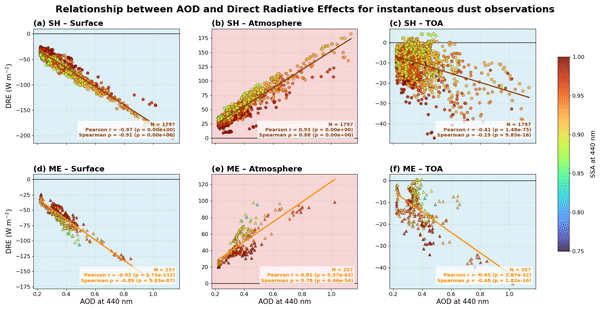
Abstract. Atmospheric mineral dust modulates surface solar radiation, with important implications for regional climate and solar energy production. In this study, we investigate dust aerosol typing and associated shortwave (SW) direct radiative effects (DREs) using radiative transfer simulations over Cyprus using a seven-year dataset (2015–2022) from the Agia Marina Xyliatou station. Dust events were identified using AERONET optical properties, lidar observations, MODIS imagery, and classified by origin (Sahara or Middle East) based on HYSPLIT back-trajectories analysis. Dust accounts for ~28.3 % of aerosol cases during spring (MAM) and ~12.7 % during autumn (SON), with 86 % of events originating from the Sahara and 14% from the Middle East. The mean AOD at 440 nm for the period studied here is 0.33 ± 0.08 for Saharan events and 0.38 ± 0.09 for Middle Eastern events, while the SSA at 440 nm remains high for both sources (0.93 ± 0.04 and 0.94 ± 0.03, respectively), indicating predominantly scattering aerosols. Radiative transfer estimates of global horizontal irradiance (GHI) agree well with ground-based irradiance measurements, with ~87 % of modelled GHI values within ±5 % and ~96 % within ±10 % of observations. The mean surface SW DREs are −84 ± 49 W m−2 for Saharan dust in March and −79 ± 33 W m−2 for Middle Eastern dust in October. At the top of the atmosphere (TOA), the estimated cooling reaches −27 W m−2, while atmospheric heating peaks at +72 ± 45 W m−2. Although the Ångström exponent is slightly higher for Middle Eastern dust (0.36 vs. 0.28), suggesting enhanced fine-mode contribution due to aerosol mixing, radiative forcing efficiencies are comparable, indicating that aerosol loading primarily controls the magnitude of radiative perturbations.
Competing interests: At least one of the (co-)authors serves as editor for the special issue to which this paper belongs.
Publisher's note: Copernicus Publications remains neutral with regard to jurisdictional claims made in the text, published maps, institutional affiliations, or any other geographical representation in this paper. While Copernicus Publications makes every effort to include appropriate place names, the final responsibility lies with the authors. Views expressed in the text are those of the authors and do not necessarily reflect the views of the publisher.-
Notice on discussion status
The requested preprint has a corresponding peer-reviewed final revised paper. You are encouraged to refer to the final revised version.
-
Preprint
(2441 KB)
-
Supplement
(202 KB)
-
The requested preprint has a corresponding peer-reviewed final revised paper. You are encouraged to refer to the final revised version.
- Preprint
(2441 KB) - Metadata XML
-
Supplement
(202 KB) - BibTeX
- EndNote
- Final revised paper


Journal article(s) based on this preprint
Interactive discussion
Status: closed
-
RC1: 'Comment on egusphere-2026-1775', Anonymous Referee #1, 22 Jun 2026
-
AC1: 'Reply on RC1', Georgia Charalampous, 04 Aug 2026
The comment was uploaded in the form of a supplement: https://egusphere.copernicus.org/preprints/2026/egusphere-2026-1775/egusphere-2026-1775-AC1-supplement.pdf
-
AC1: 'Reply on RC1', Georgia Charalampous, 04 Aug 2026
-
RC2: 'Comment on egusphere-2026-1775', Anonymous Referee #2, 29 Jun 2026
The comment was uploaded in the form of a supplement: https://egusphere.copernicus.org/preprints/2026/egusphere-2026-1775/egusphere-2026-1775-RC2-supplement.pdf
-
AC2: 'Reply on RC2', Georgia Charalampous, 04 Aug 2026
The comment was uploaded in the form of a supplement: https://egusphere.copernicus.org/preprints/2026/egusphere-2026-1775/egusphere-2026-1775-AC2-supplement.pdf
-
AC2: 'Reply on RC2', Georgia Charalampous, 04 Aug 2026
-
EC1: 'Editor comment on the final revision of the manuscript egusphere-2026-1775', Lionel Doppler, 18 Aug 2026
As Editor, I would like to thank the lead author and all the co-authors for this excellent study and for the considerable work that has gone into this manuscript.
I would also like to thank the reviewers for their precise, detailed, and constructive reports, which provide the authors with clear guidance towards concrete improvements to the manuscript.
Finally, I would like to thank the authors once again for their detailed and comprehensive responses to the reviewers’ comments.
In their responses, the authors mention a revised version of the manuscript. However, this revised version has not yet been uploaded. I would therefore kindly ask the authors to upload it as soon as possible.
In addition, before submitting the revised version of the manuscript, I would suggest that the authors add a glossary table explaining all the numerous acronyms used throughout the manuscript. Such a table would be a valuable aid for readers and would greatly facilitate their understanding of the publication.
Many thanks in advance, and best wishes to the authors for this final stage of the revision process.
Citation: https://doi.org/10.5194/egusphere-2026-1775-EC1
Peer review completion


Interactive discussion
Status: closed
-
RC1: 'Comment on egusphere-2026-1775', Anonymous Referee #1, 22 Jun 2026
The paper “Characterization of Dust Aerosol Source Types and Associated Shortwave Direct Radiative Effects Over Cyprus: A Seven-Year Study” by Georgia Charalampous and coauthors presents seven (2025-2022) years of columnar aerosol properties from the Agia Marina Xyliatou station, remote site in central Cyprus, used to derive the impact of dust transported from the Saharan and the Middle East deserts on the aerosol load and on the dust direct radiative effects.
The dust source regions are identified by the use of the airmass backtrajectories computed from the HYSPLIT dispersion model, while the optical properties of dust are isolated by comparing the aerosol classification based on aerosol optical depth (AOD) at 440 nm and the Ångström exponent (AE) (AERONET Dubovik method) and the one based on the lidar ratio and the particle linear depolarization ratio (lidar depolarization method), using the measurements from the Limassol station. An important feature of the Middle Eastern dust is the difficulty to isolate pure dust particles, due to the contamination by fine pollution during transport.
After the description of the intra-annual variability of the dust optical properties, the dust radiative effects (DRE) at the surface, at the top of the atmosphere (TOA), and in the atmosphere, are computed for the two different source regions, taking advantage of the solar irradiance measurements performed at Agia Marina Xyliatou.
Finally, the attenuation of the global horizontal irradiance (GHI) due to dust is computed to assess the effects on the solar energy production.
General comments
The article highlights the aerosol property measurements from the AMX site, which is strategically located to compare the optical properties of dust from the Sahara and from the Middle Eastern deserts.
The dataset is generally well presented, as is the data selection and the classification of dust cases from the Sahara and the Middle East regions.
The description of the instruments and measurements used in the manuscript could be improved by including some missing information, as well as that relating to the RTM input data. Furthermore, some details are missing regarding the data analysis, which I believe are important for understanding the results. All comments are described in the Specific comments section.
My main concern is the calculation and comparison of the monthly averages of the DRE, which is dependent on the solar zenith angle (SZA). The authors do not mention this dependence, and it seems that, in calculating the monthly averages, they take into account all the estimates of the instantaneous DRE in the month regardless of the SZA value. This could lead to a bias in the results and distort the subsequent conclusions.
I therefore ask the lead author and co-authors to pay attention to this aspect and to present a study that shows the consistency of the results.
For this reason, I suggest major revisions in order to publish the work.
Specific comments
Line 206: the description of the GDAS dataset in the link provides 23 instead of 55 vertical layers. Moreover, the GDAS dataset with 0.5°x0.5° seems to be available only until 2019 in the online version of the HYSPLIT trajectory model.
Section 2.2: A paragraph should be dedicated to solar irradiance instruments and measurements, instead of providing the information under Section 2.2.3 which is devoted to the description of the PollyXT system. Among the missing information, the time step of the solar irradiance measurements should be specified, since it has a role in the estimation of the cloud-free intervals and in the calculation of the dust DRE.
Section 2.2.1: the time step of the AERONET measurements should be made explicit, as well as the wavelengths of the Cimel CE348NE. On the AERONET web site I see that some channels are missing in some periods.
Section 2.3.2: the authors should argument the choice of the radiative transfer model (RTM) input parameters. Why did they select the AOD only from two wavelengths, instead of using at least four (440, 675, 870, and 1020 nm) that are available for the entire period? This would improve the description of the spectral AOD variations and the effect on the GHI simulation.
I guess that the AOD is extrapolated below 440 nm and above 675 nm by the AE and interpolated within the 440-675 nm interval, but I suggest explaining it in the text.
Which atmospheric profiles are used?
I can not find any information about the SZA interval or time step for the RTM simulations for the purpose of the validation of the model performance in reproducing the cloud-free GHI measurements. Are model simulations carried out for each cloud-free irradiance measurement or for specific SZA values?
Table 1: please explain the sentence “440 nm and 675 nm, treated as wavelength independent within each interval”, which is not clear.
Section 2.4.3: the DRE at the surface is calculated for both the downwelling and the net radiation. Which of the two is then evaluated for the successive analysis?
The authors say (lines 283-284) that “The corresponding instantaneous DREs were then derived and subsequently averaged to obtain monthly mean values”. How do they average the instantaneous DRE values? This is a key point since the DRE, either at the surface and at TOA, has a clear SZA dependence (see, e.g., Balmes and Fu, The diurnally-averaged aerosol direct radiative effect and the use of the daytime-mean and insolation-weighted-mean solar zenith angles, J. Quantitat. Spectr. and Rad. Transfer, 257, 2020, doi:10.1016/j.jqsrt.2020.107363; Wu et al., Aerosol direct radiative effects at the ARM SGP and TWP sites: Clear skies, J. Geophys. Res. Atmospheres, 126, e2020JD033663, 2021, doi:10.1029/2020JD033663; di Sarra et al., Surface shortwave radiative forcing of different aerosol types in the Mediterranean, Geophys. Res. Lett., 35, L02714, 2008, doi:10.1029/2007GL032395). Since AERONET measurements are not continuous throughout the day and, even more so, those in dusty conditions are not, the dust DRE can be estimated only for some SZAs. Furthermore, daytime SZA values vary throughout the year, so in summer the DRE can be calculated for low SZAs that are not reached in other seasons. How did the authors account for this dependence when calculating monthly averages? Averaging all instantaneous DRE values (calculated for variable SZAs) means that seasonal DREs cannot be compared. To overcome this problem, I suggest calculating the DRE for fixed SZAs. There will be SZA values (e.g., 60°) for which the DRE can be calculated throughout the year, and monthly and seasonal averages can then be computed and compared.
Section 3.2: It is not clear to how many dust AERONET measurements the calculation of the backtrajectories with the HYSPLIT model is applied. For example, if a measurement is classified as dust-dominated and the next one (expected to be close in time, let’s say after 15 minutes) is also classified as dust, do you run the model for both? This is not realistic, even because of the temporal resolution of the GDAS meteorological field. Since the origin of each case is also cross-checked with MODIS images, I guess that few cases per day can be considered.
The same applies to the cases classified as dust from the LD and AD, which are 37. Are these instantaneous measurements?
Section 3.3: When the authors talk about a “dust day”, what exactly do they mean? Is there a minimum number of instantaneous measurements identified as dust during a day for it to be classified as a “dust day”? Similarly, how is the AOD at 440 nm monthly climatology calculated? From Table 2 I understand if one dust day is present in the month than it is included in the climatology. In the case of the month of March, for the one case of Middle East dust the standard deviation represents the variability of the instantaneous measurements in a single day, while in the case of dust from the Saharan dust the standard deviation represents the variability of the daily measurements of the 15 days, that may have been occurred in different years. Are the authors sure that these data can be effectively compared?
Section 3.4: see comment on Section 2.3.2. How many model-measurement comparisons are made that provide the statistics in Figure 7 and Table 4?
Figure 7: those cases for which the percent difference between modelled and measured GHI is larger than 10% (or, better, lower than -10%) the DRE should be not be evaluated since the model is not capable of reproducing the measured irradiances, thus it is plausible that even the dust-free simulation may be unrealistic and so the DRE. Did the authors take this aspect into account?
Section 3.5: here the authors re-assess the methodology followed to compute the average monthly DRE “The DREs were initially calculated at the instantaneous level, using the corresponding aerosol optical properties and solar geometry, and were subsequently averaged to derive monthly mean values”. As the DRE is SZA-dependent, the authors should state if and how this dependence is included when computing the monthly averages. If the SZA dependence does not affect the results, a specific analysis should be provided. An alternative way of comparing the DRE in different months is to do it for fixed SZA values.
Lines 648-649: the sentence “Months with limited sample size (e.g., December for Saharan dust) should be interpreted with caution, as the corresponding monthly means are not statistically robust” here is probably referred to the surface albedo value, which is assumed to be constant, and also wavelength-independent, throughout the period and along the seasons. More generally, this sentence should be associated with the results that describe the monthly averages of the various parameters examined (AOD at 440 nm, AE, SSA, DRE) precisely because the properties of dust from the Sahara and the Middle East are compared for a number of cases that differ from a source to another.
Technical corrections
Line 97: SSR is not introduced, use GHI.
Lines 122-124: the verb is missing from this sentence. Use the same number of decimals for the coordinates of the two sites.
Line 136: add “during” before “the last 10 years”.
Line 145: add “spectral”.
Line 180: diffuse horizontal irradiance (DHI).
Line 314: I suggest “3.1 Aerosol Classification”.
Lines 323-324: the sentence “It should be noted that the statistics presented as all points correspond to the total number of individual AERONET measurements during the study period” is not clear.
Lines 325-328: the sentence should be moved further on where the SON season is mentioned again (from line 331).
Lines 339-340: the sentence “Figure 2(iv) table of this classification by showing…” should be revised.
Lines 359-360: use only one decimal.
Figure 3: the meteorological dataset indicated in the HYSPLIT plots report “GFSG”. Is it different from GDAS?
Lines 380-383: this part better in Section 2.2.2?
Lines 393-397: there are some repetitions.
Line 431: how did the authors chose the FMF threshold of 0.4?
Line 440: here the number of Saharan and Middle East dust cases (199 and 33) appear for the first time. I suggest to indicate these numbers also in Section 3.1.
Line 458: review the sentence “and this is associated with enhanced AOD values associated with increased…”.
Line 462: maybe is “year-to-year” instead of “month-to-month”?
Line 504: it seems to me that the central radius is more around 2 µm, and not 1-2 µm.
Lines 514-516: the sentence “For a more compact and quantitative comparison of particle size between the two origins, because it summarizes the combined influence of the peak position and the coarse/fine partitioning” needs to be revised.
Line 548: “DRE” instead of “ARE”.
Lines 621-622: this should be better detectable in the DRE efficiency.
Line 659-660: the sentence “The DRFE within the atmosphere (Fig. 10b) remains positive throughout the year as DRE is also positive” can be simplified.
Line 676: include a sentence for the choice of the SSA classes.
Table 5: I suggest to include the AE values in the table.
Line 706: include the standard deviation also for the ME dust cases.
Line 708: The reference to Figure 11 is incorrect, I guess is Figure 14.
Lines 710 and 711: the correct surface DRE values are -167 and -127 Wm-2, respectively, and not -168 and -126 Wm-2.
Line 736: the analysis of the airmass backtrajectories may add information, for example short-range transport may be associated with larger AOD values?
Line 742: I suggest the title “Attenuation of Global Horizontal Irradiance for Solar Energy Production”.
Line 759: maybe “monthly” instead of “seasonal”.
Section 4: when comparing the results of the present study with previous works, it should be specified if the reported data are instantaneous, daily, or monthly averages.
Line 834: change SSR with GHI.
Some typos are present.
Citation: https://doi.org/10.5194/egusphere-2026-1775-RC1 -
AC1: 'Reply on RC1', Georgia Charalampous, 04 Aug 2026
The comment was uploaded in the form of a supplement: https://egusphere.copernicus.org/preprints/2026/egusphere-2026-1775/egusphere-2026-1775-AC1-supplement.pdf
-
AC1: 'Reply on RC1', Georgia Charalampous, 04 Aug 2026
-
RC2: 'Comment on egusphere-2026-1775', Anonymous Referee #2, 29 Jun 2026
The comment was uploaded in the form of a supplement: https://egusphere.copernicus.org/preprints/2026/egusphere-2026-1775/egusphere-2026-1775-RC2-supplement.pdf
-
AC2: 'Reply on RC2', Georgia Charalampous, 04 Aug 2026
The comment was uploaded in the form of a supplement: https://egusphere.copernicus.org/preprints/2026/egusphere-2026-1775/egusphere-2026-1775-AC2-supplement.pdf
-
AC2: 'Reply on RC2', Georgia Charalampous, 04 Aug 2026
-
EC1: 'Editor comment on the final revision of the manuscript egusphere-2026-1775', Lionel Doppler, 18 Aug 2026
As Editor, I would like to thank the lead author and all the co-authors for this excellent study and for the considerable work that has gone into this manuscript.
I would also like to thank the reviewers for their precise, detailed, and constructive reports, which provide the authors with clear guidance towards concrete improvements to the manuscript.
Finally, I would like to thank the authors once again for their detailed and comprehensive responses to the reviewers’ comments.
In their responses, the authors mention a revised version of the manuscript. However, this revised version has not yet been uploaded. I would therefore kindly ask the authors to upload it as soon as possible.
In addition, before submitting the revised version of the manuscript, I would suggest that the authors add a glossary table explaining all the numerous acronyms used throughout the manuscript. Such a table would be a valuable aid for readers and would greatly facilitate their understanding of the publication.
Many thanks in advance, and best wishes to the authors for this final stage of the revision process.
Citation: https://doi.org/10.5194/egusphere-2026-1775-EC1
Peer review completion
Journal article(s) based on this preprint
Viewed
| HTML | XML | Total | Supplement | BibTeX | EndNote | |
|---|---|---|---|---|---|---|
| 464 | 261 | 59 | 784 | 136 | 71 | 74 |
- HTML: 464
- PDF: 261
- XML: 59
- Total: 784
- Supplement: 136
- BibTeX: 71
- EndNote: 74
Viewed (geographical distribution)
| Country | # | Views | % |
|---|
| Total: | 0 |
| HTML: | 0 |
| PDF: | 0 |
| XML: | 0 |
- 1
Georgia Charalampous

Konstantinos Fragkos
Ilias Fountoulakis
Kyriakoula Papachristopoulou
Anna Moustaka
Franco Marenco
Yevgeny Derimian
Argyro Nisantzi
Rodanthi-Elisavet Mamouri
Diofantos Hadjimitsis
Stelios Kazadzis
The requested preprint has a corresponding peer-reviewed final revised paper. You are encouraged to refer to the final revised version.
- Preprint
(2441 KB) - Metadata XML
-
Supplement
(202 KB) - BibTeX
- EndNote
- Final revised paper
The paper “Characterization of Dust Aerosol Source Types and Associated Shortwave Direct Radiative Effects Over Cyprus: A Seven-Year Study” by Georgia Charalampous and coauthors presents seven (2025-2022) years of columnar aerosol properties from the Agia Marina Xyliatou station, remote site in central Cyprus, used to derive the impact of dust transported from the Saharan and the Middle East deserts on the aerosol load and on the dust direct radiative effects.
The dust source regions are identified by the use of the airmass backtrajectories computed from the HYSPLIT dispersion model, while the optical properties of dust are isolated by comparing the aerosol classification based on aerosol optical depth (AOD) at 440 nm and the Ångström exponent (AE) (AERONET Dubovik method) and the one based on the lidar ratio and the particle linear depolarization ratio (lidar depolarization method), using the measurements from the Limassol station. An important feature of the Middle Eastern dust is the difficulty to isolate pure dust particles, due to the contamination by fine pollution during transport.
After the description of the intra-annual variability of the dust optical properties, the dust radiative effects (DRE) at the surface, at the top of the atmosphere (TOA), and in the atmosphere, are computed for the two different source regions, taking advantage of the solar irradiance measurements performed at Agia Marina Xyliatou.
Finally, the attenuation of the global horizontal irradiance (GHI) due to dust is computed to assess the effects on the solar energy production.
General comments
The article highlights the aerosol property measurements from the AMX site, which is strategically located to compare the optical properties of dust from the Sahara and from the Middle Eastern deserts.
The dataset is generally well presented, as is the data selection and the classification of dust cases from the Sahara and the Middle East regions.
The description of the instruments and measurements used in the manuscript could be improved by including some missing information, as well as that relating to the RTM input data. Furthermore, some details are missing regarding the data analysis, which I believe are important for understanding the results. All comments are described in the Specific comments section.
My main concern is the calculation and comparison of the monthly averages of the DRE, which is dependent on the solar zenith angle (SZA). The authors do not mention this dependence, and it seems that, in calculating the monthly averages, they take into account all the estimates of the instantaneous DRE in the month regardless of the SZA value. This could lead to a bias in the results and distort the subsequent conclusions.
I therefore ask the lead author and co-authors to pay attention to this aspect and to present a study that shows the consistency of the results.
For this reason, I suggest major revisions in order to publish the work.
Specific comments
Line 206: the description of the GDAS dataset in the link provides 23 instead of 55 vertical layers. Moreover, the GDAS dataset with 0.5°x0.5° seems to be available only until 2019 in the online version of the HYSPLIT trajectory model.
Section 2.2: A paragraph should be dedicated to solar irradiance instruments and measurements, instead of providing the information under Section 2.2.3 which is devoted to the description of the PollyXT system. Among the missing information, the time step of the solar irradiance measurements should be specified, since it has a role in the estimation of the cloud-free intervals and in the calculation of the dust DRE.
Section 2.2.1: the time step of the AERONET measurements should be made explicit, as well as the wavelengths of the Cimel CE348NE. On the AERONET web site I see that some channels are missing in some periods.
Section 2.3.2: the authors should argument the choice of the radiative transfer model (RTM) input parameters. Why did they select the AOD only from two wavelengths, instead of using at least four (440, 675, 870, and 1020 nm) that are available for the entire period? This would improve the description of the spectral AOD variations and the effect on the GHI simulation.
I guess that the AOD is extrapolated below 440 nm and above 675 nm by the AE and interpolated within the 440-675 nm interval, but I suggest explaining it in the text.
Which atmospheric profiles are used?
I can not find any information about the SZA interval or time step for the RTM simulations for the purpose of the validation of the model performance in reproducing the cloud-free GHI measurements. Are model simulations carried out for each cloud-free irradiance measurement or for specific SZA values?
Table 1: please explain the sentence “440 nm and 675 nm, treated as wavelength independent within each interval”, which is not clear.
Section 2.4.3: the DRE at the surface is calculated for both the downwelling and the net radiation. Which of the two is then evaluated for the successive analysis?
The authors say (lines 283-284) that “The corresponding instantaneous DREs were then derived and subsequently averaged to obtain monthly mean values”. How do they average the instantaneous DRE values? This is a key point since the DRE, either at the surface and at TOA, has a clear SZA dependence (see, e.g., Balmes and Fu, The diurnally-averaged aerosol direct radiative effect and the use of the daytime-mean and insolation-weighted-mean solar zenith angles, J. Quantitat. Spectr. and Rad. Transfer, 257, 2020, doi:10.1016/j.jqsrt.2020.107363; Wu et al., Aerosol direct radiative effects at the ARM SGP and TWP sites: Clear skies, J. Geophys. Res. Atmospheres, 126, e2020JD033663, 2021, doi:10.1029/2020JD033663; di Sarra et al., Surface shortwave radiative forcing of different aerosol types in the Mediterranean, Geophys. Res. Lett., 35, L02714, 2008, doi:10.1029/2007GL032395). Since AERONET measurements are not continuous throughout the day and, even more so, those in dusty conditions are not, the dust DRE can be estimated only for some SZAs. Furthermore, daytime SZA values vary throughout the year, so in summer the DRE can be calculated for low SZAs that are not reached in other seasons. How did the authors account for this dependence when calculating monthly averages? Averaging all instantaneous DRE values (calculated for variable SZAs) means that seasonal DREs cannot be compared. To overcome this problem, I suggest calculating the DRE for fixed SZAs. There will be SZA values (e.g., 60°) for which the DRE can be calculated throughout the year, and monthly and seasonal averages can then be computed and compared.
Section 3.2: It is not clear to how many dust AERONET measurements the calculation of the backtrajectories with the HYSPLIT model is applied. For example, if a measurement is classified as dust-dominated and the next one (expected to be close in time, let’s say after 15 minutes) is also classified as dust, do you run the model for both? This is not realistic, even because of the temporal resolution of the GDAS meteorological field. Since the origin of each case is also cross-checked with MODIS images, I guess that few cases per day can be considered.
The same applies to the cases classified as dust from the LD and AD, which are 37. Are these instantaneous measurements?
Section 3.3: When the authors talk about a “dust day”, what exactly do they mean? Is there a minimum number of instantaneous measurements identified as dust during a day for it to be classified as a “dust day”? Similarly, how is the AOD at 440 nm monthly climatology calculated? From Table 2 I understand if one dust day is present in the month than it is included in the climatology. In the case of the month of March, for the one case of Middle East dust the standard deviation represents the variability of the instantaneous measurements in a single day, while in the case of dust from the Saharan dust the standard deviation represents the variability of the daily measurements of the 15 days, that may have been occurred in different years. Are the authors sure that these data can be effectively compared?
Section 3.4: see comment on Section 2.3.2. How many model-measurement comparisons are made that provide the statistics in Figure 7 and Table 4?
Figure 7: those cases for which the percent difference between modelled and measured GHI is larger than 10% (or, better, lower than -10%) the DRE should be not be evaluated since the model is not capable of reproducing the measured irradiances, thus it is plausible that even the dust-free simulation may be unrealistic and so the DRE. Did the authors take this aspect into account?
Section 3.5: here the authors re-assess the methodology followed to compute the average monthly DRE “The DREs were initially calculated at the instantaneous level, using the corresponding aerosol optical properties and solar geometry, and were subsequently averaged to derive monthly mean values”. As the DRE is SZA-dependent, the authors should state if and how this dependence is included when computing the monthly averages. If the SZA dependence does not affect the results, a specific analysis should be provided. An alternative way of comparing the DRE in different months is to do it for fixed SZA values.
Lines 648-649: the sentence “Months with limited sample size (e.g., December for Saharan dust) should be interpreted with caution, as the corresponding monthly means are not statistically robust” here is probably referred to the surface albedo value, which is assumed to be constant, and also wavelength-independent, throughout the period and along the seasons. More generally, this sentence should be associated with the results that describe the monthly averages of the various parameters examined (AOD at 440 nm, AE, SSA, DRE) precisely because the properties of dust from the Sahara and the Middle East are compared for a number of cases that differ from a source to another.
Technical corrections
Line 97: SSR is not introduced, use GHI.
Lines 122-124: the verb is missing from this sentence. Use the same number of decimals for the coordinates of the two sites.
Line 136: add “during” before “the last 10 years”.
Line 145: add “spectral”.
Line 180: diffuse horizontal irradiance (DHI).
Line 314: I suggest “3.1 Aerosol Classification”.
Lines 323-324: the sentence “It should be noted that the statistics presented as all points correspond to the total number of individual AERONET measurements during the study period” is not clear.
Lines 325-328: the sentence should be moved further on where the SON season is mentioned again (from line 331).
Lines 339-340: the sentence “Figure 2(iv) table of this classification by showing…” should be revised.
Lines 359-360: use only one decimal.
Figure 3: the meteorological dataset indicated in the HYSPLIT plots report “GFSG”. Is it different from GDAS?
Lines 380-383: this part better in Section 2.2.2?
Lines 393-397: there are some repetitions.
Line 431: how did the authors chose the FMF threshold of 0.4?
Line 440: here the number of Saharan and Middle East dust cases (199 and 33) appear for the first time. I suggest to indicate these numbers also in Section 3.1.
Line 458: review the sentence “and this is associated with enhanced AOD values associated with increased…”.
Line 462: maybe is “year-to-year” instead of “month-to-month”?
Line 504: it seems to me that the central radius is more around 2 µm, and not 1-2 µm.
Lines 514-516: the sentence “For a more compact and quantitative comparison of particle size between the two origins, because it summarizes the combined influence of the peak position and the coarse/fine partitioning” needs to be revised.
Line 548: “DRE” instead of “ARE”.
Lines 621-622: this should be better detectable in the DRE efficiency.
Line 659-660: the sentence “The DRFE within the atmosphere (Fig. 10b) remains positive throughout the year as DRE is also positive” can be simplified.
Line 676: include a sentence for the choice of the SSA classes.
Table 5: I suggest to include the AE values in the table.
Line 706: include the standard deviation also for the ME dust cases.
Line 708: The reference to Figure 11 is incorrect, I guess is Figure 14.
Lines 710 and 711: the correct surface DRE values are -167 and -127 Wm-2, respectively, and not -168 and -126 Wm-2.
Line 736: the analysis of the airmass backtrajectories may add information, for example short-range transport may be associated with larger AOD values?
Line 742: I suggest the title “Attenuation of Global Horizontal Irradiance for Solar Energy Production”.
Line 759: maybe “monthly” instead of “seasonal”.
Section 4: when comparing the results of the present study with previous works, it should be specified if the reported data are instantaneous, daily, or monthly averages.
Line 834: change SSR with GHI.
Some typos are present.