
the Creative Commons Attribution 4.0 License.
the Creative Commons Attribution 4.0 License.
 | 20 Apr 2026
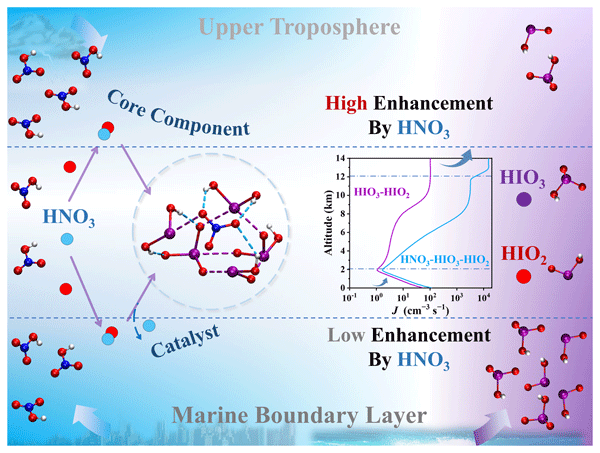
Altitude-Dependent Role of Nitric Acid in Iodic Acid-Iodous Acid Nucleation: From Marine Boundary Layer Catalyst to Upper Troposphere Core Component
Abstract. With global sulfur emissions declining and concurrent marine iodine emissions rising, new particle formation (NPF) driven by iodic acid (HIO3) and iodous acid (HIO2) has become critical to global aerosol and cloud condensation nuclei (CCN) budget. However, the role of ubiquitous nitric acid (HNO3) in this iodine-driven nucleation across altitudes from the marine boundary layer (MBL) to the upper troposphere (UT) remains poorly understood. Herein, we integrated quantum chemical calculations with Atmospheric Cluster Dynamics Code (ACDC) simulations to unravel the altitude-dependent enhancement mechanism by which HNO3 enhances HIO3-HIO2 nucleation. Under MBL conditions, HNO3 acts as a catalyst to promote nucleation via collision and re-evaporation processes, yielding a modest 2–3-fold enhancement in nucleation. In contrast, as altitude increases to the UT, where cluster evaporation is effectively suppressed by low temperature, HNO3 becomes a core component of nucleation clusters, driving a 200-fold enhancement in nucleation. Consequently, the cluster formation rates of the HNO3–HIO3–HIO2 mechanism reach 103–104 cm-3 s-1, exceeding those of the well-documented H2SO4–NH3–HNO3 mechanism under comparable UT conditions. Our findings establish HNO3 as a critical atmospheric agent that amplifies iodine oxoacid nucleation across altitudes, providing a critical chemical explanation for intense NPF events in both polluted coastal regions and the UT. This altitude‑dependent role of HNO3 links marine iodine emissions to troposphere‑wide particle formation, with important implications for global CCN budgets and the refinement of climate models.
-
Notice on discussion status
The requested preprint has a corresponding peer-reviewed final revised paper. You are encouraged to refer to the final revised version.
-
Preprint
(1800 KB)
-
Supplement
(9480 KB)
-
The requested preprint has a corresponding peer-reviewed final revised paper. You are encouraged to refer to the final revised version.
- Preprint
(1800 KB) - Metadata XML
-
Supplement
(9480 KB) - BibTeX
- EndNote
- Final revised paper


Journal article(s) based on this preprint
Interactive discussion
Status: closed
-
RC1: 'Comment on egusphere-2026-1771', Anonymous Referee #1, 17 May 2026
-
AC1: 'Reply on RC1', Xiuhui Zhang, 13 Jul 2026
The comment was uploaded in the form of a supplement: https://egusphere.copernicus.org/preprints/2026/egusphere-2026-1771/egusphere-2026-1771-AC1-supplement.pdf
-
AC1: 'Reply on RC1', Xiuhui Zhang, 13 Jul 2026
-
RC2: 'Comment on egusphere-2026-1771', Jonas Elm, 22 May 2026
Zhang et al. investigates the effect of nitric acid (HNO3) on the clustering of iodic acid (HIO3) and iodous acid (HIO2). The (HIO3)n(HIO2)m cluster structures are taken from previous work by the same group, and the current investigation feels like a natural extension.
The cluster configurations are sampled using well-established protocols and state-of-the-art quantum chemical methods. The calculated thermochemistry is used in the atmospheric cluster dynamics code (ACDC) to simulate new particle formation (NPF) rates. Specifically, the authors simulate NPF at Zhejiang, Mace Head, Greenland and in the upper troposphere. The overall finding is that nitric acid contributes to the cluster formation in all regions. I find the altitude analysis performed in this manuscript particularly interesting and extremely well carried out. This is good inspiration for other work in the field.
I only have minor issues with the justification of the applied methods. I.e. how much can we trust that the methods are giving reliable results, without backing up the accuracy of the methods. I acknowledge that the sensitivity tests alleviate some of this concern, but it does not give the full picture.
Overall, the paper is interesting, well-written and advances our understanding of NPF in the marine environment. I believe it is a good fit for ACP and recommend publication after the following comments have been addressed.
Comments
Line 72: “… with detailed procedures provided in the Supporting Information”
I would appreciate that the sampling details are also included in the methods. Hence, integrate the “Multi-step cluster conformational search method” from the SI to the methods section as this will make it more transparent whether one can trust the found structures.
In addition, the applied UFF forcefield cannot handle bond breaking. Did the authors sample the cluster structures using ionic monomers to simulate bond breaking (see Kubečka et al., https://doi.org/10.1021/acs.jpca.9b03853).
Only selecting the lowest 100 cluster configurations based on PM7 could lead to the global minimum cluster being missed (see Kurfman et al., https://doi.org/10.1021/acs.jpca.1c00872). Could the authors comment on this aspect?
Line 74: “All identified low-energy cluster conformations were rigorously optimized and subjected to frequency analysis using the Gaussian 09 package (Frisch et al., 2009) at the ωB97X-D/6-311++G(3df,3pd) (for H, O, N) + aug-cc-pVTZ-PP with ECP28MDF (for I) level of theory”I am missing some justification to why the ωB97X-D functional and why the 6-311++G(3df,3pd) basis set was used. There exist many benchmarks that advocate this level of theory, but without a proper reference it may seem like an arbitrary choice.
Line 80, equation (1): I am missing some specification on how the spin-orbit coupling SOC was calculated. Could the authors please elaborate.In addition, I believe it was Khanniche et al. (10.1016/j.comptc.2016.09.010, https://doi.org/10.1021/acsearthspacechem.6b00010) and Engsvang et al. (https://doi.org/10.1021/acsomega.4c01235) that suggested that SOC is important for iodine species in the atmosphere. It might be worth to explicitly acknowledging the previous foundational work in the manuscript.
Line 83: “… DLPNO-CCSD(T)/aug-cc-pVTZ (for H, O, and N) + aug-cc-pVTZ-PP with ECP28MDF (for I) level of theory with TightPNO and TightSCF settings.”Engsvang et al. (https://doi.org/10.1021/acsomega.4c01235) demonstrated that relativistic effects are important to include in the Hamiltonian. Even a simple scalar relativistic method such as ZORA was found to lead to a difference. Without relativistic correction the calculated binding energies likely lead to too stable clusters. The authors should comment on this aspect.
Line 108-111: Please mention the explicit boundary conditions in the main text. Setting the boundary clusters as clusters consisting of only six molecules could lead to artefacts in the ACDC simulations, giving too high cluster formation rates (see Besel et al., https://doi.org/10.1021/acs.jpca.0c03984). Too small boundary cluster will yield too high cluster formation rates. This aspect should be elaborated in the manuscript.
Section 3.1 and figure 1: I do not see what Figure 1 is contributing with to the present study. It is simple chemistry to identify the donor/acceptor groups in molecules. No need for electrostatic potential maps for doing this. Please remove this part.Instead it would be much more informative to include some of the cluster structures which are hidden in the SI.
Line 152: “Six-molecule clusters with an acid-to-base ratio of 1:1 (HNO3 and HIO3 as acids, HIO2 as base) exhibit the lowest Gibbs free energies of formation (ΔG). This 1:1 stoichiometry preference is consistent across all cluster sizes (Figure S2).”The 1:1 acid-to-base ratio is general finding in cluster formation studies. This was originally found by Olenius et al. (https://doi.org/10.1063/1.4819024) and generalized by Elm et al. (https://doi.org/10.1021/acs.jpca.7b08962). This finding should be put into context with previous work, as it is not a unique finding discovered here.
Line 165: “Although HNO3-containing clusters require a higher cboundary than HIO3–HIO2 clusters, ambient HNO3 concentrations (108–1011 molecules/cm3), spanning clean polar regions to polluted coastal environments”Could you add a reference here for HNO3 reaching 108 molecules cm-3 in clean polar regions?
Line 174: I do not understand figure 2(b). How can clusters that do not include HNO3 depend on its concentration for cboundary?
Line 206: “Given the ppb-level HNO3 concentrations observed in the UT, this enhanced sensitivity underscores the amplified importance of HNO3 in iodine oxoacid nucleation at high altitudes.”Do you have a reference for HNO3 reaching 1 ppb in the UT?
Line 223: “HIO3 concentration was set to 1×10⁷ molecules cm-3 in the MBL (coastal emission hotspot) (Sipilä et al., 2016) and reduced by one order of magnitude in the FT. Due to limited field constraints on HIO3 at high altitudes, its concentration was held constant above the FT.”I am a bit concerned that the iodine oxoacid concentrations might be a bit too high in the UT. Has it actually been proven that iodine oxoacids can be transported to the upper troposphere or just been inferred? From the cited work (Twohy et al., 2002; Randel et al., 2010; Williamson et al., 2019), I only find mention of convective clouds, but not that they can transport iodine. Would iodine species formed in the lower troposphere not quite rapidly form particles and thereby be scavenged before being transported to the upper troposphere?
Line 315: “Both HNO3-HIO3-HIO2 and HIO3-HIO2 mechanisms are consistent with the upper limit of field-observed cluster formation rates.”In figure 6(a) and 6(b) it is seen that both mechanisms actually exceed the observed upper limit. I suspect this could be related to too strongly binding clusters. As mentioned under methods above this could originate either from the boundary conditions or the applied quantum chemical methods. This aspect should be further commented on.
Line 344: I commend the authors for making a section on the potential uncertainties in the quantum chemical results and applied concentration. However, based on previous benchmarks, it should be explicitly stated that it is more likely that the applied methods are yielding too low free energies. Hence, the +1 kcal/mol scenario is probably the most likely.Citation: https://doi.org/10.5194/egusphere-2026-1771-RC2 -
AC2: 'Reply on RC2', Xiuhui Zhang, 13 Jul 2026
The comment was uploaded in the form of a supplement: https://egusphere.copernicus.org/preprints/2026/egusphere-2026-1771/egusphere-2026-1771-AC2-supplement.pdf
-
AC2: 'Reply on RC2', Xiuhui Zhang, 13 Jul 2026
Peer review completion


Interactive discussion
Status: closed
-
RC1: 'Comment on egusphere-2026-1771', Anonymous Referee #1, 17 May 2026
The authors integrate high-level quantum chemical calculations with Atmospheric Cluster Dynamics Code simulations to systematically investigate how HNO3 influences HIO3–HIO2 nucleation across the troposphere. The results reveal that HNO3 can undergo a functional transition from a nucleation catalyst in the warm marine boundary layer (MBL) to a core structural component of nucleating clusters in the cold upper troposphere (UT). This conclusion is particularly important given declining global sulfur emissions, rising marine iodine emissions, and the well-recognized significance of upper tropospheric new particle formation for the global cloud condensation nuclei budget. The manuscript is clearly written and employs state-of-the-art computational methodologies for atmospheric cluster nucleation research, while its altitude-resolved mechanistic analysis provides a valuable, novel perspective to the field. Overall, this work is logically structured and easy to follow, with a topic that aligns closely with the scope of Atmospheric Chemistry and Physics. I recommend this work for publication following the adequate addressing of the comments below.
Scientific issues:
- 2(b) shows boundary clusters determined at 228, 248, 268, and 288 K. However, the ACDC simulations in this work cover a temperature range of 204–288 K (Fig. 4a), yet boundary clusters are not provided for the remaining temperatures. Boundary clusters should be provided for all the studied temperatures.
- The introduction briefly notes that HNO3 stabilizes sulfuric acid-based clusters, without explicitly extending this established behavior to iodine oxoacid systems. A clear logical bridge is missing: if HNO3 enhances sulfuric acid nucleation via hydrogen bonding and proton transfer, it is reasonable to hypothesize a stabilizing effect in iodine oxoacid systems, given their ability to form hydrogen bond and halogen bond networks. Adding this analogy would strengthen the motivation for investigating HNO3 in iodine-driven nucleation, making the hypothesis less speculative and better grounded in existing knowledge.
- In Section 2.1, the cluster composition is defined as (HNO3)x(HIO3)y(HIO2)z with 1 ≤ x ≤ 3, but no justification is provided for limiting the number of HNO3 molecules to three. This arbitrary cutoff lacks chemical or kinetic rationale. A brief explanation (e.g., thermodynamic or kinetic stability) should be added to clarify this constraint.
- In Section 2.3, the kinetic criterion βc/∑γ > 1 defines stable clusters, but the monomer concentration c is not clearly specified. Given that HNO3, HIO3, and HIO2 concentrations differ by orders of magnitude, an ambiguous c undermines the criterion. Please clarify whether c refers to the dominant precursor concentration or an equivalent concentration.
- A previous study has shown that HIO3–HIO2–DMA nucleation (Atmos. Chem. Phys., 24, 5823–5835, 2024) plays an important role in the marine boundary layer. This nucleation mechanism is also relevant to the Zhejiang and Mace Head cases, where DMA is abundant. To better illustrate the practical atmospheric significance of the proposed HIO3–HIO2–HNO3 nucleation pathway, a direct comparison with the well-documented HIO3–HIO2–DMA nucleation mechanism should be included.
- The conclusion links Arctic NPF enhancement to anthropogenic nitrogen emissions but does not explain how elevated HNO3 interacts with iodine species under the cold, low condensation sink Arctic conditions. This weakens the causal link. Additional environmental and mechanistic context should be provided.
Technical issues:
Lines 19. The “nucleation” in “200-fold enhancement in nucleation” should be “in the cluster formation rate”.
Line 48. The “proton transfer-driven electrostatic interactions” should be changed to “proton-transfer driven electrostatic interactions”.
Line 165 Inconsistent unit notation: “molecules/cm³” appears here whereas the rest of the manuscript uses “molecules cm⁻³”.
Line 196. The “minimizes scavenging of nascent clusters This enhancement…” should be changed to “minimizes scavenging of nascent clusters. This enhancement…”
Line 209. The caption refers to “Heatmaps of (a) cluster formation rates” but only one panel is labelled.
Line 329. The “solidifying HIO3’s role as a UT nucleation core component” should be changed to “solidifying HNO3’s role as a UT nucleation core component”.
Line 540. The reference Jones et al. (Atmos. Chem. Phys., 2014, 14, 11843–11851) is listed but not cited in the main text.
Lines 590-595. The two references “Li, J., Ning, A., Liu, L., and Zhang, X. … 2024a” and “Li, J., Ning, A., Liu, L., and Zhang, X. … 2024b” are identical references with the same title, journal, DOI.
Citation: https://doi.org/10.5194/egusphere-2026-1771-RC1 -
AC1: 'Reply on RC1', Xiuhui Zhang, 13 Jul 2026
The comment was uploaded in the form of a supplement: https://egusphere.copernicus.org/preprints/2026/egusphere-2026-1771/egusphere-2026-1771-AC1-supplement.pdf
-
RC2: 'Comment on egusphere-2026-1771', Jonas Elm, 22 May 2026
Zhang et al. investigates the effect of nitric acid (HNO3) on the clustering of iodic acid (HIO3) and iodous acid (HIO2). The (HIO3)n(HIO2)m cluster structures are taken from previous work by the same group, and the current investigation feels like a natural extension.
The cluster configurations are sampled using well-established protocols and state-of-the-art quantum chemical methods. The calculated thermochemistry is used in the atmospheric cluster dynamics code (ACDC) to simulate new particle formation (NPF) rates. Specifically, the authors simulate NPF at Zhejiang, Mace Head, Greenland and in the upper troposphere. The overall finding is that nitric acid contributes to the cluster formation in all regions. I find the altitude analysis performed in this manuscript particularly interesting and extremely well carried out. This is good inspiration for other work in the field.
I only have minor issues with the justification of the applied methods. I.e. how much can we trust that the methods are giving reliable results, without backing up the accuracy of the methods. I acknowledge that the sensitivity tests alleviate some of this concern, but it does not give the full picture.
Overall, the paper is interesting, well-written and advances our understanding of NPF in the marine environment. I believe it is a good fit for ACP and recommend publication after the following comments have been addressed.
Comments
Line 72: “… with detailed procedures provided in the Supporting Information”
I would appreciate that the sampling details are also included in the methods. Hence, integrate the “Multi-step cluster conformational search method” from the SI to the methods section as this will make it more transparent whether one can trust the found structures.
In addition, the applied UFF forcefield cannot handle bond breaking. Did the authors sample the cluster structures using ionic monomers to simulate bond breaking (see Kubečka et al., https://doi.org/10.1021/acs.jpca.9b03853).
Only selecting the lowest 100 cluster configurations based on PM7 could lead to the global minimum cluster being missed (see Kurfman et al., https://doi.org/10.1021/acs.jpca.1c00872). Could the authors comment on this aspect?
Line 74: “All identified low-energy cluster conformations were rigorously optimized and subjected to frequency analysis using the Gaussian 09 package (Frisch et al., 2009) at the ωB97X-D/6-311++G(3df,3pd) (for H, O, N) + aug-cc-pVTZ-PP with ECP28MDF (for I) level of theory”I am missing some justification to why the ωB97X-D functional and why the 6-311++G(3df,3pd) basis set was used. There exist many benchmarks that advocate this level of theory, but without a proper reference it may seem like an arbitrary choice.
Line 80, equation (1): I am missing some specification on how the spin-orbit coupling SOC was calculated. Could the authors please elaborate.In addition, I believe it was Khanniche et al. (10.1016/j.comptc.2016.09.010, https://doi.org/10.1021/acsearthspacechem.6b00010) and Engsvang et al. (https://doi.org/10.1021/acsomega.4c01235) that suggested that SOC is important for iodine species in the atmosphere. It might be worth to explicitly acknowledging the previous foundational work in the manuscript.
Line 83: “… DLPNO-CCSD(T)/aug-cc-pVTZ (for H, O, and N) + aug-cc-pVTZ-PP with ECP28MDF (for I) level of theory with TightPNO and TightSCF settings.”Engsvang et al. (https://doi.org/10.1021/acsomega.4c01235) demonstrated that relativistic effects are important to include in the Hamiltonian. Even a simple scalar relativistic method such as ZORA was found to lead to a difference. Without relativistic correction the calculated binding energies likely lead to too stable clusters. The authors should comment on this aspect.
Line 108-111: Please mention the explicit boundary conditions in the main text. Setting the boundary clusters as clusters consisting of only six molecules could lead to artefacts in the ACDC simulations, giving too high cluster formation rates (see Besel et al., https://doi.org/10.1021/acs.jpca.0c03984). Too small boundary cluster will yield too high cluster formation rates. This aspect should be elaborated in the manuscript.
Section 3.1 and figure 1: I do not see what Figure 1 is contributing with to the present study. It is simple chemistry to identify the donor/acceptor groups in molecules. No need for electrostatic potential maps for doing this. Please remove this part.Instead it would be much more informative to include some of the cluster structures which are hidden in the SI.
Line 152: “Six-molecule clusters with an acid-to-base ratio of 1:1 (HNO3 and HIO3 as acids, HIO2 as base) exhibit the lowest Gibbs free energies of formation (ΔG). This 1:1 stoichiometry preference is consistent across all cluster sizes (Figure S2).”The 1:1 acid-to-base ratio is general finding in cluster formation studies. This was originally found by Olenius et al. (https://doi.org/10.1063/1.4819024) and generalized by Elm et al. (https://doi.org/10.1021/acs.jpca.7b08962). This finding should be put into context with previous work, as it is not a unique finding discovered here.
Line 165: “Although HNO3-containing clusters require a higher cboundary than HIO3–HIO2 clusters, ambient HNO3 concentrations (108–1011 molecules/cm3), spanning clean polar regions to polluted coastal environments”Could you add a reference here for HNO3 reaching 108 molecules cm-3 in clean polar regions?
Line 174: I do not understand figure 2(b). How can clusters that do not include HNO3 depend on its concentration for cboundary?
Line 206: “Given the ppb-level HNO3 concentrations observed in the UT, this enhanced sensitivity underscores the amplified importance of HNO3 in iodine oxoacid nucleation at high altitudes.”Do you have a reference for HNO3 reaching 1 ppb in the UT?
Line 223: “HIO3 concentration was set to 1×10⁷ molecules cm-3 in the MBL (coastal emission hotspot) (Sipilä et al., 2016) and reduced by one order of magnitude in the FT. Due to limited field constraints on HIO3 at high altitudes, its concentration was held constant above the FT.”I am a bit concerned that the iodine oxoacid concentrations might be a bit too high in the UT. Has it actually been proven that iodine oxoacids can be transported to the upper troposphere or just been inferred? From the cited work (Twohy et al., 2002; Randel et al., 2010; Williamson et al., 2019), I only find mention of convective clouds, but not that they can transport iodine. Would iodine species formed in the lower troposphere not quite rapidly form particles and thereby be scavenged before being transported to the upper troposphere?
Line 315: “Both HNO3-HIO3-HIO2 and HIO3-HIO2 mechanisms are consistent with the upper limit of field-observed cluster formation rates.”In figure 6(a) and 6(b) it is seen that both mechanisms actually exceed the observed upper limit. I suspect this could be related to too strongly binding clusters. As mentioned under methods above this could originate either from the boundary conditions or the applied quantum chemical methods. This aspect should be further commented on.
Line 344: I commend the authors for making a section on the potential uncertainties in the quantum chemical results and applied concentration. However, based on previous benchmarks, it should be explicitly stated that it is more likely that the applied methods are yielding too low free energies. Hence, the +1 kcal/mol scenario is probably the most likely.Citation: https://doi.org/10.5194/egusphere-2026-1771-RC2 -
AC2: 'Reply on RC2', Xiuhui Zhang, 13 Jul 2026
The comment was uploaded in the form of a supplement: https://egusphere.copernicus.org/preprints/2026/egusphere-2026-1771/egusphere-2026-1771-AC2-supplement.pdf
-
AC2: 'Reply on RC2', Xiuhui Zhang, 13 Jul 2026
Peer review completion
Journal article(s) based on this preprint
Viewed
| HTML | XML | Total | Supplement | BibTeX | EndNote | |
|---|---|---|---|---|---|---|
| 337 | 157 | 54 | 548 | 243 | 41 | 36 |
- HTML: 337
- PDF: 157
- XML: 54
- Total: 548
- Supplement: 243
- BibTeX: 41
- EndNote: 36
Viewed (geographical distribution)
| Country | # | Views | % |
|---|
| Total: | 0 |
| HTML: | 0 |
| PDF: | 0 |
| XML: | 0 |
- 1
Jiaze Zhang

Haotian Zu
Jing Li
Fengyang Bai
Jie Yang
The requested preprint has a corresponding peer-reviewed final revised paper. You are encouraged to refer to the final revised version.
- Preprint
(1800 KB) - Metadata XML
-
Supplement
(9480 KB) - BibTeX
- EndNote
- Final revised paper
The authors integrate high-level quantum chemical calculations with Atmospheric Cluster Dynamics Code simulations to systematically investigate how HNO3 influences HIO3–HIO2 nucleation across the troposphere. The results reveal that HNO3 can undergo a functional transition from a nucleation catalyst in the warm marine boundary layer (MBL) to a core structural component of nucleating clusters in the cold upper troposphere (UT). This conclusion is particularly important given declining global sulfur emissions, rising marine iodine emissions, and the well-recognized significance of upper tropospheric new particle formation for the global cloud condensation nuclei budget. The manuscript is clearly written and employs state-of-the-art computational methodologies for atmospheric cluster nucleation research, while its altitude-resolved mechanistic analysis provides a valuable, novel perspective to the field. Overall, this work is logically structured and easy to follow, with a topic that aligns closely with the scope of Atmospheric Chemistry and Physics. I recommend this work for publication following the adequate addressing of the comments below.
Scientific issues:
Technical issues:
Lines 19. The “nucleation” in “200-fold enhancement in nucleation” should be “in the cluster formation rate”.
Line 48. The “proton transfer-driven electrostatic interactions” should be changed to “proton-transfer driven electrostatic interactions”.
Line 165 Inconsistent unit notation: “molecules/cm³” appears here whereas the rest of the manuscript uses “molecules cm⁻³”.
Line 196. The “minimizes scavenging of nascent clusters This enhancement…” should be changed to “minimizes scavenging of nascent clusters. This enhancement…”
Line 209. The caption refers to “Heatmaps of (a) cluster formation rates” but only one panel is labelled.
Line 329. The “solidifying HIO3’s role as a UT nucleation core component” should be changed to “solidifying HNO3’s role as a UT nucleation core component”.
Line 540. The reference Jones et al. (Atmos. Chem. Phys., 2014, 14, 11843–11851) is listed but not cited in the main text.
Lines 590-595. The two references “Li, J., Ning, A., Liu, L., and Zhang, X. … 2024a” and “Li, J., Ning, A., Liu, L., and Zhang, X. … 2024b” are identical references with the same title, journal, DOI.