
the Creative Commons Attribution 4.0 License.
the Creative Commons Attribution 4.0 License.
 | 24 Apr 2026
Measurement Report: Evolving Sources and Composition of Urban Submicron Aerosols in Dublin: Impacts of Emission Reductions and Transboundary Transport
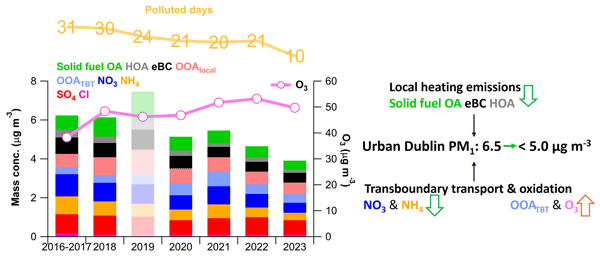
Abstract. Home heating remains a main driver of winter air pollution across many European cities, yet long-term evaluations of pollution trends and mitigation responses remain limited. Here we present continuous measurements of chemically-speciated PM1 (particles with aerodynamic diameter < 1 μm) in Dublin, a temperate European city influenced by local residential heating and continental pollution, from 2016 to 2023 to assess pollution trends under solid fuel reduction efforts. Two typical pollution types were identified: intense short-lasting events (few hours, PM1>100 µg m-3) driven by heating emissions, and moderate long-lasting events (several days, PM1<60 µg m-3) originating from transboundary transport. Their interplay shapes seasonal pollution patterns: PM1 peaks in winter, driven by local emissions, while transboundary transport dominates PM1 in spring. Annual PM1 declined from 6.5 to < 5.0 µg m-3 over the years, mainly due to reductions in nitrate and ammonium (-0.11 and -0.09 µg m-3 yr-1), followed by solid fuel organic aerosols and black carbon (-0.07 and -0.08 µg m-3 yr-1). Although high pollution events were largely dominated by heating emissions, their intensity and frequency clearly declined. In contrast, limited reductions in locally-formed oxygenated organic aerosols (OOAlocal), combined with increased transported OOA (+0.34 µg m-3 yr-1), raised their relative importance alongside rising ozone levels. This highlights the need for integrated strategies addressing PM1 and ozone pollution. While declining nitrate and ammonium indicates regional precursor reductions, a rebound in local pollutants in 2023 highlighted the persistent vulnerability to heating emissions.
Competing interests: At least one of the (co-)authors is a member of the editorial board of Atmospheric Chemistry and Physics. The peer-review process was guided by an independent editor, and the authors also have no other competing interests to declare.
Publisher's note: Copernicus Publications remains neutral with regard to jurisdictional claims made in the text, published maps, institutional affiliations, or any other geographical representation in this paper. While Copernicus Publications makes every effort to include appropriate place names, the final responsibility lies with the authors. Views expressed in the text are those of the authors and do not necessarily reflect the views of the publisher.-
Notice on discussion status
The requested preprint has a corresponding peer-reviewed final revised paper. You are encouraged to refer to the final revised version.
-
Preprint
(2142 KB)
-
Supplement
(2775 KB)
-
The requested preprint has a corresponding peer-reviewed final revised paper. You are encouraged to refer to the final revised version.
- Preprint
(2142 KB) - Metadata XML
-
Supplement
(2775 KB) - BibTeX
- EndNote
- Final revised paper


Journal article(s) based on this preprint
Interactive discussion
Status: closed
- RC1: 'Comment on egusphere-2026-1756', Anonymous Referee #1, 06 Jun 2026
-
RC2: 'Comment on egusphere-2026-1756', Anonymous Referee #2, 18 Jun 2026
General comments
This manuscript presents a long time series of ACSM data (~7 years) in Dublin, and uses this to assess trends in the influence of different aerosol species and the impact of specific sources during this time period. The authors demonstrate that local emissions from domestic heating have been reducing in response to changes in policy, while the influence of transboundary pollution is increasing. These two sources, together, are identified as the most important drivers of high pollution events in the city.
The long time series presented here is a strength of this study; datasets of real-time aerosol composition with this large a span are still relatively uncommon, making this a valuable addition to the literature. The results are important for understanding the drivers of aerosol pollution in European cities. Results are presented clearly and the conclusions are sound. I would recommend that this paper is suitable for publication in ACP, after the comments below have been addressed.
Specific comments
- In lines 150–158, the authors describe using a ratio between eBC and OA to reconstruct the eBC time series where data were unavailable during 2018–2020. This is justified by citing the relatively stable ratio between the two species, with the reconstructed data then being used to analyse eBC trends. However, I would argue that the variation in ratio over the time series (between 0.18 and 0.31) is not negligible, and that this presupposes stability in the aerosol sources over the study period. Given the large amount of data missing, the trend that is identified is likely more a reflection of changes in OA than it is a true observation of a trend in eBC. I would suggest that there is not enough information available here to carry out a genuine trend analysis for eBC.
- In section 3.1, the authors present a case study period to identify typical characteristics of pollution events dominated by transported aerosol, in contrast to those dominated by local heating emissions. How representative were these chosen examples? How many pollution events occurred throughout the full period, and how many of these were associated with each of these sources? Were there any other sources that led to similar events? It would be valuable to look at these case studies in the context of the full dataset. This could also be used to support the authors' decision to focus primarily on these two sources.
- Lines 256–7: How do you know that 15–17% of HOA originates from oil heating?
- Lines 478–80: Please clarify whether this is referring to an increase in oxidative capacity in the region that the aerosol is originally emitted from, or an increase at the measurement site. This increase in local/regional O3 concentrations and oxidative capacity is mentioned several times – is there an understood or hypothesised reason for this increase? Given that this increasing trend in transboundary pollution is an important outcome of this paper, it would be valuable to explore the reasons for and implications of this in more depth.
- Lines 488–9: The SO2 trend is associated with “shifts in fuel usage under influences of the European energy crisis”. A citation is needed here.
- Given the time period that is presented here, I was surprised that there was no mention of the impact of the COVID pandemic on emission patterns. Was any influence observed, and is there a chance that data from 2020 and 2021 may be biased as a result of behaviour change during this period?
Technical comments
- Line 319: ‘annual’ is missing an ‘l’.
- 6: The purpose of the grey markers should be explained in a legend or in the figure caption.
- All figures with trendlines: the significance of the trendline should be visible somewhere on the figure.
Citation: https://doi.org/10.5194/egusphere-2026-1756-RC2 - AC1: 'Comment on egusphere-2026-1756', Lu Lei, 21 Jul 2026
Peer review completion


Interactive discussion
Status: closed
-
RC1: 'Comment on egusphere-2026-1756', Anonymous Referee #1, 06 Jun 2026
This manuscript conducts continuous eight-year (2016–2023) observations of submicron particulate matter (PM1) chemical composition in an urban background environment in Dublin; this dataset is solid and possesses significant scientific value for evaluating the long-term effectiveness of solid fuel emission reduction policies in Europe. The paper introduces a supervised machine learning model to accurately distinguish between the local formation and transboundary transport sources of oxygenated organic aerosol (OOA), which holds significant innovative merit in terms of methodology. However, several profound scientific loopholes remain in the manuscript regarding the representativeness of certain typical case studies, the analytical methods for long-term trends, and the socio-economic attribution arguments for key conclusions. These issues must be carefully revised or supplemented with additional analysis before the manuscript can be considered for publication
- Page 5, Line 150-155 The text mentions that the equivalent black carbon (eBC) data from 2018 to 2020 were missing due to instrument failure, and the missing data were estimated and reconstructed by multiplying the existing organic aerosol (OA) data by a strongly correlated ratio. However, the data presented in Table S1 show only partial annual eBC/OA correlations and ratios. Given that the paper itself has demonstrated significant seasonal differences in aerosol source composition, the rationality of using a single annual average ratio to reconstruct seasonal eBC concentrations needs to be clearly justified. It is recommended that the authors additionally provide seasonal eBC/OA ratios and their coefficients of variation (CV), and re-evaluate the uncertainty that this reconstruction method introduces to the overall trend analysis.
- Page 6-7, Line 199-216 To elucidate the characteristics of two typical pollution events, the authors selected only one case study each from March 2021 for analysis in Section 3.1, indicating a local combustion source and a transport source, respectively. However, it is questionable whether using a brief peak triggered by an occasional cold wave and lasting only a few hours to represent a typical, multi-day winter persistent heating pollution event with high background levels is scientifically rigorous. At the same time, this study spans an eight-year period during which solid fuel regulatory policies in Ireland were intensively tightened. Existing studies have shown significant differences in the carbonaceous components emitted by different solid fuels; therefore, using the chemical composition compounding ratios from a single 2021 case study cannot reflect the statistical characteristics of similar events prior to (2016–2018) and following (2023) the evolution of these policies. The authors should explain the generalizability of this case study, or provide a multi-sample composite analysis or statistical average characteristics across different policy stages.
- Page 8, Figure 2 merges and averages the same-month data for all years from 2016 to 2023, but the paper simultaneously demonstrates a significant long-term downward trend for each component. This means there are systematic differences in the orders of magnitude between the same-month data of earlier years (2016–2018) and later years (2021–2023), and simple averaging produces an artificial result that does not represent any actual year. It is suggested to provide at least a comparison of seasonal curves between two sub-periods (the early and late stages) to evaluate whether the seasonal pattern itself evolves over time.
- Page 11, Line 376-380; Page 15, Line 488; Page 16, Line 510–515The authors attribute the significant decline in extreme peaks of solid fuel OA and eBC in 2021 to "increased public awareness before the official implementation of the solid fuel regulations in October 2022". The authors attribute the rebound of local pollutants (especially wood-burning OA) in 2023 to increased solid fuel use driven by the European energy crisis and the delayed manifestation of policy effectiveness. Similarly, the rebound of SO42– in 2022–2023 is attributed to the "use of low-cost but high-sulfur fuels". These inferences lack direct evidence, and some arguments present potential self-contradictions.
- Page 4, Line 113-129; Page 18, Line 563 Both the abstract and conclusion claim that this study is the "first long-term source apportionment study of PM1pollution in Dublin". However, the text simultaneously cites multiple PM1 source apportionment studies already conducted in Dublin or Ireland (Lin et al., 2018, 2019a, 2019b, 2022, 2023, etc.), some of which also cover a substantial time span. What exactly is the core innovation of this study in terms of study period, methodology, or scientific questions compared to the aforementioned existing works? It is recommended to more explicitly articulate the specific knowledge gaps filled by this study in the introduction, rather than generalizing it loosely as the "first".
- Page 4, Line 145; Page 14,Line 443 "nitrogen dioxides" is misspelled as "nitrogen deoxidizes"; "reduced" is misspelled as "recued". A thorough language check throughout the manuscript is recommended.
Citation: https://doi.org/10.5194/egusphere-2026-1756-RC1 -
RC2: 'Comment on egusphere-2026-1756', Anonymous Referee #2, 18 Jun 2026
General comments
This manuscript presents a long time series of ACSM data (~7 years) in Dublin, and uses this to assess trends in the influence of different aerosol species and the impact of specific sources during this time period. The authors demonstrate that local emissions from domestic heating have been reducing in response to changes in policy, while the influence of transboundary pollution is increasing. These two sources, together, are identified as the most important drivers of high pollution events in the city.
The long time series presented here is a strength of this study; datasets of real-time aerosol composition with this large a span are still relatively uncommon, making this a valuable addition to the literature. The results are important for understanding the drivers of aerosol pollution in European cities. Results are presented clearly and the conclusions are sound. I would recommend that this paper is suitable for publication in ACP, after the comments below have been addressed.
Specific comments
- In lines 150–158, the authors describe using a ratio between eBC and OA to reconstruct the eBC time series where data were unavailable during 2018–2020. This is justified by citing the relatively stable ratio between the two species, with the reconstructed data then being used to analyse eBC trends. However, I would argue that the variation in ratio over the time series (between 0.18 and 0.31) is not negligible, and that this presupposes stability in the aerosol sources over the study period. Given the large amount of data missing, the trend that is identified is likely more a reflection of changes in OA than it is a true observation of a trend in eBC. I would suggest that there is not enough information available here to carry out a genuine trend analysis for eBC.
- In section 3.1, the authors present a case study period to identify typical characteristics of pollution events dominated by transported aerosol, in contrast to those dominated by local heating emissions. How representative were these chosen examples? How many pollution events occurred throughout the full period, and how many of these were associated with each of these sources? Were there any other sources that led to similar events? It would be valuable to look at these case studies in the context of the full dataset. This could also be used to support the authors' decision to focus primarily on these two sources.
- Lines 256–7: How do you know that 15–17% of HOA originates from oil heating?
- Lines 478–80: Please clarify whether this is referring to an increase in oxidative capacity in the region that the aerosol is originally emitted from, or an increase at the measurement site. This increase in local/regional O3 concentrations and oxidative capacity is mentioned several times – is there an understood or hypothesised reason for this increase? Given that this increasing trend in transboundary pollution is an important outcome of this paper, it would be valuable to explore the reasons for and implications of this in more depth.
- Lines 488–9: The SO2 trend is associated with “shifts in fuel usage under influences of the European energy crisis”. A citation is needed here.
- Given the time period that is presented here, I was surprised that there was no mention of the impact of the COVID pandemic on emission patterns. Was any influence observed, and is there a chance that data from 2020 and 2021 may be biased as a result of behaviour change during this period?
Technical comments
- Line 319: ‘annual’ is missing an ‘l’.
- 6: The purpose of the grey markers should be explained in a legend or in the figure caption.
- All figures with trendlines: the significance of the trendline should be visible somewhere on the figure.
Citation: https://doi.org/10.5194/egusphere-2026-1756-RC2 - AC1: 'Comment on egusphere-2026-1756', Lu Lei, 21 Jul 2026
Peer review completion
Journal article(s) based on this preprint
Data sets
Evolving Sources and Composition of Urban Submicron Aerosols in Dublin: Impacts of Emission Reductions and Transboundary Transport L. Lei et al. https://doi.org/10.5281/zenodo.19610048
Viewed
| HTML | XML | Total | Supplement | BibTeX | EndNote | |
|---|---|---|---|---|---|---|
| 356 | 208 | 52 | 616 | 81 | 58 | 65 |
- HTML: 356
- PDF: 208
- XML: 52
- Total: 616
- Supplement: 81
- BibTeX: 58
- EndNote: 65
Viewed (geographical distribution)
| Country | # | Views | % |
|---|
| Total: | 0 |
| HTML: | 0 |
| PDF: | 0 |
| XML: | 0 |
- 1

Chunshui Lin
Kirsten N. Fossum
Darius Ceburnis
John Gallagher
Colin D'Dowd
Jurgita Ovadnevaite
The requested preprint has a corresponding peer-reviewed final revised paper. You are encouraged to refer to the final revised version.
- Preprint
(2142 KB) - Metadata XML
-
Supplement
(2775 KB) - BibTeX
- EndNote
- Final revised paper
This manuscript conducts continuous eight-year (2016–2023) observations of submicron particulate matter (PM1) chemical composition in an urban background environment in Dublin; this dataset is solid and possesses significant scientific value for evaluating the long-term effectiveness of solid fuel emission reduction policies in Europe. The paper introduces a supervised machine learning model to accurately distinguish between the local formation and transboundary transport sources of oxygenated organic aerosol (OOA), which holds significant innovative merit in terms of methodology. However, several profound scientific loopholes remain in the manuscript regarding the representativeness of certain typical case studies, the analytical methods for long-term trends, and the socio-economic attribution arguments for key conclusions. These issues must be carefully revised or supplemented with additional analysis before the manuscript can be considered for publication