
the Creative Commons Attribution 4.0 License.
the Creative Commons Attribution 4.0 License.
 | 12 May 2026
Molecular-Level Characterization of Urban Aerosol Analogues in Controlled Atmospheric Simulations
Abstract. Urban air pollution involves complex mixtures of gases and particulate matter whose molecular-level composition and gas-particle partitioning remain poorly characterized, limiting our understanding of secondary organic aerosol (SOA) formation. We address this gap using controlled atmospheric simulations combined with detailed molecular characterization.
Two distinct urban atmospheric scenarios were simulated in the CESAM smog chamber: a standard urban (traffic emissions and biogenic precursors) and a biomass burning enhanced. Both scenarios were aged under controlled irradiation with NOx to simulate tropospheric photochemistry.
PM1 concentrations reached 15 ± 7 µg.m-3 for the standard scenario and 63 ± 24 µg.m-3 for the biomass burning scenario, with organic aerosol fractions of approximately 17 % and 40 %, respectively. Gas-phase analysis via proton-transfer-reaction time-of-flight mass spectrometry (PTR-TOF-MS) identified 23 volatile organic compounds (VOCs), dominated by oxygenated species (74–77 %). Particle-phase molecular analysis using ultrahigh-performance liquid chromatography electrospray ionization ion mobility quadrupole time-of-flight mass spectrometry (UPLC/ESI-IMS-QTOFMS) revealed 32 distinct compounds. The biomass burning scenario showed elevated source-specific tracers, including a levoglucosan isomer, nitrophenolic compounds (e.g., 3-methyl-4-nitrocatechol, 4-nitroguaiacol), and oxidized aromatics. Volatility distributions estimated via group contribution methods placed most compounds in the semi-volatile, low-volatility, and extremely low-volatility organic compound ranges (C* < 300 µg m-3), indicating substantial functionalization and partitioning.
These results demonstrate the capacity of simulation chambers to generate reproducible urban aerosol analogues with distinct source-specific molecular signatures and well-characterized volatility distributions. This detailed molecular speciation provides a robust basis for process-oriented model evaluation and opens perspectives for systematic investigations of SOA formation pathways under controlled urban photochemical conditions.
-
Notice on discussion status
The requested preprint has a corresponding peer-reviewed final revised paper. You are encouraged to refer to the final revised version.
-
Preprint
(1145 KB)
-
Supplement
(272 KB)
-
The requested preprint has a corresponding peer-reviewed final revised paper. You are encouraged to refer to the final revised version.
- Preprint
(1145 KB) - Metadata XML
-
Supplement
(272 KB) - BibTeX
- EndNote
- Final revised paper


Journal article(s) based on this preprint
Interactive discussion
Status: closed
-
RC1: 'Comment on egusphere-2026-1743', Anonymous Referee #1, 02 Jun 2026
- AC1: 'Reply on RC1', Elie Al Marj, 26 Aug 2026
-
RC2: 'Comment on egusphere-2026-1743', Anonymous Referee #2, 02 Jun 2026
In this manuscript, the authors investigate the molecular-level composition and gas-particle partitioning of secondary organic aerosols. Using the CESAM smog chamber, they simulated standard and biomass burning-enhanced urban scenarios under controlled photochemistry. The study uses PTR-TOF-MS and UPLC/ESI-IMS-QTOFMS to identify gas- and particle-phase compounds, characterizing source-specific tracers and volatility distributions. The topic is interesting; however, several issues need to be addressed.
- The chamber experiments lasted for 7 days. Over such an extended period, the inner walls of the chamber are highly susceptible to organic adsorption saturation, potentially forming a film. Consequently, could the heterogeneous secondary reactions occurring on the wall-adsorbed species interfere with the SOA composition in the later stages of the experiment? It is recommended that the authors provide relevant analyses to explicitly evaluate the impacts of chamber wall loss on the variations in SOA molecular composition throughout the continuous 7-day simulation.
- The experimental system involves biomass burning processes, which typically generate PAHs. Given the potent biotoxicity of PAHs and the analytical compatibility of detection methods, GC is more suitable for the characterization of these compounds. Therefore, the authors are suggested to refine the analytical protocol specifically targeting this class of substances.
- In the chamber, the photooxidation of α-pinene readily generates OOMs. Due to their poor thermal stability and extremely strong adsorptive capacity, traditional filter-membrane extraction methods are prone to causing thermal decomposition and compositional loss of these species. To ensure the accuracy of the analytical results, the authors are suggested to consider utilizing CIMS for real-time, online monitoring.
- While this simulation study utilizes pure chemical precursors, actual biomass burning emissions typically contain trace amounts of transition metals. These metals can trigger Fenton-like reactions to generate ROS, thereby inducing cytotoxic effects. To ensure the coherence and continuity of the subsequent toxicity validation, it is advisable to employ ICP-MS to characterize the elemental composition and supplement the study with corresponding research data.
Citation: https://doi.org/10.5194/egusphere-2026-1743-RC2 - AC2: 'Reply on RC2', Elie Al Marj, 26 Aug 2026
-
RC3: 'Comment on egusphere-2026-1743', Anonymous Referee #3, 09 Jun 2026
Review for manuscript “Molecular-Level Characterization of Urban Aerosol Analogues in
Controlled Atmospheric Simulations” by E. Marj et al.
The manuscript presents an investigation of the molecular-level composition of urban emissions under two different scenarios. By using the CESAM smog chamber, the authors studied the urban and biomass burning scenarios under controlled experiments. Additionally, by using a combination of online and offline instrumentation, the authors study the aerosol and gaseous composition and molecular-level analysis of organics, providing a validation of their findings.
Given the clear relevance of this work to urban air quality and human health, I recommend the paper for publication if the following issues are addressed:
-Lines 45-50: Add supporting references.
- Line 115-120: The oxidation procedure of the experiments is not clear. What do (days and nights) mean? Did you do both photo-aging and dark-aging experiments? If not, I wonder how these results can be representative of real-world conditions. This needs to be mentioned in the limitations section.
- Line 150-155: Specify if the emissions include both gases and particles.
- Line 160: Details such as the OH exposures achieved by the end of aging and the corresponding atmospheric age need to be specified. In addition, I would recommend comparing the OA/SOA mass produced in these measurements to other chamber studies with comparable OH exposure.
- Line 165: Baseline traffic emissions also include primary particulate emissions along with VOCs, which contain a significant fraction of organic aerosols. Shouldn’t this first scenario also include particulate emissions in the chamber? Otherwise, I would not say that this scenario represents typical urban atmospheric composition during moderate pollution episodes.
-Line 167: Were there any changes in RH between these two scenarios? As mentioned by the authors, usual residential wood combustion occurs during colder months (line 75). This favors the gas-particle partitioning of the VOCs. How representative is this scenario of the real world regarding rh?
- Line 230: The effect of vapor and particle wall losses on the measured particle concentration and SOA composition needs to be addressed.
- Line 240-245: Can authors specify how much organics are primarily emitted and how much is secondarily formed for the biomass burning scenario? Have you tried PMF analysis for organic data from ACSM?
- Line 315: I find it hard to understand how continuous exposure of 7 days of photochemical aging in a chamber is representative of the real-world environment, where we have daytime oxidation followed by nighttime, and there is a boundary layer inversion during nighttime, etc. This needs to be clarified in the limitations section.
-Line 352: Have you observed any nucleation events in SMPS data? If not, this sentence is irrelevant? Please justify.
Conclusions section: This section should focus more on the key scientific results from this study and relate them to air quality and toxicology, rather than saying why atmospheric simulation chambers are complementary to field studies. It is a well-established method.
Citation: https://doi.org/10.5194/egusphere-2026-1743-RC3 - AC3: 'Reply on RC3', Elie Al Marj, 26 Aug 2026
Peer review completion


Interactive discussion
Status: closed
-
RC1: 'Comment on egusphere-2026-1743', Anonymous Referee #1, 02 Jun 2026
In this manuscript, the authors simulated two urban atmospheric scenarios, namely a standard urban pollution scenario and a biomass-burning-enhanced scenario, using the CESAM smog chamber and the PolluRisk exposure platform. They showed that PM1 and organic aerosol concentrations increased markedly under the biomass-burning-enhanced scenario, with characteristic molecular markers detected, including a levoglucosan isomer, nitrophenolic compounds, and oxidized aromatic products. However, this manuscript has major flaws and is not suitable for publication in ACP.
The conclusion “atmospheric simulation chambers as complementary tools to field studies for urban air quality assessment” has long been recognized by the atmospheric chemistry community, so I did not find any real novelty in this work.
The second paragraph of the Introduction is very brief and states in a single sentence that the molecular composition of PM1 particles may play a role in toxicological responses. In addition, this paragraph should be expanded to more clearly explain why molecular-level characterization of PM1 is important for understanding aerosol toxicity and health effects. More importantly, the authors did not report any toxicity or health effects, so the paper did not answer this scientific question.
The authors argue that the focus of this work was the molecular-level chemical composition. However, the chemical analysis results were too simplified to show insights into any new findings. Specifically, the author primarily reported qualitative results in the component analysis, with very few quantitative or semi-quantitative discussions.
Have the potential effects of wall loss and photolysis of reaction products in the chamber been considered? These processes may influence the measured concentrations and chemical composition of the oxidation products, and should be discussed.
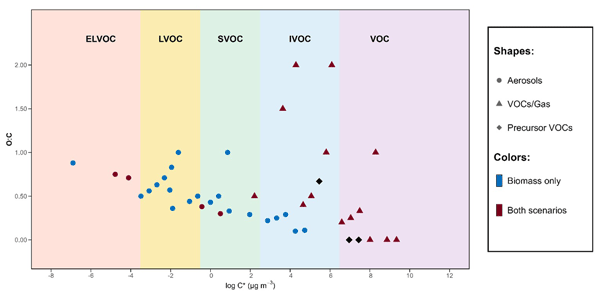
The authors state that compounds in the SVOC-LVOC-ELVOC ranges were predominant based on Fig. 5. However, Fig. 5 does not show the relative signal intensities or abundances of individual compounds. Therefore, concluding predominance solely based on the number of detected compounds may be biased.Citation: https://doi.org/10.5194/egusphere-2026-1743-RC1 - AC1: 'Reply on RC1', Elie Al Marj, 26 Aug 2026
-
RC2: 'Comment on egusphere-2026-1743', Anonymous Referee #2, 02 Jun 2026
In this manuscript, the authors investigate the molecular-level composition and gas-particle partitioning of secondary organic aerosols. Using the CESAM smog chamber, they simulated standard and biomass burning-enhanced urban scenarios under controlled photochemistry. The study uses PTR-TOF-MS and UPLC/ESI-IMS-QTOFMS to identify gas- and particle-phase compounds, characterizing source-specific tracers and volatility distributions. The topic is interesting; however, several issues need to be addressed.
- The chamber experiments lasted for 7 days. Over such an extended period, the inner walls of the chamber are highly susceptible to organic adsorption saturation, potentially forming a film. Consequently, could the heterogeneous secondary reactions occurring on the wall-adsorbed species interfere with the SOA composition in the later stages of the experiment? It is recommended that the authors provide relevant analyses to explicitly evaluate the impacts of chamber wall loss on the variations in SOA molecular composition throughout the continuous 7-day simulation.
- The experimental system involves biomass burning processes, which typically generate PAHs. Given the potent biotoxicity of PAHs and the analytical compatibility of detection methods, GC is more suitable for the characterization of these compounds. Therefore, the authors are suggested to refine the analytical protocol specifically targeting this class of substances.
- In the chamber, the photooxidation of α-pinene readily generates OOMs. Due to their poor thermal stability and extremely strong adsorptive capacity, traditional filter-membrane extraction methods are prone to causing thermal decomposition and compositional loss of these species. To ensure the accuracy of the analytical results, the authors are suggested to consider utilizing CIMS for real-time, online monitoring.
- While this simulation study utilizes pure chemical precursors, actual biomass burning emissions typically contain trace amounts of transition metals. These metals can trigger Fenton-like reactions to generate ROS, thereby inducing cytotoxic effects. To ensure the coherence and continuity of the subsequent toxicity validation, it is advisable to employ ICP-MS to characterize the elemental composition and supplement the study with corresponding research data.
Citation: https://doi.org/10.5194/egusphere-2026-1743-RC2 - AC2: 'Reply on RC2', Elie Al Marj, 26 Aug 2026
-
RC3: 'Comment on egusphere-2026-1743', Anonymous Referee #3, 09 Jun 2026
Review for manuscript “Molecular-Level Characterization of Urban Aerosol Analogues in
Controlled Atmospheric Simulations” by E. Marj et al.
The manuscript presents an investigation of the molecular-level composition of urban emissions under two different scenarios. By using the CESAM smog chamber, the authors studied the urban and biomass burning scenarios under controlled experiments. Additionally, by using a combination of online and offline instrumentation, the authors study the aerosol and gaseous composition and molecular-level analysis of organics, providing a validation of their findings.
Given the clear relevance of this work to urban air quality and human health, I recommend the paper for publication if the following issues are addressed:
-Lines 45-50: Add supporting references.
- Line 115-120: The oxidation procedure of the experiments is not clear. What do (days and nights) mean? Did you do both photo-aging and dark-aging experiments? If not, I wonder how these results can be representative of real-world conditions. This needs to be mentioned in the limitations section.
- Line 150-155: Specify if the emissions include both gases and particles.
- Line 160: Details such as the OH exposures achieved by the end of aging and the corresponding atmospheric age need to be specified. In addition, I would recommend comparing the OA/SOA mass produced in these measurements to other chamber studies with comparable OH exposure.
- Line 165: Baseline traffic emissions also include primary particulate emissions along with VOCs, which contain a significant fraction of organic aerosols. Shouldn’t this first scenario also include particulate emissions in the chamber? Otherwise, I would not say that this scenario represents typical urban atmospheric composition during moderate pollution episodes.
-Line 167: Were there any changes in RH between these two scenarios? As mentioned by the authors, usual residential wood combustion occurs during colder months (line 75). This favors the gas-particle partitioning of the VOCs. How representative is this scenario of the real world regarding rh?
- Line 230: The effect of vapor and particle wall losses on the measured particle concentration and SOA composition needs to be addressed.
- Line 240-245: Can authors specify how much organics are primarily emitted and how much is secondarily formed for the biomass burning scenario? Have you tried PMF analysis for organic data from ACSM?
- Line 315: I find it hard to understand how continuous exposure of 7 days of photochemical aging in a chamber is representative of the real-world environment, where we have daytime oxidation followed by nighttime, and there is a boundary layer inversion during nighttime, etc. This needs to be clarified in the limitations section.
-Line 352: Have you observed any nucleation events in SMPS data? If not, this sentence is irrelevant? Please justify.
Conclusions section: This section should focus more on the key scientific results from this study and relate them to air quality and toxicology, rather than saying why atmospheric simulation chambers are complementary to field studies. It is a well-established method.
Citation: https://doi.org/10.5194/egusphere-2026-1743-RC3 - AC3: 'Reply on RC3', Elie Al Marj, 26 Aug 2026
Peer review completion
Journal article(s) based on this preprint
Data sets
Mass spectrometry data for molecular-level characterization of urban aerosol analogues in controlled atmospheric simulations. E. Al Marj et al. https://doi.org/10.5281/zenodo.19546628
Viewed
| HTML | XML | Total | Supplement | BibTeX | EndNote | |
|---|---|---|---|---|---|---|
| 485 | 121 | 59 | 665 | 69 | 48 | 50 |
- HTML: 485
- PDF: 121
- XML: 59
- Total: 665
- Supplement: 69
- BibTeX: 48
- EndNote: 50
Viewed (geographical distribution)
| Country | # | Views | % |
|---|
| Total: | 0 |
| HTML: | 0 |
| PDF: | 0 |
| XML: | 0 |
- 1
Elie Al Marj
Ambre Delater
Aline Gratien
Marie Line Torrijos
Juan Camilo Macias Rodriguez
Mathieu Cazaunau
Edouard Pangui
Antonin Bergé
Cécile Gaimoz
Thomas Bertin
Emmanuelle Mebold
Bénédicte Picquet-Varrault
Jean-François Doussin
Clément Buissot
Sophie Lanone
Patrice Coll

The requested preprint has a corresponding peer-reviewed final revised paper. You are encouraged to refer to the final revised version.
- Preprint
(1145 KB) - Metadata XML
-
Supplement
(272 KB) - BibTeX
- EndNote
- Final revised paper
In this manuscript, the authors simulated two urban atmospheric scenarios, namely a standard urban pollution scenario and a biomass-burning-enhanced scenario, using the CESAM smog chamber and the PolluRisk exposure platform. They showed that PM1 and organic aerosol concentrations increased markedly under the biomass-burning-enhanced scenario, with characteristic molecular markers detected, including a levoglucosan isomer, nitrophenolic compounds, and oxidized aromatic products. However, this manuscript has major flaws and is not suitable for publication in ACP.
The conclusion “atmospheric simulation chambers as complementary tools to field studies for urban air quality assessment” has long been recognized by the atmospheric chemistry community, so I did not find any real novelty in this work.
The second paragraph of the Introduction is very brief and states in a single sentence that the molecular composition of PM1 particles may play a role in toxicological responses. In addition, this paragraph should be expanded to more clearly explain why molecular-level characterization of PM1 is important for understanding aerosol toxicity and health effects. More importantly, the authors did not report any toxicity or health effects, so the paper did not answer this scientific question.
The authors argue that the focus of this work was the molecular-level chemical composition. However, the chemical analysis results were too simplified to show insights into any new findings. Specifically, the author primarily reported qualitative results in the component analysis, with very few quantitative or semi-quantitative discussions.
Have the potential effects of wall loss and photolysis of reaction products in the chamber been considered? These processes may influence the measured concentrations and chemical composition of the oxidation products, and should be discussed.
The authors state that compounds in the SVOC-LVOC-ELVOC ranges were predominant based on Fig. 5. However, Fig. 5 does not show the relative signal intensities or abundances of individual compounds. Therefore, concluding predominance solely based on the number of detected compounds may be biased.