
the Creative Commons Attribution 4.0 License.
the Creative Commons Attribution 4.0 License.
 | 11 May 2026
Inefficient Consumption of Natural Gas Drives Methane Emissions from a Megacity
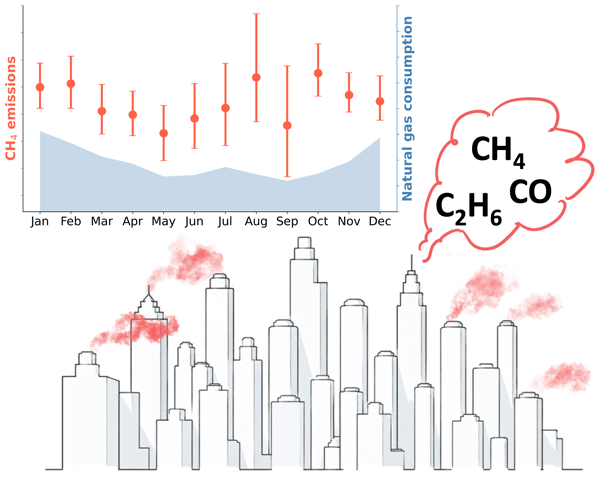
Abstract. Reducing methane emissions offers a significant near-term opportunity for climate mitigation if the dominant sources are effectively targeted. Natural gas is a large and manageable methane source. Despite extensive pipeline upgrades in cities, methane reductions remain far smaller than expected, suggesting missing emission pathways. Using long-term tower observations in a U.S. megacity, we found a strong seasonal cycle in methane emissions peaking during the winter heating and summer cooling seasons. Natural gas methane emissions dominated both seasons and were strongly correlated with consumption, yielding a loss rate of 1.7±0.6 %, equivalent to about $300 M USD/yr of unused natural gas. Incomplete combustion was the primary natural gas signal observed, indicating future mitigation planning should prioritize inefficient natural gas consumption.
-
Notice on discussion status
The requested preprint has a corresponding peer-reviewed final revised paper. You are encouraged to refer to the final revised version.
-
Preprint
(3830 KB)
-
Supplement
(14028 KB)
-
The requested preprint has a corresponding peer-reviewed final revised paper. You are encouraged to refer to the final revised version.
- Preprint
(3830 KB) - Metadata XML
-
Supplement
(14028 KB) - BibTeX
- EndNote
- Final revised paper


Journal article(s) based on this preprint
Interactive discussion
Status: closed
-
RC1: 'Comment on egusphere-2026-1742', Anonymous Referee #1, 27 May 2026
- AC1: 'Reply on RC1', Yuwei Zhao, 07 Jul 2026
-
RC2: 'Comment on egusphere-2026-1742', Anonymous Referee #2, 27 May 2026
The authors used ~2 years of tower-based measurements (1 urban site, 3 rural) of CO2 and CH4 mole fraction in the NYCMA, plus tower measurements from a targeted campaign measuring CH4, C2H6, CO, and other constituents. They used measurements to develop scaling factors (SF) for enhancements simulated using a footprint model and inventory estimates for each month, then multiplied the inventory estimate by the scaling factor to produce an observation-informed emissions estimate. They also used ΔC2H6:ΔCH4 and ΔCO:ΔCH4 ratios to characterize CH4 sources in the NYCMA. They identified a seasonal trend in CH4 emissions, that thermogenic sources dominate year-round, and that incomplete combustion of natural gas is a major source of CH4 emissions.
This manuscript describes a thorough analysis of a unique dataset that, in my opinion, makes a valuable contribution to the field. It provides useful insight on urban CH4 sources through characterization of CH4 sources in the largest city in the U.S. I recommend this manuscript for publication following some revisions described below.
Major comments:
- In the methods, the authors explain that they used three inventories to compute simulated enhancements. Then, they compute the SFs for an inventory and use that to compute an observation-informed emissions estimate. But it is unclear if just one inventory’s simulated enhancements were used for the SFs and emissions estimates, and if so, which one, or whether all three were used and somehow incorporated into the uncertainty. I suggest the authors clarify this important detail.
- The overall language about incomplete combustion being a major source is not very quantitative (i.e., what fraction of emissions are associated with incomplete combustion), but incomplete combustion being the driver of emissions is presented as the major finding of this study. I am referring particularly at the paragraph at lines 328-343, but this is also a major theme of the paper. I certainly agree that your results suggest that incomplete combustion is an important source (and that itself is a significant finding worthy of publication). I would say a dominant source is >50%. It would help if the authors would be more quantitative about this – for example, what fraction of thermogenic methane plumes have an R2ΔCO: ΔCH4 above a threshold that definitively points to incomplete combustion? If the authors don’t have that kind of metric yet (I believe using ΔCO: ΔCH4 ratios for this purpose is a relatively new practice), I suggest being more careful about the wording.
- In particular, lines 336-337: R2 < 0.1 for ΔCO: ΔCH4 seems low to illustrate the point being made in this sentence. Even in the biogenic example in Fig. 3, the ΔCO: ΔCH4 R2 is 0.22. I understand maybe there is a range above 0.1 that is more ambiguous on whether there’s a combustion signature or not, but this comparison implies everything above 0.1 has a combustion signature. Maybe focusing on R2 values above a more definitive threshold would be less ambiguous.
- It is unclear how the data from the Aug 16 mobile measurement campaign contribute to the study. I suggest leaving this out of the paper.
- I strongly suggest the authors add some discussion and a figure describing the footprint of their estimates (footprint size and location, what lies in the footprint, etc.). This would be useful generally, but especially helpful to understand the comparison to Schiferl et al. in lines 302-312.
- Section 2.4, Figure 1: Could the authors elaborate on why they chose this bootstrapping method to determine the background? It seems like, with multiple background sites, it would be appropriate to use a transport model to determine which background site to use. On a similar note, what is the predominant wind direction? It seems like W/SW winds may not be represented by these background sites. Of course, it’s not realistic to have a background site in every direction, but I suggest the authors add some discussion about this to the manuscript.
- Lines 243-247: Why compare the monthly mean diel cycle? Based on the text, it seems like the authors are using this to evaluate and compare the inventories. However, it seems like comparing afternoon hours only would be more appropriate given the higher model uncertainty at other times of day. (Minor note: this paragraph is also missing the reference to the figure number)
Minor comments:
- Title: did the authors mean to say inefficient "combustion" instead of "consumption"?
- Lines 24-25: It does not seem accurate to refer to a city as an individual source. I suggest rewording or removing this part of the sentence.
- Line 89: Please specify the frequency when you say “high-frequency” – although it is specified elsewhere in the paper, I suggest this to avoid confusion as this section is the primary description of that dataset and some readers may not consider 1Hz to be high-frequency.
- Lines 94-96: I am unsure what the authors mean by “discrete” 15- and 5-minute windows. Are the measurements not continuous? If not, how frequent are these discrete sampling periods?
- Line 167: This table is missing.
- Lines 210-211: Are the authors referring to the results of this study? If so, this sentence should be in the results, not the methods.
- Line 230: Do the authors mean “variables” or “parameters” instead of “configurations”?
- Line 238: I suggest replacing “indicating” with “suggesting”.
- Line 259: I suggest rewording “Emission Flux” to avoid redundancy.
- Line 296: The authors state there is a “distinct” seasonal variation, but the months seem generally within each other’s uncertainty bars.
- Lines 315-317: The authors use the slope/correlation method with ΔC2H6:ΔCH4 to determine whether there is a thermogenic contribution, but I got lost on how this turns into a percent thermogenic contribution. Is that just the fraction of the data points that have a thermogenic contribution? Please clarify.
- Line 330: I suggest specifying the “larger fraction.” The figures are informative, but it’s hard to tell what fraction quantitatively because all the crosses and dots are on top of one another.
- Figure 5: Why do the colors change between the top two and bottom three pie charts, and why is there a gap between them? If no reason, I suggest removing the gap and keeping the color scheme consistent.
Citation: https://doi.org/10.5194/egusphere-2026-1742-RC2 - AC2: 'Reply on RC2', Yuwei Zhao, 07 Jul 2026
Peer review completion


Interactive discussion
Status: closed
-
RC1: 'Comment on egusphere-2026-1742', Anonymous Referee #1, 27 May 2026
In “Inefficient Consumption of Natural Gas Drives Methane Emissions from a Megacity,” Zhao et al. utilize multiple measurement platforms to investigate the sources of methane emissions in the New York City Metropolitan Area. The observations presented in this work represent a dense dataset from which much can be learned about the largest metropolitan area in the United States. Understanding the sources of methane emissions in cities is key to successful mitigation strategies. Accordingly, I find the study timely and of interest to a broad audience.
The study is very thoroughly presented with clear figures and method descriptions. However, I believe there are some areas that should be addressed prior to publication.
- Section 2.6. This section lacks citations for the transport models and their application in this work. Another option could be to reference the later section, 2.6.3.
- Line 302: The term “suburban outflow” is first introduced here, but it wasn’t clear to me what this means. It appears to reference the difference between this work and that of Schiferl et al. 2025, but it wasn’t clear how they are different. I assume it has to do with the footprint of the Mineola Tower versus that of what is used in Schiferl at al.
- There is clearly significant added value from concurrent measurements of CH4, CO, and C2H6. However, is it fair to attribute all the variability in observed CH4:CO and CH4:C2H6 to source behavior? If I understand correctly, “plumes” in this work correspond to relatively short time periods (as suggested by Figure 5b) and each undergo the slope analysis. If that is the case, is it possible they have experienced different levels of atmospheric mixing, such that, depending on the sources, that could influence the derived CH4:CO and C2H6:CH4 slopes? So, is it fair to completely attribute all the observed variability to combustion efficiency in the statement below:
Line 332: “Thermogenic plumes with moderate R2 ∆CO:∆CH4 (between 0.1 and 0.8) are observed more frequently during months with building heating loads (Figure S12), suggesting greater variability in combustion efficiency, likely driven by various natural gas combustion processes for heating purposes.”
- In supplemental section 3, the authors examine street-level data of two pipeline leaks, with high correlation between CH4 and C2H6, but not CO. Were there other instances of strong correlations between CH4, C2H6, and CO in the street-level data? This would indicate incomplete combustion of natural gas and support the attribution conclusions since the transport time would be relatively short. In the current manuscript, it wasn’t clear to me how the street-level observations were incorporated into the larger study.
- Line 336: “In contrast, only 7% (summer) and 6% (winter) of the identified thermogenic plumes were observed to have no combustion signature (R2 ∆CO:∆CH4 < 0.1), showing that natural gas emissions from pipeline leaks were less frequently observed at the Mineola tower compared to combustion-related natural gas sources.” What was the reasoning for using 0.1 as the cutoff here? For lower correlations between CO and CH4, one might expect noise/uncertainty to have a larger effect on the calculated R2 value. Would the conclusions change if you used a larger threshold for these conclusions?
Citation: https://doi.org/10.5194/egusphere-2026-1742-RC1 - AC1: 'Reply on RC1', Yuwei Zhao, 07 Jul 2026
-
RC2: 'Comment on egusphere-2026-1742', Anonymous Referee #2, 27 May 2026
The authors used ~2 years of tower-based measurements (1 urban site, 3 rural) of CO2 and CH4 mole fraction in the NYCMA, plus tower measurements from a targeted campaign measuring CH4, C2H6, CO, and other constituents. They used measurements to develop scaling factors (SF) for enhancements simulated using a footprint model and inventory estimates for each month, then multiplied the inventory estimate by the scaling factor to produce an observation-informed emissions estimate. They also used ΔC2H6:ΔCH4 and ΔCO:ΔCH4 ratios to characterize CH4 sources in the NYCMA. They identified a seasonal trend in CH4 emissions, that thermogenic sources dominate year-round, and that incomplete combustion of natural gas is a major source of CH4 emissions.
This manuscript describes a thorough analysis of a unique dataset that, in my opinion, makes a valuable contribution to the field. It provides useful insight on urban CH4 sources through characterization of CH4 sources in the largest city in the U.S. I recommend this manuscript for publication following some revisions described below.
Major comments:
- In the methods, the authors explain that they used three inventories to compute simulated enhancements. Then, they compute the SFs for an inventory and use that to compute an observation-informed emissions estimate. But it is unclear if just one inventory’s simulated enhancements were used for the SFs and emissions estimates, and if so, which one, or whether all three were used and somehow incorporated into the uncertainty. I suggest the authors clarify this important detail.
- The overall language about incomplete combustion being a major source is not very quantitative (i.e., what fraction of emissions are associated with incomplete combustion), but incomplete combustion being the driver of emissions is presented as the major finding of this study. I am referring particularly at the paragraph at lines 328-343, but this is also a major theme of the paper. I certainly agree that your results suggest that incomplete combustion is an important source (and that itself is a significant finding worthy of publication). I would say a dominant source is >50%. It would help if the authors would be more quantitative about this – for example, what fraction of thermogenic methane plumes have an R2ΔCO: ΔCH4 above a threshold that definitively points to incomplete combustion? If the authors don’t have that kind of metric yet (I believe using ΔCO: ΔCH4 ratios for this purpose is a relatively new practice), I suggest being more careful about the wording.
- In particular, lines 336-337: R2 < 0.1 for ΔCO: ΔCH4 seems low to illustrate the point being made in this sentence. Even in the biogenic example in Fig. 3, the ΔCO: ΔCH4 R2 is 0.22. I understand maybe there is a range above 0.1 that is more ambiguous on whether there’s a combustion signature or not, but this comparison implies everything above 0.1 has a combustion signature. Maybe focusing on R2 values above a more definitive threshold would be less ambiguous.
- It is unclear how the data from the Aug 16 mobile measurement campaign contribute to the study. I suggest leaving this out of the paper.
- I strongly suggest the authors add some discussion and a figure describing the footprint of their estimates (footprint size and location, what lies in the footprint, etc.). This would be useful generally, but especially helpful to understand the comparison to Schiferl et al. in lines 302-312.
- Section 2.4, Figure 1: Could the authors elaborate on why they chose this bootstrapping method to determine the background? It seems like, with multiple background sites, it would be appropriate to use a transport model to determine which background site to use. On a similar note, what is the predominant wind direction? It seems like W/SW winds may not be represented by these background sites. Of course, it’s not realistic to have a background site in every direction, but I suggest the authors add some discussion about this to the manuscript.
- Lines 243-247: Why compare the monthly mean diel cycle? Based on the text, it seems like the authors are using this to evaluate and compare the inventories. However, it seems like comparing afternoon hours only would be more appropriate given the higher model uncertainty at other times of day. (Minor note: this paragraph is also missing the reference to the figure number)
Minor comments:
- Title: did the authors mean to say inefficient "combustion" instead of "consumption"?
- Lines 24-25: It does not seem accurate to refer to a city as an individual source. I suggest rewording or removing this part of the sentence.
- Line 89: Please specify the frequency when you say “high-frequency” – although it is specified elsewhere in the paper, I suggest this to avoid confusion as this section is the primary description of that dataset and some readers may not consider 1Hz to be high-frequency.
- Lines 94-96: I am unsure what the authors mean by “discrete” 15- and 5-minute windows. Are the measurements not continuous? If not, how frequent are these discrete sampling periods?
- Line 167: This table is missing.
- Lines 210-211: Are the authors referring to the results of this study? If so, this sentence should be in the results, not the methods.
- Line 230: Do the authors mean “variables” or “parameters” instead of “configurations”?
- Line 238: I suggest replacing “indicating” with “suggesting”.
- Line 259: I suggest rewording “Emission Flux” to avoid redundancy.
- Line 296: The authors state there is a “distinct” seasonal variation, but the months seem generally within each other’s uncertainty bars.
- Lines 315-317: The authors use the slope/correlation method with ΔC2H6:ΔCH4 to determine whether there is a thermogenic contribution, but I got lost on how this turns into a percent thermogenic contribution. Is that just the fraction of the data points that have a thermogenic contribution? Please clarify.
- Line 330: I suggest specifying the “larger fraction.” The figures are informative, but it’s hard to tell what fraction quantitatively because all the crosses and dots are on top of one another.
- Figure 5: Why do the colors change between the top two and bottom three pie charts, and why is there a gap between them? If no reason, I suggest removing the gap and keeping the color scheme consistent.
Citation: https://doi.org/10.5194/egusphere-2026-1742-RC2 - AC2: 'Reply on RC2', Yuwei Zhao, 07 Jul 2026
Peer review completion
Journal article(s) based on this preprint
Viewed
| HTML | XML | Total | Supplement | BibTeX | EndNote | |
|---|---|---|---|---|---|---|
| 503 | 209 | 71 | 783 | 165 | 61 | 63 |
- HTML: 503
- PDF: 209
- XML: 71
- Total: 783
- Supplement: 165
- BibTeX: 61
- EndNote: 63
Viewed (geographical distribution)
| Country | # | Views | % |
|---|
| Total: | 0 |
| HTML: | 0 |
| PDF: | 0 |
| XML: | 0 |
- 1

Andrew Hallward-Driemeier
Luke Schiferl
Trey Maddaleno
Michael Vermeuel
Dylan Millet
Delphine Farmer
Roisin Commane
The requested preprint has a corresponding peer-reviewed final revised paper. You are encouraged to refer to the final revised version.
- Preprint
(3830 KB) - Metadata XML
-
Supplement
(14028 KB) - BibTeX
- EndNote
- Final revised paper
In “Inefficient Consumption of Natural Gas Drives Methane Emissions from a Megacity,” Zhao et al. utilize multiple measurement platforms to investigate the sources of methane emissions in the New York City Metropolitan Area. The observations presented in this work represent a dense dataset from which much can be learned about the largest metropolitan area in the United States. Understanding the sources of methane emissions in cities is key to successful mitigation strategies. Accordingly, I find the study timely and of interest to a broad audience.
The study is very thoroughly presented with clear figures and method descriptions. However, I believe there are some areas that should be addressed prior to publication.
Line 332: “Thermogenic plumes with moderate R2 ∆CO:∆CH4 (between 0.1 and 0.8) are observed more frequently during months with building heating loads (Figure S12), suggesting greater variability in combustion efficiency, likely driven by various natural gas combustion processes for heating purposes.”