
the Creative Commons Attribution 4.0 License.
the Creative Commons Attribution 4.0 License.
 | 23 Feb 2026
An Improved Method for Raindrop Size Distribution Retrieval Using Combined Dual-frequency Radar DFR
Abstract. Accurate retrieval of raindrop size distributions (DSDs) is essential for understanding cloud and precipitation microphysics. The dual-frequency ratio (DFR) measured by dual-frequency radars is independent of the normalized intercept parameter (Nw) and depends solely on the mass-weighted mean diameter (Dm). This characteristic makes DFR a powerful parameter for DSD retrieval. However, the DFR-Dm relationship is subject to a dual-solution ambiguity, particularly for smaller particles. In this study, W-band reflectivity is synthetically incorporated through scattering simulations based on measured DSDs, and retrieval relationships are established among X/Ka-band DFR, Ka/W-band DFR, and Dm. The results show that the ambiguity in the DFR-Dm relationship is substantially reduced, and the proposed method demonstrates clear advantages over conventional approaches, especially when retrieving DSDs of weak echoes. This advancement effectively addresses a key gap in the measurement and analysis of light precipitation processes.
-
Notice on discussion status
The requested preprint has a corresponding peer-reviewed final revised paper. You are encouraged to refer to the final revised version.
-
Preprint
(10418 KB)
-
The requested preprint has a corresponding peer-reviewed final revised paper. You are encouraged to refer to the final revised version.
- Preprint
(10418 KB) - Metadata XML
- BibTeX
- EndNote
- Final revised paper


Journal article(s) based on this preprint
Interactive discussion
Status: closed
-
RC1: 'Comment on egusphere-2026-174', Anonymous Referee #1, 27 Apr 2026
-
AC4: 'Reply on RC1', Liang Feng, 23 Jun 2026
The comment was uploaded in the form of a supplement: https://egusphere.copernicus.org/preprints/2026/egusphere-2026-174/egusphere-2026-174-AC4-supplement.pdf
-
AC4: 'Reply on RC1', Liang Feng, 23 Jun 2026
-
CC1: 'Comment on egusphere-2026-174', Yichen Chen, 11 May 2026
This manuscript addresses a key challenge in dual-frequency radar retrievals of raindrop size distributions (DSD) — the dual-solution ambiguity in the DFR-Dm relationship. The authors propose a novel solution by incorporating Ka/W-band DFR as an additional constraint, combined with T-matrix scattering simulations. The research is well-structured, the experimental design is sound, and the validation using ground-based disdrometer data is rigorous. The proposed method demonstrates clear improvements, particularly for weak echo regions. Overall, The manuscript is well suited for Atmospheric Measurement Techniques and will be valuable to the community. Accordingly, I recommend this manuscript for publication; however, you may consider the minor comments as follows:
- The manuscript's central assumption is the availability of W-band (93.75 GHz) data. However, W-band radar suffers from extreme attenuation in rainfall, potentially losing signal within hundreds of meters during moderate to heavy rain. It appears from Section 3.6 that Z_W was simulated using T-matrix calculations based on measured DSDs, rather than being directly observed. If true, this manuscript presents a proof-of-concept simulation study rather than a retrieval algorithm ready for operational radar data. The authors must clarify this point explicitly in the abstract, introduction, and conclusions. A more accurate framing would be "simulation-based retrieval framework" rather than simply "retrieval method."
- When DFR(X,Ka) ≤ 0, the algorithm switches to DFR(Ka,W). However, Table 6 shows that 12.5% of data points still fall within the ambiguous zone of DFR(Ka,W) (i.e., DFR(Ka,W) ≤ 0). The authors do not specify how these remaining ambiguous cases are handled. Are they discarded? Assigned a default Dm value? Or constrained by another relationship (e.g., Z_Ka-LWC)? The authors should provide a complete decision tree or flow chart (as an enhancement to Figure 1) that explicitly states the retrieval strategy for all possible combinations of DFR(X,Ka) and DFR(Ka,W). Additionally, the retrieval performance for these "doubly ambiguous" cases should be highlighted in Figure 17.
- In Section 3.1 (Instruments), the authors provide detailed specifications for the X/Ka-band radar and the 2DVD disdrometer. However, there is no mention of any W-band radar or the source of W-band reflectivity data. This is a critical omission for understanding the experimental setup. Please add a clear statement at the end of Section 3.1 or at the beginning of Section 3.3: "W-band reflectivities used in this study are simulated using the T-matrix method based on measured DSDs."
- Figure 6 shows dense scatterplots for Z_X-DFR(X,Ka) and Z_Ka-DFR(Ka,W). The 6th-order polynomial fitting curves are barely visible despite being provided in equation form. Please increase the line width or color contrast of the fitting curves. Also, add a note in the caption stating "The black curve represents the 6th-order polynomial fit."
- Several sentences could be clarified for better readability. For example, on Page 12, the sentence "...the corrected reflectivities were validated against those derived from ground-based raindrop size distributions measurements" — the word "those" is ambiguous. It should read "...validated against the theoretical reflectivity values derived from ground-based DSD measurements." Similarly, on Page 17, "This characteristic underpins the interpretation..." would be more accurate as "This characteristic guides the choice of retrieval algorithms..."
- In Table 1, the unit for Antenna Gain is listed as "dB". While this is common, the formal unit should be "dBi" (decibels relative to isotropic). Please consider this correction.
Citation: https://doi.org/10.5194/egusphere-2026-174-CC1 -
AC3: 'Reply on CC1', Liang Feng, 23 Jun 2026
The comment was uploaded in the form of a supplement: https://egusphere.copernicus.org/preprints/2026/egusphere-2026-174/egusphere-2026-174-AC3-supplement.pdf
-
CC2: 'Comment on egusphere-2026-174', Li Luo, 15 May 2026
This manuscript addresses the DFR-Dm dual-solution ambiguity in dual-frequency radar DSD retrievals by incorporating Ka/W-band DFR as an additional constraint. The method is well-designed and shows clear improvements, particularly for weak echoes. The following three key issues should be addressed prior to publication.
1. Clarify that W-band data are simulated, not observed
The manuscript's central innovation relies on Ka/W-band DFR, but it appears from Section 3.6 that W-band reflectivities are simulated using T-matrix calculations based on measured DSDs, rather than directly observed. Given that W-band radar suffers from extreme attenuation in rainfall, this distinction is critical. The authors must explicitly state in the abstract, introduction, and Section 3.1 that this is a simulation-based retrieval framework, and add a clear statement: "W-band reflectivities used in this study are simulated using the T-matrix method based on measured DSDs."
2. Specify handling of remaining ambiguous cases (DFR(Ka,W) ≤ 0)
Table 6 shows that 12.5% of data points still fall within the ambiguous zone of DFR(Ka,W) (i.e., DFR(Ka,W) ≤ 0). The authors do not specify how these "doubly ambiguous" cases are handled (discarded? default value? constrained by Z_Ka-LWC?). Please provide a complete decision tree or flow chart (as an enhancement to Figure 1) and evaluate the retrieval performance for these cases.
3. Quantitative assessment of the inversion errors caused by temperature variations
Provide quantitative error analysis (e.g., Dm bias) for 0°C, 10°C, and 30°C, not just state that errors are small.
Citation: https://doi.org/10.5194/egusphere-2026-174-CC2 -
AC2: 'Reply on CC2', Liang Feng, 23 Jun 2026
The comment was uploaded in the form of a supplement: https://egusphere.copernicus.org/preprints/2026/egusphere-2026-174/egusphere-2026-174-AC2-supplement.pdf
-
AC2: 'Reply on CC2', Liang Feng, 23 Jun 2026
-
CC3: 'Comment on egusphere-2026-174', Tiantian Yu, 20 May 2026
This manuscript proposes an improved method for raindrop size distribution retrieval by combining dual-frequency radar DFR information, with the aim of reducing the well-known dual-solution ambiguity in the DFR–Dm relationship. The topic is relevant to radar meteorology and precipitation microphysics, and the manuscript addresses an important limitation of conventional DFR-based DSD retrieval methods, especially under weak-echo and light-precipitation conditions.
The proposed approach appears promising, and the reported improvement in the proportion of uniquely retrievable Dm values is encouraging. However, several key methodological issues need to be clarified before the manuscript can be considered for publication. In particular, the source and practical role of the W-band reflectivity require much clearer explanation, and the novelty of the proposed method should be more explicitly distinguished from previous studies.
1. The source and practical role of the W-band reflectivity must be clarified
The most important issue in the manuscript concerns the use of W-band reflectivity and DFR(Ka,W). The abstract states that W-band reflectivity is synthetically incorporated through scattering simulations based on measured DSDs. However, the instrument section only describes an X/Ka dual-frequency vertically pointing radar and a 2DVD disdrometer. No actual W-band radar measurement appears to be available.
2. The novelty of the proposed method should be more clearly distinguished from previous studies
The manuscript reviews several previous approaches for addressing the DFR–Dm ambiguity, including generalized DFR methods and differential dual-frequency radar equation methods. However, the distinction between the present method and previous work is not yet sufficiently clear.
3. The English language and grammar require careful revision
The manuscript contains a number of grammatical and stylistic issues that should be corrected before publication. For example, the section title “Compression the Ambiguous zone of DFR-Dm” is grammatically incorrect and could be revised to:
“Reduction of the Ambiguous Zone in the DFR–Dm Relationship.”
Similarly, the conclusion begins with “A improved raindrop size distribution retrieval method,” which should be corrected to:
“An improved raindrop size distribution retrieval method.”
4. The figures should be improved for clarity and interpretation
Several figures are central to the manuscript but could be made clearer.
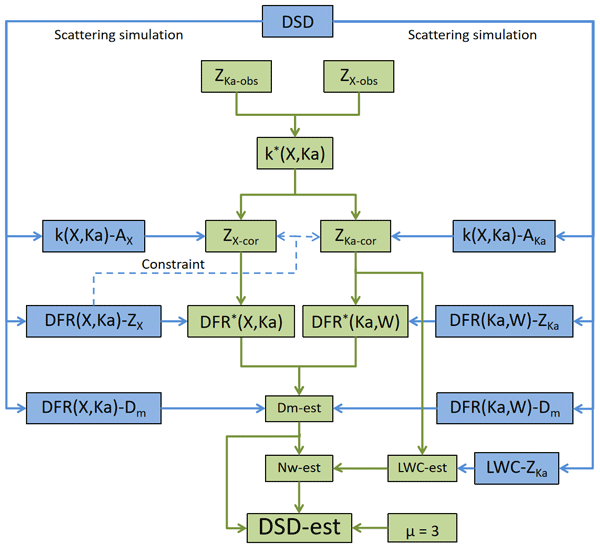
For example, Fig. 1 should explicitly distinguish between observed variables, simulated variables, intermediate retrieval products, and final outputs. This is especially important because the role of the W-band reflectivity is currently ambiguous.
Fig. 11 is one of the most important figures in the manuscript because it demonstrates the reduction of the ambiguous DFR–Dm region. The ambiguous zones, thresholds, and physical interpretation should be labeled more clearly.
Fig. 17 contains many panels and is somewhat difficult to read. The authors may consider separating the Dm and Nw results into different figures or improving the layout.
For Figs. 18 and 19, the number of samples in each reflectivity interval should be reported, either in the figure panels or in the caption.
5. Terminology and notation should be standardized
The manuscript should use consistent terminology and notation throughout. For example: Dm, Nw, and LWC should follow a uniform notation style.
Clear and consistent notation will make the retrieval procedure easier to follow.
Citation: https://doi.org/10.5194/egusphere-2026-174-CC3 -
AC1: 'Reply on CC3', Liang Feng, 23 Jun 2026
The comment was uploaded in the form of a supplement: https://egusphere.copernicus.org/preprints/2026/egusphere-2026-174/egusphere-2026-174-AC1-supplement.pdf
-
AC1: 'Reply on CC3', Liang Feng, 23 Jun 2026
-
RC2: 'Comment on egusphere-2026-174', Anonymous Referee #2, 01 Jun 2026
The manuscript addresses an important problem in dual-frequency radar retrieval of raindrop size distributions, namely the ambiguity in the DFR-Dm relationship. The proposed use of an additional Ka/W-band constraint is an interesting idea and may have value for improving retrievals in weak-echo or small-drop regimes. However, in its current form, the manuscript requires substantial revision before the method and conclusions can be fully evaluated.
My primary concern is that the retrieval framework is not described clearly enough to determine how independent the information used in the retrieval actually is. In particular, the Ka/W-band constraint appears to be based on W-band reflectivities simulated from measured DSDs rather than independent W-band radar observations. This creates a potential circularity problem, especially because the same or closely related DSD information appears to be used to construct retrieval relationships and evaluate the retrieved parameters. The manuscript should more clearly distinguish observed quantities from simulated or fitted quantities and explain how the method would be applied to independent radar observations.
More broadly, the study is based on a small dataset from a single location and relies heavily on fitted relationships derived from that dataset. The authors should therefore be more cautious in presenting the method as generally applicable. Additional discussion is needed regarding calibration uncertainty, attenuation correction, FMCW radar-specific issues, beam mismatch, representativeness of the 2DVD validation, and the practical limitations of using W-band observations in rain. The discussion and conclusion should also be expanded to address these limitations and to identify the additional validation required before the method can be considered robust across different precipitation regimes, locations, and radar systems.
1) The abstract is too general and should quantify the claimed improvement. The authors state that the proposed method substantially reduces the DFR-Dm ambiguity and performs better than conventional approaches, especially for weak echoes, but the abstract does not report any specific performance metrics.2) The authors should clarify that the method retrieves DSD parameters under an assumed normalized gamma distribution with fixed μ, rather than independently retrieving the full DSD shape. Since μ is fixed and LWC is obtained from a fitted ZKa-LWC relationship, the resulting DSD is strongly constrained by the assumed distribution form and fitted relationships. The manuscript should avoid implying that the full DSD is independently retrieved without these assumptions.
3) The use of an FMCW radar system should be discussed in more detail. The proposed retrieval depends on accurate X- and Ka-band reflectivity measurements, so the authors should explain how the two radar channels were calibrated and matched in range, timing, sensitivity, and beam volume.
This is especially important because the method relies on DFR, which can be strongly affected by small calibration offsets or system artifacts. Since the authors claim improved performance in weak-echo conditions, they should also discuss FMCW-specific issues such as signal-to-noise limits, leakage/clutter suppression, range sidelobes, and range-Doppler effects. These factors could affect the computed DFR and therefore the retrieved Dm and Nw.
4) The manuscript states that the Ka-band beamwidth is 0.4° and the X-band beamwidth is 1°, and that a 3-point moving average along the time dimension adjusts the Ka-band beamwidth to 1.2°. This statement needs clarification. Temporal smoothing does not directly change antenna beamwidth.The authors should revise this section to describe the procedure more accurately. If the intent is to reduce scale mismatch between the two frequencies by temporal averaging, then the authors should say so and quantify the effective sampling distance associated with the averaging window. If the authors are claiming an effective beamwidth adjustment, they need to justify how this was calculated.
5) A major concern is that the Ka/W-band constraint does not appear to come from independent W-band radar observations. Instead, the W-band reflectivity appears to be simulated from the same measured DSD dataset used to build the retrieval relationships. This creates a risk of circular reasoning: the method appears to use DSD observations to create a simulated W-band constraint, then evaluates the retrieval against DSD-derived quantities.
The authors should clearly separate observed radar quantities from simulated quantities. They should also show that the method works on independent data that were not used to build the simulated Ka/W relationships, preferably through event-independent or site-independent validation.6) Although a retrieval flow chart is provided, the manuscript does not include a clear narrative description of the algorithm. As a result, the operational retrieval procedure remains difficult to follow. The authors should walk the reader through the method step by step, identifying the required inputs, which quantities are directly observed, which are simulated or fitted, and the order in which Dm, LWC, and Nw are retrieved.
The manuscript should also clarify the mathematical form of the retrieval. Is the method simply direct evaluation of fitted relationships, lookup-table interpolation, numerical inversion, optimization, or another approach? This clarification is important for reproducibility and for understanding how the algorithm would be applied to independent radar observations.
7) The comparison between radar retrievals at approximately 120 m and surface 2DVD measurements requires more discussion. The authors should address the representativeness error caused by fall time, wind drift, vertical air motion, radar sampling volume, and the much smaller sampling area of the disdrometer. These effects may contribute to differences between retrieved and observed DSD parameters and should be considered in the validation.
8) A large fraction of the dataset falls in the DFR(X,Ka) ≤ 0 ambiguous regime. This may be physically reasonable for light rain or small-drop populations, but the authors should show the distribution of DFR, Dm, rain rate, and reflectivity and explain why this regime dominates the dataset. They should also demonstrate that the large negative-DFR fraction is not caused by relative calibration bias, attenuation-correction error, beam mismatch, or limited sampling of precipitation regimes.
9) The choice of fixed μ = 3 needs stronger justification. The sensitivity test shows that μ affects both Dm and Nw retrievals. However, the results appear to show that μ = 0 gives the smallest Dm retrieval error, while larger μ values improve Nw error. The authors choose μ = 3, citing consistency with prior work. This may be reasonable, but the justification should be expanded.
The authors should clarify the objective function used to select μ. Is the priority minimizing Dm error, Nw error, DSD shape error, or some combined metric? Since the proposed method is intended to retrieve DSDs, not only Dm, the authors should consider evaluating full DSD reconstruction error as a function of μ. The authors should also discuss whether μ is expected to vary by precipitation regime and whether fixing μ = 3 limits performance in convective or light-rain cases.
10) The manuscript introduces a raindrop axis-ratio relationship after discussing polarization-dependent scattering from oblate raindrops. However, the radar observations used here are vertically pointing, for which the authors state that polarization-dependent differences are effectively eliminated and ZH≈ZV. The authors should clarify the role of the assumed axis-ratio model in the vertically pointing T-matrix simulations. If the axis ratio is used only to compute absolute backscatter cross sections and frequency-dependent DFR behavior under vertical incidence, this should be stated explicitly. The authors should also quantify the sensitivity of the simulated DFR–Dm relationships to the assumed axis-ratio relation, especially at Ka and W band where non-Rayleigh scattering effects may be important.
11) The manuscript should discuss the practical difficulty of using W-band radar measurements in rain. While the simulated Ka/W-band DFR relationship may help reduce the DFR(X,Ka)-Dm ambiguity, real W-band observations can be strongly attenuated by rain, cloud liquid water, atmospheric absorption, and wet radome effects. In moderate or heavy precipitation, the W-band signal may become too weak or unreliable to provide a useful constraint.
This point is especially important because the manuscript claims that the proposed method is useful for weak-echo situations. Weak echoes are also where W-band detectability, calibration uncertainty, and signal-to-noise limitations may become especially important, while moderate to heavy rain introduces severe attenuation concerns. Since the manuscript uses simulated W-band reflectivity rather than actual W-band radar observations, the authors should clarify whether the method is intended for real triple-frequency radar measurements or only as a simulation-based constraint. If it is intended for real W-band use, they should show under what rain-rate, range, reflectivity, and attenuation conditions W-band observations would remain useful.
12) Figure captions should be much more descriptive and should pay careful attention to which values are simulated vs. measured.
13) The discussion and conclusion are too limited given the scope of the claims. The study is based on only three development cases and one validation case from a single observation site. This is a small and geographically limited dataset, and the manuscript does not adequately discuss whether the retrieval relationships would generalize to other locations, precipitation regimes, seasons, climates, or radar systems.
This limitation is especially important because the proposed method relies heavily on curve fitting and regression relationships derived from the available DSD dataset, including the DFR-Dm relationships, the simulated Ka/W constraint, and the ZKa-LWC relationship. With such a small and localized dataset, these fitted relationships may reflect site-specific DSD characteristics rather than a generally applicable retrieval method.
The authors should add a more complete limitations section. In particular, they should discuss the limited sample size, the use of one site, the dependence on local DSD characteristics, the lack of independent W-band observations, and the uncertainty of applying near-surface DSD-derived relationships to elevated radar volumes. The future-work discussion should also be expanded. The introduction states that limitations and future research directions will be discussed, but the conclusion only briefly mentions height-dependent DSD models and does not provide a broader path for validating or extending the method.
Citation: https://doi.org/10.5194/egusphere-2026-174-RC2 -
AC5: 'Reply on RC2', Liang Feng, 23 Jun 2026
The comment was uploaded in the form of a supplement: https://egusphere.copernicus.org/preprints/2026/egusphere-2026-174/egusphere-2026-174-AC5-supplement.pdf
-
AC5: 'Reply on RC2', Liang Feng, 23 Jun 2026
Peer review completion


Interactive discussion
Status: closed
-
RC1: 'Comment on egusphere-2026-174', Anonymous Referee #1, 27 Apr 2026
Retrieving raindrop size distribution (DSD) using disdrometers has become a research hotspot in the field of weather radar in recent years, as DSD is crucial for understanding cloud and precipitation microphysical processes. This study combines disdrometer measurements with X-Ka band vertically pointing radar to perform DSD retrieval. To address the ambiguity problem in X-Ka band retrieval, the Ka-W band is further introduced as a joint constraint to reduce the ambiguous region between the dual-frequency ratio (DFR) and the mass-weighted diameter (Dm), thereby improving DSD retrieval accuracy. Multi-frequency radar retrieval is an important research direction, and the DFR-Dm ambiguity is a key issue in DSD retrieval. Although this study has practical significance, the methodology section suffers from unclear descriptions and logical issues related to circular reasoning.
Major issues:
- The radar used in this study is an X-Ka dual-frequency radar. The proposed method employs the Ka-W dual-band to constrain the retrieval process of the X-Ka dual-frequency radar in order to mitigate the ambiguity problem inherent in X-Ka dual-frequency observations. However, no measured data from W-band radar are provided in the paper. It remains unclear how this constraint can be implemented in practical applications.
- This study uses DSD data observed by disdrometers during three rainfall events to fit the attenuation coefficients for the X-band and Ka-band radars. These coefficients are then used to correct attenuation in the X-band and Ka-band radar observations from the same three rainfall events. Subsequently, the DFR-Dm relationship is fitted, and DSD retrieval is performed. This algorithm may suffer from logical issues of self-consistency bias.
Specific comments:
- The flowchart shown in Figure 1, along with its corresponding steps and the formulas contained therein, requires additional explanatory clarification.
- Table 1 indicates that the X-Ka dual-frequency radar has the capability to observe polarimetric parameters. If more polarimetric observation parameters could be used to constrain the DSD retrieval, the retrieval accuracy would theoretically be higher than that achieved using only dual-frequency parameters.
- Figure 3 shows the radar reflectivity factors observed by the X-band and Ka-band radars below the melting layer. The paper does not specify how the position of the melting layer is determined. Furthermore, does the retrieved DSD correspond to the entire rainfall region below the melting layer or only to the near-surface layer? Since the algorithm is based on ground-based disdrometer observations, it is inferred that the retrieval results should represent near-surface conditions. However, the radar observations are presented as corresponding to the rainfall region below the melting layer, indicating an inconsistency.
- In Figure 5, the attenuation coefficients are fitted based on disdrometer-observed drop size data and used for radar attenuation correction. Figure 8 then compares the corrected radar retrieval results with the disdrometer observation data from the same several rainfall events. This procedure may suffer from a self-consistency trap. Similar issues exist in the DSD retrieval section.
- Figure 6 presents DFR results for the Ka-band and W-band obtained through simulations, but no measured W-band data are provided in the paper. In practical applications, how can the W-band be used to constrain the retrieval process?
- Figure 12 shows the DFR-Dm relationship curves, indicating that DFR(Ka, W) exhibits a narrower ambiguous region. However, even if DFR(Ka, W) can effectively reduce the ambiguous region, actual observations only include X-band and Ka-band dual-frequency radar data. Under these conditions, how the W-band radar can be introduced to achieve retrieval constraints requires further explanation.
Citation: https://doi.org/10.5194/egusphere-2026-174-RC1 -
AC4: 'Reply on RC1', Liang Feng, 23 Jun 2026
The comment was uploaded in the form of a supplement: https://egusphere.copernicus.org/preprints/2026/egusphere-2026-174/egusphere-2026-174-AC4-supplement.pdf
-
CC1: 'Comment on egusphere-2026-174', Yichen Chen, 11 May 2026
This manuscript addresses a key challenge in dual-frequency radar retrievals of raindrop size distributions (DSD) — the dual-solution ambiguity in the DFR-Dm relationship. The authors propose a novel solution by incorporating Ka/W-band DFR as an additional constraint, combined with T-matrix scattering simulations. The research is well-structured, the experimental design is sound, and the validation using ground-based disdrometer data is rigorous. The proposed method demonstrates clear improvements, particularly for weak echo regions. Overall, The manuscript is well suited for Atmospheric Measurement Techniques and will be valuable to the community. Accordingly, I recommend this manuscript for publication; however, you may consider the minor comments as follows:
- The manuscript's central assumption is the availability of W-band (93.75 GHz) data. However, W-band radar suffers from extreme attenuation in rainfall, potentially losing signal within hundreds of meters during moderate to heavy rain. It appears from Section 3.6 that Z_W was simulated using T-matrix calculations based on measured DSDs, rather than being directly observed. If true, this manuscript presents a proof-of-concept simulation study rather than a retrieval algorithm ready for operational radar data. The authors must clarify this point explicitly in the abstract, introduction, and conclusions. A more accurate framing would be "simulation-based retrieval framework" rather than simply "retrieval method."
- When DFR(X,Ka) ≤ 0, the algorithm switches to DFR(Ka,W). However, Table 6 shows that 12.5% of data points still fall within the ambiguous zone of DFR(Ka,W) (i.e., DFR(Ka,W) ≤ 0). The authors do not specify how these remaining ambiguous cases are handled. Are they discarded? Assigned a default Dm value? Or constrained by another relationship (e.g., Z_Ka-LWC)? The authors should provide a complete decision tree or flow chart (as an enhancement to Figure 1) that explicitly states the retrieval strategy for all possible combinations of DFR(X,Ka) and DFR(Ka,W). Additionally, the retrieval performance for these "doubly ambiguous" cases should be highlighted in Figure 17.
- In Section 3.1 (Instruments), the authors provide detailed specifications for the X/Ka-band radar and the 2DVD disdrometer. However, there is no mention of any W-band radar or the source of W-band reflectivity data. This is a critical omission for understanding the experimental setup. Please add a clear statement at the end of Section 3.1 or at the beginning of Section 3.3: "W-band reflectivities used in this study are simulated using the T-matrix method based on measured DSDs."
- Figure 6 shows dense scatterplots for Z_X-DFR(X,Ka) and Z_Ka-DFR(Ka,W). The 6th-order polynomial fitting curves are barely visible despite being provided in equation form. Please increase the line width or color contrast of the fitting curves. Also, add a note in the caption stating "The black curve represents the 6th-order polynomial fit."
- Several sentences could be clarified for better readability. For example, on Page 12, the sentence "...the corrected reflectivities were validated against those derived from ground-based raindrop size distributions measurements" — the word "those" is ambiguous. It should read "...validated against the theoretical reflectivity values derived from ground-based DSD measurements." Similarly, on Page 17, "This characteristic underpins the interpretation..." would be more accurate as "This characteristic guides the choice of retrieval algorithms..."
- In Table 1, the unit for Antenna Gain is listed as "dB". While this is common, the formal unit should be "dBi" (decibels relative to isotropic). Please consider this correction.
Citation: https://doi.org/10.5194/egusphere-2026-174-CC1 -
AC3: 'Reply on CC1', Liang Feng, 23 Jun 2026
The comment was uploaded in the form of a supplement: https://egusphere.copernicus.org/preprints/2026/egusphere-2026-174/egusphere-2026-174-AC3-supplement.pdf
-
CC2: 'Comment on egusphere-2026-174', Li Luo, 15 May 2026
This manuscript addresses the DFR-Dm dual-solution ambiguity in dual-frequency radar DSD retrievals by incorporating Ka/W-band DFR as an additional constraint. The method is well-designed and shows clear improvements, particularly for weak echoes. The following three key issues should be addressed prior to publication.
1. Clarify that W-band data are simulated, not observed
The manuscript's central innovation relies on Ka/W-band DFR, but it appears from Section 3.6 that W-band reflectivities are simulated using T-matrix calculations based on measured DSDs, rather than directly observed. Given that W-band radar suffers from extreme attenuation in rainfall, this distinction is critical. The authors must explicitly state in the abstract, introduction, and Section 3.1 that this is a simulation-based retrieval framework, and add a clear statement: "W-band reflectivities used in this study are simulated using the T-matrix method based on measured DSDs."
2. Specify handling of remaining ambiguous cases (DFR(Ka,W) ≤ 0)
Table 6 shows that 12.5% of data points still fall within the ambiguous zone of DFR(Ka,W) (i.e., DFR(Ka,W) ≤ 0). The authors do not specify how these "doubly ambiguous" cases are handled (discarded? default value? constrained by Z_Ka-LWC?). Please provide a complete decision tree or flow chart (as an enhancement to Figure 1) and evaluate the retrieval performance for these cases.
3. Quantitative assessment of the inversion errors caused by temperature variations
Provide quantitative error analysis (e.g., Dm bias) for 0°C, 10°C, and 30°C, not just state that errors are small.
Citation: https://doi.org/10.5194/egusphere-2026-174-CC2 -
AC2: 'Reply on CC2', Liang Feng, 23 Jun 2026
The comment was uploaded in the form of a supplement: https://egusphere.copernicus.org/preprints/2026/egusphere-2026-174/egusphere-2026-174-AC2-supplement.pdf
-
AC2: 'Reply on CC2', Liang Feng, 23 Jun 2026
-
CC3: 'Comment on egusphere-2026-174', Tiantian Yu, 20 May 2026
This manuscript proposes an improved method for raindrop size distribution retrieval by combining dual-frequency radar DFR information, with the aim of reducing the well-known dual-solution ambiguity in the DFR–Dm relationship. The topic is relevant to radar meteorology and precipitation microphysics, and the manuscript addresses an important limitation of conventional DFR-based DSD retrieval methods, especially under weak-echo and light-precipitation conditions.
The proposed approach appears promising, and the reported improvement in the proportion of uniquely retrievable Dm values is encouraging. However, several key methodological issues need to be clarified before the manuscript can be considered for publication. In particular, the source and practical role of the W-band reflectivity require much clearer explanation, and the novelty of the proposed method should be more explicitly distinguished from previous studies.
1. The source and practical role of the W-band reflectivity must be clarified
The most important issue in the manuscript concerns the use of W-band reflectivity and DFR(Ka,W). The abstract states that W-band reflectivity is synthetically incorporated through scattering simulations based on measured DSDs. However, the instrument section only describes an X/Ka dual-frequency vertically pointing radar and a 2DVD disdrometer. No actual W-band radar measurement appears to be available.
2. The novelty of the proposed method should be more clearly distinguished from previous studies
The manuscript reviews several previous approaches for addressing the DFR–Dm ambiguity, including generalized DFR methods and differential dual-frequency radar equation methods. However, the distinction between the present method and previous work is not yet sufficiently clear.
3. The English language and grammar require careful revision
The manuscript contains a number of grammatical and stylistic issues that should be corrected before publication. For example, the section title “Compression the Ambiguous zone of DFR-Dm” is grammatically incorrect and could be revised to:
“Reduction of the Ambiguous Zone in the DFR–Dm Relationship.”
Similarly, the conclusion begins with “A improved raindrop size distribution retrieval method,” which should be corrected to:
“An improved raindrop size distribution retrieval method.”
4. The figures should be improved for clarity and interpretation
Several figures are central to the manuscript but could be made clearer.
For example, Fig. 1 should explicitly distinguish between observed variables, simulated variables, intermediate retrieval products, and final outputs. This is especially important because the role of the W-band reflectivity is currently ambiguous.
Fig. 11 is one of the most important figures in the manuscript because it demonstrates the reduction of the ambiguous DFR–Dm region. The ambiguous zones, thresholds, and physical interpretation should be labeled more clearly.
Fig. 17 contains many panels and is somewhat difficult to read. The authors may consider separating the Dm and Nw results into different figures or improving the layout.
For Figs. 18 and 19, the number of samples in each reflectivity interval should be reported, either in the figure panels or in the caption.
5. Terminology and notation should be standardized
The manuscript should use consistent terminology and notation throughout. For example: Dm, Nw, and LWC should follow a uniform notation style.
Clear and consistent notation will make the retrieval procedure easier to follow.
Citation: https://doi.org/10.5194/egusphere-2026-174-CC3 -
AC1: 'Reply on CC3', Liang Feng, 23 Jun 2026
The comment was uploaded in the form of a supplement: https://egusphere.copernicus.org/preprints/2026/egusphere-2026-174/egusphere-2026-174-AC1-supplement.pdf
-
AC1: 'Reply on CC3', Liang Feng, 23 Jun 2026
-
RC2: 'Comment on egusphere-2026-174', Anonymous Referee #2, 01 Jun 2026
The manuscript addresses an important problem in dual-frequency radar retrieval of raindrop size distributions, namely the ambiguity in the DFR-Dm relationship. The proposed use of an additional Ka/W-band constraint is an interesting idea and may have value for improving retrievals in weak-echo or small-drop regimes. However, in its current form, the manuscript requires substantial revision before the method and conclusions can be fully evaluated.
My primary concern is that the retrieval framework is not described clearly enough to determine how independent the information used in the retrieval actually is. In particular, the Ka/W-band constraint appears to be based on W-band reflectivities simulated from measured DSDs rather than independent W-band radar observations. This creates a potential circularity problem, especially because the same or closely related DSD information appears to be used to construct retrieval relationships and evaluate the retrieved parameters. The manuscript should more clearly distinguish observed quantities from simulated or fitted quantities and explain how the method would be applied to independent radar observations.
More broadly, the study is based on a small dataset from a single location and relies heavily on fitted relationships derived from that dataset. The authors should therefore be more cautious in presenting the method as generally applicable. Additional discussion is needed regarding calibration uncertainty, attenuation correction, FMCW radar-specific issues, beam mismatch, representativeness of the 2DVD validation, and the practical limitations of using W-band observations in rain. The discussion and conclusion should also be expanded to address these limitations and to identify the additional validation required before the method can be considered robust across different precipitation regimes, locations, and radar systems.
1) The abstract is too general and should quantify the claimed improvement. The authors state that the proposed method substantially reduces the DFR-Dm ambiguity and performs better than conventional approaches, especially for weak echoes, but the abstract does not report any specific performance metrics.2) The authors should clarify that the method retrieves DSD parameters under an assumed normalized gamma distribution with fixed μ, rather than independently retrieving the full DSD shape. Since μ is fixed and LWC is obtained from a fitted ZKa-LWC relationship, the resulting DSD is strongly constrained by the assumed distribution form and fitted relationships. The manuscript should avoid implying that the full DSD is independently retrieved without these assumptions.
3) The use of an FMCW radar system should be discussed in more detail. The proposed retrieval depends on accurate X- and Ka-band reflectivity measurements, so the authors should explain how the two radar channels were calibrated and matched in range, timing, sensitivity, and beam volume.
This is especially important because the method relies on DFR, which can be strongly affected by small calibration offsets or system artifacts. Since the authors claim improved performance in weak-echo conditions, they should also discuss FMCW-specific issues such as signal-to-noise limits, leakage/clutter suppression, range sidelobes, and range-Doppler effects. These factors could affect the computed DFR and therefore the retrieved Dm and Nw.
4) The manuscript states that the Ka-band beamwidth is 0.4° and the X-band beamwidth is 1°, and that a 3-point moving average along the time dimension adjusts the Ka-band beamwidth to 1.2°. This statement needs clarification. Temporal smoothing does not directly change antenna beamwidth.The authors should revise this section to describe the procedure more accurately. If the intent is to reduce scale mismatch between the two frequencies by temporal averaging, then the authors should say so and quantify the effective sampling distance associated with the averaging window. If the authors are claiming an effective beamwidth adjustment, they need to justify how this was calculated.
5) A major concern is that the Ka/W-band constraint does not appear to come from independent W-band radar observations. Instead, the W-band reflectivity appears to be simulated from the same measured DSD dataset used to build the retrieval relationships. This creates a risk of circular reasoning: the method appears to use DSD observations to create a simulated W-band constraint, then evaluates the retrieval against DSD-derived quantities.
The authors should clearly separate observed radar quantities from simulated quantities. They should also show that the method works on independent data that were not used to build the simulated Ka/W relationships, preferably through event-independent or site-independent validation.6) Although a retrieval flow chart is provided, the manuscript does not include a clear narrative description of the algorithm. As a result, the operational retrieval procedure remains difficult to follow. The authors should walk the reader through the method step by step, identifying the required inputs, which quantities are directly observed, which are simulated or fitted, and the order in which Dm, LWC, and Nw are retrieved.
The manuscript should also clarify the mathematical form of the retrieval. Is the method simply direct evaluation of fitted relationships, lookup-table interpolation, numerical inversion, optimization, or another approach? This clarification is important for reproducibility and for understanding how the algorithm would be applied to independent radar observations.
7) The comparison between radar retrievals at approximately 120 m and surface 2DVD measurements requires more discussion. The authors should address the representativeness error caused by fall time, wind drift, vertical air motion, radar sampling volume, and the much smaller sampling area of the disdrometer. These effects may contribute to differences between retrieved and observed DSD parameters and should be considered in the validation.
8) A large fraction of the dataset falls in the DFR(X,Ka) ≤ 0 ambiguous regime. This may be physically reasonable for light rain or small-drop populations, but the authors should show the distribution of DFR, Dm, rain rate, and reflectivity and explain why this regime dominates the dataset. They should also demonstrate that the large negative-DFR fraction is not caused by relative calibration bias, attenuation-correction error, beam mismatch, or limited sampling of precipitation regimes.
9) The choice of fixed μ = 3 needs stronger justification. The sensitivity test shows that μ affects both Dm and Nw retrievals. However, the results appear to show that μ = 0 gives the smallest Dm retrieval error, while larger μ values improve Nw error. The authors choose μ = 3, citing consistency with prior work. This may be reasonable, but the justification should be expanded.
The authors should clarify the objective function used to select μ. Is the priority minimizing Dm error, Nw error, DSD shape error, or some combined metric? Since the proposed method is intended to retrieve DSDs, not only Dm, the authors should consider evaluating full DSD reconstruction error as a function of μ. The authors should also discuss whether μ is expected to vary by precipitation regime and whether fixing μ = 3 limits performance in convective or light-rain cases.
10) The manuscript introduces a raindrop axis-ratio relationship after discussing polarization-dependent scattering from oblate raindrops. However, the radar observations used here are vertically pointing, for which the authors state that polarization-dependent differences are effectively eliminated and ZH≈ZV. The authors should clarify the role of the assumed axis-ratio model in the vertically pointing T-matrix simulations. If the axis ratio is used only to compute absolute backscatter cross sections and frequency-dependent DFR behavior under vertical incidence, this should be stated explicitly. The authors should also quantify the sensitivity of the simulated DFR–Dm relationships to the assumed axis-ratio relation, especially at Ka and W band where non-Rayleigh scattering effects may be important.
11) The manuscript should discuss the practical difficulty of using W-band radar measurements in rain. While the simulated Ka/W-band DFR relationship may help reduce the DFR(X,Ka)-Dm ambiguity, real W-band observations can be strongly attenuated by rain, cloud liquid water, atmospheric absorption, and wet radome effects. In moderate or heavy precipitation, the W-band signal may become too weak or unreliable to provide a useful constraint.
This point is especially important because the manuscript claims that the proposed method is useful for weak-echo situations. Weak echoes are also where W-band detectability, calibration uncertainty, and signal-to-noise limitations may become especially important, while moderate to heavy rain introduces severe attenuation concerns. Since the manuscript uses simulated W-band reflectivity rather than actual W-band radar observations, the authors should clarify whether the method is intended for real triple-frequency radar measurements or only as a simulation-based constraint. If it is intended for real W-band use, they should show under what rain-rate, range, reflectivity, and attenuation conditions W-band observations would remain useful.
12) Figure captions should be much more descriptive and should pay careful attention to which values are simulated vs. measured.
13) The discussion and conclusion are too limited given the scope of the claims. The study is based on only three development cases and one validation case from a single observation site. This is a small and geographically limited dataset, and the manuscript does not adequately discuss whether the retrieval relationships would generalize to other locations, precipitation regimes, seasons, climates, or radar systems.
This limitation is especially important because the proposed method relies heavily on curve fitting and regression relationships derived from the available DSD dataset, including the DFR-Dm relationships, the simulated Ka/W constraint, and the ZKa-LWC relationship. With such a small and localized dataset, these fitted relationships may reflect site-specific DSD characteristics rather than a generally applicable retrieval method.
The authors should add a more complete limitations section. In particular, they should discuss the limited sample size, the use of one site, the dependence on local DSD characteristics, the lack of independent W-band observations, and the uncertainty of applying near-surface DSD-derived relationships to elevated radar volumes. The future-work discussion should also be expanded. The introduction states that limitations and future research directions will be discussed, but the conclusion only briefly mentions height-dependent DSD models and does not provide a broader path for validating or extending the method.
Citation: https://doi.org/10.5194/egusphere-2026-174-RC2 -
AC5: 'Reply on RC2', Liang Feng, 23 Jun 2026
The comment was uploaded in the form of a supplement: https://egusphere.copernicus.org/preprints/2026/egusphere-2026-174/egusphere-2026-174-AC5-supplement.pdf
-
AC5: 'Reply on RC2', Liang Feng, 23 Jun 2026
Peer review completion
Journal article(s) based on this preprint
Viewed
| HTML | XML | Total | BibTeX | EndNote | |
|---|---|---|---|---|---|
| 752 | 526 | 97 | 1,375 | 81 | 117 |
- HTML: 752
- PDF: 526
- XML: 97
- Total: 1,375
- BibTeX: 81
- EndNote: 117
Viewed (geographical distribution)
| Country | # | Views | % |
|---|
| Total: | 0 |
| HTML: | 0 |
| PDF: | 0 |
| XML: | 0 |
- 1
Liang Feng
Jiefan Yang

Zeyong Guo
Jiming Sun
Yue Sun
Huiling Yang
The requested preprint has a corresponding peer-reviewed final revised paper. You are encouraged to refer to the final revised version.
- Preprint
(10418 KB) - Metadata XML
Retrieving raindrop size distribution (DSD) using disdrometers has become a research hotspot in the field of weather radar in recent years, as DSD is crucial for understanding cloud and precipitation microphysical processes. This study combines disdrometer measurements with X-Ka band vertically pointing radar to perform DSD retrieval. To address the ambiguity problem in X-Ka band retrieval, the Ka-W band is further introduced as a joint constraint to reduce the ambiguous region between the dual-frequency ratio (DFR) and the mass-weighted diameter (Dm), thereby improving DSD retrieval accuracy. Multi-frequency radar retrieval is an important research direction, and the DFR-Dm ambiguity is a key issue in DSD retrieval. Although this study has practical significance, the methodology section suffers from unclear descriptions and logical issues related to circular reasoning.
Major issues:
Specific comments: